Aloha Friday Message – April 2, 2021 – While it was still dark

2114AFC040221 – While it was still dark

Read it online here, please. And please, when you visit there, use one of the social media links at the bottom of the page to share this post. Thank you! And remember, we now have a READER VIEW available, so share this link or this email often.

    John 20:1 1 Early on the first day of the week, while it was still dark, Mary Magdalene came to the tomb and saw that the stone had been removed from the tomb.

The grace of the Lord Jesus Christ and the love of God and the fellowship of the Holy Spirit be with all of you. Today is “Good Friday.” Last week we mentioned Good Friday as we considered the Repentant Thief crucified to the right of Jesus’ cross, and said, “The Precious Blood of Jesus “is poured out for many” (See Mark 14:24) on Good Friday, but we also know that such grief is “Good Grief” because it is a Holy Grief in the same way that Good Friday is a Holy Day of Remembrance – “Do this in memory of Me.” Our Good Grief contributes to our sincere contrition and effective repentance so that one day we, too, will be with Jesus in Paradise after witnessing That Old Rugged Cross with him.”

This weekend we will experience again the beauty and the sadness of the Triduum which consists of Holy Thursday, Good Friday, and Holy Saturday. These are all celebrated in anticipation of the Great Feast of Resurrection Day which most people call Easter Sunday. Thursday night we remember The Last Supper, the Washing of Feet, the betrayal of Jesus by Judas, and Jesus’ arrest and “trial.” It was during that trial that Peter thrice denied ever knowing Jesus. Then Friday comes after a sleepless night filled with abuse and pain, Jesus is brought before Pilate. Pilate sees no point in stirring up trouble by crucifying The King of the Jews, so he tries to get out of it by having Jesus scourged – nearly to the point of death. The Jewish religious and civil officials insist on condemning Jesus, Pilate finally relents, and turns him over to the Romans for crucifixion at 9 in the morning. Jesus endures hours of agony – the whole point of crucifixion was to cause as much pain as possible – and at 3 in the afternoon he dies.

As evening approaches, a secret Disciple name Joseph of Arimathea asks Pilate for the body so it will not be exposed during the Day of Preparation for the Passover. Jesus is placed in a borrowed tomb. During that day, the Sabbath, he is dead and buried, but he is also alive in Spirit; we know this because he goes to encourage the Souls in Sheol who are waiting for his Resurrection. No one knows that the spectacular event of The Resurrection is only hours away! It would come on the first day of the week, echad which literally means “one” or “first” because the six “workdays” of the week are named 1, 2, 3, 4, 5, and 6. The Seventh Day is called Shabbat the Sabbath, the day God rested from all his work of Creation and sanctified as Holy. That is why we say to those who celebrate the Sabbath, “Shabbat shalom,” which means Sabbath of Peace. For Jesus’ Disciples, that Shabbat was nowhere near peaceful – it was absolutely horrible. It was so horrible that all of them were justifiably in fear for their lives. Their Lord, the Messiah, had been killed! Who would be next?

And then something extraordinary happens. A truly remarkable woman dis an exceptionally courageous thing. She went to the tomb where the dead body of Jesus had been placed so she could anoint the body with spices in accordance with Jewish burial customs. We have two accounts of this event – one in the Gospel of Mark and one in the Gospel of John. In Mark 16:1-12, we read that “Mary Magdalene, and Mary the mother of James, and Salome bought spices, so that they might go and anoint him.” Mary Magdalene was completely dedicated to Jesus because he had cast out seven demons (See Mark 16:9 and Luke 8:2). In the Gospel of John – our Key Verse for today – Mary is alone, and acting “while it was still dark.” In John’s Gospel, this is an important statement rooted in his theme throughout his account: The Light of the World and the rejection of that Light by the Darkness of Sin and Death.

John sets the scene “while it was still dark,” that is, while the world was still in the grip of sin and death. The World – including Mary Magdalene – does not know that the Light has risen and Darkness flees from that Light – Jesus. John tells us right up front in his Gospel (John 1:1-14 which is often quoted in these pages), and at least 16 times he refers to Jesus and his Mission as Light. After the Resurrection, the Gospel of John continues with important accounts of Jesus interacting with Mary Magdalene, the message Jesus gave her to take to the other Disciples – his Apostles – and the description of Thomas’ reaction to their assertion that they had seen the Risen Lord. Then we have the beautiful recounting of Jesus meeting with seven of the Apostles at Galilee. This narrative includes what I call the Penance of Peter; three times Jesus asks, “Peter, do you love me?” Three times Peter answers, “Yes, Lord, you know I do.” Jesus tells him to feed the lambs, to tend the sheep, and to feed the sheep. Peter is to be the Shepherd for the Holy and Apostolic Church Jesus will establish through Peter’s leadership. We know now what none of the Apostles or Disciples knew in those days after the Resurrection: There would be much for them to endure. One of the greatest examples of that kind of endurance is Mary of Magdala.

     This Mary, the Magdalene, knew the torment of great sin, having given herself over to demonic possession for many years. There are many fascinating “accounts” of her life – even a noncanonical “Gospel” – but what we know of her from Scripture is really all we need to know. She was courageous, outspoken, empowered by the Holy Spirit, and possessing great faith in her Teacher. She would go with him all the way from Capernaum to Calvary and beyond. Several years ago I read an excellent “docunovel” (↔ Click Link) titled Mary, called Magdalene by Margaret George. You might want to try it sometime. It is a fascinating look into the era when Jesus the Christ of God walked on this Earth. One very strong impression I gained from that book was the amazing magnitude of The Magdalene’s endurance. On that topic, I want to share with you another boatload of Scripture on endurance. The purpose will become clear when we come to the concluding remarks in this post. Please read (don’t just skim through) the following:

James 5:11 11 Indeed we call blessed those who showed endurance. You have heard of the endurance of Job, and you have seen the purpose of the Lord, how the Lord is compassionate and merciful.

1 Corinthians 4:12 12 and we grow weary from the work of our own hands. When reviled, we bless; when persecuted, we endure;

2 Corinthians 1:6 if we are being afflicted, it is for your consolation and salvation; if we are being consoled, it is for your consolation, which you experience when you patiently endure the same sufferings that we are also suffering.

Matthew 24:9-13 “Then they will hand you over to be tortured and will put you to death, and you will be hated by all nations because of my name. 10 Then many will fall away, and they will betray one another and hate one another. 11 And many false prophets will arise and lead many astray. 12 And because of the increase of lawlessness, the love of many will grow cold. 13 But the one who endures to the end will be saved.

Mark 13:13 13 and you will be hated by all because of my name. But the one who endures to the end will be saved.

Hebrews 12:7 Endure trials for the sake of discipline. God is treating you as children; for what child is there whom a parent does not discipline?

1 Peter 2:19 19 For it is a credit to you if, being aware of God, you endure pain while suffering unjustly.

In a recent post – 2106AFC020521 – Searching in the Dark – we “anticipated” this telling of the story of Mary of Magdala. Mary went to minister to Jesus even though everything she knew in this World told her he was gone. She endured the fear, traveled in the darkness and cold, and carried with her the resolution to do the right thing. Recall that Passover was during the Hebrew month of Abib which is now the month Nisan in the current Jewish calendar; this is the March-April part of the calendar we use. Temperatures in Jerusalem would have been in the mid-50s to the upper-60s. Despite the danger, the cold, the immense sorrow she endured, she got up and went to Jesus while it was still dark. Belovéd, this is a dark, dark time, and a time for serious prayer for, with, and about each other; for our Nation, for our civic and religious leaders; for our families, for our neighbors; in thanksgiving, adoration, and praise for our Heavenly Father and his only-begotten Son; for our own souls; for our enemies and oppressors; and for the innocent at all stages of life from conception to natural death. We can learn a lot from Jesus’ prayer life, and it is especially important to learn and know that an early prayer in the dark is a great prayer to make when searching for Peace and Hope. Like Mary of Magdala, we can summon the faith, the discernment, the patience and perseverance, and the humility to exercise THE POWER OF PRAYER. I have come to believe that God only gives four answers to prayer:
1. “Yes!”
2. “Not yet.”
3. “I have something better in mind.”
4. “You’ve got to be kidding!

Jesus leads the way, and the Way goes to Calvary. Mary followed Jesus on the Way, and endured witnessing the horrific death of her Rabbouni. Her love and faith is an example for our struggles in this dark hour. Think about her story, the crushing grief, the paralyzing fear, the indomitable courage, and the inexpressible JOY she knew when Jesus spoke her name.

Listen carefully, Belovéd. He is speaking your name, too. Do you, do I, do we have the faith and love that Mary Magdalene had? Can we not only endure these dark days, but truly prevail over all the World casts onto us? Will we rise early in the morning to minster to Jesus, to feed his lambs, to tend his sheep? Will we walk this Lonesome Valley  (↔ Music Link) with Mary Magdalene, and Mary the mother of James, and Salome?

As we celebrate the Resurrection of the Lord this weekend, let us also anticipate our resurrection with him when he returns in Glory as he promised. It’s not dark when we have The Light of the World (↔ Music Link). HAPPY RESURRECTION DAY!

Whatever, whenever, wherever, whoever, however, if ever, forever —
at your service, Belovéd!

Please pray with us here at Share-a-Prayer.

Unless otherwise indicated, all scripture passages are from the New Revised Standard Version Catholic Edition (NRSVCE) New Revised Standard Version Bible: Catholic Edition, copyright © 1989, 1993 the Division of Christian Education of the National Council of the Churches of Christ in the United States of America. Used by permission. All rights reserved.

Biblical languages inserts from Bible Hub (Bible Hub: Search, Read, Study the Bible in Many Languages) Visit at http://biblehub.com

Creative Commons License
Aloha Friday Messages by Charles O. Todd, III is licensed under a Creative Commons Attribution-ShareAlike 3.0 Unported License

 

Aloha Friday Message – March 26, 2021 – Good Grief!

2013AFC032621 – Good Grief! (See also Aloha Friday Message Mercy Series)

Read it online here, please. And please, when you visit there, use one of the social media links at the bottom of the page to share this post. Thank you! And remember, we now have a READER VIEW available, so share this link or this email often.

     Mark 15:32-34 32 Let the Messiah, the King of Israel, come down from the cross now, so that we may see and believe.” Those who were crucified with him also taunted him.33 When it was noon, darkness came over the whole land until three in the afternoon. 34 At three o’clock Jesus cried out with a loud voice, “Eloi, Eloi, lema sabachthani?” which means, “My God, my God, why have you forsaken me?”

Luke 23:39-43 39 One of the criminals who were hanged there kept deriding him and saying, “Are you not the Messiah? Save yourself and us!” 40 But the other rebuked him, saying, “Do you not fear God, since you are under the same sentence of condemnation? 41 And we indeed have been condemned justly, for we are getting what we deserve for our deeds, but this man has done nothing wrong.” 42 Then he said, “Jesus, remember me when you come into your kingdom.” 43 He replied, “Truly I tell you, today you will be with me in Paradise.”

1 John 1:9 If we confess our sins, he who is faithful and just will forgive us our sins and cleanse us from all unrighteousness.

Aloha nui loa, ʻŌmea! Grace and Peace to each of you from God our Father and our Lord, Jesus the Christ, in the Power of the Holy Spirit. It’s almost here. Sunday, March 28th is Palm Sunday and Easter a week later! Today I want to talk about some Extra-Ordinary Mercy, so let’s get right into it.

We say we want to repent, to do the right things, to be all we can be in the Grace of God. Then we come across this little snag in Jeremiah 13:2323 But there is little hope for you ever doing good, you who are so accustomed to doing evil. Can an Ethiopian [Cushite] change the color of his skin? Can a leopard remove its spots? [1] Let’s face it ʻŌmea, we are accustomed to doing evil. Some of us expect to have that pardoned on or before the day of reward. Others we know may be hanging on to the past possible moment to get in a “miraculous conversion” like the guy who ended up going to Paradise with Jesus when they both died from the agonizing pain, blood loss, and suffocation in the crucifixion they endured. That man – often referred to in apocryphal (“unofficial”) pious literature as St. Dismas or Dysmas – is also called the Penitent Thief. His name means “sunset” or “death.” The other guy’s name – according to the same unconfirmed sources – was Gestas. The derivation is from Greek “Gesta” meaning complaining or moaning. Dismas received Mercy as he was dying because he told Gestas to stop insulting and mocking Jesus, then – according to the Gospel of Luke – he turned to Jesus and asked to be remembered when Jesus “came into” his Kingdom. Jesus assures him he will be in Paradise with Jesus that very day.

What and where is Paradise? The New Testament occurrences of the word are written in the spirit of Jewish apocalyptic literature – a genre of literature in the Bible that focuses on the end time. In our Key Verse from Luke, Paradise is the place where Jesus and the Dismas are going. Again, looking at the Greek for the last phrase in this verse (today you will be with me in Paradise) – the word semeron {say’-mer-on} means this very day. Another word of interest here is esē comes from the Greek word eimi {i-mee’} for to be or to exist. All of the words in the phrase are crystal clear about what they denote so that we could read it as “this very day exactly you will actually be with exactly me in exactly Paradise.” Pretty clear what he meant, yes? Considering the pain he and his two fellow victims were in, it was not a time for dithering about word choices. Yet, it is so very much “in character” for Jesus to make a direct confirmation of salvation despite the agony and distress he was feeling at that very moment.

Jesus’ word to this repentant thief was a word of forgiveness, as was Jesus First Word [2] from the Cross, “Father forgive them …” He first forgave his executioners. Next he forgave one who acknowledged the justice of his own punishment, repented of his sins, and asked to be remembered in Jesus’ Kingdom. Today we still read about this man who, at Death’s door, appealed to the Creator of Heaven and Earth for Mercy. Shall we not do likewise and ask for forgiveness in our appeal to The One who overcame Sin and Death? “Forgiveness” is something which is sometimes hard to understand. We might liken it to what people say about art: I don’t know much about art, but I know it when I see it. We have some misguided ideas about forgiveness, though, even if we “know it when we see it.”

Forgiveness is not what we see in today’s “cancel culture” – sanitizing the past. That helps no one because it destroys the good with the bad. Forgiveness destroys only the bad and leaves wholly Holy the good because forgiveness is an act of Grace brought forth by Love. That is the effect of Mercy. If we try to “decontaminate the past,” we end up with vengeance. That is not correction, and certainly not Mercy. Justice can be retroactive, even restorative, but if that kind of action is taken, then Justice must be administered with Mercy; otherwise Justice cannot be rehabilitative, and that is what Grace and Forgiveness accomplish when used together. We are restored to fellowship – communion – with God. (Remember that the Greek word koinonia {koy-nohn-ee’-ah} means fellowship, communion, mutual participation together as community – see CCC §948) By now, we all know that Forgiveness begins with repentance (Greek: metanoia change of mind, repentance, a change of mind, change in the inner man, “doing a 180º back to God”). That’s something we need to get done before Easter arrives.

In a post (↔ Click Link) a few years back, we had a short checklist of seven things to do to do in preparation for Easter: Repent, be baptized, believe, confess, come to Jesus, carry your cross, and follow Jesus. It’s quite a list, especially considering the first step in light of today’s Key Verse from Jeremiah.  If you want to repent and to do good instead of evil, it seems Jeremiah is saying, “Give it up. You’re never going to make it.” Even so, love compels us to try to repent, to reform, to apologize. When we hurt someone we love, they feel terrible, and – if we’re honest about it – we feel terrible, too, because of what we did. I can repent, say I’m very sorry, that I’ll never do that again; but, I am not always able to keep that promise. How about you? Do you find it’s hard to bring your heart and mind to sincere contrition and effective repentance? How does repentance work anyway? A better question might be “How is repentance supposed to work?”

I have trouble with “sincere contrition and effective repentance” *all* *the* *time!* Don’t you? As I meditated on this problem all week I felt stronger and stronger about the idea that my attitude of gratitude needs a better ALtitude. LQQK at all the amazing gifts God has given me! Am I grateful? Sure! Am I grateful for all of it? Sure! Do I know how much “all of it” is? Hmmm …. no. I don’t know that, just like I don’t know how much I sin because I let habits do my thinking and praying for me rather than going one-on-one with God through the Sacrament of Reconciliation (a.k.a. Confession). I can see that in some ways humility is directly attached to gratitude as well. If we turn away from sin we end up turning toward God. That is something for which we can be truly and deeply thankful. When we acknowledge everything that we have and realize it all comes from God, we are grateful and humbled: That gives us the aphorism “The bigger the gratitude, the deeper the humility.” Humility is what makes contrition and repentance sincere and effective. As we have seen, St. Dismas’ appeal to Jesus was way better than Gestas taunting. I sometimes wonder if Gestas took some bitter pleasure when he heard Jesus call out to God with the opening words of Psalm 22 – “My God, my God, why have you forsaken me?” If you’ll take a moment to peek at 1511AFC031315 – Recitation, you’ll see an analysis of that quote in our Key Verse from Mark’s account of the Crucifixion. Compare this with Matthew 27:46 46 And about three o’clock Jesus cried with a loud voice, “Eli, Eli, lema sabachthani?” that is, “My God, my God, why have you forsaken me?” The meanings are the same. The one in Mark 15:34 is in Aramaic and the one in Matthew 27 is of Hebrew origin. I’m going to transplant a section from that 2015 message:

Why did Jesus say that? This is a simple and important question to answer because we now know so much about the Jews of that time and place. Jesus fully understood what was needed; he informed his disciples several times that he was going to be turned over to his enemies, suffer greatly, die, and be raised again. They simply could not understand what all that meant. He also had supreme confidence in God’s purpose, power, and providence – his divine intervention in the fate of all earthlings. Consider that Jews in Jesus’ time were, for the most part, well-trained in the Law and the Prophets. The Psalms were something like the Hymnal of the Hebrews. People, especially men, were expected to know them and to be able to recite them “on demand.” Thus, a teacher of Hebrew Scripture would expect his students to be able to take a cue from the beginning of a Psalm and then recite the entire thing, all the while rehearsing in their mind what they had been taught about its meaning. For example, today if someone were to say or sing “Oh say can you see …” most of us would be able to go on with that famous lyric. If someone said “In the land where I was born / Lived a man who sailed the sea …” we might not be able to recall the entire text, but we would at least know what it was about and generally what happened. If I were to say, “For God so loved the world that …” probably most of the world could finish that sentence. In Jerusalem at that time if someone spoke the words “Eli, Eli, lema sabachthani,” the Jewish listeners would know the next 29 verses. They would know the various parts of that Psalm, and that it contained confident praise of God and an assurance of victory by God’s strong hand. Jesus knew this also, and from the cross led many minds to that Psalm which had been memorized by pious students of the Scriptures and was always readily available for recitation. It was often used by Jews to remind them that, even in the face of death, God was with them and would provide the victory for them. Even at the point of unimaginable agony and imminent death, Jesus was moved to PRAISE God!

Belovéd, if we believe that we want to be like Jesus, then we must take up our cross and follow him to Calvary and beyond! Then we will have direct experience with the Joy St. Dismas found that day because, as our final Key Verse says, 1 John 1:9 If we confess our sins, he who is faithful and just will forgive us our sins and cleanse us from all unrighteousness. That is koinonia to the MAX! We cannot “change” the spots and stains of sin on our hearts, but Jesus can wipe them clean. We indeed grieve for the immense suffering Jesus endured. The Precious Blood of Jesus “is poured out for many” (See Mark 14:24) on Good Friday, but we also know that such grief is “Good Grief” because it a Holy Grief in the same way that Good Friday is a Holy Day of Remembrance – “Do this in memory of Me.” Our Good Grief contributes to our sincere contrition and effective repentance so that one day we, too, will be with Jesus in Paradise after witnessing  That Old Rugged Cross with him. (↔ Music Link) That is extra-ordinary Mercy! AMEN.

Whatever, whenever, wherever, whoever, however, if ever, forever —
at your service, Belovéd!

Please pray with us here at Share-a-Prayer.

Unless otherwise indicated, all scripture passages are from the New Revised Standard Version Catholic Edition (NRSVCE) New Revised Standard Version Bible: Catholic Edition, copyright © 1989, 1993 the Division of Christian Education of the National Council of the Churches of Christ in the United States of America. Used by permission. All rights reserved.

Biblical languages inserts from Bible Hub (Bible Hub: Search, Read, Study the Bible in Many Languages) Visit at http://biblehub.com

Creative Commons License
Aloha Friday Messages by Charles O. Todd, III is licensed under a Creative Commons Attribution-ShareAlike 3.0 Unported License

[1] (New English Translation [NET] NET Bible® copyright ©1996-2006 by Biblical Studies Press, L.L.C. http://netbible.com All rights reserved.)

[2] See “Seven Last Words of Christ by Chick Todd” at https://www.catholic365.com/Search/


Aloha Friday Message – March 19, 2021 – The Road Ahead

2112AFC031921 – The Road Ahead

Read it online here, please. And please, when you visit there, use one of the social media links at the bottom of the page to share this post. Thank you! And remember, we now have a READER VIEW available, so share this link or this email often.

     John 12:26 26 Whoever serves me must follow me, and where I am, there will my servant be also. Whoever serves me, the Father will honor.

Jeremiah 31:33 33 But this is the covenant that I will make with the house of Israel after those days, says the Lord: I will put my law within them, and I will write it on their hearts; and I will be their God, and they shall be my people.

Hebrews 5:7 In the days of his flesh, Jesus offered up prayers and supplications, with loud cries and tears, to the one who was able to save him from death, and he was heard because of his reverent submission.

Aloha nui loa, ʻŌmea! May the God of peace himself sanctify you entirely; and may your spirit and soul and body be kept sound and blameless at the coming of our Lord Jesus Christ. We are nearing the end of the Lenten Season; this Sunday is the Fifth Sunday in Lent. Next Sunday is the beginning of Passion week which opens with Palm Sunday. Toward the end of that week we experience the Holy Triduum – the Passion, Death, and Resurrection of Jesus culminating in our Easter Sunday celebration. In the past several weeks, we have been following Jesus as he resolutely set his eyes, heart, mind, and spirit toward Jerusalem. He has told his Disciples three times that he must suffer greatly, die, and be raised up on the third day. They nod outwardly, but inwardly they have no idea whatsoever what he is talking about nor do they understand how much they themselves will be changed by what they will experience in the next few days. The Road to Jerusalem was – for them – just another journey with the Master. For Jesus, it was the most important yet most dreadful road he ever traveled. Let us ask each other, then, what does the road ahead look like for us?

It may seem impertinent, but who are “us?” I am reminded of Walt Kelley’s famous Pogo comic-strip quote, “We have met the enemy and he is us.” This is a twist on Oliver Hazard Perry’s words after a naval battle: “We have met the enemy, and they are ours.” In the context of this message – as in nearly all of the messages in this blog – the “us,” and the “we” are Christians – believers in the Christ of God. We are not addressing the Christian mission of evangelism outside the Church; we are focusing on evangelization and edification inside the Church. Now, why the quote from Pogo? As we look at the Church today, there seems to be a good deal of confusing rhetoric from more than a few directions. With over 4,000 non-Catholic denominations, more than a score of Liturgical Rites aligned with Rome, and only God knows how many invented religions, it is increasingly clear that all that divisiveness mirrors the multidimensional “polarization” seen in The World. “We” are not all that different, it seems, from “them” except that we cite doctrine and theology as the basis for our separations (or unifications). What if I told you none of that is important? Well, that would certainly tighten a few jaws, but let me show you what I mean.

Just where do you think we’re going, and how are we supposed to get there? We know we are supposed to answer “We’re going to Heaven and we get there by believing in and serving Jesus.” That is a good answer, but a bit shallow. We have a couple of other stops along the way. Please reflect on this: Jesus has been telling his Disciples that he must suffer greatly at the hands of the Jews, that he will die, and then he will rise again. His Road to Jerusalem was the only Road to Calvary. Now consider our Gospel Key Verse: Whoever serves me must follow me, and where I am, there will my servant be also. Do we have Calvary on our own little roadmap? Jesus knew what awaited him at the end of that trip, and the man called Jesus dreaded it because he know it would be terrible. Nonetheless he says, “I am troubled now. Yet what should I say? ‘Father, save me from this hour’? But it was for this purpose that I came to this hour. Father, glorify your name.” Then a voice came from heaven, “I have glorified it and will glorify it again.” (See John 12:27-28) This occurs six days (↔ Click Link) before the Passover in Jerusalem, and Jesus’ Passion. He had just been to a lovely dinner hosted by his friends in Bethany – Lazarus, Martha, and Mary – and he was anointed by Mary with “a pound of costly perfume made of pure nard.” Does our journey make room for such an anointing? What would we do if someone even started to do that to us? Would we react like Judas Iscariot who became indignant and said, “Why was this perfume not sold for three hundred denarii and the money given to the poor?” (Remember a denarius was a day’s wage.) Whoever serves me must follow me, and where I am, there will my servant be also. Are we still on that road with Jesus or do we need to get on the road again? (↔ NOT a Music Link!) What is the purpose of being on the road? In Willie’s song, the purpose is to get together with friends and make music, and to see the World like a band of gypsies. Now, that’s not to say that Ol’ Willie hasn’t got a few Christian thoughts in his rucksack, but if we think about it, he’s talking about a community, relationships, friendships; the purpose of those connections is creativity – not procreation, but art and invention that contribute to the World Order of Good. We know, though, that The World is evil and will die, but the Word will always be Goodness and Light so it will live and grow. Is our road the road that ends in the Presence of God? Is our purpose on this Road the Glory of God? For the worldly, the secular-humanist earthlings who express contempt for us “religious nuts,” the end of every road is the happiness of comfort among other earthlings. What is our purpose for coming to this hour, this wide-spot in the road? Is it, or is it not, the purpose for which Jesus is here at this hour, in this place, ready to be with us as we share with him our Love, our Service, and our Obedience? As we travel with each other in Jesus’ company, do we have “God’s law within us, written on our hearts” according to his covenant?

His covenant-share is that he will redeem us as he says “… for I will forgive their iniquity, and remember their sin no more.” What is our covenant-share in this prophecy? We are to follow, to trust, to obey, to love God and neighbor. (God leads. God’s People follow.) WE must remember that Jesus offered up prayers and supplications, with loud cries and tears, to the one who was able to save him from death, and he was heard because of his reverent submission. Follow, trust, obey, love – this is what we call “followership,” and followership ≡ submission to God’s will to the exclusion of our own will. That is easy to say and tougher than nailing Jell-O to a flag pole.

Maybe you remember seeing this back in November 2020

Stairways to Heaven & Hell

The late Rev. Adrian Rogers stated in one of his messages that God uses Scripture to show us what we can become if we focus on the Word. He said that the deeper you are in the Word “you become like what you look at.” The entire Word of God is in Christ Jesus and Christ Jesus is in the entire word of God. If you are in the Word, where are you? In Christ Jesus! If the Word of God is in you, then inside you is Christ Jesus, “changed into the same image from glory to glory!” We will see him as he is for we shall be like him.  (See 1334AFC082313 – Mirror, Mirror on the Shelf – reposted to Facebook Wednesday 3/17) All of this is part of Jesus’ servants being where he is – including on the road to Calvary.

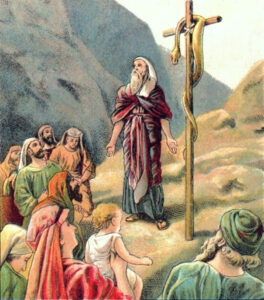
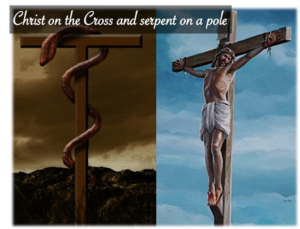
Do you remember what Jesus said about that, about being lifted up? It’s in the third chapter of John: John 3:14-15 14 And just as Moses lifted up the serpent in the wilderness, so must the Son of Man be lifted up, 15 that whoever believes in him may have eternal life. (Please use the Scripture link to see this passage in context. It is important to understand how this fits into the Gospel lesson for this Sunday.) To what is Jesus referring? Here are a couple of illustrations to help us refresh those aging memories. Numbers 21:8-9 And the Lord said to Moses, “Make a poisonous serpent, and set it on a pole; and everyone who is bitten shall look at it and live.” So Moses made a serpent of bronze, and put it upon a pole; and whenever a serpent bit someone, that person would look at the serpent of bronze and live.

God had given Israel his Law – the Ten Commandments (See Exodus 20:1-17 and Deuteronomy 5:6-21),  – they were given before the fiery serpents and the bronze serpent on a pole). How is it, then, that Moses made a metallic image of a poisonous snake and told the People of Israel to look at it to save their lives? Isn’t that an idol, a “graven image?” The difference here is that God ORDERED Moses TO MAKE THE DEVICE. It is a prefiguring, a “type,” which God used to show us how we must always rely on him for our salvation. That is why Jesus referred to it when he was talking to Nicodemus. I believe he told Nicodemus that because Nicodemus would remember “the rest of the Story.” In the days of King Hezekiah, the People were burning incense and praying to that device Moses had made! 2 Kings 18:4 He [Hezekiah] removed the high places, broke down the pillars, and cut down the sacred pole. He broke in pieces the bronze serpent that Moses had made, for until those days the people of Israel had made offerings to it; it was called Nehushtan. {nekh-oosh-tawn’} “The serpent-thing of brass/bronze/copper” (↔ Click Link for more information)

Belovéd, our days are often filled with deep, frightful prayers and supplications for our Nation, for our Church, for our intercessory Prayer List, and for all of us who call upon the Name of The Lord. These are nowhere near as intense as the prayers Jesus made. The evil that has washed over us like a horrific tsunami is indeed terrifying because it has nearly washed out the Road we must travel, the stairway we must seek. Now that we’ve considered where that Road begins and ends, we have what we need to give deeper consideration of Jesus’ purpose for glorifying his Father by going to his death on the Cross: “This voice did not come for my sake but for yours. Now is the time of judgment on this world; now the ruler of this world will be driven out. And when I am lifted up from the earth, I will draw everyone to myself.” He said this indicating the kind of death he would die.

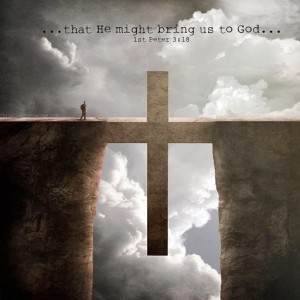
That is the road we are on – or should be on. If not, we need to get back on the Road again but this time make absolutely certain we are the servants who are accompanying their Master to the Place he has prepared for us. It is not an easy road. There are high peaks, deep valleys, raging rivers, stormy seas, dragons, demons, and edges of huge cliffs. Jesus can handle all of that because he has given us something to bridge the gaps along our difficult road.  As we travel that Road with Jesus, we recall Jesus’ words, “Whoever serves me, the Father will honor.” We choose to follow him because we hear him calling, (↔ Music Link) and so we have Decided to Follow Jesus. (↔ Music Link)

Whatever, whenever, wherever, whoever, however, if ever, forever —
at your service, Belovéd!

Please pray with us here at Share-a-Prayer.

Unless otherwise indicated, all scripture passages are from the New Revised Standard Version Catholic Edition (NRSVCE) New Revised Standard Version Bible: Catholic Edition, copyright © 1989, 1993 the Division of Christian Education of the National Council of the Churches of Christ in the United States of America. Used by permission. All rights reserved.

Biblical languages inserts from Bible Hub (Bible Hub: Search, Read, Study the Bible in Many Languages) Visit at http://biblehub.com

Creative Commons License
Aloha Friday Messages by Charles O. Todd, III is licensed under a Creative Commons Attribution-ShareAlike 3.0 Unported License

 St. Joseph

PRAY FOR US

Aloha Friday Message – March 12, 2021 – Wrath and Grace

2111AFC031221 – Wrath and Grace

Read it online here, please. And please, when you visit there, use one of the social media links at the bottom of the page to share this post. Thank you! And remember, we now have a READER VIEW available, so share this link or this email often.

      2 Chronicles 36:15-16 15 The Lord, the God of their ancestors, sent persistently to them by his messengers, because he had compassion on his people and on his dwelling place; 16 but they kept mocking the messengers of God, despising his words, and scoffing at his prophets, until the wrath of the Lord against his people became so great that there was no remedy.

Ephesians 2:8-10 For by grace you have been saved through faith, and this is not your own doing; it is the gift of God— not the result of works, so that no one may boast. 10 For we are what he has made us, created in Christ Jesus for good works, which God prepared beforehand to be our way of life.

John 3:17-19 17 Indeed, God did not send the Son into the world to condemn the world, but in order that the world might be saved through him. 18 Those who believe in him are not condemned; but those who do not believe are condemned already, because they have not believed in the name of the only Son of God. 19 And this is the judgment, that the light has come into the world, and people loved darkness rather than light because their deeds were evil.

Aloha nui loa, ʻŌmea! Grace and Peace to each of you from God our Father and our Lord, Jesus the Christ, in the Power of the Holy Spirit. Today I want to address one of the Seven Deadly Sins and, as we do so, to consider one way to defeat that sin in our lives. The sin I wish to address is a sin by which we seem to be surrounded – and it is taking over much of our lives. We’ll begin with an excerpt from the First Weekend in Lent in 2016:

This chart is based on many analyses of Christian scholars who looked for a way to present information on their understanding of the nature and severity of these sins. One common way to present them is by using the mnemonic “PEGSLAW.” That is the basis for this table:

The 7 Deadly Sins and Their Corresponding Virtues
P Pride Humility
E Envy Kindness
G Gluttony Temperance
S Sloth1 Diligence
L Lust2 Chastity
A Avarice3 Charity
W Wrath Patience
1Acedia, Apathy
2Covetousness, Concupiscence
3Greed, Cupidity

The one we will look at today is Wrath. When we speak of “the wrath of God,” we are citing the divine judgment upon sin and sinners which will be meted out on the Day of Reward against unrepentant sinners, but it is important to know that it is being felt today by the ungodly as the hardening of their hearts through the creation of their “Cancel Culture.” As you can see, the corresponding Virtue is Patience. Patience is a Virtue that starts with God. God is patient with us – for example we have Numbers 14:18a 18 The Lord is slow to anger and abounding in steadfast love, forgiving iniquity and transgression and Exodus 20:6 but showing steadfast love to the thousandth generation of those who love me and keep my commandments. “Steadfast love” is Mercy, and thank God that God is merciful! Nonetheless, what is so alarming is the pointless, violent, corrosive, angry Wrath that sweeps through mobs of hundreds, sometimes thousands of people all around the World. Is God patient with them? Does he expect us to be patient with them? The answer to both questions is yes – up to a point. When we are Patient with each other as believers, there is great peace in that because that sort of Patience is integrated into The Fruit of the Spirit. It is the ability to endure whatever comes. “Endure” in this context is to persist, to carry on; it is not the kind of endurance that is characterized as passive toleration. This is a kind of Patience that is to be as God’s Patience is – “slow to anger and abounding in steadfast love, forgiving iniquity and transgression [and aggression?] and showing steadfast love to the thousandth generation of those who love him. In my own sinful and often prideful little mind, that is a great way to approach Patience – after all, it’s what God does! – so, because we know that, we also have good reason to rejoice in the Gift of Salvation.

Rejoicing just happens to be the theme of Laetare Sunday – the Fourth Sunday of Lent and that happens this weekend. Back in 2020 during Advent we celebrated Gaudete Sunday. Both of those Sundays are celebrations of rejoicing. The vestments are Rose-colored. During the austerity of Lent we pause to reflect on how loving and patient God is to have provided us with so great a Savior, so let’s think on that topic for a bit.

In our first Key Verse from the Sunday readings we see that God did everything he could to wake us up (not to be confused with this most recent nonsense movement “woke”). He sent Judges, and Prophets, and Messengers, and his earthlings rejected them because they kept mocking the messengers of God, despising his words, and scoffing at his prophets, until the wrath of the Lord against his people became so great that there was no remedy. He had already destroyed every living thing except the inhabitants of the Ark, so instead, he sent us his Son, our Savior, for this reason: 17 Indeed, God did not send the Son into the world to condemn the world, but in order that the world might be saved through him. 18 Those who believe in him are not condemned; but those who do not believe are condemned already, because they have not believed in the name of the only Son of God. 19 And this is the judgment, that the light has come into the world, and people loved darkness rather than light because their deeds were evil. Those who embrace Wrath do so in their own darkness and – having rejected the Light – they are condemned already unless they repent and believe the Gospel. And woe to those who claim to be believers but lure others into sin and darkness by claiming to be pure, wise, and “woke.”

I urge you to look into these passages: Isaiah 9:16, Matthew 18:6, 2 Peter 2:1, Romans 1:18–32, and especially 2 Timothy 3:1-5 You must understand this, that in the last days distressing times will come. For people will be lovers of themselves, lovers of money, boasters, arrogant, abusive, disobedient to their parents, ungrateful, unholy, inhuman, implacable, slanderers, profligates, brutes, haters of good, treacherous, reckless, swollen with conceit, lovers of pleasure rather than lovers of God, holding to the outward form of godliness but denying its power. AVOID THEM! (my emphasis added). In these passages you will see what happens when sinful leaders and sinful followers disdain the Mercy of God and give the pretense of being godly in their thoughts, words, and deeds while they are actually children of Wrath and Pride, the siblings of Ignorance and Want.

Belovéd, we need not – must not – be misled by these demonic manifestations of Satan’s power. Indeed, we know Truth and Truth has freed us “from all sin and unrighteousness” because as we read in 1 John 5:16-19 16 If you see your brother or sister committing what is not a mortal sin, you will ask, and God will give life to such a one – to those whose sin is not mortal. There is sin that is mortal; I do not say that you should pray about that. 17 All wrongdoing is sin, but there is sin that is not mortal. // 18 We know that those who are born of God do not sin, but the one who was born of God protects them, and the evil one does not touch them. 19 We know that we are God’s children, and that the whole world lies under the power of the evil one. It is exactly that kind of information that makes the Gospel “The Good News!” and we could sure use a load of that these days!! Therefore, Belovéd, in keeping with the spirit of Laetare Sunday, let us REJOICE! In Scripture we have plenty of examples of ways to rejoice. Here’s a quick reminder:

Rejoice with one another, Beloved. Pray for, with, and about one another. Be kind to one another, and be especially kind to strangers. Remember what He said: “Whatever you do to the least of these…” and “I AM coming tomorrow.” Isn’t that a good enough reason to rejoice? There’s a post for that right here, and in that post you will find these biblical terms for REJOICE:

Samah – שָׂמַ֖ח – Jubilant, spontaneous dancing, signing (simhach) – 1 Chronicles 29:9
Alaz – עָלַז – Exult – Burst into leaping with joy – Habakkuk 3:17-18
Nagilah – נָגִ֖ילָה – Let us rejoice – Psalm 118:4
Euphraino – εὐφραίνω – To gladden the mind – Revelation 12:12
Kauchaomai – καυχάομαι – Glory in success and boast against – 1 Corinthians 1:30-31
Sunchairo – a συγχαίρω – Rejoicing together, with others – Luke 15:6
Agalliao – ἀγαλλιάω – Rejoice Greatly, to exult; jump for joy – Revelation 19:6-8
Chairo – χαίρω – Rejoicing over experiencing God’s Grace; be glad in the Lord – Luke 15:32

That is such a great word – REJOICE. When I hear it, I hear it as re-joys as in joys again, and again, and again. One of the best JOY words around is Halleluiah and its alternative Alleluia. We are to be an Alleluia People! What does that word mean? It means GOD BE PRAISED. We used to sing a song about that. (↔ Music Link) We’d be divided into two groups – boys and girls, left-side and right-side, children and adults – and on the Halleluiah phrases one group would stand. When Praise ye the Lord came up the Halleluiah group sat down and the second group stood up. There was a lot of “jumping up and down.” Rejoicing is like that. It’s just being so happy that we simply can’t sit still. (↔ Music Link) That’s one of the effects of being baptized with FIRE and the Holy Spirit!

Pope Francis I on his election chose that name because St. Francis is a Saint who typifies joyful commitment to the hard work of evangelization. He is “Everybody’s Saint.” When I was a kid, I learned a song attributed to him that sings in my soul to this day. It is an Alleluia song, a song of Praise, and when we praise God, we are caught up in rejoicing with him for his Saving Grace as we rejoice because of his “steadfast love and lovingkindness” in our daily lives For by grace you have been saved through faith. Perhaps you will also remember this beautiful hymn. It remains a favorite here! It is All Creatures of Our God and King (↔ Music Link). You can find the full lyrics here (↔ Click Link). It is reminiscent of Isaiah 12:6 Shout aloud and sing for joy, O royal Zion, for great in your midst is the Holy One of Israel.

The Wrath of God is real. We see it affecting those around us every day. We will not be subject to it if we remember to Rejoice in the Lord who is our Life and our Salvation since Those who believe in him are not condemned; For we are what he has made us, created in Christ Jesus for good works, which God prepared beforehand to be our way of life. That is the Gift and the effect of Grace, the unmerited favor of God. It beats Wrath hands down every time. REJOICE!

Whatever, whenever, wherever, whoever, however, if ever, forever —
at your service, Belovéd!

Please pray with us here at Share-a-Prayer.

Unless otherwise indicated, all scripture passages are from the New Revised Standard Version Catholic Edition (NRSVCE) New Revised Standard Version Bible: Catholic Edition, copyright © 1989, 1993 the Division of Christian Education of the National Council of the Churches of Christ in the United States of America. Used by permission. All rights reserved.

Biblical languages inserts from Bible Hub (Bible Hub: Search, Read, Study the Bible in Many Languages) Visit at http://biblehub.com

Creative Commons License
Aloha Friday Messages by Charles O. Todd, III is licensed under a Creative Commons Attribution-ShareAlike 3.0 Unported License
Aloha Friday Message – March 5, 2021 – You Shall Not

2110AFC030521 – You Shall Not

Read it online here, please. And please, when you visit there, use one of the social media links at the bottom of the page to share this post. Thank you! And remember, we now have a READER VIEW available, so share this link or this email often.

     Exodus 20:2-3 I am the Lord your God, who brought you out of the land of Egypt, out of the house of slavery; you shall have no other gods besides me.

Leviticus 18:3 You shall not do as they do in the land of Egypt, where you lived, and you shall not do as they do in the land of Canaan, to which I am bringing you. You shall not follow their statutes.

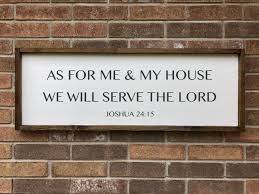
Joshua 24:15 15 Now if you are unwilling to serve the Lord, choose this day whom you will serve, whether the gods your ancestors served in the region beyond the River or the gods of the Amorites in whose land you are living; but as for me and my household, we will serve the Lord.

Aloha nui loa, ʻŌmea! The grace of the Lord Jesus Christ and the love of God and the fellowship of the Holy Spirit be with all of you

There was a plaque very similar to this one in the house where my family lived after I moved out of the house in which I grew up . As I recall, it was on the main floor of their multilevel house at the bottom of the stairs going up to the second floor. Our dad was, in his own quiet way, proud of that declaration. It stated his faith simply but eloquently. His attitude was pretty much centered on “you shall.” There were rules in our house about what you could not do, that’s for sure, but there were more rules about what you should do. Later on in my own life I worked it out to “Do what you know is right. Avoid what you know is wrong. Ask God to bless the choice.” That pretty much works out every time I remember it. God has some simple rules, too.

In Jehovah’s dealing with Israel, he started them off with a list of actionable rules that began with “thou shalt not.” There’s a really good reason for that, and we’ll begin by discussing that reason.

We know that God is always Loving and Forgiving (↔ Music Link). How do we know? He told us so, over and over. In these writings I have often mentioned God’s Perfect Integrity. God is ONE. He first conveyed this through Moses. The first and most obvious place to see God’s oneness is in Deuteronomy 6:4. I’m going to put it here  with some “added emphasis” so you can see how it is recorded in Scripture.

 4 Hear, O Israel: The Lord is our God, the Lord is one.

שְׁמַ֖ע יִשְׂרָאֵ֑ל יְהוָ֥ה אֱלֹהֵ֖ינוּ יְהוָ֥ה ׀ אֶחָֽד ׃

Sh’ma Yisrael Adonai Elohaynu Adonai Echad.

Now, this Perfect Integrity is the authority on which God’s Perfect Justice is based. Justice applies to everything we do and can be understood as the natural consequences of our thoughts, words, and deeds. Justice always gives us what we deserve and those consequences can be pleasant or not. Another core aspect of the effect of Perfect Integrity is God’s Perfect Love. REAL love must be based in Integrity, otherwise it is fickle and unpredictable. God’s Love is REAL Love because it is unchanging and constantly unending. Because his Justice is Perfect and his Love is Everlasting, he offers us Love that reinforces Justice by making it a Gift to us – a Gift called Grace. Through this Gift of Grace, God is also able to bestow on us the Gift of Mercy – and make no mistake about it – Mercy is a remarkable Gift! In the same way that Justice applies natural consequences, Mercy applies Supernatural Consequences, and those are always GOOD consequences. As we said, justice gives us what we deserve. Mercy gives us what we do not deserve – consistently-good consequences. These consistently-good consequences are known to us as Blessings, and if you’ve made time recently to count how many of those you have already, you’ll know that Blessings abound when we are open to the Grace available to us through REAL Love. This Mercy from God is another core aspect of his Perfect Integrity. Like him, it is unique, eternal, integral to him and all he does (therefore integral to all Creation). This Endless Mercy is the enabling factor that brings us Endless Salvation through Christ our Lord. That Endless Salvation has a distinctly Divine Purpose in God’s dealings with his earthlings.

That Divine Purpose is Restoration. “In the beginning” our First Parents were created in the image and likeness of God, and shared his Integrity – they were without sin. Then, we broke that integrity through duplicity – compromise, which is the antithesis of integrity – and lost our original relationship with him through Original Sin. This was caused by a failure to be humble – we stretched out our hand to claim that which we already had – Unity with God – and traded it for separation, humiliation, and death. Humiliation is an affront to pride and a product of shame; shame comes because we know the difference between Good and Evil and chose (and choose) that which is not good. Humility is the only antidote for shame because being humble is an act of worship and a product of Love which leads us to unification God and with each other thus completing the restoration of our original relationship with our Creator. God does this because his Perfect Integrity is expressed for us in his unfailing Kindness – his care for his Creations. Kindness is an attribute of God that he expects us to have and to use. As sinful souls, how are we to know how to be kind and merciful as he requires? Well, Good God that he is, he has given us detailed instructions called the B.I.B.L.E. and in that Operator’s Manual he included an extensive set of Rules. Those Rules are summarized in a tidy little package we call The Ten Commandments. For most of the people who have a least a little familiarity with that package, what is most memorable is “thou shalt not.”

This would be a good spot to pause for a moment and review the Ten Commandments. There are several ways of listing them. There are differences in the order and wording for Catholic and non-Catholic Christians, and those differ from the Jewish listing. We’ll look at just the Christian comparison here.


10 Commandments ~ Catholic Christian Version 10 Commandments ~ Non-Catholic Christian Version
1.     You shall not have other gods before Me.

2.     You shall not take the Name of the Lord in vain.

3.     Remember to keep holy the Lord’s day.

4.     Honor your father and your mother.

5.     You shall not kill.

6.     You shall not commit adultery.

7.     You shall not steal.

8.     You shall not bear false witness against your neighbor.

9.     You shall not covet your neighbor’s wife.

10. You shall not covet your neighbor’s goods.

1.     You shall have no other gods but me.

2.     You shall not make unto you any graven images

3.     You shall not take the name of the Lord your God in vain

4.     You shall remember the Sabbath and keep it holy

5.     Honor your mother and father

6.     You shall not murder

7.     You shall not commit adultery

8.     You shall not steal

9.     You shall not bear false witness

10. You shall not covet anything that belongs to your neighbor

(For the Jewish summary, please follow this link.)

We have been told repeatedly here and elsewhere that the way to keep these commandments (they are the Ten Commandments, not the Ten Recommendations) is to Love God and neighbor as we love ourselves. That sounds simple, but we all know that its simplicity is what trips us up. Why is it so difficult to Love God and our neighbors? It is difficult because we forget. Being reminded we’ve forgotten is truly humbling, sometimes even humiliating; we resolve to do better, but sooner than we wish – we forget again. Fortunately God is patient. When we ask Him “What more do you want?” He says, “I don’t want more. I want it all.” Yikes! Talk about Amazing Grace!! He wants all our imaginations about what we are, have, and can be, and He will replace that with all we are created to be. That’s a pretty good deal! So why don’t we always accept the terms of that deal? We forget to remember what He put there and displace it with what we put there. We choose to disremember because we decide not “to walk humbly with our God.” (Once again, Micah 6:8 comes to mind). We have an abundance of ways to be reminded, to remember that Love is the Way of God. Here are a few of those reminders.

Colossians 2:8 See to it that no one takes you captive through philosophy and empty deceit, according to human tradition, according to the elemental spirits of the universe, and not according to Christ.

Romans 8:6-9 To set the mind on the flesh is death, but to set the mind on the Spirit is life and peace. For this reason the mind that is set on the flesh is hostile to God; it does not submit to God’s law—indeed it cannot, and those who are in the flesh cannot please God. But you are not in the flesh; you are in the Spirit, since the Spirit of God dwells in you. Anyone who does not have the Spirit of Christ does not belong to him.

John 14:1515 If you love me, you will keep my commandments.

1 John 5:3-5 For the love of God is this, that we obey his commandments. And his commandments are not burdensome, for whatever is born of God conquers the world. And this is the victory that conquers the world, our faith. Who is it that conquers the world but the one who believes that Jesus is the Son of God?

2 John 1:6 And this is love, that we walk according to his commandments; this is the commandment just as you have heard it from the beginning—you must walk in it.

1 Corinthians 16:13–14 13 Keep alert, stand firm in your faith, be courageous, be strong. 14 Let all that you do be done in love.

1 Peter 2:1 1 Rid yourselves, therefore, of all malice, and all guile, insincerity, envy, and all slander.

1 Pet. 3:10 10 For “Those who desire life and desire to see good days, let them keep their tongues from evil and their lips from speaking deceit.

Deuteronomy 4:2 You must neither add anything to what I command you nor take away anything from it, but keep the commandments of the Lord your God with which I am charging you.

There are nearly equal numbers of Bible verses that contain “you shall” and “you shall not.” Here are a few passages where Israel was told “you shall:”

Genesis 3:19 By the sweat of your face you shall eat bread until you return to the ground, for out of it you were taken; you are dust, and to dust you shall return.”

Exodus 3:15 God also said to Moses, “Thus you shall say to the Israelites, ‘The LORD, the God of your ancestors, the God of Abraham, the God of Isaac, and the God of Jacob, has sent me to you’: This is my name forever, and this my title for all generations.

Exodus 28:30 In the breastpiece of judgment you shall put the Urim and the Thummim, and they shall be on Aaron’s heart when he goes in before the LORD; thus Aaron shall bear the judgment of the Israelites on his heart before the LORD continually.

Numbers 3:15Enroll the Levites by ancestral houses and by clans. You shall enroll every male from a month old and upward.

Deuteronomy 5:1 Moses convened all Israel, and said to them: Hear, O Israel, the statutes and ordinances that I am addressing to you today; you shall learn them and observe them diligently.

Jeremiah 7:23 23 But this command I gave them, “Obey my voice, and I will be your God, and you shall be my people; and walk only in the way that I command you, so that it may be well with you.”

There we have it, Belovéd. The answer is that we must not forget to obey his voice, to know him as our God, to know ourselves as his people, and only to obey his commandments by not forgetting what he put here for us so that we do not replace them with what we put here for him. If we remember to do these things, all will be well with us.

We must not compromise on his Commandments or his Law! There is only ONE God and he has only ONE Law. When we break any part of that Law, we have broken the whole Law, but he still Loves us and redeems us because he does Love us. We must only remember how much he loves (↔ Music Link) us, even to his death.

Whatever, whenever, wherever, whoever, however, if ever, forever —
at your service, Belovéd!

Please pray with us here at Share-a-Prayer.

Unless otherwise indicated, all scripture passages are from the New Revised Standard Version Catholic Edition (NRSVCE) New Revised Standard Version Bible: Catholic Edition, copyright © 1989, 1993 the Division of Christian Education of the National Council of the Churches of Christ in the United States of America. Used by permission. All rights reserved.

Biblical languages inserts from Bible Hub (Bible Hub: Search, Read, Study the Bible in Many Languages) Visit at http://biblehub.com

Creative Commons License
Aloha Friday Messages by Charles O. Todd, III is licensed under a Creative Commons Attribution-ShareAlike 3.0 Unported License
Aloha Friday Message – February 26, 2021 – HERE I AM.

2109AFC022621 – HERE I AM.

Read it online here, please. And please, when you visit there, use one of the social media links at the bottom of the page to share this post. Thank you! And remember, we now have a READER VIEW available, so share this link or this email often.

      Genesis 22:1-2 1 After these things God tested Abraham. He said to him, “Abraham!” And he said, “Here I am.”* He said, “Take your son, your only son Isaac, whom you love, and go to the land of Moriah, and offer him there as a burnt offering on one of the mountains that I shall show you.”

Acts 9:10 10 Now there was a disciple in Damascus named Ananias. The Lord said to him in a vision, “Ananias.” He answered, “Here I am, Lord.”

Genesis 22:7-8 Isaac said to his father Abraham, “Father!” And he said, “Here I am, my son.” He said, “The fire and the wood are here, but where is the lamb for a burnt offering?” Abraham said, “God himself will provide the lamb for a burnt offering, my son.” So the two of them walked on together.

Exodus 3:4 When the Lord saw that he had turned aside to see, God called to him out of the bush, “Moses, Moses!” And he said, “Here I am.”

Isaiah 58:9a – Then you shall call, and the Lord will answer; you shall cry for help, and he will say, Here I am. * This declaration in Hebrew is hinneh, and it is used hundreds of times in the Bible. Usually it is translated as Behold! Or Lo and it carries a meaning of “Look here,” or “I am here” and usually occurs when a person in authority is speaking (God calling Samuel, for example, or Jeremiah surrendering to his accusers while relying on God’s Providence).

Aloha nui loa, ʻŌmea! Grace and peace be multiplied to you in the knowledge of God and of Jesus our Lord. It is already the second weekend of Lent, and this weekend we will listen to some of the most remarkable passages in the entire Bible. First, there is the story in Genesis 22 where God “put Abraham to the test” by requiring him to sacrifice his precious son, Isaac. Abraham complies by acting in faith that God had promised him he would have heirs through Isaac more numerous than the stars and he reckoned that God could even raise Isaac from the dead. The Apostle Paul reminds the Romans that – like Abraham – God did not withhold his own Precious Son from death. God is for us so we have nothing to fear from those who would oppose us. Lastly, in the Gospel, we have the remarkable account of The Transfiguration (← Check it out!). Today I want to focus on Abraham’s absolutely resolute faith. As you can tell from the Key Verse passages up there, the response of a true Servant of God is “Here I am,” sometimes flipped to say “Here am I.” When God speaks the name of one of his servants, the ones who are committed to serving him and him only, and they reply in humble readiness, it reminds me of the response we were trained to give in the Armed Forces: Sir! Yes Sir! We enthusiastically show our readiness to serve as did the Psalmist in Psalm 40:7-8 Then I said, “Here I am; in the scroll of the book it is written of me. I delight to do your will, O my God; your law is within my heart.” We know our duty – to Trust and Obey – and we discharge that duty without reserve.

God establishes servants wherever service is needed. That makes sense, doesn’t it? If something needs to be done, bring in those who are capable of doing it. And we can readily see that God’s servants know what he wants because they are prepared for whatever he asks (See in context Deuteronomy 30:11-14 14 No, the word is very near to you; it is in your mouth and in your heart for you to observe.) In Isaiah 58:9, we have a prefiguring of the promise in Genesis 2  – the presence of God in the lives of his earthlings. After all, it is his Spirit that makes us living souls. God is always here, always near, always and all ways Always, and that means he knows us more intimately than we know ourselves. (See my “2nd-most-favorite-Psalm,” Psalm 139:13-16) God chose to make his Son – his ONLY BEGOTTEN SON – manifest in flesh, flesh like ours. He is always present (Omnipresent – here I am, not “here I will be”) He calls us to be present (Here I am Lord) (↔ Music Link) and when we respond, great things happen! We find Grace, Power in the Holy Spirit, Peace surpassing all understanding, surrender to God as he lays hold of us, our willingness to serve escalates, our preparedness is sharpened, we are aglow with the Presence of God. Of course, we are not as refulgent as Christ was as he spoke with Moses and Elijah, but we do shine! Have you ever heard God’s voice? I have. I have shared this before, but I want to share it again today.

Suppose we start out with Isaiah 6:8 Then I heard the voice of the Lord saying, “Whom shall I send, and who will go for us?” And I said, “Here am I; send me!” I always liked that. It was, in a special way, part of my decision to give my life to “Full Time Christian Service” at age 10 at Camp IdRaHaJe – which is an abbreviation for “I’d Rather Have Jesus.” (↔ Music Link) Later – in high school – I thought I had a calling to the Ministry in the Reformed Church in America. Long story short, one thing led to another, the Draft happened, and that idea faded away. The message for that calling was “Preach my Word.” Once I was in the Air Force, I was led to my conversion in the Catholic Church. Just two weeks after my first fully-Catholic day, I married the love of my life – Crucita – and not long after, the message in the call became “Teach my Word.” I’m still working on that directive. Here is one way that happens.

The Psalm I love best is Psalm 138 (← Check it out!). It is my all-time-favorite Psalm. The first two verses are filled with wonderful praise:

Psalm 138:1 I thank you, Lord, with all my heart;
in the presence of the angels to you I sing.
New American Bible (Revised Edition)(NABRE)

I like that part about singing in the presence of the Angels. It reminds me of Psalm 22:3 which says that God “inhabits the praises of his people.” The rest of the Psalm is so reassuring. God will surely hear the cry of the suffering.

There is a passage in 1 Corinthians that steadies me with grateful conviction – conviction that enables my service because it matches up with my “Sir! Yes sir!” The Apostle Paul is describing how he received the Gospel, “as to one born abnormally,” when Jesus met him on the road to Damascus. 1 Corinthians 15:10 10 But by the grace of God I am what I am, and his grace toward me has not been in vain. On the contrary, I worked harder than any of them—though it was not I, but the grace of God that is with me. This verse always reminds me that I have not yet worked as hard as I should, or as hard as I can, on behalf of the Gospel. I am what I am by the grace of God, though, and he constantly challenges me to be a better steward of the many, many gifts he has presented me in my life.

I often remind myself and others to “Honor the Giver by accepting the Gift.” When I look at the faith of my Old Friend Abraham, or reflect on the determination and courage of Moses, or recognize in David a heart that God called “a man after my own heart” (See Acts 13:22), I know I fall far short of the servanthood to which I aspire. One of the many reasons for that is that he gifted me with words, and sometimes (way too many times) the words I use are not the Word from God’s own heart. Then he calls, and I remember.

When he calls us, we remember that he chose us, we did not choose him. To him, we are not “hey you” because he has called each of us by name. I remember that he comforts and consoles as well as corrects and counsels because he has given us his Holy Spirit – not just me, but all the faithful in Christ Jesus. Nothing can stop, divert, sully, or prevent his Love from filling our lives. We are victors, conquerors in Christ, and we have not only the Victory, but also the spoils of the victory: The repudiation of every evil that has tried to harm us. We have an indefatigable and inexhaustible source of Love and Protection called “God’s Providence.”

“If God is for us …” Sadly, that has too often been used as justification for ungodly acts. This kind of misuse of Scripture is false prophecy – falsely claiming that “what I am doing is right because God has ordained it” when what is being done is clearly wrong. I fervently urge you to make time to read every word of 2 Peter 2! I’m just going to pull out three verses so you can get the flavor of what The Apostle Peter said there: 12 These people, however, are like irrational animals, mere creatures of instinct, born to be caught and killed. They slander what they do not understand, and when those creatures are destroyed,  they also will be destroyed, 13 suffering the penalty for doing wrong. They count it a pleasure to revel in the daytime. They are blots and blemishes, reveling in their dissipation while they feast with you. 14 They have eyes full of adultery, insatiable for sin. They entice unsteady souls. They have hearts trained in greed. Accursed children! If you watch or listen to a broadcast news, we see and hear of such persons multiple times daily. They not only desecrate what Good the Lord has allowed to come to all (see Matthew 5:43-45) but despoil and detest all Good that is to come: Proverbs 17:15 15 One who justifies the wicked and one who condemns the righteous are both – alike an abomination to the Lord. Belovéd, we are called by name to serve God and one another. That means we serve Truth, and in the Truth there is no darkness, no pain, no toil, no trouble, no tears; because of and within his Word, we are assured that there is only God and God is Love. I’m hoping you remember this:

GOD ≡ LIGHT ≡ LOVE ≡ TRUTH ≡ WAY ≡ LIFE ≡ ETERNAL ≡ MERCY ≡ GOD (↔ Music Link – really!)

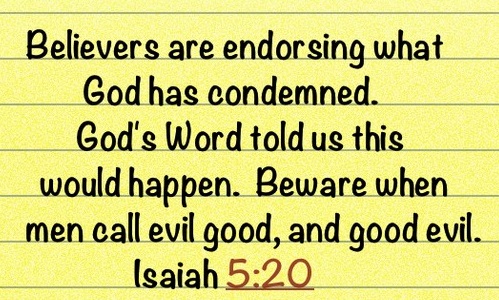
Let those who have ears hear and those who have lips speak. God is not mocked, (← Check it out!) The warning is clear. That warning is what we started off with this year, and it is important that we do not ignore it. Do you remember that in 2101AFC010121 – Head for the Light we referred to believers who are endorsing what God has condemned? Take a look: Satan is darkness and in him is no Light at all. And yet, we have many people – thousands upon thousands – swearing that light is darkness and evil is good (See Isaiah 5:18-23, especially v. 20 which reads in part 20 Ah, you who call evil good and good evil, who put darkness for light). There is 1 light and there is 1 darkness in the Spiritual War we act against, but that darkness is not merely the absence of Light, it is also the presence of evil and every bit as real as the Light we follow and eventually become. They are headed away from the Light. WE are headed for the Light, which is to say we are moving toward Heaven for and because of the Love of God.

We will touch on this often during this year because from the highest echelons of power to the lowest depths of perversion, we are being led away from the proclamation of and obedience to the Word. IF WE GO THAT ROUTE, we will go with those “irrational animals” to the Second Death to be destroyed with them. He chose us, he called us, he counts on us; but, more importantly, we can count on him because Then you shall call, and the Lord will answer; you shall cry for help, and he will say, Here I am. God himself did indeed provide the Lamb! Now may God help us in this perilous time!

Whatever, whenever, wherever, whoever, however, if ever, forever —
at your service, Belovéd!

Please pray with us here at Share-a-Prayer.

Unless otherwise indicated, all scripture passages are from the New Revised Standard Version Catholic Edition (NRSVCE) New Revised Standard Version Bible: Catholic Edition, copyright © 1989, 1993 the Division of Christian Education of the National Council of the Churches of Christ in the United States of America. Used by permission. All rights reserved.

Biblical languages inserts from Bible Hub (Bible Hub: Search, Read, Study the Bible in Many Languages) Visit at http://biblehub.com

Aloha Friday Messages by Charles O. Todd, III is licensed under a Creative Commons Attribution-ShareAlike 3.0 Unported License
 

Aloha Friday Message – February 19, 2021 – Noah Was a Carpenter

2108AFC021921 – Noah Was a Carpenter

Read it online here, please. And please, when you visit there, use one of the social media links at the bottom of the page to share this post. Thank you! And remember, we now have a READER VIEW available, so share this link or this email often.

     Genesis 6:8 But Noah found favor in the sight of the Lord.

1 Peter 3:20b-21a God waited patiently in the days of Noah, during the building of the ark, in which a few, that is, eight persons, were saved through water. 21 And baptism, which this prefigured, now saves you

Aloha nui loa, ʻŌmea! Grace and Peace to each of you from God our Father and our Lord, Jesus the Christ, in the Power of the Holy Spirit. Now why would I write, “Noah was a carpenter” when everyone knows that?

I don’t know why that popped into my head. I was looking for an older post I had made, and I typed in the word Noah to see if it would highlight it as a misspelled word. It didn’t. As I looked at it, the rest of the sentence just flowed as I typed.

Noah was a carpenter.

I wonder if he knew that when he was growing up? More precisely he was a shipbuilder. Of course he couldn’t have known that because his was probably the first ship built. Based on the information we have from Genesis, it must have been a rough ride. Here’s some suggested reading from Ritchie’s Sermon Topics.

Coming Judgment Announced Genesis 6:12-1312 And God saw that the earth was corrupt; for all flesh had corrupted its ways upon the earth. 13 And God said to Noah, “I have determined to make an end of all flesh, for the earth is filled with violence because of them; now I am going to destroy them along with the earth.

Noah believed the warning ~~ Hebrews 11:7 –  By faith Noah, warned by God about events as yet unseen, respected the warning and built an ark to save his household; by this he condemned the world and became an heir to the righteousness that is in accordance with faith.

Noah built the Ark according to God’s plan ~~ Genesis 6:14-16 – 14 Make yourself an ark of cypress [gopher] wood; make rooms in the ark, and cover it inside and out with pitch. 15 This is how you are to make it: the length of the ark three hundred cubits, its width fifty cubits, and its height thirty cubits. 16 Make a roof for the ark, and finish it to a cubit above; and put the door of the ark in its side; make it with lower, second, and third decks.

Noah and his family obeyed God’s Invitation to enter the Ark ~~ Genesis 7:1 1 Then the Lord said to Noah, “Go into the ark, you and all your household, for I have seen that you alone are righteous before me in this generation.

Noah and his family were in God’s hand ~~ Genesis 6:17-18 17 For my part, I am going to bring a flood of waters on the earth, to destroy from under heaven all flesh in which is the breath of life; everything that is on the earth shall die. 18 But I will establish my covenant with you; and you shall come into the ark, you, your sons, your wife, and your sons’ wives with you.

Despite what you saw in the movies, God shut the door  BUT no one else could open it; yet, the Ark stayed afloat ~~ Genesis 7:16-18 16 And those that entered, male and female of all flesh, went in as God had commanded him; and the Lord shut him in.

17 The flood continued forty days on the earth; and the waters increased, and bore up the ark, and it rose high above the earth. 18 The waters swelled and increased greatly on the earth; and the ark floated on the face of the waters.

God caused the floodwaters to retreat, and all who were Just reentered the World to worship him ~~ Genesis 8:18-2218 So Noah went out with his sons and his wife and his sons’ wives. 19 And every animal, every creeping thing, and every bird, everything that moves on the earth, went out of the ark by families.

20 Then Noah built an altar to the Lord, and took of every clean animal and of every clean bird, and offered burnt offerings on the altar. 21 And when the Lord smelled the pleasing odor, the Lord said in his heart, “I will never again curse the ground because of humankind, for the inclination of the human heart is evil from youth; nor will I ever again destroy every living creature as I have done. 22 As long as the earth endures, seedtime and harvest, cold and heat, summer and winter, day and night, shall not cease.”

To these I would add the following:

Jonah 3:9 Who knows? God may relent and change his mind; he may turn from his fierce anger, so that we do not perish. WE know, Belovéd, because we have the Words of everlasting Life.

The floods will never come again, but the next full-World destruction will come by fire ~~ See 2 Peter 3:5-10 But by the same word the present heavens and earth have been reserved for fire, being kept until the day of judgment and destruction of the godless. 10 But the day of the Lord will come like a thief, and then the heavens will pass away with a loud noise, and the elements will be dissolved with fire, and the earth and everything that is done on it will be disclosed.

Matthew 18:14 14 So it is not the will of your Father in heaven that one of these little ones should be lost. Every evil shall be destroyed. Every righteousness shall be preserved. (See John 10:28 below↓)

John 1:14 14 And the Word became flesh and lived among us, and we have seen his glory, the glory as of a father’s only son, full of grace and truth. That is True Righteousness!

John 10:9 I am the gate. Whoever enters by me will be saved, and will come in and go out and find pasture. Jesus is the fulfillment of all the covenants God has made with his earthlings. The Ark carried the Just. The Gate opens the Way.

John 10:28 28 I give them eternal life, and they will never perish. No one will snatch them out of my hand. The World will be destroyed, but the Just shall not perish. Sound familiar? The Just were in the Ark, and only the Just were saved.

Romans 3:4 By no means! Although everyone is a liar, let God be proved true, as it is written, “So that you may be justified in your words, and prevail in your judging.” (See Psalm51:4) Remember, we got into this mess because of a series of lies from that old liar and murderer, Satan.

1 Thessalonians 4:14 14 For since we believe that Jesus died and rose again, even so, through Jesus, God will bring with him those who have died. “All the faithful departed and those whose faith is known to you alone.”

Where he leads me, I will follow (↔ Music Link), because I know he’s coming back for us. Will I, will you, will we be ready, or will Christ find the World is as bad, or worse than, in Noah’s time? You and I know that we will joyfully, willingly, obediently wait for him because Every Day with Jesus is Sweeter than the day before (↔ Music Link). And you know what? When I’m that happy, I just can’t help but sing, because In My Heart There Rings a Melody. (↔ Music Link) And Why do I Sing About Jesus? (↔ Music Link) “S/he who sings gladly prays twice.” Just think how that Worship Service with Noah his family must have been! And it’s all because Noah did what God asked. He even made sure he had the plan right.

Noah did a little talking with the Lord when he first got the request. He seems to have felt he was not cut out for that kind of job. However, God knows better (of course!) and so God insists. Noah wisely obeys. A door is closed. A remnant is saved. The rest is amazing.

It makes me wonder: What does God want me to be if I grow up? How about you? Do you ever wonder about that? I hope so. It’s one of the gazillion ways God tries to get our attention, to get us thinking about things above instead of things here and elsewhere. As He did with Noah, when God really wants you to do something, God just won’t let it rest. I think that may be why we have the saying, “We are restless until we find our rest in God.” (Written by St. Augustine) Noah was a carpenter. Jesus was a Carpenter. Both of them cooperated with God and changed the world. “If I was a carpenter…” To tell you the truth, I’m terrible with carpentry tools. God gave me a way different toolbox. He won’t let me rest until I start using it. If I look at the tools He gave me, it’s pretty clear I’m not going to be building any arks. I’m going to be building something, though, that’s almost as big and complicated as an ark – at least that’s the way Noah and I both feel about it! And I’d best get on with it else I might find myself standing on the wrong side of the door with God patiently waiting for me to become favorable in his sight.

Please remember to pray for –

  • Truth ~~ Almighty Everliving God, Lord of Hosts, We humbly ask you to grant us the Grace to seek Truth, to recognize it when we find it, the courage to embrace it wherever it is found, and the wisdom to exclude all else that is not Truth.
  • In Jesus’ Precious Name. AMEN.
  • Peace ~~ real and lasting peace – in our hearts and minds, in our homes, in our nation, in our world
  • The Called ~~ like Noah – who can barely believe what God has chosen for them by gifting them with what it takes to do it
  • Everyone ~~ who prays for you and everyone who asks for your prayers
  • And – this is important – pray for and about YOU. You might be surprised by how attentive God can be. And when he calls, answer and rejoice. Maybe we might even sing a tune or two!

Thanks for everything! I love you. Make it a great day: Give it to God and see what He can do with it. You know, of course, God Will Take Care of You (↔ Music Link).

Whatever, whenever, wherever, whoever, however, if ever, forever —
at your service, Belovéd!
Please pray with us here at Share-a-Prayer.

Unless otherwise indicated, all scripture passages are from the New Revised Standard Version Catholic Edition (NRSVCE) New Revised Standard Version Bible: Catholic Edition, copyright © 1989, 1993 the Division of Christian Education of the National Council of the Churches of Christ in the United States of America. Used by permission. All rights reserved.

Biblical languages inserts from Bible Hub (Bible Hub: Search, Read, Study the Bible in Many Languages) Visit at http://biblehub.com

Creative Commons License
Aloha Friday Messages by Charles O. Todd, III is licensed under a Creative Commons Attribution-ShareAlike 3.0 Unported License
 

Aloha Friday Message – February 12, 2021 – Where there’s a will

2107AFC021221 – Where there’s a will

Read it online here, please. And please, when you visit there, use one of the social media links at the bottom of the page to share this post. Thank you! And remember, we now have a READER VIEW available, so share this link or this email often.

    Mark 1:40-41 40 A leper came to him begging him, and kneeling he said to him, “If you choose, you can make me clean.” 41 Moved with pity, Jesus stretched out his hand and touched him, and said to him, “I do choose. Be made clean!”
1 Corinthians 10:31, 11:1 31 So, whether you eat or drink, or whatever you do, do everything for the glory of God. Be imitators of me, as I am of Christ.

Aloha nui loa, ʻŌmea! Grace and peace be multiplied to you in the knowledge of God and of Jesus our Lord.

I have been thinking this week about how wonderful it is to know the Lord and how important it is to know that we know him. Does that sound like double-talk or circular logic? Perhaps I can explain what I mean.

Most people, even non-Christians, can recognize Jesus. Hopefully you read the story I sent on Tuesday about the little girl who had never heard about Jesus until the murder-suicide of her parents. Recognizing him is not the same as knowing him. Tens-of-thousands of people in Jesus’ day saw him, recognized him, watched him, but not all of them knew him, and of those who did know him, not all of them followed him. Some of us “of a certain age” can remember a song from 1958 sung by The Teddy Bears’ Annette Kleinbard with lyrics “To know, know, know him is to love, love, love him … Everyone says there’ll come a day when I’ll walk along side of him.” The song continues with a complaint that the object of  the young lady’s affection ignores her. Just as in Jesus’ time, not everyone paid attention to Jesus. In fact, the longer he was around, the wider the separation became for those who loved him and the many who were indifferent to him. Jesus did and does notice those of us who love him, who follow him. A few years after that release of the Teddy Bears’ hit, Little Peggy March took off with “I will follow him.” (↔ Music Link) Much to our surprise, that song was revived in the 1992 movie “Sister Act 1.” I say it was surprising because the lyrics (↔ Click Link) were “remarkably adaptable” under a religious connotation.

1958 was also the year Bill Harmon’s song came into popular play. It is called Reach Out and Touch the Lord as He Walks By. It’s a great way to be closer to God – reach out and touch him like an old friend. There is something so consoling in a touch. When infants are in the PICU, it is essential that someone touches and holds them, otherwise they will not – cannot – thrive. When we are hurt, or frightened, or in love, or feeling welcomed, we like to touch and be touched. If we think about those times in our lives when someone gently touched us, those are pleasant memories. They are even more pleasant when the touch is unexpected. If someone special reaches out and takes our hand or touches us on the shoulder, we feel a shudder of warmth. Most pleasant of all is when we ask for that touch or hug, and it is given with  love and received with joy. Now, we can  consider that as we try to imagine the reaction of the leper described in our Key Verse today.

This man has seen Jesus heal others. In humility, he approaches Jesus – even risking rejection because of the Law regarding lepers (↔ Click Link), and begs Jesus to consider healing him. His request is in a unique form: “If you choose, you can make me clean.” Some biblical sources phrase that as “If you are willing.” (← Check it out!) He is expressing faith that Jesus will gladly heal him. Indeed, Jesus come back with, “I do choose. Be made clean!”

The Greek word for choose or willing or wish or want to is thelo {thel’-o}. This word also includes the concept that one would take delight in, or have pleasure in, doing so because the person is ready and willing to act, and the act will be in the best interest of the person requesting it. If we stretch it a bit we could read this sentence as “If it would please you, you can make me clean.” However we look at what the man said, Jesus response was and emphatic I WILL as in “I do will it.” The man requested “Jesus Best Offer” – healing, and he was cleansed immediately. A couple of verses down the page we read that Jesus ordered him not to tell anyone other than the Priests that he no longer had leprosy (See Leviticus 13-14) Why did Jesus say that? He said it because he knew if other people heard what he had done (remember this was very early on in his ministry), he’d have many, many more people after him for healing. Well, the man spread the news everywhere, and sure enough, Jesus had to stay out of the towns and villages for a time. Nonetheless, people went into the countryside and looked for him (remember last week’s lesson?) The point here is that Jesus did some unexpected things: He didn’t chase the man away. He didn’t just speak a healing word (← Check it out!). He did the unthinkable – he went toward the man and actually touched him! What do you think about that?

      Would you like to have Jesus reach out and touch you? I sure would! I’d love to see him standing right here with his hand out and saying, “Come on, let’s go! Walk with me. We’ve got places to go and things to do.” We all would love that, but take a moment to reflect on the demeanor and posture of the man who was healed. HE reached out to Jesus first in humility and faith. He was willing to take the risk that Jesus would ignore him like everyone else did. If we know we know the Lord, then we know what he does. Now, look at our second Key Verse for today. The Apostle Paul says, “… whatever you do, do everything for the glory of God. Be imitators of me, as I am of Christ.” When a stranger reaches out to us these days, we’re more likely to go into “Stranger-Danger” mode; not without good reason, mind you, because there are plenty of dangerous strangers out there. However, we can be prepared to give strangers Jesus’ Best Offer – a hand in help, a touch in Love, an embrace in Faith. That is at least one way we can imitate the Apostle Paul and Jesus! I heard this song by JM Talbot recently, and I think it would be “my best offer” to share it with you right now: Healer of my Soul (↔ Music Link) We need to ask ourselves, “How are we making other’s lives better?” Jesus said, “I have called you friends, because I have made known to you everything that I have heard from my Father.” (See John 15:15). Do we realize that have the authority to teach and do what Jesus did, the means to live out what we believe, to know that we know him? We have an obligation to tend to the maintenance actions of faith. We are called to mercy, to engage (← Check it out!) with Jesus and with neighbors to make a difference (↔ Music Link). What happens to us Belovéd when we reach out, go out, and make a difference? We take Jesus’ Love and his Best Offer with us! John 15:9-11 As the Father has loved me, so I have loved you; abide in my love. 10 If you keep my commandments, you will abide in my love, just as I have kept my Father’s commandments and abide in his love. 11 I have said these things to you so that my joy may be in you, and that your joy may be complete.

That reaching-out must begin in humble Faith – Faith that comes from a clean heart. We must remember we are sinners, but Jesus still loves sinners because Jesus loves all of us who love him and each other. And what is the Key Verse that tells us how to find that demeanor and posture taken by the leper in this lesson? Psalm 32:5 Then I acknowledged my sin to you, and I did not hide my iniquity; I said, “I will confess my transgressions to the Lord,” and you forgave the guilt of my sin. Selah. Oh Belovéd! How deeply we long for that healing touch, those healing words, that smile of Love and acceptance! No longer will the leprosy of our soul separate us from our brothers and sisters in Christ. See Leviticus 13:45-46 for how the Law required lepers to be shunned.

We must also say something about those instances in prayer where we start out with “Lord, if you are willing, …” Many of us have experience with receiving no response to that prayer, and we wonder, “Why? What did I do wrong?”  “Lord, if you are willing” is the right prayer, just as is “thy kingdom come, thy will be done” is the right prayer. It is the right demeanor. It is the right posture. It is that readiness to accept HIS will that makes us open to Jesus’ Best Offer which is often a better offer than healing. We can be like Jesus and the Apostle Paul – reach out and touch someone with our best offer – joyfully, willingly, lovingly giving solace from our hearts to theirs. That empowers our faith by empowering theirs. God bless you, Belovéd, for all the times and ways you have touched me because it was your will to do so!

1 John 4:6-7 We are from God. Whoever knows God listens to us, and whoever is not from God does not listen to us. From this we know the spirit of truth and the spirit of error. Beloved, let us love one another, because love is from God; everyone who loves is born of God and knows God. We know we know him because we Love as he Loves.

Whatever, whenever, wherever, whoever, however, if ever, forever —
at your service, Belovéd!
Please pray with us here at Share-a-Prayer.

Unless otherwise indicated, all scripture passages are from the New Revised Standard Version Catholic Edition (NRSVCE) New Revised Standard Version Bible: Catholic Edition, copyright © 1989, 1993 the Division of Christian Education of the National Council of the Churches of Christ in the United States of America. Used by permission. All rights reserved.

Biblical languages inserts from Bible Hub (Bible Hub: Search, Read, Study the Bible in Many Languages) Visit at http://biblehub.com

Creative Commons License
Aloha Friday Messages by Charles O. Todd, III is licensed under a Creative Commons Attribution-ShareAlike 3.0 Unported License


Aloha Friday Message – February 5, 2021 – Searching in the Dark

2106AFC020521 – Searching in the Dark

Read it online here, please. And please, when you visit there, use one of the social media links at the bottom of the page to share this post. Thank you! And remember, we now have a READER VIEW available, so share this link or this email often.

Key Verses

Mark 1:35-37 35 In the morning, while it was still very dark,

he got up and went out to a deserted place, and there he prayed. 36 And Simon and his companions hunted for him. 37 When they found him, they said to him, “Everyone is searching for you.”

John 20:1 1 Early on the first day of the week, while it was still dark, Mary Magdalene came to the tomb and saw that the stone had been removed from the tomb. (← Check it out! Another stone was moved!)

¡Que la bendición esté siempre con ustedes y que Dios los bendiga, Amados! (May blessing always be with you and may God bless you, Belovéd!) Well, this has been quite a week! We’re nowhere near Lake Wobegon, but lots of interesting things have happened. Some of you may have heard that we lost a couple of Aloha Friday Messages from the MBN site when the account-hosting was transferred to a new server. Thanks to the generous (and brilliant) sponsors of the Moon Beam Network blog site, we are “back in business.” Posts from January 22 and January 29 have been restored, and we don’t anticipate any further problems going forward. Today we’re going to look into a theme from the January 22nd post – 2104AFC012221 – An Echo in the Dark. In our Key Verses for today, we read about actions in the dark – Jesus gets up before dawn (and probably before the chickens) and goes out to pray in a deserted place. Why so early, and what did he pray about?

I confess that’s not something I’ve thought much about. We tend to skim over those mentions of Jesus’ praying. “Of course he prayed; he even taught us to pray. He was always talking to his Father.” Some might ask, certainly with no intention of being flippant, “Well, if he’s taking to his Father and Jesus is God, is he talking to himself?” What would you say if your kids asked you that, or what if that came up in a Sunday School class? What would we say? I think I would say, “No, Jesus was talking to his Father because even though he is God, he is God the Son, and the Father and the Son communicated often.” We have records of some 30 different prayers of Jesus in the Gospels – the largest number of them are in Matthew’s Gospel. Jesus did have a habit of prayer, and that is what we should all strive to develop. Here are some things every Disciple should know about Jesus’ prayer life so that we can apply them to our prayer life.

  • He prayed in private where and when he could pray without distractions. Mark 1:35 35 In the morning, while it was still very dark, he got up and went out to a deserted place, and there he prayed. Mark 6: 46 46 After saying farewell to them, he went up on the mountain to pray. Luke 5:16 16 But he would withdraw to deserted places and pray.
  • He prayed to give thanks and blessing for God’s providence. Mark 6:41 41 Taking the five loaves and the two fish, he looked up to heaven, and blessed and broke the loaves, and gave them to his disciples to set before the people; and he divided the two fish among them all. Matthew 14:19 19 Then he ordered the crowds to sit down on the grass. Taking the five loaves and the two fish, he looked up to heaven, and blessed and broke the loaves, and gave them to the disciples, and the disciples gave them to the crowds. (See also Luke 9:16 and Mark 8:1-13)
  • He prayed to sanctify the bread that became his Body, blessed and broken for us. Matthew 26:26 26 While they were eating, Jesus took a loaf of bread, and after blessing it he broke it, gave it to the disciples, and said, “Take, eat; this is my body.” Mark 14:22 22 While they were eating, he took a loaf of bread, and after blessing it he broke it, gave it to them, and said, “Take; this is my body.”
  • Sometimes he prayed as part of a healing as in Mark 7:34 34 Then looking up to heaven, he sighed and said to him, “Ephphatha,” that is, “Be opened.”
  • In the Gospel of John, we have an incredibly beautiful prayer from Jesus about his Disciples – and Belovéd, that includes us. I’m not going to reproduce that prayer here because it is the entire chapter of John 17. The link will take you to the full chapter of John 17, but I will get us started on reading it (please make time today or sometime this week to read this prayer at least once) – 1 After Jesus had spoken these words, he looked up to heaven and said, “Father, the hour has come; glorify your Son so that the Son may glorify you, since you have given him authority over all people, to give eternal life to all whom you have given him. And this is eternal life, that they may know you, the only true God, and Jesus Christ whom you have sent.
  • He prayed to rebuke the storm and calm the Sea of Galilee – Mark 4:35–41 39 He woke up and rebuked the wind, and said to the sea, “Peace! Be still!” Then the wind ceased, and there was a dead calm. (See also Matthew 8:23–27 and Luke 8:22–25)

   We know that in today’s expressions, some people would call Jesus “an observant Jew who followed the Law impeccably.” We know that his contemporaries addressed him a Rabbi, Master, and Rabbouni (See John 20:16) Jesus always gave thanks and blessed food before eating. Do we do the same? He prayed to his Father in times of distress – the temptation in the desert, the agony in the garden, and the torture of the Cross. We can certainly visualize Jesus talking to his Father about his day-to-day living with the Disciples – including Jesus’ Mother, Mary; Mary Magdalene; Mary the mother of James and Joseph; Salome, the mother of James and John; Mary’s sister, Mary the wife of Clopas, and Joanna, the wife of Herod’s Steward, Chuza. Jesus doubtless prayed for the disciples he would entrust with the Priesthood. I’m pretty sure he even prayed for Judas Iscariot – at least when Judas went out with a prayer partner among the 72 as well as among the 12 sent to neighboring towns.

Jesus was a man of prayer, and his prayers included thanks, blessing, praise, and worship (in the synagogue and probably even in his private prayers). We know he prayed about people, and we know he prayed with people, and we can recall moments when he prayed for people – like the widow’s young son being carried to the cemetery, Peter’s mother-in-law, the demoniac at Genessaret, or the young paralytic lowered through the ceiling. Some of those were prayers that occurred in his heart but were perhaps not verbalized as were other prayers. Honestly, knowing how committed Jesus was to his ministry and to his Father, I envision him to be nearly always in prayer – even when vexed as with the money changers and animal vendors in the temple, or when socializing as with his dear friends Lazarus, Martha, and Mary. I think he probably got a kick out of the “Boanerges Boys,” James and John and their characteristically Jewish mother who was always “promoting” them. I imagine, too, that Peter sometimes gave him a headache, and Thomas often surprised him with his insights into Jesus’ life and teaching. (See John 11:16) Jesus’ very Life was a prayer – a perfect sacrifice of adoration, thanksgiving, and praise offered up Every Moment of Every Day (↔ Music Link) He got that from his Father, and his Mom and Dad.

Remember when he was twelve and stayed behind at the Temple to talk with the Teachers, the Priests, and the Scribes? His attentiveness as well as his insightful answers impressed them all. That didn’t all come from his Divinity. He must have had excellent home-schooling, and of course the opportunities to learn the Law and Scriptures at the synagogue and the Great Temple were always part of his life – Mary and Joseph took him to Jerusalem every year for Passover, right? That year, when they stopped, turned around, and hustled back to Jerusalem, they found him there in the Temple and were obviously surprised he had elected to stay behind. His reply shows that he always, even then, put God his Father first above all things and persons. “Why were you looking for me? Don’t you know it behooves me to be doing the work of my Father in his House?” I think if I was in the shoes of Joseph and Mary, that would be one of those “oh-yeah-no?” moments! So let’s go back and reiterate some of this to see how we can use Jesus’ prayer life as a template for our own.

We could start with the MBN Prayer (← Check it out!) The MBN is a large circle of friends who take the time and care to pray for, about, and with each other. That is the work of an intercessor.

When we pray FOR each other, we act as intercessors, “in-the-place-of” praying. It’s making a prayer on behalf of someone else rather than on behalf of ourselves.

When we pray ABOUT each other, we’re making prayers that are intended to be blessings. We ask God for this favor or that outcome for one another. I might pray about your health or you might pray about me to find strength in a trial.

When we pray WITH each other, ah, there’s a power in that. Usually this is focused on something outside of both of us, like the people who are suffering in Southeast Asia, or a child who has been kidnapped.

There is The War Room (↔ Click Link) concept – a place we can go – as Jesus did – to have solitude and freedom from distractions, a place where we know that praying is serious business. There are standardized prayers – both personal and general (↔ Click Links). Jesus liked to start his day with prayer and get up EARLY to put God first in his day as he learned from his parents. Jesus prayed often (always is pretty often, yes?). Sometimes Jesus prayed publicly as he did at Lazarus’ tomb. Mostly he prayed privately. He prayed with assurance and Faith in his Father. He prayed with Love in his heart. He prayed in times of joy, and he prayed in the darkest times of his Life. Mary Magdalene understood that, and was at the tomb before dawn to mourn and to pray.

Belovéd, this is a dark, dark time, and a time for serious prayer for, with, and about each other; for our Nation, for our civic and religious leaders; for our families, for our neighbors; in thanksgiving, adoration, and praise for our Heavenly Father and his only-begotten Son; for our own souls; for our enemies and oppressors; and for the innocent at all stages of life from conception to natural death. We can learn a lot from Jesus’ prayer life, and it is especially important to learn and know that an early prayer in the dark is a great prayer to make when searching for Peace and Hope. It is a wonderful way to emulate how 36 … Simon and his companions hunted for him. 37 When they found him, they said to him, “Everyone is searching for you.” Search for him – even in this present darkness – in your prayers, and you will find he is also praying for, with, and about you. Blesséd be God forever in his Angels and in his Saints (and may we be counted among them always). Listen for him. He’s calling your name (↔ Music Link) to come and pray with him.

Whatever, whenever, wherever, whoever, however, if ever, forever —
at your service, Belovéd!

Please pray with us here at Share-a-Prayer.

Unless otherwise indicated, all scripture passages are from the New Revised Standard Version Catholic Edition (NRSVCE) New Revised Standard Version Bible: Catholic Edition, copyright © 1989, 1993 the Division of Christian Education of the National Council of the Churches of Christ in the United States of America. Used by permission. All rights reserved.

Creative Commons License
Aloha Friday Messages by Charles O. Todd, III is licensed under a Creative Commons Attribution-ShareAlike 3.0 Unported License


Aloha Friday Message – January 29, 2021 – Do you hear what I hear?

2105AFC012921 – Do you hear what I hear? (↔ Music Link)

Read it online here, please. And please, when you visit there, use one of the social media links at the bottom of the page to share this post. Thank you! And remember, we now have a READER VIEW available, so share this link or this email often.

     Deuteronomy 18:15 15 The Lord your God will raise up for you a prophet like me from among your own people; you shall heed such a prophet.

Matthew 4:13-16 13 He left Nazareth and made his home in Capernaum by the sea, in the territory of Zebulun and Naphtali, 14 so that what had been spoken through the prophet Isaiah might be fulfilled:

15 “Land of Zebulun, land of Naphtali,
on the road by the sea, across the Jordan, Galilee of the Gentiles—
16 the people who sat in darkness
have seen a great light,
and for those who sat in the region and shadow of death
light has dawned.”
(See Isaiah 9:1-2)

Psalm 95:7c – O that today you would listen to his voice!

Aloha nui loa, ʻŌmea! E pili mau na pomaika‘i ia ‘oe a me ke akua ho’omaika‘i ‘oe, ʻŌmea! (May blessing always be with you and may God bless you, Beloved!) I have been laboring over how to write what is in my heart. It turns out that I’ve already done that in 1804AFC012618 – A Prophet In Deed. As I reviewed the Scripture for this coming weekend, the passages you see above “asserted themselves” and captured my attention. This is what happens in the process of Lection Divina. I will present you with a brief look at that process.

     The Latin phrase literally translated is Divine Reading. It is a technique that allows us to “inhabit” the Scripture we’ve chosen rather than to analyze its content, structure, meanings, history, historicity, and relevance. One begins with preparation – it takes time, and time must be set aside for the process. Next, we read the passage – reading (Lectio) it usually 2-3 times. I’m sure all of us have had the experience of reading or hearing something with which we feel familiar, and yet somehow something new pops up.

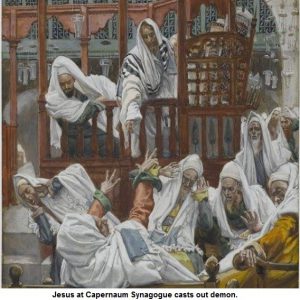
After reading the passage multiple times, we silently meditate (Meditatio) on the passage. Sometimes in my preparation, this period of reflection may even last a day or two. I want to hear it with “body (ears), mind (intellect), and spirit (in my heart-of-hearts).” During this process one might consider questions such as these: What word or words in this passage caught my attention? What in this passage comforted me? What in this passage challenged me? What in this passage inspired me? What would HE like others to know about this passage?

Once we have an idea about how and/or why the Scripture affects us, a period of quiet, contemplative meditation ensues. During this time we evaluate how this Scripture related to our day-to-day experiences. What is there in our lives that resonates with this passage? As a brief example, look at the Key Verse from Deuteronomy. Moses is speaking to the assembly of Israel, so what does he mean saying “God will raise up for you a Prophet like me?” When, who, where, how, do I know this Prophet? In what way is the Prophet like Moses? In this segment of preparation, we take time to consider how our own thoughts, words, and deeds are reflected in or affected by that passage. For me, this is usually where the Big Surprises start. I often feel an “Oh, really?” or “Holy Moses!” moment – some call it a light-bulb moment or a flash-of-lightning experience. That’s when it’s time to say “Thank you Lord!”

The final process in Lection Divina is Oratio – Prayer. After another review of the passage – for me it’s often read out loud – then there is prayer. I thank the Holy Spirit for sending me what I need to have for what he wants to write. I ask him to guide my thinking, my hands, and especially my heart. Sometimes using something like Psalm 143 (← Check it out!) is beneficial. That is a very brief introduction to Lection Divina. (↔ Click Link) I urge you to browse the Internet to find out more. (May I also suggest you use DuckDuckGo? Try it. You’ll like it!) Now, I mentioned I had already said something about today’s Key Verses, so here’s what I meant. I’m not going to copy-paste everything from 1804AFC012618, but there are some sections I think bear repeating. Let’s start with the whole idea of Prophet (see 1804 for some homophone puns about Prophet and profit). What is a Prophet?

Originally posted under Aloha Friday Messages at https://aloha-friday.org – The Moon Beam Network – updated for this post.

One common notion is that a prophet is someone who predicts the future, a “see-er,” seer as in someone who is clairvoyant, can divine the future through supernatural powers. In this connotation, a person is often already considered a false prophet, a hoaxer, and one whose pronouncements are self-promoting. This is not the biblical meaning of prophet. There are words in the Bible that are translated as “seer,” and the persons associated with that word (usually the Hebrew cho-zeh {kho-zeh’} as in 2 Samuel 24:11 or ra’ah/ro’eh {raw-aw’/ro-eh’}) are recognized as persons through whom God sends messages. We see this in 1 Samuel 9:9 (Formerly in Israel, anyone who went to inquire of God would say, “Come, let us go to the seer”; for the one who is now called a prophet was formerly called a seer.)

The Old Testament word for prophet is nabiy’  {nah-bee’}. There are some disagreements among scholars about the origin of that word, but one that is well-accepted is that this noun comes from the verb noba’ meaning to “bubble up,” “boil over”,” as in “to pour forth an abundance of words,” such as those who speak within divine inspiration. It is by and through the power and inspiration of God that a prophet speaks, and a prophet can’t help but speak when and what God commands any more than a boiling pot can stop bubbling. And that is the key. Those who have Divine Inspiration are True Prophets. The converse is that those whose “inspiration” is self-generated are the False Prophets. How then can we tell the difference? If we look at the verses following Jesus description of wolves in sheep’s clothing, the answer is clear. (See Matthew 7:15-19)

In today’s key verse, we have a prophecy about a future prophet who will be a perfect prophet in word and deed. He will speak what God tells him to speak. Jesus is that prophet. In Sunday’s Gospel we will hear in Mark 1:22 22 They were astounded at his teaching, for he taught them as one having authority, and not as the scribes. In John 5:19 and John 7:16, Jesus confirms that he is a prophet when he says that the words he speaks are not his own, but come from his Father, the one who sent him. This is the primary test of a true prophet – that what s/he says is consistent with what God says. A second test is whether or not the prophecy comes true. This is what makes us suppose that “prophecy” is “predictive.” Jesus consistently speaks and does what God commands. Those who listen and believe receive the reward of eternal life. Those who refuse to believe are judged by the Word, i.e., the words Jesus spoke on behalf of his Father:

     John 12:44-49 44 Then Jesus cried aloud: “Whoever believes in me believes not in me but in him who sent me. 45 And whoever sees me sees him who sent me. 46 I have come as light into the world, so that everyone who believes in me should not remain in the darkness. 47 I do not judge anyone who hears my words and does not keep them, for I came not to judge the world, but to save the world. 48 The one who rejects me and does not receive my word has a judge; on the last day the word that I have spoken will serve as judge, 49 for I have not spoken on my own, but the Father who sent me has himself given me a commandment about what to say and what to speak. 50 And I know that his commandment is eternal life. What I speak, therefore, I speak just as the Father has told me.”

In just a few verses surrounding today’s Key Verse, we have a snapshot of Jesus’ teaching on a Sabbath in the vicinity of the synagogue of Capernaum (Mark 1:21-31) combines teaching and miracles of exorcism and healing. Mention is not made of the content of the teaching but of the effect of astonishment and alarm on the people. Jesus’ teaching with authority, making an absolute claim on the hearer, was in the best tradition of the ancient prophets, not of the scribes. The narrative continues with events that evening (Mark 1:32-34; see the notes on Matthew 8:14-17) and the next day (Mark 1:35-39). The cleansing in Mark 1:40-45 stands as an isolated story. [Notes, New American Bible (Revised Edition) (NABRE)] Capernaum Καφαρναούμ (Kapernaoum) {cap-er-nah-oom’} was the place where Jesus set up a residence. The name means “village of comfort.” It was a large and busy city in the region of Galilee situated on the western shore of the Sea of Galilee (a.k.a. Lake of Gennesaret) near the place where the Jordan flows into the lake.

I urge you to revisit John 3:16-22 so that you can see how Jesus’ prophecy – speaking the Word and Will of God – fits in with his mission. Just for good measure, we should also carefully read (in context with Lectio Divina for practice) Matthew 10:32-33 and Matthew 10:40-42. We can get some idea of what happens to people who claim to be prophets, but who do not have the word, the will, or the permission of God to speak. Check out Jeremiah 14:14-19, Matthew 7:15-19, and of course all of Matthew 24. Anybody can take a guess at what the future will bring, but only a Prophet can tell us God’s will. Many claim to have that ability to prophesy, but test everything as we are told in 1 Thessalonians 5:20-21 20 Do not despise the words of prophets, 21 but test everything; hold fast to what is good. What do we use as a test? Please, go up a couple of lines and click on Matthew 7:15-19. The answer is in verse 16a – 16 You will know them by their fruits. If any prophesy is inconsistent with what God himself says or directs, then it is FALSE. When a speech begins with “The Word of the Lord came to me,” or “Thus says the Lord God,” we had better pay attention!

Belovéd, do not cling to what is false, but only to what is true, and remember that everything Jesus said or did conforms to the definition of a True Prophet because he was Divinely Inspired. Those who have Divine Inspiration are True Prophets. By their fruits you will know them through the deeds that they do in Love. Deeds performed as acts of sacrifice are validations of the words of Love. Jesus’ message is the prophetic Word – spoken on behalf of God and powered by his inspiration – that becomes redemptive by his perfect sacrifice. Jesus’ loving promises are spoken in love, and the deed – the action of, the doing of – speaking those words of promise is the Love of God through Christ Jesus. There is no truer deed, no truer prophet, no truer prophecy that to prophesy as Jesus did: John 15:13 13 No one has greater love than this, to lay down one’s life for one’s friends. This prophecy is Love given in deed and not merely in word. 1 John 3:18 18 My little children, let us not love in word, neither in tongue; but in deed and in truth. Authorized (King James) Version (AKJV) And, Belovéd, we know that Jesus’ word is True because we know He Lives! (↔ Music Link) O that today you would listen to his voice! [For] you shall heed such a Prophet; the people who sat in darkness have seen a great light, and for those who sat in the region and shadow of death light has dawned.” Even on the Fourth Sunday of Ordinary time, a Christmas Carol and an Easter song can tell us what God wants to say to us. He loves us!!!

Whatever, whenever, wherever, whoever, however, if ever, forever —

at your service, Belovéd!

Please pray with us here at Share-a-Prayer.

Unless otherwise indicated, all scripture passages are from the New Revised Standard Version Catholic Edition (NRSVCE) New Revised Standard Version Bible: Catholic Edition, copyright © 1989, 1993 the Division of Christian Education of the National Council of the Churches of Christ in the United States of America. Used by permission. All rights reserved.

Biblical languages inserts from Bible Hub (Bible Hub: Search, Read, Study the Bible in Many Languages) Visit at http://biblehub.com

Creative Commons License
Aloha Friday Messages by Charles O. Todd, III is licensed under a Creative Commons Attribution-ShareAlike 3.0 Unported License


Pages Email Newsletter Categories Archives Connect
  • Connct to us here