Aloha Friday Message – November 23, 2018 – Giving thanks for Black Friday

1847AFC112318 – Giving thanks for Black Friday

Read it online here, please. And please, when you visit there, use one of the social media links at the bottom of the page to share this post. Thank you! And remember, we now have a READER VIEW available, so share this link or this email often.

   John 18:37 37 Pilate asked him, “So you are a king?*” Jesus answered, “You say that I am a king. For this I was born, and for this I came into the world, to testify to the truth. Everyone who belongs to the truth listens to my voice.”
*King in Greek βασιλεύς (basileus) {bas-il-yooce’} – leader of the people, prince, commander, lord of the land, king, in certain contexts Emperor.

Aloha nui loa, ʻŌmea! You may wonder, “What in the World has happened to that geezer?! Thankful for Black Friday, the day we celebrate Avarice and Lust? No way, Old Man!”

But wait! There’s more! Does that sound familiar? We’ll be hearing that phrase thousands of times over the next month as the $19.95 Super Deals are endlessly advertised on TV. However, that’s not the “more” I’m thinking of. There is more to this weekend that recovering from yesterday’s Holiday meal, more to remember than Pilgrims and turkey and football and stampeding shoppers. Look at our Key Verse for today. Does it remind you of anything, another holiday perhaps? Hopefully you recognize that it is part of the Easter Triduum (not Tridium). It is from the Good Friday readings of Christ’s Passion and Death on the Cross. It’s used other times throughout the year as well, and this weekend is one of those times because we are in Cycle B of the Liturgical Calendar. During Cycle A, we read from Matthew 25:31-46, The Judgment of the Nations. During Cycle C, we read from Luke 23:35-43, which gives us the account of Jesus being mocked on the cross and the actions of the repentant criminal.
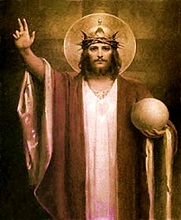
   This weekend is the end of the Liturgical Year, The Solemnity of Our Lord Jesus Christ, King of the Universe, or more simply The Feast of Christ the King.

Did you know that the Friday of the Triduum – which is called Good Friday in many countries – is also called Black Friday? Good Friday is the middle of the Triduum, the ending of Lent (also a word used only in Western Christianity). The Triduum is a single, albeit long, celebration which starts with the evening service commemorating the Last Supper of Holy Thursday and continues to the evening of Easter Sunday. Though chronologically three days, they are liturgically one day unfolding for us the unity of Christ’s Paschal Mystery.

“Good Friday” has other names in other Rites, languages, and Denominations around the world. Why and how did we get that name? There are no clear explanations for it, and it seems that is only the name in English-speaking countries. In the Eastern Rite churches it is called Great and Holy Friday. In German it is called Karfreitag, Suffering Friday or Sorrowful Friday. In some places it is called Easter Friday. In French it is Le Vendredi Saint – Holy Friday. In Spanish is Viernes Santo – also Holy Friday. According to some catechisms, the term Good Friday is a reflection of Christ’s victory over death through his Passion, Death, and Resurrection. Christ, by His Death, “showed His great love for man, and purchased for him every blessing.” Good, in this sense, means “holy.” But Black Friday has another, more-Worldly meaning, too.

In the United States, Black Friday is historically associated with the massive economic crisis which began on Friday September 24, 1869 (follow the link for historical insights). It was the collapse of the US Gold Market perpetrated by Jay Gould and James Fisk, Jr. At that time, gold was periodically released from government coffers and sold to help stabilize the post-war economy during the recovery after the Civil War. These rascals bought up as much gold as they could by using “insider information.” When the scheme became known, the President, Ulysses Grant, called for the release of four-million dollars in gold. The price plummeted, there was an economic panic because the Gold Exchange Bank could not cover the huge losses. Stock prices fell 20% over several days – which caused many brokerage firms to bankrupt – and commodities across the board took gigantic losses which affected farming for years and years afterwards. There was another Black Friday during the 1929 Stock Market Crash between October 24-29, 1929 which is historically viewed as a forewarning of the 12-year-long Great Depression.

These days, “Black Friday” is also associated with economic episodes. In the sixties retailers started to refer to the Friday after Thanksgiving as Black Friday because they could count on the Holiday Season sales to take them “out of the red” – an accounting ledger-keeping term meaning operating at a loss – and “into the black” which is an accounting ledger-keeping term meaning operating at a profit. To capitalize on that, merchants began using deeply discounted sales to attract more customers. It didn’t take long for Black Friday to sprout monster-feet and take off! Now “Black Friday Specials” can start a week or even a month ahead of the fourth Friday in November and last for days or weeks! That’s where we see the dehumanizing effects of avarice and lust (See the Lenten Series from 2016 for more information.) That is a very, very worldly example of a Black Friday, and something for which I personally cannot be deeply thankful. I’m glad that businesses can sometimes pull out of a financial red-hole and get “back in the black,” but the sight of frenzied shoppers trampling each other so they can spend their money in a vain attempt to “show their love” for friends and family literally makes me ill. The Black Friday in the Triduum can also sometimes make me ill, but for a very different reason.

When I reflect on the Passion and Crucifixion, I cannot escape the horror, the deep sorrow, the pervasive guilt, and the revulsion over what Christ suffered because of me. I have a part in that suffering, and even in the exultations of the greatest joys in life – the birth of a child, the marriage of a couple, the salvation of a soul, the celebration of Jesus’ birth, the magnificence of Jesus’ Resurrection, and so many other joyous occasions – I cannot completely rejoice because the blackness of Black Friday is blackened by me. When I am dealing with a day of pain or heartache or anxiety, my heart will flash upon the image of Christ crucified, and my grumbling and mewling must be silenced; what my body suffers is minuscule by comparison.

Jesus had all the body parts any man has, plus all the feelings, all the susceptibilities, and all the good things in every human life. He just didn’t have sin. But: For you, for me, for us he became sin and died to take all our sins away. And that, perhaps, is what is the most important and most striking about the ways we can identify with him. I did the sin. He did the reparation. Do you remember the song “When He was On the Cross, I Was On His Mind” (↔ Music Link) which was popular around 2007 and earlier? That is another thing we have in common with Jesus. He knows our sins because he paid for every single one of them. He paid-in-full once for all because he loved us that well, well enough for him to lose everything so we could gain everything through his loss. I am grateful for that immeasurable benefit to my life, and – despite the doubts and fears I feel in this present darkness (See Ephesians 6:12) – the realization that he has conquered my death and expiated my sins extinguishes everything negative.

Whenever that happens, the sentiment that follows is Thanksgiving, the brilliantly illuminating understanding that It is Well With My Soul (↔ Music Link) flows into heart, mind, and spirit. How about you, Belovéd? On this Worldly Black Friday, can you take a moment to reflect on the Triduum’s Black Friday and know that this day is only a passing Worldly thing that matters not one whit in comparison to the bliss of “this glorious thought” that we find in Acts 17:28 28 For ‘In him we live and move and have our being’; as even some of your own poets have said, ‘For we too are his offspring.’? For me, though it pains me to see it, I will heed the words (and the caveat) in Jeremiah 6:16 16 Thus says the Lord: Stand at the crossroads, and look, and ask for the ancient paths, where the good way lies; and walk in it, and find rest for your souls.
But they said, “We will not walk in it.”
The caveat is that fewer and fewer souls look for the good way and more and more souls foolishly refuse to walk in it. Remember, Jesus gave us his Peace, and it’s pretty easy to get along in life knowing that. (See Matthew 11:2929 Take my yoke upon you, and learn from me; for I am gentle and humble in heart, and you will find rest for your souls – just as Jeremiah prophesied.) And while we’re sharing that attitude of gratitude, I also want to thank those of you who read this little missives (especially the “not-so-little” ones!) for tuning in whenever you can. That’s another source of Thanksgiving in which we can all rejoice.

Whatever, whenever, wherever, whoever, however, if ever, forever — at your service, Belovéd! (See you at the Triduum!)

Please pray with us here at Share-a-Prayer.

Unless otherwise indicated, all scripture passages are from the New Revised Standard Version Catholic Edition (NRSVCE) New Revised Standard Version Bible: Catholic Edition, copyright © 1989, 1993 the Division of Christian Education of the National Council of the Churches of Christ in the United States of America. Used by permission. All rights reserved.

Biblical languages inserts from Bible Hub (Bible Hub: Search, Read, Study the Bible in Many Languages) Visit at http://biblehub.com

Creative Commons License
Aloha Friday Messages by Charles O. Todd, III is licensed under a Creative Commons Attribution-ShareAlike 3.0 Unported License


Aloha Friday Message – November 16, 2018 – Let’s end this!

1846AFC111618 – Let’s end this!

Read it online here, please. And please, when you visit there, use one of the social media links at the bottom of the page to share this post. Thank you! And remember, we now have a READER VIEW available, so share this link or this email often.

   Daniel 12:2-3 Many of those who sleep in the dust of the earth shall awake, some to everlasting life, and some to shame and everlasting contempt. Those who are wise shall shine like the brightness of the sky, and those who lead many to righteousness, like the stars forever and ever.

Aloha nui loa, ʻŌmea! Do you recognize this key verse? It’s been used twice recently. This week we use it because it is from the Old Testament reading for this Sunday as we continue to follow Jesus on his journey to the Cross and our readings touch on what is called eschatology. That is the “science of” (-ology) and the root word eskhatos. The Greek word used comes from έσχατος {es’-kha-tos} meaning “last.” It is the study of “last times” – the end of the ages, the end of the World, the end of it ALL. I wish I still had the “term paper” I wrote in high school on that topic. I remember it took a long time to type! I hope it included some biblical citations like the one above.

I’d like to live in a bright world like that described in Daniel, a world filled with the light of wisdom and righteousness, wouldn’t you? It seems that is not an option these days. There is so much darkness, so much blatant evil, and so much foolishness that there is no quiet or Peace to be had. We have wars, terrible diseases, wars, terrible famines, wars, violence on every side, and the Earth groans with the sicknesses caused by centuries of abuse. What kind of a World is this anyway?

It is a world predicted by Jesus and all the prophets before him – a world on its way to perdition. I’d like to look at two of the terribly terrible things we hear about in the news every day, and then I want to look at what we can do to end such agony. Bear with me as we go where the pain runs deep.

If there are 1.5 Billion Muslims in the world, let’s say for the purpose of illustration that 2% are militantly violent. Two-percent sounds like a smallish number – it means that 98% are not militantly violent. However, two-percent of 1.5 Billion is THIRTY MILLION. We know from verifiable quantitative evidence that significant losses can be perpetrated by small numbers of jihadists – 1 to a dozen perhaps – and even more can be done in groups of tens to hundreds. We can often stop one actor, or a dozen, or a score, or sometimes even several hundred; but, THIRTY MILLIONS of combatants spread quite literally across the world are clearly unstoppable. Something is going to happen somewhere sometime somehow that reeks of evil. From 2007 to 2016 one source shows that nearly 200,000 people were killed in terrorist attacks (not all of them by Muslim factions). That’s nearly 20,000 deaths per year, and that’s a moderately low estimate because not all deaths are reported.

Another example can be drawn by looking at Catholic Priests. It is estimated that there are currently just over 466,000 ordained persons with ministerial duties, according to one source that is, they are authorized to perform some or all of the Seven Sacraments of the Church. This includes Priests and Deacons. If we apply the same percentage of 2% to that number we come to just over 9,300. Many of the abuses we are hearing about now happened over the past 30-40 years. According to data from the Center for Applied Research in the Apostolate, from 1980 to 2010 the average number of priests was 408,547. Using the same 2% “cut,” that gives a projection of 8,171 who may be under suspicion. That’s an estimated 204 cases – not incidents but cases – of abuse per year. There is strong evidence that non-Catholic Christians have a similar rate of occurrences. If we add those estimates, that comes to nearly 400 cases of clerical abuse per year. As stated above, “Something is going to happen somewhere sometime somehow that reeks of evil.”

   There are so very many other examples of evil gripping at our lives, our planet, our past, present, and future. What can we do? Isn’t this the “End Time,” the Last Days before God finally says, “THAT’S ENOUGH!”?

As we say in our house, “God knows, but he’s not tellin’.” It’s good to remember that not even Jesus knows the answer to that one. You’ll recall what he said in Mark 13:32 32 “But about that day or hour no one knows, neither the angels in heaven, nor the Son, but only the Father.” There are over 150 past predictions that the world will come to an end, and a bunch more future predictions – like the end to the Messianic reign in 3239 (based on studies of the Talmud), or the coming of “Armageddon” in 2020, or The Rapture by 2021. So far, everyone in the past has been wrong; that doesn’t stop people – past or future – from trying to set that date in stone. We are reminded of Ecclesiastes 10:12-14 12 Words spoken by the wise bring them favor, but the lips of fools consume them. 13 The words of their mouths begin in foolishness, and their talk ends in wicked madness; 14 yet fools talk on and on. No one knows what is to happen, and who can tell anyone what the future holds? It’s also good (even wise) to remember Matthew 24:44 44 Therefore you also must be ready, for the Son of Man is coming at an unexpected hour. This, of course, must be preceded by the Gospel reaching all nations as in Matthew 24:14 14 And this good news [Gospel] of the kingdom will be proclaimed throughout the world, as a testimony to all the nations; and then the end will come. As every kid in the back of the car has said, “Are we there yet?” HOW DO WE STOP THIS MESS?!?! Well, let us ask, “What does God say?” You’ll remember seeing this before!

Micah 6:8:
He has told you, O mortal, what is good;
and what does the Lord require of you
but to do justice, and to love kindness,
and to walk humbly with your God?

That is how we end it. Not with a bang, not with a whimper, but with a closer walk (↔ Music Link) with our God. Some may say, “Oh, my! That seems too good to be true!” Really? You will call God a liar? All he really, really wants is for us to return to him. Do you remember this from Acts 3:19-21? 19 Repent therefore, and turn to God so that your sins may be wiped out, 20 so that times of refreshing may come from the presence of the Lord, and that he may send the Messiah appointed for you, that is, Jesus, 21 who must remain in heaven until the time of universal restoration that God announced long ago through his holy prophets.

Belovéd, seek him while he may be found, call him when he is near, go where he is going, and we’ll all get there together. How long will all of this take? In the two “main” apocalyptic books in the Bible – Daniel and Revelation [the Greek word for this is ἀποκάλυψις (apokalupsis) {ap-o-kal’-oop-sis} – a revelation, an unveiling or uncovering, revealing], we have a phrase: “A time, two times, and half a time.” In “Apocalyptic Literature,” this represents an indefinite, evil period of time. Some interpret it as 3½ years (42 months) – or 3.5 centuries, or one-half of seven (i.e., “perfect”) years, and therefore the antithesis of perfection; since seven is the Jewish “perfect” number, half of it signifies great imperfection. (See also Revelation 11:1-2 and Revelation 13:5) In addition to that there are complicated “formulas” that dissect the prophecies in these two books (and portions of the prophecies of Isaiah, Joel, and Zechariah) and come up with a time-table that spells everything out in days, weeks, and months. All well and good, but they still don’t know when it will start! Has it started already? Just when do – or did – the “End Times” get going?

We can turn to Jesus’ own descriptions of that time given to us in Luke 21:10-33. I urge you to select one of the translations shown there and read the whole thing. That will help you make sense of this statement which is based on Luke 21:24d: until the times of the Gentiles are fulfilled. We have seen this kind of “time measurement” before in the past. Look to Genesis 15:16But in the fourth generation [about 400 years according to many scholars] they shall come hither again: for the iniquity of the Amorites is not yet full. The Children of Abraham would not return to the Promised Land until the Amorites (the residents of Canaan) were ripe for punishment, when they had done as much evil without repentance as is possible. When will the Gentiles be ripe for punishment? It seems to me we must be getting close to that day of wrath and those times of tribulation. There certainly have been terrible times in the past, and I can’t say with certainty that today is more terrible than all the other days before it; BUT, things are certainly bad enough that we need to be walking in lock-step with Jesus. Let’s end this by converting every soul we see, by praying for those who refuse repentance and conversion, and by praying, “EVEN SO, COME LORD JESUS!”

Whatever, whenever, wherever, whoever, however, if ever, forever — at your service, Belovéd!

Unless otherwise indicated, all scripture passages are from the New Revised Standard Version Catholic Edition (NRSVCE) New Revised Standard Version Bible: Catholic Edition, copyright © 1989, 1993 the Division of Christian Education of the National Council of the Churches of Christ in the United States of America. Used by permission. All rights reserved.

Biblical languages inserts from Bible Hub (Bible Hub: Search, Read, Study the Bible in Many Languages) Visit at http://biblehub.com

Creative Commons License
Aloha Friday Messages by Charles O. Todd, III is licensed under a Creative Commons Attribution-ShareAlike 3.0 Unported License


Aloha Friday Message – November 9, 2018 – Once is Enough

1845AFC110918 – Once is Enough

Share-A-Prayer

Opening with a special prayer request for our close friend LN in his 80’s, married to B for about 5 years we think. Stroke 11/08/18, serious enough to be hospitalized. Please pray for rapid and accurate diagnosis, treatment, and efficacious recovery.

Read it online here, please. And please, when you visit there, use one of the social media links at the bottom of the page to share this post. Thank you! And remember, we now have a READER VIEW available, so share this link or this email often.

   Hebrews 9:26b But as it is, he has appeared once for all at the end of the age to remove sin by the sacrifice of himself. IMPORTANT: USE THIS LINK TO SEE THE PASSAGE IN CONTEXT.

Aloha nui loa, ʻŌmea! Thank you for joining us today. This will be a difficult essay for some of us because some of us will want to argue with it. That’s OK; however, that’s not the purpose. If you, the reader, are a Catholic, then we hope this will be something that will help you understand your faith a little better. If you, as a reader are not a Catholic – or perhaps not a Christian of any sort – you may find this more challenging, but I hope you will also learn a little more about Catholic teachings. The caveat here, of course, is that this old man is in no way a qualified theologian, and of course that means that what I will present here is my informal and private take on how things work. I apologize in advance for anything you find far-fetched or offensive. As I said, this is something for Catholics to ponder and for non-Catholics (including non-Christians) to sample open-mindedly. We can begin with a few things nearly everyone can agree upon:

  • A sack of flour makes a very big biscuit
  • You can’t make a silk purse from a sow’s ear
  • You can put lipstick on a pig, but it’s still a pig
  • Two things in life are certain: Death and taxes
  • Not even God can please all the people all the time
  • A tolled bell cannot be unrung
  • What we do says who we are. Actions speak louder than words.
  • We become what we repeatedly do.
  • Empty cans make the most noise
  • The leopard cannot change its spots
  • Never wrestle with a pig. You both get dirty and the pig likes it (getting dirty, not the wrestling. Pigs hate wrestling.)

Now, let’s jump right into the Word. Why have we selected this Key Verse? It was chosen because it refers to the completeness of Christ’s sacrifice on the cross. Did you use the link to read the context? If so, you saw that Christ’s Passion, Death, and Resurrection completed God’s plan for Salvation; he does not need “to suffer again and again since the foundation of the world.” Once was enough, and at the appointed time, once suffices for all time. By Grace we have the gift of Faith and through Grace we are saved. Here is where the potential for disputation arises. Many are convinced that there is ample evidence in Scripture that supports the principle “Once Saved, Saved Forever,” and that once we have claimed Jesus Christ as our Lord and Savior, we can never “undo” or “lose” our Salvation. Here are some additional thoughts about that position.

The Apostle Paul in Romans 1:5, and Romans 16:26 refers to “the obedience of faith” as an essential element of Christian life. In Matthew 7:21, Jesus warned his Disciples (and includes us, Belovéd) 21 “Not everyone who says to me, ‘Lord, Lord,’ will enter the kingdom of heaven, but only the one who does the will of my Father in heaven.”

Here’s one we’ve seen before: Romans 11:29 29 for the gifts and the calling of God are irrevocable. (Please use this link to see the passage in full context so that its meaning is clear.) Note that it says the “gifts and the calling of God.” Surely one of those gifts is the gift of Grace by which we are saved. That is certainly irrevocable; but is it universally irresistible? Back in the day when I was a “solid five-point Calvinist,” I would have said yes. I could have argued for the total depravity of human nature; unconditional election for whomsoever God set aside for his Glory before he created us; limited atonement which – although sufficient for the sins of all – would only be effective for the “sins of many” who are chosen by God in advance; irresistible grace that attracts only the elect who are called to Christ by the Father; and perseverance of the saints – once saved, forever and always saved. Once I realized that these “five points” meant that God intentionally created souls for eternal damnation, I just couldn’t stick with that any longer. Here are some of the Scriptures that led me to that change.

Matthew 10:32-33 32 “Everyone therefore who acknowledges me before others, I also will acknowledge before my Father in heaven; 33 but whoever denies me before others, I also will deny before my Father in heaven.”

Revelation 22:11-12 11 Let the evildoer still do evil, and the filthy still be filthy, and the righteous still do right, and the holy still be holy. 12 See, I am coming soon; my reward is with me, to repay according to everyone’s work.

Here’s one with a couple of aphorisms that could be added to that list we started with:

2 Peter 2:20-22 20 For if, after they have escaped the defilements of the world through the knowledge of our Lord and Savior Jesus Christ, they are again entangled in them and overpowered, the last state has become worse for them than the first. 21 For it would have been better for them never to have known the way of righteousness than, after knowing it, to turn back from the holy commandment that was passed on to them. 22 It has happened to them according to the true proverb, “The dog turns back to its own vomit,” (See Proverbs 26:11) and, “The sow is washed only to wallow in the mud.”

1 Corinthians 10:12-13 12 So if you think you are standing, watch out that you do not fall. 13 No testing has overtaken you that is not common to everyone. God is faithful, and he will not let you be tested beyond your strength, but with the testing he will also provide the way out so that you may be able to endure it.

Sometimes that “testing” might include getting shed of malevolent spirits. Jesus pointed out that sometimes that can herald a worse disaster: Matthew 12:45 45 Then it goes and brings along seven other spirits more evil than itself, and they enter and live there; and the last state of that person is worse than the first. So will it be also with this evil generation.

The Gift of Grace means that there is nothing we can do to earn our salvation, yet, the Apostle Paul tells us to work out your own salvation with fear and trembling; 13 for it is God who is at work in you, enabling you both to will and to work for his good pleasure. (See Philippians 2:12-13) We have said repeatedly here that Grace is a Gift. When we accept the Gift, the Grace leads us toward Christ and Salvation. When we reject the Gift, we do not receive Grace and therefore we CANNOT be led toward Christ and Salvation. That is some scary stuff right there! It reminds me of something attributed to the famous (or infamous) evangelist Billy Sunday: “Going to church doesn’t make you a Christian any more than going to a garage makes you an automobile.” He also said, “Hell is the highest reward that the devil can offer you for being a servant of his.” Rev. Sunday was a Christian Fundamentalist; nevertheless, he gave hundreds of thousands the opportunity to “walk the sawdust trail” and come forward during the Altar Call to choose Christ over sin.

He often railed against “backsliders,” (See Jeremiah 2:19) knowing that all of us can “get religion” and then “get empty” quicker than a snap: I’m against a lot of amusements popular among church members, as you people are going to find out before I am through in Boston. I don’t give that (snapping his fingers) whether you like my preaching or not. Understand? It’s a question of whether you are interested in decency. If you live wrong you can’t die right. Emerson said: “What you are speaks so loudly that I cannot hear what you say. That’s how I think of it, too, as does The Church: If you live wrong you can’t die right. Now, that’s probably oversimplifying the Catholic point of view; but, upon reflection over the Church’s teaching, I can see how a couple of scenarios could end up placing a soul in peril of Hell.

First, there’s the lipsticked pig, the washed sow, and the dog who returns to its vomit – their essential nature is not changed. Whatever you do to it or with it, the changes made are entirely external. There is no conversion, no true repentance, no reconciliation, and no change. Is it possible that at some future point known only to God that those soul-sanctifying changes can be made – even if the subject continuously rejects them past the point of death? That’s for God to know and us to guess. (This is where someone who wants to write a book instead of an essay would insert the idea of Purgatory. I’ll stick with the essay!)

Next there are those who embrace the idea of Christianity, but cannot handle the lifestyle. It is similar to “We become what we repeatedly do.” In the Parable of the Sower, this is the seed that falls on rocky ground. There’s nothing that holds these souls strongly enough that they can persevere and ultimately prevail over their lack of roots. In even worse straits are those who deeply embrace the Grace and Love of God and fill their lives with service, worship, and love to God and neighbor – until worldly concerns or their own weaknesses make their lives burst into flames as hot as Hell itself. Can we reject the Gift of Salvation? Of course we can – unless, that is, God has created some or many of us expressly for the purpose of hating us. (See Wisdom 11:23-25 which refutes this.) That just doesn’t ring true. God is Love.

When the Day of Reward – Judgment Day – finally comes, will everyone, every soul, be taken into Heaven? Remember this from two weeks ago? Daniel 12:2 Many of those who sleep in the dust of the earth shall awake, some to everlasting life, and some to shame and everlasting contempt. What is it, then, that makes the difference? In our house we say, “God knows, but he’s not telling.” Except that God is telling us that we can use our free will to reject the Grace that results in Salvation. If we ever once accept that Grace and that Salvation, can we truly never be deprived of it? I have come to believe that we can, sadly, never know for sure until we hear it in The Next Life. Nonetheless, it seems plausible that if I am given a gift and then never use it, or choose to abuse it, or even to cast it away, then the gift is no longer mine to claim. Will the giver of all good gifts return it to me at the end of time, or will I will “go away into eternal punishment” (See Matthew 25:31–46)? If I am like the unforgiving servant in Matthew 18:23-35, can I blow my chances for eternal life? Here area few more passages for us to reflect upon. These pretty well sum up what I think.

John 10:27-30 27 My sheep hear my voice. I know them, and they follow me. 28 I give them eternal life, and they will never perish. No one will snatch them out of my hand. 29 What my Father has given me is greater than all else, and no one can snatch it out of the Father’s hand. 30 The Father and I are one.

John 15:6 Whoever does not abide in me is thrown away like a branch and withers; such branches are gathered, thrown into the fire, and burned.

2 Peter 2:4God did not spare the angels when they sinned, but cast them into hell* and committed them to chains of deepest darkness to be kept until the judgment
*ταρταρόω (tartaroó) {tar-tar-o’-o} Use of this word by the Apostle Peter is similar to Christ’s use of the word Gehenna. It represents eternal punishment for the worst of the worst – the wickedest of demons and people.

Romans 11:22 22 Note then the kindness and the severity of God: severity toward those who have fallen, but God’s kindness toward you, provided you continue in his kindness; otherwise you also will be cut off.

Matthew 26:28 28 for this is my blood of the [new] covenant, which is poured out for many for the forgiveness of sins. (For many but not for ALL)

John 3:17 17 Indeed, God did not send the Son into the world to condemn the world, but in order that the world might be saved through him. (World, but not whole world)

Once is enough when it comes to Christ’s death for the remission of sins. Once may not be enough when it comes to keeping us in a life of righteousness.

Unless otherwise indicated, all scripture passages are from the New Revised Standard Version Catholic Edition (NRSVCE) New Revised Standard Version Bible: Catholic Edition, copyright © 1989, 1993 the Division of Christian Education of the National Council of the Churches of Christ in the United States of America. Used by permission. All rights reserved.

Biblical languages inserts from Bible Hub (Bible Hub: Search, Read, Study the Bible in Many Languages) Visit at http://biblehub.com

Creative Commons License
Aloha Friday Messages by Charles O. Todd, III is licensed under a Creative Commons Attribution-ShareAlike 3.0 Unported License

There’s a long train coming. God may not throw us off the train, but that doesn’t stop us from deciding to jump off before we get to the depot.


Aloha Friday Message – November 2, 2018 – Me First

1844AFC110218 – Me First

Read it online here, please. And please, when you visit there, use one of the social media links at the bottom of the page to share this post. Thank you! And remember, we now have a READER VIEW available, so share this link or this email often.

   Mark 12:28-3128 One of the scribes came near and heard them disputing with one another, and seeing that he answered them well, he asked him, “Which commandment is the first of all?” 29 Jesus answered, “The first is, ‘Hear, O Israel: the Lord our God, the Lord is one; 30 you shall love the Lord your God with all your heart, and with all your soul, and with all your mind, and with all your strength.’ 31 The second is this, ‘You shall love your neighbor as yourself.’ There is no other commandment greater than these.”

   John 14:23 23 Jesus answered him, “Those who love me will keep my word, and my Father will love them, and we will come to them and make our home with them.”

Aloha nui loa, ʻŌmea! The LORD has done great things for us! We are filled with Joy! (See Psalm 126:3) Can you think of the greatest thing God has done for us? Well, certainly, it must be gifting us Salvation. Wait, maybe that should be creation – he created us; but then he had to implement his plan for Salvation. How about forgiveness? Is that his greatest gift to us? How should we decide which is the Greatest Gift? Jesus? Life? Eternal Life? Love?

Ahhhhh, LOVE! Creation, Salvation, Forgiveness, Jesus, Life, Eternal Life – all of these are manifestations of God’s Love. No one else can Love us the way God loves us, and he loved us before we even knew him (See 1 John 4:19). He created us in Love, for Love, to be Loved by him. There’s certainly no entity anywhere that is anything like God. Only God is God, and there’s just one thing he wants from us: Love.

If we give God the Love we have for him we will also give him everything else he wants from us – respect, obedience, community, friendship, worship and adoration – all the things we think we cannot do because we are sinful humans we can do if we just LOVE HIM. As simple as that sounds, for many of us the how of Love remains elusive. How can we love God as he fully deserves given that we are incapable of anything near that level of perfection?

Perhaps if we look to the ways we sustain our love for each other, we can find some ideas about how we can sustain our love for God. When we love someone, we want to be with them, to share our lives with them, to listen to them and share our thoughts with them, to be attentive to their needs, and – as much as possible – to do whatever pleases them. We have a special regard for their needs, and in many instances, try to place their needs and even wants above our own. We think about our loved ones when we are separated; we miss them. We share their joys and sorrows, their victories and defeats, ups and downs, good days and bad days; we think of loved-ones as “us,” more than we think of them as “other.” We are always aware they are part of our lives because of the love we share for each other. We sometimes even look for ways to be like them. It is the same with loving God. He is an acknowledged part of Every Moment of Every Day. (↔ Music Link)

Sometimes we act as if the capability to Love God is a total mystery. However, it’s not as if he never told us, or gave us any examples, of how to love him. Where can we look for clear instruction about how to love him? Yes, of course, you already know that answer! We have The Word of God – The Bible – to teach us what we need to know. We can begin with the commandment Jesus mentioned in verses 29-30 of our Key Verse: “The first is, ‘Hear, O Israel: the Lord our God, the Lord is one; 30 you shall love the Lord your God with all your heart, and with all your soul, and with all your mind, and with all your strength.’ This is also known as the Shema Prayer. It is the foundation of every Judeo-Christian doctrine and creed. There is ONE God, who alone is God and there is none other bedsides him. He, The One, is ONE – the only primary integral Entity as he himself declares in Isaiah 43:15 15 I am the Lord, your Holy One, the Creator of Israel, your King. Let’s look at the Shema and see how it’s put together:

(This image is also a clickable link.)

This declaration conveyed to us by Moses is so powerful! The connotation is “hear, listen to this, and obey.” In this “hearing” one achieves consent, agreement, understanding because what is heard is so undeniably clear it goes straight to our hearts. We know we have heard Truth speak. And when Truth speaks, there is life. Do you remember what Jesus said about truth? John 8:32 And ye shall know the truth, and the truth shall make you free. And Truth? John 14:6b “I am the way, and the truth, and the life. No one comes to the Father except through me.” That is the Life that comes from the listening. It is life that renews us in holiness.

God is HOLY, and what (or who) he consecrates – sets apart and makes unique – is holy. If we wish to Love God, we first need to know God and since God is HOLY and ONE that means we need to be when and where he is. That’s pretty easy! God is everywhere all the time; all we have to do is look!

1 Chronicles 28:9c If you seek him, he will be found by you

Isaiah 55:6 Seek the Lord while he may be found, call upon him while he is near

Joshua 1:8a This book of the law shall not depart out of your mouth; you shall meditate on it day and night

Psalm 119:97 97 Oh, how I love your law! It is my meditation all day long.

Psalm 119:11 11 I treasure your word in my heart, so that I may not sin against you.

1 Peter 1:13-16 13 Therefore prepare your minds for action; discipline yourselves; set all your hope on the grace that Jesus Christ will bring you when he is revealed. 14 Like obedient children, do not be conformed to the desires that you formerly had in ignorance. 15 Instead, as he who called you is holy, be holy yourselves in all your conduct; 16 for it is written, “You shall be holy, for I am holy.”

Leviticus 11:44a 44 For I am the Lord your God; sanctify yourselves therefore, and be holy, for I am holy.

Belovéd, it is not as if God has made himself unavailable to us! He has called us and we are his. (See Isaiah 43:1c) Nor can we claim that we don’t know what he expects; he gave us the entirety of Scripture to help us figure that out. Given the volume of all that information, how do we go about sorting out what’s most important. Again, looking at Scripture, we can take our cue from our Key Verse. What did Jesus say was most important? First, we must love God; second, we must love one another. Is there any evidence that loving one another is efficacious?

Leviticus 19:18b … you shall love your neighbor as yourself

Romans 13:8b … the one who loves another has fulfilled the law. (Which is the above commandment in Leviticus.)

1 John 3:11 11 For this is the message you have heard from the beginning, that we should love one another.

1 Corinthians 16:14 14 Let all that you do be done in love.

1 John 4:7-8 Beloved, let us love one another, because love is from God; everyone who loves is born of God and knows God. Whoever does not love does not know God, for God is love.

1 John 4:16 16 So we have known and believe the love that God has for us. God is love, and those who abide in love abide in God, and God abides in them.

2 John 1:6 And this is love, that we walk according to his commandments; this is the commandment just as you have heard it from the beginning—you must walk in it.

That pretty much brings us full circle. There is ONE God who is the HOLY ONE. No one and nothing in our lives can ever, or should ever, supersede God. He alone is God and he alone is worthy of all our love. Christ Jesus commands us to love one another (See John 13:34 and John 15:12) “Love one another as I have loved you.”  When he says “as I have” it means just as or in the same way as – in Greek καθὼς [kathos] (kath-oce) – in exactly the same manner, to precisely the same degree, to the complete extent, and in a way that is identical to. We could go back to the identity expression we have used in the past when we said

LIGHT ≡ GOD ≡ LOVE ≡ TRUTH ≡ WAY ≡ LIFE ≡ FOREVER

We can therefore say

YOUR LOVE FOR EACH OTHER ≡ MY LOVE FOR YOU

This mystery is the Stewardship of Love. Everything we have – including Love – comes from God. We give back to God that which he has given to us. I recommend to you 1443AFC102414 – All You Need is LOVE. You will find some tables there summarizing the Two Great Commandments. If we love our parents, or our siblings, or our friends, or our spouses, or our neighbors, or any other person, then we know how to love God. We love God first before all else; as he said, ME FIRST. It works like this:

  1. God loves us, so
  2. We love God first, so then
  3. We love each other second, and
  4. Repeat step 1 – 3.

Then God – Father, Son, and Holy Spirit – will come to us to make their home with us. You see, God loves us so much he still wants to be with us all the time! That is why he has prepared eternity for us – to be together.

Whatever, whenever, wherever, whoever, however, if ever, forever — at your service, Belovéd!

Unless otherwise indicated, all scripture passages are from the New Revised Standard Version Catholic Edition (NRSVCE) New Revised Standard Version Bible: Catholic Edition, copyright © 1989, 1993 the Division of Christian Education of the National Council of the Churches of Christ in the United States of America. Used by permission. All rights reserved.

Biblical languages inserts from Bible Hub (Bible Hub: Search, Read, Study the Bible in Many Languages) Visit at http://biblehub.com

Creative Commons License
Aloha Friday Messages by Charles O. Todd, III is licensed under a Creative Commons Attribution-ShareAlike 3.0 Unported License


Aloha Friday Message – October 26, 2018 – Trust the Dust

1843AFC102618 – Trust the Dust

Read it online here, please. And please, when you visit there, use one of the social media links at the bottom of the page to share this post. Thank you! And remember, we now have a READER VIEW available, so share this link or this email often.

¡Que la bendición esté siempre con ustedes y que Dios los bendiga, Amados! (May blessing always be with you and may God bless you, Belovéd!)

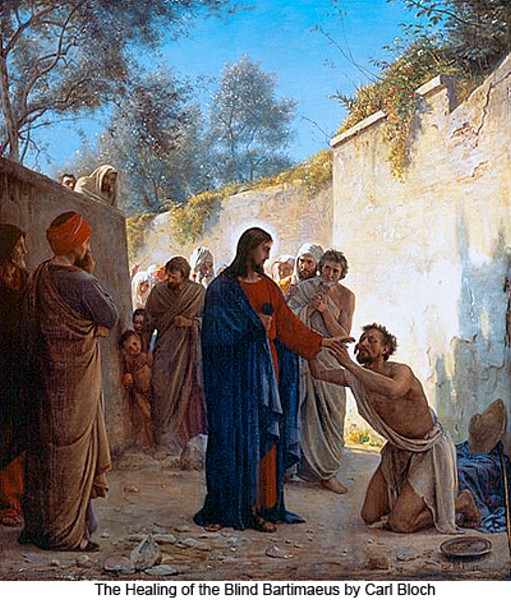
This coming Sunday, the Gospel message in most churches that have an established liturgical cycle will be from Mark 10 – the story of “Blind Bartimaeus.” This is one of my favorite passages, and it’s really tempting to get into it again. You may recall that Bartimaeus did something that was highly symbolic when Jesus called to him. You’ll find it in

Mark 10:50 50 So throwing off his cloak, he sprang up and came to Jesus. There are three actions here: [1] He threw off his cloak, [2] he sprang up and [3] he came to Jesus. You can find out more about that story here and why his actions were so carefully recorded. Persons who were blind were important elements in Jesus’ ministry. You’ll recall that the Messianic prophecies always contained a statement that the Messiah would make the blind see. (See, for example, Job 29:15, Isaiah 42:7, Isaiah 29:18, and Psalm 146:8.) For a list of Jesus’ encounters with blind men, follow this link.  (This makes a good reference for studying “blindness” in the Gospels.) Among those illustrations, the one in the 9th chapter of the Gospel of John is particularly interesting (See the full account in John 9):

John 9:6 When he had said this, he spat on the ground and made mud with the saliva and spread the mud on the man’s eyes …

Belovéd, you may have noticed that there is not a Key Verse in this message yet; you may also notice that the title, Trust the Dust, is rather obscure. That is because I want to pick out several little gems from Sunday’s readings – and other locations – and analyze them. Therefore, instead of a Key Verse we will have Bible Gems. Here is the first one:

Genesis 2:7 then the Lord God formed man from the dust of the ground, and breathed into his nostrils the breath of life; and the man became a living being. The Hebrew word used for breath in this verse is נְשָׁמָה (neshamah) {nesh-aw-maw’} and it signifies Wind, a vital breath, or  divine inspiration, “breath of life.” A few pages farther into the book we have this:

   Genesis 3:14 14 The Lord God said to the serpent, “Because you have done this, cursed are you among all animals and among all wild creatures; upon your belly you shall go, and dust you shall eat all the days of your life. When we hear “bite the dust,” or think about eating dust, we think of a creature that is repugnant, dishonorable, despicable, mean-spirited, loathsome, and forlorn. Adam and Eve received the permission and possibility of repentance and redemption, but the Serpent is in no wise offered these gifts, for in his fallen nature he has disdained all mercy. If man is dust, does this mean the Serpent consumes man? That is a question for keener minds than mine, but I admit that – just as the serpent consumes dirt as the sauce in its meat – perhaps as Satan strikes at the spiritual identity of humanity he also consumes some of the “flesh” of those he attacks.

   Genesis 3:19 19 By the sweat of your face you shall eat bread until you return to the ground, for out of it you were taken; you are dust, and to dust you shall return. ” Ashes to ashes, dust to dust – this phrase originates in this curse in Genesis. We come from dust and we return to dust (no matter how else we decided preserve our corpses). In Job 30:19, Job says 19 He has cast me into the mire, and I have become like dust and ashes. Dust and ashes are amorphic and have no continuity; if the wind blows or water covers them they are scattered and impossible to reassemble. Mire is like boggy, sticky-icky mud sometimes including dung. Nonetheless, dust and ashes are mixtures and not compounds – they can be mechanically separated. Dust is always dust, ash is always ash, and only chemical action or extreme physical disruption can alter that. While we are alive, the “dust” that makes us can be separated and identified in the compounds that keep us alive, but once the breath of life is gone from us, we revert to just a pile of elemental chemicals and a puddle of water.

   Isaiah 65:25 25 The wolf and the lamb shall feed together, the lion shall eat straw like the ox; but the serpent—its food shall be dust! They shall not hurt or destroy on all my holy mountain, says the Lord. Here again we see that the serpent is relegated to remaining the lowest of the low. On God’s Holy Mountain, not even the most wicked can bring harm to God’s creatures as they dwell in Peace together. This promise is similar in many ways to the Old Testament reading for this Sunday which comes from Jeremiah 31:7-9. In this passage, the LORD promises to bring his people back  from the land of the north, and gather them from the farthest parts of the earth, among them the blind and the lame, those with child and those in labor, together; a great company, they shall return here. Despite our many failings, our sins, and our rebellion, God is always ready to save us if only we repent and serve him. The consequences for failing to do that have been presented here before: YOLO-F. You only live once – and it’s forever. Here’s an example of teaching on that:

  Daniel 12:2 Many of those who sleep in the dust of the earth shall awake, some to everlasting life, and some to shame and everlasting contempt. We will live on this Earth for a few scores of years, and then we will live a live as spirit until the Day of Resurrection. From the moment of our death in this life, our bodies revert to the clay of the earth – dust – but our spirits live on as we await the joyful hope of the coming of our Lord, Jesus the Christ, and with that the Resurrection of the Dead. We will no longer be mortal dust. We will be like him for “we shall see him as he is.” (See 1 John 3:2; what a glorious promise!!) Now, we come to a gem that bowled me over. You know how you read a passage in the Bible and think you know what it says and then WHAMMO! – something else jumps off the page and into your heart and mind? Check this out:

   Hebrews 2:17-18 17 For this reason he had to be made like them, fully human in every way, in order that he might become a merciful and faithful high priest in service to God, and that he might make atonement for the sins of the people. 18 Because he himself suffered when he was tempted, he is able to help those who are being tempted. I always kind of focused on 17b: that he might become a merciful and faithful high priest, and that he himself suffered when he was tempted. To me, that spelled “fully human in every way.” BUT WAIT! THERE’S MORE! If Jesus was fully human in every way, his human body was DUST. His human body died like dust; but, something happened, didn’t it? God will not “allow his holy one to experience corruption.” (See Psalm 16:10 and Acts 2:25-27) What does THAT mean?!?!? The dust that Jesus was became the Glorified Resurrected body that Jesus is because that’s what God promised Eve for her seed. It was the first promise of eternal life. Adam and Eve were prevented from eating of the Tree of Life when God cast them out of Eden. How do we understand this banishment?

God saw that his earthlings now knew they had the knowledge of good and evil, that they had sinned, and that they had brought that stain of imperfection into the Garden and into their lives. God did not want them to eat of the tree of Life because if they did, they would live in perpetual disgrace. God provided them with Grace and the promise of Salvation, but having seen their weakness, he acted to prevent them from eating of that fruit of everlasting life. He had a plan – such a beautiful yet terrifying plan! – to restore all that had been destroyed by sin. He sent us a “Second Adam,” a “last Adam” who became a life-giving spirit. (Please take a moment to read 1 Corinthians 15:45-49. It will be edifying.) Verse 49 says 49 Just as we have borne the image of the man of dust, we will also bear the image of the man of heaven. We know Jesus also bore the image of the man of dust so that we might also bear the image of the man of Heaven. This is the Gospel Paul taught. We see it in this passage from Second Timothy:

    2 Timothy 2:8-10 Remember Jesus Christ, raised from the dead, a descendant of David—that is my gospel, for which I suffer hardship, even to the point of being chained like a criminal. But the word of God is not chained. 10 Therefore I endure everything for the sake of the elect, so that they may also obtain the salvation that is in Christ Jesus, with eternal glory.

Oh, Dearly Belovéd, that is why we can “Trust the Dust!” What God made perfect in Adam, Adam made imperfect in sin. What Adam made imperfect in sin, God redeemed by restoring perfection in, through, and by Christ. Through him, with him, and in him, in the Power of the Holy Spirit, all Glory and Honor is HIS now and forever. Trust the dust, little children. God made it, and he doesn’t make junk. He used the dust to make you and me, and also to make Mary and Jesus. What Jesus did with the dust is something only God can do, and he did it – in LOVE – just for you, just for me, just for us because – no matter what else we do – he’s crazy in love with us and offers the Gift of Eternal Life with him. Why would any of us ever settle for anything less? I cannot answer that, Belovéd, but I can see and bear witness to the millions, even billions, who consciously, willingly, and foolishly reject that Gift. Pray for them! Their YOLO-F will be exactly what God has promised – as it will be for those who wisely accept the Gift of Salvation. Trust the Dust because that is God’s instrument for our return to him.

And how do we trust the dust? We do that by knowing the Lord, because – as we chant in our Responsorial Psalm this Sunday – The Lord has done great things for us; we are filled with joy. Those that sow in tears shall reap rejoicing. We rejoice because our Savior is a priest forever according to the order of Melchizedek. (See Hebrews 5:6 from this week’s Epistle). In this life, we return to dust; that is necessary so that, if we chose to serve the Lord, we shall return rejoicing, no longer dust. 1 John 3:2 Belovéd, we are God’s children now; what we will be has not yet been revealed. What we do know is this: when he is revealed, we will be like him, for we will see him as he is. He will not be dust and neither shall we!

Whatever, whenever, wherever, whoever, however, if ever, forever — at your service, Belovéd!

Unless otherwise indicated, all scripture passages are from the New Revised Standard Version Catholic Edition (NRSVCE) New Revised Standard Version Bible: Catholic Edition, copyright © 1989, 1993 the Division of Christian Education of the National Council of the Churches of Christ in the United States of America. Used by permission. All rights reserved.

Biblical languages inserts from Bible Hub (Bible Hub: Search, Read, Study the Bible in Many Languages) Visit at http://biblehub.com

Creative Commons License
Aloha Friday Messages by Charles O. Todd, III is licensed under a Creative Commons Attribution-ShareAlike 3.0 Unported License


Aloha Friday Message – October 19, 2018 – Maximum Allowable

  • 1842AFC101918 – Maximum Allowable

Read it online here, please. And please, when you visit there; use one of the social media links at the bottom of the page to share this post. Thank you! And remember, we now have a READER VIEW available, so share this link or this email often.

    Isaiah 53:10 10 Yet it was the will of the Lord to crush him with pain. Another translation says “It was Yahweh’s good pleasure to crush him with pain” The New Jerusalem Bible. Ed. Susan Jones. New York: Doubleday, 1985

Aloha nui loa, ʻŌmea! Today we will look at some of the most difficult passages to read in the Bible. They are not difficult because their meaning is obscure; quite to the contrary, the meaning is abundantly clear. These passages are difficult because they describe in stark language what Jesus was looking forward to on his journey back to Jerusalem: Death by crucifixion as ordained by his Father – a death that would inflict the maximum allowable suffering on the frailty of his human body. Was God so cruel that he would delight in seeing his Only Begotten Son suffer incredible pain in body, mind, and spirit? There’s a famous TV personality who is rankled and infuriated by this kind of statement “God was pleased to crush him with pain.” Of course, this woman also rejects that God is God and Jesus is God and claims she is as much god as either of them. She is looking at Jesus’ sacrifice through worldly eyes that do not see into Eternity. God sees beyond what she can see, and what God sees pleases him immensely.  Let’s start by looking at the language in our Key Verse.

Let’s begin by listening to this (↔ Music Link) very popular piece of music. I heard it in Shrek. You may have also heard it on America’s Got Talent or American Idol. It’s played on radio stations often. It was written by Leonard Cohen over 30 years ago. It has been covered by dozens of artists. There are reportedly as many as 15 verses of the finished piece and originally as many as 80 verses in the draft. Everyone recognizes at least some of the verses, especially the first one:

“I heard there was a secret chord
That David played and it pleased the Lord
But you don’t really care for music, do you?”

Just what does it take to please the Lord? We can look to one of God’s “besties” to get an idea. You’ll remember the Lord chose Jesse’s youngest son, David, to succeed Saul as King of Israel because David was a man after God’s own heart (See 1 Samuel 13:14 and Acts 13:22) God is pleased when our hearts are like his heart. What is God’s heart like? Generous, kind, loving, forgiving, merciful, full of graces, perfectly integral. Who has more integrity that God? He himself tells us he is ONE. How then can God delight in the death of his Servant and Son? We need to dig a little deeper and ask –

Why would Isaiah prophesy that God would be pleased to see his Messiah suffer? What kind of father wants to see his son die a horrible death? What kind of God determines that crucifixion the way to fulfill his plan of Salvation? Once again, if we turn to the original words, we can get a clearer understanding of this passage.

Many of us have heard this verse dozens of times. We’ve heard it in sermons, homilies, and Bible-study lessons. It comes from Isaiah’s prophecy of The Suffering Servant. Perhaps the most quoted verse from this passage is Isaiah 53:6

6  All we like sheep have gone astray;
we have all turned to our own way,
and the Lord has laid on him
the iniquity of us all.

This verse, I think, holds the key to better understanding what follows in verse 10 about God being pleased to see Jesus suffer. There are myriad paths we can take to analyze this connection, but I’d like to keep it simple. When Adam sinned, God’s plan for salvation, already prepared since before Creation, was activated. It required the shedding of blood, and death. For millennia, that was accomplished through the sacrifice of animals in place of humans. But at the right time, God gave us the Christ to die for all the ungodly souls in all of time (See Romans 5:6-8 and Galatians 4:4). The first step in unraveling this mystery of Christ’s suffering is that it was part of the Plan so that he could take on “the iniquity of us all.”

Whose plan was it? God’s plan. And just to check our understanding of what that means, what should be our understanding of who GOD IS with regard to that plan? Was it God the Father who said, “Son, I’ve got some Good News and some bad news.”? Was it God the Son who said, “Father, I think I have an idea that will clear up this whole mess.”? Was it God the Holy Spirit who said, “How long should we wait before we proceed with our plan?” You have guessed the correct answer! It was ALL of the above! God has always been a community of Love. There wasn’t any “imposition of will.” There was only congruity of will! If, then, “everybody” in the Trinity was in agreement, we still need to know why God was pleased. Let’s look at three words in the Old Testament that mean “pleased.” The first one to look at is the verb used in Isaiah 53:10.

The word is חָפֵץ (chaphets) {khaw-fates’}. It is to delight in something, to receive that which is desired, or be pleased to do. Another word used frequently is יָאַל (ya’al) {yaw-al’}. This carries the connotation of being content, aiming to please, willingly make a beginning, agree to, to be content, resolve to, be determined to. See for example Genesis 18:27, Judges 17:11, and/or 1 Samuel 12:22. Another word in this sense is רָצָה (ratsah) {raw-tsaw’}. This one connotes favorable acceptance, to satisfy or feel satisfaction, to be determined, or to make oneself acceptable. All three of these words carry the meaning of being pleased or satisfied. It was חָפֵץ (chaphets) that Isaiah used to express God’s inspiration as he wrote this incredible prophetic poetry about The Suffering Servant whom God chose for us.

We could never have chosen Christ to suffer and die for us! It is not our privilege to do so; it is a privilege assigned only to God. And Christ, as God, chose to suffer and die for us – even for us who sin greatly! All who are called are justified by his willing sacrifice. He willingly laid down his life for us because that obedience pleased God and that means it pleased Christ to do it. Why? God saw with satisfaction the obedient and willing sacrifice of the Christ. God looked ahead to Jesus’ sacrifice and saw the JOY of our redemption! It was God’s determinate plan that Jesus would be the instrument of our redemption (See Acts 2:23) Moreover, God the Father chose Jesus as the sacrificial victim – the blood offering – for our sin and Jesus concurred! Jesus willingly offered himself as a pleasing sacrifice that would make the Father rejoice. You see, Jesus’ heart is like his Father’s heart because it is his Father’s heart. That is why we often pray, “Jesus meek and humble of heart, make my heart like unto your heart!” Jesus’ offering was the perfected sin offering (See Exodus 29:14 and Leviticus 4:3) given by Jesus for us as the perfected guilt or trespass offering (See Leviticus 7:2 and Ezekiel 46:20).

Here we need to look at two nearly antithetical aspects of Jewish law regarding sin. The Hebrews made sacrificial offerings of many kinds. Some were “guilt (a.k.a. trespass) offerings.” These were temporal actions for dealing with the consequences of sin. The goal was to accomplish satisfaction for the errors committed. Some were “sin offerings.” The sin offerings were made for the expiation – amends, penitence, punishment, reparation – for sins. In his Passion, Death, and Resurrection, Jesus accomplished both. He provided the temporal satisfaction for the consequences of sin as well as the full atonement for all sin. And Jesus was pleased to do this because it was God’s plan.

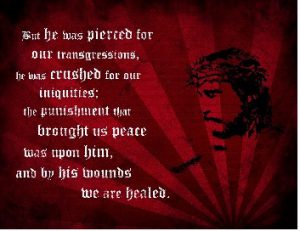
In Isaiah 53:5, Isaiah writes:

But he was wounded for our transgressions,
    crushed for our iniquities;
upon him was the punishment that made us whole,
    and by his bruises we are healed.

Here the Suffering Servant is portrayed as a Guilt Offering and in Isaiah 53:10, he is further portrayed as a Sin Offering. Jesus did it all – willingly, completely, perfectly – just as God (The Trinity) had planned it. It pleased God to do that because it was The Plan.

“The plan for what?” you might ask. The Plan for our Salvation. God’s Plan of Salvation was not for his benefit – although as we have seen it pleased him to formulate it and bring it to fruition – but while God was pleased to create this Salvation, he is all the more pleased to bless and approve, to sanctify and make holy, this plan for our benefit. He is especially delighted, joyous, and genuinely pleased-as-punch to see that we are redeemed by this plan. “By his stripes we are healed.” What kind of language is that for prophecy? You might ask, “Shouldn’t prophecy be future tense?” Yes, you are right again! God has no future tense, no past tense, but only present tense, all the time, everywhere. That pleases God who are always happy to destroy the barriers between God and Man. He who gave himself as a ransom for us all, he who paid in full all the debts of our sins, including death, he who willingly sought to please God so that God might be pleased to welcome us back into fellowship with Him – HE is pleased that WE are once again fully HIS.

That certainly pleases me. It also blesses me because it blesses God. It pleases us because when we say “God Bless YOU,” we mean that blessing to be in present tense in the same way that God is in present tense – all the time and everywhere. We have been given the remarkable Gift of Free Will so that when we finally hear and understand that “he bore the sin of many, and made intercession for the transgressors” (See Isaiah 53:12), we will know why Isaiah says, “through him the will of the LORD shall prosper,” (See Isaiah 53:10c) because our hearts become like unto his heart – utterly devoid of iniquity.

    All of your sin, all of my sin, all of our sins, all of every sin is “paid in full,” negated, wiped out, gone without a trace as if sin had never happened. Only God can do that! And when we read “he shall see his offspring and prolong his days,” all of that is predicated by and contingent upon his dying in “the land of the living,” to reopen to us the “Realm of the Resurrection.” God made Jesus to be sin by imputation (See 2 Corinthians 5:21) “so that in him we might become the righteousness of God.” That was so very pleasing to God – our Almighty Everliving Triune God – that God rejoiced in its perfect Perfection. That is why he did delight in seeing his Only Begotten Son suffer incredible pain in body, mind, and spirit. It was not for him or for the suffering that he felt delight. God’s Justice always precedes God’s Mercy. Here we see what Jesus did for our benefit. He was spurned, suffered, infirm, stricken, smitten, afflicted, pierced, crushed, harshly treated, condemned, chastised, killed, and all of this was done because it pleased God to do it so that we can be restored to God’s presence.

It was for our restoration to his presence that he felt delight. After all, we are created in him, by him, and for him. How could we, and he, not rejoice to be back together again!? So, Belovéd, let us echo the words and actions of the Apostle Paul in Hebrews 4:16 16 Let us therefore approach the throne of grace with boldness, so that we may receive mercy and find grace to help in time of need because, as Jesus himself said in Mark 10:45 45 For the Son of Man came not to be served but to serve, and to give his life a ransom for many. That is God’s plan, and it is a mighty good one because it applied the maximum allowable atonement for the maximum allowable redemption. Hallelujah! Hallelujah!

Whatever, whenever, wherever, whoever, however, if ever, forever — at your service, Belovéd!

Unless otherwise indicated, all scripture passages are from the New Revised Standard Version Catholic Edition (NRSVCE) New Revised Standard Version Bible: Catholic Edition, copyright © 1989, 1993 the Division of Christian Education of the National Council of the Churches of Christ in the United States of America. Used by permission. All rights reserved.

Biblical languages inserts from Bible Hub (Bible Hub: Search, Read, Study the Bible in Many Languages) Visit at http://biblehub.com

Creative Commons License
Aloha Friday Messages by Charles O. Todd, III is licensed under a Creative Commons Attribution-ShareAlike 3.0 Unported License


Aloha Friday Message – October 12, 2018 – Prophet and Loss

1841AFC101218 – Prophet and Loss

Read it online here, please. And please, when you visit there, use one of the social media links at the bottom of the page to share this post. Thank you! And remember, we now have a READER VIEW available, so share this link or this email often.

   Mark 10:29-31 29 Jesus said, “Truly I tell you, there is no one who has left house or brothers or sisters or mother or father or children or fields, for my sake and for the sake of the good news, 30 who will not receive a hundredfold now in this age — houses, brothers and sisters, mothers and children, and fields, with persecutions — and in the age to come eternal life. 31 But many who are first will be last, and the last will be first.”

Aloha nui loa, ʻŌmea! Today we continue with the 10th chapter of the Gospel of Mark. You may remember that this Gospel was probably the first one written – it is usually dated around 66-70 AD. We believe that the intent of the person(s) who compiled this Gospel were more motivated by the idea of presenting a theological exposition rather than an historical record of the life, travels, and teachings of Jesus.

There are many nearly word-for-word connections between the Gospels of Mark and Luke, and for several centuries it was believed that Mark was synopsis of Matthew’s Gospel. During much of that time, it was also believed that the author was one John Mark – the companion and assistant to the Apostle Paul; further scholarship on ancient copies of this Gospel indicate it may not have been authored by a single person, but by a group of gentiles, that is, Greeks – the Gospel is written in Κοινή (Koiné) {koi-né} Greek. Other evidence that it was intended for a gentile audience is that many Jewish and Aramaic terms are explained and/or translated; this would not be the case if the audience were intended for Jewish followers of The Way as is the case with the Gospel of Matthew. Matthew goes to great lengths to demonstrate Jesus’ Jewish roots, his connection to and fulfillment of Mosaic Law, and Jesus’ messianic salvific role in God’s plan.

In today’s Key Verse, Jesus is quoted as telling the Apostles – and quite likely some gentile Disciples – that everything they have “given up” or lost, or had taken away – with be restored to them many times over: ” houses, brothers and sisters, mothers and children, and fields, […] — and in the age to come eternal life. Jesus had just stated in Mark 10:23-25 23 Then Jesus looked around and said to his disciples, “How hard it will be for those who have wealth to enter the kingdom of God!” 24 And the disciples were perplexed at these words. But Jesus said to them again, “Children, how hard it is to enter the kingdom of God! 25 It is easier for a camel to go through the eye of a needle than for someone who is rich to enter the kingdom of God.” This statement was a real shocker for the crowd around Jesus. Worldly success was seen as favor from God and poverty something to be avoided. If the wealthy were not “the favored ones,” then who could be saved? The Greek word used here for “hard” is δυσκόλως (duskolós) { doos-kol’-oce} and it points to that which is preposterously impossible – like walking a camel through the eye of a needle. (Parallel versions can be found in Matthew 19:23-36, and Luke 18:24-27) This is a metaphor for absurd situations. (And yes, there really is no evidence that there was a gate in Jerusalem called The Eye of the Needle.) Then Jesus points out that those who are overly-attached to the idol of wealth will find it exceedingly difficult to set that Worldly view aside and embrace the humility and lowliness required for entering the Kingdom of God and the Life of the Gospel. This is given as a heartfelt comment of sorrow at Jesus’ remarks to the young man who asked him “What must I do to be saved.” The character is often referred to as “the rich young ruler.”   {{ – and a little “speculative biblical history here:” Do you remember the young man in Mark 14:51-52 wearing only a linen cloth and the grabbed him but he left the cloth and ran into the night naked? Some have suggested that he may have been “the rich young ruler” who had indeed sold all that he had and returned to follow Jesus. }} This rich man who posed the question which led to this lesson on trusting in worldly riches is also the only person mentioned in the Gospels as being loved by Jesus: Mark 10:21-22 21 Jesus, looking at him, loved him and said, “You lack one thing; go, sell what you own, and give the money to the poor, and you will have treasure in heaven; then come, follow me.” 22 When he heard this, he was shocked and went away grieving, for he had many possessions. Other translations say that he was deeply saddened, that his face fell, that his hopes were dashed. This was terrible news!

It’s such terrible news that in recent years (and on and off throughout church history), the “Gospel of prosperity” has been popular. This particular heresy certainly is appealing to many. “God wants you to be rich! He wants you to be swimming in money and material things! Tell HIM you’re ready for HIS blessings!” Wow. Jesus said repeatedly that putting worldly things first – fame, wealth, respect, power – all of that had no place in the Kingdom of Righteousness. After all, what Treasure in Heaven can top being fabulously wealthy? Jesus’ statement about there is no one who has left house or brothers or sisters or mother or father or children or fields, for my sake and for the sake of the good news, indicates that even in this life, what we “give up” for the privilege of living in the Kingdom will be returned to us in this life; and in addition, we would have in the age to come eternal life. Belovéd, have you noticed I edited out one other little phrase of Jesus’ promise for his Disciples? Scan up  a paragraph or two and look for […]. What do you think is missing? Do you remember what it says in the Key Verse? The missing words are underlined there: with persecutions. Now that doesn’t sound like any fun at all! I have to give up everything I have and give it to the poor, and then I’ll get back – in some fashion other than material wealth – everything I lost and as an extra bonus, I can expect persecutions?

Somehow that’s not the kind of “deal” most folks find attractive. We do the things that God wants us to do and then get punished and persecuted for our obedience? Who wants a job like that? Well, if you go dust off your Bible and heft it a little, it might surprise you to learn that at least half of what you’re hefting is prophetic in nature. Aside from the Major Prophets – Isaiah, Jeremiah (including Lamentations), Baruch (for the Catholic Bible), Ezekiel, and Daniel – and the Minor Prophets – Hosea, Joel, Amos, Obadiah, Jonah, Micah, Nahum, Habakkuk, Zephaniah, Haggai, Zechariah, and Malachi – there are also many prophetic passages in other books of the Bible such as Psalms (to name a few: 2, 18, 22, 45, 89,102, 132 and many more). What or who is a prophet?

A prophet is anyone who claims to speak God’s words or to teach in his name and is inspired by God to deliver God’s Word and Will to others. The Old Testament word for prophet is נָבִיא (nabiy’ ) {nah-bee’}. There are some disagreements among scholars about the origin of that word, but one that is well-accepted is that this noun comes from the verb noba` meaning to “bubble up,” “boil over”,” as in “to pour forth an abundance of words,” such as those who speak within divine inspiration. It is by and through the power and inspiration of God that a prophet speaks, and a prophet can’t help but speak when and what God commands any more than a boiling pot can stop bubbling. And that is the key. Those who have Divine Inspiration are True Prophets. The converse is that those whose “inspiration” is self-generated are the False Prophets. Belovéd, let’s stand in agreement with Moses that all may be gifted with prophecy! (See Numbers 11:29) How wonderful it would be if all of us could lay aside all our Worldly idols and speak the words God sends us which begin with, “Thus says the LORD.” What is it that prevents us? I think it may be those two little words we’d rather not hear: with persecutions.

In studying the Bible, we will see that every person who “received the gift of prophecy” also received a heap-and-a-half of persecution! To be a winner in God’s Kingdom, you have to be a loser! We lose everything so that we become as one who has left house or brothers or sisters or mother or father or children or fields, for my sake and for the sake of the good news. That’s the wage of the prophet: LOSS! And yet, in Mark 8:36 we read 36 For what will it profit them to gain the whole world and forfeit their life? What do you, what do I, what do we WANT? Over the years in these writings we’ve pretty much agreed that want we WANT and what we NEED are separated by a vast abyss. God gives us what we need; and how does he know what we need? We need what God wants. If God doesn’t want it in us, we don’t need it! Does God want prophecy in us, does he want us to speak his Word and his Will? If so, we will certainly become a Prophet and a Loss. Upon reflection, Belovéd, doesn’t that sound like a perfectly good idea? Some of us may think we’re the last person who could be called to prophesy for our God, but maybe there is something else to consider here: But many who are first will be last, and the last will be first. When we are looking for what we should do first in the Kingdom, we will find that what we should do first is be there! (↔ Music Link)

Whatever, whenever, wherever, whoever, however, if ever, forever — at your service, Belovéd!

Unless otherwise indicated, all scripture passages are from the New Revised Standard Version Catholic Edition (NRSVCE) New Revised Standard Version Bible: Catholic Edition, copyright © 1989, 1993 the Division of Christian Education of the National Council of the Churches of Christ in the United States of America. Used by permission. All rights reserved.

Biblical languages inserts from Bible Hub (Bible Hub: Search, Read, Study the Bible in Many Languages) Visit at http://biblehub.com

Creative Commons License
Aloha Friday Messages by Charles O. Todd, III is licensed under a Creative Commons Attribution-ShareAlike 3.0 Unported License

Aloha Friday Message – October 5, 2018 – Consecrated by God

1840AFC100518 – Consecrated by God to God For God

Read it online here, please. And please, when you visit there, use one of the social media links at the bottom of the page to share this post. Thank you! And remember, we now have a READER VIEW available, so share this link or this email often.

   Genesis 2:21-25 21 So the Lord God caused a deep sleep to fall upon the man*, and he slept; then he took one of his ribs and closed up its place with flesh. 22 And the rib that the Lord God had taken from the man he made into a woman** and brought her to the man. 23 Then the man said, “This at last is bone of my bones and flesh of my flesh; this one shall be called Woman, for out of Man this one was taken.” 24 Therefore a man leaves his father and his mother and clings to his wife, and they become one flesh. 25 And the man and his wife were both naked, and were not ashamed.
* אּישׁ (ish) {eesh} – man, husband
** נָשִׁים (ishshah) {ish-shaw’} – woman, wife

E pili mau na pomaika‘i ia ‘oe a me ke akua ho’omaika‘i ‘oe, ʻŌmea! (May blessing always be with you and may God bless you, Beloved!) Today’s topic arises from the reading for this coming Sunday. In the past several weeks we have been surrounded by a conflagration of accusations and counter-accusations about sexuality and interpersonal relations. Much harm has been done on both sides of the current issue; however even greater harm as been done through millennia of abuse, neglect, confusion, and failure to honor the aegis of God’s commands at the moment when Eve first approached Adam. In the passage above, we have a description of how God brought about this marvelous duality of beings. Eve was created from the flesh and bone of Adam. You might call it mythology, but I call it  Common Sense. Here’s why:

God had created animals out of the clay even as Adam was created. When God saw that none of those were suitable for a companion and helpmeet for the man, he took part of the man and made of that a partner for him. Adam liked the change! He took one look at Eve and said, “at last!” I have a suitable companion. That joy in seeing Eve was a blessing for God. It made God happy to see Adam happy, and I dare say Eve was happy to see Adam as well. She was, quite literally, “made for him.” Talk about love at first sight! But, as we well know, later those two came to a rough patch in the road. Maybe it had something to do with the quality of materials used to create them?

Man comes from dirt, and – as I have often said here – that pretty well defines his character – dirt. Woman comes from dirt that had been improved by making it a living being; woman was created from the flesh of the man. Woman, it could be said, was created from better ingredients, not just dirt, but improved dirt. Borrowing from Papa John Pizza a little – “Better Ingredients. Better People.” Men – who come from dirt, remember – have a hard time accepting that “first” is not directly-equal to “better.” I am reminded of “The Diaries of Adam and Eve” as translated by Mark Twain:

Adam: Dear Diary. This new creature with the long hair is a good deal in the way. It is always hanging around and following me about. I don’t like this: I am not used to company. I wish it would stay with the other animals. (To himself) Cloudy today, wind in the east, think we shall have rain. We? Where did I get that word? I remember now, the other creature uses it.

When a married couple learns that the pronoun “WE” is the appropriate pronoun for a couple, that is when God is also praised, because that is when God’s intentions for Man and Woman come together. They are “one flesh” and – in many ways it seems – also one soul if everything is working well. I cordially invite you to look back with me to February 14, 2011 for a special message about how that works for Crucita and me!

I remember a Radio Preacher’s sermon on the thirty-first chapter of Proverbs. One statement he made struck me as particularly and elegantly insightful. He said, “There is nothing in this world more beautiful than a virtuous woman serving the Lord.” I thought about all the difficulties women have endured for millennia because they were deemed lesser in every way because of their gender. You know what I have often said about women: Naturally they are not the lesser; they are certainly deserving of all equitable consideration and treatment. In fact, I argue that women are the better part of humanity. Man was made from dirt. Woman was made from flesh and bone. Better ingredients, better people. OK, so I probably sound a little flippant (and redundant) there, but I say that to illustrate that indeed there is little in this world that can outshine the Light one sees in a life lived with virtue and valor. And that applies to both men and women, boys and girls, saints and sinners. We are being led by Satan to ignore the Light and embrace the Darkness. Note I said “led.” We DO NOT have to follow his lead or dance to his tune!

Adam and Eve were Consecrated by God to God For God. We don’t hear the word “consecrate” very often so it’s useful to take a closer look at it:

CONSECRATED: Dedicated to a sacred purpose; to devote irrevocably to God by a solemn ceremony; to devote to a purpose with or as if with deep solemnity or dedication;

God created man for God, not as God, but for God. God created Woman for man and only for man – not for woman, not for beast, not for abuse or neglect – for man; and in and with man, Woman is created for God.  They are consecrated by God to God for God and for each other. Sin has corrupted that Consecration, but sin has not eliminated that Consecration. Earthlings have tried mightily for all of recorded time to get around the idea (and ideal) of that Consecration, and they’ve made quite a mess of Life because of those efforts, BUT we have not eliminated the holiness of being created to serve God together as one flesh – as one entity if you will. In our sinful stubbornness, we’ve tried thousands of ways to wiggle out of that – everything from divorce to prostitution to domestic violence gender confusion to character assassination. All of those things are wrong because they contravene the Holy Consecration of Man and Woman to God. We have made prodigious efforts to essentially slap God in the face for daring to create us as complementary, harmonizing, paired beings. We have demanded that God “stay out of our business” so we can redefine his Gift of Consecration according to our own poor judgment. What foolishness that is! (See Isaiah 45:9 and Romans 9:21) Throughout our history we have contrived to make society primarily patriarchal – with a few exceptions of matriarchal structuring. Whichever we choose, we have nearly always forgotten that leadership is not ownership. (Please reread Ephesians 5:22-33 as a reminder of how God intends Matrimony to be lived.)

Matrimony is another word we hear only in certain contexts – for example in the Catholic Church, the Sacrament which unites the lives of two baptized adults is called Matrimony. This word is worth a closer look, too. Matrimony derives from an Old French word, matrimoignie. The word stem for this term is a Latin word matrimonium. There is a root form matr- which is from the Latin for mother – “mater.” In the word “matrimony,” the stem matr- is followed by the suffix mony (think acrimony, parsimony, alimony, ceremony, hegemony, etc) and that suffix indicates a role, or a function, or more properly a state of being. Therefore Matrimony is a state of being which literally leads to a woman as a mother. In the CCC ¶ 1660 is this very clear statement. 1660 The marriage covenant, by which a man and a woman form with each other an intimate communion of life and love, has been founded and endowed with its own special laws by the Creator. By its very nature it is ordered to the good of the couple, as well as to the generation and education of children. Christ the Lord raised marriage between the baptized to the dignity of a sacrament (cf. CIC, can. 1055 § 1; cf. GS 48 § 1).

There are two words there to which I direct your attention: Covenant and Dignity. When we fail to recognize the gender equity implicit in the placement of two (and only two) genders in life, we ignore the power of that Covenant and besmirch the Dignity of our Consecration to God as essential components of his creation. Men and women who attempt to replace individual perceptions of self with anything other than what God created us to be forcefully disrupt the essence of human nature. Husbands and fathers who neglect their children and abuse their spouses, wives and mothers who neglect their children and abuse their spouses, men and women who manipulate and abuse each other to satisfy carnal cravings – all of these are contrary to the Creator’s intentions for the descendants of אּישׁ and נָשִׁים. Pause and reflect for a moment on this quote from Matthew Henry (1662-1714):

   “Eve was not taken out of Adam’s head to top him, neither out of his feet to be trampled on by him, but out of his side to be equal with him, under his arm to be protected by him, and near his heart to be loved by him.”

For those of us who remember the good old Baltimore Catechism we may recall that Matrimony confers Sacramental Graces which are “1st, To sanctify the love of husband and wife; 2nd, To give them grace to bear with each other’s weaknesses; 3rd, To enable them to bring up their children in the fear and love of God.”

In closing, I would be remiss not to present Jesus’ very clear teaching on this:

Mark 10:6-9 But from the beginning of creation, ‘God made them male and female.’ ‘For this reason a man shall leave his father and mother and be joined to his wife, and the two shall become one flesh.’ So they are no longer two, but one flesh. Therefore what God has joined together, let no one separate. God did not, has not, will not Consecrate or condone any other Matrimony. Earthlings have attempted to change the definition of Matrimony and marriage as a marriage solemnized as a civil contract without religious ceremony between any two human beings regardless of gender. Some have also decided that it’s pointless to even consider marriage when cohabitation – regardless of gender or number – brings psychosocial satisfaction to participants. Let me state as plainly as possible; this is wrong and must be condemned as must all other aberrations of relationships between men and women. It is equally wrong to say, “it’s none of my/your business.” If that’s not acceptable, we’ll have plenty of time between now and the Resurrection to complain about it to God – you see, he makes the rules; we don’t!

Whatever, whenever, wherever, whoever, however, if ever, forever

— at your service, Belovéd!

Remember this?

GOD ≡ LIGHT ≡ LOVE ≡ TRUTH ≡ WAY ≡ LIFE ≡ ETERNAL ≡ MERCY ≡ GOD

Click on it! ( ↨ Music Link)

Unless otherwise indicated, all scripture passages are from the New Revised Standard Version Catholic Edition (NRSVCE) New Revised Standard Version Bible: Catholic Edition, copyright © 1989, 1993 the Division of Christian Education of the National Council of the Churches of Christ in the United States of America. Used by permission. All rights reserved.

Biblical languages inserts from Bible Hub (Bible Hub: Search, Read, Study the Bible in Many Languages) Visit at http://biblehub.com

Creative Commons License
Aloha Friday Messages by Charles O. Todd, III is licensed under a Creative Commons Attribution-ShareAlike 3.0 Unported License

Aloha Friday Message – September 28, 2018 – Discernment and Discrimination

1839AFC091418 – Discernment and Discrimination

Read it online here, please. And please, when you visit there, use one of the social media links at the bottom of the page to share this post. Thank you! And remember, we now have a READER VIEW available, so share this link or this email often.

   Mark 9:38-40 38 John said to him, “Teacher, we saw someone casting out demons in your name, and we tried to stop him, because he was not following us.” 39 But Jesus said, “Do not stop him; for no one who does a deed of power in my name will be able soon afterward to speak evil of me. 40 Whoever is not against us is for us.

Aloha nui loa, ʻŌmea! Well, I think we’re “Back in the Saddle Again.” Although it will be only three weeks this coming Monday (10/1), progress is being made. I haven’t been able to get busy on my keyboard during most of that time, blinksut that is starting to change. Thank you – all of you – again for the prayerful support. My caregivers – Timothy and Crucita – thank you as well. Now, let’s get into this lesson which I’ve been percolating for a couple of weeks.

In this passage from the Gospel of Mark, the Disciples are appalled that others who are not “us” are doing something that belongs to “us.” They are not us. They shouldn’t be doing what we do. It is wrong for them to be like us because they are the “other.” This perception is one of the main stanchions on which “Civilization” is built. We are us. You are them. You are not us and we are not you. The “Us-Them Dichotomy” has been written about in thousands of texts and articles. How in the World did we ever come up with something so polarizing?

It’s in every form of story, history, Scripture, religion, nationalism, and even in our speculations about whether or not other sentient life exists “somewhere out there.” This tendency to form identity through exclusion is so natural that we never really think about it much. We do not often realize how disruptive this divisiveness is. Perhaps there are some earthlings who – by some fault of nature – have ideas that are radically dehumanizing, or pathological expressions of mental disorders, perhaps it is “merely ignorance” or pig-headed defiance, or even warped perceptions of interpersonal identifications brought about by inhumane abuse – whatever may be the genesis of negativity for some of us, most of us do not fixate every waking moment on the tension of dissention and the seduction of destruction. We cannot help but notice, however, that there are indeed some persons who do live like that, persons who actually do fixate every waking moment on the idea of destroying THEM. One might hope that deep in the soul of such a one there would be a glimmer of goodness and rightness – the “Anakin Skywalker” waiting to be released. As we are reminded daily through the major syndicated media, that is a very shallow hope. The individuals and groups that are consumed with malevolent wrath about their stations in life stridently proclaim that their angst is the fault of others who discriminate against them.

This word, DISCRIMINATE, is ill-used these days. It is not properly understood and the connotative meaning has obscured the genuine denotative meaning. Sometimes it is even confused with the word DISCERN. Let’s find out how these words are so easily confused in this era of violent divisiveness.  Both words start with the prefix dis which is a Latin prefix indicating apart, separated, asunder, separate, negative, opposite. DISCERN has as its root a Latin root cenere – to separate, distinguish, perceive, recognize, notice, observe. DISCRIMINATE seems to be virtually identical. It is derived from discrimen – distinction which yields discriminat- which means distinguish between by noting difference, interval, distinction, separation. We use DISCERN when speaking of an individual, personal perception of an unobvious yet ubiquitous underlying truth. We use DISCRIMINATE when speaking of using perceptions of obvious distinctions as the bases for judgments which may or may not be valid or true. Discriminating, as originally used, involves acute and precise observations of differences, of distinction, of separation and division, and of characteristics. Today it has a meaning very meaning that is more closely related to judgment. Judgment involves a perceived difference in power, and that one person has the right to use that power against another. Discernment is more internal in its aspects and is used to make choices based on reasoning, intuition, or verifiable perceptions. It is devoid of partiality. We might easily conclude that discernment is always good and discrimination is always bad. Let’s look at some Scripture for guidance on that analysis.

God made a distinction between the Nation of Israel and all other nations when he chose them as “his people,” brought them out of Egypt, and established them in Canaan through the intentional annihilation of other nations in that region.  God gave earthlings his spirit and created them in his likeness and image. Animals, on the other hand, are created by him but not created like him.  “You Only Live Once,” and it’s forever. Not all souls will spend “forever” in the presence of God.  There are entry requirements for Heaven! (and for Hell as well!) God’s laws command that we discriminate between all that is holy and all that is wicked.  Jesus taught that we will be judged by the same standards we use to judge others, and that we must amend our own lives before pointing out deficiencies in the lives of others. Is any of this discernment on God’s part, or discrimination? What do you think? “Well, I think you’re off your rocker old man! Discrimination isn’t in the Bible, and in fact it’s unbiblical! What do you think of that!?”

I think that’s close to being true, at least in the negative, judgmental sense attached to “discrimination” in our culture (even around the world). But let me just put a list of passages where “discern” is used: Genesis 31:32, Genesis 38:25, 2 Samuel 14:17, 2 Samuel 19:35, 1 Kings 3:9, 1 Kings 3:11, Ezra 3:13, Job 4:16, Job 6:30, Ezekiel 44:23, Jonah 4:11, Malachi 3:18, Matthew 16:3, Luke 12:56, Hebrews 5:14. I didn’t put links on them because I want you to trust that I have that right. If I was being judgmental, I’d say that you probably wouldn’t click on all of those links anyway. (But go ahead and try at least 2-3 if you wish!) So here’s my question: Based on what you’ve just seen above, am I wrong in stating

  • Abortion is murder, and those who promote or perform abortion are accomplices to murder and therefore evil?
  • There is but one God and his name is YHWH – El Shaddai-Olam?
  • There are “truths” to be found in Hinduism, Buddhism, Taoism, Islam, but only Real Truth is found only in Christianity?
  • There are two genders – period, and any claim otherwise is unfounded and totally subjective?
  • There is one race – the human race – which God made remarkably diverse and that any creed, culture, law, or action that denies that is evil?
  • Judging someone for actions instigated by, for, or through evil is discernment and not racist, biased, misogynistic, prejudicial, or unbiblical?
  • It is quite likely more souls are going to Hell than to Heaven this week?
  • ALL of the above are nondiscriminatory statements?

Consider these:
Discriminate against the World and its baubles
1 John 2:15-17 15 Do not love the world or the things in the world. The love of the Father is not in those who love the world; 16 for all that is in the world—the desire of the flesh, the desire of the eyes, the pride in riches—comes not from the Father but from the world. 17 And the world and its desire are passing away, but those who do the will of God live forever.

Do not expect spiritual actions from those who are unspiritual.
1 Corinthians 2:14 14 Those who are unspiritual do not receive the gifts of God’s Spirit, for they are foolishness to them, and they are unable to understand them because they are spiritually discerned.

If someone claims to be Christian but their actions proclaim otherwise – stay away from them. If someone who claims not to be a Christian acts in the same way, have nothing to do with them, either.
1 Corinthians 5:9-11 I wrote to you in my letter not to associate with sexually immoral persons – 10 not at all meaning the immoral of this world, or the greedy and robbers, or idolaters, since you would then need to go out of the world. 11 But now I am writing to you not to associate with anyone who bears the name of brother or sister who is sexually immoral or greedy, or is an idolater, reviler, drunkard, or robber. Do not even eat with such a one.

Don’t get hung up on convoluted controversies. It does not depend on what the definition of “IS” is.
2 Timothy 2:23-26 23 Have nothing to do with stupid and senseless controversies; you know that they breed quarrels. 24 And the Lord’s servant must not be quarrelsome but kindly to everyone, an apt teacher, patient, 25 correcting opponents with gentleness. God may perhaps grant that they will repent and come to know the truth, 26 and that they may escape from the snare of the devil, having been held captive by him to do his will.

Confront heresy directly, fearlessly, and properly (without silly arguments) all the time.
2 Timothy 4:3-4 For the time is coming when people will not put up with sound doctrine, but having itching ears, they will accumulate for themselves teachers to suit their own desires, and will turn away from listening to the truth and wander away to myths. 1 Timothy 4:1-2 1 Now the Spirit expressly says that in later times some will renounce the faith by paying attention to deceitful spirits and teachings of demons, through the hypocrisy of liars whose consciences are seared with a hot iron.

If it is of human and not divine origin, it is most likely ungodly, unbiblical, evil, and idolatrous.
Wisdom 14:22-31 22 Then it was not enough for them to err about the knowledge of God, but though living in great strife due to ignorance, they call such great evils peace. 23 For whether they kill children in their initiations, or celebrate secret mysteries, or hold frenzied revels with strange customs, 24 they no longer keep either their lives or their marriages pure, but they either treacherously kill one another, or grieve one another by adultery, 25 and all is a raging riot of blood and murder, theft and deceit, corruption, faithlessness, tumult, perjury, 26 confusion over what is good, forgetfulness of favors, defiling of souls, sexual perversion, disorder in marriages, adultery, and debauchery. 27 For the worship of idols not to be named is the beginning and cause and end of every evil. 28 For their worshipers either rave in exultation, or prophesy lies, or live unrighteously, or readily commit perjury; 29 for because they trust in lifeless idols they swear wicked oaths and expect to suffer no harm. 30 But just penalties will overtake them on two counts: because they thought wrongly about God in devoting themselves to idols, and because in deceit they swore unrighteously through contempt for holiness. 31 For it is not the power of the things by which people swear, but the just penalty for those who sin, that always pursues the transgression of the unrighteous.

Belovéd, what are we to do? Where is this gift of discernment which is not judgmental and not discrimination in the most negative sense? How can we purge this evil from our midst? I know of only one way: Replace it. Love with discernment.

Must we love everybody? Of course we must. “But I don’t really like him/her/them at all!” We don’t have to like someone to Love them. Perhaps people we don’t like are actually easier to love. With people we like, there are always little things we wish maybe they would or wouldn’t do. But that’s not always true with people we don’t like. Everything they do sets us off, so there are no little tweaks we might hope for in our relationships with them. If we’re going to love them, we have to love them as-is, warts and all as the saying goes. Not all love is Love. Have you ever heard the hymn –

Let the Beauty of Jesus Be Seen in Me Lyrics Albert Orsborn Melody (↔ Music Link)

Let the beauty of Jesus be seen in me (Jones)
Let the beauty of Jesus be seen in me,
All His wonderful passion and purity.
O Thou Spirit divine all my nature refine
‘Til the beauty of Jesus be seen in me.*

When your burden is heavy and hard to bear
When your neighbors refuse all your load to share
When you’re feeling so blue, don’t know just what to do
Let the beauty of Jesus be seen in you.

When somebody has been so unkind to you,
Some word spoken that pierces you through and through.
Think how He was beguiled, spat upon and reviled,
Let the beauty of Jesus be seen in you

From the dawn of the morning ’til close of day,
In example in deeds and in all you say,
Lay your gifts at His feet, ever strive to keep sweet
Let the beauty of Jesus be seen in you.

*  This first verse is transcribed as originally written. Additional lyrics composed by other lyricists.

That is how we discern – with eyes, hearts, and mind of Love seen as the Beauty of Jesus!

Whatever, whenever, wherever, whoever, however, if ever, forever — at your service, Belovéd!

Unless otherwise indicated, all scripture passages are from the New Revised Standard Version Catholic Edition (NRSVCE) New Revised Standard Version Bible: Catholic Edition, copyright © 1989, 1993 the Division of Christian Education of the National Council of the Churches of Christ in the United States of America. Used by permission. All rights reserved.


Aloha Friday Messages by
Charles O. Todd, III is licensed under a Creative Commons Attribution-ShareAlike 3.0 Unported License

Biblical languages inserts from Bible Hub (Bible Hub: Search, Read, Study the Bible in Many Languages) Visit at http://biblehub.com

Aloha Friday Message – September 21, 2018 – Tongue Tied

1838AFC092118 – Tongue Tied

Read it online here, please. And please, when you visit there, use one of the social media links at the bottom of the page to share this post. Thank you! And remember, we now have a READER VIEW available, so share this link or this email often.

Aloha nui loa, ʻŌmea! This weekend is another difficult post. I had intended to write on Discernment and Discrimination. Not all love is Love; however, my DELL’s internal Power Supply croaked, so we’re going to go a different direction. There is so much in the news these days about things the people said and/or did even decades ago. The tone of the rhetoric back and forth is wearying. The world is filled with self-proclaimed experts in any and every subject. Everyone claims to have the right solution – all of which pretty much boil down to “I was right all along and all of you knew that but did it wrong anyway!” The mythical 15-minutes-of-fame has become a marathon of accusations, counter-accusations, and often outright lies which deluge the Information Highway with more than any of us can possibly process – all ending in a lifetime of shame (sometimes well-earned!). The other day it got me thinking about the way cowboys would prevent their horse from running off; they hobbled it – they tied it up in such a way that it could still graze, but not wander far from camp. I wondered if we could hobble – or even completely tie up – those wagging tongues and the vicious damages they care causing.

Today I have two things on my mind. The first is this past Sunday’s Healing Word: Orbit. The second is this verse from

   Proverbs 13:3 Those who guard their mouths preserve their lives; those who open wide their lips come to ruin.

This passage always reminds me that [1] one of these days my mouth is going to be the end of me, and [2] despite that, I can do something about it. I know this because of what I learned when studying the Epistle of James 3:1-12. (Go ahead and read that one right quick. It’s very helpful!)

James talks about the power of speech, the power of the tongue. The power of speech is one of the most amazing gifts God has given us. In any language a human can praise God, bless God, worship God, adore God, glorify God, teach fellow souls about the power of God’s Word, and assist the Holy Spirit to lead lost sinners to Christ. But with that same tongue we can blaspheme God, insult God, sin against God and our brothers and sisters, and – like the Adversary – we can tell lies that can ruin a life, destroy a relationship, or break someone’s heart.

We have the ability to speak truth; it is certainly the best way to influence others; and yet so often we take this ability for granted or – worse – abuse it and invent our own “truth.” James’ Epistle gives us several different ways to understand the versatility of the tongue: the bit, the rudder, fire, a poisonous animal, a fountain, and a fig tree. I’d like to focus on the first and third of those for today.

A bit: Let’s think of the whole body and then think about how small a part of that body comprises the tongue. Yet, for such a small part, it truly is wonderful because of all the things it does; Taste, chew, speak, swallow, spit watermelon seeds, whistle, drink, even breathe; all of these things are possible because of the way the tongue was created. Small thing; big functionality. That functionality is one of the major determining factors in how we live out the course of our life on Earth. James points out another small thing with big functionality: a bit – and bridle of course. The analogy is that we put a bit into a horse’s mouth and – with the bridle – we can control a horse. A horse something that is animal as opposed to mineral, alive as opposed to inert, has a certain amount of self volition as opposed to with no self-control (bingo!), and doesn’t work at all unless it is held firmly in place. Hmmm. My tongue is alive, often does what I don’t want (including get between my teeth when I am eating), and sometimes I lose control of it because it gets disconnected from my bridle a/k/a brain. And whenever it “acts out on its own” someone or something usually gets hurt.

Fire: Many lives, governments, marriages, self-images, and even politicians have been reduced to ashes by a “tiny slip of the tongue,” a “little white lie,” an insult delivered as humor, or complex orchestrations of propaganda. James points out that the smallest spark – set loose carelessly or deliberately I would say – can set a whole forest afire. If you’ve ever been at a bonfire, you know how hot and dangerous it can be, and that’s a fire that is supposed to be controllable. A forest fire is something that is at once terrifying and fascinating. Who cannot watch the images on TV as a fire creeps across the land devouring everything in its path? But if you’ve ever been at, in, or even close to a forest fire, you know it is something only slightly less powerful than the ocean. Such destruction can begin from the smallest incident and progress far beyond its place of origin. Even a small, brief contact with fire can cause lasting trauma. Have you ever burned your finger lighting a match or picking up a heated object? Fire can cause hurt and, in some instances – depending on how it is controlled – can also provide help. We set intentional burns to make fire-breaks, we cauterize wounds, we smelt ore, we cook food, we defend against the wild, and fill a room with light – all generated by fire under control. James’ point is that when fire is allowed to be out-of-control, usually bad things happen. I am leaving lightening strikes out of this illustration because, for me, that opens the door to another huge area of learning.

James’ images in this passage are meant to show us what may happen when we fail to control our tongues. He states that the person who can control his/her tongue can control the whole body – and avoid sinning in the flesh. If we step back a little farther and look at the context of this passage, we see that it begins with an admonition to those who are, or wish to be, teachers. In the early church there were apparently a lot of people who laid claim to knowing the truth about Jesus. James admonishes them to be careful, because a teacher has a greater and higher level of accountability. The authority to teach can be abused; it can even be falsified. James cautions people to be discerning about the fruit of their service to others. (See last week’s AFC as well as Matthew 7:14, and Luke 6:44). We, too, must be discerning (see 1 John 4:1-3 … “Beloved, do not trust every spirit but test the spirits to see whether they belong to God, because many false prophets have gone out into the world. 2 This is how you can know the Spirit of God: every spirit that acknowledges Jesus Christ come in the flesh belongs to God, 3 and every spirit that does not acknowledge Jesus does not belong to God.”

OK, so we get the idea: The tongue can be a tiny little monster at times, yet it is essential to life, but can also be a source of death. We need to be careful how we control it and how we deal with the consequences. Another passage in Proverbs speaks of the person who doesn’t care about the destructive power of his carelessly spoken words. “Like a madman who throws firebrands, arrows, and death, is the man who deceives his neighbor, and says, ‘I was only joking!’” (See Proverbs 26:18-19) Often the folks who cannot keep their mouths shut and control their speech (including Social Media Speech) claim “I didn’t mean to offend anyone. I know it was wrong, and I apologize.” Or “It’s my inalienable human right to say and do what I want. If you don’t like it, leave, or do what I demand.” (See Proverbs 26:18-19) It’s easy to let our ego move us away from “love thy neighbor as thyself” and smack-dab into “Umm-m-m-m-m! You stu-ped! I’m going to tell.” It’s easy because that’s what The World expects under the domination of The Prince of The Air – Satan, The Accuser whose whole existence is controlled by his own lying tongue. Because of that he was cast away from God, and when I follow his advice, I am also moving away from my Creator.

Some days I am close enough to God and strong enough in my faith that the Light and Warmth of The Son enriches everything in my life. Other days my orbit carries me into cold and darkness and my life shrivels; that dark cold even affects everyone in my life.

  • When my orbit has nothing at the center, I just run around in a circle until I lose control and dash off into oblivion.
  • When I orbit around something powerful enough to keep bringing me in no matter how much or how often my own momentum wants to carry me out, my orbit is cleaner and less likely to lead to destruction.
  • When I orbit with and around others who are centered in that same power, we influence each other and become a system of orbiting bodies. Now I can’t extend that too far without running into trouble, because the point I want to make is that where we have the potential and power to control our lives, we should do so.

Orbits are a complex function of gravity and mass. That gravitational pull is a little like a bridle. If I oversimplify that, and draw that oversimplification back to the passage in the Letter of James, what I learn is that the best place to put that bridle connected to the bit that controls my life is in the hands of The Master. My brain, my heart, my tongue, my imagination, my devotions – all of these can be turned over to Him. Once in a while (like nearly every day) in the same way a headstrong horse yanks at the bit-and-bridle, I can regain “control” for a while. That usually does not turn out well. That bridle is the “orbit” that keeps me centered on where the Real Power resides. Hobble my tongue, Lord. I don’t want to hurt anyone with that thing!

Thank you for your prayers this past week. My surgery was spot on, but the recuperation is considerably different this time. Much more swelling and level 7,8 pain in my left thigh pretty much 24/7. However, both prostheses are properly placed, I’ve got the best Ortho team and PT team, and two exceptional caregivers who are helping me get going – Crucita and Timothy. Please continue your prayerful support of everyone in the MBN, especially those who have asked for our prayers. I really do hope you ae using the prayer list link I provide. And while we’re at it, there’s this from that page:

We pray for all leaders everywhere in all institutions, governments, organizations, religions, families, and relationships that they might govern with morality, com passion, integrity, wisdom, and justice so that we can all live together in Peace. LORD GOD, tie up our tongues so that in our thoughts, words, and deeds we will not sin against you or each other.

Share a Prayer
Please pray with us here.

Unless otherwise indicated, all scripture passages are from the New Revised Standard Version Catholic Edition (NRSVCE) New Revised Standard Version Bible: Catholic Edition, copyright © 1989, 1993 the Division of Christian Education of the National Council of the Churches of Christ in the United States of America. Used by permission. All rights reserved

.

Creative Commons License
Aloha Friday Messages by Charles O. Todd, III is licensed under a Creative Commons Attribution-ShareAlike 3.0 Unported License


Pages Email Newsletter Categories Archives Connect
  • Connct to us here