Aloha Friday Message – September 14, 2018

1837AFC091418 – Recuperation-Required Rerun

Read it online here, please. And please, when you visit there, use one of the social media links at the bottom of the page to share this post. Thank you! And remember, we now have a READER VIEW available, so share this link or this email often.

Aloha nui loa, ʻŌmea! This week I just don’t have the stamina to spend 6-8 hours at my keyboard creating this week’s post. I wasn’t able to use my computer earlier in the week because it was seriously ill – the monitor finally died yesterday – so that pushed everything into Thursday, and there’s just not enough left in the tank. The topic I was given will require some clear thinking and a good deal of research, so we’ll just have to try that another time. Instead, I’m going to send a rerun of something from 2012 that is connected to the readings for this weekend: Isaiah 50:4-9Psalm 116:1-6, 8-9James 2:14-18Mark 8:27-35

James 3:17 17 But the wisdom from above is first pure, then peaceable, gentle, willing to yield, full of mercy and good fruits, without a trace of partiality or hypocrisy.

E pili mau na pomaika‘i ia ‘oe a me ke akua ho’omaika’i ‘oe! (May blessing always be with you and may God bless you!)

Today we take a peek into a truly remarkable epistle, the Epistle of James. First, let’s pick up a little background. The Epistle of James begins, “James, a servant of God and of the Lord Jesus Christ, to the twelve tribes in the Dispersion: Greetings.” In this opening greeting, James refers himself as a servant (viz. “slave”) of God and of the Lord Jesus Christ. This points us away from the assumption that the epistle was written by the same James that was an Apostle, the brother of John, and a possible relative of Jesus who is usually referred to by the word ἀδελφὸν [{a•DEL•phon}: a brother, member of the same religious community, especially a fellow-Christian] (See Galatians 1:19)
   Secondly, this document is not really in the form of an epistle – a letter – like those which were written by Paul. There’s no general blessing at the beginning, and the document ends abruptly by stating that whoever converts a sinner “will save his soul and will cover a multitude of sins.” No one who is a contemporary of James is mentioned by name. Only the Great Heroes of the Jews are mentioned. It has no distinct divisions other than segues from one topic to another. It is a very pleasant, well-composed essay about the ethical boundaries the Christian Community should respect and teach. It is a collection of the respected teaching of someone who had a strong commitment to Christ as Lord and Savior, James the Just. The “letter” was distributed and studied widely throughout the Diaspora. For the next 300 years or so there was ongoing debate as to whether or not this document was something that should be included in the uncontested (canonical) literature but it was finally ratified by the third council of Carthage in 397 AD. It always traveled with the name JAMES attached to it.

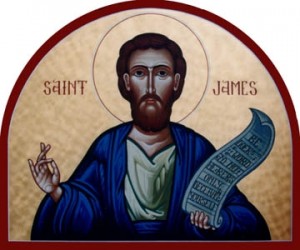
This particular JAMES seems to have been recognized as a representative of the early Christian community in Jerusalem who is often referred to as James the Just. He was stoned to death under the authority of the High Priest at that time, one Ananus II, who was the son of the High Priest Ananias who completed a famous role in the Passion of Christ. It may be no coincidence that this epistle seems to have appeared within a year or so of that incident, around 62 A.D. James was clearly a man who was well respected in the early church, not just in Jerusalem, but throughout the Diaspora, the dispersion of the Jews and of the Church. I accept the assertion of many scholars who have identified him as “James the brother of the Lord” – a cousin of Jesus – who at first did not believe, but then came to know a profound faith when Jesus appeared to him individually after the resurrection (See Corinthians 15:3-11 especially v. 7)

So, all in all, this epistle was a collection of information sent out by James the Just and/or his disciples. It was sent to encourage the early Christians (first called Christians in the Church of Antioch in about 31 AD) to endure everything brought against them by


  • relying on God’s generous wisdom, James 1:5
  • recognizing Christ as the Living Word of God (LOGOS), James 1:19-2:13 16
  • understanding the true work of faith by putting true faith to work James 2:14-26
  • speaking always in, through, and with LOVE James 3:1-12
  • tuning to the wisdom of God to inform the wisdom of man James 3:13-18
  • submitting fully to God’s authority and teaching in Jesus James 4:1-17
  • resisting the enticements of materialism James 5:1-6
  • waiting patiently for the imminent return of the Lord, James 5:7-11 and
  • using the power of faith rather than the power of persuasion James 5:12-20

For the next 300 years or so there was ongoing debate as to whether or not this document was something that should be included in the uncontested (canonical) literature but it was finally ratified by the third council of Carthage in 397 AD.

The two verses I chose capture something about the book of James that has always brought me back to reading it when I have questions about how certain things should get done – day-to-day living things. I have a knack for finding ways to do foolish things, to “lack wisdom.” At times it seems it is the only aspect of my life in which I truly excel. James 1:5 was one verse that was quoted frequently to me when I was growing up. The idea is to ask God for HIS wisdom, because it’s way better than mine, and to ask with confidence because of God’s generosity.

From there, James goes on to say. “But when you ask him, be sure that your faith is in God alone. Do not waver, for a person with divided loyalty is as unsettled as a wave of the sea that is blown and tossed by the wind.” There is just so much good, practical, easy-to-understand advice in this treatise on good Christian conduct. If you have teens in your family, try reading it with them– half a chapter a day at least –so they can hear the content. It will serve them well both soon and later.

It is in James that we have the idea of the tongue being a terribly powerful weapon worse than fire, stronger that a ship’s rudder, and able to bring calamity on others and especially one’s self. (James 3:1-12) In the very next section of James, he writes about the importance of wisdom from above and how those who teach about God must rely on that more than anything else. Only the Wisdom of God is so pure that it can put our hearts and minds at rest. Our own wisdom leaves much that can undo itself, whereas God’s wisdom is so complete that there is nothing in it which can be undone. It is not through religiosity that wisdom comes, but the The Spirit of God which is the Spirit of Wisdom that accompanied God at the Creation and is with God always. Immersing our intent in God’s wisdom makes that intent pure and peaceable and the person with that intention become purified, humbled, and holy. It purifies the heart above all else, making the intention and the one who holds that intention righteous, harmless, and just.

When our inward lives – our hearts and minds – are transformed like this, made pure and just in the Wisdom of God, our outward lives – our works, prayers,  joys, sorrow, sufferings, victories, defeats, distress, desires, and dreams – all of these in turn become pure, then peaceable, gentle, open to reason, full of mercy and good fruits, impartial, and sincere.

So we know we should seek God’s own Wisdom, and sometimes even God’s own energy, so we can grasp that wisdom, and when He bestows that wisdom on us, we must accept it with humility and openness so that we will willingly allow our life in him to conform to that Wisdom which is also His will and His Gift to us through Jesus.

It would probably take you about 20 minutes to read straight through this remarkable document (which truly is one of my favorite things to do), so I urge you sometime this week either to read it through, or just read 1 chapter a day until all five chapters have been read. I am certain you will benefit from that exercise.

And here is Wisdom, Belovéd:


“‘Love the Lord your God with all your heart and with all your soul and with all your mind.’ This is the first and greatest commandment. And the second is like it: ‘Love your neighbor as yourself.’ All the Law and the Prophets hang on these two commandments.”

When your enemies treat you with kindness and are conciliatory, are you more inclined to spring to a renewed attack, or return the kindness with the goal of reconciliation?

W-W-J-D? Easy answer: Die for you to reconcile you to God.

Whatever, whenever, wherever, whoever, however, if ever, forever — at your service, Beloved.

Next time we hope to get into Discernment and Discrimination. Not all love is Love.

Unless otherwise indicated, all scripture passages are from the New Revised Standard Version Catholic Edition (NRSVCE) New Revised Standard Version Bible: Catholic Edition, copyright © 1989, 1993 the Division of Christian Education of the National Council of the Churches of Christ in the United States of America. Used by permission. All rights reserved.

Creative Commons License
Aloha Friday Messages by Charles O. Todd, III is licensed under a Creative Commons Attribution-ShareAlike 3.0 Unported License

Biblical languages inserts from Bible Hub (Bible Hub: Search, Read, Study the Bible in Many Languages) Visit at http://biblehub.com

 

Aloha Friday Message – September 7, 2018 – UNPLUGGED

1836AFC090718 – UNPLUGGED

Read it online here, please. And please, when you visit there, use one of the social media links at the bottom of the page to share this post. Thank you! And remember, we now have a READER VIEW available, so share this link or this email often.

   Isaiah 35:5-6 * – Then the eyes of the blind shall be opened, and the ears of the deaf unstopped; then the lame shall leap like a deer, and the tongue of the speechless sing for joy. For waters shall break forth in the wilderness, and streams in the desert; * The Link will take you to this passage in context. Additional discussion will be based on that context.

Psalm 146:8 the Lord opens the eyes of the blind. The Lord lifts up those who are bowed down; the Lord loves the righteous.

Mark 7:32, 33a-35 32 They brought to him a deaf man who had an impediment in his speech; and they begged him to lay his hand on him. 33 He took him aside in private, away from the crowd, 34 Then looking up to heaven, he sighed and said to him, “Ephphatha,” that is, “Be opened.” 35 And immediately his ears were opened, his tongue was released, and he spoke plainly.

Aloha nui loa, ʻŌmea! Thanks and praise be to God who gives us everything that’s good and in whom there is no change or variation. (See James 1:17-18 from last week) This week as I open the kit that contains God’s gift for us, I am grateful that he still insists on taking an active role in my day-to-day life. Yes, he is there with me every day. We get up together, and my day starts with, Good morning LORD, and thank you for this day. As we go out to help the world together, go beside me all the way.” My friend and fellow laborer in Christ, Brendan Case, reminded me of that recently. The Holy Spirit, who is the Lord, the Giver of Life, goes with us everywhere we go because … well, because it’s what he does. Remember, from the very moment God created earthlings he wanted to be with us. Even when we are not receptive to his presence, he still wants to go with us. It’s pretty clear he loves this place he created. He feeds all the animals (or goes along when we feed them), and takes care of the seas, the breeze, the grass, and the trees. Sure, things get messed up – we have storms, and fires, and diseases, and discomforts; but, he’s still with us all the time because he always wants to give us good things, things that help restore our awareness of him. When that awareness is restored we can see him and hear him so very much better. He likes it like that.

As I was contemplating the readings for this weekend (See Lectio Divina), I was reminded of something my parents used to say. It was a bit of nonsense that was clearly meant to be amusing. These days, I suppose someone could stand up and say, “That offends me!” Well, y’all have a right to be offended, I suppose, and that’s that as the offense is within you, and not me. Here’s that silly little quote: “I saw,” said the blind man, “a hole in the wall.” “So I’ve heard,” said the deaf-mute, “but, you can’t see at all!” As Mr. Spock would say, “That is illogical.” A blind man cannot see a hole in the wall, and the deaf-mute could not chastise him about his statement. But you know, God certainly takes that in a different turn. He says that the blind will see, the deaf will hear, the mute will speak, the lame will walk – and LEAP!, and sick will be cured, and the dead shall be raised. (See 1 Corinthians 15:50-52) In this World, that just doesn’t make sense; and that is precisely my point. Those are the things that occur in the Kingdom of God, and as Jesus was walking toward Jerusalem to willingly die for us, he paused along the way to share God’s gloriously generous gift of mercy with all who would accept it. Sometimes he said, “What do you want me to do for you?” (See Mark 10:51) Sometimes he said “Do you believe that I am able to do this?” (See Matthew 9:28) At one point he asks, “Why are you looking for me?” (See Luke 2:49) Jesus confronted his Disciples with their own blindness and other limitations. It was as if their eyes were filled with dust, and their ears with mud. They could neither see nor hear that the Gospel was the Key to the Kingdom of God. It was like their eyes and ears were all plugged up. Jesus’ confrontations were intended to help them get unplugged.

We talk about “going unplugged” these days, too. In this technical age, we usually mean turning off the iPhone (or Blackberry or Android or whatever), and shutting down our social media account(s) for a time. In the world of music, it means playing music with acoustical instruments – unamplified and perhaps in a way more pure. Jesus beckons us to get completely unplugged so we can see and hear better. “Take the plank out of your own eye before you remove the speck in your brother’s eye. (See Matthew 7:5) Jesus repeatedly told the Disciples (not just the Apostles, but all who came to listen to him) that they should relinquish everything that tied them to The World. He wanted them to turn away from evil and embrace the Gospel (… repent and believe the good news – Mark 1:15) We have many expressions that describe what happens when we have so much going on that we can’t think straight – plugged up, jammed up, messed up, muddied up, overwhelmed, plunged under, backslid, lost, and hopelessly confused. In the Kingdom of God, all of those get fixed. We can taste and see that the Lord is Good (See Psalm 34:8). All of this happens when we stop saying, “I’ve got this” and start saying, “Jesus, can you get that for me?” We often (usually?) fail to recognize, as did the Disciples, that what we can do for, in, and with ourselves in this World is of no avail. We who know Christ and claim him as Savior walk with the Holy Spirit everywhere all the time. He’s right there, asking to be included in what we’re doing; we choose to carry on with our DIY attitude and leave him out of our day. But, what if we didn’t?

What if every day we unplugged, unjammed, cleaned up, drained out, and plunged ahead? What if we blinked and cleared our eyes, washed out or ears, cleaned up our mouths, purified our hearts, brightened our spirits, and jumped for joy in the Lord instead of slogging along in the World? What if we looked harder into the answer Jesus gave to John’s Disciples when they asked him “Are you the One?” Look at Matthew 11:4-5 Jesus answered them, “Go and tell John what you hear and see: the blind receive their sight, the lame walk, the lepers are cleansed, the deaf hear, the dead are raised, and the poor have good news brought to them. “That’s cool,” you say, “But that’s Jesus. This is me, and I can’t do that.” Oh, yeah? Well unplug your ears, open your eyes, and latch on to this in John 14:12 12 Very truly, I tell you, the one who believes in me will also do the works that I do and, in fact, will do greater works than these, because I am going to the Father. (Thank you, Brendan, for reminding us of that! Brendan says faith works like ABC’s – A: I can’t do that. B: God can. C: I’m gonna let him! Check out these books and other lessons.) The Lord has done marvelous deeds (See Psalm 118:23 23 This is the Lord’s doing; it is marvelous in our eyes.) This is how we affirm that The Lord lifts up those who are bowed down; the Lord loves the righteous. We can go directly to Jesus, with the Holy Spirit at our side as our helper and advocate, and ask him to open our eyes, empower our mouths, unstop our ears, enliven our hands, and cleanse our hearts. We can, and must, invite him to treat us to recurring moments of Ephphatha:  34 Then looking up to heaven, he sighed and said to him, “Ephphatha,” that is, “Be opened.” 35 And immediately his ears were opened, his tongue was released, and he spoke plainly. What if you prayed, “Oh, God! I want to be unplugged!” Do you think Jesus might ask you, “Do you believe that I am able to do this?” What will you say, what will you see, what will you hear if you do believe?!?!? Try it! You’ll like it! Why not give it a go? You know by now the Lord opens the eyes of the blind. The Lord lifts up those who are bowed down; the Lord loves the righteous. Not you, you say? It’s time to wrap it up then.

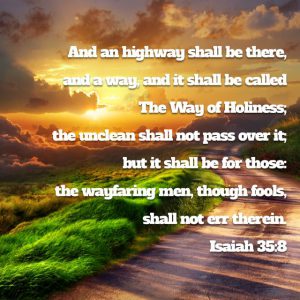
   I said earlier that there would be more from the context of Isaiah 35. If we want to know where we’ll end up if we ask Jesus to make us whole, we can just take a look at Isaiah 35:8 A highway shall be there,  and it shall be called the Holy Way; the unclean shall not travel on it, but it shall be for God’s people; no traveler, not even fools, shall go astray. If we are in any way plugged up, jammed up, messed up, muddied up, overwhelmed, plunged under, backslid, lost, and hopelessly confused – then we need to hit the road called the Holy Way. We have seen that Jesus has pointed us on The Way, and given us a Companion to be our guide. Let’s get unplugged – together – and enter in by that King’s High Way, for indeed, the Kingdom of God is at hand. Try see Isaiah 30:21!  (Seriously, ya gotta click on that one!)



Whatever, whenever, wherever, whoever, however, if ever, forever — at your service, Belovéd!

Share a Prayer
Please pray with us here.

Unless otherwise indicated, all scripture passages are from the New Revised Standard Version Catholic Edition (NRSVCE) New Revised Standard Version Bible: Catholic Edition, copyright © 1989, 1993 the Division of Christian Education of the National Council of the Churches of Christ in the United States of America. Used by permission. All rights reserved.

Creative Commons License
Aloha Friday Messages by Charles O. Todd, III is licensed under a Creative Commons Attribution-ShareAlike 3.0 Unported License


Aloha Friday Message – August 31, 2018 – What’d ya get?

1835AFC083118 – What’d ya get?

Read it online here, please. And please, when you visit there, use one of the social media links at the bottom of the page to share this post. Thank you! And remember, we now have a READER VIEW available, so share this link or this email often.

   Mark 7:18-23 18 He said to them, “Then do you also fail to understand? Do you not see that whatever goes into a person from outside cannot defile, 19 since it enters, not the heart but the stomach, and goes out into the sewer?” (Thus he declared all foods clean.) 20 And he said, “It is what comes out of a person that defiles. 21 For it is from within, from the human heart, that evil intentions* come: fornication, theft, murder, 22 adultery, avarice, wickedness, deceit, licentiousness, envy, slander, pride, folly. 23 All these evil things come from within, and they defile a person.” (See also Matthew 15:16-20)

*In the Old Testament, God often refers to these as imaginations, the wicked inclinations of our hearts, and the malevolent plots we make against each other – and HIM!

James 1:17-18 17 Every generous act of giving, with every perfect gift, is from above, coming down from the Father of lights, with whom there is no variation or shadow due to change. 18 In fulfillment of his own purpose he gave us birth by the word of truth, so that we would become a kind of first fruits of his creatures.

Aloha nui loa, ʻŌmea! In the readings for this weekend, we once again hear from the Apostle James. I think that epistle is one of my favorite Inspirations Stations. There are so many wonderful bits of advice. Nearly every sentence is worth a homily. The verses I chose from James today appear frequently in these lessons. When we talk about gifts, or stewardship, or God’s generosity, or God’s undeniable Power and Might, we are talking about how he gives us gifts. When we accept his gifts, open them, and use them, God is happy, and we are happier for having made use of his gifts – that is, if we use his gifts properly. There is one particular gift we manage to use improperly way too often: Imagination. Here’s an example:

Genesis 6:5 (Maftir) Adonai saw that the people on earth were very wicked, that all the imaginings of their hearts were always of evil only. Complete Jewish Bible (CJB) Copyright © 1998 by David H. Stern. All rights reserved.

If you click on that link, you’ll also see this verse in the Authorized King James version. That’s the Bible I grew up with. I remember studying this verse – along with others where “imagin*” was used. Imagination, the gift of thought, is one of God’s greatest gifts. It must have been in us even before the Fall, because Eve and Adam were able to imagine what it would be like to be more like God. That was the first instance where earthlings misused the gift of thought and instead of thinking up something good, something evil entered the heart and mind of humanity. The Hebrew word root used here is יֵ֫צֶר (yetser) {yay’-tser} – thought, the forming of ideas in the mind, imagination, mind, frame / framework. It is also translated as inclination of the human heart; for example we have this from the ending of the Great Flood Story:

Genesis 8:20-22 20 Then Noah built an altar to the Lord, and took of every clean animal and of every clean bird, and offered burnt offerings on the altar. 21 And when the Lord smelled the pleasing odor, the Lord said in his heart, “I will never again curse the ground because of humankind, for the inclination of the human heart is evil from youth; nor will I ever again destroy every living creature as I have done. 22 As long as the earth endures, seedtime and harvest, cold and heat, summer and winter, day and night, shall not cease.” We have a propensity – a natural tendency – to use our imagination for things that are contrary to God’s nature and will. When we do that, we contaminate our lives with “fornication, theft, murder, 22 adultery, avarice, wickedness, deceit, licentiousness, envy, slander, pride, folly.” In the passage from Matthew (Matthew 15:16-20) the list goes For out of the heart come evil intentions, murder, adultery, fornication, theft, false witness, slander. We are given the gift of thought – imagination – to help us appreciate God’s Grace and Generosity. We also have a gift that we can employ to make turning thought into actions that are holy: Free Will. This is another gift we frequently do not use well. What do you get when you use these gifts? As it does will all of God’s gifts, it depends on how you use them. How we use them depends on how we understand them. What is a gift?

A gift is something that is transferred from one person to another. It is “paid for” by the giver and not by the person who receives. Yet if the gift is given and received, the one who receives give honor to the giver by accepting the gift, and so we exchange gifts by giving and receiving. If a gift is given but not accepted, then the giver is demeaned. A gift cannot be a gift if it is not accepted freely without sense of obligation to return a gift or payment. Nor is a received gift meant to be horded. This especially applies to gifts from God. They’re not much use if you do something with them!

   All of God’s gifts come as a kit. The gift and everything you need to be able to use it effectively come together in one package. Not only that, but he also gave us an instruction manual. Remember “Basic Instructions Before Leaving Earth”? Yep. The B-I-B-L-E. He also gives us living examples of how to share and appreciate his gifts – Tradition and the Lives of His Holy Ones. You don’t have to be canonized to be a Saint. You just have to accept and to use God’s gifts. You use them by giving them away. In the image shown, what part is the part that has been given? What is the part that has been lost? How much more is there to give? And does giving it away mean we get emptier or fuller? Think about these things as you enumerate the gifts that have been given to you: Have you accepted all of them? How do you know what they are? Are there some more out there or in there that you have not yet accepted? How much have you given? Is that enough? What about the gift of LOVE? You know you have it – how do you use it?

When we love another, we try to please that person. We find out what the other likes, what pleases them, and strive to provide whatever it is at whatever the cost. Such is love; the deeper the love, the deeper the cost. No one can outdo God’s generosity, and it is foolish to try, even foolish to believe we can somehow repay him. How then can we please him?

There’s the ultimate Bonus Question! “If I could answer that, I’d make millions!” Well, I don’t know about that, but I do know the answer isn’t that hard. Why? Because God seems to never tire of telling us what it takes to make him happy. Here’s what HE says:

  • Don’t make anyone or anything else more important to you than I AM.
  • Do what I tell you to do and do that all the time
  • Don’t be afraid of me; I love you and you are mine. (↔ Music Link)
  • Take care of yourself and your neighbors.
  • Be kind to widows, orphans, prisoners, and foreigners.
  • Don’t hurt anyone, but don’t be a wimp either. You can be humble and still be strong.
  • Honor me by accepting and using all the gifts I give you
  • Be like me. I AM Light. I AM Love. I AM justice tempered with mercy. I AM righteousness. I AM in integral part of you.
  • Wake up! Stop dying in the Darkness and start living in the Light!
  • All I need from you is a humble and contrite heart so there is plenty of room for me to fill up your life with countless blessings.

Little Children, my Belovéd, let us seek the Light and only the Light for that is what best pleases the Father of Lights. See James 1:17. If we use our imagination to spur us into the actions of Love, we will be helping one another love each other. Try this on for size: Hebrews 10:24-25 24 And let us consider how to provoke one another to love and good deeds, 25 not neglecting to meet together, as is the habit of some, but encouraging one another, and all the more as you see the Day approaching. When we use our gift of thought to guide and inform our gift of Love, we make Love grow. When we use our gift of thought to manipulate and re-form our gift of love, we make Love corrupt, toxic, and filled with fornication, theft, murder, 22 adultery, avarice, wickedness, deceit, licentiousness, envy, slander, pride, folly. If we think we are “owed” love, we are thinking wrongly! Love and thought are gifts – gifts among thousands and thousands of blessings every single earthling receives throughout every single life.

They are gifts, not rewards. They are a matter of grace and not of merit. Such are all the favors which God bestows on sinners including forgiveness, peace, joy, holiness, and eternal life. It is an invitation (κλῆσις – klēsis in Greek), not a command; a beckoning rather than an imperative – and it is always with the intent of bestowing “grace beyond measure.” In this passage the gifts are things that make up the very core of all of us. They are gifts that allow us to more fully live our lives as he intended. They are not gifts that can be taken away. Are you in a ministry? That can be lost. We’ve certainly seen that before. Have you refused a calling to serve in the capacity for which you were created? You could miss out on a happy life because of it. No, these external gifts can be lost or refused, damaged or ignored. God’s deepest, oldest, and most wonderful gifts are part of us from the moment of creation and come to us by God’s perfect will for us. The Apostle Paul told us in Romans 11:29 29 … the gifts and the calling of God are irrevocable. And it is God’s will that we shall not be deprived of those gifts – no one can take them away from us; BUT we can use them wrongly, we can squander them on things that are ungodly, we can dishonor the Giver by dishonoring the Gift.

God gives us so many gifts! Life and health, faith and love and certainly hope, prosperity or poverty, shelter and peace, and all things of earthly life. All of these, if you think about it, can pass from our possession; but the calling to him and his righteousness, and the gifts of salvation are irrevocable. Everybody has them. Not all accept them. But let’s look at one man who did.

God has called you, and you will know constant joy and peace in your earthly life when you accept that call because that call guarantees you will receive all of his abundant love and grace here and in eternity with him. God has called you, and you will know unmanageable sorrow and conflict in your earthly life when you ignore that call because while that refusal guarantees you may perhaps receive some of the blessings give to all people of good will, you will not partake in all of the abundant love and grace – not because he withholds it, but only because you refuse it. Do you remember Diana Ross’ big hit, “I’m going to make you love me?” God would never sing that song! He will never force you to accept his love, his protection, his eternal life, or his forgiveness. He will, however, allow you to wallow in the discomforts caused by self-righteousness, obstinacy, and arrogant proclamations of self-sufficiency. To put it bluntly, you’ll be left twisting in the wind.

However, if you heard the call and accepted the gifts, you are happy with your life because “we know that God causes all things to work together for good to those who love God, to those who are called according to His purpose.” (See Romans 8:28) And what is his purpose? Belovéd, it is simply to be able to spend all eternity with you – yes! YOU! – for you are one of his all-time favorite bits of creation, so that your Joy will be complete. (See John 15:11) You have the gift of thought; think about this: Try to list the very BEST gifts you’ve gotten. What’d ya get? God can give you what you can imagine; after all, he is God! Jeremiah 32:27 27 “Look, I am Adonai, the God of every living creature; is there anything too hard for me? Complete Jewish Bible (CJB) Copyright © 1998 by David H. Stern. All rights reserved. What do you imagine he’d like you to have and to use?

Make a list of all the things [1] you’re good at that [2] you really love to do and that [3] other people tell you they notice. Anything that makes all three of those criteria is a gift you are sharing. Then, continue the list with the things you’re good at and really love to do, but nobody ever notices you can do those things. Those are gifts you have been given but have not shared. Time to get busy heapin’ those gifts on everyone you can find! Then make a list of those things that you’re really good at, but don’t really enjoy all that much. Those are the gifts you stuck on the mantel or hid in the attic. It is time to open them up, take them out for a spin, and make better use of them.

One of the very-best gifts I got was that I was burned! Please follow that link for a look into the mind of an 11 year-old geek! Another of the very-best gifts I got is

Whatever, whenever, wherever, whoever, however, if ever, forever — at your service, Belovéd!

Share-A-Prayer
Please pray with us here.

Unless otherwise indicated, all scripture passages are from the New Revised Standard Version Catholic Edition (NRSVCE) New Revised Standard Version Bible: Catholic Edition, copyright © 1989, 1993 the Division of Christian Education of the National Council of the Churches of Christ in the United States of America. Used by permission. All rights reserved.

Creative Commons License
Aloha Friday Messages by Charles O. Todd, III is licensed under a Creative Commons Attribution-ShareAlike 3.0 Unported License

Biblical languages inserts from Bible Hub (Bible Hub: Search, Read, Study the Bible in Many Languages) Visit at http://biblehub.com


MBN Message — 1834.1AFC082618-John6Summary — August 26, 2017

1834.1AFC082618-John6Summary

Aloha nui loa, ʻŌmea! Today’s Gospel once again comes from the Gospel of John, Chapter 6. It is a continuation of what we have been studying for five consecutive Sundays, from the 17th to the 21st Sundays in Ordinary Time. When we celebrated the Feast of Corpus Christi back in June, we cited passages from this chapter. John introduces The Church to Jesus’ teaching that his flesh is True Food and his Blood is True Drink. I’d like to share the post from that weekend with you again today as we reflect on the last portion of this amazing chapter. In the Old Testament reading, all of Israel affirms with Joshua that they will serve the LORD. In today’s Gospel, many are scandalized by Jesus’ words and fall away. They take offense at his teaching. Today, many are scandalized by Jesus’ teaching still, but even more are scandalized by what those who claim to be Disciples have done. We join The Church in praying for those who have misused the Gospel and tha authority of the church in ways that bring scandal. Here is a link to the lesson from Corpus Christ, and als a link to John, Chapter 6.

Post ~~ /archives/9021

John 6 ~~ http://www.usccb.org/bible/john/6


Aloha Friday Message – August 24, 2018 – Serving Others

1834AFC0082418 – Serving Others

Read it online here, please. And please, when you visit there, use one of the social media links at the bottom of the page to share this post. Thank you! And remember, we now have a READER VIEW available, so share this link or this email often.

   Ephesians 5:21 21 Be subject to one another out of reverence for Christ.


¡Que la bendición esté siempre con ustedes y que Dios los bendiga, Amados! (May blessing always be with you and may God bless you, Belovéd!)

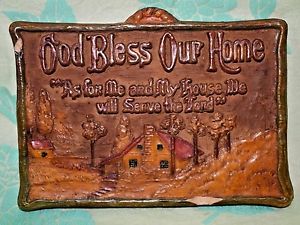
Today we revisit one of my Dad’s favorite verses. I have a kind of flickering memory of a plaque in our home on Ivy Way that said, “As for me and my house, we will serve the LORD.” My Dad really worked at living like that, and – as head of the household – he helped us understand it was the right way to live. We were to serve Jesus first, others, second, and ourselves last. This adage produced the acronym JOYJesus, Others, Yourself. After over 70 years of hearing that aphorism, I can vouch for its authenticity and value. In fact, we’ve covered this passage a couple of times previously (See these references) Today we will try to go after some additional insights, nonetheless we encourage you to check out at least one of the five messages at that link – perhaps “1234AFC082412 – Who’s your Master?” would be a good choice. If you do that, you can add some additional perspective to this message about submitting to another. What does that mean, anyway?

To submit, in this context, is to surrender, acquiesce, yield, accept, surrender; it is to cease desisting, stop resisting, and end insisting on getting things your way. We are not very good at that Belovéd! Our society greatly values independence, self-reliance, individualism to the point of exclusion of everyone else. Shall we serve someone? It breaks my heart to know that all too often the response to that is, “Oh, hell no!” If you will take a look at that other post, you’ll find this link: ~~ Bob Dylan Gotta serve somebody, 1979. (↔ Music Link) It’s a great track, so take some time to enjoy it. It’s a good tie-in with the idea of our Key Verse – Be subject to one another out of reverence for Christ. This is deep, deep Christology which we should investigate further.

In this passage, the word for submitting comes from ὑποτάσσω (hupotassó) {hoop-ot-as’-so} to place under, or submit one’s self; and it has a suffix – transliterated menoi – which in context means to remain, or to be held/kept continually; thus, we have ὑποτασσόμενοι (hupotassomenoi) {hoop-ot-as’-so-me’-nō-ee}. It is a relationship that is “forever;” it doesn’t dissolve in a torrent of adversity, or a puddle of disappointment. There is staying-power in this kind of relationship. It is like our relationship with Jesus is supposed to be – lasting, indestructible, and mutual. It is a Christ-like thing to do: “Love one another as I have loved you.” (See John 13:34) The apostle insists  married Christians should develop a strong mutual love as he insists that marriage is a ordained by God (See Genesis 2:24). In this context, Christian marriage takes on a deeper understanding of the intimate relationship of love between Christ and the church. Wives should assist their husbands in the same manner as t the Church  serves Christ (See Ephesians 5:22-24), and the husband should provide for  and nurture his wife with the devotion of Christ to the church (See Ephesians 5:25-30). This wasn’t “the way it was” back in Paul’s day. It certainly has been misrepresented and abused in recent history, and it isn’t really very popular these days, either. It is uncommon to find wives who are submissive to their husbands “in all things.” (See Ephesians 5:24) In fact, there are some couples – married or not – who believe mutual submission is junk and contrary to their life-values. As we have said here in the past, that’s not the way God set things up. There are rules in the universe he created, and one of those rules is mutuality of service – to Him and to each other.

That is why the Apostle Paul continues by saying “ to one another.” Being selfish creates an intolerable imbalance in the mutuality of respect. Respect is a gift that should be freely given. If the giver offers respect and the gift is rejected, then the intended recipient fails to gain respect. If we insist that respect – and by inference, love – must be earned, then that makes these kinds of relationships into commodities. You cannot earn respect because that makes it a commodity, something that can be bought or sold. You cannot – and must not insist upon – love being earned for the same reason. The act of loving must be a gift; when accepted, it becomes mutual; when rejected, it remains as love unreturned, but love nonetheless. Love is what prompts us to submit to another. God is Love. He loved us before we loved him. (See 1 John 4:19) We love God because of that – and because of everything else he does for us – and that mutuality of love completes God’s plans for us. (See Deuteronomy 6:4-9) Loving and serving God is the precedent for loving and serving each other – even outside the bonds of Holy Matrimony. That is why the Apostle Paul continues by saying “ out of reverence for Christ.

We do not love one another or serve one another for personal gain. Well, that’s not quite right these days, is it? In fact, through the ages, many have professed love and service solely for the purpose of personal gain. It goes both ways; men as well as women misconstrue the concept of a marriage partner as a way to get ahead or even to get even. Here we can look back to what Joshua told Israel as they were on the verge of cleaning up Canaan: Joshua 24:15 15 Now if you are unwilling to serve the Lord, choose this day whom you will serve, whether the gods your ancestors served in the region beyond the River or the gods of the Amorites in whose land you are living; but as for me and my household, we will serve the Lord. Belovéd, those who are unwilling to serve the LORD will certainly find it difficult to serve another. Conversely, those who have difficulty serving another will definitely have great difficulty in serving the Lord. If we place our lives as first, that places God – at best – as second, and that’s not going to last. That is the formula for a very turbulent and tortuous life. In Creation, there is a proper order for everything and everyone. Some of the more miserable people we know are trying so hard to combine unrelated life-ways that include truth and untruth. They want to be Christian / Buddhist / Hindu / Amerindian / Scientologist / Rastafarian all in one day. As Hagrid would say, “Codswallop!” (← Image Link!) This kind of “spiritualist Smörgåsbord” is unfulfilling; in fact it is so unhealthy that it brings about a perpetual despondence that cripples those who try it. “The LORD your God is ONE.” (See Deuteronomy 6:4 CJB) Of course that doesn’t mean that you’re not free to make up your own gods and serve them. You can even borrow other peoples’ gods to serve. If, however, you want to serve El Shaddai-Olam – Almighty-Everliving God – there’s only one choice, so take it, make it, and never break it. You have Free Will. Use it wisely. Try starting with this question:

Are you grateful that you serve God before all, in all, and for all? If you and your household truly serve the LORD, then serving others is part of your inner-being. It’s not nearly as difficult as many make it out to be – this whole idea of being subject to one another. Turn your eyes, you heart, your mind, your ears, your whole being upon Jesus. No matter what happens to you, when you Turn Your Eyes Upon Jesus, (↔ Music Link) your life is set aright. If you’re like me and things get “a little crazy” sometimes, take a minute to put your hand in the hand of the Man (↔ ANOTHER Music Link) who stilled the waters. You will indeed see others – and yourself – differently enough to be mutually subject to one another.

Unless otherwise indicated, all scripture passages are from the New Revised Standard Version Catholic Edition (NRSVCE) New Revised Standard Version Bible: Catholic Edition, copyright © 1989, 1993 the Division of Christian Education of the National Council of the Churches of Christ in the United States of America. Used by permission. All rights reserved.

Creative Commons License
Aloha Friday Messages by Charles O. Todd, III is licensed under a Creative Commons Attribution-ShareAlike 3.0 Unported License

Biblical languages inserts from Bible Hub (Bible Hub: Search, Read, Study the Bible in Many Languages) Visit at http://biblehub.com


A Treasure Trove of Favorite Scriptures for You


Here is a little treasure trove of favorite Bible verses for your meditations.

Peace – John 14:2727 Peace I leave with you; my peace I give to you. I do not give to you as the world gives. Do not let your hearts be troubled, and do not let them be afraid.

Power – Acts 1:8 But you will receive power when the Holy Spirit has come upon you; and you will be my witnesses in Jerusalem, in all Judea and Samaria, and to the ends of the earth.

Comforter – John 14:26 26 But the Advocate, the Holy Spirit, whom the Father will send in my name, will teach you everything, and remind you of all that I have said to you.

Protection – Acts 16:6 – They went through the region of Phrygia and Galatia, having been forbidden by the Holy Spirit to speak the word in Asia.

Spiritual Values – Ephesians 2:3-7 All of us once lived among them in the passions of our flesh, following the desires of flesh and senses, and we were by nature children of wrath, like everyone else. But God, who is rich in mercy, out of the great love with which he loved us even when we were dead through our trespasses, made us alive together with Christ — by grace you have been saved — and raised us up with him and seated us with him in the heavenly places in Christ Jesus, so that in the ages to come he might show the immeasurable riches of his grace in kindness toward us in Christ Jesus.

New Life – 2 Corinthians 3:5-6 Not that we are competent of ourselves to claim anything as coming from us; our competence is from God, who has made us competent to be ministers of a new covenant, not of letter but of spirit; for the letter kills, but the Spirit gives life.

Spirit of Truth – John 16:13 13 When the Spirit of truth comes, he will guide you into all the truth; for he will not speak on his own, but will speak whatever he hears, and he will declare to you the things that are to come.

Access to Abba – Ephesians 2:17-18 17 So he came and proclaimed peace to you who were far off and peace to those who were near; 18 for through him both of us have access in one Spirit to the Father

Hope – Romans 15:13 13 May the God of hope fill you with all joy and peace in believing, so that you may abound in hope by the power of the Holy Spirit.

Liberty – 2 Corinthians 3:17 17 Now the Lord is the Spirit, and where the Spirit of the Lord is, there is freedom.

Change – Acts 10:44-48 44 While Peter was still speaking, the Holy Spirit fell upon all who heard the word. 45 The circumcised believers who had come with Peter were astounded that the gift of the Holy Spirit had been poured out even on the Gentiles, 46 for they heard them speaking in tongues and extolling God. Then Peter said, 47 “Can anyone withhold the water for baptizing these people who have received the Holy Spirit just as we have?” 48 So he ordered them to be baptized in the name of Jesus Christ. Then they invited him to stay for several days.

Love – John 15:10 10 If you keep my commandments, you will abide in my love, just as I have kept my Father’s commandments and abide in his love.

Life – John 3:16-18 16 “For God so loved the world that he gave his only Son, so that everyone who believes in him may not perish but may have eternal life. 17 “Indeed, God did not send the Son into the world to condemn the world, but in order that the world might be saved through him. 18 Those who believe in him are not condemned; but those who do not believe are condemned already, because they have not believed in the name of the only Son of God.

Courage – Isaiah 41:13 13 For I, the Lord your God, hold your right hand; it is I who say to you, “Do not fear, I will help you.”

Happiness – John 13:15-17 15 For I have set you an example, that you also should do as I have done to you. 16 Very truly, I tell you, servants[a] are not greater than their master, nor are messengers greater than the one who sent them. 17 If you know these things, you are blessed if you do them.

Healing – James 5:14-15 14 Are any among you sick? They should call for the elders of the church and have them pray over them, anointing them with oil in the name of the Lord. 15 The prayer of faith will save the sick, and the Lord will raise them up; and anyone who has committed sins will be forgiven.

Renewal – Revelation 21:1-2 1 Then I saw a new heaven and a new earth; for the first heaven and the first earth had passed away, and the sea was no more. And I saw the holy city, the new Jerusalem, coming down out of heaven from God, prepared as a bride adorned for her husband.

Rest – Matthew 11:28-30 28 “Come to me, all you that are weary and are carrying heavy burdens, and I will give you rest. 29 Take my yoke upon you, and learn from me; for I am gentle and humble in heart, and you will find rest for your souls. 30 For my yoke is easy, and my burden is light.”

Forgiveness – Colossians 3:13 13 Bear with one another and, if anyone has a complaint against another, forgive each other; just as the Lord has forgiven you, so you also must forgive.

Cleansing – 1 John 1:9 – If we confess our sins, he who is faithful and just will forgive us our sins and cleanse us from all unrighteousness.

Wisdom – James 1:5 If any of you is lacking in wisdom, ask God, who gives to all generously and ungrudgingly, and it will be given you.

And

Wisdom – James 3:17 17 But the wisdom from above is first pure, then peaceable, gentle, willing to yield, full of mercy and good fruits, without a trace of partiality or hypocrisy.

Calm – Philippians 4:6 Do not worry about anything, but in everything by prayer and supplication with thanksgiving let your requests be made known to God.

Help – Isaiah 55:6 Seek the Lord while he may be found, call upon him while he is near

And

Help – Psalm 46:1 – God is our refuge and strength, a very present help in trouble.

Relationship – Ephesians 4:31-32 31 Put away from you all bitterness and wrath and anger and wrangling and slander, together with all malice, 32 and be kind to one another, tenderhearted, forgiving one another, as God in Christ has forgiven you.

Worship – Ecclesiastes 5:1 1 Guard your steps when you go to the house of God; to draw near to listen is better than the sacrifice offered by fools; for they do not know how to keep from doing evil.

And

Worship – 1 Chronicles 16:29 29 Ascribe to the Lord the glory due his name; bring an offering, and come before him. Worship the Lord in holy splendor

Creative Commons License
Aloha Friday Messages by Charles O. Todd, III is licensed under a Creative Commons Attribution-ShareAlike 3.0 Unported License

Use the links provided to see these passages in other versions.

Share-A-Prayer
Please pray with us
here.

Whatever, whenever, wherever, whoever, however, if ever, forever — at your service, Belovéd!


Aloha Friday Message – August 17, 2018 – Wisdom’s Household

1833AFC081718 – Wisdom’s Household

Read it online here, please. And please, when you visit there, use one of the social media links at the bottom of the page to share this post. Thank you! And remember, we now have a READER VIEW available, so share this link or this email often. PLEASE ALSO CHECK OUT OUR UPDATED LINKS SECTION AT THE BOTTOM OF THE RIGHT COLUMN.

Proverbs 9:1-6 1 Wisdom has built her house, she has hewn her seven pillars. She has slaughtered her animals, she has mixed her wine, she has also set her table. She has sent out her servant-girls, she calls from the highest places in the town, “You that are simple, turn in here!” To those without sense she says, “Come, eat of my bread and drink of the wine I have mixed. Lay aside immaturity, and live, and walk in the way of insight.”

   Ephesians 5:15-1715 Be careful then how you live, not as unwise people but as wise, 16 making the most of the time, because the days are evil. 17 So do not be foolish, but understand what the will of the Lord is.

   John 6:56-5756 Those who eat my flesh and drink my blood abide in me, and I in them. 57 Just as the living Father sent me, and I live because of the Father, so whoever eats me will live because of me.

E pili mau na pomaika‘i ia ‘oe a me ke akua ho’omaika‘i ‘oe, ʻŌmea! (May blessing always be with you and may God bless you, Beloved!) Today we return to the topic of Wisdom as given to us in the book of Proverbs. In a previous message back in June we quoted a passage from the Book of Wisdom (See 1826AFC070618) in which we learned that God fully intended for us to live with him in eternal intimacy. Sin changed that. Our First Parents thought they were wiser than God and desired to increase their knowledge through disobedience. Despite this infidelity, God gave them access to the possibility of redemption. In the same way that they had chosen to be disobedient, they would now have to choose to be obedient; Free Will and the Knowledge of Good and Evil are the fruit of their disobedience. From the time of Eden to the Miracle of Bethlehem, all earthlings struggled with their lack of Wisdom which they inherited from Adam and Eve. Then Jesus came and Wisdom walked among us.

I chose this passage today because it gives us some beautiful images that prefigure the Advent of Christ and the coming of the Holy Spirit. Let’s take it apart a bit, and then see how it connects with the other Key Verses.

Wisdom has built her house – she is at a place where she can be found, a place that is her abode, her household. We can dwell with her there, and since Wisdom was with God during the processes of Creation, her household is God’s household. Next we read she has hewn her seven pillars. This echoes the construction of Solomon’s Temple and – as a prefiguring of the fruit of the Holy Spirit – also alludes to the Sevenfold Fruit of the Spirit. This, in turn, connects with a prophecy in Isaiah. In the book of Isaiah, chapters 6-12 are verses that prophesy the coming of Emmanuel (sometimes the section is called the “Book of Emmanuel”). In chapter 11, we have this famous passage: Isaiah 11:2-3The spirit of the Lord shall rest on him, the spirit of wisdom and understanding, the spirit of counsel and might, the spirit of knowledge and the fear of the Lord. His delight shall be in the fear of the Lord. Does any of that sound familiar? Well, yes, we often read the first 10 or 12 verses from this chapter during the second week of Advent, but also we can find a list similar to this in Paul’s list of Gifts of the Holy Spirit in 1 Corinthians 12:4-11. The fact is that Wisdom’s Residence is built like a holy Temple with four columns in the corners supporting the gallery of the first story and three in the middle of three sides (See The Pillar Function of the Speeches of Wisdom, Chapter 2). Wisdom’s dwelling is holy and well-designed.

Next we read She has slaughtered her animals, she has mixed her wine, she has also set her table. (See Proverbs 9:2) This is a poetic description of a sumptuous feast. The meal includes huge quantities of food. Here we recall the great Marriage Feast of the King in Matthew 22. The feast is immense and the King has invited many, but they give him the brush-off with all sorts of excuses about being unable to attend. The wine has been mixed with spices to make the meal even more extravagant, but the invitees don’t care. Eventually the King invited every stranger his servants could find. He supplied each of them with a Wedding Garment – a long-standing custom in the region – which demonstrated extravagance, but one man refused (or neglected) to wear it and was thrown out. God in his Wisdom invites all and provides for all the garment of repentance (See 1743AFC102717). Wisdom’s feast is also for all who will come.

Just as the Kings servants called everyone from everywhere to the King’s Wedding Feast,  She has sent out her servant-girls, she calls from the highest places in the town, “You that are simple, turn in here!” The gates are open, the doors as well, and the invitation is everywhere. She especially calls on those most in need of her feast and her dwelling: To those without sense she says, “Come, eat of my bread and drink of the wine I have mixed. Lay aside immaturity, and live, and walk in the way of insight.” Clearly it would be wiser to accept her invitation than to continue to live in ignorance. We are called to be wise, and to be wise is to be obedient to God.

In our Key Verses from Ephesians, Paul says 15 Be careful then how you live, not as unwise people but as wise, 16 making the most of the time, because the days are evil. 17 So do not be foolish, but understand what the will of the Lord is. This is the message Wisdom is broadcasting in the passage from Proverbs. There is no need to shun the gifts of the Feast, or to stay away from Wisdom’s abode. The days are evil, and certainly one must be wise enough to recoil from the tidal wave of evil that bears down on us daily. Many of us carry in our hearts that dark inkling of the final days which makes us cling to the hope that we can avoid the cataclysmic events foretold throughout the New Testament. Are we wise enough to choose to follow Christ’s admonition? The time is fulfilled, and the kingdom of God has come near; repent, and believe in the good news!” (See Mark 1:15) This is what the Apostle Paul means when he says Be careful then how you live, not as unwise people but as wise, making the most of the time. Wisdom is waiting for us to dwell in the house she built according to God’s perfect plan for every single one of us. That is where we find the feast. And what a feast it is! Jesus gave this description of it:

   John 6:54-57 54 Those who eat my flesh and drink my blood have eternal life, and I will raise them up on the last day; 55 for my flesh is true food and my blood is true drink. 56 Those who eat my flesh and drink my blood abide in me, and I in them. 57 Just as the living Father sent me, and I live because of the Father, so whoever eats me will live because of me. What a FEAST! It is a perfect, sumptuous, endless, glorious feast that feeds the soul with endlessly renewing and unceasing LIFE. Jesus is the True Light (See John 1:9), the True Vine ( See John 15:1), the True Bread from Heaven (See John 6:32), the True God (See 1 John 5:20), and he is True Food and True Drink – everlasting and eternal. Whosoever would decline such a feast will surely be cast into darkness where there will be “weeping and gnashing of teeth.” (See Luke 13:28) Just as the servants go out to gather all possible attendees for the King’s Feast and Wisdom’s Banquet, the ministers of the Gospel go out to invite all to feast on the True Food and True Drink. This is the best, most righteous, and wisest response to the invitation to Lay aside immaturity, and live, and walk in the way of insight.

Come, Belovéd, let us put on the garment of Repentance and enter into the Feast of Heaven and Earth at The Table of Plenty. The times are evil and only those who share in this plenteous feast will hear the voice of the Son of God: John 5:25-27 25 “Very truly, I tell you, the hour is coming, and is now here, when the dead will hear the voice of the Son of God, and those who hear will live. 26 For just as the Father has life in himself, so he has granted the Son also to have life in himself; 27 and he has given him authority to execute judgment, because he is the Son of Man.” There is Life in none other. Jesus is True and this is Truth. Who among us will have nothing to do with Truth and Wisdom by failing to worship, or worse, by choosing to worship ignorance? Who among us will be True Worshipers of God as Jesus commands?

John 4:23 23 But the hour is coming, and is now here, when the true worshipers will worship the Father in spirit and truth, for the Father seeks such as these to worship him. This is Wisdom. Worshipping the Father in Spirit and in Truth is Wisdom that is not the wisdom of earthlings but rather the Wisdom that is “from above.” If we go back to the Book of James, the First Bishop of Jerusalem has this to say about Wisdom;

James 1:5 If any of you is lacking in wisdom, ask God, who gives to all generously and ungrudgingly, and it will be given you.

And

James 3:17 17 But the wisdom from above is first pure, then peaceable, gentle, willing to yield, full of mercy and good fruits, without a trace of partiality or hypocrisy. As we just heard from the Apostle Paul, So do not be foolish, but understand what the will of the

Lord is. The will of the Lord is to be Wise. Why would we settle for anything less? Let us abide in him and him in us for then we abide in Wisdom.


Whatever, whenever, wherever, whoever, however, if ever, forever — at your service, Belovéd!

Share-A-Prayer
Please pray with us here.

Unless otherwise indicated, all scripture passages are from the New Revised Standard Version Catholic Edition (NRSVCE) New Revised Standard Version Bible: Catholic Edition, copyright © 1989, 1993 the Division of Christian Education of the National Council of the Churches of Christ in the United States of America. Used by permission. All rights reserved.

Creative Commons License
Aloha Friday Messages by Charles O. Todd, III is licensed under a Creative Commons Attribution-ShareAlike 3.0 Unported License

Aloha Friday Message – August 10, 2018 – I AM COME

1832AFC081018 – I AM, COME

Read it online here, please. And please, when you visit there, use one of the social media links at the bottom of the page to share this post. Thank you! And remember, we now have a READER VIEW available, so share this link or this email often.

Aloha nui loa, ʻŌmea! As I write this we are delighting in the Lord’s Providence that hurricane Hector continues past our fair state without stopping by for a visit. To be sure, there are some effects but nothing catastrophic. We thank God for that. Our El Shaddai-Olam, the GREAT I AM, generously gives his Only Begotten Son so whosoever would believe in him might live forever in the Father’s House of many mansions. Jesus reminded his followers – including us, Belovéd – that he, Jesus, is the Christ of God. The reminders he gave us came in the form of seven remarkable statements in the Gospel of John that affirmed he is the Son of The Living God. (See Matthew 16:16 for Peter’s declaration) Today we are going to look back at those statements and think about why Jesus came; why did he say “I AM come?” (Also translated as “I came.”)

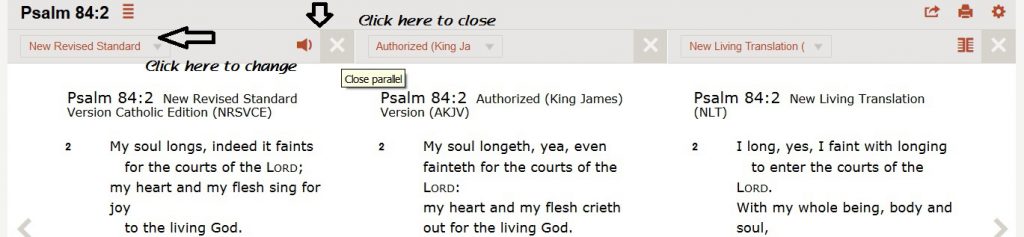
I also want to pass along a tip for the Scripture links I provide. If you follow the link, you will see 3-4 translations displayed. This can sometimes be difficult to read on a small screen like an iPhone. You can click on the CLOSE box [X] to eliminate one (or more) of the versions displayed. Also, if you’d like to look for another version with which you may be familiar, you can click on the DROP-DOWN box and scroll through dozens of translations. Here is an illustration:


  Isaiah 54:13 13 All your children shall be taught by the Lord,
and great shall be the prosperity of your children.

John 6:45 45 It is written in the prophets, ‘And they shall all be taught by God.’ Everyone who has heard and learned from the Father comes to me.

I am often saddened and perplexed by fellow earthlings who claim they do not know why Jesus is God, or do not understand why he was sent by God for them. Some folks even claim that Jesus didn’t know why he was here, what he was doing, or why he had to die. This is simply balderdash – hogwash, garbage, nonsense, bunkum, and a genuine lie from the father of lies. We are just going to go ahead and list a bouquet of Bible verses that show Jesus not only knew he was the Son of the Living God (and his Disciples confessed that as well), but that he knew why he was sent to us, and how it would change the World for those who choose to respond to his Father’s beckoning. All of these statements are in the Gospel of John. Jesus is the Son of the Great I AM who came to restore us to the presence of his Father, the Almighty Ever Living God – El Shaddai-Olam. Let’s listen to what Jesus says about his connection with his Father and with us.

In the Gospel of John, there are 7 distinct statements Jesus makes which all begin with “I AM.” These statements are significant for thousands of reasons (at least thousands of sermons and homilies, articles, essays, and tracts have been written about them). One of the most significant reasons is that the structure – in Greek – of the statements is a bit unusual. It is a little like the intensive form we sometimes see in a statement that combines two pronouns for emphasis such as I myself. What we see – in Greek and in Latin translations – is Ἐγώ εἰμι ≡ I am me …. Ego sum (I am) ≡ Me, I am … This intensive/emphatic form carries a very clear message; it leaves no doubt about excluding everyone but Jesus from the claim about to be made. Combining that intensive pronoun with a definitive article “the” makes a very strong statement: “I myself am specifically and only this.” I AM WHO AM or I AM THAT I AM: YHWH.

So, here is a list of the statements:

Seven I AM Statements
I AM …
The Bread of Life (John 6:35, 48-51)
The Light of the World (John 8:12)
The Gate (John 10:9)
The Good Shepherd (John 10:11)
The Resurrection and the Life (John 11:25)
The Way, The Truth, and The Life (John 14:6)
The True Vine (John 15:1 & 5)

I AM THE BREAD OF LIFE – Jesus begins his sustaining relationship with the citizens of the Kingdom of God the same way his Father did: With Bread. God revealed the power of his love by providing bread – Manna – in the desert. Manna sustained life, but only in a temporal, ephemeral way. People still got hungry the next day and needed more manna. And even after eating manna for many, many days, people also eventually died. Jesus says that he is the Living Bread come down from Heaven (John 6:51). And this Living Bread sustains eternal life. While Israel had manna in the desert to sustain their corporeal lives, Jesus alone (I AM) can sustain Spiritual Life, Life as known only in God and by God, but now made available to us through Jesus. Through Jesus we are transformed so that we will also know Life in God as God knows Life. Only Jesus can do this because he is the only truly begotten son of I AM. Remember? That was the NAME YHWH, and the use of that style of speaking – this intensive/emphatic form – was (and is) the way God speaks. So not only do we have Jesus demonstrating that he and he alone can rightfully claim to be the Bread of Life, but his statement also asserts his Deity by identifying with YHWH – I AM. The Apostle John is stating something that would have been very clear to Jesus’ listeners, but it would also be very extraordinary. They even say, “How can he say he came down from heaven?” This was a mind-blowing statement, and the ones that followed were even more remarkable.

I AM THE LIGHT OF THE WORLD. LIGHT is a strong recurring theme in the Gospel of John. Take a look:

  • John 1:4in him was life, and the life was the light of all people.
  • John 3:1919 And this is the judgment, that the light has come into the world, and people loved darkness rather than light because their deeds were evil.
  • John 9:5As long as I am in the world, I am the light of the world.
  • John 12:35-3635 Jesus said to them, “The light is with you for a little longer. Walk while you have the light, so that the darkness may not overtake you. If you walk in the darkness, you do not know where you are going. 36 While you have the light, believe in the light, so that you may become children of light.” After Jesus had said this, he departed and hid from them.
  • John 12:4646 I have come as light into the world, so that everyone who believes in me should not remain in the darkness.

Jesus was speaking in the part of the Temple where the offerings were put (John 8:20), where candles burned to symbolize the pillar of fire that led the people of Israel through the wilderness (Exodus 13:21-22). In this context, Jesus called himself the Light of the world. The pillar of fire represented God’s presence, protection, and guidance. Jesus brings God’s presence, protection, and guidance. Is he the Light of your world?

I AM THE GATE. In Jesus’ time and place sheep were the source for precious staples such as wool, milk, and meat. They were not raised for slaughter only, but were counted as a resource, as wealth. They were certainly worth protecting, so they were usually penned in. On the pen, there was only one doorway in the wall. Since the sheep were valuable, often the shepherd slept in the doorway – he was, in fact, THE door! Once again, Jesus is confronting the Pharisees. In the previous chapter (9) Jesus had healed a blind man using clay made from dirt and his own spit. They are questioning the blind man and claiming he is a liar and even accuse Jesus of being a sinner. Jesus testifies that the blind man has seen “the Son of Man.” Jesus uses this metaphor of the sheepfold to illustrate that the safety, security, protection, and care given to sheep by a lowly shepherd is possible because the shepherd becomes the barrier between the sheep and the dangers outside the sheepfold.

I AM THE GOOD SHEPHERD. Jesus intensifies his metaphor by showing that the Gate or Door) is the Shepherd, and a Good Shepherd at that. He, literally, lays down his life to protect the sheep. In this we see another sharp contrast between Jesus and the Pharisees. They were supposed to be the “Shepherds of Israel” – spiritually that is – and they were anything but good. They are acting like the hired-hand who doesn’t really have anything of himself invested in the sheep or the sheepfold. To him they are just dumb animals, and in a similar way, Jesus accuses the Pharisees of not caring for the people of Israel. The Pharisees would sacrifice nothing of themselves for the people, yet Jesus is preparing to “lay down his life for the sheep.” Not just for the sheep in the sheepfold of Israel does he do this, but he says it is also done for “sheep of another pen” (The gentiles, see John 10:16)

I AM THE RESURRECTION AND THE LIFE. Here, Jesus is talking to Martha, the sister of Lazarus. She believes he is talking about the end-of-the-world resurrection. In a matter of minutes Jesus fully validates his statement by calling Lazarus out of the tomb. Jesus gives a very powerful object lesson: I AM The Resurrection. Death is no longer a final obstruction. I AM the Life. The Life in Jesus is not constrained by any temporal bounds; it is eternal. Jesus shows all present that he has a supernatural and divine authority that reigns with unquestionable supremacy over even death. As we later learned, that supremacy covered even his own death.

I AM THE WAY, THE TRUTH, AND THE LIFE. Back in 2011, we touched on the meaning of this statement while discussing the floor plan of the Temple, particularly the Sanctuary and Holy of Holies. Pop back there for a look if you don’t recall it. In this statement, the heaviest emphasis is on the first part, The Way. He is talking about the path to Salvation, for he says, “No man comes to the Father except through me.” Each of these elements is distinctly separate and unique, but all three share this in common: All three refer exclusively to Jesus, and work together to disclose his divinity. Jesus says he is The Truth, not just someone who knows, or teaches, or exemplifies truth. He is The Truth, that is Jesus and Truth are identical. Therefore what he says and does is True because it is what God has ordained for Jesus’ purpose. Then he says he is The Life, and here again we see that it identifies his divinity, his oneness with God the Father who created us and everything around us out to the edges of creation (if such a thing exists and an edge of creation). As The Way and the Truth, he is the point of mediation and expiation the point at which the loops of the infinity symbol cross and these – the Way and The Truth – tie humanity together as recipients of God’s Gracious Mercy. As The Life, Jesus connects us – through and in him – to and for God the Father thus making it possible for God to “be all in all” (1 Corinthians 15:28), because “He is before all things, and in him all things hold together.” (Colossians 1:17)

I AM THE TRUE VINE. In Psalm 80:8 we read, “You brought a vine out of Egypt; you drove out the nations and planted it.” The vine, of course, was Israel and it was transplanted into a better soil – a land of milk and honey – from which Israel with God’s help and direction had cleared the land of its former noxious inhabitants. Once transplanted, a vine draws moisture and nutrients from the earth and the sky, in a way uniting them. The stalk of the vine divides in smaller and smaller portions out to all the tips of the tendrils, leaves, and finally the fruit. It gives this nourishment to all without interruption. Any leaf, any tendril, any branch, or twig that is connected to the vine is connected to the roots. Jesus is the Divine vine that unites heaven and earth, and his father is the vinedresser. Jesus is the source of all Life in his disciples (including us), and through him we receive the grace and energy to become fruitful in holiness. And it is God the Father who prunes – cleans and cares for the vine. There’s something important about this I want you to know, and it has to do with pruning grape vines:

If a grape vine is not properly pruned, it will “overproduce.” It will make a huge number of buds and leaves, so many in fact that it cannot support the fruit that comes from this explosion of vegetation. When purging, the master of the vineyard cuts away all but 2-5% of the remaining growth from the previous year! Only 2-5% is left. Think about that. If the vine is left without pruning a second year, the fruit it produces will be of poor quality, the grape clusters will be sprawling and disheveled, and not much of the fruit will actually ripen. Even if some of the fruit ripens, the vine pours so much energy into producing the fruit that the production of leaves and woody-stalk is diminished.

If you’re going to stay connected to The True Vine, you are going to be expected to “bear fruit that will last,” and for that 90-95% must be pruned away. 90-95%, Beloved. Wouldn’t we all love to get rid of 90-95% of the things that keep us from being fruitful?

So we have covered these statements. All of them affirm the identity of Jesus as the Christ of God. They confirm his divinity, his mission, and his eternal role in creation, salvation, and reconciliation. Jesus is Truly the I AM because he is Truly YHWH. In the Aramaic Bible in Plain English this last passage reads “I AM THE LIVING GOD, The True Vine, and my Father is the vine dresser.” Amen, to that. Come, I AM, and be our God and Redeemer. We know that has been revealed and is real because we have been taught by God.

Whatever, whenever, wherever, whoever, however, if ever, forever — at your service, Belovéd!

Share-A-Prayer
Please pray with us here.

Unless otherwise indicated, all scripture passages are from the New Revised Standard Version Catholic Edition (NRSVCE) New Revised Standard Version Bible: Catholic Edition, copyright © 1989, 1993 the Division of Christian Education of the National Council of the Churches of Christ in the United States of America. Used by permission. All rights reserved.

Creative Commons License
Aloha Friday Messages by Charles O. Todd, III is licensed under a Creative Commons Attribution-ShareAlike 3.0 Unported License

Biblical languages inserts from Bible Hub (Bible Hub: Search, Read, Study the Bible in Many Languages) Visit at http://biblehub.com


Aloha Friday Message – August 3, 2017 – Day-Old Bread

1831AFC080318 – Day-Old Bread

Last week’s index number was mistakenly entered as 1831AFC080318. It should have been 1830AFC072718 – A Heart’s Desire.

Read it online here, please. And please, when you visit there, use one of the social media links at the bottom of the page to share this post. Thank you! And remember, we now have a READER VIEW available, so share this link or this email often.

  Psalm 78:25 25 Mortals ate of the bread of angels;
he sent them food in abundance.

Aloha nui loa, ʻŌmea! Wow, time is really flying! Yesterday was August 2, an important day in our family for two reasons. First it is the birthday of Merilee Alice Todd. Born in 1953, she’d be 65 this week. We miss our sister, the only girl in a family with six kids. She left this world to be with our mom and dad on August 28, 2006 at age 53. And, it was on her birthday in 2008 that David Earl Conrad, the Choir Master at Kauaʻi High School went to meet our Maker. Both died due to massive heart attacks. Both were greatly loved by just about everyone. If they had met each other, they would have been great friends here, so we’re pretty confident they’ve been friends there for quite some time. Remembering her brings up a lot of images from the past, and as I was preparing this message, one image in particular popped up. Here it is:

This is a King Soopers Grocery Store. It was one of the places we frequented to buy “day-old bread.” The grocer would fill at least one shopping cart with discounted bread. We arrived as a strike-team – swoop into the store (it had a turnstile entry like a subway station) and head for the “bread baskets.” One of us would grab an empty shopping cart and the others would start gathering (crabbing was more like it) loaves of bread and we’d toss it over to the sibling guarding the cart. We were rarely the only family doing this, so competition was pretty fierce. Merilee could hold her own in that mêlée, and because she was small, she could slip under the turnstile and get in good position while the empty cart was brought in. This was especially important during the school year, because with six kids eating 1-2 sandwiches a day, we went through a LOT of bread! We used to make up dozens (seemed like hundreds) of sandwiches all at once – using our day-old bread – and put them in waxed paper sandwich bags, stack’em into shoe boxes, and stuff’em in the freezer. That way, all you had to do was go to the freezer, grab your sandwich(es), get an apple from the bin under the stairs, pick up a few chips, and some of mom’s homemade cookies, and lunch was ready. Of course by the time lunch hour came around, the sandwich had mostly defrosted and it was really soggy with little ice-crystals here and there. We mostly made bologna salad and egg salad as I recall. Even the lettuce – if we had some to put in – defrosted and was pretty wilted and tasteless. BUT, we had a lunch and it filled us up, and that was that.


This memory comes to mind because of the content of the Scripture for this Sunday and last Sunday. Last Sunday, Jesus fed 5,000+ people with 5 loaves of bread and 2 fish. You remember how that turned out, don’t you? Matthew 14:20 20 And all ate and were filled; and they took up what was left over of the broken pieces, twelve baskets full. There certainly was an abundance of food. Last week we commented that God always gives us so much of anything we need that we always have enough for ourselves plus some to share. In today’s key verse, the Psalmist recalls the gift from God to the Israelites in the desert: Manna, the bread of the Mighty Ones. If we take a look at a few of the words in that passage, we can gain some good insights into how the LORD likes to do things:

  1. Bread – לֶ֣חֶם (lechem) { lekh’-em} bread; also connotatively, food – especially satisfying food.
  2. Angels – a אַ֭בִּירִים (’abbîrîm) from אַבִּיר (abbir) {ab-beer’} mighty, valiant, Stallions(!), valiant steeds, the mighty ones, and in this case, Angels.
  3. Abundance – לָשֹֽׂבַע׃ (lā-śō-ḇa‘) from שֹׂ֫בַע (soba) {so’-bah} satiety, abundance, fullness, fully satisfied, enough to have plenty plus leftovers.

Jesus’ miracles of feeding thousands of people with the contents of one single meal resonate with the history of Israel in the wilderness for 40 years (See Exodus 16:35). God supplied them with manna all of that time and there was always enough. Those who gathered much and those who gathered little had enough. You will enjoy reading this passage about the manna in Exodus 16. Each had enough to eat; if there was more than could be finished, they had to discard it. If they tried to save some for the next day, it rotted and got all wormy. They could gather enough for the whole family every day. The was one exception: They could gather two day’s worth before the Sabbath so they would not have to work at gathering on the Sabbath; however it had to be boiled or baked. This “bread from Heaven” never had a chance to become day-old bread because it was consumed as- and when-needed. God also provided meat – quail – which came to them for the evening meal. God had heard enough of their wailing and whining and decided to give them reason to stop grumbling.

Even with the abundance of manna, they complained that they should never have left Egypt. There they had food, and meat, and melons and cucumbers, and certainly much more than just MANNA. This is recalled in the Psalms here: Psalm 105:40 40 They asked, and he brought quails, and gave them food from heaven in abundance. God had a pretty good idea there! He told them, “If you don’t stop grumbling about my provision for you, you’ll be sorry.” He told them they’d have to eat quail for a monthuntil it comes out of your nostrils and becomes loathsome to you.” (See Numbers 11:18-20) It’s a pretty clear reminder that later got translated at family dinner tables as “eat what you’re given or go without!” You know, in a way, God says that to us about Jesus, too.

John 6:32-35 32 Then Jesus said to them, “Very truly, I tell you, it was not Moses who gave you the bread from heaven, but it is my Father who gives you the true bread from heaven. 33 For the bread of God is that which comes down from heaven and gives life to the world.” 34 They said to him, “Sir, give us this bread always.” 35 Jesus said to them, “I am the bread of life. Whoever comes to me will never be hungry, and whoever believes in me will never be thirsty. That’s prefigured for us in Exodus 16:31, scripture tells us they called it מָ֑ן (man) {mawn} which means “What (is it)?” According to the accounts of their wanderings in the desert, they had it available to them – along with the quail – for 40 years. It could be prepared several ways – baked, boiled, ground into flour and made into cakes/loaves of bread. It was always there, always fresh, and always the same. Jesus is always here, always fresh, always the same FOREVER. Jesus DOESN’T GET OLD. Loving Jesus never gets old. Being loved by Jesus never gets old. We can never take in so much of him that he becomes loathsome to us. His flesh is true (perfect) food and is blood is true (perfect) drink. This means that, as bread becomes fully assimilated – completely incorporated – into our living bodies, it is the same for Christ Jesus who becomes fully assimilated into our souls as part of the Divine presence. The Manna which came down from Heaven into the wilderness sustained the bodies of the Israelites, but not the souls. Jesus, the Bread come down from Heaven feeds us the source of all life – God. God is the Father of Life. Jesus is the Deliverer of Life who announces the Salvation of God through the conquest of Death. We literally become what we eat because he says “for my flesh is true food and my blood is true drink.”

I think God tells us there is no way we can gather an excess of his Grace, for even though our need for Grace is immense, God’s store of Grace is infinitely larger. Remember what he told Paul: “My Grace is sufficient for thee.” There’s always just enough, never too little and never too much. It’s always just Right for he himself is Righteousness. And what did Jesus say about those of us who want that Righteousness? Matthew 5:6Blessed are those who hunger and thirst for righteousness, for they shall be satisfied. Fresh Bread from Heaven is yours! Just open up your heart and tell God, “Fill’er up!”

Why is there “day-old” bread? That’s easy to figure out isn’t it? More bread was baked than could be sold. Instead of hoarding it or discarding it, the grocer and/or baker give the buyer a discount. This kind of abundance is not like God’s kind of abundance. God blesses us in great measure with everything we need – so much that we have ways to help meet the needs of others. Jesus tells his Disciples – and us – that he is the true bread sent down from Heaven. I am baffled and saddened when people turn down the Bread from Heaven so they can chew on the sand in the Wilderness. In the passage from Exodus, the Israelites had been on their trek for about six weeks. They were hungry, tired, and pretty cranky. The exultant nation – just starting to get itself together – was already out of patience, and also out of the corn they had brought with them. They began to distrust Moses. Why did Moses come for them? Because God sent him. Why did Jesus come here? Because God sent him. What are the Passion, Death, and Resurrection of Jesus accomplishing in you and in me this very moment? What do we believe? We should believe that it was his Father’s will that everyone who looks upon Jesus and believes in him will have eternal life and will be raised up on the last day. (Verse 40) In verse 47 he says, “Very truly, I tell you, whoever believes has eternal life.” The food that does not perish is the eternal food, the Christ of God! That is why for thousands of years Christians have proclaimed:

I believe in one Lord Jesus Christ, the Only Begotten Son of God, born of the Father before all ages. God from God, Light from Light, true God from true God, begotten, not made, consubstantial with the Father; through him all things were made. For us men and for our salvation he came down from heaven, and by the Holy Spirit was incarnate of the Virgin Mary, and became man.

Believing is how we internalize the power of the Resurrection. Just as we internalize food and beverages by eating and drinking, we internalize the sacrifice of Jesus’ body broken for our sins and Jesus’ blood poured out for our salvation by eating his flesh and drinking his blood. Eating and drinking mean believing! How can we find the faith to truly believe?

Jesus himself tells us the answer and then provides the answer in verse 63: Life is spiritual. Your physical existence doesn’t contribute to that life. The words that I have spoken to you are spirit and life. They are life! If we try to understand the power of Communion by using worldly parameters, it makes no sense. We walk away grumbling, as did Jesus’ contemporaries and just as the Israelites did in the desert. The Perfect Food that preserved their lives for a whole generation was right outside their door every morning. The perfect food that brings eternal life is right at the door of our hearts every moment. Even after forty years of manna, manna, manna, Israel lived on manna and the word of God through faith, trust, and obedience. Who among us would prefer to chew on sand and sticks and rocks and roots rather have the manna of the Body and Blood of Christ? Don’t settle for day-old bread! Go get your manna!


Do you have manna, manna, manna every day? Then you should be happy, happy, happy every day! Come on, sing along with me! Manna in the morning, manna in the noontime, manna at supper time! The joy of sharing in the Eucharist, Holy Communion, is an even greater joy!! Opening the Word and devouring it every day? Fantabulous!! What do you think? Manna, manna, manna? How about

MA-NA-MA-NAH! Doot-doo-didoo-doot!! ( Music Link)

Share-A-Prayer

Pray with us here, please ….

Unless otherwise indicated, all scripture passages are from the New Revised Standard Version Catholic Edition (NRSVCE) New Revised Standard Version Bible: Catholic Edition, copyright © 1989, 1993 the Division of Christian Education of the National Council of the Churches of Christ in the United States of America. Used by permission. All rights reserved.

Creative Commons License
Aloha Friday Messages by Charles O. Todd, III is licensed under a Creative Commons Attribution-ShareAlike 3.0 Unported License

Biblical languages inserts from Bible Hub (Bible Hub: Search, Read, Study the Bible in Many Languages) Visit at http://biblehub.com

Aloha Friday Message – July 27, 2018 – A Heart’s Desire

1830AFC072718 – A Heart’s Desire

Read it online here, please. And please, when you visit there use one of the social media links at the bottom of the page to share this post. Thank you! And remember, we now have a READER VIEW available, so share this link or this email often.

  Psalm 145:16 16 You open your hand,
satisfying the desire* of every living thing.

Aloha nui loa, ʻŌmea! Are you well today? Are you happy today? Are you wealthy today? Are you delighted today? Do you posses all that you desire today? Are you unwell today? Are you unhappy today? Are you disappointed today? Do you lack anything that you desire today? What do you, do I, do we desire and how to we acquire and/or squander those things? Let’s begin by looking at the Scriptural idea of desire: *In this passage it is רָצֽוֹן׃ (rā-ṣō-wn) {raw-tsone’} meaning that which is acceptable, delightful, pleasurable, that which our will anticipates, favorable, that which fully satisfies, the completion of fulfillment.

Today’s Key Verse is the Psalmist’s reminder to us that everything is in God’s control; he has his hand in every thought, word, deed, and need. This passage is one of those instances where the Omnibenevolence of God is acknowledged and praised. Because it speaks of “desire” and “heart” in a single breath, it is often tied to this passage:

Psalm 37:4 Take delight in the Lord,
and he will give you the desires** of your heart.

**In this passage the word for desire is מִשְׁאֲלֹ֥ת (miš-’ă-lōṯ) from (mishalah) {mish-aw-law’} meaning request, petition, desire, want, need, yearning, aspiration. Both of these passages describe the merciful kindness of God as he generously gives us everything we need. Perhaps like me you have learned that sometimes I cannot make room for the things I need because I am holding on too tightly to the things I want.

From Psalm 119:4You have commanded your precepts to be kept diligently – which I had heard many times, I eventually came to understand that “my heart’s desire” did not properly come from within my heart; it was placed within my heart by God. When I made enough room in my life for God to load me up with his gifts, he did not give me – has not given me, will not give me – the things my imagination craves because those things are usually not good for me. Instead, if I get rid of the junk, he places a treasure in me and invites me to use it. In short, if I walk the talk, I get the fullness of his bounteousness. If our hearts desire what we need, all our needs are always fully met.

Not long ago I came across a statement attributed to Frank Sinatra. I feel it probably came from St. Augustine or St. Vincent de Paul, but I haven’t been able to locate it that way. Frank allegedly said, “If you possess something but you can’t give it away, then you don’t possess it – it possesses you.” This reminds me of one of my favorite “Little One-Liners”: Life is our greatest treasure because it is given to us expressly for the purpose of losing it, and how well we do that is what makes all the difference.

When we get to the point where it finally dawns on us that all – yes ALL – of the gifts we accept from God are meant to be given away and that all the gifts we accept from the World are meant to be hoarded, then we are mature enough to realize that we have to find our happiness in our needs being met, not in our wants being gratified. So many times we hear, “If you have your health, that’s everything.” Yet, how many of us are satisfied with health as our only possession? Beyond that, how many of us can actually claim to have our health? Honestly, how many people do we know who are perfectly (OK, nearly-perfectly) healthy? If that’s everything, does that mean that those of us who do not have our health have nothing? Of course it doesn’t mean that! “What would it mean for you to win this competition?” “It would mean everything. It would mean the world to me. It would mean my life is finally changing for the better.” They don’t ask you, “What would it mean to you to lose this competition?” because no one wants to know what another loser feels like; we all know how it feels to be lost, or at a loss, or to lose something / anything / everything. Losing is as much a part of life as dying; BUT you do not lose anything you give away!

If it is your heart’s desire to be generous, you will receive your heart’s desire by being generous, not by being greedy. If it is your heart’s desire to have everything you what, you will have your heart’s desire by wanting everything you have. If it is your heart’s desire to be healthy, you will receive your heart’s desire by living healthily in hope – even if you are chronically ill. How can that be? All of us who are chronically ill know that one day we will be completely healed; it may not be made manifest in this world, but we know it is already manifested in the next! What is it we want in this World? In my experience, I think the Psalmist said it best in Psalm 73:25 25 Whom have I in heaven but you? And there is nothing on earth that I desire other than you. What if God was and is and always will be our only desire? Wouldn’t everything else be “icing on the cake?” Wouldn’t that be Abundance on top of Plenty?

And what is this Abundance? What is this promise God is making? Is it all the material, physical, momentary, monetary, temporary, short-lived things we work so hard all our lives to acquire? Of course not! The Abundance is The Kingdom of God present in and through Christ Jesus. Christ and Heaven are ours without any indebtedness. We owe God nothing for this abundant Grace, this gift of absolute satisfaction and contentment that satisfies our hunger and quenches our thirst far, far beyond our expectations. It is the Rich Abundance of HIS Righteousness.

  Those who are satisfied with what the World has to offer do not respond to this call from God. They neither hunger nor thirst for righteousness – virtues, morality, decency, honesty; all these are commodities which could be used to buy worldly products, goods, services, and comforts. Instead, they accumulate that which is unrighteous and ultimately useless because “you can’t take it with you.” They have no expectation of anything greater than what they can possess. Even love itself becomes a possession that can be bought and sold, withheld, decorated, abused, and discarded. Everything is disposable. Only what-they-want-next has value. Everything they have has been bought with a price. And they fail to realize that they, too, have been bought with a price, and should not become slaves to the World. (See 1 Corinthians 7:23)  Thus inclined, they reject God’s offer of abundance, joy, and everlasting happiness. They have what they think they need because they have taken what they want. Don’t be like them. When you go out into the World, go to give away Christ to everyone you meet instead of meeting everyone to see what they will give you. This especially applies to your “Church Life.”

As our dear friend, Fr. Chuck Faso, says “When we exit the church, we enter the World. The signs in the church above the door could say ENTRANCE. We ‘go in Peace to serve the Lord and each other.'” We are sent at the end of every church service – Mass or otherwise – to take the peace from our visit with God, the teaching we received, and the energy from the nourishment of Word and Eucharist and to share all of that with the World. The purpose of that sharing is to take invitations to everyone who has not come into the Kingdom of God. We share what-we-have-become when we feed on the Word and on the Christ. It is the rest (peace and comfort) of the story (our life in God). We cherish the sacrament of nourishment so much that we cannot help but want to share it – if indeed we partake of it fully. What we share through our gifts to others and to the Church becomes the treasure laid up for us in Heaven. It is returned to us in full measure, shaken down, pressed together, and filled to overflowing (See Luke 6:38). The measure of return is God’s measure, better than ours, because his is always more generous. What he returns to us is always better than we can imagine, better than we deserve, and more than we can hold; it just flows out onto the people around us. No matter what trials we have, the blessings we receive make the trials seem more manageable by comparison.

What are our heart’s desires worth if they do not find satisfaction in knowing, loving, and serving God and each other? God’s hand is opening – not because of what we desire, but because of what HE desires. He desires that we should know that we have everything that is acceptable, delightful, pleasurable, all that which our will anticipates, whatever is favorable, and that which fully satisfies; in short, the completion of fulfillment. We are blessed with everything we need to the point of affluent abundance – our cups overflow and our desires are satisfied. God gives every living thing – from starfish to grass to old fuddy-duddies – everything they need to survive. For God’s earthlings he goes a step beyond if we but Commit our way to the Lord; trust in him and remember his precepts [are] to be kept diligently. Then we will have the desires of our heart because we desire only what we need.

Whatever, whenever, wherever, whoever, however, if ever, forever — at your service, Belovéd!

Share-A-Prayer

Pray with us here, please ….

Unless otherwise indicated, all scripture passages are from the New Revised Standard Version Catholic Edition (NRSVCE) New Revised Standard Version Bible: Catholic Edition, copyright © 1989, 1993 the Division of Christian Education of the National Council of the Churches of Christ in the United States of America. Used by permission. All rights reserved.

Creative Commons License
Aloha Friday Messages by Charles O. Todd, III is licensed under a Creative Commons Attribution-ShareAlike 3.0 Unported License

Biblical languages inserts from Bible Hub (Bible Hub: Search, Read, Study the Bible in Many Languages) Visit at http://biblehub.com


Pages Email Newsletter Categories Archives Connect
  • Connct to us here