Aloha Friday Message – March 9, 2018 – Why me?

1810AFC030918 – Why me?

Read it online here, please. And please, when you visit there, use one of the social media links at the bottom of the page to share this post. Thank you! And remember, we now have a READER VIEW available, so share this link or this email often.

Ephesians 2:10 –  10 For we are his workmanship, having been created in Christ Jesus for good works that God prepared beforehand so we may do them. New English Translation (NET)

Aloha nui loa, ʻŌmea! Today I am sharing with you some of the things we often do not share. In our family this week we are experiencing new sorrows that are not new and old memories that are no longer old. A much-loved family member has died. A dear friend who has been gravely ill and yet supremely courageous has learned – as one battle draws to a close – that there is a greater battle ahead. As you well know from in depths of your own heart, it hurts. Even if we know better, we can sometimes hear ourselves saying “Why me?” or “Why her?” or “Why this?” or “Why now?” or “Why must we suffer this?”  or “Why, God, why?!?”

That’s a good question. “Why God?” What good is it to know God if knowing God cannot prevent or end our suffering? So many times people will say that suffering is meaningless, or that it was punishment from God. Not so!! Faith, strength, endurance, patience, wisdom, leadership, and holiness are the fruits of suffering. For you, whom I love so deeply, I dread to see your suffering even if it means – sometime, eventually – the enrichment of your life and the betterment of the world. “What do you mean by that?”  I mean I need to be reminded that God prepares us for what we need to do … my old friend Abraham continues to teach me that. Asking “Why God” is important if we choose to know God, but I think it’s even more important if we choose not to know God. What is God doing in our lives if we suffer regardless of whether or not we know him? We might as well ask “What is the purpose of God?” That seems to be a popular question these days. For millennia humans have been asking that, and through much consideration of that issue, we came to learn that we cannot understand any sort of answer to “Why God?” unless we can answer “Why me?” Why am I, why are you, why are we – all of us – here? That is one of the fundamental questions in Catechisms. Here are some examples:

Do you remember the movie Alfie? (↔ Music Link) The theme song lyrics begin with “What’s it all about, Alfie?” A few lines farther in we hear, “Are we meant to take more than we give or are we meant to be kind?” If we ponder what we see in the news reports every day, it might be fair to say that about half of the people are committed to being unkind to the other half, and it’s often hard to tell which half originally chose that lack of kindness. If we are created to know and to love God and each other, why can’t we? I believe it is, in part, because we don’t take time to know what God had in mind when he created us – and frankly some of us have doubts as to whether or not God did create any of us.

When I hear those doubts expressed, I turn to The Word because I know Truth to be there. Here are some things that God gave us through his servants to help us better understand why he would do such an audacious thing as creating us. How can the instructions from God we received through the prophets be of any value to us, fellow humans with God’s chosen spokespersons?

2 Peter 1:20-2220 First of all you must understand this, that no prophecy of scripture is a matter of one’s own interpretation, 21 because no prophecy ever came by human will, but men and women moved by the Holy Spirit spoke from God.

Ah. Now that makes sense to me. In today’s Key Verse, the Apostle Paul says, “… having been created in Christ Jesus for good works that God prepared beforehand so we may do them.” We know that Christ was with God at creation (John 1:1-3), so the good things that we choose to do in our lives were established in us from Day Zero. Moses alluded to that when he told the people of Israel in Deuteronomy 5:32-3332 You must therefore be careful to do as the Lord your God has commanded you; you shall not turn to the right or to the left. 33 You must follow exactly the path that the Lord your God has commanded you, so that you may live, and that it may go well with you, and that you may live long in the land that you are to possess. That’s really straight forward – literally – go on the path God gives us and do not wander off.

It is so difficult to do that – to stick to the path and not wander off. But give ear to what Jeremiah has to say about that in Jeremiah 32:39-4039 I will give them a single-minded purpose to live in a way that always shows respect for me. They will want to do that for their own good and the good of the children who descend from them. 40 I will make a lasting covenant with them that I will never stop doing good to them. I will fill their hearts and minds with respect for me so that they will never again turn away from me. New English Translation (NET) Does it ever seem to you that it is difficult if not impossible these days to be like-minded with everyone? I can honestly tell you it’s difficult to be like-minded with Christians as a whole, or even within a denomination, or a city, or … or a family. What does it take to be like-minded?

Being like-minded means making room for another mind; and then making room for another mind; and then making room for another mind; and so on. Selfish pride is what Satan uses to divide us from God and from each other. “Are we meant to take more than we give or are we meant to be kind?” It’s hard to do that – to be kind – if we insist that we should “just be human.” THERE ARE BETTER THINGS! Isaiah 43:19-2119 I am about to do a new thing; now it springs forth, do you not perceive it? I will make a way in the wilderness and rivers in the desert. 20 The wild animals will honor me, the jackals and the ostriches; for I give water in the wilderness, rivers in the desert, to give drink to my chosen people, 21 the people whom I formed for myself so that they might declare my praise.

God created us in his image and likeness. He chose a particular group of humans to be his witnesses to the World – Believers. Throughout the history of Israel, they were a nation of believers set aside – consecrated – by God to bear witness that God is powerful, gracious and good. For thousands of years he sent us messengers to tell us we need to remember that. Was there condemnation for forgetting? Yes, there was, and as a consequence of those failures to obey, God promised – in very clear terms – that he would make it easier to remember: 2 Corinthians 5:1717 So if anyone is in Christ, there is a new creation: everything old has passed away; see, everything has become new! (Please use the following link to see this marvelous assurance in context. There are many scriptural gems here! 2 Corinthians 5:1-17). How’s that for keeping a promise!

And what is this new thing? It is a New Life! Do you remember Art Garfunkel’s soulful ballad “Old Man?” (↔ Music Link) in the last verse, he sings, “Won’t be no God to comfort you,  you taught me not to believe that lie.” How can this be true when in these writings we have consistently said that we are gifted with Eternal Life. It is true in the Worldly sense, but in a biblical sense it is perfectly untrue: Romans 6:6We know that our old self was crucified with him so that the body of sin might be destroyed, and we might no longer be enslaved to sin. That “old man,” the sinner who rejects God, is made new through the choice of returning God’s endless love. And it’s not as if none of us know how to make that change. Even here, the Word is crystal clear: Ephesians 4:22-2422 You were taught to put away your former way of life, your old self, corrupt and deluded by its lusts, 23 and to be renewed in the spirit of your minds, 24 and to clothe yourselves with the new self, created according to the likeness of God in true righteousness and holiness. 1 Corinthians 15:3-5For I handed on to you as of first importance what I in turn had received: that Christ died for our sins in accordance with the scriptures, and that he was buried, and that he was raised on the third day in accordance with the scriptures, and that he appeared to Cephas, then to the twelve. 1 John 1:5-7This is the message we have heard from him and proclaim to you, that God is light and in him there is no darkness at all. If we say that we have fellowship with him while we are walking in darkness, we lie and do not do what is true; but if we walk in the light as he himself is in the light, we have fellowship with one another, and the blood of Jesus his Son cleanses us from all sin.

Why are we given this message? Why does God keep wanting us to be like him and show others his Love? Here is Jesus’ teaching on that matter: Matthew 5:14-1614 You are the light of the world. A city built on a hill cannot be hid. 15 No one after lighting a lamp puts it under the bushel basket, but on the lampstand, and it gives light to all in the house. 16 In the same way, let your light shine before others, so that they may see your good works and give glory to your Father in heaven.

If you are asking, “What does all this have to do with suffering?” the reply is “everything.” When we share another’s suffering and sorrow, we are witnessing to the powerful love of God. We are showing the World what it means to be making room for another mind; and then making room for another mind; and then making room for another mind; and so on. Be a believer who believes in other believers and then serves them.  And if you don’t believe? Not all of you will accept this, perhaps, but I feel quite strongly that every good thing in your life is there for you by the Grace of God through Jesus who is the Word of Truth. No good thing or act – past, present, or future – could exist without His will. God is praised in all of those good things which come to us only through Jesus because everything that Jesus is or does is of, through, and by God. Nothing can supersede, exceed, or surpass those gifts. All that is required to make them realities present in your own day-to-day existence is to honor the Giver by accepting the Gift. Is today the day you will honor the Giver and accept the Gift as Savior and Lord? I do that every day, and I am inviting you to join me.

That is how God works in us, works through us, and works for us. Again, turning to the Apostle Paul in Philippians 2:12-1312 Therefore, my beloved, just as you have always obeyed me, not only in my presence, but much more now in my absence, work out your own salvation with fear and trembling; 13 for it is God who is at work in you, enabling you both to will and to work for his good pleasure. When we share our thoughts, words, and deeds, our works, our prayers, our joys, our sorrows, our victories and our defeats, our fears and anxieties, our hearts’ desires, everything we do and everything we fail to do, all that we are and all that we have with each other, we are giving God worship and praise because we are  created in Christ Jesus for good works that God prepared beforehand so we may do them.

Belovéd, in this sharing we have much Hope, because it is sharing Love and God is love!

GOD ≡ LOVE ≡ LIGHT ≡ WAY ≡ TRUTH ≡ LIFE

“Why me?” Because God chose me, and you, and us, before we even knew him so that he could love us so much we would love him in return.

Share-A-Prayer

  • For JE – a lifetime of illnesses and suffering, now dealing with psoriatic arthritis and experiencing much pain and frequent falls.
  • For IDC – on the verge of beating breast cancer and now faced with brain cancer.
  • For RR and her entire family grieving the passing of another loved-one.
  • For all the chronically ill who endure pain and many other discomforts, please, let’s make time to be in unity with another mind; and then make room for another mind; and then make room for another mind; and so on. Especially for NAS, RB, KD, DP, LC, KW,FO, and AD, Let us pray to the Lord. LORD HEAR OUR PRAYER.

Whatever, whenever, wherever, whoever, however, if ever, forever — at your service, Belovéd!

Unless otherwise indicated, all scripture passages are from the New Revised Standard Version Catholic Edition (NRSVCE) New Revised Standard Version Bible: Catholic Edition, copyright © 1989, 1993 the Division of Christian Education of the National Council of the Churches of Christ in the United States of America. Used by permission. All rights reserved.

Creative Commons License
Aloha Friday Messages by Charles O. Todd, III is licensed under a Creative Commons Attribution-ShareAlike 3.0 Unported License

Aloha Friday Message – March 2, 2018 – Wise Choice

1809AFC030218 – Wise Choice

Read it online here, please. And please, when you visit there, use one of the social media links at the bottom of the page to share this post. Thank you! And remember, we now have a READER VIEW available, so share this link or this email often.

1 Corinthians 1:25 25 For God’s foolishness is wiser than human wisdom, and God’s weakness is stronger than human strength.

E pili mau na pomaika‘i ia ‘oe a me ke akua ho’omaika‘i ‘oe, ʻŌmea! (May blessing always be with you and may God bless you, Beloved!) For the next three weeks I will be using passages from Cycle B in the Lectionary. Our RCIA/C students will be studying Cycle A’s readings, because this is the period of The Scrutinies in their training for the Sacraments of Initiation. In the Cycle B readings, the passage from the Old Testament is from Exodus 20 – the Ten Commandments. Here are links to all of the readings: Exodus 20:1-17, Psalm 19:8-11, 1 Corinthians 1:22-25, and John 2:13-25.

I wish to begin by showing you The Ten Commandments from a version of the Bible not often cited in these lessons, The New Jerusalem Bible. You’ll note that British spellings are used (neighbour for example). Verse 21 is somehow clearer to me in this version.

The 10 Commandments from the New Jerusalem Bible ~~ Exodus 20:1-17

NJB Deuteronomy 5:6 ‘ “I am Yahweh your God who brought you out of Egypt, out of the place of slave-labour. 7 ‘ “You will have no gods other than me. 8 ‘ “You must not make yourselves any image or any likeness of anything in heaven above or on earth beneath or in the waters under the earth; 9 you must not bow down to these gods or serve them. For I, Yahweh your God, am a jealous God and I punish the parents’ fault in the children, the grandchildren and the great-grandchildren, among those who hate me; 10 but I show faithful love to thousands, to those who love me and keep my commandments. 11 ‘ “You must not misuse the name of Yahweh your God, for Yahweh will not leave unpunished anyone who uses his name for what is false. 12 ‘ “Observe the Sabbath day and keep it holy, as Yahweh your God has commanded you. 13 Labour for six days, doing all your work, 14 but the seventh day is a Sabbath for Yahweh your God. You must not do any work that day, neither you, nor your son, nor your daughter, nor your servants — male or female — nor your ox, nor your donkey, nor any of your animals, nor the foreigner who has made his home with you; 15 so that your servants, male and female, may rest, as you do. Remember that you were once a slave in Egypt, and that Yahweh your God brought you out of there with mighty hand and outstretched arm; this is why Yahweh your God has commanded you to keep the Sabbath day. 16 ‘ “Honour your father and your mother, as Yahweh your God has commanded you, so that you may have long life and may prosper in the country which Yahweh your God is giving you. 17 ‘ “You must not kill. 18 ‘ “You must not commit adultery. 19 ‘ “You must not steal. 20 ‘ “You must not give false evidence against your fellow. 21 ‘ “You must not set your heart on your neighbour’s spouse, you must not set your heart on your neighbour’s house, or field, or servant-man or woman — or ox, or donkey or any of your neighbour’s possessions.”

Henry Wansbrough, ed., The New Jerusalem Bible. New York; London: Doubleday; Darton, Longman & Todd, 1985. ISBN: 0385142641

Also, before I continue, I will state clearly that what I write today is from my own heart and is not intended to be anything near being an exhaustive study of this passage. I’m not a Torah Scholar, trained theologian, or any other sort of expert. I just want to share with you what little I know and understand about the wisdom behind this excerpt from the Bible. At times you may think to yourself “Well, that’s obvious,” and so it may be. If you can tell it’s obvious, that means you can discern the difference between obscure and obvious. Here is an example:

A certain man was perplexed about his two horses. He just couldn’t tell them apart. He spoke to the local Pastor about this and the Pastor advised him to do several things to increase the differences between the two. As instructed, the man first trimmed two inches from one horse’s tail, but still they looked alike to him. The pastor said to try trimming the mane of the other horse instead. Of course, both tail and mane grew back, so he was still unable to tell the difference. The Pastor was frustrated with the man’s ineptness, so he scolded him and told him to just measure the height of the horse at the shoulder. The man returned jubilantly praising the Pastor’s wisdom. “Pastor, it was brilliant what you said! The black horse is exactly two-inches taller than the white one!”

Well, Belovéd, what can we learn from this story? I am reminded of something from Tom Peters and Bob Waterman’s book, In Search of Excellence: “Obviously the obvious isn’t so obvious anymore.” I mean, who can’t tell the difference between a black horse and a white horse? If the man was blind, we could understand that; but he is not. He knows one horse is white and one is black, and he could see the tape measure. What is his problem?!? If he can discern the colors and the size, can he not discern that they belong to separate horses?

Ah. Discernment. The ability to distinguish one thing from another. A white horse from a black horse, a red shirt from a green shirt, a good choice from a bad choice – all of these could be called mirrored dichotomies – paired-opposites that are obviously dissimilar. Well, except for maybe the part about good and bad choices. We seem to have a difficult time with discernment there. Sometimes it may seem that the difference between a good choice and a bad choice is hard to discern. I mean, what is the basis for discernment? And why do some people seem to have that process mastered and some people haven’t a clue? How does one choose between good and bad? Do we have the power to choose for ourselves which is which?

You bet we do! All of us have the power of discernment. It is part of our genetic and spiritual heritage as humans. Recall the incident in Eden. Eve and then Adam consumed “The fruit of the tree of the knowledge of good and evil.” What is that fruit? Not an apple, that’s pretty certain. The fruit from that root – the knowledge of good and evil – is the ability to tell good from evil. The sin that separated Adam and Eve from the presence of God was graced by the gift of free will, the ability to choose between good and evil. Some fruit! Sin brings evil into the world – and vice versa – and right along with evil comes the ability to tell the difference between good and evil, black and white, and light and darkness. With that ability, the ability of discernment, also comes the responsibility to make a choice, to resolve a dichotomy, to make a choice between two mutually-exclusive things. In everything in our lives we face the same kind of dichotomy – the conflict between good and evil, between carnal and spiritual, between conscience and consciousness of the effect of our choices. How do we choose?

Hopefully we choose wisely. To choose, one must have at least some basic knowledge of the nature of things such as which plants are good for food and which are poisonous. We need to know a least a little about music or art or any and all other phenomena in our lives to be able to tell one from the other. We received from God the gift of intelligence, and despite some recent and very observable incidents of failure to use intelligence, we use that gift to accrue knowledge. This little logo is something I’d like to see on the rear windows and bumpers of cars. It comes from Proverbs 9:10 10 The fear [reverence] of the Lord is the beginning of wisdom, and the knowledge of the Holy One is insight [understanding]. Jehovah wants us to know him so that we can show The World what a good God he is.

Just how can we know him? Look at Deuteronomy 10:12-14, Deuteronomy 30:19-20, and (my favorite) Micah 6:8 and you will see God wants us to know him, to honor him, to love him, and obey him. And to trust him, to serve him, to worship him, and to seek him, we need to know, honor, love, and obey him. But how do we know God? He’s … well, AWESOME! AND HE IS GREAT, BREATHTAKING, WONDERFUL, OVERWHELMING, TREMENDOUS, STUPENDOUS, MAGNIFICENT, MAJESTIC, OMNIPOTENT, OMNIPRESENT, OMNISCIENT, SUPERLATIVE, ETERNAL, FEARSOME, AND KIND, LOVING, FORGIVING, GENTLE, SAVING, A PROTECTOR, A LEADER, A REFUGE, AND ABSOLUTELY DIVINE BECAUSE HE IS LORD-ALMIGHTY-GOD! And he is Spirit and Truth and for most of us that means he is invisible. That is a stumbling block for many. If they do not see God, they cannot be sure he is real. Paul addressed that issue when writing to the Romans. In Romans 1:20 he says, “For since the creation of the world God’s invisible qualities–his eternal power and divine nature–have been clearly seen, being understood from what has been made, so that people are without excuse.

He does amazing things so that we will remember that the Lord is kind and merciful.

In my little world, certainly one of the most amazing things God does is to love me. Sinful as I am, he still leads me, speaks to me, hears me, and never abandons me. By Worldly standards, that would be foolish. I am grateful God is not bound by Worldly standards; nor should we be. Here in Hawaiʻi, we are shuddering over the possibility of yet another attempt at a Death With Dignity Bill. It just might pass this time! It is another attempt to legislate immorality. Exodus 20:13 says “You shall not kill.” The Hebrew word here is תִּֿרְצָֽ֖ח׃ (trə-ṣāh) from the verb רָצַח (ratsach){ raw-tsakh’} meaning to slay, to murder, “manslayer.” I can discern that murder is wrong, no matter what the circumstance, without knowing The Ten Commandments. I can discern this because I can see quite clearly that life is better than death, even a life of suffering. Others see it differently, and claim that they should not – indeed cannot – be forced to see Life as an eternal gift from God (YOLO-F). This is the “wisdom” of humankind based on the understanding that we have the Gift of Free Will, a result of gaining knowledge of the difference between Good and Evil. Their argument is fallacious. And by breaking one Commandment, they break the whole law. They are not the 10 Suggestions, or the 10 Options; they are The One Law with ten requirements. They are The Universal Law upon which everything in human life is founded.

It is truly true that there is no foolishness or weakness in God. The message of the Cross, the story of Salvation, the knowledge of the Law, the Goodness of God – all of these are confounding to The World because all of these are things that are spiritually discerend. If one begins by rejecting the very concept of the Spirit of God moving over the waters (Genesis 1:1-2), if one’s gathering of knowledge relies only on what is visible and “provable,” then that one’s knowledge is incomplete and will not – again indeed cannot – progress to understanding or wisdom. If one neglects or rejects the Divine, that one has only half a life or less. There is but one fundamentally wise choice. Chose that one. It comes to this:

Some have problems for God and some have problems with God.

Those who have problems for God need to work with God.

Those who have problems with God need to work for God.

Chose wisely Belovéd. Begin by revering the LORD.

Whatever, whenever, wherever, whoever, however, if ever — at your service, Beloved!

  • Pray for our leaders – all leaders everywhere – to lead with morality, compassion, integrity, wisdom, and justice so we can all live together in Peace.
  • Pray for loved-ones everywhere with chronic illness.
  • Pray for victims of violence everywhere – at home, at war, at work or school, and in the hearts of perpetrators.

Unless otherwise indicated, all scripture passages are from the New Revised Standard Version Catholic Edition (NRSVCE) New Revised Standard Version Bible: Catholic Edition, copyright © 1989, 1993 the Division of Christian Education of the National Council of the Churches of Christ in the United States of America. Used by permission. All rights reserved.

Creative Commons License
Aloha Friday Messages by Charles O. Todd, III is licensed under a Creative Commons Attribution-ShareAlike 3.0 Unported License

Biblical languages inserts from Bible Hub (Bible Hub: Search, Read, Study the Bible in Many Languages) Visit at http://biblehub.com


Aloha Friday Message – February 23, 2018 – What did you say?

1808AFC022318 – What did you say?

Read it online here, please. And please, when you visit there, use one of the social media links at the bottom of the page to share this post. Thank you! And remember, we now have a READER VIEW available, so share this link or this email often.

Aloha nui loa, ʻŌmea! Today we have another guest on the page, and this time it is The Holy Bible. I won’t have much to say, but Scripture will. Belovéd, we are under attack like never before in this era. As Christians we are being characterized as mentally ill, unfit to lead, pariahs in our own society. We know we can listen to God. We have seen his work. We know in our hearts that what David Haas wrote is true:

We have been told. (↔ Music Link)
We’ve seen his face
and heard his voice alive in our hearts.
“Live in my love with all your heart.
As the Father has loved me, so I have loved you.”

There are so many key verses today! At the end of this list, there also a table with over a dozen more passages you can see. Some of those are pretty awesome as well.

Psalm 14:1-5 Fools say in their hearts, “There is no God.” They are corrupt, they do abominable deeds; there is no one who does good. The Lord looks down from heaven on humankind to see if there are any who are wise, who seek after God. They have all gone astray, they are all alike perverse; there is no one who does good, no, not one. Have they no knowledge, all the evildoers who eat up my people as they eat bread, and do not call upon the Lord? There they shall be in great terror, for God is with the company of the righteous.

Isaiah 30:21 21 And when you turn to the right or when you turn to the left, your ears shall hear a word behind you, saying, “This is the way; walk in it.”

Exodus 19:9 Then the Lord said to Moses, “I am going to come to you in a dense cloud, in order that the people may hear when I speak with you and so trust you ever after.

Deuteronomy 4:36 36 From heaven he made you hear his voice to discipline you. On earth he showed you his great fire, while you heard his words coming out of the fire.

1 Samuel 3:10 10 Now the Lord came and stood there, calling as before, “Samuel! Samuel!” And Samuel said, “Speak, for your servant is listening.”

Proverbs 28:13-14 13 No one who conceals transgressions will prosper, but one who confesses and forsakes them will obtain mercy. 14 Happy is the one who is never without fear [reverence*], but one who is hard-hearted [unrepentant] will fall into calamity.

Job 5:13 13 He takes the wise in their own craftiness; and the schemes of the wily are brought to a quick end.

Psalm 85:8 Let me hear what God the Lord will speak, for he will speak peace to his people, to his faithful, to those who turn to him in their hearts.

Proverbs 12:15 15 Fools think their own way is right, but the wise listen to advice.

John 10:27 27 My sheep hear my voice. I know them, and they follow me.

Romans 8:5-8 For those who live according to the flesh set their minds on the things of the flesh, but those who live according to the Spirit set their minds on the things of the Spirit. To set the mind on the flesh is death, but to set the mind on the Spirit] is life and peace. For this reason the mind that is set on the flesh is hostile to God; it does not submit to God’s law – indeed it cannot, and those who are in the flesh cannot please God.

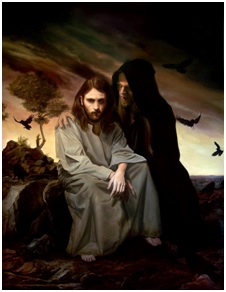
John 8:47 47 Whoever is from God hears the words of God. The reason you do not hear them is that you are not from God.

*This may also be “without fear [of sinning]”

Location Core content
Genesis 22:1-19 Moses listens, and obeys, when God tells him to sacrifice Isaac.
Proverbs 18:13 Listen before you answer
Proverbs 19:20 Listen to advice
Malachi 4:1-3 All arrogant evildoers will be stubble to be burned
Psalm 32:8-9 Don’t act like a mule
Mark 13:11 The Holy Spirit will tell you what to say
John 10:6 Other sheep will listen to Jesus’ voice
John 18:37c “Everyone who belongs to the truth listens to my voice.”
Romans 8:31 If God is for us, who can be against us?
Romans 8:33 God will defend his Elect
Romans 10:17 Faith comes by hearing
Hebrews 2:1-4 We must pay greater attention to what we have heard
1 Corinthians 1:18-25 Has not God made foolish the wisdom of the world?
1 John 5:15 He hears us in whatever we ask
Revelation 3:20-24 Let anyone who has an ear listen to what the Spirit is saying

What shall we do, then, Belovéd? I think first we must believe these promises and embrace them so as to completely live in, by, and through them. Secondly, I think we must, must pray for and educate the arrogantly evil persons who deny the reality of God as well as the reality of hearing him speak – mostly in our heart – but also, sometimes, in our minds and/or ears. I have heard him both ways, and he has never denied me his counsel or his love.

Belovéd, as we listen to his voice as articulated to us in Holy Scripture, let us take courage as the Psalmist says in Psalm 27:1414 Wait for the Lord; be strong, and let your heart take courage; wait for the Lord!

Finally, in addition to embracing Scripture and praying while teaching the arrogant, we need to ask for God’s merciful intervention: For leaders throughout the world and all of those in authority, guide them to govern with morality, compassion, integrity, wisdom, and justice so we can all live together in Peace. AMEN. There is a great division – not only in our country, but also around the world – between the World’s Way and God’s Way. God’s Way will triumph, but there will be much more to endure as the divisions deepen, widen, and grow in intensity. Some of us might say, “l don’t want to get into all this, and neither should you. It’s just all politics, bad politics at that!” No, Belovéd, this is not just bad politics; this is Spiritual Warfare: Ephesians 6:12 12 For our struggle is not against enemies of blood and flesh, but against the rulers, against the authorities, against the cosmic powers of this present darkness, against the spiritual forces of evil in the heavenly places. Even at the threshold of Heaven, evil strives to capture the weak and reckless and to drag them into Satan’s miserable pit of destruction.

Who else but God can bring peace to all the troubled souls who embrace the evils The World offers? We know a secret, Belovéd:

Psalm 37:3-7
Trust in the Lord, and do good;
so you will live in the land, and enjoy security.
Take delight in the Lord,
and he will give you the desires of your heart.
Commit your way to the Lord;
trust in him, and he will act.
He will make your vindication shine like the light,
and the justice of your cause like the noonday.
Be still before the Lord, and wait patiently for him;
do not fret over those who prosper in their way,
over those who carry out evil devices.

God will prepare us, as he prepared Abraham. Many times in these essays I’ve written about “My Old Friend Abraham.” Most of could never do the things Abraham did. Why? Because that is not our gift. Abram was a righteous man to whom God elected to revel himself as El Shaddai – Almighty God. Abram believed what God told him, and for his faith in God, El Shaddai made him Abraham the Father of Many Nations – and the founder of our faith in God. Abraham was prepared by God to do great things. We are all prepared by God to do some things. When we do part of those “some things” for ourselves, we are not giving all that God has given us. Every good and perfect gift comes from above (See James 1:17), so everything we have that is good comes from God through Christ Jesus. Everything we have that is not good does not. We should never try to give God the things that did not come from him; however, we can ask him to take them and make them good. That is what God does. He takes stuff that’s not-so-good and makes it wonderful. Believe it or else, he can even bring good things out of all the ugliness brought about in the past month, the past year, the past decade, the past century! Truly, “He hears us in whatever we ask,” and ” If God is for us, who can be against us?” I assure you it will not matter if it is those who “say in their hearts, “There is no God.'” Be still and wait on the Lord inwardly, but speak up and confront the arrogantly evil compassionately. What did you say? You said, “Love one another as I have loved you.”

What did you say? You said, “God loves you, so I will, too. Now let’s see if we can solve this problem together.”

Whatever, whenever, wherever, whoever, however, if ever, forever — at your service, Belovéd!

Unless otherwise indicated, all scripture passages are from the New Revised Standard Version Catholic Edition (NRSVCE) New Revised Standard Version Bible: Catholic Edition, copyright © 1989, 1993 the Division of Christian Education of the National Council of the Churches of Christ in the United States of America. Used by permission. All rights reserved.

Creative Commons License
Aloha Friday Messages by Charles O. Todd, III is licensed under a Creative Commons Attribution-ShareAlike 3.0 Unported License

Aloha Friday Message – February 16, 2018 – Top Forty Countdown

1807AFC021618 – Top Forty Countdown

Read it online here, please. And please, when you visit there, use one of the social media links at the bottom of the page to share this post. Thank you! And remember, we now have a READER VIEW available, so share this link or this email often.

Mark 1:13 13 He was in the wilderness forty days, tempted by Satan; and he was with the wild beasts; and the angels waited on him.

Matthew 4:11 11 Then the devil left him, and suddenly angels came and waited on him.

¡Que la bendición esté siempre con ustedes y que Dios los bendiga, Amados! (May blessing always be with you and may God bless you, Belovéd!) Good morning and welcome to the first Friday of Lent. Some of us look upon these forty days of preparation for Easter with dread. We sometimes get stuck on the idea that we have to “give up something” for Lent. “Jesus made a sacrifice and so must we.” That’s an OK way to look at it I suppose, but I’d much rather look at it as 40 days of good, strong spiritual discipline (often lacking in my day-to-day endeavors). That means I have 40 days to really work hard on making my relationship with Jesus, others, and myself better. Do you recognize that formula J-O-Y? J is for Jesus, O is for Others, and Y is for you. Lent can be for us a season of sorrow and mourning, of struggle and denial of personal comforts, or it can be a time of waiting filled and willed with great hope!

Why do we wait with hope? Well, it is certainly for the joy of Easter Morning, but it is because of what happened before that stupendous day. Not the Passion, not the Ministry, not the waiting, but only the long-held HOPE that began in Genesis and was perfectly expressed by Job. Here is how he confidently expressed his hope: Job 19:25-27 25 For I know that my Redeemer lives, and that at the last he will stand upon the earth; 26 and after my skin has been thus destroyed, then in my flesh I shall see God, 27 whom I shall see on my side, and my eyes shall behold, and not another. My heart faints within me! If you’d like to hear that in a very special setting, try this: “I Know That My Redeemer Liveth” (↔ Music Link) MY Redeemer went into the desert for 40 days as preparation for his ministry.

This period of preparation is described in the Gospels as forty days and forty nights. We see that phrase in Scripture often. One can be quite literal about it and claim it covered 40 calendar days; another way to think of it is as an expression of “a really long time.” Either way, a period of waiting that lasted 40 units of time is a common occurrence in Scripture:

The most famous perhaps belongs to Moses as we read in Exodus 24:18 18 Moses entered the cloud, and went up on the mountain. Moses was on the mountain for forty days and forty nights. Again, after Moses smashed the tablets because of Israel’s sin of idolatry, we read in Exodus 34:28 28 He was there with the Lord forty days and forty nights; he neither ate bread nor drank water. And he wrote on the tablets the words of the covenant, the ten commandments. Equally famous is the forty days of rain we learn about in Genesis 7:4, 10-12 4 “For in seven days I will send rain on the earth for forty days and forty nights; and every living thing that I have made I will blot out from the face of the ground.” 10 And after seven days the waters of the flood came on the earth. 11 In the six hundredth year of Noah’s life, in the second month, on the seventeenth day of the month, on that day all the fountains of the great deep burst forth, and the windows of the heavens were opened. 12 The rain fell on the earth forty days and forty nights.

There are more:

  • There were forty years of peace during the leadership of Gideon (Judges 8:28)
  • Goliath presented himself to the army of Israel for forty days. (1 Samuel 17:16)
  • After eating a loaf of bread and drinking a cruse of Elijah fled from Jezebel traveling to Horeb for forty days without stopping(1 Kings 19:8)
  • David rules over Israel forty years (1 Kings 2:11)
  • Jonah announced that Nineveh would be overthrown in forty days, but they repented and the Lord stayed his anger (Jonah 3:4-10)
  • 40 stripes was the maximum whipping penalty (Deuteronomy 25:3).
  • The holy place of the temple was 40 cubits long (1 Kings 6:17)
  • Ezekiel bore the iniquity of the house of Judah for 40 days (Ezekiel 4:6)
  • Jesus remained on earth 40 days after resurrection (Acts 1:3)

When 40 is used in terms of time, it often represents a period of testing, hardship, and reprimand. It is a time of waiting, growing, and preparing for the blessings that are sure to follow. For Jesus, his 40 days in the wilderness were a time of resolution to do his Father’s will. Satan came to test him, perhaps because he suspected Jesus was indeed the Son of God, and Jesus was victorious in the test. At the moment of that Great Victory, Jesus was attend to by angels. Satan had seen enough, and he took off. We sometimes need a reminder of who and what Satan is.

We first hear of Satan in 1 Chronicles 21:1 – he “stood up against Israel, and incited David to count the people of Israel.” He is first referred to as the devil in the New Testament. The terms are roughly equivalent. Satan is a devil and a devil, like Satan, is one who “stands against” – opposes, accuses, contends – against us, the earthlings. Satan, also referred to by his angelic name Lucifer, the “Angel of Light,” is that angel which rebelled against God by desiring to be “greater-than-or-equal-to” God. When he was cast out of heaven (See Isaiah 14:12-15), he took many of his followers with him. He is the prosecutor who charges us with sin and attempts to bend us to his will by twisting the truth; he is a liar. Satan looks like this in Hebrew: שָּׂטָן‎‎ (Satan) {saw-tawn’}, meaning “enemy” or “adversary,” who is always opposed to God’s will, constantly plotting against God and all of humanity. In the Greek version of the Old Testament, he is referred to as διάβολος diabolos {dee-ab’-ol-os}, a slanderer who throws misrepresentation of Truth into our path.

He is the Prince of Demons, the Old Serpent, Old Scratch, and Prince of the Air. He gained Adam’s right to God’s Garden when Adam gave the Serpent a higher level of trust than he gave God.  Satan’s minions (which are not at all like the cute little yellow creatures so popular these days) are called Fallen Angels – δαιμόνιον (daimonion) {dahee-mon’-ee-on} – evil spirits who are the messengers and ministers of the devil. They serve him by plaguing us with lies and more lies attempting to get us to trust ourselves rather than God; in short, they try to get us to commit their sin of opposing God in all things. Jesus saw Satan fall and I sincerely believe he was expecting him to show up when he went into the desert to fast and pray.

That is what we are to do during this season of Lent – fast, pray, wait, and HOPE. Jesus knew what was ahead of him. He did not cower when facing his enemy. Jesus knew he was God’s only begotten Son, and he had a job to do. If you are alive and reading this today, you, too, have a job to do.

God said, “This is my Belovéd Son in whom I am well pleased.” Satan leads with “IF you are the Son of God, turn these stones into bread.” Satan tells us as well, “Don’t just stand there! Do something!” This is the same lie he told Eve: “Don’t wait for God to make life better. You can do it yourself.” In this Gospel passage, Satan quotes – or rather misquotes – Scripture. We often hear of folks who decide to “test their faith” by testing God. How do we test God? By taking risks with sinful things we know will hurt us – everything from addictions to misplaced piety. Our holiness does not come from within us – it comes from God and returns to God when we choose to be righteous.

In the Gospel of Mark, the whole forty days and the temptations therein are summed up in one sentence. Jesus was with the wild beasts (μετὰ τῶν θηρίων). This describes for us the intense seclusion of his trial. In addition we can infer that due to the virtue of our Redeemer he was unafraid and unmolested by any beast or vermin as did Adam in Eden. Jesus is indeed the Savior promised in Genesis 3:15, the Redeemer Job anticipated, and the prophet Moses declared God had prepared for his people in Deuteronomy 18:15-18 15 The Lord your God will raise up for you a prophet like me from among your own people; you shall heed such a prophet. 16 This is what you requested of the Lord your God at Horeb on the day of the assembly when you said: “If I hear the voice of the Lord my God any more, or ever again see this great fire, I will die.” 17 Then the Lord replied to me: “They are right in what they have said. 18 I will raise up for them a prophet like you from among their own people; I will put my words in the mouth of the prophet, who shall speak to them everything that I command.

What Jesus spoke to us was to “repent and believe the Gospel.” In these coming 40 days (minus three for Wednesday, Thursday, and today), we can do just that. These can be the best 40 Days of 2018 if only we live these days in Hope and make them our Top 40 Countdown to Victory in Jesus (↔ Music Link). Belovéd, let’s do this together – let’s make these Forty Days and Forty Nights (↔ Music Link) as authored by George Hunt Smyttan in 1856 the Top Forty Days of 2018. Remember, we each have our own Guardian Angel (↔ Music Link), and all over Heaven we know that we can sing Angels Watching Over Me (↔ Music Link). Perhaps you also will remember to sing one more hymn with reverent joy and hope:

These Forty Days of Lent, O Lord (↔ Music Link)

These forty days of Lent, O Lord,
With you we fast and pray;
Teach us to discipline our wills
And follow Lord your way.

As you with Satan did contend,
And did the victory win,
O give us strength in You to fight,
In you, to conquer sin.

As thirst and hunger you have known
So teach us gracious Lord,
To die to self and only live
By your most holy word.

And through these days of penitence,
And through your Passiontide,
Forever more, in life and death,
O Lord with us abide.

Abide with us, so that this life
Of suffering once past,
An Easter of unending joy
We may attain at last.

There is such J.O.Y. in Hope! Instead of giving up something for Lent, take up something instead. TAKE UP HOPE! You might just end up in the company of angels.

Whatever, whenever, wherever, whoever, however, if ever, forever — at your service, Belovéd!

Share-A-Prayer

Pray for an end to the anger that is tearing this nation and this world apart. Anger is one of Satan’s favorite tools (he tried to use it against Job), so use Hope and Joy instead of anger.

Unless otherwise indicated, all scripture passages are from the New Revised Standard Version Catholic Edition (NRSVCE) New Revised Standard Version Bible: Catholic Edition, copyright © 1989, 1993 the Division of Christian Education of the National Council of the Churches of Christ in the United States of America. Used by permission. All rights reserved.

Creative Commons License
Aloha Friday Messages by Charles O. Todd, III is licensed under a Creative Commons Attribution-ShareAlike 3.0 Unported License

Biblical languages inserts from Bible Hub (Bible Hub: Search, Read, Study the Bible in Many Languages) Visit at http://biblehub.com


Aloha Friday Message – February 9, 2018 – Follow The Leader

1806AFC020918 – Follow The Leader

Read it online here, please. And please, when you visit there, use one of the social media links at the bottom of the page to share this post. Thank you! And remember, we now have a READER VIEW available, so share this link or this email often.

Excerpt from Mark 6:30-46 30 The apostles gathered around Jesus, and told him all that they had done and taught. 31 He said to them, “Come away to a deserted place all by yourselves and rest a while.”

Mark 1:40-41 40 A leper came to him begging him, and kneeling he said to him, “If you choose, you can make me clean.” 41 Moved with pity, Jesus stretched out his hand and touched him, and said to him, “I do choose. Be made clean!” (Follow the link to also see the New American Bible (Revised Edition) (NABRE) version of this passage)

1 Corinthians 11:1 Be imitators of me, as I am of Christ.

Aloha nui loa, ʻŌmea! Are you ready for a Hymn Sing? When I was a teenager – age 15 – 18 – I was in Christian Endeavor. We used to have kids from all over Denver and many other places in Colorado come together by the hundreds about once a month just to sing hymns together. It was wonderful! I don’t know of anyone or anywhere that is still done; let me know if you do, though, OK? I ask if you are ready for a Hymn Sing because I plan on sticking a bunch of (↔ Music Link) signals in this post. Let’s start off with that excerpt from Mark 6:30-46.

Last week in our lesson on Capernaum, we looked at how Jesus would go off on his own and pray in a deserted place. We certainly do need to get out of the rat-race rut these days and just spend a little quiet quality time with Jesus. We can trust him to sit there quietly with us, and perhaps he might quietly speak a Word of Wisdom to us, or give us a little knowledge, and insight into his life and ours. So, as we did last week, let’s retreat to a quiet place and prayerfully read his Word and sing his praise.

We go away to a place of rest to compose our hearts and minds in God. Some of us feel convicted by our sin and wish to join in the Sacraments to set our lives aright. Some of us feel the necessity of “being religious,” and some appreciate the fellowship with others whose religious aspirations and views match ours. Some of us feel the joy of friendships and some of us feel shunned by the hypocrites around us. Some of us believe we are better at complying with the practices of worship and praise – we recite, gesture, sing, listen, and nod appreciatively on cue – and some of us think that the people around us are superficial religious nuts who have no idea about the depth of faith in our own hearts. If we look at all of these traits of the people at church, we see that we are a microcosm of humanity very much like the crowds – including The Twelve and Jesus’ closest disciples – who were the foreshadowing of the Kingdom of God and The Church of today.

In that sense, we recognize – or at the very least, we should suspect – that we are a work in progress. We are aware of our own imperfections (even if we don’t always fess up to them), and sometimes we are (regrettably) more acutely aware of the imperfections of others both in the assembly and outside in the World. For whatever reason we have for being in church, we come as we are even though we may not exhibit our true selves. Perhaps from time to time we pray or sing “Just As I am.” (↔ Music Link)  And sometimes, if we lift up our hearts and minds in prayer, we acknowledge our sins and repent, calling on our Lord and Savior to cleanse us from the things that keep us at the threshold of the Gates of Heaven as fully-participative citizens of the Kingdom of God. We may, on occasion, become so in tune with what God wants from his servants that we cry out “Here I am, Lord.” (↔ Music Link) There, in church, we are inspired by the people, things, and actions around us to do as Jesus invites: “Come away to a deserted place all by yourselves and rest a while.” In the tabernacle of our hearts, we go to that inner closet where only God sees the real person that we are. Once we have placed our attention in the presence of God, we are ready to take a meal together; we feast on the Word and The Presence of Christ. But how do we get to the Presence of Christ? Can it only be in a church pew that we find him? Christ is always with us, but are we always with him? Recall Isaiah 55:6 Seek the Lord while he may be found, call upon him while he is near.

Going with the Lord is not difficult if we make up our minds to be where he is when he is there. HUH? Maybe this will help: I have decided to follow Jesus (↔ Music Link). Jesus asks his Disciples to follow him. How are we going to do that if we don’t look for him? We have to follow Jesus. Why? Because when he calls us, we belong to him! Now I belong to Jesus (↔ Music Link) isn’t just a “pretty thought;” it’s a reality once you go wherever he goes. He leads, and we follow because he is the Good Shepherd: John 10:14-18 14 I am the good shepherd. I know my own and my own know me, 15 just as the Father knows me and I know the Father. And I lay down my life for the sheep. 16 I have other sheep that do not belong to this fold. I must bring them also, and they will listen to my voice. So there will be one flock, one shepherd. 17 For this reason the Father loves me, because I lay down my life in order to take it up again. 18 No one takes it from me, but I lay it down of my own accord. I have power to lay it down, and I have power to take it up again. I have received this command from my Father.” Saviour Like a Shepherd Lead Us (↔ Music Link) now, you are probably beginning to get the idea of what a Hymn Sing is like!

Certainly we want to follow Jesus! He invites us over and over to do just that:

Matthew 16:24 24 Then Jesus told his disciples, “If any want to become my followers, let them deny themselves and take up their cross and follow me.”

John 1:35-37 35 The next day John again was standing with two of his disciples, 36 and as he watched Jesus walk by, he exclaimed, “Look, here is the Lamb of God!” 37 The two disciples heard him say this, and they followed Jesus.

John 8:12 12 Again Jesus spoke to them, saying, “I am the light of the world. Whoever follows me will never walk in darkness but will have the light of life.”

Some days we have problems in this era with trusting our leaders to lead us to safety, prosperity, and well-being. We wonder if they are reliable. We wonder, sometimes, if they are sane. But Jesus is another story. He is easy to trust because he is God, and there is a sweetness in trusting in God. Remember Psalm 34:8 O taste and see that the Lord is good; happy are those who take refuge in him! It is why we sing ‘Tis so sweet in Jesus and Jesus Loves Me (That’s not a Music link, but this is).


He is calling me, calling you, calling us to follow him. Let’s go already! Like the Apostle Peter said in 1 Peter 2:21-25 21 For to this you have been called, because Christ also suffered for you, leaving you an example, so that you should follow in his steps. 22 “He committed no sin, and no deceit was found in his mouth.” [See Isaiah 53:9] 23 When he was abused, he did not return abuse; when he suffered, he did not threaten; but he entrusted himself to the one who judges justly. 24 He himself bore our sins in his body on the cross, so that, free from sins, we might live for righteousness; by his wounds you have been healed. 25 For you were going astray like sheep, but now you have returned to the shepherd and guardian of your souls.

Come on, let’s sing together as we go together and Follow The Leader! You take his hand (↔ Music Link); I’ll take your other hand and go with you!    ♥

Whatever, whenever, wherever, whoever, however, if ever, forever — at your service, Belovéd!

Unless otherwise indicated, all scripture passages are from the New Revised Standard Version Catholic Edition (NRSVCE) New Revised Standard Version Bible: Catholic Edition, copyright © 1989, 1993 the Division of Christian Education of the National Council of the Churches of Christ in the United States of America. Used by permission. All rights reserved.

Creative Commons License
Aloha Friday Messages by Charles O. Todd, III is licensed under a Creative Commons Attribution-ShareAlike 3.0 Unported License


Aloha Friday Message – February 2, 2018 – Capernaum

1805AFC020418 – Capernaum

Read it online here, please. And please, when you visit there, use one of the social media links at the bottom of the page to share this post. Thank you! And remember, we now have a READER VIEW available, so share this link or this email often.

Psalm 147:3-5 He heals the brokenhearted, and binds up their wounds. He determines the number of the stars; he gives to all of them their names. Great is our Lord, and abundant in power; his understanding is beyond measure. ¡Que la bendición esté siempre con ustedes y que Dios los bendiga, Amados! (May blessing always be with you and may God bless you, Belovéd!) Today we will continue with Jesus’ mission which was situated for some time in Capernaum. Last week we looked into an event early in his ministry where, at the synagogue of Capernaum, he combined teaching and the miracles of exorcism and healing. This weekend’s reading from the Gospel of Mark (Mark 1:29-39) continues with events immediately after his teaching in the synagogue. He then goes to the home of Peter and Andrew. James and John went with those three. On entering the house, Jesus learned that Peter’s mother-in-law was ill with a fever. He went to her, healed her, and she immediately got up and served her guests. Later that evening, “the whole town was gathered at the door,” and Jesus healed many diseases and cast out many demons. After this long period of healing and ministering, Jesus surely must have been tired. Nonetheless we read (as in our Gospel reading for Sunday) he healed many. As the Psalmist says, God heals the brokenhearted. He heals those whose lives are broken by their health, by their tormenting demons, and he makes them whole. God is so wonderfully powerful that he knows the name and place of every star in the universe. His Word spoke them into being, and his Word named them all. God’s greatness is so vast that we cannot begin to understand it; and yet we experience it daily. The man, Jesus, was surely tired, but God the Son had more to do that day. He went off on his own to pray.

Mark 1:35 35 In the morning, while it was still very dark, he got up and went out to a deserted place, and there he prayed. Jesus went off alone to pray several times. He often went to a deserted place. Have you ever asked why he felt the need to pray? He was and is God, after all. A child once asked “Was Jesus just talking to himself then?” No. God the Son was speaking to God the Father. What would Jesus need to pray about? I always felt he was asking for strength, in much the same way as he did in Gethsemane. Here are some examples of passages where Jesus was praying: Matthew 14:23; Matthew 26:36-48; Mark 6:46; Mark 14:32-42; Luke 3:21; Luke 5:16; Luke 6:12; Luke 9:18; Luke 9:28; Luke 11:1; Luke 22:39-71; and best of all, John 17:1-26. That last one in John 17 is a great example of how Jesus prayed for his Disciples – including us! Now, how is that that the Creator of the Universe of whom John said, “All things came into being through him, and without him not one thing came into being” (See John 1:3) wants to pray for those Disciples and for these Disciples reading this message? Jesus chose to pray to ask his Father to protect us. Why did he choose? Jesus was human, and as a human I believe he, too, had free will. We understand in Scripture and in Liturgy that Jesus willing sacrificed his own life for us – for humanity. “Not my will but thine be done.” Jesus knows we also have that choice. We can choose to live with, in, and for him or with, in, and for ourselves. The former is difficult and increasingly rare. The latter is easy and increasingly popular; just watch the evening news or any of the several dozen awards programs constantly televised. Jesus went off to pray for himself and for us. He went somewhere that he could control the distractions of his day-to-day life – the crowds, the draining of his personal and spiritual energy, the fear of being killed before it was time … and the absolute knowledge that he would die a horrible death as a completely innocent man. Jesus did this because it was a wise thing to do; it helped him cope with the rigors of his fully human nature; and so the God of whom David said Great is our Lord, and abundant in power; his understanding is beyond measure also has the understanding that it is essential for Jesus to pray! If Jesus has the wisdom to pray, and if we wish to imitate Jesus, then we must pray as well. We often hear the words of Matthew 6:6 (in multiple versions here). Many people take this quite literally and set up a War Room or a Prayer Chapel in their own homes. For many years, my prayer chapel was my car. I usually had at least 30 minutes between home and work, and that was enough time to have a good long session with my Triune God El Shaddai-Olam. It’s a good idea to have a certain place to pray that allows you to be free (or freer) of distractions. It’s also a good idea to have a regular time to pray. First thing in the morning seems to work best for many folks. Start your day off with God and pretty much everything is well-ordered because you did the important things first (instead of doing urgent or selfish things first). It is especially important to be regular in prayer if you are one of those souls whose life is struggle after struggle after struggle. David says God heals the brokenhearted. Constant illness, or sorrow, of persecution, or any other negativity can really wear you down. In that verse, brokenhearted is שָׁבַר (shabar) {shaw-bar’}. It carries a connotation for being crushed, torn apart, shattered, or broken into pieces. God heals that! Many of us love sing that old hymn “TAKE IT TO THE LORD IN PRAYER.” What a Friend We Have in Jesus (↔ Music Link) Jesus did; so should we. That peace that surpasses all understanding (See Philippians 4:7) need not be forfeited because we don’t want to “bother God with our troubles.” God knows our troubles. He is pleased to attend to our prayers anytime, anywhere; he will take and shield thee. Take it to the Lord in prayer.  But where?

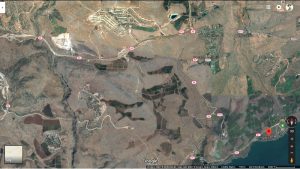
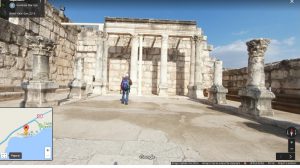
In most of those passages I gave you about Jesus praying, we are told he went off to a deserted place to pray. That word is ἔρημον (eremos) {er’-ay-mos}, and it means solitary, lonely, desolate, uninhabited, deserted by others, and even deprived of the aid and protection of others, especially of friends, acquaintances, or kindred. Belovéd, you already know we are never alone, especially when we go to God in prayer. Jesus went to such a deserted place just outside Capernaum. You’ll remember that he “relocated” there at the start of his ministry. He was teaching at the synagogue there in Capernaum and then in today’s lesson – he went over to Peter’s house and continued ministering there. Very early the next morning, before sunrise, he left to find a deserted place to pray. I’m going to put two photos here. One is an aerial photo of present-day Capernaum and the other is the ruins of “The White Synagogue,” a 4th century AD synagogue apparently built at the same location as the synagogue in Jesus’ day. (See bottom photo below)


If you look at the photo on the left, you can see that there are still many places that look “empty;” there no agriculture, gardens, or housing; just rock and dirt and plenty of it! I say this because it’s not that difficult to find a place close to where you are that can be your preferred place of prayer. It’s good to have a time and place that you yourself set aside for the sole purpose of conversing with our God. In the lower right of this photo you can see the balloon marker that indicated the location of Capernaum, and the body of water that fills that corner if the Sea of Galilee. It had several names throughout the millennia. It was also called Lake Tiberias. In Arabic it was called Buḥayrat Ṭabarīyā. Historically in Hebrew the name was Yam Kinneret. It is famous for its biblical associations; its Old Testament name was Sea of Chinnereth, and later it was called the Lake of Gennesaret. Chinnereth and Gennesaret are probably the same place – a smallish town a wee-bit southwest of Capernaum and right on the coast of this fairly large lake. And so Belovéd, we can feel comfortable going to the God who spoke into being all the stars and then named them each one by one, the God who heals the brokenhearted, the God who had the courage and will to pray to his Father for himself and for us. Please, take it to the Lord in prayer! Great is our Lord, and abundant in power; his understanding is beyond measure. That means he even understands you and me. Praise God!

Whatever, whenever, wherever, whoever, however, if ever, forever — at your service, Belovéd!

Unless otherwise indicated, all scripture passages are from the New Revised Standard Version Catholic Edition (NRSVCE) New Revised Standard Version Bible: Catholic Edition, copyright © 1989, 1993 the Division of Christian Education of the National Council of the Churches of Christ in the United States of America. Used by permission. All rights reserved.

Biblical languages inserts from Bible Hub (Bible Hub: Search, Read, Study the Bible in Many Languages) Visit at http://biblehub.com

Creative Commons License
Aloha Friday Messages by Charles O. Todd, III is licensed under a Creative Commons Attribution-ShareAlike 3.0 Unported License

Aloha Friday Message – January 26, 2018 – A Prophet In Deed

1804AFC012618 – A Prophet In Deed

Read it online here, please. And please, when you visit there, use one of the social media links at the bottom of the page to share this post. Thank you! And remember, we now have a READER VIEW available, so share this link or this email often.

Deuteronomy 18:18-20 18 I will raise up for them a prophet like you from among their own people; I will put my words in the mouth of the prophet, who shall speak to them everything that I command. 19 Anyone who does not heed the words that the prophet shall speak in my name, I myself will hold accountable. 20 But any prophet who speaks in the name of other gods, or who presumes to speak in my name a word that I have not commanded the prophet to speak—that prophet shall die.”
Aloha nui loa, ʻŌmea! January is nearly gone. What’s happening to this world? How can we be going through time so quickly; and why is that speed so predictable? Part of it has to do with, I believe, the toilet-paper syndrome. Life is like a roll of toilet paper. The closer to the end, the faster it goes. Ah, but which “end” are we coming to?

For many of us born in the 40’s, the end is nearer for us than for those of you born in the 70’s and 80’s. Even those among us in the early 90’s are probably already experiencing that time acceleration. When we were children, we couldn’t wait to get older – even counting our age in fractions – “I’m nine-and-a-half plus 13 days.” I find I’m in less of a hurry nowadays, but time is not. It just flies by in a blur. It goes by so fast that some days we can’t even keep track of what has happened, or what is happening, and have only foggy guesses about what’s going to happen.

There are plenty of folks out there, though, who are in the business of telling us what’s going to happen based on what is happening. Quite a few of them work in mainstream media or politics (although sometimes it’s hard to tell which is which lately). Some of these folks think they are prophets of the future and believe they can predict what happens, and they think that is “prophecy.” They believe they are able to prophesy what’s going to happen to us if so-and-so doesn’t stop (or start) doing such-and-such. We sometimes attribute the Gift of Prophecy to horoscopes (God forbid!), or to pundits who blather on in public about every possible outcome. That is a common and unfortunate understanding of what and who a prophet is. Let’s get that straightened out. Here are a bunch of questions about prophets, and yes, these are intended to be punny.

Prophet Humor Was Jimmy Swaggart a prophet or a loss? Do Camp-Meeting Revivalists depend on high-volume prophets? If Jerry Falwell joined weight-watchers, is that a prophet reduction? Could the spaces between the texts on the Dead Sea scrolls be considered prophet margins? Is Jean Dixon a paper prophet? How about Sidney Omar? When Tibetan Lamas levitate, is that a rise in prophets? Is Oral Roberts an example of prophet variability? Are seminaries prophet-making organizations? Were/are Sun Yat Moon and Eric Pepin gross prophets? Atheists are non-prophet centers. Was the Soviet Polit Bureau a non-prophet organization? Was the PTL club a prophet distribution program or a non-prophet organization? Are Seminaries, Monasteries, Nunneries, and Abbeys prophet centers? If you win all of the sports betting pools at work, does that mean you have prophet-ability?

OK, yes, most of those are pretty lame and based on the homophones prophet and profit. But really, what is a prophet and what is a “seer?” Here is a very formal definition gathered from the International Standard Bible Encyclopedia (ISBE):

One common notion is that a prophet is someone who predicts the future, a “seer” as in someone who is clairvoyant, can divine the future through supernatural powers. In this connotation, a person is often already considered a false prophet, a hoaxer, and one whose pronouncements are self-promoting. This is not the biblical meaning of prophet. There are words in the Bible that are translated as “seer,” and the persons associated with that word (usually the Hebrew חֹזֶה (cho-zeh) {kho-zeh’} or רָאָה (ra’ah) {raw-aw’}) are recognized as persons through whom God sends messages. We see this in 1 Samuel 9:9 (In former times in Israel, anyone who went to consult God used to say, “Come, let us go to the seer” for he who is now called prophet was formerly called seer.)

The Old Testament word for prophet is נָבִיא (nabiy’ ) {nah-bee’}. There are some disagreements among scholars about the origin of that word, but one that is well-accepted is that this noun comes from the verb noba` meaning to “bubble up,” “boil over”,” as in “to pour forth an abundance of words,” such as those who speak within divine inspiration. It is by and through the power and inspiration of God that a prophet speaks, and a prophet can’t help but speak when and what God commands any more than a boiling pot can stop bubbling. And that is the key. Those who have Divine Inspiration are True Prophets. The converse is that those whose “inspiration” is self-generated are the False Prophets. How then can we tell the difference? If we look at the verses following Jesus description of wolves in sheep’s clothing, the answer is clear.

In today’s key verse, we have a prophecy about a future prophet who will be a perfect prophet in word and deed. He will speak what God tells him to speak. Jesus is that prophet. In Sunday’s Gospel we will hear in Mark 1:22 22 They were astounded at his teaching, for he taught them as one having authority, and not as the scribes. In John 5:19 and John 7:16, Jesus confirms that he is a prophet when he says that the words he speaks are not his own, but come from his Father, the one who sent him. This is the primary test of a true prophet – that what s/he says is consistent with what God says. A second test is whether or not the prophecy comes true. Jesus consistently speaks and does what God commands. Those who listen and believe receive the reward of eternal life. Those who refuse to believe are judged by the Word, i.e., the words Jesus spoke on behalf of his Father:

John 12:44-49 44 Then Jesus cried aloud: “Whoever believes in me believes not in me but in him who sent me. 45 And whoever sees me sees him who sent me. 46 I have come as light into the world, so that everyone who believes in me should not remain in the darkness. 47 I do not judge anyone who hears my words and does not keep them, for I came not to judge the world, but to save the world. 48 The one who rejects me and does not receive my word has a judge; on the last day the word that I have spoken will serve as judge, 49 for I have not spoken on my own, but the Father who sent me has himself given me a commandment about what to say and what to speak. 50 And I know that his commandment is eternal life. What I speak, therefore, I speak just as the Father has told me.”

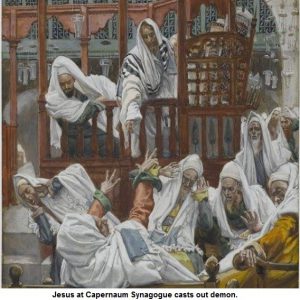
In just a few verses surrounding today’s Key Verse, we have a snapshot of Jesus’ teaching on a Sabbath in the vicinity of  the synagogue of Capernaum (Mark 1:21-31) combines teaching and miracles of exorcism and  healing. Mention is not made of the content of the teaching but of the effect of astonishment and alarm on the people. Jesus’ teaching with authority, making an absolute claim on the hearer, was in the best  tradition of the ancient prophets, not of the scribes. The narrative continues with events that evening (Mark 1:32-34; see the notes on Matthew 8:14-17) and the next day (Mark 1:35-39). The cleansing in Mark 1:40-45 stands as an isolated story.  [ Notes, New American Bible (Revised Edition) (NABRE)] Capernaum Καφαρναούμ (Kapernaoum) {cap-er-nah-oom’} was the place where Jesus set up a residence. The name means “village of comfort.” It was a large and busy city in the region of  Galilee situated on the western shore of the Sea of Galilee (a.k.a. Lake of Gennesaret) near the place where the Jordan flows into the lake.

I urge you to revisit John 3:16-22 so that you can see how Jesus’ prophecy – speaking the Word and Will of God – fits in with his mission. Just for good measure, we should also carefully read (in context) Matthew 10:32-33 and Matthew 10:40-42. We can get some idea of what happens to people who claim to be prophets, but who do not have the word, the will, or the permission of God to speak. Check out Jeremiah 14:14-19, Matthew 7:15-19, and of course all of Matthew 24. Anybody can take a guess at what the future will bring, but only a Prophet can tell us God’s will. Many claim to have that ability to prophesy, but test everything as we are told in 1 Thessalonians 5:20-21 20 Do not despise the words of prophets, 21 but test everything; hold fast to what is good. What do we use as a test? Please, go up a couple of lines and click on Matthew 7:15-19. The answer is in verse 16a – 16 You will know them by their fruits. If any prophesy is inconsistent with what God himself says or directs, it is FALSE.

Belovéd, do not cling to what is false, but only what is true, and remember that everything Jesus said or did conforms to the definition of a True Prophet because he was Divinely Inspired – Those who have Divine Inspiration are True Prophets. By their fruits you will know them through the deeds that they do in Love. Deeds performed as acts of sacrifice are validations of the words of Love. Jesus’ message is the prophetic Word – spoken on behalf of God and powered by his inspiration – that becomes redemptive by his perfect sacrifice. Jesus’ loving promises are spoken in love, and the deed – the action of, the doing of – speaking those words of promise is the Love of God through Christ Jesus. There is now truer deed, no truer prophet, no truer prophecy that to prophesy as Jesus did: John 15:13 13 No one has greater love than this, to lay down one’s life for one’s friends. This prophecy is Love given in deed and not merely in word. 1 John 3:18 18 My little children, let us not love in word, neither in tongue; but in deed and in truth. Authorized (King James) Version (AKJV)

Here is how we can know the effectiveness, the efficacy, of that prophecy. We learn of the Love of God and it’s power is that we Love To Love (↔ Music Link) him in word and in deed … and in song! (In Ireland, they have a proverb, “He who sings well prays twice.”)

Whatever, whenever, wherever, whoever, however, if ever, forever — at your service, Belovéd!

Unless otherwise indicated, all scripture passages are from the New Revised Standard Version Catholic Edition (NRSVCE) New Revised Standard Version Bible: Catholic Edition, copyright © 1989, 1993 the Division of Christian Education of the National Council of the Churches of Christ in the United States of America. Used by permission. All rights reserved.

Creative Commons License
Aloha Friday Messages by Charles O. Todd, III is licensed under a Creative Commons Attribution-ShareAlike 3.0 Unported License

Biblical languages inserts from Bible Hub (Bible Hub: Search, Read, Study the Bible in Many Languages) Visit at http://biblehub.com


Aloha Friday Message – January 19, 2018 – Fish Catch

1803AFC011918 – Fish Catch

Read it online here, please. And please, when you visit there, use one of the social media links at the bottom of the page to share this post. Thank you! And remember, we now have a READER VIEW available, so share this link or this email often.

John 1:14-15 14 Now after John was arrested, Jesus came to Galilee, proclaiming the good news of God, 15 and saying, “The time is fulfilled, and the kingdom of God has come near; repent, and believe in the good news.”

Aloha nui loa, ʻŌmea! This coming Sunday, many of us will be reading an excerpt from the book of Jonah. One of the most popular stories circulating on the Internet is about the little girl and her teacher discussing Jonah’s story: A little girl was talking to her teacher about whales. The teacher said it was physically impossible for a whale to swallow a human because even though it was a very large mammal its throat was very small. The little girl stated that Jonah was swallowed by a whale. Irritated, the teacher reiterated that a whale could not swallow a human; it was physically impossible. The little girl said, “When I get to heaven I will ask Jonah!” The teacher asked, “What if Jonah went to hell?” The little girl replied, “Well, then you can ask him.” Jonah was called to get a job done. Among the Aloha Friday Messages there are several essays about being called. In some of those writings, the person(s) called responded, in others, they did not. Recently we’ve written about The Church and those who were called, answered the call, and then went back to their former lives. Today, I want to look into a few of those persons who answered the call and followed through. Let’s start with Jonah.

You will remember that God called out to Jonah and told him he was to go to Nineveh, but Jonah disobeyed and ran away. Jonah 1:1-3 1 Now the word of the Lord came to Jonah son of Amittai, saying, “Go at once to Nineveh, that great city, and cry out against it; for their wickedness has come up before me.” But Jonah set out to flee to Tarshish from the presence of the Lord. He went down to Joppa and found a ship going to Tarshish; so he paid his fare and went on board, to go with them to Tarshish, away from the presence of the Lord. He was on that ship when a huge storm came up and the sailors cast lots to find out who had brought this great misfortune upon them. Ships sailing to and from Tarshish bore fantastic treasures of silver, gold, iron, lead, and tin. A ship in such a storm would mean a great loss in lives and cargo. When they had cast the lots, Jonah was identified as the “source of the problem.” He came up with a very surprising solution. He told them to throw him overboard!

Jonah 1:15-17 15 So they picked Jonah up and threw him into the sea; and the sea ceased from its raging. 16 Then the men feared the Lord even more, and they offered a sacrifice to the Lord and made vows. 17 But the Lord provided a large fish to swallow up Jonah; and Jonah was in the belly of the fish three days and three nights. This is where I’m supposed to point out the Bible doesn’t say “whale;” it says “great fish.” How did Jonah survive in the belly of a great fish for three days and three nights? It’s a mystery, one that prefigures Christ’s death and burial. However it came about, Jonah was apparently convinced the Lord meant business because he prayed for his life:

Jonah 2:8-10 “Those who worship vain idols forsake their true loyalty. But I with the voice of thanksgiving will sacrifice to you; what I have vowed I will pay. Deliverance belongs to the Lord!” 10 Then the Lord spoke to the fish, and it spewed Jonah out upon the dry land.

Jonah repented and obeyed. He went on to carry out his mission of prophecy against the people of Nineveh. Jonah 3:1-5 1 The word of the Lord came to Jonah a second time, saying, “Get up, go to Nineveh, that great city, and proclaim to it the message that I tell you.” So Jonah set out and went to Nineveh, according to the word of the Lord. Now Nineveh was an exceedingly large city, a three days’ walk across. Jonah began to go into the city, going a day’s walk. And he cried out, “Forty days more, and Nineveh shall be overthrown!” And the people of Nineveh believed God; they proclaimed a fast, and everyone, great and small, put on sackcloth.

Sackcloth in the Bible is a cloth made of black goats’ hair. It was prickly, itchy, and fairly heavy. As the name implies, it was used for sacks, and also worn by those in mourning or – along with ashes – as a sign of deep repentance. Nineveh “heard the word and repented.” When Jonah’s message was understood – that Nineveh would be overthrown – they [1] believed, [2] fasted, and [3] humbled themselves in repentance. Our key verse for today has pretty much the same formula: “The time is fulfilled, and the kingdom of God has come near; repent, and believe in the good news.” Nineveh was spared because a fish caught Jonah – sort of the reverse of what happens when humans go to catch a fish. We may recall that Jesus was particularly interested in fishermen. His first Disciples were fishermen – Andrew and his brother Peter (see last week’s post). Just a few words farther down the page in the Gospel of Mark we see that Jesus’ call to several fishermen was a life-changing experience. I’m going to put the whole passage here so you don’t have to look it up. (But it would be wonderful if you went and found your Bible to look it up or even clicked on the link I provide so you can see it in three different versions!) Mark 1:16-20 16 As Jesus passed along the Sea of Galilee, he saw Simon and his brother Andrew casting a net into the sea—for they were fishermen. 17 And Jesus said to them, “Follow me and I will make you fish for people.” 18 And immediately they left their nets and followed him. 19 As he went a little farther, he saw James son of Zebedee and his brother John, who were in their boat mending the nets. 20 Immediately he called them; and they left their father Zebedee in the boat with the hired men, and followed him. We have two sets of brothers who may have been business partners. They were called and left everything – nets, boats, family, coworkers (“hired men”) – and followed him. They had been catching fish for a living, now the fish were less important than following Jesus. FOLKS, THEY CHOSE TO FOLLOW HIM. They left everything because Jesus said “Follow me and I will make you Fishers of Men (↔ Music Link). Many are called, few are chosen. (See Matthew 22:14) Some were apparently either not called or ignored the call:

Zebedee, the hired men, Thomas’s twin, Peter’s wife and his mother-in-law, the bride and groom at Cana, the boy with the loaves and fishes (brought to Jesus by Andrew), the man carrying the water jug who leads the way to The Upper Room, the person who owned The Upper Room; the man who owned the donkey and the foal; these are not called by Jesus, and except for Zebedee we do not know their names. Of the Twelve who were called, we know their names and smatterings of their history. We know they were called by Jesus. Some who were called turned away, like “the rich young ruler.” The ones who answered the call became The Church. The ones who lived the call became the saints. BUT “those who do not believe are condemned already, because they have not believed in the name of the only Son of God. (See John 3:16-21 especially verse 18)

Fish and fishermen figure prominently in Jesus miracles: The feeding of the 5000 and the 4000, the Great Catch (See Luke 5:1-11), Jesus’ third appearance to the Disciples after his resurrection (See John 21:4-14), and the fish with the coin in its mouth (See Matthew 17:27).

Answering the call of Jesus is undoubtedly a life-changing experience. We give up the life of sin and paganism and live in Christ’s Law of Love as The Church. If we return to that life, we choose to fail to do what is right and willfully do what is wrong which means we are living outside The Church. Go back to last week’s post and read 1 Corinthians 6:9-20. If those who are in The Church receive the same condemnation as those who are outside The Church, then what sort of Eternity awaits whose who deny The Church by denying The Lord? Are all to be saved? Will all repent and believe the Gospel? Do me a solid and check out these two verses, then answer me, “What must we do to be saved?”

A Gaelic Prayer

See Matthew 10:32-33 and Luke 9:26. C’mon, you’ve got to be at least a little curious! Are we going to catch the fish, is the fish going to catch us, or are we in the desert of The World where no one can fish and no fish can be caught? Are we doing anything to catch people for God? Suppose we learned we have “forty days” left? Would burlap be a good substitute for sackcloth? If God is already crazy in love with us, shouldn’t we reciprocate? What are you doing, what am I doing, what are we doing to impress God with our worship and awe? Whatever it is, we should stop and just go with Psalm 63: “Step by step You’ll lead me and I will follow you all of my days.” (↔ Music Link) Matthew 9:9b … and he said to him, “Follow me.” And he got up and followed him.

As the hand is meant for holding and the eye for seeing, you have created me for JOY, O God. Share with me in finding that joy everywhere: in the violet’s beauty, in the lark’s melody, in the child’s face, in a mother’s love, in the purity of Jesus. Amen.

Traditional Gaelic Prayer

Whatever, whenever, wherever, whoever, however, if ever, forever — at your service, Belovéd!

Unless otherwise indicated, all scripture passages are from the New Revised Standard Version Catholic Edition (NRSVCE) New Revised Standard Version Bible: Catholic Edition, copyright © 1989, 1993 the Division of Christian Education of the National Council of the Churches of Christ in the United States of America. Used by permission. All rights reserved.

Creative Commons License
Aloha Friday Messages by Charles O. Todd, III is licensed under a Creative Commons Attribution-ShareAlike 3.0 Unported License

Aloha Friday Message – January 12, 2018 – What’s in a name?

1802AFC011218 – What’s in a name?

Read it online here, please. And please, when you visit there, use one of the social media links at the bottom of the page to share this post. Thank you! And remember, we now have a READER VIEW available, so share this link or this email often.

John 1:40-42 40 One of the two who heard John speak and followed him was Andrew, Simon Peter’s brother. 41 He first found his brother Simon and said to him, “We have found the Messiah” (which is translated Anointed). 42 He brought Simon to Jesus, who looked at him and said, “You are Simon son of John. You are to be called Cephas” (which is translated Peter)

1 Samuel 1:20 20 In due time Hannah conceived and bore a son. She named him Samuel, for she said, “I have asked him of the Lord.”

1 Samuel 3:10 10 Now the Lord came and stood there, calling as before, “Samuel! Samuel!” And Samuel said, “Speak, for your servant is listening.”

Aloha nui loa, ʻŌmea! May blessings always be with you and may God bless you in every way, Beloved!

When I was growing up (I’m almost afraid to tell you this!) everyone I knew called me Chuckie. By the time I got to fourth grade, I “rebelled” against that and told everyone to just call me Chuck. That worked all the way through high school. Then, at Hope College in Holland Michigan, I changed it to Chick – mainly because I was tired of all the “chuck” jokes like “how much wood could a wood chuck chuck,” and chuck wagon, and drill-chuck, and chuck-wrench, and chuck steak, and chuck out, and up-chuck, and chuck-full, and (maybe the worst) chuck-hole. Whew! Well, it didn’t take much longer for “Chick” to get the same treatment – here chick-chick-chick, and Chick Corea (one heckuva great jazz pianist), Chic-lets, chickadee, chick’n’noodle (really!), and chick peas, chick flick, Chick-fil-A, and a weird one – chickerica. ¡Ai! I submitted to these nick names of Chuckie, Chuck, and Chick because my given name, Charles, sounded too formal to me … “Chaahhhhrlz.” Now, my dad was called Charles by many people – including my mom and most of his coworkers in the Air Force and the Denver FHA office – but he never wanted to be called Charlie (and I never picked up that moniker, either!). On Facebook I was unable to get my profile listed as “Chick Todd,” even though nearly everyone I know and everyone who knows me calls be Chick. Nonetheless my name is CHARLES OLIN TODD, III (and there are also COT IV and COT V!)

Charles is an old European name – the French version is Charles and the Germanic version is Karl. The name is usually translated as “manly” or “strong.” My middle name, Olin is from Gaelic for holly or Norse for “recalls ancestors.” Todd – Scottish (northern Middle English) for red (tod) or fox (todde). When I received the Sacrament of Confirmation, I chose the name Timothy. Timothy comes from the Greek word (Timotheos) {tee-moth’-eh-os} meaning “honoring God.” Timothy was a fellow laborer in Christ with the Apostle Paul. We named our son using my names: Timothy Olin Todd. My Dearest Darling Wife’s name, Crucita, comes from the Spanish word Cruz (her father’s first name which means Cross) with the female-diminutive ita attached (and the z becomes a c). Many people believe that giving a child a strong name affects them throughout life; I can see some merit in that. Others believe that giving a child a unique name or a uniquely-spelled name (like Krystiin instead of Christine, or Emily, Emely, Emilee, Emilie, or even Emmalee) sets them apart. We came across a little girl named Escusada (really!) because mom thought it was a beautiful name – even when she found out that word is Spanish for “toilet.” In this era, the giving of names is more about being unique than it is about having a name with meaningful roots. That was not the case in most cultures until the mid-twentieth century.

Biblical names always had meanings that expressed something about the person. We know many of them:

  • Abram – Exalted Father
  • Abraham – Father of many
  • Isaac – He laughs. Laughter.
  • Κηφᾶς (Kephas) {kay-fas’} In the New Testament spelled Cephas (pronounced KAY-fus, not SEE-fus), the Aramaic word for “Stone” or “rock.” The Greek word is Πέτρος – (Petros) {pet’-ros} Peter = “a rock or a stone”
  • Andrew = “manly” from Greek Andreas {an-dreh’-as}
  • Simon – From Σιμων (Si-mon’), the Koiné Greek form of the Hebrew name שִׁמְעוֹן (Shim’on) Shimon = “he has heard”
  • אֶלְקָנָה (Elkanah) {el-kaw-naw’} = “God has possessed” or “God has created” He was Samuel’s father.
  • שְׁמוּאֵל . Shemuel {sehm-oo-ale’} Samuel = “his name is El”
  • חַנָּה (Hannah) {chan-ah’} = grace; she was Samuel’s mother.
  • Iesous {ee-ay-sooce’} Jesus and/or Joshua = “Jehovah is salvation” Joshua was the famous captain of the Israelites, Moses’ successor. Symbolically, the name Yehoshua/Yeshua/Jesus conveys the idea that God (YHVH) delivers or saves (his people). Yehoshua {yeh-ho-shoo’-ah} is another form of Joshua or Jehoshua = “Jehovah is salvation” – also seen as Yeshua – Jesus.

Some surnames – family names – can from what people did, for instance

  • Cooper – a maker of wooden, steamed-wood staves for barrels using metal hoops
  • Wagoner and Carter – operated a wagon or cart
  • Smith – a metals worker
  • Joiner – for carpenters
  • Mason – Stone worker
  • Spenser – provisioner
  • Marshall – horse-keeper, steward
  • Stewert – steward, bailiff
  • Garth – lives or works in a garden
  • Brooks – lives near a small stream

All these names carry a meaning related to what the parents hoped for in their child or what the person did as a profession. We know that the names of American First Peoples – from the Iroquois to the Hawaiians – also have clear and carefully-chosen meanings. For the most part, the kinds of names shown here represent positive connotations. There are also slang terms with very negative connotations usually used as racial slurs; we won’t list any of those here, but all of us probably know a few. The derivations of those words can be as fascinating as the derivation of other names. They are used as “labels” to point out the “otherness” of people, to make it clear there is a separation between “us and them.” Sometimes in the Bible, those names of separation are used to identify persons and pursuits that are improper. When I started this essay today, there were a few of those words that came along with the biblical names. None of us would want to carry these names to the next generation!

  • Fornicator
  • Adulterer
  • Prostitute
  • Robber
  • Reviler
  • Idolater
  • The unrighteous

A rose by any other name is …. A sinner by any other name is …. I want to show you just two passages that have these kinds of labels. It is important to remember as you read these words written by the Apostle Paul that he is referring to alleged Christians. They claimed to be Christian, but their behaviors were very un-Christian:

1 Corinthians 5:11 I wrote to you in my letter not to associate with sexually immoral persons— 10 not at all meaning the immoral of this world, or the greedy and robbers, or idolaters, since you would then need to go out of the world. 11 But now I am writing to you not to associate with anyone who bears the name of brother or sister who is sexually immoral or greedy, or is an idolater, reviler, drunkard, or robber. Do not even eat with such a one. 12 For what have I to do with judging those outside? Is it not those who are inside that you are to judge? 13 God will judge those outside. “Drive out the wicked person from among you.”

1 Corinthians 6:9-20Do you not know that wrongdoers will not inherit the kingdom of God? Do not be deceived! Fornicators, idolaters, adulterers, male prostitutes, sodomites, 10 thieves, the greedy, drunkards, revilers, robbers—none of these will inherit the kingdom of God. 11 And this is what some of you used to be. But you were washed, you were sanctified, you were justified in the name of the Lord Jesus Christ and in the Spirit of our God.

12 “All things are lawful for me,” but not all things are beneficial. “All things are lawful for me,” but I will not be dominated by anything. 13 “Food is meant for the stomach and the stomach for food,” and God will destroy both one and the other. The body is meant not for fornication but for the Lord, and the Lord for the body. 14 And God raised the Lord and will also raise us by his power. 15 Do you not know that your bodies are members of Christ? Should I therefore take the members of Christ and make them members of a prostitute? Never! 16 Do you not know that whoever is united to a prostitute becomes one body with her? For it is said, “The two shall be one flesh.” 17 But anyone united to the Lord becomes one spirit with him. 18 Shun fornication! Every sin that a person commits is outside the body; but the fornicator sins against the body itself. 19 Or do you not know that your body is a temple of the Holy Spirit within you, which you have from God, and that you are not your own? 20 For you were bought with a price; therefore glorify God in your body.


Fornication and adultery are two very common and very misunderstood words in modern usage. These behaviors are so prevalent that they are widely accepted, even among Christians. The Hebrew word translated “fornication” in the Old Testament was also used as an expression of idolatry which was characterized as spiritual whoredom. Adultery, as it appears in scripture, always refers to the sexual sin of married people with someone other than their spouse. The word is used in the Old Testament both factually and metaphorically. The Hebrew etymology for “adultery” is “breaking wedlock.” In the New Testament, the two Greek words translated “adultery” are nearly always used contextually to refer to sexual sin involving married partners. The modern dictionary definitions of fornication (voluntary sexual intercourse between persons not married to each other, which would include adultery) and adultery (voluntary sexual intercourse between a married person and a partner other than the lawful spouse). In the New Testament, “fornication” comes from the Greek word porneia, which includes adultery and incest. Porneia comes from another Greek word that also includes indulging in any kind of unlawful lust; and you might also see that it is the root word for this modern era’s severe plague of pornography.

How many “couples” do you know who hold marriage in disdain and practice cohabitation (“shacking up,” “just living together”) because they refuse to accept the idea of Holy Matrimony? They are fornicators. How many individuals do you know that have had extramarital affairs? They are adulterers. Do you know anyone, male or female, that offers or participates in sexual activities for money or other remuneration (including porn stars and those who watch porn, and of course prostitutes of any type)? They are all prostitutes. Do you know people who cheat on their Income Taxes? They are thieves. Do you know someone who uses racial slurs or character slurs or speaks derisively about neighbors or public figures? They are revilers (all of us should click on that link!) These are things so common they are deemed “acceptable,” based on the rampant moral relativism propagated throughout The World. The worst aspect of that is that very, very few people consider any of this to be “wrongdoing” or unrighteousness – even among Christians. Keep in mind what St. Paul said in 1 Corinthians 5:12-13 12 For what have I to do with judging those outside? Is it not those who are inside that you are to judge? 13 God will judge those outside. “Drive out the wicked person from among you. Too many people are too willing to judge everyone. “Do not judge, so that you may not be judged. For with the judgment you make you will be judged, and the measure you give will be the measure you get.” (See Matthew 7:1-2) and if “those outside” judge us as Christians, what is the outcome? “If you were arrested for being a Christian, would there be enough evidence to convict you?” Why are these things wrong? They are wrong because they contradict the Will of God and the Truth he created them to be.

The citizens of the “outside” have declared war on each other and dragged us into their mess. Stay out of it! MYOB! If it is true that “What we do says who we are, actions speak louder than words,” then we must avoid labeling or being labeled in any way as unrighteous wrongdoers, because Do you not know that wrongdoers will not inherit the kingdom of God? Do not be deceived! Is that unfair? No, it is not. It is what God decreed. It is his universe, his rules. If someone doesn’t like that, (as I’ve said often), they are in for one helluva surprise! “But they’re such good people! Look at the great things they do for poor people, for people who are discriminated against by good people! See how generous they are! Anyone who does good things for people is a good person. You can’t tell me that someone who says they love God and takes care of other people is evil!” OK. Go read Isaiah, Chapter 5 and Matthew 24:4-27, and maybe even Psalm 50. Then you will know that God has spoken. Are you listening, servant? For what have I to do with judging those outside?

Whatever, whenever, wherever, whoever, however, if ever, forever — at your service, Belovéd!

Share-A-Prayer

Our friends, family, and fellow citizens in California now dealing with floods and deadly mudslides after losing everything in those overwhelmingly devastating fires.

BONUS SECTION FOR ONLINE VERSION ONLY

” So you shall purge the evil from your midst.”

Deuteronomy 13:5
Deuteronomy 17:7
Deuteronomy 17:12
Deuteronomy 19:19
Deuteronomy 22:20-24
Deuteronomy 24:7
Hebrews 10:26-31 26 For if we willfully persist in sin after having received the knowledge of the truth, there no longer remains a sacrifice for sins, 27 but a fearful prospect of judgment, and a fury of fire that will consume the adversaries. 28 Anyone who has violated the law of Moses dies without mercy “on the testimony of two or three witnesses.” 29 How much worse punishment do you think will be deserved by those who have spurned the Son of God, profaned the blood of the covenant by which they were sanctified, and outraged the Spirit of grace? 30 For we know the one who said, “Vengeance is mine, I will repay.” And again, “The Lord will judge his people.” 31 It is a fearful thing to fall into the hands of the living God.

Frank Peretti On Knowing The Truth
“There’s no way for you to know whether what I’m telling you is true unless you know what the truth is. And there’s no way for you to know what the truth is unless there is a truth that you can know. [Editor: If you’re searching for the truth, and there is none, then what are you searching for?] You’ve got to have a truth that true whether you believe it or not. It is a truth that is true whether you like it or not. It’s true whether you even know about it or not. It’s just TRUE: OBJECTIVE EXTERNAL ETERNAL TRUTH THAT STANDS IN AND OF ITSELF.”

Unless otherwise indicated, all scripture passages are from the New Revised Standard Version Catholic Edition (NRSVCE) New Revised Standard Version Bible: Catholic Edition, copyright © 1989, 1993 the Division of Christian Education of the National Council of the Churches of Christ in the United States of America. Used by permission. All rights reserved.

Creative Commons License
Aloha Friday Messages by Charles O. Todd, III is licensed under a Creative Commons Attribution-ShareAlike 3.0 Unported License

Biblical languages inserts from Bible Hub (Bible Hub: Search, Read, Study the Bible in Many Languages) Visit at http://biblehub.com


Aloha Friday Message – January 5, 2018 – The Fruitful House of Bread

1801AFC010518 – The Fruitful House of Bread

Read it online here, please. And please, when you visit there use one of the social media links at the bottom of the page to share this post. Thank you! And remember, we now have a READER VIEW available, so share this link or this email often.

Matthew 2:5-6 They said to him, “In Bethlehem of Judea, for thus it has been written through the prophet: ‘And you, Bethlehem, land of Judah, are by no means least among the rulers of Judah; since from you shall come a ruler, who is to shepherd my people Israel.’”

¡Que la bendición esté siempre con ustedes y que Dios los bendiga, Amados! (May blessing always be with you and may God bless you, Belovéd!)

Aloha nui loa, ʻŌmea! Welcome to another year of engaging with God’s Word. A year ago we looked into the idea of Showing Up. The importance of showing up cannot be overemphasized. If you’re not there, you can’t be part of what’s happening. In school, it means you are unavailable for instruction. At work it means you are unavailable for production. In church, it means you are unavailable for praise. In life, it means you’re not available for days, nights, or weekends. In that message from a year ago, we looked into the day the Magi showed up at the house of Joseph, Mary, and Jesus. We don’t know if that house was in Bethlehem – the place where Jesus was born – but we should know a little more about that place – Bethlehem of Ephrathah. It is a very interesting name and an even more interesting place. Let’s start with the word, Bethlehem.

לֶ֣חֶם בֵּֽית־ Beit-Lechem or Beyth Lechem {bayth leh’-khem} means House (Beyth) of Bread (Lechem). What a perfect place for the birth of The Bread of Life! It is the place where Jacob buried Rachael. It is in the Tribal Possession of the Tribe of Judah. That area was very beautiful and fertile, abundant in figs, grapes, almonds, and olives. The country is what we’d call “hilly,” gently-rolling hills. It is just a bit uphill from Jerusalem and about 5.52 miles south of Jerusalem (straight line distance). Here’s a little table that will give you some idea about the elevations in that area. Mt. Hermon is the highest elevation in Israeli- controlled territories:

TABLE:

City Elevation (feet)*
Mount Moriah (Temple Mount) 2438 ASL
Jerusalem 2474 ASL
Bethlehem 2543 ASL
Mount Hermon 7,297 ASL
Sea of Galilee -695.8 BSL
Dead Sea -1,410.8 BSL
*ASL/BSL = Above/Below Sea Level

Bethlehem is connected with the story of Boaz and Ruth (and hence to the genealogy of Jesus) in Ruth 4:11-12 11 Then all the people who were at the gate, along with the elders, said, “We are witnesses. May the Lord make the woman who is coming into your house like Rachel and Leah, who together built up the house of Israel. May you produce children in Ephrathah and bestow a name in Bethlehem; 12 and, through the children that the Lord will give you by this young woman, may your house be like the house of Perez, whom Tamar bore to Judah.”

In this passage we also see the place-name Ephrathah; אֶפְרָ֗תָה {ef-raw’-thaw} or Ephraath {ef-rawth’}. It was considered a synonym for Bethlehem by even as far back as the book of Genesis. Ephrath is an older name. We see it in Genesis 35:19-20 19 So Rachel died, and she was buried on the way to Ephrath (that is, Bethlehem), 20 and Jacob set up a pillar at her grave; it is the pillar of Rachel’s tomb, which is there to this day. People from Ephrathah would be referred to as אפרתי (Ephrathites); for example Jesse of Bethlehem (the father of David) is called an Ephrathite (1 Samuel 17:12), and so are Elimelech (Naomi’s husband was Elimelech which means “my God is King”) and Naomi (whose name means “my delight”) and their sons Mahlon and Chilion died (Ruth 1:1-3). Naomi and her daughter-in-law, Ruth, went to live in Moab after Elimelech and his two sons died; Ruth’s name means “Friendship.”  The name Ephrath(ah) means “place of fruitfulness.” (It also ironically means “ash-heap!”) The most famous prophecy about “Bethlehem Ephrathah” is found in Micah 5:2-3 But you, O Bethlehem of Ephrathah, who are one of the little clans of Judah, from you shall come forth for me one who is to rule in Israel, whose origin is from of old, from ancient days. Therefore he shall give them up until the time when she who is in labor has brought forth; then the rest of his kindred shall return to the people of Israel. You can see that this is the Scripture cited in our Key Verse, Matthew 2:5-6. Let’s look back at Micah’s famous prophecy again:

It begins with But you, O Bethlehem of Ephrathah, who are one of the little clans of Judah …. It helps to understand a little about that peculiar designation. It has an important meaning in societies that have a tribal-based administration. It works like this: Nation → Tribe → Clan → Family → Person. Bethlehem of Ephrathah is a small clan of the Tribe of Judah of the Nation Israel. King David was born there and his family is/was part of that clan. David is a son of Jesse (whose father was Obed, the son of Boaz and Ruth). Jesus, in turn, is also a descendent of Jesse (See Isaiah 11:1 and the First Chapter of Matthew.)

As we continue, we read from you shall come forth for me one who is to rule in Israel, whose origin is from of old, from ancient days. Another way to display that last phrase is “Ancient of Days.” This is a synonym for God (See Daniel 7:9). It also occurs as from everlasting, or from antiquity, or from eternity. This ruler is and will be, of course, the Christ of God, the Son of David, the Word (Logos), the Light of the World, and the Messiah promised in Eden.

In verse 3 we see Therefore he shall give them up until the time when she who is in labor has brought forth. To whom does “she” refer? About 30 years before Micah recorded this amazing prophecy, Isaiah prophesied in Isaiah 7:14 14 Therefore the Lord himself will give you a sign. Look, the young woman [virgin] is with child and shall bear a son, and shall name him Immanuel. And what about give them up until the time? For the people in Micah’s vicinity, this also meant that “Daughter Zion” would be delivered from her enemies in the same way that the world is now being delivered from our Ancient Foe. (See Revelation 12:1-6)

And lastly, then the rest of his kindred shall return to the people of Israel. Historically, the return of the Remnant of Israel freed by Cyrus (See 1742AFC102017 – Whaddya think of that, eh?). Biblically, it is all the descendants of Abraham, Isaac, Jacob, Jesse, and The Messiah (by adoption). It all starts in the Little Town of Bethlehem (↔ Music Link) a quiet little town in the hill-country from which came the greatest of earthly Kings and the King of Kings. God does stuff like that. He picks the second, or even eighth, son. He chose Jonah who was a reluctant, even rebellious, prophet. He chose a pagan (Gideon a.k.a. Jerubbaal) to rescue Israel from the Midianites. He chose Cyrus to deliver Israel from Babylon. Moses was 80 years old and a fugitive shepherd when he saw The Burning Bush. Abraham and Sarah were so old no one but God could see it was possible for them to have children. Elisha was out plowing a field when Elijah named him as his successor. The Apostle Paul was a zealous Pharisee viciously persecuting The Way when Jesus called him to be the Apostle to the Gentiles. When God chooses, no one looses – as long as they obey God.

How about us, Belovéd? Are we small fish in a small pond in a small creek on a small hill? What shall we do if God asks us, or plans for us, to do the extraordinary? Is there a good way to handle a request like that? Consider the humongous request presented to Mary, the young woman who would bear the Son of God. Can we speak with confidence that same fiat? “Let it be done to me according to your word.”? God only knows what can happen if we just show up and say, “OK, Lord, what’s next?” Who but he knows how fruitful we can be in his House of Prayer?   בֵּית תְפִלָה (bayith tephillah) {bah’-yith tef-il-law’} (See Isaiah 56:7)

Whatever, whenever, wherever, whoever, however, if ever, forever — at your service, Belovéd!

Unless otherwise indicated, all scripture passages are from the New Revised Standard Version Catholic Edition (NRSVCE) New Revised Standard Version Bible: Catholic Edition, copyright © 1989, 1993 the Division of Christian Education of the National Council of the Churches of Christ in the United States of America. Used by permission. All rights reserved.

Creative Commons License
Aloha Friday Messages by Charles O. Todd, III is licensed under a Creative Commons Attribution-ShareAlike 3.0 Unported License

Biblical languages inserts from Bible Hub (Bible Hub: Search, Read, Study the Bible in Many Languages) Visit at http://biblehub.com


Pages Email Newsletter Categories Archives Connect
  • Connct to us here