Aloha Friday Message – June 9, 2017 – Koinonia

1724AFC060917 – Koinonia

The Solemnity of the Most Holy Trinity ~~ June 11, 2017

Read it online here, please. And please, when you visit there, use one of the social media links at the bottom of the page to share this post. Thank you!

2 Corinthians 13:13 [14] 13 The grace of the Lord Jesus Christ, the love of God, and the communion of the Holy Spirit be with all of you. [Enumeration of verses differs in other translations. Follow the link to see that.]

¡Que la bendición esté siempre con ustedes y que Dios los bendiga, Amados! (May blessing always be with you and may God bless you, Belovéd!)

So what is that, Koinonia? And why did I choose it for today? Κοινωνία Koinonia {koy-nohn-ee’-ah} means fellowship, association, community, communion, distribution, contribution, or to communicate. This word partially describes the way we share in the life and mission of the Body of Christ, and also hints at how the Holy Trinity is a single community of Three Divine Persons.

I am asking you to click on these three links so see what they say. When you open them, you can pick one version – “translation” – to read, or you can compare them side by side.

Matthew 28:19, 1 Peter 1:1-2, 1 Samuel 16:13

You can also find more information about the Holy Trinity here. The trinity is difficult to explain which is why it’s difficult to understand; or perhaps it’s the other way around – it is difficult to understand because it is difficult to explain. As we tell our RCIA students, it is a Mystery, something so outside of our experience that we cannot properly envision how it could work. We have the same sort of Mystery to deal with when we try to understand the Resurrection, or the Incarnation for that matter. We can get into discussions about the “generative” and “spirative” processes in the Trinity, but that doesn’t really make it any easier. When it comes to the Holy Trinity, we’re “Lost in Space.” I would like to use a couple of scriptural examples of Mysteries that are just as mind-blowing, but which we seem better able to accept. Perhaps this is because we’ve been exposed to The Bible According to Otto Preminger.

Mr. Preminger was a fabulous director and occasional producer in Hollywood. One of his most famous files was Exodus starring Charlton Heston. We all know that movie, and we all remember the scene where Israel crossed the Red Sea on dry land. We find that a little easier to believe because we have seen it – at least seen how it was portrayed. Did you know that Israel – and even individuals – crossed rivers on dry land in other Biblical accounts? The first time was at the edge of the Red Sea – with Pharaoh’s army right on their heels – but later, they crossed the Jordan River on dry land? Here are three examples of the crossing “on dry land.”

Exodus 14 – Israel passes through the Red Sea on dry ground. (See Exodus 14:21-22)

Joshua 3 – Israel crosses the Jordan on dry ground some forty years later (See Joshua 3:17)

2 Kings 2:8 Then Elijah took his mantle and rolled it up, and struck the water; the water was parted to the one side and to the other, until the two of them crossed on dry ground.

It seems to me, that with the help of Mr. Preminger, we can “accept” the idea of Israel crossing the Red Sea on dry land, then it is just as plausible that they crossed the Jordan River on dry land. We’re talking about God here, and God’s omnipotence is well-attested throughout Scripture. Elijah was certainly one of the greatest-ever prophets, so the idea that he could smack the river with his mantle and then God would cause the waters to part is the same sort of Mystery as the Red Sea and Jordan River crossings. In the same line of reasoning, it does not seem preposterous that Elijah would be swept up into Heaven in a Fiery Chariot (See 2 Kings 2:11), or that Jesus walked across the Sea of Galilee (See Matthew 14:22-33).I have never seen any of those events depicted in a Hollywood film, but I can imagine them because I can imagine the water-crossings of the Israelites. If we can get our heads around those Mysteries, then it seems that it must be possible to conceptualize the Trinity as well. Maybe you will remember an essay call Whole in One.

In that essay, we read: If we are Disciples of Christ, we know that Jesus named the three Persons in the Trinity at the end of the Gospel of Matthew – our opening verse. You will remember, though, that even the Disciples who were there with him throughout his Mission just couldn’t grasp that Jesus was God – and we have Jesus’ word on it that he is. Consider this, for example: John 14:9 Jesus said to him, “Have I been with you all this time, Philip, and you still do not know me? Whoever has seen me has seen the Father. How can you say, ‘Show us the Father’?” And also Jesus’ testimony about his relationship with God is spelled out in John 10:30 30 The Father and I are one. In John 1:1-4 we read, In the beginning was the Word, and the Word was with God, and the Word was God. He was in the beginning with God. All things came into being through him, and without him not one thing came into being. What has come into being in him was life, and the life was the light of all people. Jesus – the Logos of God – was there at Creation when the Spirit of God hovered over the waters. The whole trinity was there.

Again, at Jesus’ Baptism, the whole Trinity was there. We interact daily with the whole Trinity, for whenever we pray to God we pray to God-in-Three-Persons. Even if we pray, “Loving Heavenly Father,” or “Jesus my Lord and my God,” or “Spirit of the Living God,” we pray to God-in-Three-Persons. God is the Whole of Divinity in One Being – he’s not “the force,” he’s not “the guy upstairs,” he’s not “the intelligent designer.” He is GOD – known by many names to be sure (see 818AFC050208), but still just GOD-in-Three-Persons – Blesséd Trinity. The God of Abraham, Isaac, and Jacob is the God or our Salvation. That salvation comes from Jesus who is the only begotten Son of God (John 3:16-17) and who is one with and in God (See John 14:10-20)

Jesus was the last member of the Trinity identified to us. We knew Jehovah, we knew of the Spirit, we expected the Messiah, but until Jesus identified himself as the Christ, we did not know all the persons of the Trinity. We embrace the Mystery of the Miracles on the Old and New Testaments, and we can just as easily embrace the Mystery of the Trinity. We teach and preach about the unfathomable Mercy of God, and we can reliably know that his Mercy is also a Mystery because it is the product of Grace and Love. We can see the unity of the Trinity in a shamrock or in a Tetrahedron. We know that God is Great, God is Good, God is Omnipresent, Omnipotent, and Omniscient, and Omnibenevolent. Omnipresence is the stem of the shamrock, the base of the tetrahedron, the Foundation of the Ages. Because he can be Everywhere All That Is Can Be, he is Omnipresent. Because he is Omnipresent, he can be Omnipotent for he is All Power That Is Everywhere for All Time. And again, because he is Omnipresent and Omnipotent, he can be Omniscient for he is All Wisdom, Knowledge, and Glory in All Places At All Times for All Causes. Finally, because he is Omnipresent, Omnipotent, and Omniscient, he can be and forever is Omnibenevolent because his Perfect Justice, Perfect Love, Perfect

Light Life Word

Righteousness, and Perfect Kindness are shown to us every moment of our lives every way we look, every time we hear, everywhere we live and move and have our being. “Do you not know that your bodies are temples of the Holy Spirit, who is in you, whom you have received from God?” (1 Corinthians 6:19). Yes, he even lives in you and me! If you know that, then you know him.

That intimacy, that Communion of the Godhead, is the same communion of Faith that Paul called Koinonia. God has made himself known to us in many, many ways. Think of this: Romans 1:18-2118 For the wrath of God is revealed from heaven against all ungodliness and wickedness of those who by their wickedness suppress the truth. 19 For what can be known about God is plain to them, because God has shown it to them. 20 Ever since the creation of the world his eternal power and divine nature, invisible though they are, have been understood and seen through the things he has made. So they are without excuse; 21 for though they knew God, they did not honor him as God or give thanks to him, but they became futile in their thinking, and their senseless minds were darkened. In revealing to us the Truth about the Trinity, God has given us another glimpse into the majestic mystery of his power and grace; he is that eager to have us know him intimately, personally, and mysteriously.

It is that longing to have us with him that allows the Apostle Paul to say, allows you to say, allows me to say, allows every Christian past, present, and future to say, “ The grace of the Lord Jesus Christ, the love of God, and the communion of the Holy Spirit be with all of you..”

Amen!!
LIGHT ≡ GOD ≡ LOVE ≡ TRUTH ≡ WAY ≡ LIFE ≡ ETERNAL ≡ JUSTICE ≡ OMNIPOTENCE
≡ ONE GOD IN THREE PERSONS

Whatever, whenever, wherever, whoever, however, if ever, forever — at your service, Belovéd!

Unless otherwise indicated, all scripture passages are from the New Revised Standard Version Catholic Edition (NRSVCE) New Revised Standard Version Bible: Catholic Edition, copyright © 1989, 1993 the Division of Christian Education of the National Council of the Churches of Christ in the United States of America. Used by permission. All rights reserved.

Creative Commons License
Aloha Friday Messages by Charles O. Todd, III is licensed under a Creative Commons Attribution-ShareAlike 3.0 Unported License

Biblical languages inserts from Bible Hub (Bible Hub: Search, Read, Study the Bible in Many Languages) Visit at http://biblehub.com


Aloha Friday Message – June 2, 2017 – Cloudy Days Ahead?

1722AFC060217 – Cloudy Days Ahead?

Read it online here, please. And please, when you visit there, use one of the social media links at the bottom of the page to share this post. Thank you!

Exodus 13:21 21 The Lord went in front of them in a pillar of cloud by day, to lead them along the way, and in a pillar of fire by night, to give them light, so that they might travel by day and by night.

Sirach 24:4 I dwelt in the highest heavens, and my throne was in a pillar of cloud.

Aloha nui loa, ʻŌmea! Peace be with you. I am excited about today’s message, so let’s get right to it.

Sometimes our Good Lord gives us a ZAP! We’re just going about our business, and then suddenly we hear something or see something or learn something – or relearn something – and then …

… EVERYTHING is different! That happened to me last Sunday as I listened to the homily given by our Associate Pastor, Parochial Vicar Rev. Moses Akubele. While presenting the facts about Jesus’ ascension, he said, “… and then Jesus was taken up in a cloud which throughout Scripture is the image of God’s power.” My little brain went …

The first thing I thought about was Exodus 13:21 21 The Lord went in front of them in a pillar of cloud by day, to lead them along the way, and in a pillar of fire by night, to give them light, so that they might travel by day and by night. So when we read in Acts 1:9 When he had said this, as they were watching, he was lifted up, and a cloud took him out of their sight, we are hearing testimony from the Apostles that Jesus was taken up in the power of God. Then, a couple of verses later, two angels state quite clearly in Acts 1:11b This [same] Jesus, who has been taken up from you into heaven, will come in the same way as you saw him go into heaven – that is in the power of God.

More illustrations raced through my mind as I hustled to keep up with my notes on Fr. Moses’ homily. I recalled that in Exodus, when Moses was called by the Lord to the top of Mt. Sinai, the top of the mountain was covered in smoke “like smoke from a kiln” because the Lord descended to the mountain in fire and the whole mountain trembled violently – as did the people in fear and awe. There were tremendous trumpet blasts and when Moses spoke to God, God answered in thunder. (See all of this in Exodus 19:16-20) Then in Exodus 20:21 we read 21 Then the people stood at a distance, while Moses drew near to the thick darkness where God was. Later, in Exodus 33:7-11, we learn about the pillar of cloud that stood at the entrance of the Tent of Meeting where … the Lord used to speak to Moses face to face, as one speaks to a friend. The Power of God was present to Moses and visible to the Israelites. God clearly wanted to be seen, heard, acknowledged, appreciated, reverenced, and loved. He gave us that command himself – Love the Lord your God. And to get our attention, he used spectacular signs, wonders, and miracles – many involving clouds and/or fire – to communicate with us. (More on this in the conclusion.)

There are other interesting examples of “cloud” and “fire” in Old Testament and New Testament passages. I did a little sleuthing and here are a few of the results:

In Psalm 104:2b-4 we read You stretch out the heavens like a tent, 3 you set the beams of your chambers on the waters, you make the clouds your chariot, you ride on the wings of the wind, you make the winds your messengers, fire and flame your ministers.

Numbers 9:15-17 15 On the day the tabernacle was set up, the cloud covered the tabernacle, the tent of the covenant; and from evening until morning it was over the tabernacle, having the appearance of fire. 16 It was always so: the cloud covered it by day and the appearance of fire by night. 17 Whenever the cloud lifted from over the tent, then the Israelites would set out; and in the place where the cloud settled down, there the Israelites would camp. I want to say something more about the appearance of fire a little later on.

Ezekiel 1:4-28 (only verse 4 shown here, but check out the rest of that remarkable passage) As I looked, a stormy wind came out of the north: a great cloud with brightness around it and fire flashing forth continually, and in the middle of the fire, something like gleaming amber.

Revelation 1:10 1 And I saw another mighty angel coming down from heaven, wrapped in a cloud, with a rainbow over his head; his face was like the sun, and his legs like pillars of fire. In this passage the word “rainbow” is preceded by the Greek definite article (hē) {hey} so that it reads ἶρις – the rainbow. Thus, as one might envision a halo, this glorious angel (perhaps even Christ himself?) bears above all his magnificence the mark of one of God’s early covenants with humanity – the rainbow.

Matthew 3:11 11 “I baptize you with water for repentance, but one who is more powerful than I is coming after me; I am not worthy to carry his sandals. He will baptize you with the Holy Spirit and fire.”

Luke 12:49 49 I came to bring fire to the earth, and how I wish it were already kindled!

And finally, of course, there is the beautiful passage in the Second Chapter of Acts:

Acts 2:1-4 1 When the day of Pentecost had come, they were all together in one place. And suddenly from heaven there came a sound like the rush of a violent wind, and it filled the entire house where they were sitting. Divided tongues, as of fire, appeared among them, and a tongue rested on each of them. All of them were filled with the Holy Spirit and began to speak in other languages, as the Spirit gave them ability.

After that amazing moment, Peter addressed the crowd outside the Cenacle and reminded the Jews that the prophet Joel had declared that God himself would pour out his own Spirit:

Joel 2:28-30 28 Then afterward I will pour out my Spirit on all flesh; your sons and your daughters shall prophesy, your old men shall dream dreams, and your young men shall see visions. 29 Even on the male and female slaves, in those days, I will pour out my spirit. 30 I will show portents in the heavens and on the earth, blood and fire and columns of smoke.

OK, time to wrap this up. In Numbers 9:16, we saw 16 It was always so: the cloud covered it by day and the appearance of fire by night. In Acts 2:3 we saw 3 Divided tongues, as of fire, appeared among them, and a tongue rested on each of them. And in Exodus 13:21 we read 21 The Lord went in front of them in a pillar of cloud by day, to lead them along the way, and in a pillar of fire by night, to give them light, so that they might travel by day and by night.

(click on it)

I came to understand that the “divided tongues, as of fire,” were like miniature pillars of fire – the presence of God – so that we might travel by day and by night in the light of his glory and grace as well as in the darkness of the shadow of Death and Evil. God gives us these gifts because he does want to be seen, heard, acknowledged, appreciated, reverenced, and loved. He gave us that command himself – Love the Lord your God. And to get our attention, he used spectacular signs, wonder, and miracles – many involving clouds and/or fire – to communicate with us. This is how we know Allah is not Jehovah. Allah is unknowable and non-communicative; only Jehovah is personal, personable, and knowable. Many Muslims believe fatalistically that Allah has determined in advance the outcome of all of your life thereby denying the Grace of Free Will. Jehovah loves all of humanity and calls all to salvation in Jesus; with Allah, he loves whomever he chooses and hates whomever he chooses. Allah cannot, will not, and would not die for you or for anyone. He most certainly would not allow someone else to die for you; and since Allah has no Son, that means you cannot believe in anything or anyone that will unconditionally love you and redeem you from sin. There is no wisdom in that.

The passage from Sirach (ben Sira) at the beginning is presented as spoken by the personification of Wisdom. Wisdom was with God when all things were created, and Wisdom dwelt in the highest heavens, and [her] throne was in a pillar of cloud. Wisdom is enthroned on the Power of God. That’s why I am always referring back to Proverb 9:10a. Wisdom begins with reverencing the Lord who makes himself known and knowable in myriad ways. He makes it possible for us to find him and follow him. If ever we stumble, it is he who protects and restores us. He guides us in all of life’s circumstances in ways that are always visible to the eyes of Faith if only Faith “opens the eyes of our hearts.” He – Jesus, the only-begotten Son of the Almighty, Living, and Eternal God – is coming back to us in the cloud of God’s Power and Glory. Let us hope and pray that there are Cloudy Days ahead as Jesus comes back in Glory! Start listening for that mighty trumpet blast!

Praise Report: We are expecting to hear any day now that AD, whose breast cancer was successfully removed surgically, will be released by her oncologist as a cancer-free survivor. Stay tuned for the celebration of Victory!

Share-A-Prayer – And with that in mind, another request has been made for prayers for ID – not related to AD – diagnosed this past week with an encapsulated tumor. Good prognosis, but still some discomfiting discomforts headed her way. Let’s continue praying for her as well as for all who have been, currently are, or will be affected by cancer. Mahalo nui loa!

Whatever, whenever, wherever, whoever, however, if ever, forever — at your service, Belovéd!

Unless otherwise indicated, all scripture passages are from the New Revised Standard Version Catholic Edition (NRSVCE) New Revised Standard Version Bible: Catholic Edition, copyright © 1989, 1993 the Division of Christian Education of the National Council of the Churches of Christ in the United States of America. Used by permission. All rights reserved.

Creative Commons License
Aloha Friday Messages by Charles O. Todd, III is licensed under a Creative Commons Attribution-ShareAlike 3.0 Unported License

Biblical languages inserts from Bible Hub (Bible Hub: Search, Read, Study the Bible in Many Languages) Visit at http://biblehub.com

 

Aloha Friday Message – May 26, 2017 – What have you done?

1721AFC052617 – What have you done?

Read it online here, please. And please, when you visit there, use one of the social media links at the bottom of the page to share this post. Thank you!

Aloha nui loa, ʻŌmea! Grace and peace be unto you from God our Father and from our Lord, Jesus Christ. Normally this weekend I would be writing to you about the biggest event in my Christian life – the Ascension. Why do I say “in my Christian life?” I say that because of all the events in Jesus’ life, that moment gives me the greatest hope; it confirms everything else that Jesus said. Today I am going to just ask you to look at this essay posted at www.Catholic365.com called Look Him Up. It contains my thoughts about what the angels said to the Disciples as Jesus ascended into heaven.

Today, though, I am going to take a look at one of those verses we often skip over. It is from this Sunday’s second reading. When you see it, you’ll recognize it as something familiar, something about which we all might say, “Yeah, I remember that, so-o-o-o …” Come with me and let’s take a look:

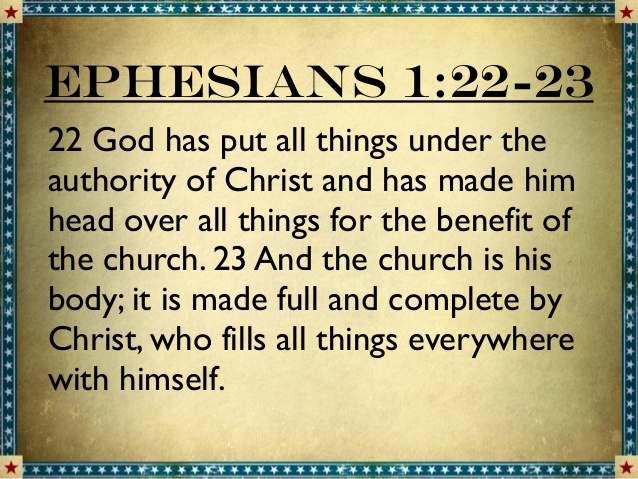
Ephesians 1:22-23 22 And he has put all things under his feet and has made him the head over all things for the church, 23 which is his body, the fullness of him who fills all in all.

OK, right, Christ is the head of the Church which is the Body of Christ on earth. I want you to think about the implications of this phrase: the head over all things for the church. Jesus is the head of the Church, no question about that, but that is not the limit of his sovereignty. Jesus is also El Shaddai – the Almighty Everliving God who created heaven and earth and All things came into being through him, and without him not one thing came into being.” (See John 1:3) He IS God. Perhaps you will also recall this bold declaration by the Apostle Paul to the Colossians:

Colossians 1:15-20 15 He is the image of the invisible God, the firstborn of all creation; 16 for in him all things in heaven and on earth were created, things visible and invisible, whether thrones or dominions or rulers or powers – all things have been created through him and for him. 17 He himself is before all things, and in him all things hold together. 18 He is the head of the body, the church; he is the beginning, the firstborn from the dead, so that he might come to have first place in everything. 19 For in him all the fullness of God was pleased to dwell, 20 and through him God was pleased to reconcile to himself all things, whether on earth or in heaven, by making peace through the blood of his cross.

We know God is Absolutely, Utterly, Unconditionally, Supremely, Unchangeably, Perfectly Sovereign. When we refer to God as being Sovereign, what does Sovereign mean? It signifies ultimate power which is once and for all an autonomous and unlimited authority over self and all others, all things, all places, and all times. That Sovereignty resides in Jesus the Christ. Last week we talked about what it means to obey Jesus’ commandments (which are, of course, God’s commandments), and we also saw that we have a choice; we can love him by obeying his commandments, or we can ignore his commandments and fail to love him (See Deuteronomy 30:19-20) If you are reading this today, perhaps it is because, like me, you have chosen to obey his commandments by loving him. Like me, you also know that loving Jesus is neither easy nor merely emotional. Loving Jesus, like any form of Love, requires action. “Like” is an emotion we feel when our minds recognize somebody or something as pleasing. It is not a “call to action.” On the other hand, “Love” is a call to action, and when we are called to action by Divinity through Divine Commands, we must choose either obedience or rebellion. Did you click on that link in Deuteronomy a few lines up? You should, because it will shed light on this link:

Joshua 24:15But if serving the Lord seems undesirable to you, then choose for yourselves this day whom you will serve, whether the gods your ancestors served beyond the Euphrates, or the gods of the Amorites, in whose land you are living. But as for me and my household, we will serve the Lord.

Whenever I see or hear that short verse, a flood of memories washes over me. Among the first and sweetest is hearing my dad quote that verse as part of his Christian witness to others. He was serious about it, and also joyous about it, even excited about what it meant for all of us. There are “contemporary Christian Music” songs about it; I don’t remember it being in any of the hymns we sang at Corona. Another memory that never fails to surface comes from 1979. I’ve mentioned this one before, but I think it’s worth bringing up again because it fits with today’s lesson. You might want to listen to this link privately because it’s about 7 minutes long and exuberant:

Gotta serve somebody  ~~ Bob Dylan, 1979 (↔ Music Link)

But you’re gonna have to serve somebody, yes indeed,
you’re gonna have to serve somebody.
It may be the devil, or it may be the Lord,
But you’re gonna have to serve somebody.

Thirty-eight years ago, Bob Dylan had a powerful conversion experience. He recorded a few Gospel songs. He changed his view of the world. The world did not exactly embrace his conversion. Years later (circa 1986) he would say he doesn’t follow any organized religion, and that the songs – the music, both religious and secular – were his lexicon. Did he leave the Lord? Well, as the saying in our house goes, “Only God knows, and he’s not tellin’.” However, what Robert Zimmerman wrote in that powerful lyric creates a strong echo in my heart for my dad’s testimony of Joshua’s statement. I’m going to have to serve somebody. That means I have to obey Somebody’s commands. I don’t wish to serve anyone other than the Lord; the Lord, however, commands that I do more than “merely” love him. What do you remember about that from last week? Who is it we are to love? We must love God and our neighbor (See Matthew 22:37-39) and even the people in our communities who are alien to us (See Leviticus 19:34). Do I, do you, do we, does somebody or anybody do that every day? You love him, so what have you done about it? What have you done? If we do any of these things, we are only starting to obey his commands because we are to do all of these … and more.

What have you done?

Served somebody. Prayed for somebody. Fed somebody. Instructed somebody. Visited somebody who is sick or in prison. Buried a loved one or a stranger. Clothed somebody. Warned somebody about sin. Comforted somebody. Forgiven somebody. Asked somebody for forgiveness. Patiently loved somebody. Shared faith with somebody. Slaked somebody’s thirst. Sheltered somebody. Helped baptize somebody. Married somebody. Loved, worshiped, adored, praised, thanked, and glorified Somebody – Jesus, the Christ of God who lives and reigns with God, the Father Almighty, in the unity of the Holy Spirit, the LORD, the Giver of Life. Been merciful to somebody as in Luke 6:36 36 Be merciful, just as your Father is merciful.

Have you? Of course you have, or at least you’ve done some of it; or maybe you’ve done all of that and more. “God knows but He’s not tellin.'” This kind of obedience goes in at least two directions – out and in.

It goes out to all the World because that is what we are commanded to do in Matthew 28:19-20 19 “Go therefore and make disciples of all nations, baptizing them in the name of the Father and of the Son and of the Holy Spirit, 20 and teaching them to obey everything that I have commanded you. And remember, I am with you always, to the end of the age.” We are to reach out, to make Disciples, to baptize with water in the Trinitarian formula, we are to teach obedience of his commands, and we are to remember him in the Sacraments and in our daily lives. It also goes in to our hearts, our churches, our loved ones, because he is the head over all things for the church, 23 which is his body, the fullness of him who fills all in all. Whatever we do in our lives, we are serving somebody; there is no insular existence that can be entirely shuttered from God. Serve him or not, he is always there to welcome our decision to serve him. That’s what we’re going to do because as for me and my household, we will serve the Lordhe, and he alone is fullness of him who fills all in all. He, and he alone, is Sovereign. What are we going to do for him? We’re gonna have to serve somebody.

Whatever, whenever, wherever, whoever, however, if ever, forever — at your service, Belovéd!

Share-A-Prayer: Recently RV underwent a PET scan. It was a difficult process because the device was over a hundred miles away, and it took several visits before they could actually complete the scan. It showed adenocarcinoma (formed from glandular structures in epithelial tissue). Non-small-cell lung cancer in his right lung, in his lymph nodes. and there are some spots in his left lung. PET scan shows spots in the right pelvis bone & the cranium. Tends to grow slower. Has spread outside of lungs, so Stage IV. R, and his wife B, are continuing to serve Somebody. Please serve them with your prayers. Thank you!

Unless otherwise indicated, all scripture passages are from the New Revised Standard Version Catholic Edition (NRSVCE) New Revised Standard Version Bible: Catholic Edition, copyright © 1989, 1993 the Division of Christian Education of the National Council of the Churches of Christ in the United States of America. Used by permission. All rights reserved.

Creative Commons License
Aloha Friday Messages by Charles O. Todd, III is licensed under a Creative Commons Attribution-ShareAlike 3.0 Unported License

New Living Translation (NLT) ~~ Holy Bible, New Living Translation, copyright © 1996, 2004, 2015 by Tyndale House Foundation. Used by permission of Tyndale House Publishers Inc., Carol Stream, Illinois 60188. All rights reserved.


Aloha Friday Message – May 19, 2017 – Do You Love Me?

1720AFC051917 – Do You Love Me?

Read it online here, please. And please, when you visit there, use one of the social media links at the bottom of the page to share this post. Thank you!

John 14:15 15 “If you love me, you will keep my commandments.” NRSVCE

15 If ye love me, keep my commandments.  ~~ Authorized (King James) Version (AKJV) KJV reproduced by permission of Cambridge University Press, the Crown’s patentee in the UK.

Aloha nui loa, ʻŌmea. The season of Easter is rapidly drawing to a close, and today I’m asking to look inside of you and answer the question God will ask you every day if you are listening. It is the way God tests us. We often think that when we endure hardships, pain, suffering, temptations, or any number of other negative things, that is God testing us. I think the test is a bit different. God tests us. He uses one of those incredible essay questions:

“Do you love Me? Why or why not?”

That’s THE BIG ONE worth 95 points out of a hundred possible points. But then he gives us lots of 25 point pop-quizzes with hundreds of bonus questions each worth up to 10 points each. Some are T/F, some multiple-choice, and some fill-in-the-blanks. Yes, He does test us, mostly on the essay, but, Good God that He is, he wants us all to get an A+ so they’re all open Book tests. Is being chronically ill with several debilitating conditions a difficult test? Is being mastered by addiction, even multiple addictions, a difficult test? Is giving your life for your child, or your spouse, or your nation, or a totally stranger a difficult test? Then what kind of test is it to love God?

If we love God, aren’t all of these other circumstances best conquered by knowing the we love God and – more importantly – God loves us? The verse I chose today is John 14:15. I’ve given you two versions of it because this is one I’ve pondered over many times. Let’s look at the first version from the New Revised Standard Version Bible. Note that it says, “If you love me, you will keep my commandments.” This could either be a declaration of fact or a commandment. Either way, the word “if” seems to make it conditional. We could switch the phrases around so it says, “You will keep my commandments if you love me.” This is a declaration that works out as an instruction: Love me, and that will be how you keep my commandments. We could get even more carried away and say it sounds like “If you really want to love me, just keep my commandments. Keeping my commandments is how you love me.” I can see how we might feel  like that is how Jesus might mean it. But even with that same, original word arrangement, there’s another sense presented. “If you [really] love me, you] will do as I have commanded] you.” Now, this also makes sense, because we know that God – the Trinity – has commanded that we love him since the very start, so if we really want to know how to love him, all we need to know – and do – is keep his commandments. It’s something to think about either way you look at it.

I decided to look deeper into God’s requirement that we love him. I was pretty surprised by what I found! There are many times in the Old Testament, especially in Deuteronomy, where God’s “thou shalt” is very clear. I decided to put them into a table for two reasons. First, because there were so many and secondly because there were also many places where God professes his love for us – initially through his love for his Chosen People. Here is the table:

Verse Core teaching
Exodus 20:6 but showing steadfast love to the thousandth generation of those who love me and keep my commandments. (God loves us)
Deuteronomy 5:10 showing steadfast love to the thousandth generation of those who love me and keep my commandments. (God loves us if we love him, and even if we don’t love him)
Deuteronomy 6:5 You shall love the Lord your God with all your heart, and with all your soul, and with all your might. (You must love him)
Deuteronomy 7:9 God who maintains covenant loyalty with those who love him (God blesses those who love him)
Deuteronomy 10:12 Only to fear the Lord your God, to walk in all his ways, to love him, to serve the Lord your God with all your heart and with all your soul (Easy: Love God, everything is good)
Deuteronomy 11:1 You shall love the Lord your God, therefore, and keep his charge, his decrees, his ordinances, and his commandments always. (Just do it. Love him!)
Deuteronomy 11:13-15 loving the Lord your God, and serving him with all your heart and with all your soul (Loving him is how to serve him)
Deuteronomy 11:22 diligently observe this entire commandment that I am commanding you, loving the Lord your God, walking in all his ways, and holding fast to him, (Follow the rules and just love him)
Deuteronomy 19:9 diligently observe this entire commandment that I command you today, by loving the Lord your God and walking always in his ways (Ah, now we’re on to something!)
Deuteronomy 30:6 so that you will love the Lord your God with all your heart and with all your soul, in order that you may live (Loving God pays off.)
Deuteronomy 30:16 If you obey the commandments of the Lord your God that I am commanding you today, by loving the Lord your God (There it is again.)
Deuteronomy 30:19-20 Choose life so that you and your descendants may live, 20 loving the Lord your God, obeying him, and holding fast to him; for that means life to you and length of days, so that you may live in the land that the Lord swore to give to your ancestors (Loving God means life.)
Joshua 22:5 observe the commandment and instruction that Moses the servant of the Lord commanded you, to love the Lord your God (Again!)
Joshua 23:11 Be very careful, therefore, to love the Lord your God. (Pretty clear there.)
Zephaniah 3:17 [God] will renew you in his love; he will exult over you with loud singing (God loves loving us!)
Romans 8:39 [nothing] will be able to separate us from the love of God in Christ Jesus our Lord. (It says what it says.)
2 John 1:3 Grace, mercy, and peace will be with us from God the Father and from Jesus Christ, the Father’s Son, in truth and love. (John 3:16-17!)
Jude 1:20-21 keep yourselves in the love of God; (That’s where the best things happen)


After looking at all of that, let’s go back to the chosen verse as it appears in the Authorized King James Version. (And here are several parallel versions of the same passage – John 14:15 – so you can look at them) It says, If ye love me, keep my commandments. About 3 times out of 5 when I debate this with myself, the conclusion I come to is that THE test God gives us is “Do you love Me? Why or why not?” If you love me, [you can prove it when you] keep my commandments. Either way, it makes sense to me. Loving Jesus enables us to keep his commandments, and keeping his commandments demonstrates that we love him. But that pesky little word “if” seems to throw me off somehow. I decided to try to understand why Jesus used that expression.

Going back to the parallel versions cited above, we find that several include the words “you will.” It’s time to look behind the translations and see what’s up. The Greek word for “if” used here is ἐάν (ean) {eh-an’}. It turns out this is a surprising conjunction. It combines two instances – if or in case then provide that X happens.

I’m going to quote from Thayer’s Greek Lexicon (found here) so that we can better grasp this idea: ἐάν – a conditional particle (derived from εἰ ἄν), which makes reference to time and to experience, introducing something future, but not determining, before the event, whether it is certainly to take place; if, in case. HUH? So, something has happened (Jesus has commanded), and in the future something could happen (commandments are kept) under the condition that (in case) we love Jesus (Ah-HA!) THIS is completely consistent with God’s continuing command to all of us: LOVE ME. “If you love me, I will bless with everything including life itself for you because I love you.” And over and over again he says, “Love me and show that love by keeping my commandments.” How do we answer God’s test question, then?

“Do you love Me? Why or why not?” I would answer, “Yes! I love you!” Maybe. I say maybe because maybe I think the next thing I’ll hear is a thunderous voice demanding to know

THEN WHY DON’T YOU KEEP MY COMMANDMENTS?!?

How do I, do you, do we answer that one? Let’s see:

  • Because I’m a sinner
  • I just don’t have the will power
  • My faith is weak
  • I don’t know what your commandments are
  • I don’t love you enough
  • Any or all of the above?

God knows I’m a sinner, so he sent Jesus to take care of that. I can do all tings through Christ who gives me strength, so that one’s out. My faith is weak, but “Lord I believe, Help my unbelief!” I know what the 10 commandments say, and I know what Jesus taught about the most important ones, but I don’t really know what Jesus means by my commandments. Are they different from the Big 10? I can’t imagine that any of us love God “enough,” certainly not as much as he loves us, and way less than what de deserves; but he knows that so he keeps giving us second chances (I once wrote about My 4,357th Second Chance). So the best answer is probably the last one, “Any or all of the above.” How can this be?

I do know, with totally certainty, that I DO love him! It’s an imperfect love for a perfect God. If you think about it – only a little, don’t over-think it as I have done – you love him too. And if you love him, then don’t you find that you’re trying as best you can to serve and obey him? Which of you honestly expects you to do more than your very best to love him, obey him, and keep his commands? Is it you, or is it him?

If HE loves US, then we stand a very good chance of loving him enough because he will love even the parts of us that love him imperfectly. How can that be. It is because when he looks at us he sees Jesus. Here are two things about which we can be absolutely certain:

John 14:20 20 On that day you will know that I am in my Father, and you in me, and I in you.

John 14:28-29 28 You heard me say to you, ‘I am going away, and I am coming to you.’ If you loved me, you would rejoice that I am going to the Father, because the Father is greater than I. 29 And now I have told you this before it occurs, so that when it does occur, you may believe.

If we know those two things, we believe; and if we believe, then we love; and if we love then we obey; and if we obey, we have kept his commands. If we have kept his commands, we know we are going to be OK in every test and trial, because Good God that He is, he wants us all to get an A+ so they’re all open Book tests. So which is right, 15 “If you love me, you will keep my commandments.” Or 15 If ye love me, keep my commandments. They’re both right! God’s message is consistent: Love and Obey. If you love, you will obey. If you obey, you will love.

I came across 2 interesting lists of things which can be characterized as “JESUS SAYS DO THIS,” i.e., his commands. You can find them here and here if you are interested.

Whatever, whenever, wherever, whoever, however, if ever, forever — at your service, Belovéd!

Unless otherwise indicated, all scripture passages are from the New Revised Standard Version Catholic Edition (NRSVCE) New Revised Standard Version Bible: Catholic Edition, copyright © 1989, 1993 the Division of Christian Education of the National Council of the Churches of Christ in the United States of America. Used by permission. All rights reserved.


Aloha Friday Messages by
Charles O. Todd, III is licensed under a Creative Commons Attribution-ShareAlike 3.0 Unported License

Biblical languages inserts from Bible Hub (Bible Hub: Search, Read, Study the Bible in Many Languages) Visit at http://biblehub.com
 

Aloha Friday Message – May 12, 2017 – Stones and Thrones

1719AFC051217 – Stones and Thrones

Read it online here, please. And please, when you visit there, use one of the social media links at the bottom of the page to share this post. Thank you!

E pili mau na pomaika‘i ia ‘oe a me ke akua ho’omaika‘i ‘oe, ʻŌmea! (May blessing always be with you and may God bless you, Beloved!)

Exodus 19:5-6 Now therefore, if you obey my voice and keep my covenant, you shall be my treasured possession out of all the peoples. Indeed, the whole earth is mine, but you shall be for me a priestly kingdom and a holy nation. These are the words that you shall speak to the Israelites.

1 Peter 2:9 But you are a chosen race, a royal priesthood, a holy nation, God’s own people, in order that you may proclaim the mighty acts of him who called you out of darkness into his marvelous light.

I want to begin with a little story that circulates around the Internet from time to time. Here we go:

In a particular small country, there was a king. He was much beloved of the people, and so they built for him a castle. But they were poor people and could only afford to build it out of grass. So they worked for weeks, and finally completed a lovely woven-grass castle for him. And the king was pleased.

Another country, significantly richer than the first, presented a peace offering of an ornate throne. The king accepted this gift graciously and was most pleased. The only trouble was, the throne was very uncomfortable. So the king got himself a more comfortable chair and stowed the massive throne in the attic. Naturally, it fell through the floor and killed him.

The moral of this story: People who live in grass houses shouldn’t stow thrones.

OK, OK, that’s really bad; but I use it to help illustrate what is important about being a priestly kingdom and a holy nation. The parody also reminds us of the old adage People who live in glass houses shouldn’t throw stones. This is taken to mean that we should not criticize others if you have similar weaknesses yourself, or it could also be “don’t act aggressively in a fragile structure.” Today we are looking at the idea of a priestly kingdom, and where there’s a kingdom, there’s a throne. We’re also looking at the idea of The Stone the Builders Rejected and the Apostle Peter’s challenge to be “living stones.” It’s part of this same chapter in the First Letter of Peter: 1 Peter 2:4-5 Come to him, a living stone, though rejected by mortals yet chosen and precious in God’s sight, and like living stones, let yourselves be built into a spiritual house, to be a holy priesthood, to offer spiritual sacrifices acceptable to God through Jesus Christ.

Taken together, this opens into an opportunity to speak about three distinct roles in Jesus’ life which become roles taken on by believers who are baptized into the Kingdom and become the kind of Servant Leaders God has envisioned for his People. It is the three combined roles of Priest, Prophet, and King that Scripture shows us. Now, you won’t find that phrase in one line in any Scripture, but you can find them listed separately in 1 Kings 1:32-45. We know that at least these three roles were part of governance in David’s time, but we also can find those roles individually defined elsewhere in Scripture. Do you want to see where they are? Come along then. We’ll start with the order in which these are introduced in Scripture.

The first person designated in the Bible as a Priest is King Melchizedek of Salem in Genesis 14:18 18 And King Melchizedek of Salem brought out bread and wine; he was priest of God Most High. We’ve mentioned this previously as presenting a Type (a foreshadowing) for Jesus as well as a source of the name of God which is El Elyon – God Most High. There are many kings named before Melchizedek is named, but he is the first Priest noted. His name translates as “king of righteousness.” In this passage, Melchizedek brings out bread and wine as an offering to El Elyon. That is what Priests so – they sanctify – set aside for holy purposes – ordinary things that are used in service to a deity. They serve others by being servants of “that higher power” in a community of believers. Priests are also set aside – sanctified – and serve as the bridge between humanity and deity. For example, the next Priest mentioned in the Bible after Melchizedek is Potipherah priest of On. His daughter was given as a wife to the Patriarch Joseph. Priests are persons who have “access to deity.” Sometimes, as with Melchizedek, they are Priest and King. And sometimes the King was also a Prophet.

Now, Prophets have an interesting reputation. Let’s face it, when we think of prophets, we think about predicting the future. There some humor in that, too. Let me show you just a couple: Do Camp-Meeting Revivalists depend on high-volume prophets? Could the spaces between the texts on the Dead Sea scrolls be considered prophet margins? Is Jean Dixon a paper prophet? Are seminaries prophet-making organizations? OK, enough of that! The thing is, the main job of a Prophet is to announce the Word of God. A Prophet speaks on behalf of God. When you hear someone start out with “Thus saith the LORD God …” you know you’re going to hear Prophecy because Prophets Prophesy. Take note of the spelling differences. A Prophecy is a statement spoken by a Prophet in and through the authority of God through the action of Prophesy. A Prophecy is a teaching from God through the Prophet to the People so that the People know what God expects of them. Sometimes the Prophecy Prophesied about an event in the future – as in Ezekiel 34:15 15 I myself will be the shepherd of my sheep, and I will make them lie down, says the Lord God. This portion of Ezekiel’s Prophecy begins in verse 11 when he repeats the command he was given by God – 11 For thus says the Lord God: I myself will search for my sheep, and will seek them out. That is a teaching to Israel about the Shepherd God is sending to them in the future. Jesus is the object of that prophecy. King David also gave us many prophecies about the Messiah. You can see more about that here. David was a King and a Prophet, but he was not a Priest and King like Melchizedek. Both men were kings, so we should also look at the role and purpose of a king.

A king is the ruler of a kingdom; we all know that. There’s a pretty impressive list of ancient kings at the beginning of the story of Lot, the nephew of Abraham. You can find that in Genesis 14:1-10. Historically a King had complete dominion over a kingdom. He was the ultimate authority and the source and summation of all governmental actions. He may have been supported in that role by a court (courtiers), and army (warriors and soldiers), and even “wise men,” magicians or shamans who advised him on the guidance of their gods. The King is Lord and Master of land, sea, sky, and People. Jesus teaches us that A True King is the servant of his people and must use his power, wisdom, and courage to keep the people safe. Many biblical kings failed miserably at that, and Israel paid the price for their selfishness and cruelty.

Let’s put these all together now – Priest, Prophet, and King. Jesus is certainly a Priest in that he served God above all others and has Perfect Access to God in his own right. (See Psalm 110:4 and Hebrews 7:17 He made the ultimate offering to God for our sin – himself. He is a Prophet because everything he told us was from his Father. (See John 5:19 and John 12:48-49). Jesus is the King of kings; as God, he alone has the ultimate authority to rule the universe he created. He is leader, prime mover, law-giver, and judge.

As believers in the Christ of God, we have a Priestly access to God our Creator through the One Mediator (See 1 Timothy 2:5-6). We, too, can offer ourselves as “a living sacrifice, holy and acceptable to God.” (See Romans 12:1) We are called apart, sanctified by the Blood of the Lamb, to serve God in our service and example to others. (See Matthew 5:16) We are participants in that priestly kingdom and a holy nation.

As Prophets, we are graced with the opportunity to speak The Word of the Lord in our hearts and minds as well as in the hearts and minds of others – our families, communities, churches, and workplaces – through example and testimony. In Numbers 11:29, Moses scolds the Israelites, “Would that all the Lord’s people were prophets, and that the Lord would put his spirit on them!” Later the prophet Joel speaks in God’s way and says, “I will pour out my spirit on all flesh.” (See Joel 2:28-29) We are the recipients of that Spirit of the Living God. In the Spirit of Prophecy, we teach our children and each other as witnesses to “The Way, the Truth, and the Life.” (See John 14:6) The Old Testament word for prophet is nabiy’ {nah-bee’}. There are some disagreements among scholars about the origin of that word, but one that is well-accepted is that this noun comes from the verb noba` meaning to “bubble up,” “boil over” as in “to pour forth an abundance of words,” such as those who speak within divine inspiration. It is by and through the power and inspiration of God that a prophet speaks, and a prophet can’t help but speak when and what God commands any more than a boiling pot can stop bubbling. And that is the key. Those who have Divine Inspiration are True Prophets. The converse is that those whose “inspiration” is self-generated are the False Prophets. By and through Christ, we can teach what God inspires in us, and are truly Prophets. (See more here) But are we also Kings?

Are we given the responsibilities of leadership, judgment, rule-makers, and progenitors in our families and communities? Consider these passages:

Ephesians 2:4-7 , Acts 6:1-6, 2 Chronicles 19:6, Matthew 4:17, and especially these – Revelation 1:4-6 John to the seven churches that are in Asia: Grace to you and peace from him who is and who was and who is to come, and from the seven spirits who are before his throne, and from Jesus Christ, the faithful witness, the firstborn of the dead, and the ruler of the kings of the earth. To him who loves us and freed us from our sins by his blood, and made us to be a kingdom, priests serving his God and Father, to him be glory and dominion forever and ever. Amen. Hebrews 13:15-16 15 Through him, then, let us continually offer a sacrifice of praise to God, that is, the fruit of lips that confess his name. 16 Do not neglect to do good and to share what you have, for such sacrifices are pleasing to God. We are anointed – consecrated, sanctified, set aside – to serve God by serving others. How can we fulfill these three roles? What is it in us that makes these roles even remotely possible? Would you be surprised that it is stone that makes this possible?

Psalm 118:22 22 The stone that the builders rejected has become the chief cornerstone.  Jesus quoted this in Matthew 21:42, Peter quotes it again in Acts 4:11, and we’ve already looked at 1 Peter 2:4-5. What does this mean? It means we are “a chip off the old block.”

We see that Jesus is the living stone rejected by the builders. In Ephesians 2:17-20, Paul concludes we are built upon the foundation of the apostles and prophets, with Christ Jesus himself as the cornerstone. As Peter told us, he makes a connection between Christ, “the stone which the builders rejected,” and believers who have become “living stones,” that is to say like Christ in that they are to be Holy, submissive to God, and to build a holy dwelling which will be a Holy Nation serving God. The word for “living” used here is zaonta {dzah’-on-tah} from zao {dzah’-o}. Zao is the verb “to live,” and zaonta is “living.” But it carries a much deeper connotation that being “merely alive.” One example is in the term “living water.” This is water that has “vital power in itself and exerting the same upon the soul.” It is living that is fresh, strong, efficient, active, powerful, and efficacious. We come to Christ as living stones animated with the same capacity for holiness found in the Apostles because that holiness comes from, in, and through Christ. What a mighty image that brings to mind! We are stone-upon-Stone. Stones thrown up are weapons for destruction. Stones laid down are tools for construction. We are stone like the corner stone – cut from the same quarry and shaped by the Master Builder. The Holy Temple we are part of is the House of the Living God built with Living Stone that has Life Everlasting. It’s a great place to stow thrones, because every occupant is Priest, Prophet, and King.

Whatever, whenever, wherever, whoever, however, if ever, forever — at your service, Belovéd!

Unless otherwise indicated, all scripture passages are from the New Revised Standard Version Catholic Edition (NRSVCE) New Revised Standard Version Bible: Catholic Edition, copyright © 1989, 1993 the Division of Christian Education of the National Council of the Churches of Christ in the United States of America. Used by permission. All rights reserved.

Creative Commons License
Aloha Friday Messages by Charles O. Todd, III is licensed under a Creative Commons Attribution-ShareAlike 3.0 Unported License

Biblical languages inserts from Bible Hub (Bible Hub: Search, Read, Study the Bible in Many Languages) Visit at http://biblehub.com

 

Share-A-Prayer
I’m asking all of you to join us in prayer for a member of our Parish and School, JF. She rides her bicycle to and from school where she is a Kindergarten teacher. Several days ago she was riding home and was struck from behind by a hit-and-run driver. Among her many serious injuries is a crushed pelvis. She’s going to need prayers and financial assistance to help her recover.


Aloha Friday Message – May 5, 2017 – Seeds and Sheep

1718AFC050517 – Seeds and Sheep

Read it online here, please. And please, when you visit there, use one of the social media links at the bottom of the page to share this post. Thank you!

John 10:9 I am the gate. Whoever enters by me will be saved, and will come in and go out and find pasture.

John 10:14-15 14 I am the good shepherd. I know my own and my own know me, 15 just as the Father knows me and I know the Father. And I lay down my life for the sheep.

¡Que la bendición esté siempre con ustedes y que Dios los bendiga, Amados! (May blessing always be with you and may God bless you, Belovéd!) It looks like Spring has sprung here, but perhaps where you are the winter still has a grip on the world. When we watch the weather reports on the evening news, it seems that every newscast has a piece about fierce storms causing misery. extensive damage, and tenacious cold. We are hoping that our current trend of “The Best Weather on the Planet” continues.

This weekend is special for our Parish, – St. Catherine of Alexandria – to have their annual School Carnival which helps fund our school (now K-12!). Many hundreds of people work hard to get it all set up, to operate the booths and kitchens, to provide entertainment, and to help the thousands who come to the Carnival to have a great experience. It takes a lot of work, and that work is the fruit of a lot of love. Love is the seed, and the fruit of that seed is the joy that is shared among workers and with the attendees. This year we are hoping again for super-nice weather so the Carnival will be even more successful. Good weather or ill, we know that every year we go through the same processes of getting ready, doing the work, inviting the community, and then putting everything away until next season. It’s just like farming in way. Everything we do is in anticipation of a good harvest for our little flock.

Sunday will be Good Shepherd Sunday. The Gospel for this “Fourth Sunday of Easter” comes from the tenth chapter of John’s Gospel. It is set during the winter, and in this chapter, Jesus is telling the crowds that he is the sheep-gate, the good shepherd, the shepherd who willingly gives his life for his sheep. The Gospel of John contains several quotes from Jesus that are reflexive – that is, the refer back to Jesus. They begin with the words I AM. His critics found this deeply offensive because by doing so, he intimates that he is divine, he is God’s Son. I’m going to list these for you, so you can look them up later.

Seven I AM Statements

            I AM …

  1. The Bread of Life (John 6:35, 48-51)
  2. The Light of the World (John 8:12)
  3. The Gate (John 10:9)
  4. The Good Shepherd (John 10:11)
  5. The Resurrection and the Life (John 11:25)
  6. The Way, The Truth, and The Life (John 14:6)
  7. The True Vine (John 15:1 & 5)

All these sayings are like mini-parables. They are statements that illustrate what and who Jesus is, they describe his purpose, and illustrate what he wants the people to understand about God’s plan for redemption through Jesus’ sacrifice. Jesus’ teachings often came in parables. One of the most beautiful chapters in the Gospel of Matthew contains many parables in one big chunk. That chapter is Matthew 31 containing the Parables of the Sower, the Wheat and Tares, the Mustard Seed, the Yeast, the Treasure in the Field, the Pearl of Great Price, the Net Filled with Fish, and the Disciple who gathers and uses both old and new. Perhaps as you go over that list, at least one or two of the titles remind you of the stories there. Another one with which you might be familiar in is Matthew 18:10-14 – the Parable of the Lost Sheep. People could understand stories about seeds and sheep. Farming and herding were mainstays of their lives. They also fished, participated in trading, built things, and Jesus spoke to them about The Kingdom using images like those as well. But sheep and seeds were especially important. Can you think why?

Do you remember who were the first farmer and first shepherd in the Bible? Turn to Genesis 4:1-2Now the man knew his wife Eve, and she conceived and bore Cain, saying, “I have produced a man with the help of the Lord.” Next she bore his brother Abel. Now Abel was a keeper of sheep, and Cain a tiller of the ground. Now, that’s not to say that Adam didn’t do a little of both of course – God had told him he must till the ground to produce his bread and given him charge over all the animals, fish, and birds. But his sons took up the roles of farming and herding. We all know how that turned out for these two men. Each presented an offering to the Lord. Cain’s offering was rejected; Abel’s offering was accepted.  Because of this, Able was the first victim of murder in the Bible. Both of these occupations – farming and herding – were difficult, and required extensive preparation, planning, nurturing, protecting; in both occupations, the one responsible for all of that also had to deal with all the incidents that could damage or destroy the crop or flock. Jesus shared stories about farming and herding because the people knew not only this story of Cain and Able, but also the stories of their own lives and how seeds and sheep shaped their future.

“Tending flocks” was usually a lonely job. One solitary shepherd might tend to a dozen sheep or several hundred sheep. Sheep are fairly obedient – although we tend to think of them as dim-witted and unwise – but they are easily spooked, too. When they are frightened, their tendency to bolt makes it difficult to keep them under control. That is why the familiarity between the shepherd and the flock was so important. The shepherd definitely needed the sheep, but most certainly the sheep needed the shepherd even more. They depended on each other. So must we. Our Good Shepherd leads us safely to good pastures and peaceful waters.

When the Psalmist says, “The Lord is my Shepherd, I lack for nothing” he is saying that he is in a one-to-one relationship with God. God needs him and he depends on God. God loves and cares for him, and he in turn loves and serves God. God gives him peaceful, contented rest and renews his strength through healing. As a shepherd, God leads David (and us) in the ways of righteousness, his own righteousness and goodness keep us nurtured and safe and shows us the goodness of a holy life. Even in the worst of times, David knows (as do we) that God will protect him from his enemies and strengthen him and his allies; God’s protection will be effective and generous.

We belong to the Good Shepherd, the Great Shepherd, but we also depend on other shepherds in our day-to-day lives. Our Pastors, Priests, and Rabbis are also part of God’s abundant generosity, part of the richness of his Table. The foretaste of that Banquet we receive at the hands of these consecrated and ordained ministers is what nourishes our spirits and makes our joy overflow while the enemies of God can only watch from afar.

We also depend on the people who feed us with crops produced from seeds. In the Parable of the Sower in Matthew 13:37-39, Jesus says “The one who sows the good seed is the Son of Man; 38 the field is the world, and the good seed are the children of the kingdom; the weeds are the children of the evil one, 39 and the enemy who sowed them is the devil; the harvest is the end of the age, and the reapers are angels.” Throughout the Bible, especially in the Old Testament, “seed” means “descendant.” The seed of Abraham means all of his descendants – more numerous than all the stars or grains of sand in the desert. Those “seeds” must be tended to as much as one tends to herds. We also know that we plant “seed verses” in our hearts, passages from Scripture that grow within us when we nurture them with love. Those seeds of faith produce a crop “some a hundredfold, some sixty, some thirty.” (See Matthew 13:8).

Beloved, where is your crop? Where is your mustard-seed bush, your acres of wheat, your vineyard of grapes, your orchard of the fruit of the spirit? You cannot expect a harvest if you do not commit to the stewardship of planting. In Matthew 25:14-30 we hear about a greedy king who harvested where he had not sown and gathered where he had not scattered seed. He coerced others to do these things on his behalf. Good stewards saw that opportunity and profited by it. If your harvest is small, unsatisfying, and unsustaining, did you plant enough seeds? When you plant the Word in the “good soil” of your heart, you have to plant more than one seed to get a harvest. You must also add to the stewardship of planting the stewardship of nurturing. And if you nurture the seeds, the crop they bear will require you to add the stewardship of harvest. It is from the harvest that the sower gets seed for the next crop and grain for the bread to feed himself and others.

Belovéd, where is your shepherd; whose voice do you follow? In whose fold do you find safety? Who is the gateway that protects you from harm? In whose flock do you find comfort? If Jesus is your shepherd, then surely goodness and mercy shall follow all the days of your life because you belong to the Ideal Shepherd.


The Ideal Shepherd Isaiah talks about in Isaiah 40:11 is the Davidic Shepherd in Psalm 23, and in Ezekiel 34, especially Ezekiel 34:15-23. Isaiah portrays this shepherd carrying the lambs with tenderness and care. Little lambs have a lot of energy, but they also tire easily. When they are moving with the flock as they graze, the little guys sometimes get tuckered out and just can’t go any farther. The good shepherd will pick up that little one and carry it for a while so it can rest without being left behind. As for the ewes, especially those still carrying their progeny, they must be led with care – slowly, with an eye toward safe paths, gentle slopes, adequate water, and  gradually move the flock so as not to endanger their lives. When Jacob and Esau were going through the process of reconciling with one another, Jacob makes a comment that driving the herd hard would kill the future of the herd – the ewes and the lambs they carried. Here’s the thing: If there are bleating, hopping, stumbling, messy, cute little lambs around, they are the future of the herd, and there will soon be more during the herd’s birthing season. Same for the Church. If there are squalling, wiggling, falling, messy, dear little children around, they are the future as well as the present Church. Their participation in the Stewardship of Worship is an essential part of The Church of Today.  Soon enough they will bring their own children to Church. Jesus loves the little children. We too should love them and as unconditionally as he did. They are our seed, our dependents, our present, and our future. They are of our flock, and our Shepherd blesses them, and us, with his tender care. Jesus is the gate, and when we enter the Kingdom through him, we are saved because he laid down his life for us. Plant that in your heart and nurture it.

Whatever, whenever, wherever, whoever, however, if ever, forever — at your service, Belovéd!

Share-A-Prayer:

  • For Michael’s son, Dakota, a child who suddenly started seizing and had to be air-evacuated to the hospital. Still in serious condition.
  • For KS – meth addiction, homeless, just got out of jail, and no one has seen him since. Family is worried, and prays he will return home and that he will hearken to the Lord’s voice and follow him.

Unless otherwise indicated, all scripture passages are from the New Revised Standard Version Catholic Edition (NRSVCE) New Revised Standard Version Bible: Catholic Edition, copyright © 1989, 1993 the Division of Christian Education of the National Council of the Churches of Christ in the United States of America. Used by permission. All rights reserved.

Creative Commons License
Aloha Friday Messages by Charles O. Todd, III is licensed under a Creative Commons Attribution-ShareAlike 3.0 Unported License

Aloha Friday Message – April 28, 2017 – Converting History

1717AFC042817 – Converting History

Read it online here, please. And please, when you visit there, use one of the social media links at the bottom of the page to share this post. Thank you!

E pili mau na pomaika‘i ia ‘oe a me ke akua ho’omaika‘i ‘oe, ʻŌmea! (May blessing always be with you and may God bless you, Beloved!) I’m going to try to keep this brief because I am a bit unwell. We’ll see how that works out. At the outset there are two things I would like to mention: [1] Happy birthday to our son, Timothy. God has blessed you in so many ways, and – in turn – you have blessed us and many others with the Gifts he has given you. [2] Thank you to my Facebook friend, RB (not the RB whose wife recently died) for a remarkable list of Old Testament passages and their matching New Testament evidences of fulfillment. So, let us begin our study for today which centers on the story of the two Disciples on the road to Emmaus. (ee-MAY-us)

This story is found only in the Gospel of Luke chapter 24, verses 13-35. There is one particular verse with which I wish to begin.

Luke 24:27 27 Then beginning with Moses and all the prophets, he interpreted to them the things about himself in all the scriptures.

I think we usually just gloss over that when we read it. I mean, if one says he interpreted to them the things about himself, we get the idea that he did a bit of a teaching along the way. But then we read in all the scriptures. Whew, that must have been a long talk! As I thought about it I began to wonder at what time they started and where,  and in which direction were they going. The reading implies that they were going from Jerusalem to Emmaus. Emmaus was about 7 miles from Jerusalem, we are told, and Jesus caught up with these two somewhere along the road. We recognize the name of one of the men – the other’s name is not given – as Cleopas (referred to by some as “Clophas”). When Jesus asks them what they are discussing, they reply with a chronology of the events of the past three days – the Passion, Crucifixion, and the news of the Resurrection that very morning. I wonder if they stopped along the way once in a while to sit and listen, to get out of the sun, to drink some water. It must have been afternoon, because as they reach their destination, they ask Jesus to have dinner with them. He agrees, goes in to eat with them, and – as he breaks the bread for the meal – they suddenly recognize him. Then, he miraculously disappears. Can you imagine what a lesson like the one he spoke to them on the way would contain? Here’s where the list from RB comes in.

In that list, there are nearly 400 Old Testament references cited and each has 1-3 New Testament citations to go along with it. It’s a pretty remarkable list! I don’t know where RB got it, but it does represent a lot of work! I’ve chosen one Old Testament passage – a favorite – and put it in the entries from the list (edited slightly) in a table. Here it is.

Isaiah 53:10-12 10 Yet it was the will of the Lord to crush him with pain. When you make his life an offering for sin, he shall see his offspring, and shall prolong his days; through him the will of the Lord shall prosper. 11 Out of his anguish he shall see light; he shall find satisfaction through his knowledge. The righteous one, my servant, shall make many righteous, and he shall bear their iniquities. 12 Therefore I will allot him a portion with the great, and he shall divide the spoil with the strong; because he poured out himself to death, and was numbered with the transgressors; yet he bore the sin of many, and made intercession for the transgressors.


Isaiah. 53:10a God’s will that He die for mankind John 18:11
Isaiah. 53:10b An offering for sin for many Matthew 20:28
Isaiah. 53:10c Resurrected and live forever 1 Corinthians 15:20-22
Isaiah. 53:10d He would prosper John 17:1-5
Isaiah. 53:11a God fully satisfied with His suffering John 12:27-32
Isaiah. 53:11b God’s servant makes others righteous Romans 5:18-19
Isaiah. 53:11c He would justify man before God Romans 5:8-9
Isaiah. 53:11d The sin-bearer for the many Hebrews 9:28
Isaiah. 53:12a Exalted by God because of his sacrifice Philippians 2:5-11
Isaiah. 53:12b His sacrifice brings reward to believers Romans 8:35-39
Isaiah. 53:12c Grouped with criminals Luke 23:32
Isaiah. 53:12d Sin-bearer for salvation 2 Corinthians 5:21
Isaiah. 53:12e Intercede to God in behalf of mankind Romans 8:31-34


Now, although I really do hope you will take the time to click on the links someday, I realize you might not want to do that today. It took about an hour for me to find all the New Testament citings and verify that they correspond to the concept in the verses from Isaiah. The letters after the number 10, 11, and 12, refer to consecutive parts or phrases of each verse. Today, though, try at least a few of them. That way you can acknowledge the work that someone did in putting together a list with over 400 entries, and you can also better understand what Cleopas and his friend learned that afternoon. The history they learned led to their conversion; they became believers when everything they had heard from Jesus along the way lined up with what they knew from experience and what they saw at the meal. It was a history that facilitated conversion. They heard the scriptures explained and understood what they meant. Can you imagine how mind-blowing that must have been for those two guys, and later on, the other Disciples whom they taught?

We can help others learn this “Converting History” as well. There are so many studies that look at the prophesies about the Messiah and how Jesus fulfilled them all. Now, some folks call this “proof-texting,” and that has a sort of negative connotation. Nonetheless, it is important that we learn – and share our learning – with others. Why? Someone has to tell them! You probably remember this one from the Apostle Paul: Romans 10:17 17 So faith comes from what is heard, and what is heard comes through the word of Christ. Christ IS The Word! Let the Word be heard! And who will speak the word? Those who believe, of course. Knowing and believing in Jesus is no just a Sunday School lesson; it is the way to eternal life which is only available through and in Jesus. I’ll bet you know what’s coming next!

John 3:16-21 16 “For God so loved the world that he gave his only Son, so that everyone who believes in him may not perish but may have eternal life. 17 “Indeed, God did not send the Son into the world to condemn the world, but in order that the world might be saved through him. 18 Those who believe in him are not condemned; but those who do not believe are condemned already, because they have not believed in the name of the only Son of God. 19 And this is the judgment, that the light has come into the world, and people loved darkness rather than light because their deeds were evil. 20 For all who do evil hate the light and do not come to the light, so that their deeds may not be exposed. 21 But those who do what is true come to the light, so that it may be clearly seen that their deeds have been done in God.”

Belovéd, come to the Light and share in the Feast. Come to the Table of Plenty. God will provide for all that you need. Do not let that old liar and thief break in and steal your Joy! Come to the Table and live The Abundant Life.

Isaiah 55:1-3 – The Abundant Life

1 Ho, everyone who thirsts,
come to the waters;
and you that have no money,
come, buy and eat!
Come, buy wine and milk
without money and without price.
Why do you spend your money for that which is not bread,
and your labor for that which does not satisfy?
Listen carefully to me, and eat what is good,
and delight yourselves in rich food.
Incline your ear, and come to me;
listen, so that you may live.
I will make with you an everlasting covenant,
my steadfast, sure love for David.

John 10:10 10 The thief comes only to steal and kill and destroy. I came that they may have life, and have it abundantly.

Well, so much for keeping it short! Have a great weekend! Aloha nui loa!

PRAY FOR OUR LIST-GIVER, RB, WHO IS DEALING WITH
SEVERAL CHRONIC ILLNESSES AND YET
MAKES TIME TO SHARE THE WORD.


Whatever, whenever, wherever, whoever, however, if ever, forever — at your service, Belovéd!

Unless otherwise indicated, all scripture passages are from the New Revised Standard Version Catholic Edition (NRSVCE) New Revised Standard Version Bible: Catholic Edition, copyright © 1989, 1993 the Division of Christian Education of the National Council of the Churches of Christ in the United States of America. Used by permission. All rights reserved.

Creative Commons License
Aloha Friday Messages by Charles O. Todd, III is licensed under a Creative Commons Attribution-ShareAlike 3.0 Unported License


Aloha Friday Message – April 21, 2017 – what is Mercy?

1716AFC042117 – What is Mercy?

Read it online here, please. And please, when you visit there, use one of the social media links at the bottom of the page to share this post. Thank you! E pili mau na pomaika‘i ia ‘oe a me ke akua ho’omaika‘i ‘oe, ʻŌmea! (May blessing always be with you and may God bless you, Beloved!)

Micah 6:8He has told you, O mortal, what is good; and what does the Lord require of you but to do justice, and to love kindness, and to walk humbly with your God?

Hosea 6:6For I desire steadfast love and not sacrifice, the knowledge of God rather than burnt offerings.

Romans 11:30-3230 Just as you were once disobedient to God but have now received mercy because of their disobedience, 31 so they have now been disobedient in order that, by the mercy shown to you, they too may now receive mercy. 32 For God has imprisoned all in disobedience so that he may be merciful to all.

Joel 2:12-13 12 Yet even now, says the Lord, return to me with all your heart, with fasting, with weeping, and with mourning; 13 rend your hearts and not your clothing. Return to the Lord, your God, for he is gracious and merciful, slow to anger, and abounding in steadfast love, and relents from punishing.

This coming Sunday is called Divine Mercy Sunday – for Catholics around the world. For Christians of other denominations, it is the first Sunday after Easter. I want to touch again on the topic of Mercy. There was a short series on Mercy back in November-December of 2013. Today I’ll start with some thoughts recently gathered, and occasionally touch on older material from that series.

In addition to the celebration of Divine Mercy Sunday, there are some current events that have tugged at my heart which affect the way I want to approach the subject. Let me begin with another item occasionally mentioned previously; it’s from a conversation between Abram and God found in Genesis 15:13-16 And they shall come back here in the fourth generation; for the iniquity of the Amorites is not yet complete.” (Click the link to see this in context.) To me, this is significant because it speaks to the patience of God – itself a Mercy. This statement occurs on the day God and Abram entered into the Covenant Promise that Abram would become Abraham, the Father of Many Nations. He would be the progenitor of the people who eventually took over the Promised Land, the Land of Canaan. But that would not happen until the fourth generation – about 400 years from that day in Abram’s history. God knows the life-course of every living soul. He patiently waits for each soul and each nation of souls to acknowledge his Sovereignty and to return to him. The Amorites were very powerful as a nation – and also very wicked. Nonetheless there were some good persons among them as well, and some of them became allies of Abraham, and later even of the nation Israel.

The point here is that eventually, despite God’s good patience, they reached a point of no return, where they would never repent; and when that point is reached and God’s patience is exhausted, God allows that the “wages of sin” overtake the sinners, and thereby they are removed from life. There are other instances where this kind of thing happened. One of them, perhaps the most notable, is Noah. God had reached the limit of his patience with the evil that was perpetrated on the earth and reluctantly decided to start over; but, he kept a remnant of Creation – one family, and at least one pair of all living creatures. I have always felt strongly warned when, in the account of the Deluge and the Ark, we read in Genesis 7:16 – 16 And those that entered, male and female of all flesh, went in as God had commanded him; and the Lord shut him in. God shut Noah, his family, and all the creatures in; and on the flip side of that, he shut everyone and everything else out. Is there a point in a sinner’s life where God can act like that; shut the sinner out of his presence?

Yes.

If you believe there is a Heaven, there is also a Hell. To put it in the simplest terms, Heaven is Eternity in the Presence of God and Hell is Eternity in the Absence of God. But, God is patient, and because of his mercy we have access to forgiveness, salvation, and Eternal Everlasting Life. That phrase in not a redundancy. Eternal means life without end. Everlasting means Life which is constantly renewed and revivified. If you don’t believe in Heaven or Hell, or God for that matter, then God will patiently wait for you to figure out that you’re missing something until such time as you are out of time and stand before Jesus on The Day of Reward (usually called Judgment Day). On that day, you will received the Reward for the conduct of your life, and that reward will be possible on the basis of Christ opening the doors to Heaven and Hell and dividing the souls before him between those locations. It is going to happen. But there is still God’s Mercy.

What are we to do? How will we know this Mercy? You’ve seen Micah 6:8 here many times. It is the clearest statement I know of declaring God’s expectations of us. We must do the right thing, be merciful to others, and walk humbly before God. It seems very simple in concept, yet surprisingly elusive in practice. God wants us to be loving and merciful because HE is loving and merciful. The whole point of creation, salvation, revelation, and life itself is that we are created in his image and all he wants from us is to live with that in mind. What could be simpler? Ah, but the way he placed that before us, and what seems to cause us to botch that up is that we have to choose to be loving and merciful. Instead, we usually choose the opposite – indifferent and cruel. Think about it. All of us have multiple opportunities to be compassionate and generous every day. Most of those opportunities go unanswered; yet God is still patient and supplies us with thousands more opportunities in our lives to be like him – a chip off the old block so to speak. God will never, ever require us to sin; we must – and do – choose to sin by ignoring his law and replacing it with our own “laws,” the rules we make up to justify intentionally rebelling against him.

Everyone is “imprisoned in disobedience” for “all have sinned and come short of the Glory of God.” We all live in sin. We can be – and are – all forgiven when we do as God intends: “Return to me with all your heart.” What is so hard about that? Surely we can see that being with and in God is far better than being with and in Satan – yet we make that latter choice so often one begins to wonder if humankind has any sense at all. There is so much evil that we wonder where there can be found any good. Do you remember that in 2014, Canadian aborted fetuses were being shipped to a power plant in Oregon and used as fuel to provide electricity? Such depravity should not – indeed could not – occur in a culture that knows it must act justly and to love mercy and to walk humbly with your God. God wants US to be with him, here in this life and eternally thereafter. He GAVE us Salvation through his Only Begotten Son. It is a Gift beyond value in this life on Earth. Jesus told the crowds, in Luke 12:32-24 “Do not be afraid, little flock, for it is your Father’s good pleasure to give you the kingdom. Sell your possessions, and give alms. Make purses for yourselves that do not wear out, an unfailing treasure in heaven, where no thief comes near and no moth destroys.  For where your treasure is, there your heart will be also.” That is what justice, love, mercy, and humility look like when put into practice in our lives. We choose to sin. We can also choose not to sin.

You may remember this from December 6, 2013 (See the whole series here.)

Proverbs 10:16The wages of the righteous is life, but the earnings of the wicked are sin and death.

Romans 6:23 Sin pays its servants: the wage is death. But God gives to those who serve him: his free gift is eternal life through Jesus Christ our Lord.

Isaiah 3:10-1110 Tell the innocent how fortunate they are, for they shall eat the fruit of their labors. 11 Woe to the guilty! How unfortunate they are, for what their hands have done shall be done to them.

God’s patience with our sin is the hallmark of his Mercy. Whether we remember his Mercy as part of a religious celebration or as a moment of clarity in our lives (hopefully both!), God is Kind and Merciful, his mercy endures forever. He wants us to have The Kingdom, but how do we get it? Like all of God’s gifts, we receive it by accepting it in Love. Love him as much as you can. That will always be enough, and you will be AMAZED at what he does with it! That is how Mercy is made manifest in your life. God’s Mercy is an additive gift; it’s part of the Kingdom.

How long will it be before God says of us, “Their iniquity is filled up; they shall be no more.”? Perhaps – maybe even probably – it will be beyond our lifetimes as a nation. But what about today in my life, in your life, in our lives in or outside of the Kingdom of Heaven, a gift from our El Shaddai Olam  עוֹלָם שַׁדָּי אֵל – Almighty Everliving God? When that Day of Reward comes, could it be that God will pull shut the doors of Heaven? If so will we be closed in or closed out? If we choose to accept his Mercy and all that comes with it, we will be closed in – with him and all the saints who have gone before us. Refuse that Mercy, and be locked out at the Day of Resurrection.

There is no merciful refuge from that day as there was for Noah. Noah was spared because he “was upright.” Much is spoken nowadays about “Sanctuary Cities and States.” Some foolishly compare them to Cities of Refuge in the Bible. In the United States and Canada, a “sanctuary city” is a city that minimally cooperates with the government at the National level for the purpose of helping people who are illegal- or undocumented-immigrants so they can potentially avoid deportation. This in no way whatsoever parallels the Biblical concept of Cities of Refuge. Here is the record of those cities: Deuteronomy 4:41-43 41 Then Moses set apart on the east side of the Jordan three cities 42 to which a homicide could flee, someone who unintentionally kills another person, the two not having been at enmity before; the homicide could flee to one of these cities and live: 43 Bezer in the wilderness on the tableland belonging to the Reubenites, Ramoth in Gilead belonging to the Gadites, and Golan in Bashan belonging to the Manassites. This clearly has nothing to do with immigration of any sort. Rather than so-called mercy, it is a way to harbor  persons who have intentionally broken the law until such time as the law is fulfilled.

What is mercy then? In the Old Testament a frequent equivalent is “steadfast Love.” See (Psalm 118:1-4 for example.) It is kindness or good will towards the miserable and the afflicted, toward those who – through their own doing, have distanced themselves from God – joined with his desire to help them. It is deeply-rooted compassion that overrides and obviates evil that is deliberately and knowingly committed, then recognized and repented. It is God’s loving-kindness for those who turn to him instead of themselves or to God’s enemies. And how do we know God’s enemies? I strongly recommend reading – OUTLOUD – the Letter of Jude. It’s only 24 verses long, but it will help you choose how to do justice, and to love kindness, and to walk humbly with your God.

What will you choose today? Will you choose God’s mercy, or will you help him shut the door against you? I close with this reminder from John 5:28-2928 Marvel not at this: for the hour is coming, in the which all that are in the graves shall hear his voice, 29 and shall come forth; they that have done good, unto the resurrection of life; and they that have done evil, unto the resurrection of damnation. Authorized (King James) Version (AKJV) KJV reproduced by permission of Cambridge University Press, the Crown’s patentee in the UK. Used by permission.

Which do you choose?

Whatever, whenever, wherever, whoever, however, if ever, forever — at your service, Belovéd!

Unless otherwise indicated, all scripture passages are from the New Revised Standard Version Catholic Edition (NRSVCE) New Revised Standard Version Bible: Catholic Edition, copyright © 1989, 1993 the Division of Christian Education of the National Council of the Churches of Christ in the United States of America. Used by permission. All rights reserved.

Creative Commons License
Aloha Friday Messages by Charles O. Todd, III is licensed under a Creative Commons Attribution-ShareAlike 3.0 Unported License

Biblical languages inserts from Bible Hub (Bible Hub: Search, Read, Study the Bible in Many Languages) Visit at http://biblehub.com



Aloha Friday Message – Thursday, April 13, 2017 – Andy Is Here!

1715AFC041317 – Andy is here

Read it online here, please. And please, when you visit there, use one of the social media links at the bottom of the page to share this post. Thank you! (Don’t miss the Music Link!)

Aloha nui loa. That could be translated “I love you very much.” That would be accurate in spirit, certainly but perhaps is not adequate as a literal translation. Your Aloha Friday message comes today, Thursday, because tomorrow is Good Friday. Perhaps some of you will have the day off. Many of you will not; nonetheless, I want to send you my Easter greeting so that it will arrive before the weekend.

When I was growing up in Denver, our family was active in our home church, Corona Presbyterian. It was in downtown Denver at Eighth and Downing. Our Pastor, Rev. Bob Lutz, led a Sunrise Service every Easter at a nearby park, Cheesman Park. It covers about 81 acres and is located about a mile and half east of downtown. It started out as a HUGE area for a cemetery, and there are legends that it is haunted. For our family, though, it was a great place for church gatherings and summer-stock performances of plays and musicals. And church.

The main feature of the park is the wide-open central lawn. It’s surrounded by a band of trees and has three structures. On the west is a small children’s playground, on the north is a rustic gazebo and on the east, the highest point in the park, is a large neo-classical pavilion. The rest of the park is grass. In warm weather the slope down away from the pavilion, which you see pictured here, was a terrific place to play, to picnic, to sunbathe, and to enjoy a quiet respite from the busy city. It also became a place of worship at least once a year. On the Saturday before Easter, the men of the church, particularly the deacons and elders, would go to the park and set up benches and chairs for the expected crowd which seemed to me to number in the thousands.

It was a beautiful celebration and one which my dad thoroughly enjoyed. When I was invited to participate with him in getting the park ready for the service, it was like a rite of passage and to this day is one of my most cherished memories. I particularly remember on Easter Sunday when we awoke very early – long before sunrise – to find about eight inches of snow had fallen and buried the park and all the seating we had worked so hard to set up the day before. The moment we knew, Dad and I sped off toward the park (we lived in University Hills about 20 miles away for downtown Denver), and joined a dozen or so other men who were rushing to clear the snow from the benches and chairs. I recall that this work was done cheerfully and with the expectation that the seats would be filled.

Well, as you might expect, attendance that year was pretty low. Despite the weather, the cold, and the diminished crowd, the spirit of the day was led by The Spirit. Our traditional Easter Greeting was, “The Lord is risen!” and the response was, “He is risen indeed!” That declaration and affirmation really resonated that particular Easter. For years after that, until my dad passed away on the day of his eighty-first birthday, one of us would call the other on Easter morning and say, “The Lord is risen!” And in that instant two hearts, two minds, two souls, two servants lifted hearts, minds, hands, and voices to affirm “He is risen indeed.”

So, today, in anticipation of Easter, I say to you, “The Lord is risen!” and as you read this He will know that you are responding in your heart, in your mind, in your soul “He is risen indeed!”

Romans 8:10-1110 But if Christ is in you, though the body is dead because of sin, the Spirit is life because of righteousness. 11 If the Spirit of him who raised Jesus from the dead dwells in you, he who raised Christ from the dead will give life to your mortal bodies also through his Spirit that dwells in you.

  • Are you absolutely certain Jesus rose from the dead?
  • How will you experience and share the Resurrection in your own life starting now and never ending?

The Season of Easter lasts from Resurrection Sunday to Pentecost Sunday. Is Christ raised from the dead? Yes! He is risen, indeed! I invite you to haul out your Bible and find 1 Corinthians 15:12-56. Yep, it’s a long passage, but you should still look it up and read it. Here is what it looks like if you click on the link. You can use the little T to close a version and the drop-down box to change a version.


We can live out our faith in the Resurrection by seeing and being Jesus to all we meet. If we read Matthew’s account of the Resurrection, we see that Jesus was alive and in charge immediately after the event. Take a look at this amazing passage:

Matthew 28:1-10 After the Sabbath, as the first day of the week was dawning, Mary Magdalene and the other Mary went to see the tomb. And suddenly there was a great earthquake; for an angel of the Lord, descending from heaven, came and rolled back the stone and sat on it. His appearance was like lightning, and his clothing white as snow. For fear of him the guards shook and became like dead men. But the angel said to the women, “Do not be afraid; I know that you are looking for Jesus who was crucified. He is not here; for he has been raised, as he said. Come, see the place where he lay. Then go quickly and tell his disciples, ‘He has been raised from the dead, and indeed he is going ahead of you to Galilee; there you will see him.’ This is my message for you.” So they left the tomb quickly with fear and great joy, and ran to tell his disciples. Suddenly Jesus met them and said, “Greetings!” And they came to him, took hold of his feet, and worshiped him. 10 Then Jesus said to them, “Do not be afraid; go and tell my brothers to go to Galilee; there they will see me.”

Belovéd, see him now!

Q: Where do we need to go to see Jesus?

A: Nowhere or anywhere or everywhere because HE IS RISEN and tells us that he is with us always (See Matthew 28:16-20) If you will look at that passage – in your own Bible or online – you will see in verse 17 ~ When they saw him, they worshiped him; but some doubted. Even with Jesus standing right in front of them, for some it was just too incredible to be credible. On the road to Emmaus, Jesus walked with the two Disciples, but they did not know him until he broke the bread and shared it with them. I know for sure that he is risen, because I have walked with him, too. (↔ Music Link) Come with me to his Garden. Walk with us. The Lord is risen, he is risen indeed. I do not doubt that at all.

(And why does the Title say Andy is here you wonder? Perhaps you’ve heard the story about the little boy telling his mama that he knew God’s name and that it was “Andy.”

His mama asked him, “How do you know God’s name is Andy?”

The little boy said, “Because that’s what it says in the song!”

“What song?” she asked.

He replied, “The one we sing at church. It says, ‘I come to the garden alone while the dew is still on the roses. Andy walks with me. Andy talks with me. Andy tells me I am his own.’”) Even a child knows that he is risen, and he is here!

Whatever, whenever, wherever, whoever, however, if ever, forever — at your service, Belovéd! Enjoy every moment of The Triduum! Aloha nui loa!

Unless otherwise indicated, all scripture passages are from the New Revised Standard Version Catholic Edition (NRSVCE) New Revised Standard Version Bible: Catholic Edition, copyright © 1989, 1993 the Division of Christian Education of the National Council of the Churches of Christ in the United States of America. Used by permission. All rights reserved.

Creative Commons License
Aloha Friday Messages by Charles O. Todd, III is licensed under a Creative Commons Attribution-ShareAlike 3.0 Unported License


Aloha Friday Message – April 7, 2017 – Friday Before Palm Sunday

1714AFC040917 – Friday Before Palm Sunday

Read it online here, please. And please, when you visit there, use one of the social media links at the bottom of the page to share this post. Thank you!

Part of this message is from a lesson in 2014. It’s been updated, but you may have some déjà vu moments. Use the links, feast on the word, and share with others. This is also an answer to a question from one of our RCIA students, KM.

Zechariah 9:9Rejoice greatly, O daughter Zion! Shout aloud, O daughter Jerusalem! Lo, your king comes to you; triumphant and victorious is he, humble and riding on a donkey, on a colt, the foal of a donkey.

Isaiah 53:1010 Yet it was the will of the Lord to crush him with pain. When you make his life an offering for sin, he shall see his offspring, and shall prolong his days; through him the will of the Lord shall prosper.

Zechariah 13:7“Awake, O sword, against my shepherd, against the man who is my associate,” says the Lord of hosts. Strike the shepherd, that the sheep may be scattered; I will turn my hand against the little ones.

John 16:3232 The hour is coming, indeed it has come, when you will be scattered, each one to his home, and you will leave me alone. Yet I am not alone because the Father is with me.

This is Friday before Palm Sunday, the Sunday that begins Holy Week and the Sunday before Easter. Jesus has become well-known by thousands because of his marvelous deeds – feeding thousands of people at a time, speaking with authority, giving the blind sight, curing lepers, making the lame walk, making the mute speak, and even raising the dead. Now he enters the city of Jerusalem, riding on a baby donkey. The fact that Jesus rode into Jerusalem on a donkey was, in part, a fulfillment of scripture. But there’s more. A king who rides in on a donkey is coming in peace. A king who rides in on a horse is coming in war. It is also significant that the colt Jesus’ disciples borrow is one that has never been ridden. Here the King of Peace is so gentle and so humble that even a young, never-before-ridden colt submits to Jesus’ presence. Instead of bucking him off, the colt meekly carries a full-grown man. It is interesting to me that the disciples who went to fetch it did so without question, and then they put their own cloaks on the back of the colt to make a more comfortable seat. I think it might have also been more comfortable for the colt! And you know, I think that colt’s mama walked next to him on that journey. Read it again and see if you think so, too. (See also Luke 19:29-40) To me, this prefigures Mary walking beside Jesus on the way to Golgotha.

As he rode through Jerusalem, the crowds who recognized him paid him homage: Mark 11:9-10Then those who went ahead and those who followed were shouting, “Hosanna! Blessed is the one who comes in the name of the Lord! 10 Blessed is the coming kingdom of our ancestor David! Hosanna in the highest heaven!”  (See also Luke 19:29-40) That word, Hosanna, is found only in the New Testament, but there are echoes of it in other places in the Old Testament, too. It means to help or to save (See Psalm 118:25 25 Save us, we beseech you, O Lord! O Lord, we beseech you, give us success! The root of the word Hosanna comes from הוֹשִׁ֘יעָ֥ה (howosiah’) {hō-wō-šî-‘āh} from יָשַׁע (yasha) {yaw-shah’} for deliver, save, salvation, victorious;  it is expressed as Hoshiya na! or HELP ME! It had meant in the past “Please save,” but eventually came to mean “Salvation is come.” In these passages in the New Testament, it means “Salvation is coming! It’s HERE!” Glory to God on High – ʾĒl ʿElyōn עֶלְיוֹן ‎ אל – God Most High as spoken by Melchizedek in Genesis 14:19). It comes from a Hebrew phrase hoshiya na. In Psalm 118:26, it is followed by “Blessed is he who comes in the name of the Lord!” Over the centuries between David and Jesus, the expression hoshiya na had come to mean Salvation is now! When Jesus got on that baby donkey, he started toward Jerusalem to fulfill what had been prophesied about the Messiah, that his death would take away the veil of sin and death. He started out at a place with which we are already familiar, the home town of Lazarus.

Jesus was in Bethany, close to Bethphage Βηθφαγή, (Béthphagé) {bayth-fag-ay’} which is from an Aramaic word meaning “Place of new – or unripe – figs” near the base of the Mount of Olives. He gets on the colt in Bethany – about 2 miles from Jerusalem, and heads into town. On the way people who have seen him, who know him – some intimately, some only be reputation – get excited about seeing him, and they begin to remember Zechariah 9:9. They start pulling down palm fronds and laying them on the path in front of him or waving them in the air. The palm was a symbol of victory – even Holy Victory. In addition people were laying their cloaks down in the road and letting the little donkey pass over them. A similar event is reported in 2 Kings 9. [They hurried and took their cloaks and spread them under him on the bare steps. Then they blew the trumpet and shouted, “Jehu is king!”] Elisha had just anointed Jehu (“Yahweh is He”) {yay-hu’} as King of Israel, and had ordered him to go avenge the murders committed by Jezebel’s forces when she had the prophets slaughtered. The king, Ahab, had permitted this, and Jehu was told to destroy Ahab as well. The people were ecstatic about this and acted quickly to honor Jehu. About 875 years later, they did the same thing for Yeshua – ישוע – Jesus.

Spreading cloaks or other objects to “pave the way” was a common demonstration of respect for the dignity and power of a person – a King, a military general, even a prophet. So now we have Jesus on a baby donkey and everyone is shouting and happy and cheering and dancing and running ahead and coming back and just going nuts over what Jesus is doing. He was finally defining himself as the Messiah, the Ruler of Israel, The Son of David! And, they surely thought he was about to kick the Romans out of town as the Rightful Ruler.

But, he was on a donkey, not a horse. And the people understood. They identified with him.

What is it that you might learn about Jesus that would help you identify more with him, feel closer with him? I remember a story I read when I was maybe a fifth-grader. It was about a little girl of about three years who had a wooden doll named Ruth. The Roman soldiers came galloping through her village scattering the villagers. As she ran to get out of the way she fell. Her mom snatched her out of the way just as the cohort reached the place where she fell. The doll slipped out of her arms. An iron-shod hoof stepped squarely on Ruth’s face. Moments later, when the dust had settled, the little girl went back and found the ruined doll. She began to cry.

Where is YOUR Bible?

Then a man’s hand rested on her shoulder and the man’s voice said, “Here, let me have a look at that.” The little girl looked up and saw a young man in his late-twenties. He had long, dark, curly hair and gentle eyes. He was smiling. The girl handed Ruth to the man. He sat down and said, “Hmmm, I think I might be able to fix her up a little. Would you like that?” Through dirty tears the girl nodded. The man borrowed a knife from his father who was walking with him. His mother went to sit with the little girl and her mom to comfort them. He started whittling around the hoof mark. Within a few minutes, the evidence of the damage was gone and Ruth had a new face with a beautiful little smile – a smile just like the little girl’s. He handed the little girl the doll, gave her a hug, and returned to the road to continue his journey to Jerusalem with his parents. Around 5-6 years later the little girl saw him again. He was riding into the city on a baby donkey, and people were shouting “Hosanna!” When he passed by her, she held up Ruth for him to see. He winked at her and wiggled his fingers to say hello to Ruth.

Have you met Jesus in a way that made him really accessible to you? Have you heard his quiet whisper on the mountaintop? Did you see him playing with his dog in the park? Have you given him a plate of food at the shelter? Did you buy him a burger and a soft-drink? Did you hear his prophecy in a song on the radio? Did he offer you loving correction and guidance in the heart of your friend? Did he bake you a batch of your favorite cookies? Did he show up at your door with a casserole when your dad died? Did he ride with you through the storm or away from the forest fire? Could you hear the nails piercing his wrists? Did someone see Jesus in you when you did these things for others? Then Jesus was present. And you were present with him.

But, as we know, the disciples who were present with him for about three years abandoned him at the worst possible time. He had been telling them for months that he must go to Jerusalem and suffer many things from the elders and chief priests and scribes, and be killed, and on the third day be raised. (Matthew 16:21) In the few days that followed his entry into Jerusalem as the King of Peace, he was betrayed by a trusted friend, arrested by people who were afraid of the Romans because of the possibility that Jesus might provoke them into becoming crueler in their governance of the nation, and then he was tortured to death. This fulfilled many prophesies, especially Isaiah 53:1010 Yet it was the will of the Lord to crush him with pain. When you make his life an offering for sin, he shall see his offspring, and shall prolong his days; through him the will of the Lord shall prosper.

Now you know a little about the story. When you are holding your palm branches Sunday, think about that little donkey and what a privilege it was to carry Jesus. Beloved, you can carry him too; in your heart, not on your back. Spread out your best things for him and invite him to have a seat. Carry him wherever you go and once in a while, just for the sheer JOY of it, shout, I said SHOUT, “HOSANNA!!”

And, with a humble and contrite heart, let us all remember the times we also not only stopped carrying Jesus, but actually ran away from him. It was for us – for you, and even for me – that he was crushed with infirmities, bruised for our iniquity, killed as a perfect sacrifice for our sins. He did indeed suffer greatly. (See Matthew 16:21From that time Jesus began to show his disciples that he must go to Jerusalem and suffer many things from the elders and chief priests and scribes, and be killed, and on the third day be raised. The manner of his death was so horrible that even today it astonishes us and anyone would endure that willingly. And yet, he gave himself – body, and blood, soul and divinity, mind and spirit – over to Death so that we might live.

Jesus had all the body parts any man has, plus all the feelings, all the susceptibilities, and all the good things in every human life. He just didn’t have sin. But: For you, for me, for us he became sin and died to take all our sins away. (See 2 Corinthians 5:21) And that, perhaps, is what is the most important and most striking about the ways we can identify with him. I did the sin. He did the reparation. Do you remember the song “When He was On the Cross, I Was On His Mind” (↔ Music Link) which was popular around 2007 and earlier? That is another thing we have in common with Jesus. He knows our sins because he paid for every single one of them. He, and only he, could do that once for all because he loved us that well, well enough for him to lose everything so we could gain everything through his loss. Knowing that, we no longer have any reason to run from his presence. We need not be scattered. He willingly became the Perfect Lamb, the offering for our sin! If we have turned away and left him, he is still no alone because God is with him. When we are with him, God is with us, too, because Jesus is “my Lord and my God” to all who believe in him.

Remember, He loved you this much:

He still loves you that much and more. Do you need to turn around and go back to him? He’s ready and waiting. Go to him.

Whatever, whenever, wherever, whoever, however, if ever, forever — at your service, Beloved!

Unless otherwise indicated, all scripture passages are from the New Revised Standard Version Catholic Edition (NRSVCE) New Revised Standard Version Bible: Catholic Edition, copyright © 1989, 1993 the Division of Christian Education of the National Council of the Churches of Christ in the United States of America. Used by permission. All rights reserved.

Creative Commons License
Aloha Friday Messages by Charles O. Todd, III is licensed under a Creative Commons Attribution-ShareAlike 3.0 Unported License

Biblical languages inserts from Bible Hub (Bible Hub: Search, Read, Study the Bible in Many Languages) Visit at http://biblehub.com
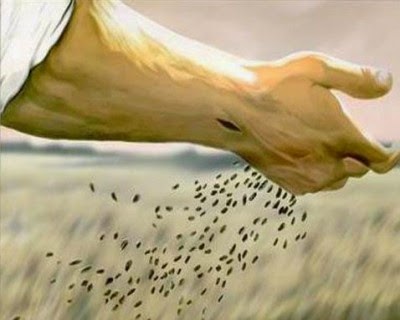
 

Pages Email Newsletter Categories Archives Connect
  • Connct to us here