Aloha Friday Message – November 11, 2016 – Can I Get a Witness?

1646AFC111116 – Can I get a Witness?

Read it online here, please. And please, when you visit there, use one of the social media links at the bottom of the page to share this post. Thank you!

Luke 21:13 13 This will give you an opportunity to testify.

GNT Luke 21:13 Ἀποβήσεται δὲ ὑμῖν εἰς μαρτύριον.

¡Que la bendición esté siempre con ustedes y que Dios los bendiga, Amados! (May blessing always be with you and may God bless you, Belovéd!) This short passage comes from the readings for the Thirty-Third Sunday in Ordinary Time. It is in this passage that Jesus tells the Disciples – and us of course – about what will happen when the end of the world is near. It is one of those “eschatological texts,” verses or passages that describe the “end times.” There are, not surprisingly, many points of view about this. All of us can recall events during the 19th and 20th centuries when the “Second Coming” was proclaimed and a date fixed for the return of Christ and the end of the world. We who are reading this post at the moment are quite convinced that those predictions and proclamations are wrong because the World has not ended – not for us, anyway.

I don’t have any intention of getting into that debate. Many denominational preachers have exact calculations based on scripture – primarily in Daniel, the Gospels, and Revelation – and often point to current events as being fulfillments of that time table. This occurs regardless of the admonition by Jesus that “But about that day and hour, no one knows …” (See Matthew 24:36, Mark 13:32, Matthew 25:13, and Acts 1:6-9.) Nonetheless, as in this passage in Acts, we are told to be watchful and in 1 Thessalonians 5:3-8 as well (You really should read that one right now.), or 1 Peter 4:3-10 (Especially relevant in this time of turmoil and uncertainty), or Revelation 3:1-6 (Addressed to the ancient church at Sardis; this is the Church I think of when I write “WAKE UP America!”). Instead, today I want to tell you about that word witness. Now, some of you may wonder why I bother to put all this Greek stuff before your eyes. Not many of us (including me) are fluent in Biblical or Koine Greek. I just want you to see it in context so that you can – with your own eyes – see (witness) that it is there and findable. It is a very important word throughout Scripture.

The first time we come across a word meaning witness is in Genesis 21:30 30 He said, “These seven ewe lambs you shall accept from my hand, in order that you may be a witness for me that I dug this well.” This “Sevenfold Oath” gave rise to the name of the well at Beersheba in the meeting between Abimelech and Abraham. The word witness is used in this instance as a legal term indicating that these two men were in agreement that this well belonged to Abraham. They made a Peace Treaty, and the seven ewe lambs were what “sealed the deal.” Whenever Abimelech or anyone in his kingdom saw the ewes or their descendants, or used their wool, or ate their flesh, they reaffirmed the treaty – the covenant – between Abraham and Abimelech. There are about 140 uses of this word witness in the Authorized King James Version and around 120 in the New American Bible, Revised Edition. The Hebrew word there is לְעֵדָ֔ה (lə-‘ê-ḏāh,) {lə-ay-daw’} which translates testimony, witness, evidence, opportunity to testify, and martyr. It is always plural and always of laws as divine testimonies. In the Septuagint (the Greek Translation of the Old Testament), the word used is μαρτύριον (marturion) {mar-too’-ree-on}. If you look at the Greek phrase under our opening verse, you will see I have it underlined. This Greek word is used – in one form or another – throughout the New Testament (Koine Greek) and in the Septuagint as well. μαρτύριον (marturion) {mar-too’-ree-on} testimony, witness; evidence, proof; opportunity to testify; from Old English martyr, from Late Latin martyr, from Doric Greek martyr, earlier martys (genitive martyros), in Christian use “martyr,” literally “witness,” probably related to mermera “care, trouble,” from mermairein “be anxious or thoughtful.” (See Online Etymology Dictionary)

Marturion is the root of our word martyr. We first see this word in Paul’s account of the martyrdom of St. Stephen in Acts 22:20 20 and when the blood of thy martyr Stephen was shed, I also was standing by, and consenting unto his death, and kept the raiment of them that slew him. ~~ Authorized (King James) Version (AKJV) KJV reproduced by permission of Cambridge University Press, the Crown’s patentee in the UK. We also see it in Revelation 2:13 in the Letter to The Church at Pergamus. Some translators use the word martyr, and some use the word witness. Here are some examples from other places in the New Testament.

John 15:27 27 You also are to testify because you have been with me from the beginning.

καὶ ὑμεῖς δὲ μαρτυρεῖτε, ὅτι ἀπ’ ἀρχῆς μετ’ ἐμοῦ ἐστε.

Matthew 24:14 14 And this good news of the kingdom will be proclaimed throughout the world, as a testimony to all the nations; and then the end will come.

Καὶ κηρυχθήσεται τοῦτο τὸ εὐαγγέλιον τῆς βασιλείας ἐν ὅλῃ τῇ οἰκουμένῃ εἰς μαρτύριον πᾶσιν τοῖς ἔθνεσιν· καὶ τότε ἥξει τὸ τέλος.

Romans 1:9-10 For God, whom I serve with my spirit by announcing the gospel of his Son, is my witness that without ceasing I remember you always in my prayers, 10 asking that by God’s will I may somehow at last succeed in coming to you.

μάρτυς γάρ μού ἐστιν ὁ θεός, ᾧ λατρεύω ἐν τῷ πνεύματί μου ἐν τῷ εὐαγγελίῳ τοῦ υἱοῦ αὐτοῦ, ὡς ἀδιαλείπτως μνείαν ὑμῶν ποιοῦμαι

Acts 22:14-15 14 Then he said, ‘The God of our ancestors has chosen you to know his will, to see the Righteous One and to hear his own voice; 15 for you will be his witness to all the world of what you have seen and heard. 15  ὅτι ἔσῃ μάρτυς αὐτῷ πρὸς πάντας ἀνθρώπους ὧν ἑώρακας καὶ ἤκουσας.

A witness (n.) is one who testifies. To witness (vt.) is to see personally in present reality. Martyr is one who gives up life for the sake of a promise to God. To martyr someone is to kill them because of their faith. In this day and age, in places around The World, hundreds – perhaps thousands or even tens of thousands – are responding to Jesus call, “Can I get a witness?” Stephen said yes. Paul said yes. Peter, James, John, and Bartholomew said yes. Who among us can say yes? Who will shed her/his own blood for Christ?

Not many are ready to be martyrs. Not all are called and prepared as was “My Old Friend, Abraham.” I know some Priests who could be called bloodless martyrs or “white martyrs.” These are people who give their lives to Christ and the Body of Christ so completely that every act, every breath, every moment is offered up as a sacrifice of adoration, thanksgiving, and praise on behalf of The Faithful and of sinners. One was a missionary in Africa, another a missionary in Chinle, AZ. I also know a whole family – with many children – whose lay-missionary work is entirely dependent on God’s mercy shown through the generosity of others. Almost daily we hear of people who are martyred – not only Christians, but Muslims, Buddhists, and persons of other faiths – across Africa, Afghanistan, Myanmar (Burma) where the Rohingya-genocide occurs, Thailand, Indonesia, Guatemala, and San Salvador – all experience martyrdom, oppression, persecution, even genocide.

American Christians often cry out that we are victims of persecution. It is certainly not anything like what the experiences of millions of people elsewhere in the world experience! We hear claims that we are oppressed in our Religious Freedom because of the abuse of our FIRST AMENDMENT RIGHTS. The US Constitution certainly does provide for protection concerning religion, verbal and written expression, to assemble for cause, and the right to ask for rectification of the perceived oppression. If we were to look into who is actually being martyred here, we’d find mighty few examples. Most of what we complain about doesn’t rise even to the level of bloodless martyr. Our idea of being a witness for Christ, pretty much stops at getting up in a tent-revival meeting and answering the altar call. But there are remarkable exceptions. Many of us – whether Catholic or Evangelical fundamentalists, or Buddhists, or Jews, or you-name-it-faiths – are content to quietly go to services and live unmolested about our faith when in society. We often barely have courage to “Stand Up for Jesus.” (↔ Music Link). What’s that you say? You disagree?

“Hey! Wait a minute! YOU of all people should know that we who receive these messages make our faith known daily. And you just said, not everyone is called to be a martyr.” You’re right of course. I’m “preaching to the choir.” Yes, all of us are called to witness for Christ. Not all of us are called to witness to Christ and struggle against sin “to the point of shedding blood,” as the Apostle Paul reminded us in Hebrews 12:4-11. If, then, we are called to witness – to testify, to give evidence of our faith, to be a witness to the Power of The Spirit, how will we, how do we, how can we do that better?

The World’s most favorite Saint, St. Francis of Assisi allegedly quipped, “Preach the Gospel at all times and only if absolutely necessary, use words.” Well, whether or not he actually said that, it certainly is an ultra-brief summary of the New Testament’s admonitions to share the Gospel. I only wish to encourage you to take the dare that the Apostles took: Be the Kingdom of God. If ever we find ourselves pulling our heads into our shells like a frightened turtle at a time when we have an opportunity to testify, then we are hiding our faith, denying Christ, and missing out on the blessing of being a witness. Being a witness means being ready to “lay down one’s life for a friend.” Sometimes that’s just as simple as saying, “I’m a Christian, and I believe that _________ is wrong because it is contrary to what God has told us.” If we’re willing to compromise on something that simple, if we have to deny our cross and turn aside from The Way, then we are not the witness Jesus called upon to leave The World behind to become The Kingdom of God.

The next two verses after Sunday’s reading are Luke 17:20-21 20 Once Jesus was asked by the Pharisees when the kingdom of God was coming, and he answered, “The kingdom of God is not coming with things that can be observed; 21 nor will they say, ‘Look, here it is!’ or ‘There it is!’ For, in fact, the kingdom of God is among you.”

If the Kingdom is in you, shouldn’t everyone be able to see it all the time? It is and opportunity – and a reason – to testify. Can I get a witness?

Whatever, whenever, wherever, whoever, however, if ever, forever — at your service, Belovéd!

Unless otherwise indicated, all scripture passages are from the New Revised Standard Version Catholic Edition (NRSVCE) New Revised Standard Version Bible: Catholic Edition, copyright © 1989, 1993 the Division of Christian Education of the National Council of the Churches of Christ in the United States of America. Used by permission. All rights reserved.

Creative Commons License
Aloha Friday Messages by Charles O. Todd, III is licensed under a Creative Commons Attribution-ShareAlike 3.0 Unported License

Biblical languages inserts from Bible Hub (Bible Hub: Search, Read, Study the Bible in Many Languages) Visit at http://biblehub.com
Aloha Friday Message – November 4, 2016 – For Christ’s Sake, Wait.

1645AFC110416 – For the Sake of Christ

Read it online here, please. And please, when you visit there, use one of the social media links at the bottom of the page to share this post. Thank you! This one is loaded with surprise links, so you know what they say … “If you see a link, click it!”

2 Corinthians 12:10 Therefore, I accept weakness, mistreatment, hardship, persecution, and difficulties suffered for Christ. It’s clear that when I’m weak, I’m strong.

2 Corinthians 12:15But I cheerfully also shall spend and I would even give up my person for the sake of your souls, even though, the more I love you, the less you love me.

Nowadays, people would say, “What’s wrong with this guy? Has he got a persecution complex or something?” I would answer, “Definitely no. A persecution complex is a delusional state and usually has no foundation in reality.” Paul was under no delusion when writing this second letter to the Corinthians. In the first letter he had admonished them to crack down on one of their members who was causing division within the church. Earlier in this letter he chides them for taking things too far and states he has forgiven the repentant man and certainly they should as well.

Paul’s statement should not be interpreted as fatalism, or as false humility, either. In his perspective there is a complementary and harmonizing connection between suffering and sanctity. When his mind, his spirit, and his body are at rest in Christ, he is “in the world but not of the world.” The verb translated “accept” in the first passage is εὐδοκέω (eudokéō) { yoo-dok-eh’-o} which carries connotations of to think well of, or to choose gladly, or willingly accept, or to think best. It is like our expression “It comes with the territory.” If someone had told Paul that his stance was heroic, Paul would reply much the same way suddenly-noticed heroes do: “I’m no hero. I was just doing my job.” And so, Beloved, we are called to look on our own actions when encumbered with weakness, mistreatment, hardship, persecution, and difficulties suffered for Christ. Do we become histrionic like the Pharisee in the temple, tooting our own horn about how deeply we suffer? Do we become tranquil and self-restrained like Paul? Not that Paul didn’t moan and groan a little about his suffering as a prisoner; he let others know he was hurting, but he also let others know that the hurt he experienced was gladly and fervently offered up for the sake of the Body of Christ. Belovéd: All who are of the Body of Christ are called to serve as Paul served – For the Sake of Christ. (↔ Music Link) – and a very good one, too!

When we are troubled, we are often led to prayer, as in “There are no atheists in foxholes.” God always hears the prayers of faith we offer up, but his answers are sometimes – perhaps often – are not what we had on our wish-list. Sometimes when we ask for direction, instead of a push in the right direction we might receive a smack up alongside the head. Sometime when we are asking for things that will harm us, he withholds them in love, or grants them so the lesson we learn will be indelible. When we don’t get what we want, sometimes, childishly (different from “child-like”), we pout, and grumble, and cry out in the anguish of our suffering that God has abandoned us. If instead he covers us with his Grace we are easily led to believe our own strong faith has saved us. When, however, we accept everything – good or bad, sweet or bitter, bliss or pain – with equanimity, poise, and self-control, we are allowing that Grace to work in us. That Grace-at-work (↔ Music Link) fortifies, enlivens, and encourages us. Through this, we show others the centrality of Jesus in our lives and God is therein glorified. Though on the Road to Calvary, we are also climbing the road to Zion and God’s own Heaven. When we are humble enough to glorify God, we are strengthened in ways that overcome every trial, every false accusation, every painful torment our adversary imposes on us. In that way, also, the adversary is defeated and Christ is victorious. (←Hint: Right-Click on the picture and select Open hyperlink!)

In our own right we are weak, but he is strong (↔ Music Link – it’s a fun one!) . When we hold our peace, we are held in peace. When we wait on God, God fulfills us. When we are quiet, he is pleasantly present and we hear and feel that presence. When we reason that God is trustworthy so that when he tells us that all will be well, we realize that whatever is happening to us is what God has desired and intended for us because of his Love for us. That is his promise (one of thousands) to us. We have only to claim it, then live it.


And how do we claim this promise? Behold!

Isaiah 30:15cIn quietness and in trust shall be your strength.

and

Exodus 14:14The Lord will fight for you, and you have only to keep still..”

Whatever, whenever, wherever, whoever, however, if ever, forever — at your service, Beloved.

I love you, but our El Shaddai-Olam* loves you infinitely more!

Isaiah 30:15 (Read the whole verse here, especially the last line)

Isaiah30-15YourStrength

“The Lord is my Shepherd. That’s all I need to know.”

Unless otherwise indicated, all scripture passages are from the New Revised Standard Version Catholic Edition (NRSVCE) New Revised Standard Version Bible: Catholic Edition, copyright © 1989, 1993 the Division of Christian Education of the National Council of the Churches of Christ in the United States of America. Used by permission. All rights reserved.

Creative Commons License
Aloha Friday Messages by Charles O. Todd, III is licensed under a Creative Commons Attribution-ShareAlike 3.0 Unported License

Biblical languages inserts from Bible Hub (Bible Hub: Search, Read, Study the Bible in Many Languages) Visit at http://biblehub.com

* All Mighty, Ever-Living God


Aloha Friday Message – October 28, 2016 – Climb to Fame and Glory

1644AFC102816 – Climb to Fame and Glory

Read it online here, please. And please, when you visit there, use one of the social media links at the bottom of the page to share this post. Thank you!

SMLP

(There are lots and lots of great links here. Take some time to follow them)

Luke 19:1-6 He entered Jericho and was passing through it. A man was there named Zacchaeus; he was a chief tax collector and was rich. He was trying to see who Jesus was, but on account of the crowd he could not, because he was short in stature. So he ran ahead and climbed a sycamore tree to see him, because he was going to pass that way. When Jesus came to the place, he looked up and said to him, “Zacchaeus, hurry and come down; for I must stay at your house today.” So he hurried down and was happy to welcome him.

Luke 19:8Zacchaeus stood there and said to the Lord, “Look, half of my possessions, Lord, I will give to the poor; and if I have defrauded anyone of anything, I will pay back four times as much.”

¡Que la bendición esté siempre con ustedes y que Dios los bendiga, Amado! (May blessing always be with you and may God bless you, Belovéd!) Maybe it’s time for something a little different, so today we’re going to do sort of an expositional approach to this story about Zacchaeus. Let’s begin with the setting.

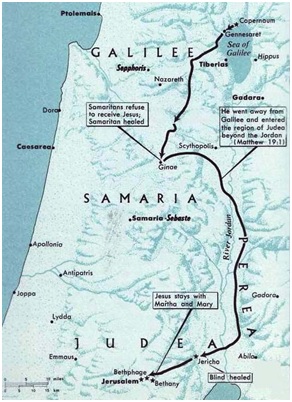
JerusalemJourneyThis story is only presented in Luke’s Gospel. It comes right after the healing of the blind (←That link will provide additional insights into this message.) Jesus is returning to Jerusalem. It’s a very long walk, and along the way many miracles are performed. He also describes what will happen to him once he gets to Jerusalem – his arrest, passion, death, and resurrection. At this point in that journey, Jesus has reached the ancient city of Jericho.  You perhaps recall the Battle of Jericho in which Joshua – יְהוֹשֻׁ֙עַ֙ (Yehoshua) {yeh-ho-shoo’-ah} or {yeh-ho-shoo’-ah} – marched with the nation of Israel round the city seven times, and then the walls collapsed. This was the first city captured by Israel in Canaan. It is perhaps one of the oldest cities in the world. The word Jericho translates to ‘Moon City,” or “its moon,” an allusion to its proximity to Jerusalem. It is situated about 5 miles west of the Jordan River. It is about 7 miles north of the Dead Sea. Jericho was about 16 miles northeast of Jerusalem. “Going up to Jerusalem” (See Psalm 122:1) from Jericho was a difficult trip. Jericho is about 800 feet below sea level and Jerusalem is about 2,500 feet above sea level. The journey was further complicated by the very rugged terrain, and by bandits who preyed on travelers going to Jerusalem (Recall the parable of The Good Samaritan.) It is surprising to me to learn that Jericho was fundamentally an oasis with a nearly tropical climate. It was a well-situated town along a principal trade route from the east. Because of that, travelers passing through paid taxes to Rome to be able to pass through there. That is how Zacchaeus made his living.

Zacchaeus lived in Jericho and was a Publican, a Tax Collector working for the Romans; as Luke 19:2 states, “he was a chief tax collector and was rich.” Tax Collectors were despised by the Jews because they were collaborators with the Romans. Their reputation was worsened because they usually levied more tax than was required by Rome; they kept the extra for themselves – and grew rich. In this instance the man’s name Ζακχαῖος (Zakchaios) {dzak-chah’-ee-yos} is truly ironic because it is derived from a word that means “pure or innocent.” His name was Greek in origin, but there is reason to believe he was a Jew. (See Ezra 2:9 for זַכָּי (Zakkay) { zak-kah’-ee}.) He was curious about Jesus and wanted to see “who Jesus was.” We know from the Gospel account of Jesus’ journey to Jerusalem that there were very large crowds surrounding him. For someone who “was short in stature,” that made seeing Jesus all the more difficult, so he climbed a tree. The type of tree described by Luke was a sycamore tree. Please see 1 King 10:27, Amos 7:14 for שִׁקְמִים (shaqam) { shaw-kawm’),  and Luke 19:4 for συκομορέα (sykomorea) {soo-kom-o-rah’-yah}.

I’ve always thought it was odd that Luke specified that particular tree. We have sycamores in North America – there are even some here on Kauaʻi – but those are usually the Plane Sycamore or the American Sycamore. Their leaves and “fruits” look like the photo on the left:

SycamoresHowever, the sycamore that Zacchaeus climbed was a type of ficus – a fig tree. You can see the small, round fruits – figs – along the trunk and branches. The Biblical symbolism of the fig tree goes all the way back to the Garden of Eden (See Genesis 3:7) and in stories and parables usually represents the “fruitfulness” (i.e., goodness or holiness) of Israel. So, to push the figurative language a bit, Zacchaeus climbed up into the fruitfulness of Israel so that he could see Jesus. And oh, what a surprise he got! Jesus saw him in the tree and told him to come down, then Jesus invited himself to stay at Zacchaeus’ house. The biggest, baddest, most despised man in town “was happy to welcome him.” It caused quite a stir in the city of Jericho! (See Luke 19:7) Then the story takes a sudden shift.

We don’t know how long Jesus stayed with Zacchaeus, but it was long enough to bring forth a dramatic conversion. Zacchaeus – a hated man who cheated others to enrich himself – declares, “Look, half of my possessions, Lord, I will give to the poor; and if I have defrauded anyone of anything, I will pay back four times as much.” What did Jesus say to him to bring about this extraordinary change? Luke doesn’t give us any additional information – it is sufficient to tell us that Zacchaeus went from super-greedy to super-generous in a very short time. Jesus left Jericho to continue his journey to Jerusalem – very literally a long (about 16-18 miles), arduous, uphill trek – but the Gospels don’t tell us any more about Zacchaeus. There is more to learn, however.

There is a collection of writings called The Apostolic Constitutions. This is a remarkable resource to read. It contains eight “books” that convey the earliest ecclesiastical laws of Christianity. This is a real, searchable, historical resource that gives much insight into the early church. Scholars believe it was put together toward the end of the Fourth Century – around 375-380 AD under the supervision of Saint Pope Clement I of Rome. They were probably written in Syria, perhaps in Antioch (a strong Christian community was established there by Christians who fled persecution in Jerusalem, Cyprus, and Crete, and later was recognized by the Apostle Peter and nurtured by the Apostle Paul). In this collection of writings – in Book Seven, Section XLVI (46) – there are references to Bishops of the early church (“presbyter” πρεσβύτερος as in 1 Titus 5:19, 1 Peter 5:1, 2 John 1:1, 3 John 1:1, usually translated as “Elders” in the KJV.) In the list of the first bishops of The Church, there is this statement: “Of Cæsarea of Palestine, the first was Zacchæus, who was once a publican.”

This World-Class sinner – through the evangelization of Jesus and the Apostles – became a respected and honored member of the early Church. According to an early historian Clement of Alexandria (about AD 150 – AD 215 and not the same person as Pope Clement I) in his book Stromata, Zacchaeus’ surname was Matthias (See Acts 1:23). Matthias  took the place of Judas Iscariot after Jesus’ Ascension. The later Apostolic Constitutions identify “Zacchaeus the Publican” as the first bishop of Caesarea. These accounts are not canonical – they are not approved as inspired scripture, and are considered by some to be pious legend – but they do give us some insight into the processes by which The Church grew and how Apostolic Authority figures into the ecclesiastical formation of Christian doctrine, worship, discipline, and structure. For those of us who are Biblicists and interested in history (admittedly few and far between!), these are fascinating reading. For most of us, though, we often do not look “behind the page” to see what the Bible tells us about the people, places, and events it contains.

The next time you hear the story of Zacchaeus, you will know more about the man, the way he lived, where he lived, and how his life changed. He went from sinner to Saint because he took the initiative of trying to see who Jesus was. Jesus welcomed his initiative as well as his conversion, and Zacchaeus stayed with his new-found “notoriety” (being a follower in The Way was even worse than being a Tax Collector for many of the Jews) and went on to become a leader in the Early Church – a man famous for his generosity and faith. Look for Jesus because he’s coming your direction. Find a good way to see who he is, and give heed to his instruction. It may mean getting up in a tree and going out on a limb, but – I know this from experience – it’s well worth the climb to share in the Glory on Heaven even without the kind of fame Zacchaeus garnered.

Keep praying for Ty and for Carol. You have the gratitude of their families for your dedication and care.

Whatever, whenever, wherever, whoever, however, if ever, forever — at your service, Belovéd!

Unless otherwise indicated, all scripture passages are from the New Revised Standard Version Catholic Edition (NRSVCE) New Revised Standard Version Bible: Catholic Edition, copyright © 1989, 1993 the Division of Christian Education of the National Council of the Churches of Christ in the United States of America. Used by permission. All rights reserved.

Creative Commons License
Aloha Friday Messages by Charles O. Todd, III is licensed under a Creative Commons Attribution-ShareAlike 3.0 Unported License

Biblical languages inserts from Bible Hub (Bible Hub: Search, Read, Study the Bible in Many Languages) Visit at http://biblehub.com
Aloha Friday Message – October 21, 2016 – Now what!

1643AFC102116 – Now what!

Read it online here, please. And please, when you visit there, use one of the social media links at the bottom of the page to share this post. Thank you!

Luke 18:14 – 14  “I tell you, this man went down to his house justified rather than the other; for everyone who exalts himself will be humbled, but he who humbles himself will be exalted.”

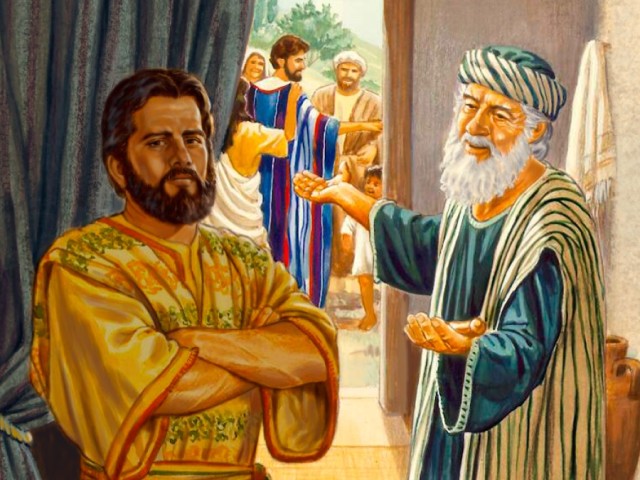
Pharisee&PublicanAloha nui loa, ʻŌmea. In the past few weeks we have heard many people exalting themselves and those with whom they identify. It seems to be a time of great unrest around the world and even in this great country of ours. Many of us fear what’s coming next. Today we look at fear – particularly when we fear being humbled.

Psalm 111:10The fear of the Lord is the beginning of wisdom; all those who practice it have a good understanding. His praise endures forever.

Proverbs 9:1010 The fear of the Lord is the beginning of wisdom, and the knowledge of the Holy One is insight.

In this context, “fear” is equivalent to reverence. We’ve touched on the ideas of reverence, gratitude, and service as components of stewardship. Today, I am thinking of a different kind of fear. It is unpleasant – or it should be – and sometimes it saves our lives, while other times it fills us with dread or even heart-stopping physiological changes. It takes hold of us when we see danger or are otherwise alarmed. We are taught in the Bible to fear – that is, reverence – our God, but we are also taught in the Bible not to fear anyone or anything else. There are over 200 places in the Bible where God says, “fear not” or “be not afraid.” Take a look at just a few of those.

Psalm 56:10-1110 In God, whose word I praise, in the Lord, whose word I praise, 11 in God I trust; I am not afraid. What can a mere mortal do to me?

Psalm 91:5-6 You will not fear the terror of the night, or the arrow that flies by day, 6 or the pestilence that stalks in darkness, or the destruction that wastes at noonday.

Proverbs 3: 25-26 25 Do not be afraid of sudden panic, or of the storm that strikes the wicked; 26 for the Lord will be your confidence and will keep your foot from being caught.

Matthew 10:28Do not be afraid of those who kill the body but cannot kill the soul. Rather, be afraid of the One who can destroy both soul and body in hell.

Luke 12: 31-3231 Instead, strive for his kingdom, and these things will be given to you as well. 32 Do not be afraid, little flock, for it is your Father’s good pleasure to give you the kingdom.

John 14:2727 Peace I leave with you; my peace I give to you. I do not give to you as the world gives. Do not let your hearts be troubled, and do not let them be afraid.

2 Corinthians 13:1111 Finally, brothers and sisters, farewell. Put things in order, listen to my appeal, agree with one another, live in peace; and the God of love and peace will be with you.

Hebrews 13:6So we can say with confidence, “The Lord is my helper; I will not be afraid. What can anyone do to me?”

Just up the page I said that fear is unpleasant – or it should be. I am thinking about the forms of so-called entertainment where we are exposed to things meant to frighten us either physical or psychologically. Physical frights are usually some mechanical monstrosity that hurtles us through space in ways that make our bodies pump adrenaline – roller coasters, sky-diving, and other physically challenging diversions. There are also the psychological fear-inducers, most notably movies, which we love to watch because they are so suspenseful and gory. Personally, I find these films offensive; I don’t see any entertainment value in watching suffering. It does nothing for me except make me ill and sleepless. I used to enjoy some “amusement park rides,” but I think I outgrew them when the discomfort I experienced riding them lasted for weeks instead of minutes.

For some strange reason, we earthlings like to give ourselves “a good scare” once in a while. We like that feeling of danger, risk, excitement – as long as it can be resolved neatly and end in laughter. Well, if there’s a “good” scare, then there’s also a “bad” scare, and that kind we don’t like as much because it is not induced, it is not pretended, it is, rather, a genuine threat to our life. This kind of fear is mostly based on the possibility or probability of actual physical pain, damage, or even loss of life. It is the fear of war, torture, vulnerability to someone or something far more powerful than we are. It is what we feel when we see a flood approaching, hear or see an explosion, recognize the rapid advance of an enemy, or realize that our own bodies have turned against us and marched us straight off to death. It can even be those terrifying moments when we are asleep and our subconscious mind unleashes incidents and threats that paralyze us until at last we awake gasping and grasping for reality.

Lately I’ve heard a lot of fear expressed about, of all things, politics. Is that a good scare or a bad scare? That’s a hard one to call. I think it depends on why it scares you. If you feel the changes coming, regardless of how the political landscape changes, pose an actual physical threat like imminent death, (which I find hard to imagine), then you need to take action to protect your life. It’s more likely you fear some loss of status which might end “life as you know it in America,” but will not in fact make you dead. You most likely will suffer, if that is your disposition, and you might even suffer long and hard. Well, that is the thorny part of the covenant we have with God; we get all of his blessings along with some persecutions. (See Mark 10:29-30)

Our world is a world of exaggerations, overstatement, hyperbole, embellishment, and all of those are synonyms for lies. And based on what we see in the World around us, you’d think we really enjoy lies! Look at all the exaggerated and deceptive things you can find on the Internet – from pornography to snake-oil medicine – and the same goes for news, entertainment, literature, art, politics, and dietary choices, in fact every aspect of life as an earthling has been distorted so badly that we seem to have lost our grip on the truth. Somehow we know this, but are still surprised that is it so pervasive and we’re part of it! How can this happen?

We are simply following our leader, the Prince of the Air. Remember him? He’s also called The Father of Lies, and the Ancient Dragon. Throughout all of human history, there have always been a few who openly, willingly, and zestfully follow his lead. His downfall was to try to ascend to Power in opposition to the will of God. Through all the millennia of history, he found many willing to repeat his error. From the sickening worshipers of Moloch to the atrocities of Stalin and Hitler, there have been people of consummate evil in this world who have flourished for a while and then exited leaving a nasty and bloody smudge in the line of history. But Beloved, we are surely not evil like that, are we? No, of course not! We modern-day earthlings don’t sacrifice the lives of infants for our own personal gain as worshipers of Moloch did. We 21st century humans do not allow our enemies to be tortured so we can exterminate their supporters. Humanity in this day and age no longer raises up pogroms of ethnic cleansing. Surely we do not pollute the earth, the sea, and the sky only for our personal comfort. Do we?

Beloved, we ought to be less afraid of politics and more afraid of judgment by and because of politics. Throughout history, there have been wars, crimes, persecutions, terror, and all brought to bear on fellow humans by the hands of a few evil men. Although the evil is perpetrated by a few, the effect falls on many. In this well-shrunken world, it is more likely than ever that the consequence will fall upon everyone and everything. We forget too easily that we did not create the universe, or even this world, or anything in it. We build things, invent things, craft things, but we do not create things. We do not even create evil; we merely cooperate with it from time to time. Hopefully these times are few and far between and we are, instead, cooperating with good. It is not the times we should fear, however. Whatever is constrained by time is to be neither a source nor outcome of fear. The worst that can happen is we die a horrible, painful, and gruesome death – like Jesus did. Instead it is better for us to die to fear and to live in Christ.

Be not afraid, I go before you always. Come. Follow me, and I will give you rest.” Please go back to the top of the page and reread those several passages about not being afraid. I am not saying we should expectantly wait in peaceful hope for martyrdom. I am saying, however, that if that time ever comes when that is our future, we will be able to accept it with the same equanimity as the Apostles and Saints who endured all not because they lost hope, but because in hope they found their endurance. Don’t be afraid of politics. Don’t be afraid of anything worldly. God will allow the World to experience the consequences of its apostasies and atrocities, and some of that will fall on us. Those who are only Worldly will suffer more than any and then will go on to suffer longer than any. Those who are other than Worldly will suffer – some greatly – but then will go on to a complete lack of suffering as they live in eternal bliss.

As I bring this to a close, I will add several more Bible references for you to consider. Read them carefully and prayerfully. Humbly submit to what God has in store for us. Here’s my point:

We are coming to what portends to be a very momentous event. Is God in charge, or not? About half of the citizenry in America will be dissatisfied no matter who wins this election. However, no matter what happens, it is still – all of it – in God’s hands. You know that he allowed Israel to be clobbered many times for many years. If it’s our turn now, then God’s will be done. If it’s not our turn now, then God’s will be done. Consider these as you prepare to accept God’s will.

Lamentations 3:37-39 37 Who can command and have it done, if the Lord has not ordained it? 38 Is it not from the mouth of the Most High that good and bad come? 39 Why should any who draw breath complain about the punishment of their sins?

James 1:13-15 13 No one, when tempted, should say, “I am being tempted by God”; for God cannot be tempted by evil and he himself tempts no one. 14 But one is tempted by one’s own desire, being lured and enticed by it; 15 then, when that desire has conceived, it gives birth to sin, and that sin, when it is fully grown, gives birth to death.

Nothing happens without God’s permission BUT NOT everything is God’s will. God doesn’t do evil things or lead or force anyone to commit evil.

Colossians 1:15-17 15 He is the image of the invisible God, the firstborn of all creation; 16 for in him all things in heaven and on earth were created, things visible and invisible, whether thrones or dominions or rulers or powers—all things have been created through him and for him. 17 He himself is before all things, and in him all things hold together.

Matthew 10:29-31 29 Are not two sparrows sold for a penny? Yet not one of them will fall to the ground apart from your Father. 30 And even the hairs of your head are all counted. 31 So do not be afraid; you are of more value than many sparrows.

Psalm 115:3 Our God is in the heavens; he does whatever he pleases.

Isaiah 46:8-11 Remember this and consider, recall it to mind, you transgressors, 9 remember the former things of old; for I am God, and there is no other; I am God, and there is no one like me, 10 declaring the end from the beginning and from ancient times things not yet done, saying, “My purpose shall stand, and I will fulfill my intention,” 11 calling a bird of prey from the east, the man for my purpose from a far country. I have spoken, and I will bring it to pass; I have planned, and I will do it.

Blessed be God forever in his Angels and in his Saints. A special shout-out to all the Pilgrims on the road this week to the Holy Land, or Rome, or Spain, or Africa – wherever God leads them. Our prayers go with you!

Pray for our leaders, Beloved. If our future must be in their hands, pray that they are in God’s hands.

Whatever, whenever, wherever, whoever, however, if ever, forever — at your service, Belovéd!

Unless otherwise indicated, all scripture passages are from the New Revised Standard Version Catholic Edition (NRSVCE) New Revised Standard Version Bible: Catholic Edition, copyright © 1989, 1993 the Division of Christian Education of the National Council of the Churches of Christ in the United States of America. Used by permission. All rights reserved.

Creative Commons License
Aloha Friday Messages by Charles O. Todd, III is licensed under a Creative Commons Attribution-ShareAlike 3.0 Unported License


Aloha Friday Message – October 14, 2016 – Again?

1642AFC101416 – Again?

Read it online here, please. And please, when you visit there, use one of the social media links at the bottom of the page to share this post. Thank you!

Luke 18:7-8 “And will not God grant justice to his chosen ones who cry to him day and night? Will he delay long in helping them? I tell you, he will quickly grant justice to them. And yet, when the Son of Man comes, will he find faith on earth?”

¡Que la bendición esté siempre con ustedes y que Dios los bendiga, Amado! (May blessing always be with you and may God bless you, Beloved!) First, thanks be to God and one mighty-fine IT company, I have my DELL back, so I can get this out to you today. That was a pretty awful feeling – maybe you’ve been there before – when you see these words on the screen:

UNABLE TO FIND A BOOTABLE DEVICE

For me, that’s like standing at the edge of Canyon de Chelly overlooking Spider Rock at the edge of the cliff with the wind blowing 35 mph at my back.

Spider Rock


Fortunately, I didn’t die; but I did get to my trusty IT guys immediately. The hard drive keeled over – sort of the electronic equivalent of a brain aneurysm – and after installing a new drive and transferring tens-of-thousands of files, mira! I’m back in business. I just lived out my faith in my friends at Kukui-IT and at DELL that somehow it would be OK eventually. I know it will work because I’ve been through about a dozen of those “Big Blue Screen” moments, and I know there’s always hope that much of what was there can be recovered. It’s a lot like that in my Christian life as well.

The passage I cited today is at the end of the story of The Unjust Judge. He’s being pestered by a very persistent widow to rule in her favor. It’s important to recall here, that as a widow, she had practically zero rights, no standing, not a prayer of being heard. But because of her persistence, the judge finally said, “If I don’t take care of her she’s going to talk me to death, so I might as well give her what she wants.” (In our family we have a saying, “It’s a terrible death to be talked to death!) This is reminiscent of another “what-if” story about a man who wakes his neighbor in the middle of the might to get something to feed a visitor that has just arrived. The man has nothing to feed to his unexpected guest, but he trusts his friend will help him out, and keeps entreating for his help despite the fact that the neighbor doesn’t want to get out of bed. In that parable, Jesus asks in Luke 11:11-13 11 “Is there anyone among you who, if your child asks for a fish, will give a snake instead of a fish? 12 Or if the child asks for an egg, will give a scorpion? 13 If you then, who are evil, know how to give good gifts to your children, how much more will the heavenly Father give the Holy Spirit to those who ask him!” and of course we all remember this one found just up the page at Luke 11:9 “So I say to you, Ask, and it will be given you; search, and you will find; knock, and the door will be opened for you.”

In the past, we have also looked at James 4:3 You ask and do not receive, because you ask wrongly, in order to spend what you get on your pleasures. Not only are we to “ask in faith believing” (See James 1:6 and Mark 11:24), but we are also to ask in righteousness – that is, we ought not to ask for things that actually pull us farther away from God and from the Faith that brings us to his Throne. Jesus tells us to be persistent as well as confident. Consider these events where confident faith in Jesus made a huge difference:

“OK, I get that, but that was over 2,000 years ago. Things like that don’t happen nowadays.” Well, of course they do! We see miraculous things happen all the time, but we just don’t pay attention because we’re too busy focusing on the tragic and hurtful things – politics, wars, terror, weather events, scandal, and our own troubles. We need to ask ourselves, “What do I believe about God’s help?” Here are some typical answers I hear:

  • God helps those who help themselves (no, that’s not a Bible verse)
  • God helps fools, children, and drunkards (odd combination, but true)
  • God helps the most desperate (true, but not always readily visible in ways we understand)
  • God can’t help anybody because there is no God (not true at all)
  • I don’t understand how God can help them but won’t help me. (Think about it. How do you know?)
  • I can’t have faith in a God who would allow things like this to happen. (Time to find out why that is.)

Some of these sound like the viewpoints of people who have not examined their faith. Consider these words of advice from the Apostle Paul:

2 Corinthians 13:5 Examine yourselves to see whether you are living in the faith. Test yourselves. Do you not realize that Jesus Christ is in you?—unless, indeed, you fail to meet the test!

1 Corinthians 11:28 28 Examine yourselves, and only then eat of the bread and drink of the cup.

When we look at our lives – especially our prayer lives – do we see evidence of faith? “If you were arrested for being a Christian, would there be enough evidence to convict you?” Are we truly trying to live a righteous life where we “… do justice, and love kindness, and walk humbly with your God?” (See Micah 6:8 – again) Could it be that the biggest or all the tests of faith is whether or not we believe God is listening, that we’re not just talking to the inside of our heads when we pray? Do we have the faith, the determination, the discernment, the patience and perseverance, and especially the humility to ask again? Can we, should, we, will we keep that faith until the very day when we meet the Lord? And yet, when the Son of Man comes, will he find faith on earth?” How do you know, how do I know, how do we know we have faith? We must check our hearts for evidence of sin.

Is there any? Of course there is! Do we know what to do about that? Of course we do! What do we want? Salvation! When do we want it? Now and forever!  From whence does it come? From Above, as we read in John 3:3 Jesus answered him, “Very truly, I tell you, no one can see the kingdom of God without being born from above.” What? Born again? How do I know when that happens?

You will know it happens when you take to heart what the Apostle Paul said in 2 Timothy 3:14-4:2 14 But as for you, continue in what you have learned and firmly believed, knowing from whom you learned it, 15 and how from childhood you have known the sacred writings that are able to instruct you for salvation through faith in Christ Jesus. 16 All scripture is inspired by God and is useful for teaching, for reproof, for correction, and for training in righteousness, 17 so that everyone who belongs to God may be proficient, equipped for every good work. 4 In the presence of God and of Christ Jesus, who is to judge the living and the dead, and in view of his appearing and his kingdom, I solemnly urge you: proclaim the message; be persistent whether the time is favorable or unfavorable; convince, rebuke, and encourage, with the utmost patience in teaching.

Every time you sin, you are in the grip of Death; every time we repent, we are in the arms of Grace, born again through repentance and faith in the efficacy of the Life, Death, and Resurrection of Christ the Lord. We are alive again, we have faith again, and we are ready for Christ again. We have faith; we need only to use it. Ask for it, seek after it, open the door to it – keep doing that until Jesus comes, and he will find faith on the Earth. Look to him; he is your keeper; the Lord is your shade at your right hand. The sun shall not strike you by day, nor the moon by night. (See Psalm 121) If “seeing is believing,” LOOK!”

Whatever, whenever, wherever, whoever, however, if ever, forever — at your service, Belovéd!

Unless otherwise indicated, all scripture passa ges are from the New Revised Standard Version Catholic Edition (NRSVCE) New Revised Standard Version Bible: Catholic Edition, copyright © 1989, 1993 the Division of Christian Education of the National Council of the Churches of Christ in the United States of America. Used by permission. All rights reserved.


Aloha Friday Messages by
Charles O. Todd, III is licensed under a Creative Commons Attribution-ShareAlike 3.0 Unported License


Aloha Friday Message – October 7, 2016 – Let’s Pray That Way!

1641AFC100716 – Let’s Pray That Way!

Read it online here, please. And please, when you visit there, use one of the social media links at the bottom of the page to share this post. Thank you!

Luke 17:11-14 11 On the way to Jerusalem Jesus was going through the region between Samaria and Galilee. 12 As he entered a village, ten lepers approached him. Keeping their distance, 13 they called out, saying, “Jesus, Master, have mercy on us!” 14 When he saw them, he said to them, “Go and show yourselves to the priests.” And as they went, they were made clean.

Me ke aloha pumehana, ʻŌmea. Have you ever heard a prayer like the one in this passage from Sunday’s Gospel? I mean, it looks pretty simple. “Jesus, Master, have mercy on us!” It’s not like the complicated, convoluted prayers we often hear in public where every fifth phrase is “we just ….” Jesus doesn’t really do anything to them – he often went and touched people, even lepers (see Matthew 8:3 and Luke 5:13). He saw them and spoke a command to them: “Go and show yourselves to the priests.” Why did this simple prayer bring healing and all the endless pleadings we sometimes catapult to heaven fall back to the ground nearly at our feet? If God wants more from us, why doesn’t he tell us what he wants so we can pray better when we tell him what we want?

Do you recall what the Apostle James said about that? Look at this from James 4:3-4 You ask and do not receive, because you ask wrongly, in order to spend what you get on your pleasures. Adulterers! Do you not know that friendship with the world is enmity with God? Therefore whoever wishes to be a friend of the world becomes an enemy of God. Why are we praying for Worldly things? “Well, because I need this or that, and Jesus said to ask God in Jesus’ name and we’d get what we want.” Hm. I’m not so sure that’s the way it works. Neither is the Apostle James – in fact, he clearly says that not how it works. We’re asking for our own pleasures. And, if we’re honest about it, that’s usually the first thing on our minds when we speak to God (instead of speaking with God). “God, fix this for me please. Oh, and thanks for that. In Jesus’ name. AMEN.” Bye God.

child-praying-child-praying-8x10-carded-NUcCYe-clipartAs you may know, Crucita and I are catechists for the Rite of Christian Initiation for Adults (RCIA). This year, we have the privilege of working with 6 (yeah, SIX) boys and their families as we prepare them for the Sacraments of Initiation which they will receive next year at the Easter Vigil. Those sacraments are Baptism, Confirmation, and First Communion of Holy Eucharist. We start the classes in mid-August and finish up on Pentecost Sunday.  It’s a pretty big deal, and by the time we close it out with a Pentecost Retreat, many lives have been changed – ours, theirs, and their families. Parents get catechized along with their kids, and that really unites the family in a way that leads to a Christ-Centered Home. Part of the catechesis is learning to pray. We teach them a five-step process: [1] Greeting (who ya gonna call?). [2] Praise (Acknowledging the Power). [3] Thanks. (Humbly recognizing previous gifts). Petition. (Whatever you are asking). [5] Closing. (Expressing confidence in and acceptance of God’s Sovereignty and Grace). We help them learn phrases for each of those steps so they can string together a prayer on their own extemporaneously by the time we get to Pentecost. Talk about goose-bumps! But how does that 5-Step Prayer Pattern compare to the prayer of the Ten Lepers. Let’s dissect it and see.

[1] Greeting – Yep, they greeted Jesus. They called his name. [2] Praise – Yep, they praised him. They called him Master. [3] Thanks. Hmmm, not initially, but later one guy did come back and worshipped Jesus. [4] Petition – Yep, they asked for healing. [5] Closing – Well, sort of. They went and did what he told them to do; they went to show themselves to the Priests. That was an Act of Faith, and as such, it was their way of “Expressing confidence in and acceptance of God’s Sovereignty and Grace.” It was their version of “In Jesus’ Name. AMEN.” So, looking at even that short prayer, we can see that it is pretty similar to what Jesus had to say about prayer earlier in Matthew 6:9-13

“Pray then in this way:
Our Father in heaven,
hallowed be your name.
10     Your kingdom come.
Your will be done,
on earth as it is in heaven.
11     Give us this day our daily bread.
12     And forgive us our debts,
as we also have forgiven our debtors.
13     And do not bring us to the time of trial,
but rescue us from the evil one.

We often hear, and most people include, “for The Kingdom, and the Glory, and the Power are Yours, Now and Forever. AMEN.” That’s how he taught us to pray. Ideally, all our prayers ought to follow that example. But thinking about God, praising God … that usually isn’t the first thing on our minds. More often than not, the first thing on my mind is … ME! Really, folks, how often do we take time to praise God in our prayers? Some of us do that daily whether we are using formal prayers or extemporaneous prayers; we always start by acknowledging, praising, and glorifying God. That’s a good thing, so if you do that all the time, keep at it. If you do it sometimes, get better at doing it. If it’s missing more often than not, work on putting it there. It helps to be able to remember all the “parts,” so acronyms are often used. Our 5-step plan would be GPTPC – not very catchy. But here’s another one that a lot of people like: ACTS – Adoration. Contrition. Thanksgiving. Supplication. Nice, huh? Here’s another one. Just give God the FACTS: Faith. Adoration. Confession. Thanksgiving. Supplication. Speaking of FAITH, how about Forwarding All Issues To Heaven? If you want to be a FIGHTER just remember Faith In God Has Tremendously Exciting Results! Do you remember WWJD – What Would Jesus Do? If you do that backwards it’s DJWW – Devil Just Won’t Win. Let go and let God? That’s Leave Everything To God OK?

You can find a bunch of these with your search engine by using the terms CHRISTIAN ACRONYMS. I’ve got a post at The Moon Bean Network with a few as well.  USE THIS LINK

Back to prayer then. The prayer of the Ten Lepers was pretty simple, and very effective. The woman with the hemorrhage just reached out and touched the Lord as he passed by; she didn’t say a word, but her faith said all that was needed. In fact Jesus told the Disciples that it’s didn’t take a lot of fancy words. Think of the parable or the Pharisee and the Publican. The Publican’s prayer was “God be merciful to me, a sinner.” This prayer acknowledges God as Superior. It recognizes and praises God’s mercy. The petition is for mercy and the confession is one of a sinner who is thankful God is merciful. So let’s look at what Jesus said about our prayers in Matthew 6:7-8 “When you are praying, do not heap up empty phrases as the Gentiles do; for they think that they will be heard because of their many words. Do not be like them, for your Father knows what you need before you ask him.” You may ask, “So if he knows, why do I have to ask him?” The answer is, “So you will know who is asking and who is answering thereby acknowledging and praising God for his mercy and grace.” It’s good for the soul. “Well,” you say, “that’s great and all that, but I don’t know how to do that kind of stuff. I mean, really, how are you supposed to talk to God after all?” Let’s turn to Paul’s letter to the Romans for that one.

Romans 8:26-27 26 Likewise the Spirit helps us in our weakness; for we do not know how to pray as we ought, but that very Spirit intercedes with sighs too deep for words. 27 And God, who searches the heart, knows what is the mind of the Spirit, because the Spirit intercedes for the saints according to the will of God. We have an Advocate, a Helper, a Paraclete who makes our prayers meaningful, useful, and right. You can get that kind of help by simply saying, “Holy Spirit, help me pray.” Use one of the acronyms, or a traditional, formal prayer, or just talk to God like you’d talk to your friend – after all, he is a Friend. (↔ Music Link) 😀

Here’s another thing to think about: Many times we start and end our conversations with God using the “GIMME” prayer. Just for your own delight, PICK ONE of the five steps we teach our RCIA/C catechumens and pray that and only that for one full minute. Won’t God be surprised at that? Remember, I love you bunches and bunches, but Jesus loves you more. God is crazy in love with you, Belovéd. Take to the Lord in prayer to say THANKS for 60 seconds.

Whatever, whenever, wherever, whoever, however, if ever, forever — at your service, Belovéd! Prayer is AMAZING!! (↔ Another Music Link!!!)

Unless otherwise indicated, all scripture passages are from the New Revised Standard Version Catholic Edition (NRSVCE) New Revised Standard Version Bible: Catholic Edition, copyright © 1989, 1993 the Division of Christian Education of the National Council of the Churches of Christ in the United States of America. Used by permission. All rights reserved.

Creative Commons License
Aloha Friday Messages by Charles O. Todd, III is licensed under a Creative Commons Attribution-ShareAlike 3.0 Unported License


Aloha Friday Message – September 30, 2016 – Too Much Is Enough

1640AFC093016 – Too Much Is Enough

Read it online here, please. And please, when you visit there, use one of the social media links at the bottom of the page to share this post. Thank you!

Habakkuk 1:2-3 O Lord, how long shall I cry for help,
and you will not listen?
Or cry to you “Violence!”
and you will not save?
Why do you make me see wrongdoing
and look at trouble?
Destruction and violence are before me;
strife and contention arise.

Me ke aloha pumehana, ʻŌmea – With Warm Aloha, Belovéd – Peace be with you. That would be nice to have, wouldn’t it? How can we know what to do that will bring us – even The World – Peace? Let’s see what the B.I.B.L.E. says about that.

Today’s text comes from the Book of the Prophet Habakkuk. It’s only three chapters long, and not often read or studied. The whole thing is a dialogue between God and Habakkuk concerning the role of God’s sovereignty over human life and all of Earth. Habakkuk complains that there are rampant injustices throughout the Jewish nation, and no one – not even God – is doing anything to address them. God assures him that the offenders will get their comeuppance when the Babylonians come in and bring Israel to ruin. The Prophet then takes off on the cruelty and tyranny of the Babylonians – how can God allow someone even more evil to oppress then further? God reminds Habakkuk that when Israel is obedient, God’s help and blessing are reliable and positive – but, even when Israel is disobedient, God’s help and blessing, his rule over all the nations, is still reliable and also still positive in the long run. Although Habakkuk’s complaint is that divine justice entails suffering for too many and for too long, God’s response is that justice comes to those who patiently and obediently wait on the Lord. God establishes order in all things by conquering the chaos brought about by disobedience. Even in “this day and age,” we struggle to understand and apply that lesson.

In the past few weeks, we have seen so much violence, some of it fairly benign like in the campaign for the Presidency, some of it horrific like terrorism and military aggression. The willingness of humans to inflict pain, sorrow, death, and terror on each other is incomprehensible – yet we know that somewhere deep inside each of us, there is that same propensity for violence, destruction, hatred, and even indifference to the welfare of others. “Why won’t you stop people from doing [whatever], God?!?! Can’t you see they are the source of our suffering?” God’s gentle reply is, “Learn obedience and patience. I am still in charge. Listen. Look. See that I AM rules over everything.” Sometimes we just want God to carpet-bomb all the evil in The World – but we are in The World.

Oh, yeah, no?

How, then, can we make it through all this “awfulness?” Where do we turn, for what or for whom do we look? There is an interesting technical word associated with this Prophet and his Prophecy. The word is Theophany. It is an incident where God is manifest – evident, revealed, shown, visible, perceived, discoverable, present – it is a moment when we know we have had a Close Encounter of the Sixth Kind – we meet The Lord. Consider Luke 24:32They said to each other, “Were not our hearts burning within us while he was talking to us on the road, while he was opening the scriptures to us?” ʻŌmea, he is right in front of us – well, he is if we are following him. If we are not following him, honestly how can we know where he is since we haven’t always taken the time to know who he is, or even why he is. He is speaking directly to us in our hearts and minds – well, he is if we are listening for him. Let’s look at some more of Habakkuk’s complaint in Habakkuk 1:4 So the law becomes slack
and justice never prevails.
The wicked surround the righteous—
therefore judgment comes forth perverted.

Isn’t that what many of us are complaining about now? “The Authorities” persecute the innocent, shedding blood and causing pain. The Criminals terrorize the Populace. The Politicians bend the will of The People instead of being bent to the Will of The People. Heinous crimes are committed in the name of unknowable gods while the perpetrators of those acts claim to be agents of Peace. The Law is banned in the Land, the Lawless claim to be flawless, and the Lord is deplored. Should we wonder, then, why it might seem that God would tarry to deliver swift justice to all the oppressors? God is Almighty and Everlasting – El Shaddai-Olam. We forget that too easily, especially when we are sending him our To-Do lists. What if HE is waiting on us to do something about this mess? What would he want us to do? What’s on HIS To-Do List for us?

Listen

Psalm 95:7 For he is our God,
and we are the people of his pasture,
and the sheep of his hand.

O that today you would listen to his voice!

Do not rebel

Hebrews 3:15 15 As it is said,

“Today, if you hear his voice,
do not harden your hearts as in the rebellion.”

Have faith

Matthew 17:20 20 He said to them, “Because of your little faith. For truly I tell you, if you have faith the size of a mustard seed, you will say to this mountain, ‘Move from here to there,’ and it will move; and nothing will be impossible for you.”

Luke 17:6The Lord replied, “If you had faith the size of a mustard seed, you could say to this mulberry tree, ‘Be uprooted and planted in the sea,’ and it would obey you.”

Let Love rule

1 Peter 1:22-25 22 Now that you have purified your souls by your obedience to the truth so that you have genuine mutual love, love one another deeply from the heart. 23 You have been born anew, not of perishable but of imperishable seed, through the living and enduring word of God. 24 For

“All flesh is like grass
and all its glory like the flower of grass.
The grass withers,
and the flower falls,
25 but the word of the Lord endures forever.”

That word is the good news that was announced to you. (See Isaiah 40:48)

WAIT FAITHFULLY

Habakkuk 2:2-4 Then the Lord answered me and said:
Write the vision;
make it plain on tablets,
so that a runner may read it.
For there is still a vision for the appointed time;
it speaks of the end, and does not lie.
If it seems to tarry, wait for it;
it will surely come, it will not delay.
Look at the proud!
Their spirit is not right in them,
but the righteous live by their faith.

Believe

Habakkuk 2:20 20 But the Lord is in his holy temple;
let all the earth keep silence before him!

Trust God not Humans

Psalm 130:5 I wait for the Lord, my soul waits,
and in his word I hope;

Psalm 146:3 Do not put your trust in princes,
in mortals, in whom there is no help.

Psalm 33:4-6 For the word of the Lord is upright,
and all his work is done in faithfulness.
He loves righteousness and justice;
the earth is full of the steadfast love of the Lord.

By the word of the Lord the heavens were made,
and all their host by the breath of his mouth.

Do YOUR work in helping others

Galatians 6:2-5 Bear one another’s burdens, and in this way you will fulfill[a] the law of Christ. For if those who are nothing think they are something, they deceive themselves. All must test their own work; then that work, rather than their neighbor’s work, will become a cause for pride. For all must carry their own loads.

Be patient – It might not be as bad as we think

James 5:7-8 Be patient, therefore, Belovéd, until the coming of the Lord. The farmer waits for the precious crop from the earth, being patient with it until it receives the early and the late rains. You also must be patient. Strengthen your hearts, for the coming of the Lord is near.

Perhaps we are all feeling overwhelmed by the tidal wave of evil racing through our lives, and we feel it is just too much to have to endure. We look to Heaven and cry out, “Violence!” There’s so much need for change! Here is an irony. If you want to change the Universe, change yourself to be more like it. If you want to change the World, change yourself to be less like it. Are we, like Habakkuk, tired of the evil, the pain, the sin, the desperation of day-to-day life? Are we tiring of waiting for The Lord to clean up this mess (even though we know we’re part of the mess)? Try this out for size, and see if there is still too much for us to handle:

Psalm 37:7-9 Be still before the Lord, and wait patiently for him;
do not fret over those who prosper in their way,
over those who carry out evil devices. Be still before the Lord, and wait patiently for him;
do not fret over those who prosper in their way,
over those who carry out evil devices.

Refrain from anger, and forsake wrath.
Do not fret—it leads only to evil.
For the wicked shall be cut off,
but those who wait for the Lord shall inherit the land.


We can be the best part of Peace on Earth. (↔ Music Link) How do we know? The Bible tells us so!

Unless otherwise indicated, all scripture passages are from the New Revised Standard Version Catholic Edition (NRSVCE) New Revised Standard Version Bible: Catholic Edition, copyright © 1989, 1993 the Division of Christian Education of the National Council of the Churches of Christ in the United States of America. Used by permission. All rights reserved.

Creative Commons License
Aloha Friday Messages by Charles O. Todd, III is licensed under a Creative Commons Attribution-ShareAlike 3.0 Unported License


Aloha Friday Message – September 23, 2016 – Listen Up!

1639AFC092316 – Listen up!

A blessed and wonderful Aloha Friday to you, Beloved! Let’s get right into this. Read it online here, please. And please, when you visit there, use one of the social media links at the bottom of the page to share this post. Thank you!

Luke 16:29 29 Abraham replied, ‘They have Moses and the prophets; they should listen to them.’

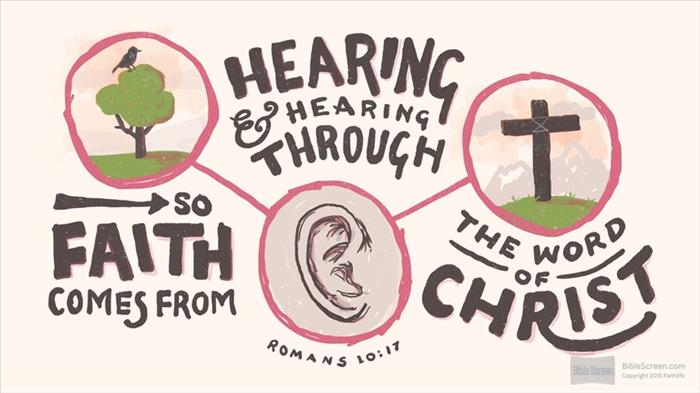
Romans 10:17 17 So faith comes from what is heard, and what is heard comes through the word of Christ.

Ro10.17To many people in today’s world, the message, the life, the reality of Jesus is just another factoid, a myth, or just unimportant. “If it sounds too good to be true, it probably is too good to be true.” But, it is True-with-a-capital-T true. And it does matter whether or not that Truth is heard. I do not want to step off here into speculations about “what if some family in the most remote village in some primitive country never hears The Word? Can they be saved?” For such derivative speculations I refer you to the Author of Life. He alone knows how all that works, and I am not about to mess with His plans. BUT it does matter for you, your friends and/or loved ones, as well as everyone who has heard The Word and rejected it as passé, or too incredible, or just not worth the time to pay attention.

“Oh, I believe there is a ‘Supreme Being’ and there is an ‘Intelligent Design,’ but as for all the rest of it, it doesn’t make sense.” (Here’s something similar to what you’ve seen in previous messages) “Organized Religion is just not my thing. I don’t need to be in some fancy building with a bunch of other hypocrites pretending to converse with someone or something I don’t understand and can’t relate to.” I get that a lot from my friends and family who are “Gen-Y through Millennials.” (See THIS LINK for some insights to that) Even many of us Boomers and our Gen-X (a/k/a “latchkey”) kids are remarkably indifferent to any form of religion or religiosity. “They are all the same, they all contain the same central truths, the same central philosophies based on equitable treatment of others, and none of them is particularly distinct from all the rest. That’s what the Dalai Lama says.” (That one always makes me SMH)

Ah, but there is one supremely different distinction this argument overlooks. The bulk of non-Christian religions are based on philosophical principles or speculations. Christianity is based not in speculation or philosophical principles, but in revelation, and is founded in the name of a Person. It is the Person of Christ that distinguishes Christianity form all other “belief systems.” It is Christ who is acknowledge and worshipped as Deity. This is not the case for other of the World’s Great Religions. Philosophy is not the beginning point of Christian theology; the starting point is the revelation of God through the Incarnation. It is precisely that concept that gives many folks cause to pause and to say, “Yeah, right. That sounds pretty speculative and philosophical to me. I mean I’ve read the books by guys like Joseph Campbell and Bill Moyers. Even Vishnu and Davaki had a ‘miraculous conception.’ It’s all mythology! IF there is a god, or several gods, he-she-it-they all come from the same collective imagination. As Jean Jacques Rousseau quipped, ‘God created man in his own image. And man, being a gentleman, returned the favor.’” And so the position held by many is that Christianity is just another system of mythology that arose out of Judaism, which might be rooted in Zoroastrianism, which might come from … how far back do you want to go?

Here’s my point: None of that matters. What matters is “1 In the beginning was the Word, and the Word was with God, and the Word was God. 2 He was in the beginning with God. 3 All things came into being through him, and without him not one thing came into being. What has come into being 4 in him was life, and the life was the light of all people. 5 The light shines in the darkness, and the darkness did not overcome it.” (John 1:1-5) It is The Word, the Logos as Christ, which makes the difference. He is the difference. To my Christian friends, that makes sense. For those of you reading this who do not profess to be Christian, I thank you for reading this far, and ask you to stay with it just a bit longer, please.

The letters Paul wrote to his protégé, Timothy, have some real gems about living as a servant of the Lord. Here are a couple of those:

1 Timothy 4:1-21 Now the Spirit expressly says that in later times some will renounce the faith by paying attention to deceitful spirits and teachings of demons, through the hypocrisy of liars whose consciences are seared with a hot iron.  

2 Timothy 3:13  13 But wicked people and impostors will go from bad to worse, deceiving others and being deceived.

In the end, then, unless you hear The Word, you will not know what has been testified to you about your salvation. Must you enter a building with a crowd of other people and collectively attempt to listen to Scripture? My heart tells me no. My heart tells me God will call you to Him in a thousand ways, and one or more of those may have something to do with “religion.” Most of them, though, will be calls to your decency, your moral compass, your faith in humanity, and all of those things originate in Christ through whom all things were made and through whom all of us are called to salvation. No one gets the call without Him. No one gets the benefit of His salvational Grace without Him giving it to him or her. Anyone who accepts that Grace shares in His liberation from condemnation. Having heard, accepted, and acted on the Word, we can and do enter into the Joy of the Kingdom. Those who have heard but rejected The Word diminish, and perhaps discard, any share in that Grace which is always available to every living soul because God is always available to every living soul:

Romans 10:20 20 Then Isaiah is so bold as to say,

“I have been found by those who did not seek me;
I have shown myself to those who did not ask for me.”
(See Isaiah 65:1-2)

Here is something else from the Prophet Isaiah: Isaiah 55:3 Incline your ear and come to me heedfully, listen, that you may have life. I will renew with you the everlasting covenant, the benefits assured to David. You should also check out Isaiah 53:1 and see how it connects with the verse at the top of the page, Luke 16:29.

Notice that Isaiah says, “listen, that you might have life.” The word used here for listen is also used in the Old Testament for the verb hear, but it is a command to hear, not always the act of hearing. The most recognizable instance is in the Shema: Sh’ma Yis’ra’eil Adonai Eloheinu Adonai echad. “Hear, Israel, the Lord is our God, the Lord is One.” This declaration by Moses is so powerful! The connotation is “hear, listen to this, and obey.” In this “hearing” one achieves consent, agreement, and understanding because what is heard is so undeniably clear it goes straight to our hearts. We know we have heard Truth speak. And when Truth speaks, there is life. Do you remember what Jesus said about truth? John 8:32 32 and you will know the truth, and the truth will make you free.” And Truth? John 14:6b “I am the way, and the truth, and the life. No one comes to the Father except through me.” That is the Life that comes from the listening. It is Everlasting Life that renews us. That renewal is testified to by God himself during Jesus’ Transfiguration.

Matthew 17:5 While he was still speaking, suddenly a bright cloud overshadowed them, and from the cloud a voice said, “This is my Son, the Beloved; with him I am well pleased; listen to him!”  And this is how God’s Love was finally manifested in the World. When you read these words, please hear them as spoken by a proud Papa who is pointing out the excellent young man standing before you. I can recall what that feels like when I think of my son, Timothy. Most of you know that Tim is an exceptional violinist. Sometimes, depending on the venue, people don’t really listen as well as I wish they would. I want them to hear how clean the music is, the virtuosity in those incredible runs, the technique and musicality of intonation and form; I want them to hear his music! “That’s my son. Listen to my son. He’s terrific! You’ve never heard anything like this before! Isn’t it wonderful?!”

In the past, I read this verse in Matthew in the narrative about the transfiguration as a thundering command: “Wake up fools! I’m giving it my best shot by sending you my only beloved son! This is your last chance! LISTEN UP!!!” Now I feel differently about it because I perceive and comprehend the Love of this wonderful Father who shares with us his Son, a Son who will suffer much because it pleases his Father to crush him. I couldn’t do that to my son, but God’s infinite love gave his son my suffering, my punishment, my death – because God loved even me. Even me. That makes absolutely no sense at all in The World. But, I don’t plan to spend Eternity in The World, so it doesn’t really matter if God’s plan makes sense here. I know what I hear, and I believe it.

Are you interested in learning more about Hearing the Voice of God? I’m going to invite you to visit Brendan Case’s dynamic course on just that topic – HEARING THE VOICE OF GOD. It is there for you, thanks to God’s generosity and Brendan’s cooperation, FREE. In Matthew 10:8b, Jesus says, “Freely you have received; freely give.” God wants to make it that easy for you; take a free course and learn how to discern God’s voice out of the thousands of voices contrary to his Word. In 1 Corinthians 2:12, Paul says, “Now we have received, not the spirit of the world, but the Spirit who is of God; that we might know the things that are freely given to us of God.” Belovéd, all the benefits assured to David are YOURS, freely given to us by God.

I challenge you to hear, accept, and act on The Word. The first challenge is: Do you know someone or someplace where The Word is unheard? Help pump up the volume by delivering it. Do it contemplatively through fervent prayer or actively through fervent evangelization. The second challenge is this: Do you know someone that has heard the Word of Christ but rejected the Grace of Faith? Evangelize them. Give him or her the reward, the gift, the Grace of the Good News. Share your Testimony. If you hear the Word, but ignore or scoff at what you heard, please try again. If someone is telling you, “I want you to know Jesus,” please try to meet Jesus. If someone you love is resisting the opportunity to find faith by hearing the Word, love them enough to keep witnessing, asking, encouraging, edifying – and praying for, with, and about them.

Christian Fundamentalist, Christian Evangelical, Orthodox Christian, Catholic, Jewish, Muslim, Hindu, Buddhist, Protestant, Universalist, Mormon, or even just “Religion-Curious,” whatever your particular persuasion, you have been called to hear, and by hearing you are called to faith, and by faith you are called to accept the Gift of Love in Christ Jesus. Did you know you can be the voice through which The Word is heard? It is often said, “Our lives are the only Bible some people will ever read.” Beloved, consider making your life an audio-book as well as a pop-up action book. Whatever your calling in Christ, honor the Giver by accepting – and sharing – the Gift of The Living Word. “Now hear ye the Word of the Lord.” He is calling! If you listen, you will hear; if you hear, Faith is just a “yes” away.

Do you have a child, a parent, a friend, a relative, a neighbor, or an acquaintance that needs to hear the Word for the first time, or hear it again? Do it now. Both of you might not have another chance later.

In your prayers:

  • Pray for those who reach and preach as well as for those who draw near to hear.
  • Pray for those who turn a deaf ear.
  • Pray for all the suffering souls whose ears are filled with the sounds of famine, war, terror, prejudice, pestilence, mockery, and abuse.
  • Pray for all those souls who afflict such things as these on others.
  • Pray for the people dying everywhere that they will find Peace and Mercy at the end of their days
  • Pray for those who suffer with chronic illness that they will know the sustaining love of God, family, friends, and caregivers in every moment of their lives.
  • Pray for Peace as though the future depends on it. Truly it does.
  • Pray for the children who are denied the opportunity to hear about Jesus for whatever reason, but especially for those children whose parents have closed their ears to The Word.
  • Pray for adults who think they haven’t got time for God, are too sophisticated to be taken in by religion, or whose lives have been so devoid of genuine love that they don’t know what Love is. SHOW THEM WHAT HAPPINESS LOOKS LIKE! (↔ Music Link)


With great love in my heart for each of you, I pray with Paul, “Grace and peace be unto you from God our Father and from our Lord, Jesus Christ.”

Whatever, whenever, wherever, whoever, however, if ever, forever — at your service, Beloved

Unless otherwise indicated, all scripture passages are from the New Revised Standard Version Catholic Edition (NRSVCE) New Revised Standard Version Bible: Catholic Edition, copyright © 1989, 1993 the Division of Christian Education of the National Council of the Churches of Christ in the United States of America. Used by permission. All rights reserved.

Creative Commons License
Aloha Friday Messages by Charles O. Todd, III is licensed under a Creative Commons Attribution-ShareAlike 3.0 Unported License


Aloha Friday Message – September 16, 2016 – Thinking Small

1638AFC091616 – Thinking Small

SMLPRead it online here, please. And please, when you visit there, use one of the social media links at the bottom of the page to share this post. Thank you!

Luke 16:10 1“Whoever is faithful in a very little is faithful also in much; and whoever is dishonest in a very little is dishonest also in much.

Aloha pumehana, ʻŌmea. Today I want to share with you the power of thinking small. It seems counterintuitive in this world where we are so often challenged to “Think BIG!” Life seems to be a hyperbole – everything is exaggerated whether good or bad, big or small, old or new, false or true. We want our lives to be bigger and our world to be smaller. We want hundreds of “friends” and belittle families. We embrace the sparkle but live in the shadows. We shun the Light and cherish the darkness. We struggle for life in a culture of death. We advocate World Peace and despise our neighbors. We condemn these faults in everyone and excuse them in ourselves. There are those among us, though, who have humbler aspirations. I will show you two women today who inspire millions to think and do in small ways. First, I want to insert the Moon Beam Network Prayer because what I will be writing about is a strong influence in that prayer.

Father, I take a moment to remember everyone in the Moon Beam Network. Watch over them all. Bless them. Protect them. Guide them. Direct them. Keep them all safe from any harm or danger in body mind and spirit. See to their temporal needs and continue to call them all to a deeper spiritual awareness of and commitment to you through Jesus. Increase their faith and fill them with your Light. Bless everyone who prays for us and everyone who asks for our prayers. Bless all of us with the will to do small things with great love, that love which we share among all of the members of the Moon Beam Network. Likewise bless everyone I have ever loved and everyone who has ever loved me, and anyone who has ever loved them, for the love we have comes from You through Your Son Jesus the Christ by the ministry of The Holy Spirit. Amen.

The Gospel verse today is from Sunday’s parable about the dishonest steward. He was cheating his boss, and the boss found out and sent him packing. Before leaving, though, he called in some of the folks who owed the boss money and cooked the books with them. He made those people complicit in his crime in the hope that they would help him avoid having to be an honest laborer once he was canned. That’s a pretty greedy, lazy outlook on life. When the boss heard about it he had to chuckle about the “creativeness” of the crook, crediting him for his cleverness. Jesus also says in Luke 16:9 And I tell you, make friends for yourselves by means of dishonest wealth [mammon] so that when it is gone, they may welcome you into the eternal homes.

Is Jesus telling us to be crooks? No, of course not. He is saying that we can use worldly wealth in ways that help others; then, when that is all used up, others will welcome you into their lasting protection. The worldly are often more careful about their actions and choices than others who are naïve in the ways of The World. Believers and nonbelievers alike are commanded by God to use their wealth to help the poor, to make the lives of others better, and to guide our lives toward compassion and generosity rather than indifference and greed. In doing so we may gain the friendship and admiration of others – even the angels would rejoice over that kind of repentance. Every time we take advantage of the opportunity to do just one little something for someone else, we take a step closer to the Narrow Gate on the Straight and Narrow way. When we do little things for the marginalized – or for the aggrandized – we do them for Jesus. Simple little things like giving alms, or food, or shelter, or clothing, or even a drink of water: Matthew 10:40-42 42 and whoever gives even a cup of cold water to one of these little ones in the name of a disciple—truly I tell you, none of these will lose their reward.” That’s the easy path to heaven – just doing the little things that make the world around you a better place for everyone around you.

I know a couple of moms who navigate the storms of life for very large families. Day after day there is an endless list of little things that are needed for the family to keep going. Their husbands play a role in it – sometimes helpful, sometimes not-so-much – and kids are deputized to do certain chores, but it’s always MOM who keeps the ship afloat and on course. We all know families like that; even families with only one child depend on Mom to make it all work. And it certainly is all work! If you ask them, “Why do you do all this?” you might on occasion hear, “Sometimes I wonder.” But if you watch them, you see that every piddling little task, every noisome chore, and every crisis conquered is accomplished through indefatigable LOVE. They do all those small things with great love. There is a reason for that thought being in the MBN Prayer.

St. TeresaPretty much all the world knows who Mother Theresa is. Recently canonized, she has been an exemplar of putting her whole life into doing the little stuff that many consider to be beneath their personal dignity. For this amazing woman, her personal dignity was simply not part of the equation. The needs of others always superseded her own needs. Here are some actual, genuine examples of how she saw that working for her in her own life:

We ourselves feel that what we are doing is just a drop in the ocean. But if the drop was not in the ocean, I think the ocean would be less because of the missing drop.

I do not agree with a big way of doing things. What matters is the individual. If we wait till we get numbers, then we will be lost in the numbers and we will never be able to show that love and respect for the person.

Don’t look for big things, just do small things with great love….The smaller the thing, the greater must be our love. [emphasis added]

Here, too, are some “quotes” misattributed to this remarkable woman:

Be faithful in small things because it is in them that your strength lies.

Not all of us can do great things. But we can do small things with great love.

Do not think that love, in order to be genuine, has to be extraordinary. What we need is to love without getting tired.

Therese_de_LisieuxI encourage you to find the actual, true quotations from St. Theresa of Calcutta. The quotes falsely attributed to her are nice, but still inaccurate. Another Saint who is often quoted (and misquoted) is St. Thérèse of Lisieux. Here are some quotes from her autobiography, The Story of a Soul.

Little things done out of love are those that charm the Heart of Christ… On the contrary, the most brilliant deeds, when done without love, are but nothingness.

But I will look for some means of going to heaven by a little way which is very short and very straight, a little way that is quite new […]. It is your arms, Jesus, which are the lift to carry me to heaven, And so there is no need for me to grow up. In fact, just the opposite: I must stay little and become less and less.

Scripture gives us many examples of God’s preference for the little things done lovingly in life. For example:

1 Corinthians 16:14 14 Let all that you do be done in love.

1 John 3:18-20 18 Little children, let us love, not in word or speech, but in truth and action. 19 And by this we will know that we are from the truth and will reassure our hearts before him 20 whenever our hearts condemn us; for God is greater than our hearts, and he knows everything.

 1 Corinthians 1:27-29 27 But God chose what is foolish in the world to shame the wise; God chose what is weak in the world to shame the strong; 28 God chose what is low and despised in the world, things that are not, to reduce to nothing things that are, 29 so that no one might boast in the presence of God.

Everywhere we turn each day we are enticed to listen to The World – social media, politics, fascist governments, all sorts of other mass-media venues, educational institutions, and global economic powers tell us we are being deprived of our piece of the pie. And where is that pie? It is pie in the sky. The real value in life is in ignoring the world and listening to God. That is one little thing you can do that will truly make The World a better place; it is your drop in the ocean, it is your starfish cast into the sea, your Little Light (↔ Music Link) that shines against the darkness. (See Luke 11:33-35) We don’t have to take our cues for success from The World in fact, we must not do that. Remember Jesus’ words in Luke 10:16 16 “Whoever listens to you listens to me, and whoever rejects you rejects me, and whoever rejects me rejects the one who sent me.”

Those moms and dads that we know who do little things with great love listen to The Word, not The World. That is how they can “do small things with great love.” That is why that thought is in our MBN prayer. Read it again, please, and pray it often. It can help you silence the din of The World around us. No, it won’t make your kids quiet down, or stop your husband from asking stupid questions. It won’t silence the neighbor who mows the lawn during the evening news or the Shih Tzu that yaps day and night. It won’t reform the guy who watches football every Sunday with 30 beer-fueled screaming fans. It won’t even turn your kids into dutiful little minions who anticipate the family’s needs and fulfill them. It will just give you that quiet place in your soul where you can take a little breather and say, “That’s done. What’s next, Father?”

⇒⇒♥⇒⇒Special message to the kids and dads in those large households: Do those little things Mom needs and treasures. Do the dishes, change the diapers, fold the laundry, put lotion on her feet, be sure there’s coffee in her mug in the morning, go to church with her and pay attention, and – best of all – tell her often and clearly “We love you. Thank you!” She does all the little things that make your life livable. And yes, I realize I chose two women who were not moms. The list of Saints who are moms begins with Our Blesséd Mother Mary and include hundreds more. Check it out!

Whatever, whenever, wherever, whoever, however, if ever, forever — at your service, Belovéd!

Unless otherwise indicated, all scripture passages are from the New Revised Standard Version Catholic Edition (NRSVCE) New Revised Standard Version Bible: Catholic Edition, copyright © 1989, 1993 the Division of Christian Education of the National Council of the Churches of Christ in the United States of America. Used by permission. All rights reserved.

Creative Commons License
Aloha Friday Messages by Charles O. Todd, III is licensed under a Creative Commons Attribution-ShareAlike 3.0 Unported License


Aloha Friday Message – September 9, 2016 – Lost and Found

1637AFC090916 – Lost and Found

Read it online here, please. And please, when you visit there, use one of the social media links at the bottom of the page to share this post. Thank you!

Luke 15:10 10 Just so, I tell you, there is joy in the presence of the angels of God over one sinner who repents.

Aloha nui loa, ʻŌmea! Does it seem to you that the calendar may have gone bonkers? How could it already be the Friday after Labor Day? There are already Christmas decorations in some of the stores. Halloween costumes are selling fast at COSTCO. Grocery stores are advertizing deep discounts on turkeys and hams. Apple released another “must-have” version of the iPhone “just in time for holiday giving (and getting!) What is wrong with me? This year it feels like time is going by me so fast that I am lost in the shuffle. I just cannot sync up with the World and keep track of all the stuff that’s happening, and the stuff I’m supposed to be gathering for my “happiness and peace of mind.” I’m moving in slow motion, and just can’t keep up any more. Motion is relative, though, and I need to remember that so I can make sense out of my perceptions about Sunday’s Gospel.

The fifteenth chapter of Luke contains one of the best-known parables in Jesus’ ministry – the Prodigal Son. It also has two other parables – the lost sheep and the lost coin. The setting is familiar – Jesus is surrounded by tax collectors and sinners, and the Pharisees are clucking their tongues about the riffraff Jesus attracts. In the first two stories, possessions are lost. The sheep is lost because it wandered off of its own volition, and the shepherd risks his own safety to seek it out and retrieve it. The coin is lost because it is misplaced or perhaps it dropped and rolled away; nonetheless it is gone, but not as an act of will but rather by accident. The son is lost because of his own stubbornness and greed, but returns when he comes to his senses and decides to repent so he can return to his father. He went out to make his place in the World, and the World rejected him. He was lost but then was found. He was dead but then was alive. He was so enchanted by the idea of fast living that he became out of sync with what was important – his home and family. There are so many lessons in this one chapter, but today I want to look behind the page and see some of the things we might have  considered.

We know that all three stories end in rejoicing. We know that friends and family are called together to rejoice with the one who was searching and found the object of that search. We know the story of the Lost Son and the Loving Father is about repentance. When the son repents and returns home, he learns that the life he discarded is still waiting for him, preserved by his loving father. He is restored to his family and his father brings in friends and relatives to a feast to share his joy. His other son, though, is miffed that his brother is back and treated like royalty. He refuses to enter into the feast. How many of us do the same – refuse to rejoice and enter the feast? How can we refuse to share our joy with the community around us? Come to think of it, why should they care?

Why should they care? What’s in it for them? They didn’t lose a sheep, or a coin, or a pile of money taken by an errant son. Do we care about the good things and hard things, the lost things and the found things, or the people and places we share with one another? Well, unless we are really miserable misanthropes who hate everyone around us, of course we care – not only about our stuff, not only about our relationships, but also about the stuff others have and for other persons as well. It’s a really simple thing – we care about others who experience loss because we have experienced loss. We’ve also experienced finding what we lost; some of us have also experienced being found after being lost. Who among us hasn’t known that moment of panic in the department or grocery store when we looked up and mom or dad was gone? Or what parent has never searched – wide-eyed and heart-pounding – for a child at the park or the beach or the store? All of us have lost stuff that was dear to us, things that held deep personal, emotional value. I am sure all of us have also experienced that moment of joyful relief when the child is found, the parents are located, the stuff is returned, and love conquers the fear of separation from whatever we hold important. That is the tagline Jesus uses as he tells these stories.

  • What man among you having a hundred sheep …
  • Or what woman having ten coins …
  • A man had two sons, and the younger one …

Yes, we rejoice when things turn around and grief becomes joy. We understand that Jesus shows us that joy when he says –

  • I tell you, in just the same way there will be more joy in heaven over one sinner who repents than over ninety-nine righteous people who have no need of repentance.
  • In just the same way, I tell you, there will be rejoicing among the angels of God over one sinner who repents.
  • … your brother was dead and has come to life again; he was lost and has been found.

In previous posts we have looked at the word repentance. You may recall it means “to turn around.” Jesus and John the Baptist used the word μετάνοια, – metanoia {met-an’-oy-ah}. It is a change of heart, a change of mind, or a change of direction as in a one-eighty turn. A closely-related word is μετανοέω – metanoéō {met-an-o-eh’-o}. Both come from the same root meanings meta – above, beyond, higher; and noein to think from nuosmind. So, metanoia is to move beyond where our hearts and minds are to a new paradigm, a new way of thinking and feeling and seeing everything in life. When we repent, we have a change of mind – not a renewing of mind (See Romans 1:12). Another way to think of it is we quash, break, nullify, defeat, or conquer a temptation that is repeatedly before us; we break a bad habit; we realign our values-system so that it aligns more closely with God’s values. WE make an effort to sin less even though we know we can never be sinless. Repentance restores our relationship with God, and often it also restores our relationships with community, family, and friends. It gives back to us the whatever or the whomever we lost because of sin; it even gives us back to us. It’s not a matter of time – how long we are away, or of intensity – how greatly we’ve sinned. It is a matter of turning around and going back, repenting. There’s a flip side to that, and that’s what is behind the page.

ProdigalBrotherRepentance restores us back to God. Intellectually, we know God doesn’t move away from us, he doesn’t take off to some mountaintop and sulk because we’ve decided to ignore him. No, he stands at the ready, eager for us to turn around and say, “Father! Abba! I’m back!” We have come back to God, and suddenly we discover God is “back with us.” While we are lost in sin, we cannot encounter God, our Loving Father who is so crazy in love with us that he can’t wait to get us back. He watches for us, reaches for us, comes out to meet us. He helps us find that lost sheep and the coin that escaped our control. Those are things and he cares about them, too; but he cares about us more! He loves us. Well, duh! Of course he does. He made us for the sake of love. He also redeemed us for the sake of love, and when we accept that redemption, God and the angels in heaven (and saints, too, I reckon) rejoice as a community over our repentance. Why? Because that means they will get to share eternity with us – with God and the angels and saints. But there’s one angel that will not rejoice. He’s the angel that says (and is always telling us), “What’s in it for me?” What do we get out of all that “Alleluia” shouting?

We get to rejoice! We get to shout ALLELUIA with El Shaddai Olam, with the angels and saints, and with our community of repentant believers who are washed in the blood of The Lamb. Now, we really should say something here about the word “prodigal.” We have somehow gotten the idea it means something like runaway – the runaway son. Prodigal actually means wasteful, reckless, uncontrolled, and extravagant. It was the boy’s extravagant lifestyle that drew him away from his Loving Father; but it was the extravagant love of his father that restored his life to him. His brother, however, grew angry and refused to rejoice. “I’ve served you faithfully for many years while this worthless bum went out and blew a fortune on everything you taught us to avoid. And now you welcome him back as if nothing ever happened? What’s wrong with you!?” ʻŌmea, we know what’s wrong here. The older son, the responsible one who did everything his father asked, expected to receive what was in it for him. He’d put a lot into his dad’s fields, and felt cheated. He’d fulfilled his obligations; his brother had not. He did not understand the purpose and scope of a father’s love. The elder son perhaps helped his father more out of expected obligation than out of love. Jesus’ message is that our Loving Father isn’t like that. Jesus came to us to find us, to restore us and our relationship with God and each other. He came looking for us, remember?

Luke 19:10 10 For the Son of Man came to seek out and to save the lost.

1 Timothy 1:15 15 The saying is sure and worthy of full acceptance, that Christ Jesus came into the world to save sinners – of whom I am the foremost.

Sunday’s Gospel focuses on the loss of things and then on the loss of relationships. When we focus on things, we are also lost, because we should focus on our encounter with God, who – as our true Loving Father – waits for us expectantly to enfold us into his extravagant embrace. That is where WE should want to be found, in our RELATIONSHIP with God. We encounter the presence and power of Christ whenever and wherever we share him by serving others. If we are lost, we have separated our lives from that power and presence, we have wandered off or rolled away or willfully turned our backs on the extravagant love of a God who came to find and restore life to us by giving us his life. That’s what’s in it for us – Eternal Life. The very first thing Jesus said when he began his ministry is found in the Gospel of Mark: Mark 1:14-15 14 Now after John was arrested, Jesus came to Galilee, proclaiming the good news of God, 15 and saying, “The time is fulfilled, and the kingdom of God has come near, repent, and believe in the good news. When we do that, we go “off the clock” that insists on what the world demands and our lives move at the pace of Eternal Life. “Earthly rantings then will bore you,” and you can rest in the palm of God’s hand because you are home. Next time you hear yourself thinking, “I don’t get anything out of church,” stop and think about what God, his angels, and your community receive through your being there. You were lost but now are found. You were dead but now are alive.

Whatever, whenever, wherever, whoever, however, if ever, forever — at your service, Belovéd!

Unless otherwise indicated, all scripture passages are from the New Revised Standard Version Catholic Edition (NRSVCE) New Revised Standard Version Bible: Catholic Edition, copyright © 1989, 1993 the Division of Christian Education of the National Council of the Churches of Christ in the United States of America. Used by permission. All rights reserved.

Creative Commons License
Aloha Friday Messages by Charles O. Todd, III is licensed under a Creative Commons Attribution-ShareAlike 3.0 Unported License

Biblical languages inserts from Bible Hub (Bible Hub: Search, Read, Study the Bible in Many Languages) Visit at http://biblehub.com

 

Pages Email Newsletter Categories Archives Connect
  • Connct to us here