Aloha Friday Message – September 4, 2016 – Love-Hate Debate

1636AFC090216 – Love-Hate Debate

Read it online here, please. And please, when you visit there, use one of the social media links at the bottom of the page to share this post. Thank you!

Luke 14:26-27 26 Whoever comes to me and does not hate father and mother, wife and children, brothers and sisters, yes, and even life itself, cannot be my disciple. 27 Whoever does not carry the cross and follow me cannot be my disciple.

Aloha pumehana, ʻŌmea. Today I want to peek into this Bible verse which is the “opening line” in This Sunday’s Gospel. I want to look at it because it is another example of Jesus’ radically different viewpoint about our relationships with God and with each other. Without looking into this properly – in context – we might be tempted to say, “How can Jesus say such a thing! Am I really going to hate my father, mother, wife, children, brothers, sisters, friends and neighbors? I thought Jesus wants us to love everyone. This must be a mistake!” It is not a mistake. Let’s find out why by looking at other things Jesus told us.

Let’s begin with a parallel Gospel quotation that is very similar, but which also gives us more insight to what Jesus was saying. It is found in Matthew 10:37-38 37 Whoever loves father or mother more than me is not worthy of me; and whoever loves son or daughter more than me is not worthy of me; 38 and whoever does not take up the cross and follow me is not worthy of me. Here we see that we are to prefer Jesus to all others. In this verse the verb for love is φιλῶν (philon’) {phee-lōn’} derived from φιλέω (phileó) {fil-eh’-o} – familial or brotherly love. Whoever would “philon” instead of “agape” Jesus does not love Jesus with greater honor than family. Still, it says quite clearly in our quote from Luke, “Whoever comes to me and does not hate father and mother ….” We need to look at the word here for “hate.”

The word used here, and in most other Gospel passages that use the word hate is μισεῖ (misei) {mis-eh-i) from μισέω (miseó) {mis-eh’-o}. The root meaning of the word is to detest by comparison. It means to choose one thing or person over another – or the other way around – to love someone or something less than the other. If there is a choice, especially a nearly equivalent choice, μισέω is to turn down one choice over the other. Jesus is telling us he expects us to love one another greatly but to love God even more. Consider these passages about loving each other for example:

Matthew 5:43-48 43 “You have heard that it was said, ‘You shall love your neighbor and hate your enemy.’ 44 But I say to you, Love your enemies and pray for those who persecute you, 45 so that you may be children of your Father in heaven; for he makes his sun rise on the evil and on the good, and sends rain on the righteous and on the unrighteous. 46 For if you love those who love you, what reward do you have? Do not even the tax collectors do the same? 47 And if you greet only your brothers and sisters, what more are you doing than others? Do not even the Gentiles do the same? 48 Be perfect, therefore, as your heavenly Father is perfect.

Matthew 15:4-6 For God said, ‘Honor your father and your mother,’ and, ‘Whoever speaks evil of father or mother must surely die.’ But you say that whoever tells father or mother, ‘Whatever support you might have had from me is given to God,’ then that person need not honor the father. So, for the sake of your tradition, you make void the word of God.

Matthew 19:17-19 17 And he said to him, “Why do you ask me about what is good? There is only one who is good. If you wish to enter into life, keep the commandments.” 18 He said to him, “Which ones?” And Jesus said, “You shall not murder; You shall not commit adultery; You shall not steal; You shall not bear false witness; 19 Honor your father and mother; also, You shall love your neighbor as yourself.”

God is Jesus’ Father and, by adoption, he is our Father as well. We honor God by honoring our parents as well as wife and children, brothers and sisters, yes, and even life itself, because God is Love and we are created in his image and likeness; we are to be love (phileo) for one another even to the point of Divine Love (agape), but in Loving one another, we ought always love God more that all others. We are to be prepared to suffer the loss of all that is precious to us in exchange for the Love and loyalty we give to God – depending on him in all things ranging from wealth to poverty, from comfort to pain, or from joyfulness to anguish. God’s gift of this life is so precious because it is given to us expressly for the purpose of losing it – and how we do that is what opens for us the Straight Road, the Narrow Gate, and the realization of his promised Everlasting and Eternal Life. Jesus himself tells us in John 12:25 25 Those who love their life lose it, and those who hate their life in this world will keep it for eternal life.

Finally, ʻŌmea, consider these:

Matthew 6:24No one can serve two masters; for a slave will either hate the one and love the other, or be devoted to the one and despise the other. You cannot serve God and wealth.

Luke 16:1313 No slave can serve two masters; for a slave will either hate the one and love the other, or be devoted to the one and despise the other. You cannot serve God and wealth.

John 7:7 The world cannot hate you, but it hates me because I testify against it that its works are evil.

John 15:18 18 If the world hates you, be aware that it hated me before it hated you.

Let us therefore in all things submit to the loving authority of our God in Christ Jesus, who is the image of the invisible God, the firstborn of all creation; 16 for in him all things in heaven and on earth were created, things visible and invisible, whether thrones or dominions or rulers or powers—all things have been created through him and for him. 17 He himself is before all things, and in him all things hold together. (Colossians 1:15-16)

Given the choice between God my Father, and my Dad and Mom – well, I love my parents, and my siblings, and my friends, my remarkable spouse, and even my home, my work, my life – but, I will choose Christ, I will choose Love, I will chose Hope because to choose anything or anyone else would be a huge self-deception. Remember this:

1 Corinthians 3:16-23 16 Do you not know that you are God’s temple and that God’s Spirit dwells in you? 17 If anyone destroys God’s temple, God will destroy that person. For God’s temple is holy, and you are that temple.

18 Do not deceive yourselves. If you think that you are wise in this age, you should become fools so that you may become wise. 19 For the wisdom of this world is foolishness with God. For it is written,
“He catches the wise in their craftiness,”
20 and again,
“The Lord knows the thoughts of the wise,
that they are futile.”

21 So let no one boast about human leaders. For all things are yours, 22 whether Paul or Apollos or Cephas or the world or life or death or the present or the future—all belong to you, 23 and you belong to Christ, and Christ belongs to God. (See Deuteronomy 30:15-20 – choose LIFE!)

Whatever, whenever, wherever, whoever, however, if ever, forever — at your service, Belovéd!

Unless otherwise indicated, all scripture passages are from the New Revised Standard Version Catholic Edition (NRSVCE) New Revised Standard Version Bible: Catholic Edition, copyright © 1989, 1993 the Division of Christian Education of the National Council of the Churches of Christ in the United States of America. Used by permission. All rights reserved.

Creative Commons License
Aloha Friday Messages by Charles O. Todd, III is licensed under a Creative Commons Attribution-ShareAlike 3.0 Unported License

Biblical languages inserts from Bible Hub (Bible Hub: Search, Read, Study the Bible in Many Languages) Visit at http://biblehub.com
 

Aloha Friday Message – August 26, 2016 – Salutations!

1635AFC082616 – Salutations!

Read it online here, please. And please, when you visit there, use one of the social media links at the bottom of the page to share this post. Thank you!

Luke 14:1111 For all who exalt themselves will be humbled, and those who humble themselves will be exalted.

Aloha pumehana, ʻŌmea (Warmest greetings, Belovéd). This verse is part of a short lesson given by Jesus on the occasion of a dinner party. The Gospel of Luke uses many references to meals as he tells us about Jesus’ ministry – ten in fact. This particular meal is at the home of “the leader of the Pharisees.” It was an opportunity for the Pharisees and the community to watch Jesus closely to see how he behaved in such prestigious company. They forgot, however, that he was watching them. He saw them entering the banquet and seeking out the places of honor, looking for recognition from their peers and underlings, and putting on the appearance of false modesty. Jesus told them, gently but firmly, “Now cut that out!”

Ah, Belovéd, we all like the recognition we get from others. We love to be greeted, to be honored, to be loved by all just because we are so darn lovable. We want praise, acclaim, honor, homage, salutations, and recognition. We don’t mind being famous-for-being-famous. The spotlight always looks better when it is focused on us. Who better to be acknowledged by all than us? Jesus shows us how quickly that can backfire. He tells us in Luke 14:8-9 ‘When you are invited by someone to a wedding banquet, do not sit down at the place of honor, in case someone more distinguished than you has been invited by your host; and the host who invited both of you may come and say to you, “Give this person your place”, and then in disgrace you would start to take the lowest place.’ Remember last week? We looked at Luke 13:30 30 Indeed, some are last who will be first, and some are first who will be last.” This is the same approach. Jesus is reminding these very important men that being important isn’t as important as being humble rather than prideful.

Pride – hubris (ὕβρις) – is the personal conviction that one is better than anyone else. The prideful person believes s/he can do more things, better things, and expects to be admired by others as much as s/he admires himself/herself. Pride is a perversion of love and a lack of humility. Pride often feigns humility with the intent of gaining more praise. Pride leads to hatred and contempt of others and in its worst form makes the proud person indifferent to everyone – even those whose obsequious behaviors feed that pride. Prideful people are preoccupied with themselves, their life, their possessions, their abilities, their appearance; everything is me, me, me. Take a look at Isaiah 14:12-15 to see what brought down an angel of God. (Seriously, use the link.) Then consider how often Israel was referred to as a “stiff-necked people.” Make an image in your mind of a prideful person, and you will see their neck stiff, eyes haughty, nose up as if it would kill them to have to look down at the rest of us. Pride excludes everyone and everything, is jealous of all that is good, and loves all that confirms one’s self – including, in particular, evil. For the prideful, only they themselves and what they do is superbly superior. But God shows us that Pride is conquered by Humility.

Humility is the recognition that one is imperfect and, because of this, lowers her/his view of himself/herself in comparison to others. This kind of meekness is characterized by the world as being overly modest, timid, submissive, weak, tepid, or just plain stupid. The humble person is aware that any and all goodness – good things, good qualities, and good actions – arise from divine Grace rather than personal effort. It is the product of love – a threefold love that balances one’s disposition to [1] the divine, [2] to self, and [3] to others in ways that seek to mend rather than sunder, to include rather than exclude, and to accept rather than reject.

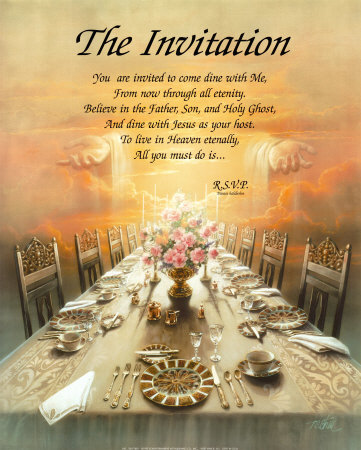
JustRSVPIn this meal-story in verses 12-14, we read – 12 He said also to the one who had invited him, ‘When you give a luncheon or a dinner, do not invite your friends or your brothers or your relatives or rich neighbors, in case they may invite you in return, and you would be repaid. 13 But when you give a banquet, invite the poor, the crippled, the lame, and the blind. 14 And you will be blessed, because they cannot repay you, for you will be repaid at the resurrection of the righteous.’ The lesson he wants to teach the Pharisees has two parts: [1] Be truly humble, and that will lead to truer praise. [2] Be openly inclusive of everyone, and God himself will enrich you.

One must take care, though, not to be completely without pride in one’s self. Personal dignity, self-respect, and healthy self-esteem are essential to healthy living. We often have difficulty remembering that we are the branches and Christ is the vine, we are the leaves and he is the roots. Healthy self-esteem recognizes that all that we are, all that we have, all that we do – every moment of every day – is given to us by the Goodness of God. When we boast – to others and/or or to ourselves – that we have done such-and-such, or we are thus-and-so, then we err by failing to glorify God rather than ourselves. As St. Paul says in Ephesians 2:8-10 For by grace you have been saved through faith, and this is not your own doing; it is the gift of God – not the result of works, so that no one may boast. 10 For we are what he has made us, created in Christ Jesus for good works, which God prepared beforehand to be our way of life. We are our best selves when we say, with true conviction, “I have immersed my life in His Heart so that my heart can be entirely filled with Him.” There is little in us about which we can boast if all that is in us is just us. Past, present, and future; thoughts, words, and deeds; works and prayers, joys and sorrows, victories and defeats – all belong to God for they are all from God. We forget that more often than we usually will admit, and get puffed up over our own self-deceptions.

There is a great illustration of this in Proverbs 27:1 Do not boast about tomorrow, for you do not know what a day may bring. Another great lesson, one that is quoted often, is found in Proverbs 16:18 18 Pride goes before destruction, and a haughty spirit before a fall. In Isaiah 10:12-19, (this is a great link to use) we read about how the King of Assyria convinced himself that he was the ultimate ruler, warrior, sage, and conqueror. He figured everything he had accomplished was because he was so superior to everyone else. He failed to realize that the reason he was so successful was because God used him as a tool to bring correction to Israel and her neighbors. God says, (see verse 15 in the link), “15 Shall the axe vaunt itself over the one who wields it, or the saw magnify itself against the one who handles it? As if a rod should raise the one who lifts it up, or as if a staff should lift the one who is not wood!” What good we do, who we are good to and good for, what we have that is good, all that we will become in goodness – it is all God’s doing. Having that awareness is what enables genuine humility. Genuine humility is the wellspring of holiness, and those who are truly holy are also truly humble. That is also a very healthy form of self-esteem because it centers us in all our relationships with God and each other. We all want a salutation – a salute, an acknowledgement, a gesture of recognition. That, in itself, is a healthy human need. When we satisfy that need as God intended, our lives are harmonious with him and with each other. There is a passage in the Wisdom book called Sirach which speaks to the life we can expect when we live as humble servants instead of exalted masters.

Sirach 3:17-18 17 My child, perform your tasks with humility; then you will be loved by those whom God accepts. 18 The greater you are, the more you must humble yourself; so you will find favor in the sight of the Lord.

Whatever, whenever, wherever, whoever, however, if ever, forever — at your service, Belovéd!

Pray for the people – ALL the people!

Unless otherwise indicated, all scripture passages are from the New Revised Standard Version Catholic Edition (NRSVCE) New Revised Standard Version Bible: Catholic Edition, copyright © 1989, 1993 the Division of Christian Education of the National Council of the Churches of Christ in the United States of America. Used by permission. All rights reserved.

Creative Commons License
Aloha Friday Messages by Charles O. Todd, III is licensed under a Creative Commons Attribution-ShareAlike 3.0 Unported License

Aloha Friday Message – August 19, 2016 – Outta Line

1634AFC081916 – Outta Line

Read it online here, please.  And please, when you visit there, use one of the social media links at the bottom of the page to share this post. Thank you!

Luke 13:30 30 Indeed, some are last who will be first, and some are first who will be last.”

Καὶ ἰδοὺ εἰσὶν ἔσχατοι οἳ ἔσονται πρῶτοι, καὶ εἰσὶν πρῶτοι οἳ ἔσονται ἔσχατοι.
Kai  idou eisin eschatoi hoi esontai prōtoi,  kai eisin  prōtoi   hoi esontai eschatoi

E pili mau na pomaika‘i ia ‘oe a me ke akua ho’omaika‘i ‘oe, ʻŌmea! (May blessing always be with you and may God bless you, Beloved!) Don’t let that opening verse intimidate you. I want to show it to you that way so that you can see just how cleverly it is put together so that its meaning is more powerful. As written, ἔσχατοι (eschatoi) and πρῶτοι (prōtoi) are superlatives which mean the absolute first and absolute last.

If you look at the third line, which is called the transliteration, you can see the “English” version of the words – the Greek letters have been “exchanged” for the letters we use in our common alphabet. If you look for pairs of words before and after the middles of the sentences, you will see that the phrases last who will be first and first who will be last are like mirror images of each other – in Greek and English. This is a brilliant way of helping people remember your point. Let me give you some familiar examples of a literary device called antimetaboleAN-ti-mə-TAB-ə-lee

  • “Ask not what your country can do for you; ask what you can do for your country.” John F. Kennedy, Inaugural Address, January 20, 1961.
  • “In America, you can always find a party. In Soviet Russia, Party always finds you!” – Yakov Smirnoff
  • “If you fail to plan, you plan to fail.”
  • “The absence of evidence is not the evidence of absence.” — Carl Sagan
  • “We do not stop playing because we grow old; we grow old because we stop playing.” — Benjamin Franklin
  • “Eat to live, not live to eat.”- Socrates

OK, you’re right, all of that is TMI – too much information and probably overly-technical. Nonetheless, it is important to understand this structure so that when we start analyzing “first” and “last,” the sense of what Jesus says will be clearer. Please take a moment to click on the link for this verse. If you do that, you will see four versions – four translations – of this remarkable teaching text. In the first three, first and last are translated in a way that conveys comparisons in chronological or numerical order. In the fourth version, the translation will convey comparisons in importance. These kinds of lessons in Jesus’ ministry are often accompanied by paradoxical illustrations. In this kind of statement, there are two statements which both sound true but generally can’t be true at the same time. “Give and it will be given to you.” “We are in the world but not of the world.” From the World’s view we are out of line when we line up with God.

We have some additional examples of this type of paradoxical contrast in Jesus’ teaching – the greatest of all is the servant of all, he who loses his life shall save it, the poorest are the richest. Jesus is always telling us that if it makes worldly sense, it is spiritually senseless. Worldly teaching says that we are to be the best, to be Number One. Currently much of The World is caught up in the idea of competition. We want to be the fastest, the strongest, the richest, the most beautiful, the most talented, the most important, and we also want to celebrate those things in others. We identify with our sports teams, our international athletes, or certain of our political leaders or religious leaders. We Americans seem to be by nature highly competitive with an aim to win; however, when our competition is tainted by personal or national greed, we lose big-time (consider what happened to Russian athletes). In fact, if we really think about it, anytime we try to elbow our way to the front, we get pushed to the back. Remember the lunch line at school? What happened if you tried to cut in front of someone? You got sent to the back of the line. What happens in heavy traffic when you see a sign that says LANE ENDS MERGE LEFT, and people in the right lane speed ahead so they and merge farther down the termination lane? People in the left lane often tighten up and block out the hasty driver who is “just trying to butt in line.” Trying to be first can sometimes backfire – especially if you make it clear to others that it’s all about you. That’s out of line.

The same often happens with the people who try to be more important than they actually are. If they flaunt their importance by putting others down, they eventually learn that they are despised by all but their brown-nosing, kowtowing flatterers – whose praise is as insincere as the braggart’s boasts of triumph. We all know people who will go to extraordinary lengths to be admired, and in the end, they end up shunned. We all know, or know of, people who seem to have reached the pinnacle of success – perhaps even several times – yet many people loathe them. So whether it is chronological or numerical order or whether it is order of importance, being first for the sake of being first makes one a loser. I think Jesus is telling us this is how it works in the Kingdom of God, too. Sometimes we come across memorable messages about that. Here is one I recall about lining up with God.

Back in the late 80s and early 90s, there was a radio program called Searchlight. It featured lessons from Pastor Jon Courson. In several of his lessons he used a little aphorism that went, “Do your best and commit the rest.” In one of his lessons, I remember he made that a three-part saying: “Be at rest. / Do your best. / Commit the rest.” Later I realized that second incidence of REST had a double meaning: REST as in whatever is lacking the Lord will provide, and REST as in give God your period of rest as a gift of faith his ability and willingness to provide for you. You don’t have to worry about resting before doing because God will use your rest to prepare you for the combination of your effort and his help. At that time, I was working a job where the general attitude was, “Do the best you can with what you have and bag the rest.” To “commit the rest” means to turn it over to God. In Proverbs 16:3, we are told Commit your work to the Lord, and your plans will be established. Perhaps all of us can recall an experience in our lives where we failed to trust the Lord to do his will with, in, and for us. Those are the times we thought we could do it on our own, that we could be first without him, and that our To-Do List was more important than his will. In Luke 13:30, Jesus is telling us that his Father’s will is for us to be servants, not masters; to be weak and meek, not strong and stern; and to be humble, not haughty. When we get out of line with others, others get out of our line. When we get out of line with God, we are way out of line. God is always there, though, to keep us on that storied straight-and-narrow line. He wants us to know Peace, and he delivers it right to us. Remember what Jesus did? He loved us enough to give us his own Peace.

In John 14:27, Jesus tells us he is leaving us his own Peace. Here in today’s passage, John 15:11, Jesus is filling us with his own Joy, a Joy that far exceeds any sense exceptional fulfillment. This is a Joy that is more than exceptional; it is unsurpassable – endless, boundless, perpetual, infinite – it is Divine Joy because it is HIS Joy. He doesn’t just share it with you – he gives it to you! He wants you to carry that with you instead of your pride, your anger, your worries, and your self-importance. He wants you to carry him all the way down the line. What do you say to that?

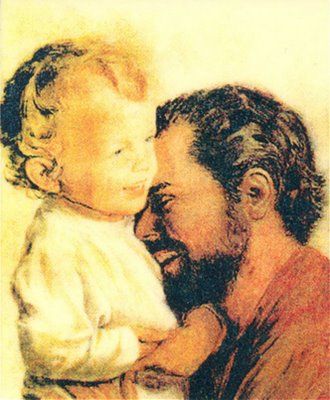
Simply say “Yes” when God says to you, “Carry me.” It is not a question. It is not a command. It is sort of a request. Most of all, it is an instruction. It is simply, “carry me.” Everything else, anything else, is suddenly secondary. Will you take a moment now, please, and imagine the moment Mary looked out the window a Jesus rough-housing with Joseph. Mary calls out, “All right you ruffians! It’s time for dinner. Come in and wash up.” Joseph rises and takes Jesus by the hand and says, “Come on, Yeshu’a, it smells good in there. Let’s see what your mama’s gotten ready for us.” Jesus runs and skips over to Joseph and tackles him around the knees saying, “Aw, Abba, let’s wrestle one more time!” “No, son, we need to get inside. Come on. Let’s go.” “OK, Abba. Carry me?”

JosephBoyJesusAnd Mary smiles as she turns away from the window. She was the first one ever, in all Eternity, to be asked by God, “Carry me?” She helped carry him to Jerusalem those first six years. Although she did not yet know then, from age seven through age eleven, he would carry himself. At age twelve, he would turn back to the Temple as he began to understand more clearly, “I am here to carry God my Father into the presence of these my brethren.” A little tear touches the corner of Mary’s eye just as Joseph ducks through the low door with Jesus over his right shoulder – the same side upon which Jesus would later carry his cross. But today, for Mary and Joseph, carrying Jesus was just part of living, just part of loving him and loving each other. It is the line they toe daily.

There is nothing else to do. If you carry him, you will have room only for him, strength only for his instructions, love only in his Love. He will become in you The Word of God, and that will be Spirit and Life. It is the only best way to be the first one who is last because it becomes Eternal in God when the world comes to Judgment. With apologies to Mr. Thomas Stearns Elliot ~~

This is the way the world ends
Not with a bang but a …
reward.

Whatever, whenever, wherever, whoever, however, if ever, forever — at your service, Belovéd!

I can never hear this Bible passage without thinking of this song, (↔ Music Link) especially the last verse. I have been a big fan of Robert Allen Zimmerman for a l-o-o-o-o-o-ng time!

Unless otherwise indicated, all scripture passages are from the New Revised Standard Version Catholic Edition (NRSVCE) New Revised Standard Version Bible: Catholic Edition, copyright © 1989, 1993 the Division of Christian Education of the National Council of the Churches of Christ in the United States of America. Used by permission. All rights reserved.


Aloha Friday Messages by
Charles O. Todd, III is licensed under a Creative Commons Attribution-ShareAlike 3.0 Unported License

Biblical languages inserts from Bible Hub (Bible Hub: Search, Read, Study the Bible in Many Languages) Visit at http://biblehub.com


Aloha Friday Message – August 12, 2016 – One Day

1633AFC081216 – One Day

Read it online here, please. And please, when you visit there, use one of the social media links at the bottom of the page to share this post. Thank you!

Psalm 40:1 I waited patiently for the Lord;
he inclined to me and heard my cry

Aloha pumehana, ʻŌmea. Today I want to bring together two characteristics about our relationship with God and with each other. The first is LOVE. The Second is PRAYER. God loves us unconditionally. Jesus commands us to love each other as he loves us – unconditionally. We tell God – the Divine Trinity – about our LOVE in prayers of adoration, thanksgiving, and praise. In our prayers we also ask God to be mindful of the persons we LOVE. I want to look at both of these biblically and also share some practical ways these actions – loving and praying – work together.

First, I want to share with you some verses about God’s LOVE. It is so amazing that, if I did not believe in it, it would be incredible. It is credible, however, because we can see it and feel it in our lives, in our hearts and minds, and in the love we share among each other. Here are some – only a few – of that wonderful things we know about God’s love – and we know them because they are things HE told us!

It is an Everlasting Love
Jeremiah 31:3b I have loved you with an everlasting love;
therefore I have continued my faithfulness to you.

Isaiah 55:3b3 Incline your ear, and come to me;
listen, so that you may live.
I will make with you an everlasting covenant,
my steadfast, sure love for David.

It is a Manifested Love
1 John 4:9-13God’s love was revealed among us in this way: God sent his only Son into the world so that we might live through him. 10 In this is love, not that we loved God but that he loved us and sent his Son to be the atoning sacrifice for our sins. 11 Beloved, since God loved us so much, we also ought to love one another. 12 No one has ever seen God; if we love one another, God lives in us, and his love is perfected in us. 13 By this we know that we abide in him and he in us, because he has given us of his Spirit.

It is a Redeeming Love
Isaiah 63:9bIt was no messenger or angel but his presence that saved them; in his love and in his pity he redeemed them; he lifted them up and carried them all the days of old.

Jude v. 21  21 keep yourselves in the love of God; look forward to the mercy of our Lord Jesus Christ that leads to eternal life.

It is a Preserving Love
Romans 8:38-39 38 For I am convinced that neither death, nor life, nor angels, nor rulers, nor things present, nor things to come, nor powers, 39 nor height, nor depth, nor anything else in all creation, will be able to separate us from the love of God in Christ Jesus our Lord.

Now, this next one isn’t exactly in the Bible, but maybe you are familiar with it.

It is Way-Cool Love
Isaiah 54:10 10 For the mountains may depart
and the hills be removed,
but my steadfast love shall not depart from you,
and my covenant of peace shall not be removed,
says the Lord, who has compassion on you.

Isaiah 49:15 15 Can a mother forget her infant, be without tenderness for the child of her womb? Even should she forget, I will never forget you.

1 John 2:5-6 – 5 but whoever obeys his word, truly in this person the love of God has reached perfection. By this we may be sure that we are in him: whoever says, “I abide in him,” ought to walk just as he walked.

And we can. We can live just as he lived, walk as he walked, love as he LOVED if we live in his LOVE.

We share LOVE, we grow LOVE, and we grow in LOVE through prayer. In today’s opening verse from Psalm 40, the Psalmist declares he waited patiently for the LORD. Sometimes we find that difficult as in the prayer, “LORD grant me patience right now!” Sometimes we just can’t seem to make what we want to say come out in a way that makes sense; we think God needs an interpreter to understand us. Let’s take a quick look at a couple of biblical statements about prayer (two out of thousands).

Romans 8:38-39 38 For I am convinced that neither death, nor life, nor angels, nor rulers, nor things present, nor things to come, nor powers, 39 nor height, nor depth, nor anything else in all creation, will be able to separate us from the love of God in Christ Jesus our Lord. (ʻŌmea, use this link to see this quote in full context.)

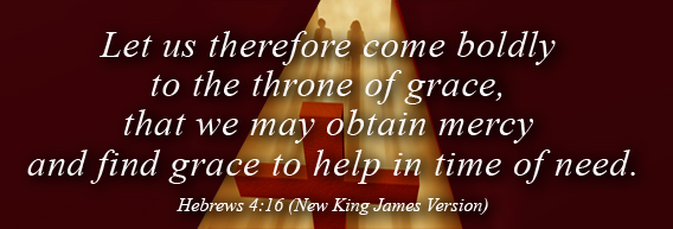
Hebrews 4:1616 Let us therefore approach the throne of grace with boldness, so that we may receive mercy and find grace to help in time of need.

Heb4.16

Yes, it is true. Nothing can separate us from the Love of God, and that means – since God is Love, he places no obstacle between us and Him. And yet, we stumble through prayer sometimes as if it were a terrible ordeal, or breeze through prayer as if it were a recitation of some sort with no depth of meaning. Paul tells us to approach the throne of grace with boldness. Sometimes we feel that we need to learn how to pray so that when we pray we don’t just babble and we don’t recite platitudes and we don’t go away thinking, “Well, if that didn’t work, I don’t know what else will!” Really? Let’s take a look at the anatomy of a prayer. For instance, how do you start?

Dear God … Ummmm, Hi God, it’s me. You know, “The Sinner in Apartment D-316?”
Jesus, I come to you today to ask for your help with my nut-case neighbor.
Almighty God, we come to you today to thank you for sparing us during this latest winter storm.”

So what kinds of “things” go into a prayer, and how can we learn to build a prayer that flows, that is both Biblical and relevant, and one which isn’t so convoluted we don’t even remember what we said? I’m going to suggest a simple outline and give some examples. Here’s the outline:

  1. Greeting
  2. Praise
  3. Thanks
  4. Petition
  5. Confession/Profession
  6. Closing

#1 – Greeting: Name the person to whom you address your prayer: God, Father, Jesus, Holy Spirit, Blessed Trinity, Lord, Master, Gracious and Loving or Almighty or Holy (plus any of the preceding), any opening like that is fine. I have said before my favorites are My El Shaddai-Olam and Abba.

#2 – Praise: Hallowed be thy name, you alone are Holy; you are our awesome God, Omnipotent and Omniscient Creator, Lover of my soul, source of all that is Good, Great, and Just Judge of all mankind, and so on. What is there in my heart and mind that just totally wows me when I think of Him? How can you combine that with the Greeting? They can work together. Here is one that was inspired by a popular contemporary Christian music group – the Hemphills – in the 80’s:

Father, we worship you as One in the Love of the Spirit and the Son.
Jesus, we honor you as Lord by all of Heaven and Earth adored.
Spirit, we love you as our Friend and giver of Love and Gifts without end.

#3 – Thanks: We thank you for all your gifts, thank you for hearing my prayer, thank you for all your blessings, thank you for subduing my enemies, thank you for this day / this life / this world / this family / this spouse / this (everything). To borrow a line from a Gospel chorus … “Thank you, Lord, for saving my soul / Thank you Lord for making me whole. / Thank you Lord for giving to me / Thy great Salvation so rich and free.” Yes. You can quote another’s prayer as part of your prayer especially if it’s a song!

#4 – Petition: This is the part we’re pretty good at. In fact, truth be told, this is almost always where most of us start. Even if we don’t usually pray the “gimme” prayer, we pretty much expect God to pop up like the genie in the bottle and grant our wishes. A bicycle, a house, a victory over an enemy, something to suit our passions, you know what to ask, and the Bible tells you how to ask – with faith, believing that you will receive it, and in Jesus’ name. But we’re not quite to that closing part yet. Sometimes the best petition is to ask God for guidance, for the grace to see and do his will, or for direction about what he would have us do next. Another is to prepare your heart for his Presence. (Please use these links.)

#5 – Confession/Profession: “Wait a minute, I’m not Catholic.” “What is there to confess, and to whom?” “What do you mean, ‘confess’? And what could I profess that God doesn’t already know?” You know that part in the Lord’s Prayer “Forgive us our debts (trespasses) as we forgive our debtors (those who trespass against us)? That is a confession of our sinfulness. “Lead us not into temptation (Do not put us to the final test): That is a confession of our weaknesses. But deliver us from evil (from the evil one): That is a confession of our awareness that we are sinners redeemed by Grace through the loving protection of God. What does that sound like outside of the Lord’s Prayer? When you pray the Apostles or Nicene Creed, your profession of faith, you declare publicly what you believe. You can declare that privately in your personal prayer as well. Here’s a little example:

Master, I do not know how to pray so that my prayers are pleasing to you, but send me your Spirit to pray with me. You are my hope and my Joy. In you alone do I find comfort and peace. You alone are worthy of Praise, O God my strength and my redeemer! In you, O LORD, I am made whole. I know my sinfulness. Grant me faith to overcome sin and to live in your presence at all times. Look into my heart, Holy Spirit, and remove all that is offensive to you. Cast me not out from your presence O God, but in your mercy save me from my sins. I confess my love for you, my Lord and my God. I place my trust in you. Jesus, I trust in you. Jesus, I love you above all things and persons, and I desire to receive you into my heart and soul. Sprit of the Living God, I surrender my entire life to the Holy Trinity without reserve. O God, you are my God and I will always praise you. I offer this prayer in the name of Jesus, the Christ who lives and reigns with God the Father Almighty, in the Unity of the Holy Spirit, the Lord, the Giver of Life. Amen.

#6 – Closing: Jesus told us to pray in His name, and that’s pretty easy: In Jesus name. Amen. In your most precious name, we pray. As the Lord taught us, we pray in His name, Amen. In faith believing, we place our trust in you, Jesus. As you have commanded through your Son, Jesus Christ, we pray in His name, AMEN. In the Power of the Blood of Jesus we humbly pray. Amen.

We don’t always have to be so formal, though. Here’s one that circulates around the Internet every so often:

=*+*=*+*=*+*=*+*=*+*=

Heavenly Father, Help us remember that the jerk who cut us off in traffic tonight is a single parent who worked nine hours that day and is rushing home to cook dinner, help with homework, do the laundry. And spend a few precious moments with her children.

Help us to remember that the pierced, tattooed, disinterested young man who can’t make change correctly is a worried 19-year-old college student, balancing his apprehension over final exams with his fear of not getting his student loans for next semester.

Remind us, Lord, that the scary looking bum, begging for money in the same spot every day (who really ought to get a job!) is a slave to addictions that we can only imagine in our worst nightmares.

Help us to remember that the old couple walking annoyingly slow through the store aisles and blocking  our shopping progress are savoring this moment, knowing that, based on the biopsy report she got back last week, this will be the last year that they go shopping together.

Heavenly Father, remind us each day that, of all the gifts you give us, the greatest gift is love. It is not enough to share that love with those we hold dear. Open our hearts not to just those who are close to us, but to all humanity. Let us be slow to judge and quick to forgive, show patience, empathy and love.

=*+*=*+*=*+*=*+*=*+*=

And once we learn to converse with God instead of simply giving him a To-Do list, then our prayer life becomes a source of constant joy. Therefore, Beloved, pray for one another that God will give all of us “the will to do small things with great love.” Remember, God – all three Persons – knows everything, is everywhere, and is all-powerful. Knowing these things, we also know God is always with us, around us, and in us, and we have no need to shout or doubt. We can be confident He reads and hears our heart’s longings. It only takes a moment for God to answer our prayer. One day it will happen. Wait patiently on the LORD. Pray in gratitude without ceasing. God Will Take Care Of You. (↔ Music Link) He will lean in to reach you and hold you in his LOVE.

Whatever, whenever, wherever, whoever, however, if ever, forever — at your service, Belovéd!

Share a Prayer

  • MBN Member CK made this request Wednesday:  A close friend of ours had a stroke today and is currently paralyzed on his left side.  Please pray for a miracle of complete recovery.
  • Pray for the family of JWG whose sudden death Wednesday night was under difficult circumstances. He was a precious godson.

Unless otherwise indicated, all scripture passages are from the New Revised Standard Version Catholic Edition (NRSVCE) New Revised Standard Version Bible: Catholic Edition, copyright © 1989, 1993 the Division of Christian Education of the National Council of the Churches of Christ in the United States of America. Used by permission. All rights reserved.

Creative Commons License
Aloha Friday Messages by Charles O. Todd, III is licensed under a Creative Commons Attribution-ShareAlike 3.0 Unported License

Aloha Friday Message – August 5, 2016 – Ready or Not

1632AFC080516 – Ready or Not

Read it online here, please. And please, when you visit there, use one of the social media links at the bottom of the page to share this post. Thank you!

Matthew 24:42, 44 42 Keep awake therefore, for you do not know on what day your Lord is coming. 44 Therefore you also must be ready, for the Son of Man is coming at an unexpected hour.

Hebrews 11:1 1 Now faith is the assurance of things hoped for, the conviction of things not seen.

Luke 123:48b From everyone to whom much has been given, much will be required; and from the one to whom much has been entrusted, even more will be demanded.

Aloha pumehana, ʻŌmea! It seems to me we just finished Easter a couple of days ago. And about a week before that, it was New Year’s Day. How is this possible, this sudden appearanCe of the first week of AUGUST??? As St. Marher said in 1225, “And te tide and te time þat tu iboren were, schal beon iblescet.” That is the antecedent of the aphorism “Time and Tide wait for no man.” We have no control over time, the power of ocean tides, the seasons, the weather, the orbit of the Earth, the configuration of the Universe, teenagers, politicians, or cats.

Sometimes I think we wonder if we have control over anything at all. If we take the fatalists’ view, we are doomed to whatever The Fates weave into our lives and we must blithely accept it and live up to our destiny. (“Luke, it is your destiny!”) No one and nothing is in charge of anything, so everything chaotically unfolds until finally, we die. The End. Time is just something that happens to us, and pretty soon, time is up and it’s over, because it is hopeless to resist. Resistance is futile. We will be assimilated. That’s just not a healthy attitude to take, and for eons, earthlings have fought valiantly against such despair. There are some who will say that this sort of innate hope which inspires us is merely a reflexive response to “The Great Unknown,” and therefore the causative factor in all forms of religion – from the pagan shaman to the theistic apostle. There is indeed something in us which brings about the necessity of the belief or emotion of HOPE. (← That’s a good one to reread.)

All three of the scripture texts at the beginning of this post come from the readings for This Sunday, August 7, 2016. The central theme of the reading is preparation. I’m not a Boy Scout, but I do like the idea of being prepared – well, as much as is possible in this whacky world of ours. There are so many crazies out there! At best we can “only hope” that we don’t enter their orbit and get caught up in whatever they are doing. That requires us to be vigilant, to be aware of our surroundings and the people in our sphere of living (which is pretty big these days because of “globalization.”) Jesus told his Disciples to be ready because his return would be at an unexpected hour. There are great passages in Matthew’s Gospel about that.

Matthew 24 and 25 are eschatological in nature – they are Jesus’ words about the “end of the age” when all of Creation will be convulsed and destroyed so that the New Heavens and New Earth will come about. His contemporaries were focused on the restoration of Israel to its former glory. They wanted their nation to be finally and completely freed of all oppressors and occupiers. They thought Jesus would be their ruler and the commander of the armies that defeated the Romans and everyone else who were not Israelites. That was their hope. Jesus led them – and us – to an even greater hope. Something Paul described as faith which is the assurance of things hoped for, the conviction of things not seen. That is a great way to understand the idea of hope. You can stick a couple of different suffixes on that word and express the range of hope that earthlings experience: -ful and –less. We can be hopeful or hopeless. I’ve pondered the range of feelings and beliefs between those extremes, and there’s not much other than being or feeling hopeful and being or feeling hopeless. Hope is a form of trust that somehow our expectations will be fulfilled. We will receive what we long for – a thing, a person, an event, a state of being that we think of a desirable as the best possible outcome will be ours. We even believe that not only can hope be fulfilled, but also it can surpass our expectations. Hope is wonderful. Is it wonderful enough?

We have so many things we want in life and out of life. Like the Disciples, we want our enemies vanquished, our fortunes made and protected, we want what we want when we want it, and we wouldn’t mind if it came to us “with no strings attached.” We want to be the one who finds the treasure and gets to keep it. Jesus is OK with that – as long as it’s the right Treasure. Consider these two passages about treasure:

Mark 10:21 21 Jesus, looking at him, loved him and said, “You lack one thing; go, sell what you own, and give the money to the poor, and you will have treasure in heaven; then come, follow me.”

Luke 12:34 34 For where your treasure is, there your heart will be also.

There is a special precaution Jesus gave us about seeking that treasure in Luke 123:48b which says From everyone to whom much has been given, much will be required; and from the one to whom much has been entrusted, even more will be demanded. As I have reflected on this, it seems to me that it involves two sides of HOPE – keeping and sharing.

We must keep hope – alive in our hearts and minds – or we experience the futility of assimilation into hopelessness. We must also share hope – and everything to which it leads – so that we do not stand alone in our expectations. On our own, hope is hard to sustain, but – as the saying goes. “Where there’s life, there’s hope. I want to reach into the past here and show you something I wrote years ago called

Circle of Life

Where there is life, there is hope.
Where there is hope, there is love.
Where there is love, there is integrity.
Where there is integrity, there is truth.
Where there is truth, there is justice.
Where there is justice, there is mercy.
Where there is mercy, there is freedom.
Where there is freedom, there is life.

Life moves on regardless of whether we are hopeful or hopeless; we just travel better when we are hopeful, and that hope is best and fullest when it is based on the Son of Man is coming at an unexpected hour. Why?

Luke 31:34-36 34 “Be on guard so that your hearts are not weighed down with dissipation and drunkenness and the worries of this life, and that day does not catch you unexpectedly, 35 like a trap. For it will come upon all who live on the face of the whole earth. 36 Be alert at all times, praying that you may have the strength to escape all these things that will take place, and to stand before the Son of Man.”

Matthew 24:36-44 36 “But about that day and hour no one knows, neither the angels of heaven, nor the Son, but only the Father. 37 For as the days of Noah were, so will be the coming of the Son of Man. 38 For as in those days before the flood they were eating and drinking, marrying and giving in marriage, until the day Noah entered the ark, 39 and they knew nothing until the flood came and swept them all away, so too will be the coming of the Son of Man. 40 Then two will be in the field; one will be taken and one will be left. 41 Two women will be grinding meal together; one will be taken and one will be left. 42 Keep awake therefore, for you do not know on what day your Lord is coming. 43 But understand this: if the owner of the house had known in what part of the night the thief was coming, he would have stayed awake and would not have let his house be broken into. 44 Therefore you also must be ready, for the Son of Man is coming at an unexpected hour.

Ready or not, here He comes!

Now, that is something worth waiting for! Based on how fast life is flying past me (or am I flying past life?), it won’t be a long wait. I even have a great place to wait. Right here on the ROCK:

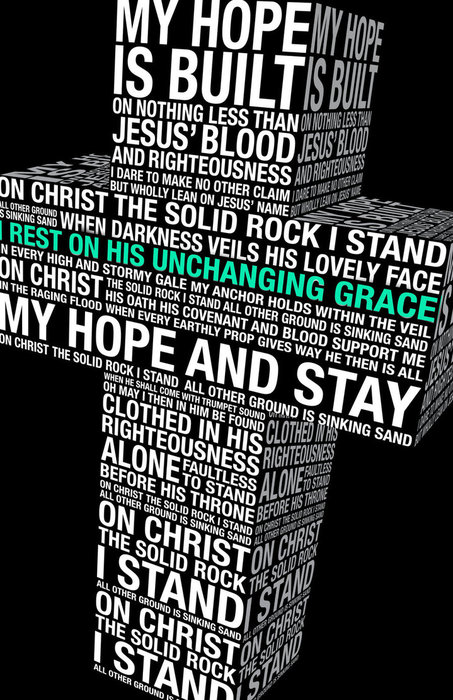
HopeRock
On Christ the Sold Rock (↔ Music Link)
-1-
My hope is built on nothing less
Than Jesus Christ, my righteousness;
I dare not trust the sweetest frame,
But wholly lean on Jesus’ name.
Chorus:
On Christ, the solid Rock, I stand;
All other ground is sinking sand,
All other ground is sinking sand.
-2-
When darkness veils His lovely face,
I rest on His unchanging grace;
In every high and stormy gale,
My anchor holds within the veil.
-3-
His oath, His covenant, His blood,
Support me in the whelming flood;
When all around my soul gives way,
He then is all my hope and stay.
-4-
When He shall come with trumpet sound,
Oh, may I then in Him be found;
In Him, my righteousness, alone,
Faultless to stand before the throne.
Whatever, whenever, wherever, whoever, however, if ever, forever — at your service, Belovéd!!

Share-A-Prayer

For FR – knee surgery coming up. Pray for guidance of the surgeons’ hands and for successful repair of an injury that dates back to a tour in Viet Nam.

Continue to pray for support of all our family and friends who have cancer and other long-term illnesses.

Unless otherwise indicated, all scripture passages are from the New Revised Standard Version Catholic Edition (NRSVCE) New Revised Standard Version Bible: Catholic Edition, copyright © 1989, 1993 the Division of Christian Education of the National Council of the Churches of Christ in the United States of America. Used by permission. All rights reserved.

Creative Commons License
Aloha Friday Messages by Charles O. Todd, III is licensed under a Creative Commons Attribution-ShareAlike 3.0 Unported License


Aloha Friday Message – July 29, 2016 – All in All

1631AFC072916 – All in All, it’s all the same.

Read it online here, please. And please, when you visit there, use one of the social media links at the bottom of the page to share this post. Thank you! (I have temporarily deactivated my Facebook account, so I am hoping you will post this to Facebook, Twitter, Google+, or whichever social-media apps you use.)

Colossians 3:11 [You] have clothed yourselves with the new self, which is being renewed in knowledge according to the image of its creator. 11 In that renewal there is no longer Greek and Jew, circumcised and uncircumcised, barbarian, Scythian, slave and free; but Christ is all and in all!11 In that renewal there is no longer Greek and Jew, circumcised and uncircumcised, barbarian, Scythian, slave and free; but Christ is all and in all!

Happy Aloha Friday, Belovéd! I hope you’ve had a great week since looking at last week’s study in Colossians 2 where we learned that God changed the way sin is dealt with. In the Old Testament, it was “covered.” With Jesus’ New Covenant in his blood (See Luke 22:20, please.), it was obliterated. Today we are going to look at one of the most remarkable aspects of that New Covenant. To understand it better, we’ll first need to compare and contrast it with the Old Covenant.

What was the Old Covenant? To find out, we need to look at Genesis 9:12-17. I hope you will click that link so you can see it in context. This is the part of Genesis where God – אֱלֹהִ֗ים (elohim) {el-o-heem’} – makes what is often called The Covenant of the Rainbow. God promises that he will never destroy all life by water again. This is unique among Old Testament Covenants in that it applies to all earthlings as well as all living things. Later covenants apply mostly to people of God’s choosing – individuals or nations. For example, later, when God Almighty (El Shaddai) speaks to Abram he says in Genesis 15:17-2118 On that day the Lord made a covenant with Abram, saying, “To your descendants I give this land, … (Click the link to see the whole description of “the Land.”) We also see this concept of covenant in Genesis 17:10-11 10 This is my covenant, which you shall keep, between me and you and your offspring after you: Every male among you shall be circumcised. 11 You shall circumcise the flesh of your foreskins, and it shall be a sign of the covenant between me and you. Many people think the Old Covenant was the Mosaic Law, and that Jesus’ New Covenant did away with Mosaic Law. Not so; Jesus fulfilled The Law, but it still stands at the Core of Christ’s Law of Love – Love of God and Neighbor.

OK, then, what is a covenant? It is a kind of contract that is based upon or creates a relationship between two parties. The conjoining parties agree to certain terms – sometimes the terms are transactional (if you give or do this, I will give or do that). Unlike a modern day contract, the transaction in a covenant is not for resources or services, but instead creates a personal bond between the participants. A covenant is sort of what we think of as a contract today, except that nowadays a contract is structured in and enforced by civil authority whereas the biblical covenant was structured in and enforced by God. In the Old Testament, “sealing the deal” often included animal sacrifice, written agreements, and official stamps or seals to protect the provenance or attribution of the agreement. The animal sacrifice was a visual reminder of what would happen if a covenant-participant broke the covenant relationship. Biblical covenants did not have a time-limiting component like a deadline or contract-termination date. They were considered to be “now-and-forever” agreements.

In today’s passage from Colossians 3, Paul does not employ that word – covenant – but it does mention one of the conditions of the Old Covenant – circumcised and uncircumcised. In this portion of Paul’s letter, he uses sharply contrasting pairs of words to make his point:

Greek and Jew
Circumcised and uncircumcised
Barbarian, Scythian
Slave and Free

All but the third example are “direct opposites.” Jews are the opposites of the gentiles (Greeks). Jews and gentiles are typified by circumcision and uncircumcision. Slaves are not freemen and freemen are not slaves. What about “barbarian” and “Scythian?” How does that comparison work? Well-cultured, civilized persons and nations considered earthlings who were primitive, lawless, violent, the antithesis of “who we are” to be “barbarians,” “utterly-not-us.” They are “the other,” “the treacherous outsider,” “the rude, wild, and unmannered foreigner.” In the time of Paul, the most primitive, violent, treacherous, rude, wild, and barbaric people in the world were the Scythians. “What’s a Scythian?” you ask? This word occurs only once in scripture – here in Colossians 3:11. It comes from the Greek word Σκύθης, Skuthes {skoo’-thace} or Skythēs. It describes a people originating in Scythia or what we now call Russia, and they were the badest, the meanest, and the roughest bunch of hooligans anywhere. The “Great Civilizations” – Roman, Greek, Persian, and so on – were subjected to invasion and raids from hordes of warriors – you might remember some of these names: Ostrogoths, Visigoths, Vandals, and the Mongols (and Genghis Kahn). More than any of these, the Scythians take the prize for being more inhumanely violent. They were the worst of the worst.

So, to sum it up, Paul was saying that whatever is opposite of your self-concept, you and your opposite are all included in the new self, which is being renewed in knowledge according to the image of its creator. Huh? If you are in Christ because you believe in Christ, if your opposite believes in Christ, you are in Christ together as “new creatures in Christ.” In that renewal, there are no more opposites. All are equal under Christ’s Law of Love. Paul makes that point even clearer by naming Greek before Jew (in all other passages he lists Jew then Greek). He is showing the people of Colossae – and of course us as well – that even if these distinctions exist in the “natural world,” they utterly cease to matter in the Divine Territory of The Kingdom of God in Christ Jesus. If we are renewed in knowledge according to the image of its [the new self’s] creator, then we learn to see through and beyond those differences that normally divide us. The New Covenant in the Blood of Christ frees every possible opposite of you that you can possibly imagine from the bondage of sin and you are united together in the bond of that New Covenant, the Covenant of Love which surpasses – but does not replace or nullify – all previous Covenants.

In Galatians 3:12-18, we find this: My point is this: the law, [ … ] does not annul a covenant previously ratified by God, so as to nullify the promise. God’s Law is one thing. God’s Promise in his Covenants is quite another. The promises of the Covenants are still now-and-forever promises, and The Law still abides, but in the renewal of our knowledge of God’s Divine Will, all of us is in all of Christ because Christ is all there is. He is all the opposites and is in all the opposites and all the opposites are in him because in Christ

THERE ARE NO MORE OPPOSITES! There is only Christ, the New Covenant. In the same way that our sins are obliterated, so also are our differences obliterated.

Whatever, whenever, wherever, whoever, however, if ever, forever — at your service, Belovéd!

Share-A-Prayer

C.R. – Lots of recovery ahead. Turns out the histology on that larger (4 lbs, 8″ across) was carcinoma. Pray for fully successful excision of that along with a perfect recovery.

PV – At the entry-way to her battle with breast cancer. Help her get through it with your prayers.

FC – Hanging in there with her family and friends (like you) praying for faith and medicine to work hand in hand to beat the metastases.

JE – Still full of great faith as one set-back after another clobbers him and his amazing wife. Just pray for his physical and emotional strength to remain as solid as the strength of his faith!

ItIsAllChrist

And he is all we need.


Unless otherwise indicated, all scripture passages are from the New Revised Standard Version Catholic Edition (NRSVCE) New Revised Standard Version Bible: Catholic Edition, copyright © 1989, 1993 the Division of Christian Education of the National Council of the Churches of Christ in the United States of America. Used by permission. All rights reserved.

Creative Commons License
Aloha Friday Messages by Charles O. Todd, III is licensed under a Creative Commons Attribution-ShareAlike 3.0 Unported License

Biblical languages inserts from Bible Hub (Bible Hub: Search, Read, Study the Bible in Many Languages) Visit at http://biblehub.com
 

Aloha Friday Message – July 22, 2016 – Your Debt Deleted

1630AFC062416 –  Your Debt Dismissed and Deleted

Read it online here, please. And please, when you visit there, use one of the social media links at the bottom of the page to share this post. Thank you! (I have temporarily deactivated my Facebook account, so I am hoping you will post this to Facebook, Twitter, Google+, or whichever social-media apps you use.)

Colossians 2:13-14 13 And when you were dead in trespasses and the uncircumcision of your flesh, God made you alive together with him, when he forgave us all our trespasses, 14 erasing the record that stood against us with its legal demands. He set this aside, nailing it to the cross.

E pili mau na pomaika‘i ia ‘oe a me ke akua ho’omaika‘i ‘oe, ʻŌmea! (May blessing always be with you and may God bless you, Beloved!) I hope you’ve had a great week and that – wherever you are – the weather has been kind to you. There have been some horrific weather events this year, and I sincerely hope you came through all that unscathed.

I chose this passage today – it’s from Sunday’s Epistle – because it is one of those passage we read and go, “OK then.” Trespasses, uncircumcision, a record that stands against us, and that record being nailed to the cross – all of these are things we don’t normally deal with in our day-to-day conversations. Nonetheless, this little bundle of words carries a powerful punch, and I’d like you to know why. Here we go!

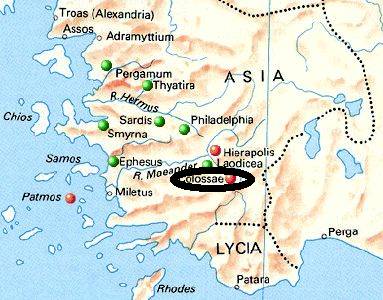
You may recall from previous messages based on passages in Colossians that the church in Colossae was having some disquiet stirred up by outsiders who disparaged Paul’s Apostolic authority, insisted on certain precepts of Jewish law as the basis for admission to the Church, and were teaching that angels had a role in salvation. They “knew” these things because they had “special information by revelation.” In this passage, Paul continues to chip away at their so-called theology. Paul really blows them away with this part of his argument. I will help you see into the unfamiliar words and hopefully that will make this passage – and Paul’s argument – more meaningful.

Trespasses – We do hear this word often when we pray The Lord’s Prayer. Some churches say “trespasses” while others say “debts,” but they mean the same thing. In the Old Testament, trespass is פֶּ֫שַׁע (pesha`) {peh’-shah} which means transgression – disobedience, indiscretion, offense, crime, debt to society and to God – SIN. In the New Testament, the word is παράπτωμα  (paraptoma) {par-ap’-to-mah} – a falling away to the side, a lapse or digression from Truth, so it is also transgression – disobedience, indiscretion, offense, crime, debt to society and to God – SIN. Paul is pointing out that, before Salvation through Christ Jesus, we were trapped in the futility of trying to live up to The Law; but, The Law is incapable of delivering the salvation that leads to Eternal Life through complete forgiveness of our trespasses – debts, offenses, etc. We are dead in sin, but can be alive through and in Christ.

Uncircumcision – This is kind of an unpleasant thought, yes? Why in the world would Paul put this in his message? Perhaps you will recall that these outsiders were insisting that men who wanted to participate in what they perceived as “The Church Proper,” had to be circumcised. As I said previously, not a terrific way to win converts! But there is more to it than that because there is more to the whole concept of circumcision. Circumcision was an outward sign of an inward dedication to The Covenant. In Genesis 17:10, God says to Abraham, 10 This is my covenant, which you shall keep, between me and you and your offspring after you: Every male among you shall be circumcised.  (Please use that link to see this passage in context. It’s important for understanding what’s coming next.) Circumcision was a permanent, very visible, and unique way of identifying someone committed to The Covenant. Ammonites, Moabites, and Edomites also kept this practice, but only the Hebrews connected to The Covenant and – more importantly later on – The Law. Those who were uncircumcised were not part of The Covenant and not expected to know or be subject to The Law. These were “The Gentiles,” the non-Jews in the world. Paul is arguing that getting circumcised now is pointless because now Christ has fulfilled all The Law. In addition, it signifies that conforming to The Law is accomplished only in Faith through Love. We see similar lessons in Ephesians 2:11-12, Galatians 5:6, and 1 Corinthians 7:19. (← Click’em. It’s good to know!) One of Paul’s most consistent themes is that human effort cannot fulfill the requirements of The Law. The Law keeps a ledger – a written indictment – against us, but Christ’s law of Love destroys that ledger. In Christ, then we have a “circumcision of the heart.” If you are a serious student of the Bible, I invite you to read all of Romans 2. If you’d like a quick peek into that passage, just read this: Romans 2:25-29.

God made you alive together with him – This is a pretty unique concept-word. It’s only found twice in the Bible – here and in Ephesians 2:5. It is Συνεζωοποίησεν suzoopoieo {sood-zo-op-oy-eh’-o}. It is to reanimate two or more entities at the same time and place – Christ is alive with and in us and we are alive with and in him. For the gentiles in Paul’s time, that was a mind-blowing idea. Two, together, yet separate, restored to new “vim, vigor, and vitality” after having been hopelessly dead in sin because of The Law. “But how could gentiles, who were surely not part of The Covenant and The Law be subject to it or even be aware of it?” you ask. Paul points out (again Romans 2) that The Law is actually within our hearts, and that is what “circumcises” – cuts us away from – the World. When we obey the good we know in our hearts, we are doing our human best to comply with The Law, but only in Christ do we break free of the law and the wages of death that it brings. Cool, huh? As Paul states, “he forgave us all our trespasses.

Next we have “erasing the record that stood against us with its legal demands.” Erasing is something we understand. It was there, and then we did something to make it not there. In this message, if I want to erase something, I highlight it and delete it; we call that erasing, but it’s actually deleting. What’s the difference? Erase is to make something visible become unseen – not invisible, but unseen. It is something that is done in the physical world. You rub a rubber nub across marks on a piece of paper and you erase it. You can write or type over it, but there are still remnants of it on the page. If you delete something in the physical world, you make it gone without a trace. In this electronic message I can erase something by marking it out like this, but you can still see what it is. The term Paul uses here is ἐξαλείψας (exaleipsas) {ex-a-li’-phas} and it means obliterated, wiped out, plastered over, completely removed, and canceled. What was cancelled? “The record” that stood against us is gone. Record? What record? The answer is surprising. That word is δόγμασιν (dogmasin) {dog’-ma-sin} and it refers to ordinances, decrees, edicts, laws, “the rules and requirements of the law of Moses; carrying a suggestion of severity and of threatened judgment.” Do you see a familiar root-word in that? How about “dogma?” A dogma is a creed, a system of belief, a code of conduct based on belief. The uncircumcised and the circumcised have broken the ordinances of God, and those charges are documented as in an indictment under The Law. We are criminals! Yikes!

Col2+14+smHe set this aside, nailing it to the cross. We might think this one is easy to figure out. My sins died with Jesus on the Cross. His death brings my salvation and the end of my sins. When I rise with him, it will also be the death of my sinful nature for I will be forever unable to sin again. But wait! There’s more! The nails of the Cross penetrated this record against us and held it fixed to the Cross and invalidated forever. The indictment – the formal charges documented against us under the law – has been nailed shut. That cancelled document has been publically nailed to the wall as testimony to its nullification of our condemnation. That contract of sin’s wages of death has been annihilated and the warrants against us destroyed. Everyone in heaven and earth and under the earth can see that we are not only pardoned of our crimes (they are erased) but we are indeed totally debt-free, and alive with, in, and for Jesus the Christ. Our ledger is stamped, “Paid in Full.”

Now you know the power of that punch by which Paul popped the pagans!

Whatever, whenever, wherever, whoever, however, if ever, forever — at your service, Belovéd!

Keep praying for FC and CR and all our family and friends battling cancer.

Unless otherwise indicated, all scripture passages are from the New Revised Standard Version Catholic Edition (NRSVCE) New Revised Standard Version Bible: Catholic Edition, copyright © 1989, 1993 the Division of Christian Education of the National Council of the Churches of Christ in the United States of America. Used by permission. All rights reserved.

Creative Commons License
Aloha Friday Messages by Charles O. Todd, III is licensed under a Creative Commons Attribution-ShareAlike 3.0 Unported License

Biblical languages inserts from Bible Hub (Bible Hub: Search, Read, Study the Bible in Many Languages) Visit at http://biblehub.com

 

Aloha Friday Message – July 15, 2016 – The Rest IN the Story

1629AFC071516 – The Rest IN the Story

Read it online here, please. And please, when you visit there, use one of the social media links at the bottom of the page to share this post. Thank you!

Genesis 18:8-9 And Abraham hastened into the tent to Sarah, and said, “Make ready quickly three measures of choice flour, knead it, and make cakes.” Abraham ran to the herd, and took a calf, tender and good, and gave it to the servant, who hastened to prepare it. Then he took curds and milk and the calf that he had prepared, and set it before them; and he stood by them under the tree while they ate.

“Always seek, expect to receive, and accept The Greater Gift.”

Aloha ʻŌmea! Here we are at Friday already, and it is also the middle of JULY! The time keeps flying by, and sometimes we get so tired from all the frenzy in our lives. Our minds and bodies tell us to take a break, to lay back, put our feet up and relax for a bit. For some of us that is hard to do because there is always more to be done, and it’s ours to do. Intellectually, we know that resting is essential to good health, but often we put it off and say, “I can rest later. Right now, I need to do this.” With that mindset before us, I want to talk about some other reasons for taking a break. It starts with the event in this Sunday’s Old Testament reading from Genesis.

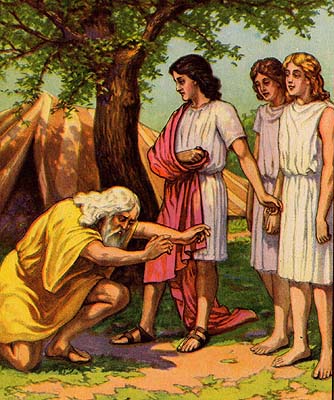
TerebinthVisitorsIn this passage from Genesis, Abraham is dozing under a very large oak called a terebinth in a place called Mamre. There were several of the large trees growing nearby. His tent was pitched close by as well and his wife, Sarah, was in the tent. Abraham sees three strangers approaching. He quickly gets up and begs them to stay, to rest, to allow him to wash the feet of one stranger in particular, and to have a little snack before they continue on their journey. We’ll look into that “little snack” shortly. Meanwhile, let’s look into why he was so hospitable

Abraham is following the custom of Hospitality. Welcoming strangers was a big deal in his culture. The greetings, the humility, the bowing, the offers of service, the cleaning of feet, sometimes the anointing with oil, and always an offer of food and rest – all of these were important aspects of hospitality. Abraham, remember, had started out in Ur of the Chaldees, and God chose him to be “the father of many nations.” God revealed himself to Abram as El Shaddai – God Almighty. El Shaddai changed his name from Abram to Abraham, and made an eternal covenant with him. Abraham was a wealthy, important man; yet, when these strangers approached, he humbled himself to be hospitable to them.

He invited them to rest under the shade of the terebinth, he had water brought to wash the feet of the traveler who seemed to be the leader. This was an important custom in the hot and dusty desert and it not only brought comfort but also used a valuable resource – water – for something other than drinking. He asked them to stay only long enough to have some refreshments. That is where we find another characteristic of Hospitality for his culture: Generosity.

He tells Sarah, “Make ready quickly three measures of choice flour.” The “measure” he ordered was called a Seah (say-ah). 1 Seah is about 33 cups US Dry Measure. 3 Seah = one Ephah or about 99 cups US Dry Measure. That is a LOT of rolls! How could anyone believe that three wandering strangers could even make a dent in such a huge pile of bread? To go along with the bread, Abraham ordered that a young, juicy calf be slaughtered and prepared. When all of that was ready, the food was presented to the visitors while Abraham stood to the side and waited on them as they “snacked.” They continued to rest, to eat, perhaps to converse, and when they were finished, the central figure among the visitors asked where Sarah was. Abraham told them she was in the tent. She had been listening at the tent entrance, and heard one of the visitors say, “I will surely return to you in due season, and your wife Sarah shall have a son.” This made Sarah laugh. You can check this out in Genesis 18:9-15. Abraham had met and spoken to El Shaddai many times. Perhaps he recognized that these strangers were divine beings – angels perhaps, or even El Shaddai as a prefiguring of his future human form in Christ. Whatever or whoever they were, Abraham’s hospitality was not wasted on the strangers.

Hospitality is a “two-way street.” It is transactional. You have to have someone who provides it and someone who receives it. The hospitality provider’s goal is to more-than-fully satisfy the guest. The guest’s goal is to accept the hospitality graciously and as completely as possible. That little adage about The Greater Gift is a corollary to “It is better to give than to receive.” You should always, always, always look for opportunities – transactions – where you can be generous and kind. Always take the opportunity to be the giver of gifts. Why? Because that is God’s way. He gives us all that is Good. He expects us to be as generous as he is. We are to give unstintingly, joyfully, and often. But it is also a great blessing to receive someone’s generosity. That is part of God’s plan, too. He gives us all that is good, and it is our choice to accept or refuse the good things he gives us. If we are participants in “God’s Hospitality,” we express our gratitude for his generosity when we graciously accept what he gives us. Thus it is that when God gives us rest, we are doubly-blessed when we receive and accept it.

The psalmist tipped us off to God’s generosity and Providence in this passage from Psalm 111:4-5 He has gained renown by his wonderful deeds;
the Lord is gracious and merciful.
He provides food for those who fear him;
he is ever mindful of his covenant.

God never forgets or breaks a promise; again, he wants us to be like him in that, too. His promises are always generous. Sometimes we have to just (I am talking facetiously now) sit down, shut up, and enjoy the Banquet. In our personal relationships, that could mean taking the time to listen to  our host/hostess. It could mean sharing a meal prepared for us even if it’s not something we would normally eat, or eating with great pleasure if it is something we like or enjoy. Sometimes it might be just sitting together and enjoying being together whether in silence or in conversation. Consider Mary and Elizabeth.

Mary went to the hill country to visit Elizabeth and stayed with her three months. They were both pregnant, they had a lot to talk about. Mary likely helped with the housework and the other chores – cooking, mending, cleaning – and Elizabeth shared with her the wisdom she had gained in her many years of life. This is the hospitality of companionship, and it should also be generously given and graciously received. Later in life, Mary shared the hospitality of companionship with Jesus as he prepared for his ministry, and followed him through that phase of his life as well, finally experiencing with him his passion, crucifixion, death and resurrection, and then the anointing with the Holy Spirit. She graciously received and generously gave in every moment of their lives together. Yet she had to endure a great deal of pain and sorrow as well. It is that patient endurance which makes hospitality a holy gift. It is the patience to wait without expectation for the response of gratitude in return for our generosity. That is tough, yet Jesus helped us to understand what that means in  Luke 8:15 15 But as for that in the good soil, these are the ones who, when they hear the word, hold it fast in an honest and good heart, and bear fruit with patient endurance. We hold the goodness of hospitality – here represented by the Gospel, the good seed – in an honest and good heart. That is the source of all hospitality – and honest and good heart. When it comes time for us to give the ultimate in hospitality, we clean up the soiled, stained, dishonest, and selfish areas of our hearts and invite Jesus in. Remember what he said about knocking at the door? Look again: Revelation 3:20 20 Listen! I am standing at the door, knocking; if you hear my voice and open the door, I will come in to you and eat with you, and you with me.

Jesus will receive your hospitality in the same way that the Abraham’s visitors received his. I want to show you two verses from Paul’s letter to the Hebrews..

Hebrews 13:2, 16 Do not neglect to show hospitality to strangers, for by doing that some have entertained angels without knowing it. – 16 Do not neglect to do good and to share what you have, for such sacrifices are pleasing to God.

In the stories of Abraham and the Visitors, Mary and Elizabeth, and Mary and Jesus, the hospitality was offered and accepted without fuss or distraction. We recently looked at the incident with Martha, Mary, Jesus, and Lazarus. Martha was doing her best to be hospitable, and Jesus was doing his best to accept her hospitality. However, Martha’s sister, Mary, was accepting Jesus’ hospitality, resting at his feet and listening as a good companion should.

Who in your life are companions whose hospitality you can accept? Think about it a moment. I hope you will include El Shaddai Olam in that group of persons. Hospitality includes giving and receiving – for example food. The greatest food of all is the Precious Body and Blood of Jesus in the Eucharist which is The Ultimate Greater Gift. That gift came to us through much suffering and sacrifice, and we would do well to remember that suffering when we express our gratitude by accepting that gift. We should also remember that suffering is also a gift. Paul said in Colossians 1:24 24 I am now rejoicing in my sufferings for your sake, and in my flesh I am completing what is lacking in Christ’s afflictions for the sake of his body, that is, the church. He is stating that he is willing to suffer on behalf of others (as Jesus did) for others are not willing to suffer so that in all Christ is glorified above all. That is what I would call the Highest Hospitality – the generous offering of one’s life for another.

Whatever, whenever, wherever, whoever, however, if ever, forever — at your service, Belovéd!

PRAISE REPORT!

Thank you for your prayers for RC! She reports her surgery was successful and that the tumors removed were noncancerous! She will have a long – 8 weeks or so – but successful recovery from the surgeries, has to deal with some complications from the anesthesia, but is expected to fully recover. Blesséd be God forever!!

Share-A-Prayer:

New prayer request: FC has learned in the past couple of weeks that her breast cancer has returned and metastasized to her brain. She will start Gamma-Knife treatments and other procedures to try to defeat this new spread of cancer. She and her husband R, surely to need the companion hospitality of our prayers as she fights against this disease.

Unless otherwise indicated, all scripture passages are from the New Revised Standard Version Catholic Edition (NRSVCE) New Revised Standard Version Bible: Catholic Edition, copyright © 1989, 1993 the Division of Christian Education of the National Council of the Churches of Christ in the United States of America. Used by permission. All rights reserved.

Creative Commons License
Aloha Friday Messages by Charles O. Todd, III is licensed under a Creative Commons Attribution-ShareAlike 3.0 Unported License

Aloha Friday Message – July 8, 2016 – High to Low (and back again)

1628AFC070816 – High to low (and back again)

Read it online here, please. And please, when you visit there, use one of the social media links at the bottom of the page to share this post. Thank you!

Colossians 1:15-16 15 He is the image of the invisible God, the firstborn of all creation; 16 for in him all things in heaven and on earth were created, things visible and invisible, whether thrones or dominions or rulers or powers—all things have been created through him and for him.

John 1:1-5 1 In the beginning was the Word, and the Word was with God, and the Word was God. He was in the beginning with God. All things came into being through him, and without him not one thing came into being. What has come into being in him was life, and the life was the light of all people. The light shines in the darkness, and the darkness did not overcome it.

Aloha kākou! Love to everyone! Today we look into this short excerpt from the letter of St. Paul to the church at Colossae is believed to be part of song – or more properly, a canticle – already in use. We don’t know exactly when or where this letter was written, but it seems that it was during one of Paul’s frequent imprisonments. You will recall last week we talked about the dangers and abuses Paul suffered while preaching the Gospel. For Paul, there is no higher calling than to be the slave of Christ. For Paul, there is no greater Master than Jesus the Christ – the Anointed One – of God. One of the most remarkable things to me in Paul’s ministry is that he not only was a missionary – carrying the Gospel to the World – and in addition a minister – caring for the spiritual and even physical well-being of the Church, but also he was an extraordinary theologian who gave the early Church many defenses against the heresies that so quickly flourished as the Gospel spread to so many different locations and cultural constructs. The letter to the Colossians is one of those theological gems that not only gives us insight to the kinds of heretical obstacles that arose then (and still persist in some ways even now), but also gives us clear instructions on how to counter those errors in teaching. The errors in this case derived from the teaching of some in the community of Colossae.

colossaeThere were some teachers at that time, teachers who did not carry any Apostolic authority, who were pushing the idea that in Christ there was a strong and necessary connection to the “Cosmos.” The stressed that certain “benevolent spirits,” angels, which had special astral powers – that is, they could share in a supposed metaphysical realm and control a variety of psychic and other paranormal activities. Angels, they posited, were worthy of worship, and that influenced them to use their “astral powers” to influence nature and even other persons. These pagan, cultic practices included austere restrictions about food, life-style, and other disciplines that Paul criticizes as detractions for the Person, Divinity, and Primacy of Christ. In other words, these people declared that one must connect with these “angelic spirits” to be able to commune with Christ and each other. There was a man in Colossae named Epaphras (ehPAFrus) – he probably was the founder of the Church at Colossae since Paul had not been to that community yet – and he sought out Paul to get help in dealing with this false teaching. Apparently the community was distressed by these ideas, but had not yet been given over to following them. (Implied in Colossians 1:3-8 and 1:23) It is the sacrilege of placing angels on the same “astral plane” as Christ that Paul blasts in today’s opening verse. Let’s take a look at what he means by those terms “things visible and invisible, whether thrones or dominions or rulers or powers.

There is and was a strong tradition of Angel Hierarchy in Judaism. The Maimonides – the Mishneh Torah – lists ten ranks or classes of angels. In the Kabalah, there are ten archangels, each of which commands a choir of angels. There is also a well-known Christian Hierarchy of Angels consisting of three “spheres” and 10 “orders.” In those three spheres we have the names of orders to which Paul refers: Thrones, Dominions, and Powers. Rulers or Powers are sometimes translated as Principalities; this word is used to refer to either angelic or earthly governance. Some translations even list all of these as earthly authorities; however, Paul clearly is referring to the tenets of this heresy about angelic beings.

Angels are mentioned often throughout our Old and New Testaments. The concept of Angels as servants and messengers has always been popular, and that is the case today as well. In Colossae, however, the angels associated with this heresy against which Paul argued involved strict rules about ceremonies and festivals and even advocated circumcision as a necessity. There was a false asceticism (See Colossians 2:21-23) that gave the appearance of piety but did nothing to eliminate or even discourage extravagance and self-indulgence. As described above, angels were worshipped and could be manipulated to gain spiritual powers over others. As such, these beliefs created a downgrading of the role of Christ as the Only Begotten Son of God. These teachers also insisted that they possessed “secret wisdom” revealed only to them. These secrets gave them higher authority and stronger claims to the powers associated with those angelic beings which “ordinary believers” could not attain. (See Colossians 2:4-8). And of course, angels are generally invisible so they cannot usually be discerned through physical means. Hence Paul refers to “things invisible.” Paul pointedly reminds the Colossians that in him all things in heaven and on earth were created. There are some important implications in that.

Please reread the quotation from the opening of the Gospel of John: All things came into being through him, and without him not one thing came into being. NOT ONE THING includes, of course, the angels which El Shaddai-Olam – the Almighty Everliving Triune God – created. You may recall that recently we looked into Ephesians 1:17-21. It is in that passage that Paul encourages the Ephesians to allow their knowledge of Christ to grow “with the eyes of your heart enlightened.” There can be no person, being, thing, place, idea, or spirit that is superior to God or existed before God. We have being. God IS Being. In the book of Nehemiah, the prophet Ezra tells us this in Nehemiah 9:6 And Ezra said:  “You are the Lord, you alone; you have made heaven, the heaven of heavens, with all their host, the earth and all that is on it, the seas and all that is in them. To all of them you give life, and the host of heaven worships you. We read also in 1 Corinthians 8:5-6 Indeed, even though there may be so-called gods in heaven or on earth—as in fact there are many gods and many lords— yet for us there is one God, the Father, from whom are all things and for whom we exist, and one Lord, Jesus Christ, through whom are all things and through whom we exist. Thus God is both Primary and Supreme in all things, through all things, for all things.

That God is Primary means that God had no “prior existence” because God is existence – he is I AM THAT I AM. He is the First Instance and nothing or no one precedes him. That God is Supreme means that God has no equal and certainly no superior. There is no person, being, thing, place, idea, or spirit that is greater than God. There cannot be because any claimant of being superior to God would be God, and not even God himself is superior to God.

Paul’s refutation of this troublesome heresy is a good reminder for us in these times of heroes and anti-heroes – even Heroes Reborn. We are too eager to attribute Divine powers to mere earthlings or even fictional characters, and sometimes even believe those attributions. We make the persons, beings, things, places, ideas, and spirits we invent or “discover through revelation” into disrealities – superstitious delusions embracing enhanced pleasure and prestige. “Many Voices – One Message” is an example of this. There is only One Voice; there are many ears hearing it and many minds and hearts processing it and – regrettably – the Message gets scrambled, misinterpreted, and misdirected.

Jesus and Jesus alone is the image of the invisible God, the firstborn of all creation. Let’s look again to the Gospel of John where he states very clearly in John 1:14-16 – 14 And the Word became flesh and lived among us, and we have seen his glory, the glory as of a father’s only son, full of grace and truth. 15 (John testified to him and cried out, “This was he of whom I said, ‘He who comes after me ranks ahead of me because he was before me.’”) 16 From his fullness we have all received, grace upon grace.”

This is a hard saying. However, let’s close by looking at Colossians 2:9-10 – For in him the whole fullness of deity dwells bodily, 10 and you have come to fullness in him, who is the head of every ruler and authority. And yet, we know that Jesus the Word, the Logos, became flesh and lived among us – truly from On High to down low; but we also know he ascended into heaven and is seated at the right hand of God the Father Almighty. That’s High to Low, and back again!

Please take a moment to look at Philippians 2:5-11, and 1 Timothy 3:16 for more evidence of the Primacy and Supremacy of Jesus the Christ of God.

Mahalo nui loa! A hui hou! (Try that Hawaiian Phrases link I gave you father up the page.)

Whatever, whenever, wherever, whoever, however, if ever, forever — at your service, Belovéd!

Remember to pray for our friends and relatives with cancer, for our nation, and for the defeat of the evil that pervades our world.

Unless otherwise indicated, all scripture passages are from the New Revised Standard Version Catholic Edition (NRSVCE) New Revised Standard Version Bible: Catholic Edition, copyright © 1989, 1993 the Division of Christian Education of the National Council of the Churches of Christ in the United States of America. Used by permission. All rights reserved.

Creative Commons License
Aloha Friday Messages by Charles O. Todd, III is licensed under a Creative Commons Attribution-ShareAlike 3.0 Unported License

Aloha Friday Message – July 1, 2016 – On The Marks

1627AFC070116 – On the Marks

Read it online here, please. And please, when you visit there, use one of the social media links at the bottom of the page to share this post. Thank you!

Galatians 6:17 (AJKV) – 17 From henceforth let no man trouble me: for I bear in my body the marks of the Lord Jesus. Authorized (King James) Version (AKJV)

E pili mau na pomaika‘i ia ‘oe a me ke akua ho’omaika‘i ‘oe, ʻŌmea! (May blessing always be with you and may God bless you, Beloved!) Today we will take a closer look at this verse to see why it had a powerful impact on those who were contemporaries of the Apostle Paul. We begin by looking at the word marks.

When we look at the Greek for this verse, we see a word that is fairly familiar to us. That word is στίγματα (stigmata) {stig’-mah-tah}. This is also related to the word stigma. When we use that word we usually mean a mark of disgrace; a stain or reproach, as on one’s reputation or dignity; an association with scandal and ill repute. The Greek root means “to stick” or pierce. When we talk about “The Stigmata,” we are usually referring to the wounds of the crucified Christ which may appear supernaturally on the bodies of various persons so that the hands, feet, head, and/or thorax appears to have wounds that may actually bleed. PioHandsIn modern times, this kind of wound was a characteristic of Saint Pio of Pietrelcina, known to the world throughout his ministry as Padre Pio, and he is often shown with his hands covered because of the large, bloody wounds in both palms. There are reports that he had similar wounds on his feet and side; I have never seen photographs of those. Many people also recall that St. Francis of Assisi had the stigmata during most of his ministry. Some people believe that is what Paul means when he says he bears the marks of the Lord Jesus. But there are a couple of other interesting things about Paul’s assertion.

First, let’s go back and look at how Paul viewed himself as a servant of the Lord. When he talks about that kind of servanthood, he uses the word δοῦλος (doulos) {doo’-los} which means SLAVE. Other times he uses the term bondman. A slave or bondman was a man who was bound to service without wages, man of servile condition. He had no rights, and his life literally depended on the whims of his owner, his master. A slave is one who gives up his will to that of another, and is devoted to that other to the disregard of his own interests. The master could do whatever he wished with, to, or for the slave, and the slave had only to endure it. Sometimes it took incredible strength to endure the harms associated with slavery – for instance, there were the stigmata for slaves. All that is atrocious and blasphemous when it is applied to the relations between man and man, but it is a blessed and magnificent truth when it is applied to the relations between a man and Christ, for this Lord has absolute authority over us, and He can do what He likes with everything that belongs to us.

In ancient times, and that includes up to the time of Paul and in certain areas of the world even today, slaves, prisoners, soldiers, and others placed under the authority of a master were/are cut to form scars, or even branded like cattle. They bear the mark of their master, their owner, the person that owns the will and fate of stigmatized. This stigma, then, is the mark of ownership – an unchangeable mark even more permanent than a tattoo. Some worshippers of pagan gods also were scarred or branded to show their devotion to their “master.” To the contemporaries of Paul, his declaration that he bore the marks of the Lord on his body was a flat out declaration that he was a slave of the Lord.

How were slaves perceived at the time of Jesus and Paul? Let’s look at a handful of scripture passages. In all of these passages the word translated as servant or slave is δοῦλος (doulos) {doo’-los}.

Luke 17:10 10 So you also, when you have done all that you were ordered to do, say, ‘We are worthless slaves; we have done only what we ought to have done!’”

Romans 1:1 1 Paul, a servant [slave] of Jesus Christ, called to be an apostle, set apart for the gospel of God

Galatians 1:10 10 Am I now seeking human approval, or God’s approval? Or am I trying to please people? If I were still pleasing people, I would not be a servant [slave] of Christ.

Philippians 1:1 Paul and Timothy, servants [slaves] of Christ Jesus – To all the saints in Christ Jesus who are in Philippi, with the bishops and deacons

1 Corinthians 7:22 22 For whoever was called in the Lord as a slave is a freed person belonging to the Lord, just as whoever was free when called is a slave of Christ.

Paul’s utter, absolute, irrevocable commitment to Christ was only possible because he saw himself as a slave belonging to Christ. As his Master, Paul accorded Jesus complete power over the Apostle’s will. Whatever happened to Paul happened because Jesus required it, period. As “a slave of God,” Paul submitted to extraordinary abuse, privation, and humiliation all for the Gospel. He was stripped and beaten with rods (Acts 16:22). Five times he was flogged 39 lashes. His hand was pierced by a lethal viper (Acts 28:3). Take a moment and read this short passage from 2 Corinthians 11:24-29. That is the life of a slave! At peril every moment because it is what the Master requires. This leads us to another possible insight into what Paul means by the marks of the Lord Jesus.

That phrase could also point to the scars left by all of those beatings! In the context of his message to the Galatians, that view also makes sense. Throughout the letter, Paul is responding to certain citizens of Galatia who cast aspersions on Paul’s claim to be an Apostle. “He wasn’t with Jesus, didn’t walk The Way with him, and he even persecuted those who took The Name. Paul is no Apostle!” Paul makes some very effective arguments against this position and vigorously asserts the genuineness of his calling and the purpose of his mission to the gentiles. Some of these know-it-alls in Galatia were insisting that in order to be a Christian, one had to fulfill the Mosaic laws – particularly circumcision. Not a great way to win converts!

Others had apparently decided that being “in the spirit” meant somebody, usually a man, who indulges in pleasures that are considered immoral and who has sexual relationships with many people – what today we call a libertine. This kind of thinking was strongly influenced by the decidedly pagan point of view of the people of Galatia many of whom may have been descendants of Celts who had invaded Greece around 290 BC. To them, being a “marked man” showed Paul’s allegiance to his God, his Master, even if the marks he bore were from the traces left there by the imprisonments, beatings, and scourgings, all endured by him in the service as a slave of Christ.  These stigmata brand him as Christ’s faithful and approved devotee, slave, and indefatigable soldier. He is, in effect, saying, “No one can doubt my designation as a loyal Apostle of Jesus, the Christ of God. I wear his brands on my body as proof of his mastery over me.” For the Galatians, that was a very convincing argument for his Apostolic Authority. It is the authority of Christ that he has been given so that he can liberate those who are presently slaves to sin. (See 1 Corinthians 7:22 again.) Paul was convinced that his status as a slave of the Lord set him free from sin, free from the law, and free from all other obligations except being a slave of Christ. His only purpose was to serve the Lord.

The absolute control over the life and will of another is appalling and sacrilegious when it occurs between earthlings; but when applied to the relationship between God and earthlings, it is a marvelous miracle of masterful Truth. Surely our Lord has the right to absolute authority over us in all things. He can do as he wishes with everything we have and are. But there is a glaring exception to the exercise of that authority. We must consent to being his slave. Paul did that from the moment of his conversion to the moment of his entrance into Glory. How well do we fare in making that commitment?

Let us first ask how slaves are acquired. They are usually bought. Someone pays for the authority to rule another person’s life. Are we bought? Yes! And our account is stamped “PAID IN FULL.” And what was the price? Love. Love sets us free. It was Love that held Christ to the Cross. It was Love that gained us our salvation. It is Love that binds us to Christ as his slaves because – as he said – “If you love me you will keep my commandments.” (See John 14:15-31) Jesus paid the highest-possible price – his life for ours. All that he requires is that we give our lives for him. It doesn’t matter to him what our live look like. He’ll take us just the way we are. That’s what Paul was telling the Galatians. When we “know better than God,” we err in favor of our personal pleasures. We’ll go up the page a bit from today’s reference and look at what Paul said to the Galatians about that in Galatians 6:8-10If you sow to your own flesh, you will reap corruption from the flesh; but if you sow to the Spirit, you will reap eternal life from the Spirit. So let us not grow weary in doing what is right, for we will reap at harvest time, if we do not give up. 10 So then, whenever we have an opportunity, let us work for the good of all, and especially for those of the family of faith.

Let us work as the slaves of Christ for, because of him, God has made us coheirs with him by making us his children. That is why Paul said in Galatians 4:6 And because you are children, God has sent the Spirit of his Son into our hearts, crying, “Abba! Father!”  And because of that … Blesséd be God forever!

Whatever, whenever, wherever, whoever, however, if ever, forever — at your service, Belovéd!

TODAY’S SCRIPTURE LINKS INCLUDE EXAMPLES FROM THE LIVING BIBLE. USE THE LINKS! Living Bible (TLB) The Living Bible copyright © 1971 by Tyndale House Foundation. Used by permission of Tyndale House Publishers Inc., Carol Stream, Illinois 60188. All rights reserved.

Unless otherwise indicated, all scripture passages are from the New Revised Standard Version Catholic Edition (NRSVCE) New Revised Standard Version Bible: Catholic Edition, copyright © 1989, 1993 the Division of Christian Education of the National Council of the Churches of Christ in the United States of America. Used by permission. All rights reserved.

Creative Commons License
Aloha Friday Messages by Charles O. Todd, III is licensed under a Creative Commons Attribution-ShareAlike 3.0 Unported License

Biblical languages inserts from Bible Hub (Bible Hub: Search, Read, Study the Bible in Many Languages) Visit at http://biblehub.com
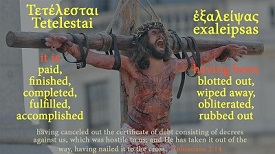
Jesus+0

Pages Email Newsletter Categories Archives Connect
  • Connct to us here