Aloha Friday Message – April 22, 2016 – Next …

1617AFC042216 – Next

Read it online here, please. And please, when you visit there, use one of the social media links at the bottom of the page to share this post. Thank you!

Hebrews 12:1-3 – Therefore, since we are surrounded by so great a cloud of witnesses, let us also lay aside every weight and the sin that clings so closely, and let us run with perseverance the race that is set before us,looking to Jesus the pioneer and perfecter of our faith, who for the sake of the joy that was set before him endured the cross, disregarding its shame, and has taken his seat at the right hand of the throne of God. Consider him who endured such hostility against himself from sinners, so that you may not grow weary or lose heart.

John 13:33b – You will look for me; and as I said to the Jews so now I say to you, ‘Where I am going, you cannot come.’

John 13:34-3534 I give you a new commandment, that you love one another. Just as I have loved you, you also should love one another. 35 By this everyone will know that you are my disciples, if you have love for one another.”

Happy Aloha Friday, Belovéd! I am excited about bringing you this topic today because I think it is something we all reflect upon from time to time: What’s next? Sometimes in our day-to-day lives, we focus on just making it through today, or even this hour; in times of stress and strife, we press on minute-by-minute. For us, time is linear, so “what’s next” is always in the future and we have to keep moving in that direction. If we get bogged down in the past, we don’t move forward – we make ourselves and everyone around us miserable. When the future looks promising, or joyful, or blessed, we look forward to the future with a positive attitude. But the future isn’t always rosy in this earthly life of ours.

We have a lot of things in our lives that can bring us down: Pain, hunger, disease, terror, fear, war, greed, persecution, and certainly sin. But we have even more things that lift us up: Comfort, fullness, healing, safety, courage, peace, generosity, help, and certainly forgiveness of our sins. In that quote from Hebrews at the opening of this post, Paul reminds us that Jesus is always with us and we should look to him when times are tough. He is the pioneer, the champion, the founder, the author and perfecter, the source and substance of our faith. He came to us knowing what he would have to endure to fulfill his Father’s will that he should “go through many sufferings and be treated with contempt.” (See Mark 9:12)  Jesus told his disciples in Mark 10:33-3433 …  “See, we are going up to Jerusalem, and the Son of Man will be handed over to the chief priests and the scribes, and they will condemn him to death; then they will hand him over to the Gentiles;34 they will mock him, and spit upon him, and flog him, and kill him; and after three days he will rise again.”

Jesus knew what was next, yet – as St. Paul says of Jesus – ” 2b who for the sake of the joy that was set before him endured the cross, disregarding its shame, and has taken his seat at the right hand of the throne of God.  Consider him who endured such hostility against himself from sinners, so that you may not grow weary or lose heart.” Oh, Belovéd! How easily we sometimes grow weary or lose heart! We know that we can go to Jesus when we face trials, but we either don’t believe he will help us, or ask for the wrong thing. We asked to be completely excused from the trial rather than to faithfully endure the trial – as Paul did; as Jesus did.

Remember, Jesus told us in John 16:3333 “I have said this to you, so that in me you may have peace. In the world you face persecution. But take courage; I have conquered the world!” We are afraid of pain and suffering, but we also know it is an integral part of the Christian life. Still we should set aside our fear and remember Jesus saying to us in John 14:2727 “Peace I leave with you; my peace I give to you. I do not give to you as the world gives. Do not let your hearts be troubled, and do not let them be afraid.” But we are afraid; we keep looking for Jesus to come and rescue us or to take us where we can be with him. Jesus anticipates that when he says in John 13:33b – “You will look for me; and as I said to the Jews so now I say to you, ‘Where I am going, you cannot come.'” Not until it’s time. You know that saying, “It’s always good in the end.” Well, if it’s not good yet, IT’S NOT THE END!!

NewJerusalem

If we look at the “very-last next,” we will see this:

Revelation 21:3And I heard a loud voice from the throne saying,
“See, the home of God is among mortals.
He will dwell with them;
they will be his peoples,
and God himself will be with them …”

There will be The New Jerusalem, the New Heavens, and The New Earth. He is making all things new! (See Revelation 21:5 and this collection – scroll down the page to see several verses)

But how do we get there? How can we last that long? We want to be with Jesus, to see him as he is. The answer is in John 13:34-3534 I give you a new commandment, that you love one another. Just as I have loved you, you also should love one another. 35 By this everyone will know that you are my disciples, if you have love for one another.” I deeply believe what John says about Jesus in 1 John 3:2Beloved, we are God’s children now; what we will be has not yet been revealed. What we do know is this: when he is revealed, we will be like him, for we will see him as he is.

Jesus knew what was next, and so do we! Therefore we also should, “for the sake of the joy that was set before” us, trust in that “great cloud of witnesses” who have – like Jesus – laid aside “every weight and the sin that clings so closely, and let us run with perseverance the race that is set before us.” Paul told Timothy in 2 Timothy 3:1212 Indeed, all who want to live a godly life in Christ Jesus will be persecuted. Jesus tells the disciples – and us – in Matthew 10:21-2221 Brother will betray brother to death, and a father his child, and children will rise against parents and have them put to death; 22 and you will be hated by all because of my name. But the one who endures to the end will be saved.

Do we want our lives filled with Peace and Joy? Of course we do! Do we want to be there when the very-last next happens? Of course we do! Then what shall we do? Love God. Love one another. Press forward through every “next” you find, “so that you may not grow weary or lose heart.” Then indeed, “we will be like him, for we will see him as he is.”

Whatever, whenever, wherever, whoever, however, if ever, forever — at your service, Belovéd!

Unless otherwise indicated, all scripture passages are from the New Revised Standard Version Catholic Edition (NRSVCE) New Revised Standard Version Bible: Catholic Edition, copyright © 1989, 1993 the Division of Christian Education of the National Council of the Churches of Christ in the United States of America. Used by permission. All rights reserved.

Creative Commons License
Aloha Friday Messages by Charles O. Todd, III is licensed under a Creative Commons Attribution-ShareAlike 3.0 Unported License

Remember in your prayers this week SW, AW, and TW whose journey in faith took them to a wonderful new life through Word and Sacrament on 4/21/2016 including 2 baptisms, 1 confirmation, 1 first communion, and one Marriage Convalidation. God is so GOOD!

And many thanks to all who wished us well for our 47th Wedding Anniversary on 4/19/2016.

Also: Special prayers of hope and thanksgiving on behalf of KD who was gravely ill, but is now out of ICU and progressing toward recovery. God is GOOD!
Aloha Friday Message – April 15, 2016 – JOY FULL

1616AFC041516 – Joy Full

Read it online here, please. And please, when you visit there, use one of the social media links at the bottom of the page to share this post. Thank you!

Acts 13:52 52 And the disciples were filled with joy and with the Holy Spirit.

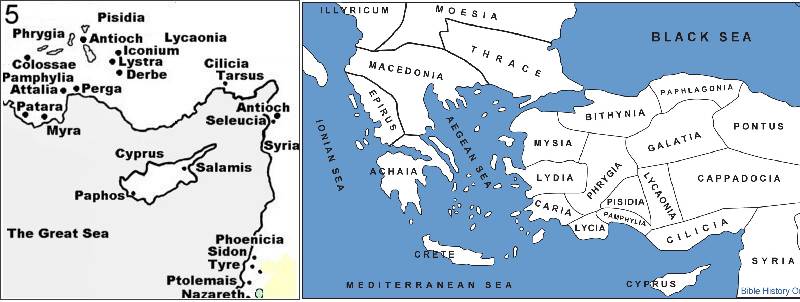
Aloha nui loa, ʻŌmea! Welcome back! This short verse comes from the first reading for the Fourth Sunday of Easter which begins “Paul and Barnabas continued on from Perga and reached Antioch in Pisidia” Perga was a very ancient city near the Mediterranean Sea in what is now Turkey.  Pisidia was a region – a small nation – farther north around Antioch. These two maps will give you a bit of an idea where Paul and Barnabas were.

RomanAsiaMaps

We see in this verse from the Acts of the Apostles that the “disciples were filled with joy and with the Holy Spirit.” I want to look at what we mean when we say “Holy Spirit.” In the King James Version of this verse it says, “And the disciples were filled with joy, and with the Holy Ghost.” I think we tend to imagine the Holy Spirit as something – or rather someone – invisible, able to move through solid objects, not confined by time or space, and even kind of spooky. When we read of or speak about “spirits,” we think about a phantom or phantasm or specter or apparition the “soul” of someone who is deceased. We also tend to think of the Holy Spirit as strictly a New Testament phenomenon. As the character “Sportin’ Life” said in Gershwin’s opera Porgy and Bess, “it ain’t necessarily so.” Let’s look at some passages from the Old Testament first just to get a handle on how that term was used.

Psalm 51:1111 Do not cast me away from your presence, and do not take your holy spirit from me.

Isaiah 63:11-13 – Then they remembered the days of old,
of Moses his servant.
Where is the one who brought them up out of the sea
with the shepherds of his flock?
Where is the one who put within them
his holy spirit,
12 who caused his glorious arm
to march at the right hand of Moses,
who divided the waters before them
to make for himself an everlasting name,
13     who led them through the depths?
Like a horse in the desert,
they did not stumble.

Of course we all remember Genesis 1:1-2. The wind blowing over the waters was the Spirit of God, the Breath of God, the same Breath he blew into Adam. In the New Testament, we find many references to the Holy Spirit or the Holy Ghost.

Luke 11:1313 If you then, who are evil, know how to give good gifts to your children, how much more will the heavenly Father give the Holy Spirit to those who ask him!

John 7:37-3937 On the last day of the festival, the great day, while Jesus was standing there, he cried out, “Let anyone who is thirsty come to me, 38 and let the one who believes in me drink. As the scripture has said, ‘Out of the believer’s heart shall flow rivers of living water.’” 39 Now he said this about the Spirit, which believers in him were to receive; for as yet there was no Spirit, because Jesus was not yet glorified.

Acts 2:4All of them were filled with the Holy Spirit and began to speak in other languages, as the Spirit gave them ability.

1 Corinthians 12 – This whole chapter describes the actions of the Holy Spirit.

Ephesians 1:13-1413 In him you also, when you had heard the word of truth, the gospel of your salvation, and had believed in him, were marked with the seal of the promised Holy Spirit14 this is the pledge of our inheritance toward redemption as God’s own people, to the praise of his glory.

Matthew 1:1818 Now the birth of Jesus the Messiah took place in this way. When his mother Mary had been engaged to Joseph, but before they lived together, she was found to be with child from the Holy Spirit.

Mark 12:3636 David himself, by the Holy Spirit, declared, ‘The Lord said to my Lord, “Sit at my right hand, until I put your enemies under your feet.”’

Obviously then the Holy Spirit had to be present from the time of creation all the way up through the book of Revelation.  But what about that passage in the seventh chapter of John? Why does it say “for as yet there was no Spirit, because Jesus was not yet glorified.”? Good question! Before we develop the answer, I think we need to take a look at what we mean when we say the Holy Spirit.

In the Old Testament, the words used for Holy Spirit are וְר֥וּחַ קָ֝דְשְׁךָ֗ – (ruwach) {roo’-akh} = spirit and (qodesh) {ko’-desh} = holy. Ruwach is the same word used in Genesis 1:2 and Psalm 51:11. It is the Breath of God, the Wind of Creation. Qodesh is the Hebrew word for Holy. The most fundamental meaning or sense of that word is “separate” or “special” or “different” or “set apart” as in “consecrated.” The temple was Holy because it was “set apart” and was different from other buildings. The Tabernacle in the Temple was holier than the Temple because it was even more different and even more set apart. In the Old Testament, then, the Holy Spirit, is different, set-apart, separate from other wind or breath. It is quite simply Holy because it comes from God; in fact, it is God.

In the New Testament, the words for Holy Spirit are Ἁγίῳ Πνεύματι. Ἁγίῳ Hagiō (hagio) {hag’-ee-o} = holy and Πνεύματι (Pneumati) {pnyoo’-mah-ti}. Would it surprise you to know that Hagiō means “different,” or “set-apart,” or “special?” What about Pneumati? Do you recognize that root pneum? We see it in pneumonia, pneumatic, and pneumonic. The root for that is πνεῦμα (pneuma) {pnyoo’-mah} which means (you guessed it!) BREATH – a gentle gust, breath from the nostrils or the mouth, the Breath of Life. In Hebrew or Greek, “Holy Spirit” means a breath that is different because it is not of this world, not like any other breath, set apart and consecrated as totally unique and it is Holy because it is God’s Breath.

Looking back at our opening passage from Acts 13, we can see why “the disciples were filled with joy.” They were filled with – baptized with – THE Holy Spirit. There’s only one, and they had it! Baptize, you will remember, means “to be fully immersed.” I can think of no better reason to be filled with joy and to know I have the Breath of God in and around me! The passage says, “And the disciples were filled with joy and with the Holy Spirit.”

One more Greek word that is important in this short verse – filled. The Greek verb for fill is Πληρόω (pléroó) {play-ro’-o}. The connotation is that of being filled with abundance, make full, to complete, to fill to the brim so there is nothing lacking, to make complete in every possible way, to render perfect. The disciples were perfectly happy and perfectly filled to the brim with divine Joy and with the Holy Spirit; however, we have not fully addressed John’s startling statement about Jesus: “for as yet there was no Spirit, because Jesus was not yet glorified.” How can we make sense of that given that we know the Holy Spirit has been the principle motive force behind everything from Creation to speaking in tongues? Jesus himself gives us some clues about this.

In John 16:7-10, Jesus says, Nevertheless I tell you the truth: it is to your advantage that I go away, for if I do not go away, the Advocate will not come to you; but if I go, I will send him to you. And when he comes, he will prove the world wrong about sin and righteousness and judgment:about sin, because they do not believe in me; 10 about righteousness, because I am going to the Father and you will see me no longer;

In John 16:13-14, Jesus says 13 When the Spirit of truth comes, he will guide you into all the truth; for he will not speak on his own, but will speak whatever he hears, and he will declare to you the things that are to come. 14 He will glorify me, because he will take what is mine and declare it to you.

The Holy Spirit will be present to Jesus’ disciples, and through them present to us, in a new and different way, a knowable way that is something new “because he will take what is [Jesus’] and declare it to you.” The disciples will know the Holy Spirit as a Paraclete, a Companion, an Advocate, a Friend, and a Unifier of the Church. Not only do they receive the Power of the Holy Spirit, but also they can share the Holy Spirit by passing him forward into the lives of others as we declare the Life of Christ in us.They were sealed with the Holy Spirit  when they “were marked with the seal of the promised Holy Spirit.” It is that indelible mark we receive when we give our lives to Christ and he claims us as his own. This new relationship with the Holy Spirit was determined by Providence before creation and could only be given to us after the Glorified Lord returned to his Father in Heaven. It is indeed the same Holy spirit that moved over the face of the deep, but now when he moves, he moves in and around us as well. God’s perfect plan was to make HIS Spirit, HIS Holiness, available to us again. Now, through the faith we have in the Christ of God, that part of his Plan is a reality that must indeed “make our joy complete.” Jesus himself said that in John 15:1111 I have said these things to you so that my joy may be in you, and that your joy may be complete. And guess what. That word complete is – ahhhh, you guessed it! Πληρόω (pléroó) {play-ro’-o}!!! You will be JOY FULL!


Whatever, whenever, wherever, whoever, however, if ever, forever — at your service, Belovéd!

Unless otherwise indicated, all scripture passages are from the New Revised Standard Version Catholic Edition (NRSVCE) New Revised Standard Version Bible: Catholic Edition, copyright © 1989, 1993 the Division of Christian Education of the National Council of the Churches of Christ in the United States of America. Used by permission. All rights reserved.

Creative Commons License
Aloha Friday Messages by Charles O. Todd, III is licensed under a Creative Commons Attribution-ShareAlike 3.0 Unported License

Biblical languages inserts from Bible Hub (Bible Hub: Search, Read, Study the Bible in Many Languages) Visit at http://biblehub.com


Aloha Friday Message – April 8, 2016 – An Ocean of Grace

1615AFC040616 – An Ocean of Grace  –  #9: Series on Virtue and Sin

Read it online here, please. And please, when you visit there, use one of the social media links at the bottom of the page to share this post. Thank you!

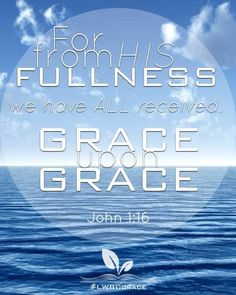
John 1:1616 From his fullness we have all received, grace upon grace.

Colossians 1:19-2019 For in him all the fullness of God was pleased to dwell, 20 and through him God was pleased to reconcile to himself all things, whether on earth or in heaven, by making peace through the blood of his cross.

1 Peter 4:7-11The end of all things is near; therefore be serious and discipline yourselves for the sake of your prayers. Above all, maintain constant love for one another, for love covers a multitude of sins. Be hospitable to one another without complaining. 10 Like good stewards of the manifold grace of God, serve one another with whatever gift each of you has received. 11 Whoever speaks must do so as one speaking the very words of God; whoever serves must do so with the strength that God supplies, so that God may be glorified in all things through Jesus Christ. To him belong the glory and the power forever and ever. Amen.

Happy Aloha Friday, Belovéd. I didn’t realize it until Tuesday, April 5, but this is #9 in the series on Virtue and Sin. I thought #8 was the recap of the series, but then on Tuesday the passage from 1 Peter jumped into the mix, and I realized there is more to say in this series.

Last week we looked at the concepts of Virtue and Sin and saw that we can choose to open the door of our heart to let in Jesus or a demon. All of us have experienced what happens when we open that door and just leave Jesus standing there while Satan’s angels bound into our lives and take over everything. We all know life is better when it is Jesus who comes in because, when we choose him, he restores our relationship with Our Father and then Peace reigns in our hearts. How is it that we make that poor choice so often? What are we missing in our decision-making process as we open our hearts – and minds – to that knock on the door? How can we ensure that we are speaking and living “as one speaking the very words of God; whoever serves must do so with the strength that God supplies, so that God may be glorified in all things through Jesus Christ,” as Peter encouraged us? Peter says that we are to “maintain constant love for one another, for love covers a multitude of sins.” How can we be that constant in our love to others? I think the answer is in that verse from John, “grace upon grace.”

In the past when I read that phrase, I thought it meant one grace piled on another grace – like a wall made of bricks – a fortress of grace built with succeeding layers of God’s gifts. Then I actually looked at the language behind that verse and discovered I had the wrong idea. The Greek word used for “upon” is the preposition ἐπί (epi) {ep-ee’}, but this verse says in Greek χάριν ἀντὶ χάριτος. John did not say χάριν ἐπὶ χάριτι; he said χάριν ἀντὶ χάριτος. That word in bold letters, ἀντὶ, is another familiar preposition anti – (anti) {an-tee’}. Here is how it is defined at Bible Hub: Short Definition: instead of, for; Full Definition: (a) instead of, in return for, over against, opposite, in exchange for, as a substitute for, (b) on my behalf, (c) wherefore, because. (d) antí (a preposition) – properly, opposite, corresponding to, off-setting (over-against); (figuratively) “in place of,” i.e. that substitutes (serves as an equivalent, what is proportional). What difference does that make, after all, if grace is given in exchange for grace rather than on top of grace? How about if it signifies grace that serves as an equivalent to the Grace of God and that Grace is within us? Here is the image I see when today I look at that door to my heart and see Jesus standing there with a demon lurking nearby:

It depends on the furnishings in the room(s) in my heart. If the interior of my heart is filled with the filth from the demons I let in before today, then if and when I invite Jesus in, “the place is a mess.” Jesus of course has the power to merely speak a word of forgiveness and make that mess go away, but I can refuse to hear that word; I can refuse to clean up my mess – a mess that is perfectly inviting for that demon and its buddies. Conversely, if the interior of my heart is decorated with Love and Grace, somehow it seems easier to invite Jesus in and leave the Devil to lurk the day away – outside! Now, how to I get that place filled with Grace and Love?

OceanOfGraceI have an ocean of Grace surrounding and filling me. Oh! And now I know why I got up in the middle of the night a couple of weeks ago and wrote down this! “I have immersed my life in His Heart so that my heart can be entirely filled with Him.” Scroll up and look at that passage from Colossians. “For in him all the fullness of God was pleased to dwell …” Jesus is the Fullness of God’s Immeasurable Grace, so when I open the door, I get the WHOLENESS OF God! Therefore I am reconciled with him as part of “all things, whether on earth or in heaven, by making peace through the blood of his cross.” Now that will change the interior of our hearts by placing Grace upon Grace! I have the Grace of choice to open that door and let Jesus in, and when I do, I receive the Fullness of Grace upon that Grace of choice. Now Peter came to know that kind of Grace when he chose to repent and to seek forgiveness. You will remember Jesus had told him in Matthew 16:1818 And I tell you, you are Peter [Petros], and on – ἐπί (epi) {ep-ee’} – this rock [petra] I will build my church, and the gates of Hades will not prevail against it. Peter was to be the foundation upon which the Church was built, and not the corresponding Grace by which it was built.

As all of this slowly dawned on me, I recalled something I got from one of my favorite Radio Evangelists, Steve Brown at Keylife. It’s something I’ve sent out before – with Steve’s permission – and I want to share it with you again.

Once there was a fish who lived in the great ocean and, because the water was transparent and always conveniently got out of the way of his nose when moved along, he didn’t know he was in the ocean. Well, one day the fish did a very dangerous thing. He began to think: “Surely I am a most remarkable being since I can move around like this in the middle of empty space.” Then the fish became confused because of thinking about moving and swimming, and he suddenly had an anxiety attack and thought he had forgotten how to move about.

At that moment he looked down and saw the yawning chasm of the ocean depths, and he was terrified that he would drop. Then he thought: “If I could catch hold of my tail in my mouth, I could hold myself up.” and so he curled himself up and snapped at his tail. Unfortunately, his spine was not quite supple enough so he missed. As he went on trying to catch hold of his tail, the yawning black abyss below became ever more terrible, and he was brought to the edge of a total nervous breakdown. The fish was about to give up when the ocean, which had been watching with mixed feelings of pity and amusement, said, “What are you doing?”

“Oh,” said the fish, “I’m terrified of falling into the deep dark abyss, and I’m trying to catch hold of my tail in my mouth to hold myself up.”

So the ocean said, “Well, you’ve been trying that for a long time now, and still you have not fallen down. How come?”

“Oh, of course, I haven’t fallen down yet,” said the fish, “because … Well, because I’m swimming!

“Well,” came the reply, “I am the Great Ocean where you swim, and I have given all of myself to you in which to swim, and I support you all the time you swim, but here you are, instead of exploring the length, breath, depth and height of my expanse, you have been wasting your time pursuing you own end.”

From then on, the fish put his own end behind him where it belonged … And set out to explore the ocean.

(Deep and heartfelt thanks to Dr. Steve Brown for originally sharing this with me so long ago!)

The love of God is like the ocean, you can see its beginnings but not its end. The Grace of God is the ocean of His Love. He is the source of the Ocean of Grace. When you acknowledge Him, it is as if you are submersed in a vast ocean being fed by a fountain of purest water. You are standing in that fountain in the center of the center of the Crystal Sea drinking from a crystal cup of the Endless Grace and Love, and this is available to every human soul alive today in Heaven and on Earth who chooses to stand in the Grace of God .  This is “so that God may be glorified in all things through Jesus Christ. To him belong the glory and the power forever and ever. Amen.” And that’s the TRUTH!

So how do we align ourselves with 1 Peter 4:7-11? Try these:

Sow generously – 2 Corinthians 9:6-15

Matthew 20:26-2826 It will not be so among you; but whoever wishes to be great among you must be your servant, 27 and whoever wishes to be first among you must be your slave; 28 just as the Son of Man came not to be served but to serve, and to give his life a ransom for many.”

Luke 11:1111 Is there anyone among you who, if your child asks for a fish, will give a snake instead of a fish?

Romans 12:1717 Do not repay anyone evil for evil, but take thought for what is noble in the sight of all.

Unless otherwise indicated, all scripture passages are from the New Revised Standard Version Catholic Edition (NRSVCE) New Revised Standard Version Bible: Catholic Edition, copyright © 1989, 1993 the Division of Christian Education of the National Council of the Churches of Christ in the United States of America. Used by permission. All rights reserved.

Creative Commons License
Aloha Friday Messages by Charles O. Todd, III is licensed under a Creative Commons Attribution-ShareAlike 3.0 Unported License

Biblical languages inserts from Bible Hub (Bible Hub: Search, Read, Study the Bible in Many Languages) Visit at http://biblehub.com


Aloha Friday Message – April 1, 2016 – A Time for Goodness’ Sake

1614AFC040116 – A Time for Goodness’ Sake

Read it online here, please. And please, when you visit there, use one of the social media links at the bottom of the page to share this post. Thank you!

2 Peter 1:3-8 His divine power has bestowed on us everything that makes for life and devotion, through the knowledge of him who called us by his own glory and power. Through these, he has bestowed on us the precious and very great promises, so that through them you may come to share in the divine nature, after escaping from the corruption that is in the world because of evil desire. 5For this very reason, make every effort to supplement your faith with virtue, virtue with knowledge,knowledge with self-control, self-control with endurance, endurance with devotion, devotion with mutual affection, mutual affection with love.If these are yours and increase in abundance, they will keep you from being idle or unfruitful in the knowledge of our Lord Jesus Christ. New American Bible (Revised Edition) (NABRE)

Luke 6:19 19 And the whole multitude sought to touch him: for there went virtue out of him, and healed them all. Authorized (King James) Version (AKJV)

Genesis 4:6-7So the LORD said to Cain: 6 “Why are you so resentful and crestfallen? 7 If you do well, you can hold up your head; but if not, sin is a demon lurking at the door: his urge is toward you, yet you can be his master.” (New American Bible Copyright © 1991, 1986, 1970 Confraternity of Christian Doctrine, Inc., Washington, DC)

Genesis 18:20-21 20 Then the Lord said, “How great is the outcry against Sodom and Gomorrah and how very grave their sin! 21 I must go down and see whether they have done altogether according to the outcry that has come to me; and if not, I will know.”

Belovéd – Grace and Peace be unto you from God our Father and from our Lord, Jesus – The Christ of God.

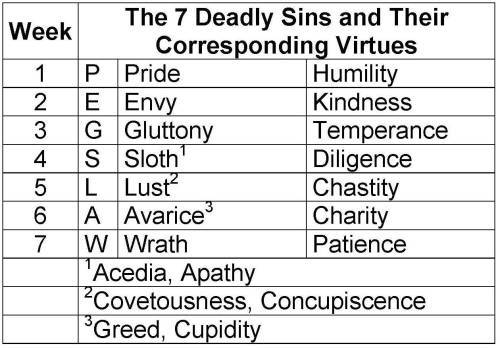
LentenSeries_MDuring the Season of Lent, we studied the seven Christian Virtues and Seven Deadly Sins. These Deadly sins are also sometimes called Cardinal Sins. Cardinal in this usage means fundamental, principal, serious, grave, severe, or dangerous. Let’s look at the list one last time.

In our last study, I stated, ” We had these Virtues first. Yes, before The Fall, Adam and Eve lived in a state of Grace in the Presence of God (all those capital letter emphasizing what an important and perfect relationship that was). Then Sin happened – starting with Pride which led to disobedience and failure to fully Love God. Sin was Satan’s tool to mess up the perfect world God had created.” Adam and Eve had a choice. Cain had a choice. I, you, we have a choice. We can let sin master us, or we can master sin. If we do that, if we do master sin, then the virtue God put into us at Creation has a chance to flourish much the same way as the seed the sower sowed fell on good soil. That sounds logical; master sin and we can keep it from entering in and bringing us death.

The verse up there that describes God talking to Cain is a terrific translation of that passage; it portrays sin as a demon lurking outside the door and waiting for a chance to pounce and lead us into sin. That says a lot more that might occur to us at a quick reading, so let’s dissect it a little.

Sin is lurking at the door. Why is it kept outside? Why doesn’t sin just walk right in and throw us to the ground? What in the world is keeping it “lurking at the door” and what door are we talking about? How does sin “enter in?” We certainly remember that; it was through Satan’s lie that Eve and Adam could be more like God if they “ate the forbidden fruit”: Genesis 3:22 – 22 Then the Lord God said, “See, the man has become like one of us, knowing good and evil; and now, he might reach out his hand and take also from the tree of life, and eat, and live forever”— Through the Sin of Adam, we inherited the ability to distinguish between good and evil, between Virtue and Sin. Why did God see it necessary to kick our First Parents out of The Garden of Eden? So that they could not exercise their freedom-to-choose again and eat of the Tree of Life – that would have meant they would live eternally in a state of sin. Adam and Eve were removed from that temptation, and so, also, are we. We cannot gain eternal life in Heaven on our own. We have to obtain it the way God resolved we should obtain it: By restoring us to the virtuous beings he created before sin entered in. How did it first enter? It was invited in. It came through the door of the heart. At heart, Adam and Eve loved God and wanted to be like him. Satan’s lie was that they could become like Him by; they already were like him in purity of Spirit, but did not know there was a contrary spirit of evil they could also know.

His urge is toward you. Satan is a rebel, a liar, a thief, and a coward. He did not want to be obedient to God because he thought he could be equal to or better than God. He lied to other angels and they lost their place in Heaven when Satan was cast out. He was given dominion over the Earth, and used that power to steal Paradise from our First Parents. He is too much of a coward to seek forgiveness because his irrepressible pride prevents it. He wants you and me. He wants to steal us from God and deny us Eternity in Paradise so we can spend Eternity in Hell with him.

Yet, you can be his master. How? Shut him out. Don’t listen. Choose Life. Choose Love. Choose Virtue. Choose God. Choose Right over and over and over again. And when you mess up and choose Wrong, when you slip and choose Evil, REPENT AND CHOOSE GOD AGAIN! Keep that demon outside the door!

Sin – a demon known as Satan – is stuck outside the door until it is invited in. He is lurking at the threshold waiting for us to open the door and say, “Come on in! Let’s celebrate!” Does that remind you of anyone in particular? Try looking at Revelation 3:20 20 Listen! I am standing at the door, knocking; if you hear my voice and open the door, I will come in to you and eat with you, and you with me. We have to choose to let Satan in. We have to choose to let Jesus in. Who is knocking at your door right this minute? Is it Jesus; or is it a clever liar who can sound like Jesus? How do you know which to choose? The answer is right there in that first word, “Listen!” Is the voice of the person knocking at that door of our heart a voice of virtue or a voice of sin, a voice of understanding or a voice of confusion? How do we, how can we, know the difference? We have to know what sin is and we have to know what virtue is. In our PC-culture, we work diligently at obscuring sin instead of working diligently at avoiding sin. We are very successful at obscuring the truth about sin. Why are we so successful? Because we choose to lie to ourselves about what sin is and how we let it into our lives. If you don’t know what sin is, how do you learn?

Throughout history and across the whole world, we can recognize an inherent awareness of what’s good and what’s bad, what is right and what is wrong, what is holy and what is evil. How can that be? Hello! It’s from the Fruit of the Knowledge of Good and Evil!! It is the ability to distinguish right things from wrong things. Where can we get better tools for doing this? Really? Start with the B.I.B.L.E. Really. Our Basic Instructions Before Leaving Earth give us lists of good things and lists of bad things, list of rules, and lists of consequences for keeping or breaking the rules; it is the Ultimate Reference Book for Good and Evil. (See Proverbs 6:16-191 Corinthians 6:9-10, Galatians 5:19-21, Philippians 4:8 and today’s reference 2 Peter 1:3-8 for example.) Another good way to figure it out – in addition to how it “feels” when we contemplate it (or do it if we skipped the contemplation step) – is to ponder whether or not we can ask God to bless what we are allowing to enter into our hearts. Remember, Jesus said that what originates in our hearts is what contaminates us; the demon in inside the door and our imagination is allowing it to make our choices. Can we, in good conscience, ask God to bless us when we are on the verge of doing something that condemns us? Is what we are considering going to bring glory to God or sin to us? (See 1 Corinthians 10:31) If we are looking for an authoritative answer about sin, go to the Ultimate Reference – inspired by the Ultimate Authority.

We can also use catechesis to learn about what sin is – and also what virtue is, for that matter. In many ways, we’ve failed at providing good catechesis (katəˈsəs). What in the world is that? It is learning about the Bible, the Word of God, and it is a life-long learning process. Catechesis is a process that is shunned by many – including many Christians. People who claim to be Christian Adherents amount to about 31% of the total world populations (and Islam about 23%). There are many Christians who know very little about their faith, their scriptures, their dogmas, and theologies – because they choose not to know. They don’t want to hear about sin – hell-fire and brimstone – because (in The World’s eyes) sin is relative and therefore irrelevant. That’s another invention of the Father of Lies. Sin is not relative, virtue is not relative and sin and virtue are never irrelevant because they are always absolute. Good is always good. Evil is always evil. Truth is always truth. Lies are always lies. God is always God, Love is always Love, Life is always life. The thing about Life, though, is that it is Eternal whether you live in Sin or whether you live in Virtue. Whichever you choose in this life will be the way you spend Eternity.

In that passage from Luke, it says, “for there went virtue out of him, and healed them all.” In the King James Version the word virtue comes from the Greek word δύναμις (dunamis) {doo’-nam-is} which connotes inherent power such that inherent power, power residing in a thing by virtue of its nature, or which a person or thing exerts and puts forth, is what causes the miracles of healing Jesus performed. The power – the virtue – was in him and it was not inhibited by sin. When we are not inhibited by sin, the virtue is in us, too. Our English word “virtue” comes from a Latin word, virtus, which means “manly strength” or “excellence,” from vir, “man.” Virtue, then is the practice of moral living and conduct, especially moral excellence or the power of good morality. We have the power in us, and we can use that power to control who or what we let inside the door. We have the power to know the difference if only we will use that power.

That is why we spent seven weeks looking at Sin and Virtue – so we could more easily recognize the differences. The difference between sin and virtue is the same in pretty much every religion in the world – I said and meant religion as some “belief systems” are not religions but governmental and/or political constructs not based on any form of divinity. If you say or someone you know tells you, “I don’t need some religion telling me what to do or think or say. I’m a very spiritual person, but not a religious person,” they are deceived. Their religion is “spirituality,” an internal, subjective, rationalizing form of relativism which affirms that there is no absolute truth or validity in anything other than one’s own point of view. And from whence does this deception arise? Yes, someone chose to open the door and let it in. That demon is no longer lurking at the door. Letting it in is like letting in all the demons of all the fundamental, principal, serious, grave, severe, and dangerous deceptions called Sin. How do you keep the door closed and how will you know when to open it? Remember that ” His divine power has bestowed on us everything that makes for life and devotion, through the knowledge of him who called us by his own glory and power.” It is time to choose virtue instead of sin, to choose goodness instead of evil.

Whatever, whenever, wherever, whoever, however, if ever, forever — at your service, Belovéd!

Pray for Peace! Pray for our country in this time of decision. VOTE! And as you make your choice, can you in good conscience ask God to bless your decision?

Unless otherwise indicated, all scripture passages are from the New Revised Standard Version Catholic Edition (NRSVCE) New Revised Standard Version Bible: Catholic Edition, copyright © 1989, 1993 the Division of Christian Education of the National Council of the Churches of Christ in the United States of America. Used by permission. All rights reserved.


Aloha Friday Messages by
Charles O. Todd, III is licensed under a Creative Commons Attribution-ShareAlike 3.0 Unported License

Biblical languages inserts from Bible Hub (Bible Hub: Search, Read, Study the Bible in Many Languages) Visit at http://biblehub.com


Aloha Friday Message – March 25, 2016 – Good Friday

1613AFC032515 – 2016 Lenten Series #7

Read it online here, please. And please, when you visit there, use one of the social media links at the bottom of the page to share this post. Thank you!

Genesis 39:1919 When his master heard the words that his wife spoke to him, saying, “This is the way your servant treated me,” he became enraged. [burning with wrath]

Exodus 22:22-2422 You shall not abuse any widow or orphan. 23 If you do abuse them, when they cry out to me, I will surely heed their cry; 24 my wrath will burn, and I will kill you with the sword, and your wives shall become widows and your children orphans.

LentenSeries_ME pili mau na pomaika‘i ia ‘oe a me ke akua ho’omaika’i ‘oe, ʻŌmea! (May blessing always be with you and may God bless you, Beloved!) Today is Good Friday, the last Friday before Easter. Technically, Lent is over as of yesterday, and we have entered into the Triduum – Holy Thursday the Day of the Lord’s Supper, Good Friday, the Day of the Lord’s Passion, and Holy Saturday, the Eve of the Lord’s Resurrection. From the evening of Holy Thursday to the evening of Easter Sunday, “[t]hough chronologically three days, they are liturgically one day unfolding for us the unity of Christ’s Paschal Mystery.” (Read more here.)

We have already looked at Pride and Humility, Envy and Kindness, the tough topics of Gluttony and Temperance, the surprising topics of Sloth and Diligence, Lust and Chastity, and Avarice and Charity. Today we finish up this list with Wrath and Patience.

Let’s begin with the Stumbling Block in the room – The Wrath of God. So many people focus on this and humanize God’s Wrath, portraying it in the same way we feel Wrath. We are convinced that God is vengeful, mean, cruel, vindictive, perpetually angry, even violent. That is just not true. Let’s set the record straight. God is Love, God is our Loving Father, and God wants all of us to be his loving children. This negative image of God as some sort of “iron fist in a velvet glove” comes from a misunderstanding of  how he expresses his Love when we earthlings reject that Love. Most of the passages that describe this Wrath of God are passages where God’s People, the Israelites, have failed to keep their side of the Covenant. They have disobeyed, lost their love for God, do not reverence God as he commanded (and deserves), and they are in dire need of correction. As a loving Father, he corrects his children. Let me give you an example of how that works for those of us who are parents.

“Don’t make me come back there!” “If you don’t cut that out right now, I’ll knock you clear into next Tuesday!” “You’d better behave yourself, or you’re going to be grounded until you’re 21.” “As long as you’re living under my roof, you will do as I say, or you can get out!”

You’ve probably heard at least one of those. Did your parents say that to you (or did you say that to your kids) because they hated you? NO! Mom and Dad were frustrated with your disobedience and threatened you with dire consequences if you didn’t clean up your act. Despite previous warnings like “Honey, don’t do that. Mommy’s afraid you’ll get hurt,” or “Son, be careful be careful with that stuff. It can ruin your whole life,” you and I did what we were told not to do, and our parents threatened to “pound some sense into your head.” This is “The Wrath of Love.”

In the Old Testament, one of the principal words in Hebrew for Wrath is אַפּ֔וֹ (’ap·pōw) from אַף (‘aph) {af}. This word has a sort of weird derivation. It actually comes from a root word meaning nose or nostril, snout, or face. Think about the face of someone who is really angry. Do we not say that his nostrils are flared, or that his face is burning red? When we feel that deep-seated, all-consuming anger flare up in our hearts and minds, we want to be vindictive, unforgiving, vengeful, merciless. God is simply not like that! God is Love and his loving response to our disobedience and lack of love is to correct us and show us the path to redemption because of his Infinite Mercy. God’s wrath is redemptive, saving, forgiving, compensating for all our failings, atoning and making reparation for our sins, indemnifying us from his just recompense for our sins. God does not force us to obey; we are free to choose obedience or disobedience. But, he certainly does give very strong hints to us about how he wants us to respond to his love.

The passage at the top – Genesis 39:19 – is from the story of Joseph and Potifar’s wife. She has a crush on Joseph and thinks she can seduce him. When he doesn’t “cooperate,” she pull off his cloak and tells her husband Joseph abused her trust. Potifar becomes filled with fury and punishes Joseph severely. This is a great example of human wrath – violent, punitive, jealous rage, and fury.

In the passage from Exodus 22, we see God’s warning about mistreating others. He says, in effect, if you treat others badly, I will give you a taste of your own medicine. To help see this better, I want to show you a number of passages that illustrate how God chastises us for our own good, so here we go.

Exodus 32:1212 Why should the Egyptians say, ‘It was with evil intent that he brought them out to kill them in the mountains, and to consume them from the face of the earth’? Turn from your fierce wrath; change your mind and do not bring disaster on your people.

Proverbs 11:2323 The desire of the righteous ends only in good;
the expectation of the wicked in wrath. (impartial punishment)

In this verse, Wrath is עֶבְרָה (ebrah) {eb-raw’} as in an arrogant and excessive outburst overflowing with rage or furious anger.

We see the same word in Isaiah 60:1010 Foreigners shall build up your walls,
and their kings shall minister to you;
for in my wrath I struck you down,
but in my favor I have had mercy on you.

Zechariah 8:13-1513 Just as you have been a cursing among the nations, O house of Judah and house of Israel, so I will save you and you shall be a blessing. Do not be afraid, but let your hands be strong. 14 For thus says the Lord of hosts: Just as I purposed to bring disaster upon you, when your ancestors provoked me to wrath, and I did not relent, says the Lord of hosts, 15 so again I have purposed in these days to do good to Jerusalem and to the house of Judah; do not be afraid.

In the New Testament, we see many allusions to the Old Testament “Wrath of God,” such as Matthew 3:7But when he [John the Baptist] saw many Pharisees and Sadducees coming for baptism, he said to them, “You brood of vipers! Who warned you to flee from the wrath to come?” Here, the word in Greek for Wrath is ὀργή (orgé) {or-gay’} meaning anger, wrath, passion; punishment, vengeance.

– And

Luke 4:2828 When they heard this, all in the synagogue were filled with rage [wrath]. The word used here for RAGE is Θυμός (thumos) {thoo-mos’} This means indignation with passionate anger that boils up and dies down again soon thereafter.

Romans 2:5But by your hard and impenitent heart you are storing up wrath for yourself on the day of wrath, when God’s righteous judgment will be revealed.

To really understand how “God’s Wrath” is an act of Love, take a few moments to read Romans, Chapter 9. (Please do that sometime soon. It’s a great read!)

As for our own wrath, it is consistently condemned as sin, almost as an amalgam of all the other sins we have studied in this series. For example, we read in Galatians 5:19-2119 Now the works of the flesh are obvious: fornication, impurity, licentiousness,20 idolatry, sorcery, enmities, strife, jealousy, anger [wrath], quarrels, dissensions, factions, 21 envy, drunkenness, carousing, and things like these. I am warning you, as I warned you before: those who do such things will not inherit the kingdom of God. (The Kingdom of Love)

God is Love. God is Righteousness. God is Holy. He wants us to be Holy. He waits for us to be Holy. He is patient with us – mostly. When we stubbornly refuse to return his love, he corrects us to encourage us to be patient. In the New Testament, the word for patience is ὑπομονή, (hupomone) {hoop-om-on-ay’}. This is interpreted as ” … the characteristic of a man who is not swerved from his deliberate purpose and his loyalty to faith and piety by even the greatest trials and sufferings.” It is patiently enduring all trials, persevering in all ordeals, trusting in the ultimate triumph of good over evil, and trusting that God can be trusted to “deliver us from all evil.” Here are some biblical quotes about patience:

Psalm 37:7Be still before the Lord, and wait patiently for him;
do not fret over those who prosper in their way,
over those who carry out evil devices.

Psalm 40:1I waited patiently for the Lord;
he inclined to me and heard my cry.

Ecclesiastes 7:8Better is the end of a thing than its beginning;
the patient in spirit are better than the proud in spirit.

Luke 8:1515 But as for that in the good soil, these are the ones who, when they hear the word, hold it fast in an honest and good heart, and bear fruit with patient endurance.

Luke 21:17-1917 You will be hated by all because of my name.18 But not a hair of your head will perish. 19 By your endurance [patience] you will gain your souls.

Romans 5:1-5 – Therefore, since we are justified by faith, we have peace with God through our Lord Jesus Christ, through whom we have obtained access to this grace in which we stand; and we boast in our hope of sharing the glory of God. And not only that, but we also boast in our sufferings, knowing that suffering produces endurance [patience], and endurance produces character, and character produces hope, and hope does not disappoint us, because God’s love has been poured into our hearts through the Holy Spirit that has been given to us.

Galatians 5:22-2322 By contrast, the fruit of the Spirit is love, joy, peace, patience, kindness, generosity, faithfulness, 23 gentleness, and self-control. There is no law against such things.

Patience is the outcome of living out the combination of Humility, Kindness, Temperance, Diligence, Chastity, and Charity. Take a look at that list. When I see those listed together, I realize I am short of the mark on all of them. It a strange way, it is almost as if those shortfalls are cumulative so that when it’s all added up, the deficit in the virtue of Patience is pretty imposing. Ask the people closest to me, and they will tell you that I have a short fuse that is easily ignited and burns quickly to spark a significant BOOM. I don’t know for sure, but I think other people’s tallies may come together in such a way that some other virtue seems to consistently fall short. It makes me wonder why these Virtues cannot effectively prevent those Sins. I mean, don’t we have these Virtues to counteract those Sins? Maybe not, if you look at which came first.

We had these Virtues first. Yes, before The Fall, Adam and Eve lived in a state of Grace in the Presence of God (all those capital letter emphasizing what an important and perfect relationship that was). Then Sin happened – starting with Pride which led to disobedience and failure to fully Love God. Sin was Satan’s tool to mess up the perfect world God had created. His spiteful interference and arrogant conduct helped permeate Creation with Death, Duplicity, and Destruction. It was like stirring in a tablespoon of baking soda mixed with salt into a cup of hot chocolate. It ruined everything – almost. I say almost, because God provided a way to “desalinate” that which Satan tried to destroy. He gave us his own sweetness to help neutralize and filter out the bitterness Satan had added. Our challenge in this life is to recapture these Virtues by giving them our uppermost attention instead of allowing those Sins to pollute our hearts and minds. The Virtues are there. Our sinful natures interfere with their full expression – we are imperfect because we are sinful. Jesus “fixed” that for us when he willingly allowed his enemies to fix him to a rough wooden cross with horrific iron nails. All of our failures and all of the just punishments that accompany them were wiped out because God allowed his Only Begotten Son to take all of that Wrath – God’s ultimate loving correction – upon himself. And then, with Sin and Death conquered, the Christ of God rose in victory over the bitterness of Death, Duplicity, and Destruction.

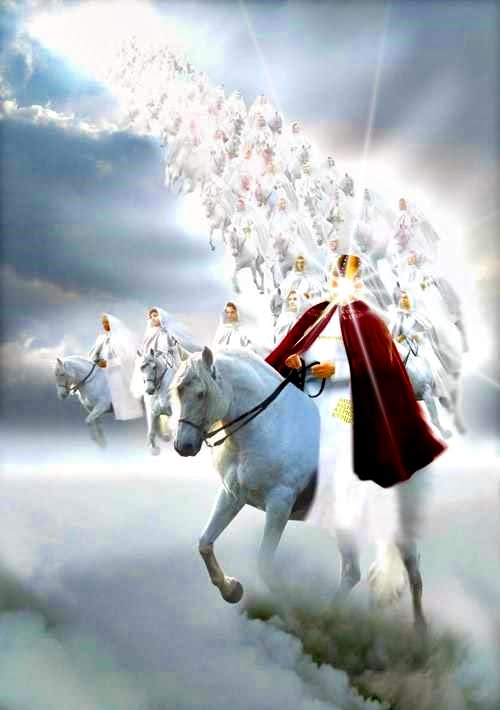
In Revelation 19:11-16, we are told that a rider called Faithful and True and named The Word of God comes to battle riding a white warhorse, slaying God’s enemies with a sharp sword which comes from his mouth. He treads down the wicked as if they were grapes, ripe and ready for utter destruction. Then at last, all that is will become as it was and more. These Virtues will be restored, and those Sins will not survive God’s triumph. Only Satan and his angels will burn with Wrath.

rev-19-11-rider-on-the-white-horse-david-miles-500wWhatever, whenever, wherever, whoever, however, if ever, forever — at your service, Belovéd!

Pray for Peace. Pray for our Country. Pray for those who will soon be leading this One Great Indivisible Nation Under God. Pray for us sinners that we remember these Virtues as we wait in joyful hope for the coming of The Lord.

Unless otherwise indicated, all scripture passages are from the New Revised Standard Version Catholic Edition (NRSVCE) New Revised Standard Version Bible: Catholic Edition, copyright © 1989, 1993 the Division of Christian Education of the National Council of the Churches of Christ in the United States of America. Used by permission. All rights reserved.

Creative Commons License
Aloha Friday Messages by Charles O. Todd, III is licensed under a Creative Commons Attribution-ShareAlike 3.0 Unported License

Biblical languages inserts from Bible Hub (Bible Hub: Search, Read, Study the Bible in Many Languages) Visit at http://biblehub.com


Aloha Friday Message – March 18, 2016 Lenten Series, #6

1612AFC031816 – 2016 Lenten Series, #6

Read it online here, please. And please, when you visit there, use one of the social media links at the bottom of the page to share this post. Thank you!

Luke 12:15 15 And he said to them, “Take care! Be on your guard against all kinds of greed; for one’s life does not consist in the abundance of possessions.”

Romans 1:29-32 29 They were filled with every kind of wickedness, evil, covetousness, malice. Full of envy, murder, strife, deceit, craftiness, they are gossips,30 slanderers, God-haters, insolent, haughty, boastful, inventors of evil, rebellious toward parents, 31 foolish, faithless, heartless, ruthless.32 They know God’s decree, that those who practice such things deserve to die – yet they not only do them but even applaud others who practice them.

LentenSeries_MAloha nui loa, ʻŌmea. Much love to you Belovéd. We are approaching Easter and the end of Lent. Today we look at the next set of words in our list of The 7 Deadly Sins and Their Corresponding Virtues. We have already looked at Pride and Humility, Envy and Kindness, the tough topics of Gluttony and Temperance, the surprising topics of Sloth and Diligence, and last week, something a little tougher: Lust and Chastity. Today’s paired topics are Avarice and Charity. You may have noticed in the table that footnote 3  lists two other words – Greed and Cupidity. Greed is a word we understand fairly well. We recognize it as an intense desire for money, or power, or food, or possessions.

We think of greedy people as materialistic, miserly, selfish, penny-pinching misanthropes who hate humanity, or who dislike and distrust other people fearing others will “rob” them of their hoarded wealth. Cupidity is not a very common word these days, but it conveys many of the same concepts. It describes what could be called an irrational, perverse, and unjust desire for wealth; it’s like a Lust for total prosperity through all things that can be acquired and possessed. The key-word listed is Avarice. Avarice is  a malicious malady which makes the getting and keeping of money and possessions the central – and often only – reason for living. Because of this, Avarice can sometimes be ironically characterized a good thing because those it its grip are convinced that the hoarding of wealth is prudent preparation for provisioning the future. The result is discriminatory injustice to others whose are denied access to the basic needs for life – income, shelter, food, and dignity. This kind of avaricious accumulation of material goods often leads to many other sins – it is the love of wealth above all; it is – as the Apostle Paul told us – the root of all kinds of evil. Jesus himself warned us about the power of greed. He knew – and we can see – that it sometimes gets in the way of entering into The Kingdom of God. Remember the “Rich Young Ruler?” He came to Jesus to ask him what he must do to be saved. Jesus looked at him with love. I believe he saw the earnest desire for salvation in the young man’s heart, but also saw the wall of greed that surrounded that desire. Let’s look again at how that short episode ended:

Luke 10:21-23 21 Jesus, looking at him, loved him and said, “You lack one thing; go, sell [everything] you own, and give the money to the poor, and you will have treasure in heaven; then come, follow me.”22 When he heard this, he was shocked and went away grieving, for he had many possessions. 23 Then Jesus looked around and said to his disciples, “How hard it will be for those who have wealth to enter the kingdom of God!”

This shocked the crowd because at that time, the Jews believed that wealth was a sign of God’s favor. How could it be, then, that wealth was now a hindrance to God’s favor? Once again, Jesus’ radical Love turned their world upside down. Throughout his ministry, Jesus pointed out that what the world thinks is “just plain great” is actually “just plain awful.” They praised and honored the wealthy, applauded them for their nearness to God, and longed to be like them – not only wealthy, but also blessed with honor and prestige.

We also give great prestige to the wealthy in these days characterized by the huge contrast between incomprehensible wealth and inconceivable poverty. We praise the wealthy – especially when they appear to be concerned about alleviating poverty. The Apostle Paul saw the same thing in history – both ancient and current to his time. Here’s what he had to say about it in Romans 1:29-32 29 They were filled with every kind of wickedness, evil, covetousness, malice. Full of envy, murder, strife, deceit, craftiness, they are gossips,30 slanderers, God-haters, insolent, haughty, boastful, inventors of evil, rebellious toward parents, 31 foolish, faithless, heartless, ruthless.32 They know God’s decree, that those who practice such things deserve to die—yet they not only do them but even applaud others who practice them. It seems to me, sadly, that things have not changed all that much. It’s so bad these days that a few people outright refuse to accept a gift of charity because of their Pride. Still others are actually proud of their neediness and not only expect charity, but vehemently assert they are entitled to it! Charity has become a commodity because it can be bought, sold, and demanded as payment. That’s not what charity is supposed to be about.

In modern American English charity is associated with philanthropy – concerted efforts to improve the general welfare of humanity. Charity per se is an attitude of sympathy toward persons less fortunate which attitude promotes acts of corporal and spiritual mercy. Throughout the New Testament, the word ἀγάπη (agapé) [ag-ah’-pay)]. Use of the word charity for agapé traces back to St. Jerome and the Latin Translation of the Bible call The Vulgate. There is no direct English or Latin translation for agapé. Most modern translations insert the word love where agapé appears in scripture. Most of those instances are in the Epistles; only two instances in the Gospels contain agapé – Matthew 42:12, and Luke 11:42. That word, agapé, was a word that was derived from a verb agapan found in the Septuagint (Greek translation of the Bible) which connoted esteem, admiration, veneration, and love. As mentioned above, today charity sometimes carries a negative connotation because some folks – thanks to our “PC World” – interpret as an accusation of neediness. “I don’t want your charity.” You and I, however, should always be able to remember that the Biblical use of the word (as well as the secular use) should and does mean LOVE. Remember that LOVE is not an emotion – like is an emotion – and love implies action. What do we do when we act on our Love?

When we act on love, we live out the core of the Gospel. You may remember this:

GOD ≡ LIGHT ≡ LOVE ≡ TRUTH ≡ WAY ≡ LIFE ≡ ETERNAL ≡ MERCY ≡ GOD

Love is what God IS. When we love one another, we love God. When we love God, that action is expressed by our loving others. Loving others and loving God leads us to avoid greed because love – agapé – begets generosity. We become generous with our possessions, generous with our time, generous with our service, and generous with our (wait for it … ) LOVE! We cannot be greedy and loving at the same time. If our emotional relationships with others are not generous and are instead characterized by jealousy then our so-called love has been corrupted with greed. When our hearts and minds are filled with judgments against others, we are in the throes of greed, believing that we are entitled to be “freed from” others we perceive as being parasites that drain away our wealth and happiness. In America in particular, we base this on (usually personal) interpretations of the “immortal declaration” penned by Thomas Jefferson in The Declaration of Independence: We hold these truths to be self-evident, that all men are created equal, that they are endowed by their Creator with certain unalienable Rights, that among these are Life, Liberty and the Pursuit of Happiness. If we are not happy, don’t feel “free,” and have a miserable life – why, it must be “their fault!” That is the voice of Greed. Life does not consist “in the abundance of possessions.” Greed is among those forms of wickedness that cause us to be ” foolish, faithless, heartless, ruthless.” Greed triggers many of the other Capital Vices – Deadly Sins – and becomes a barrier against knowing and practicing agapé.

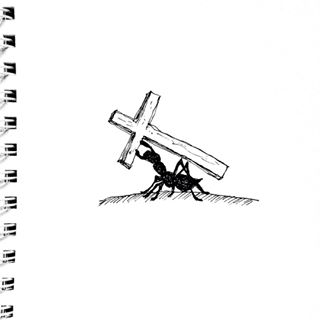
It is true that it is prudent to prepare for the future – consider the ant – Proverbs 6:6 – but when we do so in ways that prevent us from being loving, generous, and good stewards of all of God’s gifts, we are no longer prudent; we are greedy. In the background music of our lives, we should be able to easily listen to and understand this ancient hymn:

Ubi Caritas (listen to it here) (↔ Music Link)

Where Charity and Love prevail
There God is ever found;
Brought here together by Christ’s love,
By Love are we thus bound.

In that lyric, “here” means in this world – n0t just in that building we call a church. Be LOVE, Belovéd, because it’s our nature in the Spirit of the Living God.

Whatever, whenever, wherever, whoever, however, if ever, forever — at your service, Belovéd!

Share-A-Prayer
Special request for prayers for JE who is recuperating from the 43rd abdominal surgery of a long illness. Praying for successful treatment and healing.

Unless otherwise indicated, all scripture passages are from the New Revised Standard Version Catholic Edition (NRSVCE) New Revised Standard Version Bible: Catholic Edition, copyright © 1989, 1993 the Division of Christian Education of the National Council of the Churches of Christ in the United States of America. Used by permission. All rights reserved.

Creative Commons License
Aloha Friday Messages by Charles O. Todd, III is licensed under a Creative Commons Attribution-ShareAlike 3.0 Unported License

Biblical languages inserts from Bible Hub (Bible Hub: Search, Read, Study the Bible in Many Languages) Visit at http://biblehub.com


Aloha Friday Message – March 11, 2016 – 2016 Lenten Series, #5

1611AFC031116 – 2016 Lenten Series, #5

Read it online here, please. And please, when you visit there, use one of the social media links at the bottom of the page to share this post. Thank you!

Psalm 78:1818 They tested God in their heart
by demanding the food they craved.

2 Timothy 4:3-4For the time will come when they will not endure sound doctrine; but after their own lusts shall they heap to themselves teachers, having itching ears; and they shall turn away their ears from the truth, and shall be turned unto fables. Authorized (King James) Version(AKJV) (CHECK THE LINK TO SEE TWO OTHER VERSIONS OF THIS KEY VERSE)

Matthew 5:28 – But I say to you that everyone who looks at a woman with lust has already committed adultery with her in his heart.

LentenSeries_ME pili mau na pomaika‘i ia ‘oe a me ke akua ho’omaika’i ‘oe, ʻŌmea! (May blessing always be with you and may God bless you, Beloved!) today we look at the next set of words in our list of The 7 Deadly Sins and Their Corresponding Virtues. We have already looked at Pride and Humility, Envy and Kindness, the tough topics of Gluttony and Temperance, and last week, the surprising topics of Sloth and Diligence. Today’s paired topics are Lust and Chastity.

Once again, we can say we have a pretty good idea of what those are and how they affect our lives. Lust is a very strong desire, a predisposition to craving for something, an intense longing for personal gratification through the use or consumption of some object. More often than not, we associate Lust with a type of uninhibited, overpowering, intense and illicit sexual desire – and in all honesty, we usually associate that kind of preoccupation with sex to men. That kind of Lust actually objectifies women. Lust is also used to describe intense desire for other things such as food, liquor, money, fame, attention, pornography, drugs, or power. Do you notice a trend in that list? They are all worldly things. “I want what I want when I want it and I want it NOW” is the sound of Lust in action. We don’t care what it costs us now or later; now is the time to feed that appetite and damn the consequences. Lust is one of the Devil’s favorite party costumes, and when he gets the party going, we are – more often than not – plenty willing to par-TAY!  For some reason it seems to us in that moment of decision that it is way too hard to say no. In fact, most of the time we don’t miss half-a-heartbeat before we step into the mess that Lust creates. We totally forget what it means to be chaste in life because we’d rather be chased by life.

Chaste? What is that? It comes from an ancient Latin root word castus which means clean, pure, unadulterated (no pun intended). It means morally pure, decent, innocent, modest, uncorrupted, virtuous, faithful (especially to one’s spouse). This last idea – faithfulness – is usually expressed in another, similar word – chastity; same root word, and basically the same emphasis. Chastity is a description of specific sexual behaviors for men and/or women that are deemed acceptable by current societal, moral standards (which these days are pretty nebulous). We usually think of chastity in terms of cultural or religious standards – monogamy versus polygamy for example. It is also associated with abstaining from sexual activity before marriage. In several religious moral constructs, chastity is a commitment to remain unattached to members of the opposite (or even same) gender. The key to understanding chastity is knowing what is considered morally acceptable. For example, most of you know I’m an American Catholic Christian. I am married to a wonderful woman who is also an American Catholic Christian. Catholics’ understanding of marriage includes exclusivity (sic) in that sexual relations within marriage are considered chaste, but wandering body-parts outside of marriage is not. We commit to chastity within our marriage because we consider it natural – the natural order for which God created Man and Woman; but, we consider artificial birth-control as unchaste because it defeats the natural chastity God prescribed in Genesis 1:2828 God blessed them, and God said to them, “Be fruitful and multiply, and fill the earth and subdue it; and have dominion over the fish of the sea and over the birds of the air and over every living thing that moves upon the earth.” Now there are a lot of arguments about whether or not that’s still a good idea, but we’ll set those aside for the time being. Please don’t chastise me about that.

And BOOM, we have another word from the same root. To chastise is to reprimand someone severely, to really criticize a person for something they have – or have not – done. In biblical language, it usually means a severe physical punishment like losing everything you have including your property and even your life. God frequently chastises his people about their lusts. Consider these examples:

Psalm 78:1818 They tested God in their heart
by demanding [lusting for] the food they craved.

Psalm 81:1212 So I gave them over to their stubborn hearts [hearts’ lust], to follow their own counsels.

Galatians 5:1616 Live by the Spirit, I say, and do not gratify the desires [lusts] of the flesh.

1 John 2:16-1716 for all that is in the world—the desire [lust] of the flesh, the desire [lust] of the eyes, the pride in [lust for] riches—comes not from the Father but from the world.17 And the world and its desire [lust] are passing away, but those who do the will of God live forever.

1 Timothy 6:9But those who want to be rich fall into temptation and are trapped by many senseless and harmful desires that plunge people into ruin and destruction.

2 Timothy 3:1-5You must understand this, that in the last days distressing times will come. For people will be lovers of themselves, lovers of money, boasters, arrogant, abusive, disobedient to their parents, ungrateful, unholy, inhuman, implacable, slanderers, profligates, brutes, haters of good, treacherous, reckless, swollen with conceit, lovers of pleasure rather than lovers of God, holding to the outward form of godliness but denying its power. Avoid them!

Romans 1:2727 and in the same way also the men, giving up natural intercourse with women, were consumed with passion [lust] for one another. Men committed shameless acts with men and received in their own persons the due penalty for their error.

And perhaps the most famous one of all: Matthew 5:28 – But I say to you that everyone who looks at a woman with lust has already committed adultery with her in his heart. (Yes, it’s worth repeating.)

In these New Testament verses, the word used for Lust is  ἐπιθυμίαν epithymian from ἐπιθυμία (epithumia) { ep-ee-thoo-mee’-ah}: desire, passionate longing, lust.

We know enough about Lust to know it should be avoided – and really most of us usually try to avoid it (except when we can’t and do it anyway). Chastity, however, is something we don’t understand as well. It’s more than just the absence of Lust. It is a presence of commitment to something greater, something eternal, something TRUE. Lust is none of those things. Chastity is commitment to a spouse (especially if the Spouse is Christ) and further it is a commitment that doesn’t allow for any “fooling around,” “hanky-panky,” or drooling over some hunk of beefcake or cheesecake (or power, or money, or fame, or drugs, or any other unnatural union, or desire for even one’s self). We have some historical evidence – and some outrageous myths – about “chastity belts” supposedly developed to prevent any form of sexual activity; but, as is often said, “where there’s a will, there’s a way” and the will almost always won out because the perceived incentive was much stronger than the perceived disincentive. Nonetheless, chastity is still closely associated with “waiting until marriage” as well as “being faithful in marriage” so as not to commit the sins or fornication or adultery. And yet we know that most – some say as high as 80% – young couples are not chaste, do not practice chastity, and that Purity Pledges are eventually abandoned when the urge to splurge becomes unstoppable.

Lust is a very powerful commitment to action. It is powerful because it incites so many emotions – pleasure chiefly, but also blissful joy, intense excitement, that “rush” of erotic arousal, and the ecstasy of rampaging hormones being released. Let’s face it Belovéd, that torrent of pleasures rarely comes from Chastity. Along with that torrent we know we will also see certain lingering negative aftereffects – if we have anything resembling a conscience – and it isn’t just the sexual lusts that produce that deluge of negative outcomes. Eventually we discover that – whatever the object of our cravings and lusts – indulging those cravings and lusts can be singularly unhealthy and counterproductive. We develop a satisfaction tolerance so that it take more and more of “it” to give us the same high, the same “oomph,” that we got when we first let go and got hooked on “it.” Being chaste means realizing that “it” doesn’t make my life complete; in fact, spending all my energies and resources to get “it” and more of “it” just further impoverishes me mentally, physically and – especially – spiritually.

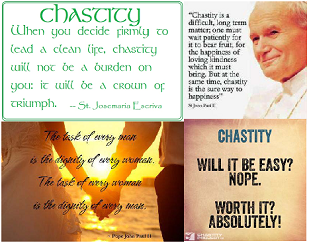
ChastityMontageMChastity is a virtue of clean living, being pure for the goodness it brings into our lives. If you’re a devout hedonist, that sounds insane – goodness is not pleasure – but actually it is. Whatever is right is good, whatever is good is pleasant, and whatever is pleasant – truly pleasant – is wholesome and eventually that leads us to be wholly holy. In the short run, Lust is one heck of a ride, but in the long run Chastity is the best ride of all because the destination for those who are chaste is one hell of a lot better than the destination for those who are not chaste.

If your ears, or other body parts, are itching to get away from Chastity, you should understand that “experimenting” with Lust is like putting out a fire with a bucket of kerosene. It’s just never a good idea. That little crush on a coworker or infatuation with a classmate is dangerous. Stop it.

For some additional insights on Choosing Chastity, see this link.


Please continue to pray for ECP who is just in so much pain from peripheral polyneuropathies and repeated falls. Also pray for BC who is experiencing persistent GI illness but still actively ministering to others through preaching the Word, spreading the Spirit, and healing others’ pain. Remember Marc and all who have for a time lost the battle against the demons that torment their lives. And remember the loving spouses, religious and ordained, and all the persons who daily rack up little victories against the Devil’s Steamroller – Lust. Remember, the God-given power of procreation is not a gift for your personal use; it is a gift to be used for God in service to all humankind.


Whatever, whenever, wherever, whoever, however, if ever, forever — at your service, Belovéd!

Unless otherwise indicated, all scripture passages are from the New Revised Standard Version Catholic Edition (NRSVCE) New Revised Standard Version Bible: Catholic Edition, copyright © 1989, 1993 the Division of Christian Education of the National Council of the Churches of Christ in the United States of America. Used by permission. All rights reserved.

Creative Commons License
Aloha Friday Messages by Charles O. Todd, III is licensed under a Creative Commons Attribution-ShareAlike 3.0 Unported License

Biblical languages inserts from Bible Hub (Bible Hub: Search, Read, Study the Bible in Many Languages) Visit at http://biblehub.com


Aloha Friday Message – March 4, 2016 – 2016 Lenten Series #4

1610AFC030416 – 2016 Lenten Series, #4

Read it online here, please. And please, when you visit there, use one of the social media links at the bottom of the page to share this post. Thank you!

Proverbs 26:14 – As a door turns on its hinges,
so does a lazy person in bed.

2 Peter 1:1010 Therefore, brothers and sisters, be all the more eager to confirm your call and election, for if you do this, you will never stumble.

Rejoice beloved! It’s Friday, and the Lord is with you!

Today we continue with our series on The 7 Deadly Sins and Their Corresponding Virtues. We have already looked at Pride and Humility, Envy and Kindness, and Gluttony and Temperance. Today we tackle a couple of terms that just aren’t used in Modern American English very often – Sloth and Diligence.

Let’s begin with the least common word, SLOTH.As you can see in the inset, two other words: Acedia and Apathy. Apathy is a word understood by most people. In addition to Apathy, here are some other words that are used in place of Sloth: Laziness, idleness, sluggishness, indolence, indifference, disinterest, unconcerned, lackadaisical, a “disinclination to action or effort.” You also see the word Acedia there. Acedia is apathy (and all those other words) with regard to religious matters. It is the kind of “I couldn’t possibly care less” attitude that pervades our society in so many ways.

Diligence – or being diligent – on the other hand is a word we use more often. Some synonyms for Diligence or diligent are ardent, hard-working, industrious, assiduous, conscientious, thorough, attentive, engaged, careful, earnest, sincere, heartfelt, highly-motivated, tireless, indefatigable, and inspired.

As you run those words through your mind, perhaps you think about the people around you – family, friends, coworkers, people in the grocery store, or even people in your church. Do some of those people seem to be lazy while others seem to be energetic? What do you think influences people to be actively involved and responsible or passively unresponsive and irresponsible? Is it perhaps a choice to be one or the other?

Yes, most of the time it is a choice. There are, of course, times when we are inactive and unresponsive without choosing to be so; clinical depression is one example. Folks who don’t understand or have never experienced depression can’t really relate to how debilitating it is; or how mentally, physically, and spiritually painful it can be. But most of the time this blatant indifference is a chosen state of mind. It’s just too much trouble to give a hoot. Choosing that position is denying the ability to be in community with others, to be a contributor to the common good, and to live out God’s purpose for us – to be productive contributors rather than destructive parasites. To live in community as God is community – Three Persons, One God. But there is more.

ConsiderAntThis kind of Apathy in life fosters apathy in our relationships with God and with each other. One of the English words used  in the context of Sloth is sluggard. The Hebrew word for that is עָצֵ֑ל (‘ā·ṣêl) {aw-tsale’} and the root word means sluggish or lazy. In Proverbs 6:6, the writer says – Go to the ant, you lazybones [sluggard]; consider its ways, and be wise. The implication there is that the lazy-bones sluggard has the capacity to choose between being lazy or being industrious. The sluggard will not get off her/his recliner or out of her/his bed to get up and do something. There are always excuses. One such excuse typifies how irrational those excuses can be sometimes. Again, we turn to Proverbs for an example: Proverbs 22:13 – The lazy person says, “There is a lion outside! I shall be killed in the streets!” You and I (and other diligent persons) will say, “Really?”, probably accompanied with an eye-roll. Being a sluggard is a bit like being a liar. There are so many details to keep up with, and the more outlandish the stance, the harder it is to keep that stance steady. As Mark Twain quipped, “If you tell the truth, you don’t have to remember anything.” Another famous excuse is, “I don’t have time for that.” There are two answers I usually offer for that objection: “If you don’t have time to do it right the first time, when will you have time to do it over?” and “If you don’t have time to do something that’s good for you, why do you have time to do things that are bad for you?” In all these excuses of the sluggard, there is clearly the promise of choice.

Choice is the kernel of Free Will. We are allowed to choose. Throughout scripture – and in every positive-focused (as opposed to, say, Satanic) religion I can think of, one is encourage to make the choice that benefits others at least as much as it benefits self. The Golden Rule is the measure of our diligence. While Sloth inhibits and even prevents virtuous conduct as something opposed to self-interest, diligence fosters – in fact demands – conduct that is unselfish and seeks to serve others. Even in the Parable of the Talents (See Matthew 25:14-30), the man who takes his one talent and hides it is referred to as “You lazy and wicked servant.” The other two servants were praised for being diligent about investing their master’s money and earning a profit. The diligent person is willing to put forth the effort to do or obtain something good. In spiritual terms, this is someone who is not bored by religion, not impeded by religious obligations, and not too lazy to get up and join the community in worship and praise. When we are diligent we will – at the very least – fulfill all our required duties and then strive to do even more. It’s not that we strive to be workaholics – because that is a misapplication of “due diligence” – but rather it is that we choose to strike a balance between doing what is communally necessary and doing what is personally gratifying. Being diligent can of course be very gratifying, but sometimes  we overdo the personal gratification bit and fail to have the time or energy to do what is best and most pleasing for God and helpful for neighbor.

The sluggard will stay home and watch sports rather than go to church. The go-getter will record the game and go to church. The sluggard finds the Ten Commandments annoying and restrictive. The go-getter find them admirable and liberating. The sluggard plants a new lawn and complains that the seeds never sprouted – despite not watering, fertilizing, and protecting it. The go-getter spreads the seeds carefully, nurtures them gently, and enjoys the pleasures of that labor. The sluggard decides there no point to praying because God doesn’t listen to him anyway when he says, “God, you need to fix this.” The go-getter prays, “God, I want to help you make this better.” The sluggard gives in to her/his unwillingness to act, to pray, to serve, or to love. The go-getter is strongly inclined to do all these things and more to help “do justice, and to love kindness, and to walk humbly” with God and neighbor (See Micah 6:8)

Proverbs 15:19 – The way of the lazy is overgrown with thorns,
but the path of the upright is a level highway.

Romans 12:1111 Do not lag in zeal, be ardent in spirit, serve the Lord.

The sin of Sloth leads to dissatisfaction and bitterness; it feeds on resentment and in turn nurtures grudges (Remember, grudges are heave and hard to carry because they have no handles). The Virtue of Diligence leads to leads to Joy and the other Fruit of the Holy Spirit; it feeds on love and in turn nurtures goodwill. The choice is up to each of us.

19 I call heaven and earth to witness against you today that I have set before you life and death, blessings and curses. Choose life so that you and your descendants may live.” (Deuteronomy 30:19) “Confirm your call and election, for if you do this, you will never stumble.” Unlike the sluggard who never moves so he will not stumble, you will move freely and be helping the hand of God.

Whatever, whenever, wherever, whoever, however, if ever, forever — at your service, Belovéd!

Share-a-Prayer: Please pray for Marc who has been very ill after succumbing to alcohol addiction. Pray for his deliverance and return to health.

Unless otherwise indicated, all scripture passages are from the New Revised Standard Version Catholic Edition (NRSVCE) New Revised Standard Version Bible: Catholic Edition, copyright © 1989, 1993 the Division of Christian Education of the National Council of the Churches of Christ in the United States of America. Used by permission. All rights reserved.

Creative Commons License
Aloha Friday Messages by Charles O. Todd, III is licensed under a Creative Commons Attribution-ShareAlike 3.0 Unported License

Biblical languages inserts from Bible Hub (Bible Hub: Search, Read, Study the Bible in Many Languages) Visit at http://biblehub.com


Aloha Friday Message – February 26, 2016 – 2016 Lenten Series, #3


1609AFC022616 – 2016 Lenten Series, #3

Read it online here, please. And please, when you visit there, use one of the social media links at the bottom of the page to share this post. Thank you!

2 Peter 1:3-7 His divine power has given us everything needed for life and godliness, through the knowledge of him who called us by his own glory and goodness. Thus he has given us, through these things, his precious and very great promises, so that through them you may escape from the corruption that is in the world because of lust, and may become participants of the divine nature. For this very reason, you must make every effort to support your faith with goodness, and goodness with knowledge, and knowledge with self-control, and self-control with endurance, and endurance with godliness, and godliness with mutual affection, and mutual affection with love.

Deuteronomy 21:2020 They shall say to the elders of his town, “This son of ours is stubborn and rebellious. He will not obey us. He is a glutton and a drunkard.” 21 Then all the men of the town shall stone him to death. So you shall purge the evil from your midst; and all Israel will hear, and be afraid.

Matthew 11:19 19 ” … the Son of Man came eating and drinking, and they say, ‘Look, a glutton and a drunkard, a friend of tax collectors and sinners!’ Yet wisdom is vindicated by her deeds.”

Galatians 5:19-21 19 Now the works of the flesh are obvious: fornication, impurity, licentiousness,20 idolatry, sorcery, enmities, strife, jealousy, anger, quarrels, dissensions, factions, 21 envy,  drunkenness, carousing, and things like these. I am warning you, as I warned you before: those who do such things will not inherit the kingdom of God.

LentenSeries_MAloha, and welcome to the third episode of our Lenten Series. We have already covered Pride vs. Humility, and Envy vs. Kindness. Today we will be looking at the virtue called Temperance – as in the Spiritual Fruit called Self-Control – and its polar opposite, Gluttony. These are two words most of us do not use very often, and in fact, their meanings evade us because not many people consider Gluttony a sin or Temperance a Virtue. Let’s look into them a little more and see if we can come to a better understanding. Let’s begin with defining Gluttony.

The most common understanding of gluttony is that it is disproportionate appetite for food. It comes from the Latin gluttire, meaning to gulp down or swallow, gluttony (Latin, gula) is the over-indulgence and over-consumption of anything to the point of waste. A glutton eats more that s/he can hold and often ends up vomiting everything eaten – and then goes back for more. It is a form of hedonism – intemperance, self-gratification, decadence – and, as expected, it produces some unhealthy results. Let’s not confuse it with bulimia nervosa which is an emotional eating disorder. Gluttony is overindulgence for the sake of personal gratification – an inordinate desire for the pleasure associated with food. Food is good. The pleasures of eating food are also good. However, when we gorge on food just for the feelings of pleasure it give us, especially when it ends up depriving others of food, that is gluttony. Gluttony is a rebellious rejection of godly moderation, and as such, becomes a form of idolatry. “What!?!? Idolatry!?!?!” Yes indeed. Anything that leads us to reject God’s gifts of health and well-being belies a rebellion against God – a sin; it is condemned because it is offensive to God.

The sin of gluttony is not limited to food, either. We must also consider that when we consume more than what is healthful for us, we are being gluttonous. Binge eating and binge drinking are both gluttony. If you get “falling-down drunk” because you overindulged during the football game, you have committed gluttony. And in the same way the bulimia (or anorexia) and not sinful, neither is alcoholism. All of these are diseases, whereas gluttony is a deliberate, known, and chosen disobedience of God.

Scripture does not  offer a general prohibition of the consumption of alcohol, but it does warn of the serious consequences of over-using alcohol, and frequently ties it to overconsumption of food. Take a look at Proverbs 23:20-21 and Colossians 3:5. If your god is your belly, then you really need to repent, turn away from that god and return to the true God.

Bottom line is that if we eat and/or drink to excess just for the personal gratification of it, we are a glutton. We may try to disguise intemperance as epicurean merit, but – as the saying goes – that’s just lipstick on the pig. We’ve made bingeing a “noble goal” and accepted the fact that getting sick after overdoing it is no big thing. We are claiming that choosing to lose control of our senses – especially common sense – is good for us. It is not. What is good for us is self-control – Temperance.

Temperance is an exercise of will; it is a choice in the same way that Gluttony is a choice. This implementation of personal will leads us to exercise restraint, to put into practice self-discipline, and to build up that flabby will-power which makes it so easy to slip into sin. Look up at that passage from Galatians again. That’s quite a list of sins! The passage in Proverbs 23 mentions “riotous eaters of flesh.” If we go back to Galatians 5:22-25 we read 22 By contrast, the fruit of the Spirit is love, joy, peace, patience, kindness, generosity, faithfulness, 23 gentleness, and self-control. There is no law against such things. 24 And those who belong to Christ Jesus have crucified the flesh with its passions and desires. 25 If we live by the Spirit, let us also be guided by the Spirit. And – we might add – “if we live by the flesh, let us also be controlled by the flesh.” Is that what we want? And yet, how often we choose that! We have the Holy Spirit to advocate for us, to help us make the better choices, as Jesus promised – he is our companion and guide, our Paraclete (παράκλητος).

In 2 Corinthians 7:1, Paul says, Since we have these promises, beloved, let us cleanse ourselves from every defilement of body and of spirit, making holiness perfect in the fear of God.” Temperance seeks to avoid that defilement by the application of common sense rather than seeking approval for our sophistication and worldly elegance. Temperance does not resist being self-indulgent about only food and drink. It resists all the worldly temptations that lure us to instant gratification through illicit pleasures. Temperance happens when we decide not to stuff ourselves at Golden Coral, or not to polish off that fifth of Vodka just because we got it on sale. It also happens when we forego the temptation for a one-night stand, or decide against cruising the Internet for sexual titillation. It happens when we decide that seeing widgets marked down 75% is not a justification for buying every one we can get our hands on. Temperance is when we delay – or even deny – gratification because there is a higher good to be possessed by doing so. There can be important individual and societal gains when we promote and practice Temperance guided by common sense rather than self-righteousness.

You may remember the Temperance Movement from your World History class. From the late Eighteenth century to the mid Nineteenth century, there was a lot of activity to try to prevent the soaring incidence of alcohol abuse. That abuse was closely connected with chronic problems such as unemployment, familial and personal abuse, poverty, and neglect. Alcohol was viewed as the root of these ills, and advocates in the Temperance Movement sought to ban alcohol and everything associated with it. That eventually led to the era of Prohibition in the United States from around 1920 to 1933. Americans could not manufacture, sell, distribute, or transport alcoholic beverages; it did not however, outlaw the purchase or consumption of those products. This experiment in social engineering is often derided with the phrase “you can’t legislate morality.” Though that may be true, you can choose morality – or immorality – and that is the way Temperance is supposed to work. It must be a choice. Let me give you a small personal example using tobacco consumption as a model.

I started smoking in high school. I tried all kinds of tobacco products – cigarettes, cigars, pipe tobacco, snuff, chewing tobacco, you-name-it tobacco. Like many tobacco users I claimed I could quit any time. And I did. Lots of times (sound familiar?), but somehow I always ended up buying more tobacco – usually pipe tobacco after the early 1980’s. I smoked for probably fifty years – or more. Then one day, after I found out I have COPD and emphysema, I thought to myself, “I need to figure out a way to turn this loose.” I discovered a fail-safe method. STOP BUYING ANYTHING THAT HAS NICOTINE IN IT! If you don’t have it, you can’t use it. The best way not to have it is to choose not to have it by not buying it (or bumming it) in the first place. “Oh, but I’m OK because I’m vaping.” No, you’re just substituting one nicotine-delivery system for another, and if you’re doing it on the cheap, it’s probably more dangerous than smoking cigarettes. Temperance is what happens by making the choice to moderate or eliminate something that is harmful in your life. Gluttony is choosing to be intemperate. Period. Think about it.

Yes, that’s Biblical. Romans 12:1-2 I appeal to you therefore, brothers and sisters, by the mercies of God, to present your bodies as a living sacrifice, holy and acceptable to God, which is your spiritual worship. Do not be conformed to this world, but be transformed by the renewing of your minds, so that you may discern what is the will of God—what is good and acceptable and perfect. And that’s because “wisdom is vindicated by her deeds.” Jesus said it, I believe it, I’m sticking to it! If we live by the Spirit, let us be guided by the Spirit, because His divine power has given us everything needed for life and godliness, through the knowledge of him who called us by his own glory and goodness. 

Whatever, whenever, wherever, whoever, however, if ever, forever — at your service, Belovéd!

Unless otherwise indicated, all scripture passages are from the New Revised Standard Version Catholic Edition (NRSVCE) New Revised Standard Version Bible: Catholic Edition, copyright © 1989, 1993 the Division of Christian Education of the National Council of the Churches of Christ in the United States of America. Used by permission. All rights reserved.


Aloha Friday Messages by
Charles O. Todd, III is licensed under a Creative Commons Attribution-ShareAlike 3.0 Unported License

Biblical languages inserts from Bible Hub (Bible Hub: Search, Read, Study the Bible in Many Languages) Visit at http://biblehub.com

sinspainting2_M

Hieronymus Bosch- The Seven Deadly Sins and the Four Last Things


Aloha Friday Message – February 19, 2016 – Lenten Series #2

1608AFC021916 – 2016 Lenten Series #2

Read it online here, please. And please, when you visit there, use one of the social media links at the bottom of the page to share this post. Thank you!

Titus 3:3 For we ourselves were once foolish, disobedient, led astray, slaves to various passions and pleasures, passing our days in malice and envy, despicable, hating one another.

Aloha nui loa, ʻŌmea. Much love to you, Belovéd. Today we continue with our series on the cardinal sins and virtues and take a look at the virtue of kindness and it’s opposite, envy. At first one might ask, “How are these opposites? Isn’t the opposite of Kindness … Meanness?” Today we will look at the Biblical meanings of these words and compare or contrast them with the worldly view. As we begin, here again is a reminder of the content of this series:

LentenSeries_M

We all have a pretty good idea of what kindness looks like. We know stories about homeless people being fed or clothed or sheltered. We know about funding drives to help a family pay the medical bills for a desperately ill family member. We know about paying it forward at the drive-through. We know about Ephesians 4:32. But what do we think of when we hear about the Kindness of God? In the Psalms we often read about God’s kindness and mercy. There is one example:

Psalm 117:2 For his merciful kindness is great toward us:
and the truth of the Lord endureth for ever.

Praise ye the Lord. (Authorized (King James) Version (AKJV))

For great is his steadfast love toward us,
    and the faithfulness of the Lord
endures forever.
Praise the Lord!

There are several words or phrases that are all from the same root words, but are translated differently. In the Old Testament for example, the word most often used for kindness is חָ֫סֶד checed {kheh’-sed}. This word can be translated as mercy, kindness, lovingkindness, goodly, kindly, goodness, or merciful. One of my favorite examples is in Proverbs 31:26 26 She opens her mouth with wisdom, and the teaching of kindness is on her tongue. This is part of the passage we refer to when we say, “She’s a Proverbs 31 Woman.” (You know who you are out there!) In the New Testament, there are a couple of Greek words used for kindness. For example we read in Acts 28:2 The natives showed us unusual kindness. Since it had begun to rain and was cold, they kindled a fire and welcomed all of us around it.  The word used there is one we readily recognize: φιλανθρωπίαν philanthropia {fil-an-thro-pee’-ah} – yes, philanthropy! This is translated as kindness, love of humanity, benevolence, compassion, generosity, or goodwill. There is another root word with which we are familiar: φιλαδελφίαν, philadelphian {fil-ad-el-fee’-ahn} φιλαδελφίαν (philadelphian). You may recognize this as one of the several words derived from one of the Greek words for Love – PHILIA φιλία (philia) {fil-i-ah}. When we think of these things, we think of ways that we are good to one another by being helpful, generous, charitable, loving, and – yes – kind. We know what it means.

We are called to be kind because God is kind. Way too many people for way too long have tried to characterize God as a mean, stingy, vindictive old man. He does get angry, and he does act on that anger, but you might say “he’s got a long fuse.” It may be hundreds, even thousands, of years before God takes corrective action to chastise and reform humanity; but, it is always done out of love and with the goal of restoring us to a right relationship with him. It is that “steadfast love” of which David speaks. Unwavering, resolute, reliable, constant, unassailable LOVE. That’s what is behind the Virtue of kindness. It is a type of selfless sacrifice that puts the welfare of other equal to – or usually above – our own. Kindness happens when we choose to forego one Good in our own lives so that others can have a Good in their lives.

This is, as we would expect, in sharp contrast to Envy. We call it “the green monster”  or say “s/he was green with envy” and think of the work jealousy. Look back at the root words in Scripture, in the Old Testament the word most frequently used is קִנְאָה qin’ah {kin-aw’}  and sometimes תְּ֭קַנֵּא tə·qan·nê {tə-kah-neh}. This word qin’ah describes the color-change that takes place in our faces when we experience an intense emotion. Greeks believed that envy – jealousy – caused an increase in the secretion of bile, and that gave one’s complexion a yellow-green “bilious” color. That color of green is also associated with being sick – “You’re looking a little green around the gills.”

The first use of the word envy is in Job 5:2 Surely vexation kills the fool, and jealousy slays the simple. Envy is a strongly-motivating emotion. When we see and understand that we are lacking some object, quality, or status which someone else has, we react with hatred directed at them. Jealousy, on the other hand, is a behavior that is more inwardly directed; we fear we have lost or can lose attention, affection, affiliation, or approval from another person we idealize. It can be overwhelming and is often the basis of what we call “poor self-image.” For example we read in Proverbs 27:4 Wrath is cruel, anger is overwhelming, but who is able to stand before jealousy?

Envy was the downfall of Lucifer (see Isaiah 14:12-14 and Luke 10:18) Envy seeks to elevate self by deprecating and condemning others. It is closely related to Pride. It is not steadfast love, but instead steadfast hatred, one step above complete indifference. One familiar Old Testament example is the action of Joseph’s brothers: Acts 7:9-10 The patriarchs, jealous of Joseph, sold him into Egypt; but God was with him,10 and rescued him from all his afflictions, and enabled him to win favor and to show wisdom when he stood before Pharaoh, king of Egypt, who appointed him ruler over Egypt and over all his household. Envy and jealousy can make us do incredibly hurtful things to others, and often even to ourselves; we punish ourselves for lacking something someone else has that “should belong” to us. We can also turn to persecution of someone we believe denigrates us. Think about this passage from Matthew and the outcome of what it expresses: Matthew 27:18  18 For he realized that it was out of jealousy that they had handed him over.

Kindness is also acted out by Sarah when Abraham explains in Genesis 20:13 13 And when God caused me to wander from my father’s house, I said to her, ‘This is the kindness you must do me: at every place to which we come, say of me, He is my brother.’” In this case, the “kindness” was that Sarah should lie about her relationship with Abraham. “Kindness” then can sometimes be misconstrued as “doing a favor” for someone even if that behavior is wrong.

Kindness is a virtue we can cultivate by being ethical, maintaining a pleasant temperament, and acting with courtesy and respect for others. Envy is an emotion which can lead to the behavior of jealousy by which we attempt to inveigle ourselves and others to put down another person or persons because of a perceived or real difference. Take a moment to reflect on the vicious, vitriolic rhetoric we witness daily in the residential campaigns. The definitely is no kindness there!

How, then do we overcome this sin of envy and jealousy? Let’s turn again to the B.I.B.L.E. to find a good strategy. Take out your Bible and turn to 2 Peter 1:3-7 His divine power has given us everything needed for life and godliness, through the knowledge of him who called us by his own glory and goodness. Thus he has given us, through these things, his precious and very great promises, so that through them you may escape from the corruption that is in the world because of lust, and may become participants of the divine nature. For this very reason, you must make every effort to support your faith with goodness, and goodness with knowledge, and knowledge with self-control, and self-control with endurance, and endurance with godliness, and godliness with mutual affection, and mutual affection with love.

That’s right, Belovéd. The resource for this virtue is not worldly goodness, but spiritual strength obtained directly through the Power of God.  Click here to look at Psalm 119:1-3, and click here to see Psalm 128:1. When we walk in the way of the Lord, when we honor and reverence God (talking about the Trinity here), we have no room for envy or jealousy. We have everything needed for life and godliness and that promotes and fosters the virtue of Kindness. It is so simple! We walk with the Lord and simply Trust and Obey (↔ Music Link). Then we will be empowered to avoid being foolish, disobedient, led astray, slaves to various passions and pleasures, passing our days in malice and envy, despicable, [and] hating one another.

Next week we will look at two of the most misunderstood characteristics of human morality – Gluttony and Temperance. Until then …

Whatever, whenever, wherever, whoever, however, if ever, forever — at your service, Belovéd!

Unless otherwise indicated, all scripture passages are from the New Revised Standard Version Catholic Edition (NRSVCE) New Revised Standard Version Bible: Catholic Edition, copyright © 1989, 1993 the Division of Christian Education of the National Council of the Churches of Christ in the United States of America. Used by permission. All rights reserved.

Creative Commons License
Aloha Friday Messages by Charles O. Todd, III is licensed under a Creative Commons Attribution-ShareAlike 3.0 Unported License

Biblical languages inserts from Bible Hub (Bible Hub: Search, Read, Study the Bible in Many Languages) Visit at http://biblehub.com

Pages Email Newsletter Categories Archives Connect
  • Connct to us here