Aloha Friday Message – October 2, 2015 – Bless God!

1540AFC100415 – Bless God!

Read it online here, please.

Psalm 103:1-3 {Of David} –

Bless the Lord, O my soul,
and all that is within me,
bless his holy name.
Bless the Lord, O my soul,
and do not forget all his benefits—
who forgives all your iniquity,
who heals all your diseases,

The liturgy this weekend in many churches will focus on marriage and the pledges given to God and to each other by men and women who share the sacrament of holy matrimony. That is a topic I would love to write about because it is such a perfect exemplar of the wisdom of God’s Creation and God’s Plan. The readings on October 4, 2015 come from Genesis 2, Psalm 128, Hebrews 2, and Mark 10. All of these passages make references to the blessings inherent in a happy and consecrated relationship between a man and a woman. It is just one of the countless ways God blesses us in ways that show us – by example – how his universe and his law work together to make our lives replete with blessings. But, I received an alternate set of directions for today’s post, and that’s it at the top of the page – Psalm 103:1-3. So here we go!

I’ve always been a little uncomfortable about “blessing God.” There is nothing that is superior to God, and no superlative that can adequately describe him. We are as different as a quark and a quasar. A quark is a part of a part of a subatomic particle. A single quark does not even carry a full charge, so the only time we can find them is when two or three are gathered together to form a hadron or a meson. Most of us don’t know what any of these things are, yet they are pieces of the elementary particles that hold together the universe. There are scores of these subatomic particles and they are the sub-elemental building blocks in everything from hydrogen atoms to … quasars. Quasars are incomprehensibly massive, heavy, powerful, and far, far, FAR away; they kind of look like stars when seen through a telescope, and they emit colossal amounts of energy.However, we still have evidence they are real and that their existence affects every moment of our lives on this small speck in the cosmos we call Earth, in the even smaller speck we call earthlings, an in the smaller still specks we call the molecules and atoms that comprise our bodies. Quarks and Quasars are so very different, but they are also closely related and can in some strange way be parts of each other and each other’s existence yet still be completely separate. The idea of me blessing God seems to play out something like a quark brightening up a quasar.

We see these words “bless the Lord” in scripture so many times, especially in the Psalms (see Psalms 16, 68, 104, and 134 for samples). When I think of a blessing, I usually think of a gift, a really nice gift, which God has given me. “Bless us, O Lord, and these thy gifts ….” He blesses me constantly with food, shelter, love, friendships, knowledge, skills, abilities, feelings, beautiful surroundings, temporal comforts, and (best of all) Salvation. Anything I have, I have only because it came from him so anything I return to him was already his in the first place. How is that a blessing? How can someone who is clearly insignificant give a gift that makes the Infinite greater? Or maybe I just don’t understand what “bless” means.

Here I go again, looking at the real words used in the real Bible so I can understand the real meaning. The word used in verses 1 and 2 is the Hebrew word “barak” which means “bless.” It looks like this: ברך barak {baw-rak’}. Among the synonyms are bless, salute, blessing, praise, kneel down, congratulate, give thanks, and to be adored. Now, that makes more sense! If I add all of that together, I come up with “worship” or “honor” or “reverence.” I am not trying to confer my favor on God; I am offering him my recognition of his omnipotence, omniscience, and omnipresence, and Omnibenevolence. I am acknowledging he is God and I am not. I am extolling, praising, exalting, applauding, revering, lauding, and glorifying God. And there’s another one of those words! Glorify God. God is the penultimate Glory. So that makes me wonder …

Q: What can my puny existence add to his Glory?
A:
Nothing.
Q: What does God need from me?
A: Nothing.
Q: Then what can I give to God?
A: Everything.

Huh?

Q: If he’s got everything and he created everything and he is everything and he’s in everything, and everything I have comes from him … how can I give him everything?!?
A:
By extolling, praising, exalting, applauding, revering, lauding, glorifying, and thanking God. That is how we bless God.

There is also the idea throughout the Bible that blessed and happy are the same thing. “Blessed are the poor in spirit …, blessed are those who mourn…, blessed are the meek…, blessed are those who hunger and thirst after righteousness….” We know those blessings mean “happy are those who….” So I believe we can also bless God in the sense that we make him happy. He does everything he can to make us happy, so we surely can think of some things we can do to make him happy. In fact, we have a whole Book called the Bible which is full of ways to make him happy. One of the best ways he recommends is to make him happy by loving each other because he loves us and because we love him. Love. My love. That is something I can give to God that is mine to give even though I received it first from him (please follow this link to 1 John 4:19 to see what I mean). And it’s just what he wants, too. Note I did not say it’s just what he needs; he doesn’t need anything from me; but, he will accept my love. He will accept your love.

BlessTheLordMySoul_smAnd do you know what else? He will accept our love! When you and I take the love he has given us, break it up, multiply it, and share it with each other … we can give that multiplied love to him too. When we bless the Lord, it is because we have understood that we are blessed by him. When we understand that blessing, we understand better how to recognize the blessings he keeps heaping into our lives. We feel grateful, so grateful that we bless him for his goodness.

You can see how it goes – round and round and round increasing in size with every round. He wants us to use what he gives us, not store it up, not throw it away, and certainly not forget about it. Here’s a little quote from MBN member SR: “When I stand before God at the end of my life, I would hope that I would not have a single bit of his Gifts left, and could say, ‘I used everything you gave me.'” That, Beloved, will bless the Lord because you did not forget all his benefits; you made full use of them in gratitude and love for his everlasting kindness.

I want to close with Adam’s words of thanks and praise to God when he first met Eve. We can find that in Genesis 2:22-25 22 And the rib that the Lord God had taken from the man he made into a woman and brought her to the man. 23 Then the man said,

“This at last is bone of my bones
and flesh of my flesh;
this one shall be called Woman,
for out of Man this one was taken.”

24 Therefore a man leaves his father and his mother and clings to his wife, and they become one flesh. 25 And the man and his wife were both naked, and were not ashamed.

God had created animals out of the clay even as Adam was created. When God saw that none of those were suitable for a companion and helpmeet for the man, he took part of the man and made of that a partner for him. Adam liked the change! He took one look at Eve and said, “at last” I have a suitable companion. That joy in seeing Eve was a blessing for God. It made God happy to see Adam happy, and I dare say Eve was happy to see Adam as well. She was, quite literally, “made for him.” Talk about love at first sight! But, as we well know, later those two came to a rough patch in the road. Maybe it had something to do with the quality of materials used to create them?

Man comes from dirt, and – as I have often said here – that pretty well defines his character – dirt. Woman comes from dirt that had been improved by making it a living being; woman was created from the flesh of the man. Woman, it could be said, was created from better ingredients, not just dirt, but improved dirt. Borrowing from Papa John Pizza a little – “Better Ingredients. Better People.” Men – who come from dirt, remember – have a hard time accepting that “first” is not directly-equal to “better.” I am reminded of “The Diaries of Adam and Eve” as translated by Mark Twain:

Adam: Dear Diary. This new creature with the long hair is a good deal in the way. It is always hanging around and following me about. I don’t like this: I am not used to company. I wish it would stay with the other animals. (To himself) Cloudy today, wind in the east, think we shall have rain. We? Where did I get that word? I remember now, the other creature uses it.

When a married couple learns that the pronoun WE is the appropriate pronoun for a couple, that is when God is also praised, because that is when God’s intentions for Man and Woman come together. They are “one flesh” and – in many ways it seems – also one soul if everything is working well. I cordially invite you to look back with me to February 14, 2011 for a special message about how that works for Crucita and me!

Whatever, whenever, wherever, whoever, however, if ever, forever — at your service, Beloved. I love you!

Remember this?

GOD ≡ LIGHT ≡ LOVE ≡ TRUTH ≡ WAY ≡ LIFE ≡ ETERNAL ≡ MERCY ≡ GOD

Click on it!

Creative Commons License
Aloha Friday Messages by Charles O. Todd, III is licensed under a Creative Commons Attribution-ShareAlike 3.0 Unported License

Unless otherwise indicated, all scripture passages are from the New Revised Standard Version Catholic Edition (NRSVCE) New Revised Standard Version Bible: Catholic Edition, copyright © 1989, 1993 the Division of Christian Education of the National Council of the Churches of Christ in the United States of America. Used by permission. All rights reserved.

Biblical languages inserts from Bible Hub (Bible Hub: Search, Read, Study the Bible in Many Languages) Visit at http://biblehub.com


 

Aloha Friday Message – September 25, 2015 – Touchable

1539AFC092515 – Touchable

Read it online here, please.

Matthew 8:3 He stretched out his hand and touched him, saying, “I do choose. Be made clean!” Immediately his leprosy was cleansed.

Mark 1:41 41 Moved with pity, Jesus stretched out his hand and touched him, and said to him, “I do choose. Be made clean!”

Matthew 9:20-21 Then suddenly a woman who had been suffering from hemorrhages for twelve years came up behind him and touched the fringe of his cloak, 21 for she said to herself, “If I only touch his cloak, I will be made well.”

Luke 18:15-16 15 People were bringing even infants to him that he might touch them; and when the disciples saw it, they sternly ordered them not to do it. 16 But Jesus called for them and said, “Let the little children come to me, and do not stop them; for it is to such as these that the kingdom of God belongs.

Matthew 17:7But Jesus came and touched them, saying, “Get up and do not be afraid.”

Aloha nui loa, ʻŌmea! Peace be with you! This week we are all aware that Pope Francis I is in America. Although his visit is short, his presence is well-documented in the news media. Some people downplay his importance. Some disagree with his message about ecology and say a religious figure ought not to deal with politics while others say that this message is of vital interest to the world. Some people see something sinister in everything he says, and others see something righteous in his words and deeds. However we feel about Pope Francis and his visit, it is possible to observe that he definitely touches people’s hearts and minds – some are inspired and some are appalled. He also touches people. There must be thousands of photos and video frames showing Pope Francis embracing, kissing, touching, holding, or reaching out to hands stretched toward him. Touching is one way we show trust and affection to one another. The Pope’s touch is like that; he reaches out in trusting love to share a moment with fellow sinners. He reaches out to make that contact that assures us he is real, and present, and here for us.

Back in the mid-eighties, there was a very popular song Reach Out and Touch Somebody’s Hand. It was popularized by Diana Ross, among others. Reach out and Touch Someone was the theme for a lot of Bell Telephone commercials. The song was written by David Lucas who worked with budding musician stars in the 50’s and 60’s and later in the 70’s worked with the group Blue Öyster Cult. Over a career of about 30 years he wrote many famous jingles including Reach Out and Touch Someone for AT&T. Here’s a YouTube link in case you’d like to listen to that again. Truthfully we depend on touch to help us build the sense of family and community that is essential to human life. Infants bond with their moms when they are held. Infants who are not held, cuddled, touched, and spoken to often fail to thrive. We are social creatures, and touch is a huge part of our socialization. We are created to be touchable. When we treat others as if they are untouchable, we are dehumanizing them, objectifying them to the point of being invisible. We are aware that at times throughout history and in more than a few cultures, some humans were considered untouchable. You could walk right by them and whatever was happening to them would be completely ignored. Being ignored is even worse than being hated. To be hated one has to be recognized, seen, and acknowledged. To be ignored is to become less than human. On the other hand, when we reach out to others – whether for our own consolation or for mercy to others – we are at our best as human beings.

Pope Francis wants us to see that in his mission as Pope. That gorgeous smile, those gentle and humble hands, the kind words and soft voice show us that the inner man is deeply touched by Jesus’ touch. Jesus reached out to touch others, but often people reached out to touch him. Jesus, too, was touchable, and for many, his touch brought healing.

Sometimes when we are in pain, we reach out for others in the hope that they will touch us with the same healing love Jesus has for all of us. We want someone to hold us, to embrace us, to open their arms and their hearts and to diminish our pain by sharing it. All of us can remember someone holding us when we skinned a knee, or suffered a loss, or felt our hopes crushed. When we share those moments with others, we become accepting of our humanity and share that human strength that is the foundation of civilization.

There are times in our lives when we do not want to be touched; these are also times of pain for us. It may be emotional, physical, or spiritual pain that causes us to shrink away from the touch of others even if it is the touch of someone who loves us. We sometimes even shrink away from God’s touch. We may feel that God cannot possibly care about how badly we feel. “If God is really so loving and kind, why has he done this to me?” Intellectually, we can dismiss that rhetorical question by admitting that God does not cause evil; he does permit evil because it is part of his Divine Plan. Knowing that any of us could sometimes feel like God has deserted us, God made himself touchable. He gave us the Man, Christ Jesus, who was incarnate of the Virgin Mary, and human in all ways except sin. He is resurrected and still very touchable. There’s another song that I recall from that same era as the ones previously mentioned. Written by Charles F. Brown in 1971, it became immensely popular in all kinds of Christian churches – including Catholic churches. (Yes, just to reiterate, Catholics are Christians!). It is called Reach Out and Touch the Lord as He Walks By. It’s a great way to be closer to God – reach out and touch him like an old friend.

When we greet each other here in Hawaiʽi, we almost always touch. It may be a hug, or just a handshake, or sometimes an elaborate fist-bump-hand-grab-big-hug-back-slap. We know that the word Aloha comes from the root word A-LO which means face-to-face, and HA which means breath. Aloha is face-to-face-breath – peace, love, openness, sincerity. We even say “Aloha Ke Akua.” That is Aloha like none other for it means “God is Love.” We aloha God – face-to-face-breath through the Holy Spirit. He touches us like that spiritually and emotionally. We like it when God touches us like that, and HE likes it when we reach out to touch him. We touch him when we are merciful. In these messages we have often discussed the Corporal and Spiritual Acts of Mercy (look there for the beginning of that series of messages). When Jesus reached out to someone, it was with compassion. In his Mercy, he healed; he touched, spoke, forgave, and loved. We can imitate and emulate Jesus by reaching out to touch him as he walks by in our brothers and sisters, our fellow earthlings. And there is one other way we can touch him: In the Eucharist.

Hand of Christ reaching down from heaven to grab the hand of man

Hand of Christ reaching down from heaven to grab the hand of man

Christ is really present in the Eucharist. That’s Jesus sitting in our hands, resting in our Tabernacle, present on the Altar. Regrettably, we are sometimes unaware of how extraordinary that is: Jesus is touchable, right now, right there, right inside my hand, right inside my body and my heart. Jesus. The One and Only Jesus is touching me because I have reached out to touch him because he reached out to save me – and you, and every living soul that ever was, is, or will be. Jesus is God’s way of being open to our touch. Put your hand in the Hand of the Man who stilled the waters. Precious Lord, take my hand. Lead me on. Help me stand. Jesus, I trust in you. Thank you for reaching out to touch me so that I, too, can be made clean!

Whatever, whenever, wherever, whoever, however, if ever, forever — at your service, Beloved!

Unless otherwise indicated, all scripture passages are from the New Revised Standard Version Catholic Edition (NRSVCE) New Revised Standard Version Bible: Catholic Edition, copyright © 1989, 1993 the Division of Christian Education of the National Council of the Churches of Christ in the United States of America. Used by permission. All rights reserved.
Creative Commons License
Aloha Friday Messages by Charles O. Todd, III is licensed under a Creative Commons Attribution-ShareAlike 3.0 Unported License


Aloha Friday Message – September 18, 2015 – WWJRD?

1538AFC091815 – WWJRD?

Read it online here, please.

James 3:16 – Where jealousy and selfish ambition exist, there is disorder and every foul practice.

This passage is taken from the New American Bible (Revised Edition) © 2010, 1991, 1986, 1970 Confraternity of Christian Doctrine, Washington, D.C. and are used by permission of the copyright owner. All Rights Reserved. No part of the New American Bible may be reproduced in any form without permission in writing from the copyright owner. Used by permission. All rights reserved.

WWJRD? Here the R stands for Really; What Would Jesus Really Do? The simple answer is: The right thing. It’s just that sometimes all of us have a little difficulty recognizing that. Here’s a little story from several years back that illustrates what I mean:

A Christian and a Quarter

Several years ago, a preacher from out-of-state accepted a call to a church in Houston, Texas. Some weeks after he arrived, he had an occasion to ride the bus from his home to the downtown area. When he sat down, he discovered that the driver had accidentally given him a quarter too much change. As he considered what to do, he thought to himself, “You’d better give the quarter back. It would be wrong to keep it.” Then he thought, “Oh, forget it, it’s only a quarter. Who would worry about this little amount? Anyway, the bus company gets too much fare; they will never miss it. Accept it as a “gift from God” and keep quiet.”

When his stop came, he paused momentarily at the door, and then he handed the quarter to the driver and said, “Here, you gave me too much change.”

The driver, with a smile, replied, “Aren’t you the new preacher in town?”

 “Yes” he replied.

“Well, I have been thinking a lot lately about going somewhere to worship. I just wanted to see what you would do if I gave you too much change. I’ll see you at church on Sunday.”

When the preacher stepped off of the bus, he literally grabbed the nearest light pole, held on, and said, “Oh God, I almost sold your Son for a quarter.”

Our lives are the only Bible some people will ever read. This is a really scary example of how much people watch us as Christians, and will put us to the test! Always be on guard — and remember — You carry the name of Christ on your shoulders when you call yourself “Christian.”

And how to we make those choices? Let’s take a look at Philippians 2:5Have in you the same attitude that is also in Christ Jesus. Paul consistently tells us that we need to model our lives in the image and form of the life of Christ. There is an interesting preposition in this passage that conveyed that quite clearly to the Philippians – and to us if we are attentive: also in Christ Jesus. The preposition there is έν [en]. The connotation is of something that is permanently and naturally (uncontrived) unchanging in place, time, or condition, something that is an integral part of the location or entity. Jesus’ attitude of love, ἀγάπη (agapé) [ag-ah’-pay)] was and is a permanent, natural, integral aspect of Jesus as Lord. That’s the kind of LOVE Paul is reminding us Jesus commanded us to cultivate and share.

To me the verse, “Have in you the same attitude that is also in Christ Jesus” now comes out as “Ensure that your disposition toward all things is identical to the predominant and fundamental disposition of Christ: Perfectly modest, humble, and unselfish and utterly consecrated to the service of God and one another. Paul has an uncanny way of packing 10 pounds of meaning into a 3 pound jar! We are obliged to live in and be governed by our conscience – even if we don’t accept the idea that there is God and Salvation and Eternal Life. Our conscience requires that we submit to authority and that we serve one another. The Supreme Authority is God. Whoever serves all is the greatest among us. Whatever we do should be done in love, not defiance, and therefore should not be judgmental but instead should be charitable. Just as we cannot make faith work without doing good things for each other, we cannot make faith work by doing bad things to each other. 1 John 4:16 So we have known and believe the love that God has for us. God is love, and those who abide in love abide in God, and God abides in them. When we try to use the power of God’s Love to serve our own ambitions, we do not abide in love. WWJRD? Abide in Love – always and all ways.

To do the right thing – the thing that Jesus would do – takes Wisdom. Do you remember this little fish? It points to Proverbs 9:10. The Wisdom we need begins when we reverence God. This is what James calls “Wisdom from above.” Let’s take a look at today’s topic-verse in context by looking at James 3:13-18:

13 Who is wise and understanding among you? Show by your good life that your works are done with gentleness born of wisdom. 14 But if you have bitter envy and selfish ambition in your hearts, do not be boastful and false to the truth. 15 Such wisdom does not come down from above, but is earthly, unspiritual, devilish. 16 For where there is envy and selfish ambition, there will also be disorder and wickedness of every kind. 17 But the wisdom from above is first pure, then peaceable, gentle, willing to yield, full of mercy and good fruits, without a trace of partiality or hypocrisy. 18 And a harvest of righteousness is sown in peace for those who make peace. “Gentleness born of wisdom” is the gentleness that comes from humility that is rooted in a deep faith in God. If we are instead puffed up with pride and selfish ambition, we stir up discord and trouble in every activity. Remember. “What we do says who we are. Actions speak louder than words.” When our actions are based in the kind of faith that leads us to love God and neighbor even as Christ has done, then we have Wisdom that is first pure, then peaceable, gentle, willing to yield, full of mercy and good fruits, without a trace of partiality or hypocrisy. Sincere, unbiased service to God and neighbor is the kind of service that produces the good works James spoke of earlier (See James 2:14-18) when he told his community (and us) that faith without works is dead. What, then, is the work we should do?

The will of our Father is to believe in the Son, to be his disciples in the same way the Apostles are his disciples. We learn from him, we live in him, we serve others for him, and we know God through him. When Jesus is Lord, we declare his Lordship by using the Gifts of the Spirit. It is only through the Spirit that we can say, “Jesus is Lord.” (See 1 Corinthians 12 especially verse 3) As his disciples, we are commissioned to make disciples of all nations (See Matthew 28:19-20). We carry out that task by serving others because we serve God in Christ Jesus – we Love God in the same way God through Christ loves us. That Way, Truth, and Light precludes jealousy and selfish ambition. If you look around and see yourself surrounded by (or infected by) disorder and every foul practice, then Worldly Wisdom (which is folly) is in charge. That’s our cue to reset our priorities and look to God first and always (See Matthew 6:33). We know this is true because it really is what Jesus told us to do. He said it. I believe it. I’m sticking to it! Like the new Preacher, we all need to remember that sometimes the only Bible others will read is our lives.

Whatever, whenever, wherever, whoever, however, if ever, forever — at your service, Beloved!

Creative Commons License
Aloha Friday Messages by Charles O. Todd, III is licensed under a Creative Commons Attribution-ShareAlike 3.0 Unported License
Unless otherwise indicated, all scripture passages are from the New Revised Standard Version Catholic Edition (NRSVCE) New Revised Standard Version Bible: Catholic Edition, copyright © 1989, 1993 the Division of Christian Education of the National Council of the Churches of Christ in the United States of America. Used by permission. All rights reserved.

Biblical languages inserts from Bible Hub (Bible Hub: Search, Read, Study the Bible in Many Languages) Visit at http://biblehub.com

 

Aloha Friday Message – September 11, 2015 – Flower of Faith

1537AFC091115 – Flower of Faith

Read it online here, please.

Mark 8:34-38 – 34 He called the crowd with his disciples, and said to them, “If any want to become my followers, let them deny themselves and take up their cross and follow me. 35 For those who want to save their life will lose it, and those who lose their life for my sake, and for the sake of the Gospel, will save it. 36 For what will it profit them to gain the whole world and forfeit their life? 37 Indeed, what can they give in return for their life? 38 Those who are ashamed of me and of my words in this adulterous and sinful generation, of them the Son of Man will also be ashamed when he comes in the glory of his Father with the holy angels.”

WhiteAlmondBlossomCloseThese are white almond blossoms. They are so beautiful to look at, and can you imagine being in an orchard filled with these beautiful flowers? I hope you’ll take a minute to go here and read up on almonds. Fascinating stuff!

So, why did I choose a picture of blossoms? Ah, well that was the “Healing Word” not too long ago. That word, blossom, has a lot of connotations. “He has really blossomed as an artist.” “She’s a blossom in a garden of roses.” “First the blossom, then the fruit.”

A blossom is a confirmation of fruitfulness. It means that the tree, or flower, or plant, or species has successfully prepared to be propagated. A blossom is the flower of a seed-bearing plant, so even grains have blossoms. It is the peak of development for the process of propagation and the beginning of the process of fruition. When we blossom, we go through something of the same process.

Remember the adage, “Bloom where you’re planted.”? When we remind one another about that, we are saying, “Make the best of your current situation. Bring your work, your life, your hopes, and dreams to fruition right where you are.” When we blossom or bloom we enter a state or time of beauty, freshness, and vigor, a state or time of high development or achievement. “His career is in full bloom.” We produce “flowers” and when we do, we are ready for the next step, producing fruit and seed. Fruit of the earth, fruit of the vine, fruit of our labors, fruit of the Spirit, fruit of endeavor; all of these come from our flowering. On this Earth we have “every kind of plant that bears seed and every kind of fruit tree on earth that bears fruit with its seed in it” as an example of blossoming. (See Genesis 1:11, 29)

As humans we can make a choice about the environment. We can adapt ourselves to our environment – be adaptable – or we can alter the environment for ourselves – be adaptive. Plants cannot normally do that in a way that is easily discernible to us. We can also choose to make adaptive choices about the environment that ruin it for everyone else. We have heard much about that of late. We can even be adaptable in ways that are unhealthy for us.

And so it is that we carry within us not only the seeds of fruition, but also the seeds of destruction. When you are transplanted, which seeds do you hope will come from your flowering? Did you know even thistles have flowers? Well, you do know that what you sow is what you reap, so if you sow thistles you won’t get sweet peas! And if you sow your wild oats, you won’t get grapes … or much of anything else but trouble, perhaps.

Still, in our human lives, we can generally choose to become something different from the way we began our lives. We can come over or be overcome. We can become a part, or come apart. We can blossom like a rose, or bloom like a thistle. We have been empowered to choose between life and death, blessing and curse, fruition and destruction. So if you are going to decide to bloom where you are planted, also choose what seeds you will bear. Will you be the wheat or the tare? (See Matthew 13:27 and 1035AFC082710) Not all thorns have roses, and not all roses have names. Not all blossoms/flowers produce seeds either, and not all seeds produce blossoming plants.

“Bloom where you’re planted” is more than just a cute saying for one’s self-assurance. It is a summary of the challenge to live a productive life, one that is of use to oneself and to others. It means finding the seeds you want to plant, planting and nurturing them, and bringing them to fruition so that the cycle of life continues. Where are your seeds? What are your seeds? And what does it take to make a seed from a blossom? Must a seed come from within your very self?

Think about these things this coming week. Please remember that if the only place you go to find your self is inside yourself, it could be that all you will find is your real self. Beloved, there is so much more to life than that! And remember that though you are one blossom in an orchard, you are part of the crop – the community of blossoms.

whitealmondorchardSo what does all of this have to do with the excerpt from the Gospel of Mark? To answer that, we have to go back to the Book of Numbers, Chapter 17. In thirteen verses we learn that Israel was grumbling about Moses and his service to God that brought them out into the desert. God tells Moses to get one staff – walking stick and scepter for them – from each of the twelve tribes. Each staff was to have the name of the tribe’s leader written on it. They were to be placed in the Tent of Meeting before the Ark of the Covenant. The staff belonging to the tribe God chose for leadership would bud. Aaron’s rod was from an almond tree. Not only did it bud, but it blossomed, and produced almonds!

We can be like Aaron’s rod. We can place our very self in the presence of the Lord. We can commit to his New Covenant in Christ Jesus. We can blossom and bear fruit when we surrender to Jesus’ Lordship in our lives. We can live unashamed in his Word. We can give our only life to Christ. I want you to think about something here. You know the Internet short-speak YOLO? It means “You Only Live Once.” But here’s the thing: It’s FOREVER. Your life will last forever. Do you want to spend forever in the glory of his Father with the holy angels? Every human life has an earthly end but is spiritually eternal. When Christ comes again, when the New Heaven and the New Earth are manifest, when all earthlings are resurrected, some will spend the rest of Eternity with God; some will not. The deciding factor is the content of each life, the way each life was used to honor God by serving others. We will be known – and judged – by our fruit.

YOLOINFINITY

Choose something in your life that will blossom and bear fruit. Love, joy, peace, patience and perseverance, gentleness, goodness, faith, kindness, humility, self-control, are all attainable in your own life. Choose them all that your joy may be full. And where do we find all these? In Jesus, of course.

Whatever, whenever, wherever, whoever, however, if ever,  forever — at your service, Beloved!

Creative Commons License
Aloha Friday Messages by Charles O. Todd, III is licensed under a Creative Commons Attribution-ShareAlike 3.0 Unported License

Unless otherwise indicated, all scripture passages are from the New Revised Standard Version Catholic Edition (NRSVCE) New Revised Standard Version Bible: Catholic Edition, copyright © 1989, 1993 the Division of Christian Education of the National Council of the Churches of Christ in the United States of America. Used by permission. All rights reserved.


THERE WILL BE LOTS OF COVERAGE TODAY ABOUT THE ATTACK ON THE WORLD TRADE CENTER. TAKE A FEW MINUTES TO SAY A PRAYER FOR THOSE WHO DIED, THOSE WHO SURVIVED, THOSE WHO WITNESSED IT, AND THOSE WHO COMMITTED THAT HEINOUS CRIME.

Aloha Friday Message – September 4, 2015 – Astonishing Faith

1536AFC090415 – Astonishing Faith

Read it online here, please.

Mark 7:37 They were astounded beyond measure, saying, “He has done everything well; he even makes the deaf to hear and the mute to speak.”

Aloha kakahiaka, ʻŌmea. Today we continue with the Gospel of Mark and one very astonishing story about healing. This episode appears only in the Gospel of Mark. It’s a story that portrays Jesus as very human – touching, speaking, spitting, praying; and this passage contains a wonderful Aramaic word that is used in preparing persons to receive the Sacraments of Initiation. That word is Ἐφφαθά (ephphatha) {ef-fath-ah’} אתפתח or אפתח which is the Aramaic word for “be opened.” It is the word of command that Jesus speaks to heal a man who is deaf and has a speech impediment. The word used for that in Hebrew it is אּלֵּם (illem) {il-lame’}, and in Greek it is μογιλάλον (mogilalon) {mog-il-al’-on} which is the same word in the Septuagint for this Sunday’s passage from Isaiah.

The above passage in Mark is linked directly to this Sunday’s Old Testament reading (Isaiah 35:4-7). In Isaiah 35:6, we read, ” then the lame shall leap like a deer,
and the tongue of the speechless sing for joy.
For waters shall break forth in the wilderness,
and streams in the desert;
Can you take a moment here to imagine what it was like for this man? His friends brought him to Jesus (a good example we should follow), and asked him to “lay hands on him,” to heal him. Surprisingly, Jesus led him away from the crowd and then made some very unique gestures. Jesus put his fingers in the man’s ears. He worked up a bit of spittle, and touched the man’s tongue. I can’t imagine how that happened! Did Jesus remove a finger from an ear to catch a drop of saliva and then touch that finger to the man’s tongue? Did Jesus touch his own tongue to the tongue of the man? All we have is that there was touch, spittle, and an Aramaic word of command , And immediately the man’s ears were opened, his speech impediment was removed, and he spoke plainly.” (See Mark 35:7) At this, the crowd – and the Apostles in particular – recognized the prophecy of Isaiah that the mute shall sing the praises of God. The passage in Mark does not describe the man singing, but I am sure he “made a joyful noise unto the Lord,” and that the man himself heard it and so did the crowd. He had something astonishing to celebrate: He had been freed from his prison of speechlessness. Recall how this also is a promise found frequently in the Old Testament as in Psalm 146:7b The Lord sets the prisoners free; God had brought together Jesus and this man to confirm that prophecy. All who saw it were amazed at Jesus’ power. Perhaps they should have been – could have been, would have been – even more amazed if they took into consideration why Jesus performed this (and – I believe) all other miracles: They were acts of compassion and mercy. They were the acts God has always asked the just – the righteous – to perform.

God always asks us to be merciful! Why does he do this? Because God himself is merciful. He always directs us to care for the orphan, the widow, the stranger, the disadvantaged, the poor, the outcast, the prisoner, the ill, the hungry and thirsty, to clothe the naked, to shelter the homeless, to visit (and care for) the sick. These things God expects of all of us so that everyone can see we are compassionate as he is compassionate. We are to “seek first the Kingdom of God.” It is in the Kingdom of God that we perform the works of God’s commands – to love God beyond everything else and to love one another as (in the same way) Christ has loved us (See John 13:34-35 or 1323AFC060713 – The Other Side of the Mountain here.) I think God reminds us about this so often throughout Scripture because we forget – even ignore – it so quickly. What happens when we fail to love God beyond everything else and to love one another as (in the same way) Christ has loved us? Well, to sum it up in a single word, we become unrighteous. Here are some other words that describe that state of being: Wicked, corrupt, deplorable, illicit, immoral, senseless, selfish, vicious, wrong, crooked, sinful, villainous, out of line, evil, culpable, or ungodly.

That last one is especially important because we are all created “in the image and likeness of God.” (See Genesis 1:26) when our lives are ungodly, we are living contrary to the purpose of our creation. I believe that, contrary to the way we usually think, we will not be judged for our sins, but for our lack of righteousness. In Acts 17:30-31 30 “While God has overlooked the times of human ignorance, now he commands all people everywhere to repent, 31 because he has fixed a day on which he will have the world judged in righteousness (ἐν δικαιοσύνῃ) by a man whom he has appointed, and of this he has given assurance to all by raising him from the dead.” This phrase, ἐν δικαιοσύνῃ¸ means “in the condition of.” We spend so much time being unrighteous. How can this be? How do we live out this unrighteousness? We do that when we fail to see how our own selfishness oppresses others. Lately, this has been in the news quite a lot, and much of that news is generated by Francis I.

When we place personal material gain over the needs and rights of others, we are unrighteous – as when we euthanize adults, or abort infants, or destroy a regional ecology, we are unrighteous. When we seek personal gratification through exploitation of children, or abuse those with whom we live, we are unrighteous. When we advocate and commit and urge others to do violence against others and do that in the name of God, we are unrighteous. When we fail to be merciful in physical or spiritual ways, we are being unrighteous. Whenever we fail to act with compassion and love, we are guilty of ignoring the needs of others; even the least among us should be a recipient of our righteous care. You know that I keep coming back to Micah 6:8 … to do justice, and to love kindness, and to walk humbly with your God. It sounds so simple. It is easily memorized. It is well to aspire to this. And it is so easy to fall far short of the mark. In the same way that we are astonished by what Jesus does, so also are we astonished at what it takes to be like him. Astonishment is not faith. Faith is using that astonishing grace to become a disciple. That’s what we’re supposed to do – become disciples.

Being a disciple is an astounding lifestyle. Only in him and through him can there be righteousness because outside of him there is no one righteous, no not one. (See Psalm 143:2 and Romans 3:7-10) Our prayer, then should be that we will come before the Lord to have our ears opened and our tongues set free so that we can proclaim the Gospel unhindered, sing joyfully before the Lord, and to witness to the saving Power of God by living and working in God’s righteousness. Sometimes we have to start over on that every day; sometimes it’s every hour. We have Christ’s assurance that he will be with us every hour that we need him even unto the end of the world. We have only to turn and see him standing here, to hear him speaking here, and to leap for joy to have the Precious Presence here. Let us go to him for he calls to us, 28 “Come to me, all you that are weary and are carrying heavy burdens, and I will give you rest. 29 Take my yoke upon you, and learn from me; for I am gentle and humble in heart, and you will find rest for your souls. 30 For my yoke is easy, and my burden is light. (Matthew 11:28-30)

Go to him. Be taken aside to be healed. Come back to the World, astounded beyond measure, and proclaim his wondrous deeds. In this there is righteousness.

Whatever, whenever, wherever, whoever, however, if ever, forever — at your service, Beloved!

Did you use all of the links? Did you find the one with music?

Creative Commons License
Aloha Friday Messages by Charles O. Todd, III is licensed under a Creative Commons Attribution-ShareAlike 3.0 Unported License

Unless otherwise indicated, all scripture passages are from the New Revised Standard Version Catholic Edition (NRSVCE) New Revised Standard Version Bible: Catholic Edition, copyright © 1989, 1993 the Division of Christian Education of the National Council of the Churches of Christ in the United States of America. Used by permission. All rights reserved.

Biblical languages inserts from Bible Hub (Bible Hub: Search, Read, Study the Bible in Many Languages) Visit at http://biblehub.com

 

Aloha Friday Message – August 28, 2015 – The Gift of Law

1535AFC083015 – The Gift of Law

Read it online here, please.

Deuteronomy 4:5-8 See, just as the Lord my God has charged me, I now teach you statutes and ordinances for you to observe in the land that you are about to enter and occupy. You must observe them diligently, for this will show your wisdom and discernment to the peoples, who, when they hear all these statutes, will say, “Surely this great nation is a wise and discerning people!” For what other great nation has a god so near to it as the Lord our God is whenever we call to him? And what other great nation has statutes and ordinances as just as this entire law that I am setting before you today?

E pili mau na pomaika‘i ia ‘oe a me ke akua ho’omaika’i ‘oe, ʻŌmea! (May blessing always be with you and may God bless you, Beloved!)

Today’s focus passage is from the fourth chapter of Deuteronomy. The book of Deuteronomy is a collection of three long discourses by Moses about The Law – the Decalogue more commonly known as The Ten Commandments. The sections tell the people of Israel how these laws will enable them to live in the land God has given to them. If they follow the law God has given them, if they are faithful to God’s leadership and teaching, God himself will accompany them in all that they do. It is especially emphasized that they are not to follow or even consider other gods; there is one God, one Creator, one place of worship, and one law. The Torah presents the account of the creation, the Promised Land, the early history of the Hebrews, the laws of the Priesthood, the Census of the People and the dedication of the Tabernacle, and finishes with Deuteronomy as an historical retrospective of all that precedes it.

10-commandments-49012_640Deuteronomy is the fifth and last book of the Torah and summarizes the teaching of the Law. It also serves somewhat as an introduction to the historical books of Joshua, Judges, 1 & 2 Samuel and 1 & 2 Kings. The bulk of the book – Deuteronomy 21:1-Deuteronomy 28:69 – is a long listing of reviews of the various laws and regulations given to Moses, certain prophecies that accompany the Law, rules of national and interpersonal conduct, lists of curses and blessing associated with the keeping of the law, the promises for obedience, and the consequences of disobedience. All of this is based on the two accounts of the Ten Commandments; the first is in Exodus 20 and the second is in Deuteronomy 5.

Some might consider this rather “dry” reading as the content lists off scores of does and don’ts. Some folks look at some of those admonitions and use that as their argument for ignoring the Bible, or at least ignoring the Old Testament. An example can be found in Deuteronomy 21:18-21. This concerns rebellious offspring (age is not listed in the criteria). They are to be taken to the gate of the city, charged with disobedience, and stoned to death by the elders of the community. There are a number of rules like this, and – again – folks point to those and say, “the Judea-Christian tradition is full of the violence of an unjust and violent God!” On the other hand, today in what some claim to be “Sharia Law,” violent punishments like these are said to be the proper way of dealing with sin. One might readily ask, “Isn’t law supposed to promote justice and good will? How can violence be part of that?”

We often point at The Golden Rule (See Matthew 7:12 and Luke 6:31) as a kind of summary of the Law and many believe it originated with Jesus. Actually many of the ancient codes of law as well as a wide variety of religions have a very similar teaching. It is sometimes referred to as the Ethics of Reciprocity. If you would be interested in seeing more about that, I recommend the Wikipedia article titled Golden Rule. In these messages we have often directed attention to Matthew 22:36-40 which tells us the two most important commandments are to Love God completely and to loves one’s neighbor. There are some instances where this Law of Reciprocity is either reversed or even contradicted. Satanists and certain groups of severely vicious racists promote the idea that those who are on “your side” are to be treated well and those who are not are to be eliminated. This is the kind of hate-speech we are now hearing frequently by the demonically-inclined proponents of radicalized Islam that are identifying themselves as ISIS. One might summarize their ethical reciprocity rule as “Do unto others before they do unto you.”

Certainly it can also be said that many religions – including Christianity at some points in history – committed many heinous acts in the name of “salvation” such as tortures, executions, and even genocide all in the cause of preventing souls from being tortured in Hell for eternity. Fortunately, we have matured beyond that point in genuinely-Christian faiths. I make the emphasis there because there are in this age some persons professing to be Christian that most certainly are not. For these people, the concept of Divine Law is based on greed and hatred. There is nothing “divine” about what they teach or how they behave. If we consult the History of Legal Codes, we can see that there were basic sets of laws to govern persons and nations as far back as 2300 BC. That’s 1400 years before Moses! We might recall that in Ancient Mesopotamia there were complex codes of Babylonian origin, and one in particular – the Code of Hammurabbi – is usually studied in Ancient History classes either in High School or College. Knowing the Law or studying the law is not always the same as following the law.

How we behave when considering the Law is a reflection of how we respect the Law. How we respect the Law is a reflection of how well we understand the Law. For the balance of this message, we will be looking at these manifestations of compliance with the Ten Commandments. Perhaps the first thing we should tackle is the idea that the Ten Commandments are 10 Laws. That is not true. It is one Law that has ten parts, so if you break one part of the Law, you have broken the whole Law. “But I’ve never murdered anyone or committed adultery! How can you say I’ve broken the whole law?” If you break a corner out of a window, you have broken the window. That’s not hard to understand. The window is considered as a whole. Whether you smash it to smithereens or just put a crack in the glass, it is from that point forward a broken window. In the same way, the Law, as set forth in the Ten Commandments is THE Law; that is not a plural word – Law. Note the verb form I used: Ten Commandments IS. Present tense, simple case, affirmative language which basically denotes equality between the subject and predicate.

     Here’s an illustration to help us understand. It’s called “Auntie’s Teacup.” Think about your Auntie’s favorite tea cup, the one beautifully decorated with flora designs, hand painted, wonderful glaze, and a matching saucer. As you recall its appearance, remember that it has an inside and outside; it has a handle, a lip, and a foot. The painting is detailed and there are images on the front and back of the cup. Then there is the saucer. The cup and the saucer actually belong together.

Now, imagine you were washing her cup after she’s had her oolong tea and a palmier, and as you put it back, you knock a triangular piece out of the back side of the cup. The cup is broken. It can be glued together, but it is still a broken cup – with a repair. Even if the damage was only to scrape away part of the flower off the saucer, the set is damaged, ruined; it is a broken set. It is one cup that has many parts, and only one of the parts is slightly broken. Auntie can still drink tea out of it, but it will never be the same. Her cup is broken. Even if you apologize profusely, the cup is broken. Even if she says “It’s OK dear. It’s only a teacup,” you know that’s not quite right. It is not “just a teacup.” It is her favorite. Your tried to take care of it and you broke it. Just one teacup with many parts. The whole cup and saucer has been broken – even if the cup hasn’t been “smashed to smithereens,” it’s broken.

That is like the Law of God, the Law we call the Ten Commandments. It is one Law with several parts. Anytime we break one of the parts, we have failed to keep “The Whole Law.” Let’s recall what Jesus said to the rich young ruler in Mark 10:19-21 – 19 You know the commandments: ‘You shall not murder; You shall not commit adultery; You shall not steal; You shall not bear false witness; You shall not defraud; Honor your father and mother.’” 20 He said to him, “Teacher, I have kept all these since my youth.” 21 Jesus, looking at him, loved him and said, “You lack one thing; go, sell what you own, and give the money to the poor, and you will have treasure in heaven; then come, follow me.” The wealthy man went away deeply saddened because he had many possessions. He thought he had kept The Whole Law. Jesus told him there was one more part to live: Love your neighbor. Years later, the Apostle Paul would write Galatians 5:14 14 For the whole law is summed up in a single commandment, “You shall love your neighbor as yourself.”

No one can “keep the whole Law” for the Law brings condemnation, and Salvation is only from God. Nonetheless, even through Salvation, we are not excused from the Law. The Law is fulfilled in Christ, by Christ, and through Christ. But in Matthew 5:17-18, Jesus says, 17 “Do not think that I have come to abolish the law or the prophets; I have come not to abolish but to fulfill. 18 For truly I tell you, until heaven and earth pass away, not one letter, not one stroke of a letter, will pass from the law until all is accomplished. To be quite direct about it, the passage says that Jesus alone fulfills The Whole Law – all the moral obligations and all the ritualistic obligations – and that none of the Law would be abolished until it – God’s plan of redemption and salvation – was fulfilled. I restate that as “all of the Law is still there.” And it is not difficult to infer that the consequences of compromising the Law are still there as well. If we fail to love and serve God, and/or fail to love and serve our neighbor, we have broken The Whole Law.

Knowing that it is the One Law, it is easy to understand that no one lives without breaking the Law. And it is attempting to live like that upon which the Pharisees repeatedly failed. Until challenged by Jesus’ teaching about the real meaning and purpose of the law, we earthlings consistently got it wrong. We’re still getting it wrong, but doing a better job of understanding why we’re wrong. And that is the Gift of the Law. The Law itself shows us how to “do justice, and to love kindness, and to walk humbly with our God.” (See Micah 6:8 again). By understanding this, we can pray, “Teach me and help me to be just and merciful, to live righteously, and to walk humbly before You wherever Your Spirit guides me.” In short, we endeavor to live the Law of Love.

Exceeding reciprocity is really nothing new either. If you understand reciprocity as being “blessings for a blessing and invitation for invitation” (to dinner for example) then you also probably accept “eye for an eye, tooth for a tooth.” That was the retributive side of reciprocity. As early in Scripture as Leviticus 19:18, we read 18 You shall not take vengeance or bear a grudge against any of your people, but you shall love your neighbor as yourself: I am the Lord. Jesus tells us in Luke 6:28 to “bless those who curse you, pray for those who abuse you.” In the Gospel of Matthew this is presented as Love for Enemies in Matthew 5:43-48 (Click on that one to see it in context.) God repeatedly tells us to exceed reciprocity. For example, in Romans 12:20 Paul quotes Proverbs 25:21-22: 21 If your enemies are hungry, give them bread to eat;     and if they are thirsty, give them water to drink; 22 for you will heap coals of fire on their heads,     and the Lord will reward you.

This is something that seems to go against human nature and it can be intensified though our sinfulness. Love your enemies? Return good for evil? Look at 1 Peter 3:9 Do not repay evil for evil or abuse for abuse; but, on the contrary, repay with a blessing. It is for this that you were called—that you might inherit a blessing. THAT is the Law of Love, the Gift of Law that helps us define sin. It is the Law of Love that surpasses the One Law of Moses. It fulfills all that Law through loving God and each other. What a wonderful gift that is! We are a Chosen Nation, a Priestly Kingdom chosen by God and blessed by God with the Gift of his law, for what other great nation has statutes and ordinances as just as this entire law that I am setting before you today? Blessed be God forever!

Whatever, whenever, wherever, whoever, however, if ever, forever — at your service, Beloved!

Unless otherwise indicated, all scripture passages are from the New Revised Standard Version Catholic Edition (NRSVCE) New Revised Standard Version Bible: Catholic Edition, copyright © 1989, 1993 the Division of Christian Education of the National Council of the Churches of Christ in the United States of America. Used by permission. All rights reserved.

Creative Commons License
Aloha Friday Messages by Charles O. Todd, III is licensed under a Creative Commons Attribution-ShareAlike 3.0 Unported License


Aloha Friday SUPPLEMENTAL Message – August 21, 2015

1534AFC082115 – Supplement

Read it online here, please.

I hope you will pardon me for coming back so soon. There is something else I am led to share with you, so I hope you will take time to read this message as well. I am grateful for your willingness to read these messages. They come to me, and are sent to you, after prayerful reading of Scripture using the method some of you know as “Lectio Divino.” There is a lot going on in our lives, in our communities, in our nation, and in our world that requires watchful waiting, and that waiting must be faith-based. We who are in Christ know of his bountiful Graces that give hope to the World that even whose who ignore or abhor Christ and his Way are blessed by those Graces. Therefore, I respectfully ask you to return with me to this Sunday’s epistle and consider its implications.

Ephesians 5:25-3325 Husbands, love your wives, just as Christ loved the church and gave himself up for her, 26 in order to make her holy by cleansing her with the washing of water by the word, 27 so as to present the church to himself in splendor, without a spot or wrinkle or anything of the kind—yes, so that she may be holy and without blemish. 28 In the same way, husbands should love their wives as they do their own bodies. He who loves his wife loves himself. 29 For no one ever hates his own body, but he nourishes and tenderly cares for it, just as Christ does for the church, 30 because we are members of his body. 31 “For this reason a man will leave his father and mother and be joined to his wife, and the two will become one flesh.” * 32 This is a great mystery, and I am applying it to Christ and the church. 33 Each of you, however, should love his wife as himself, and a wife should respect her husband. *Genesis 2:24

The union of a man and woman in marriage is a prefiguring, a representation, of the relationship between Christ and the Church. It is right that it should be a sacrament because it was thus established by God to be so. Marriage is the foundation of all human community because it is the means by which we generate a family. “Family” is a word ill-used these days. As an example of how severely the concept of family has been corrupted, one has only to consider the “situation comedy” called Modern Family or to reflect on the recent Supreme Court Decisions regarding the Defense of Marriage Act and the “Constitutional right” of same-sex marriage. The sanctity of marriage is, nonetheless, untarnished because the aberrational union of two persons of the same sex is not a marriage per se; it is simply another evil promulgated by co-opting immorality as “truth and justice.” It is, in other words, a sugar-coating of evil for the sake of being “politically correct.” It is making out that a lie is instead a truth, and therefore good. Immorality can never be “good.” It is an affront against the divine requirement of virtuous living.

As surely as humankind has in its history all manner of immorality since the occurrence of Original Sin, immorality continues to divide and defile the relationships between men and women. The condoning of immorality has been growing unchecked for centuries, but in the past fifty years or so, it has become so much a part of our lives that we scarcely think of it as sin any more. In fact, there is such a lack of a sense of sin that we no longer seem to believe sin exists and blindly accept moral relativism – “What’s true for you might not be what’s true for me, and what’s right to you might not be what’s right to me.” Hogwash! Truth is Truth, as Mr. Frank Peretti pointed out, and you can’t call it by a different name and make it go away. Here are some quotes from various sources about determining truth.

“Sitting in a pew in church doesn’t make you a Christian any more than sitting in an oven makes you a biscuit.” (or) “Sleeping in the garage doesn’t make you a car.”

“One Roman Tribune to another: ‘I’ve figured out how to solve the garbage problem here in Rome. We’ll just rename it “tribute” and then Caesar will want it all for himself!'”

“A fetus isn’t human until it draws its first breath. It’s just tissue.”

“We don’t have to get married. Love isn’t ratified by a piece of paper. Families come in all shapes and sizes. It’s love that matters, not religion. We love each other, and don’t need anyone or anything to be a family for each other.”

Living together, shacking-up, hooking-up, casual sex, unlimited partners, and other transient relationships are condoned – even encouraged – by many people the world around. Saying that’s OK doesn’t make it OK. If you call garbage tribute, it’s still garbage. What’s in a name? What’s in a word? “A rose by any other name …” And immorality by any other name is still immorality. There is another name used in the Bible for immorality – specifically the immorality of extramarital cohabitation. That word is fornication. Let me show you what the Apostle Paul said about it in 1 Corinthians 6:9-10 Do you not know that wrongdoers will not inherit the kingdom of God? Do not be deceived! Fornicators, idolaters, adulterers, male prostitutes, sodomites, 10 thieves, the greedy, drunkards, revilers, robbers—none of these will inherit the kingdom of God. Here is another quote from Paul’s letter to the Galatians.

Galatians 5:19-2319 Now the works of the flesh are obvious: fornication, impurity, licentiousness, 20 idolatry, sorcery, enmities, strife, jealousy, anger, quarrels, dissensions, factions, 21 envy,[a] drunkenness, carousing, and things like these. I am warning you, as I warned you before: those who do such things will not inherit the kingdom of God. 22 By contrast, the fruit of the Spirit is love, joy, peace, patience, kindness, generosity, faithfulness, 23 gentleness, and self-control. There is no law against such things.

These sins are embraced in our “modern culture,” but it is a culture of death. In a true marriage between one man and one woman, they turn away from that kind of behavior and opened their lives to the fruit of the Spirit for now there is love, joy, peace, patience, kindness, generosity, faithfulness, 23 gentleness, and self-control. There is no law against such things.

“But the concept of ‘marriage’ has changed before. Didn’t Abraham have relations with his wife’s servant, and didn’t ultra-wise King Solomon have 700 wives and 300 concubines?” Both statements are true. In 1 Kings 11:1-5, the passage states that Solomon’s errors led him astray from God. Our errors about marriage – and a host of other things ordained by God – are also leading us astray much to the delight of our ancient enemy, Satan. Our government (and other governments as well) have declared that heterosexual marriage is unimportant and that it is legal for same-sex partners to have legal standing as couples in the federal tax codes. Our “Supreme Court” (and the courts of many other nations) has repeatedly declared that it is legal to murder babies in the most heinous fashion. That is simply renaming garbage as treasure. Whatever is moral and right will always be moral and right because what determines the morality of a thing or action is not what we call it but what GOD calls it. It may be legal for a mother to kill her child or for a man or a woman to legally cohabitate with a person of the same gender, but both of these are immoral; they are depraved corruptions of the divinely instituted relationship upon which God gave his blessing as human community. The laws enacted by any human court cannot and do not supersede laws given to us in Truth, by Truth, and for Truth.

So, we see that – as Paul said – this is a great mystery, and an even greater mystery is that the caring relationship between a man and a woman in a valid marriage is the pattern of the relationship between Christ and his Bride, the Church. For now, the Church is espoused to Christ during this period of God’s great Grace. When the Bride and Groom are united at the wedding feast, they will “become one flesh.” And what God will join together then cannot and will not be separated. Whatever sort of changes we think we can make to marriage, nothing we do can alter what God decreed in the creation of man and woman – that they shall faithfully support each other in loving repect for their partner, for their God, and for their vows given before God and man.

Aloha Friday Message – August 21, 2015 – I can help

1534AFC082115 – I can help the next person in line.

Read it online here, please.

Joshua 24:15 – But if serving the Lord seems undesirable to you, then choose for yourselves this day whom you will serve, whether the gods your ancestors served beyond the Euphrates, or the gods of the Amorites, in whose land you are living. But as for me and my household, we will serve the Lord.

But you’re gonna have to serve somebody, yes indeed
You’re gonna have to serve somebody,
It may be the devil or it may be the Lord
But you’re gonna have to serve somebody.

~~ Bob Dylan Gotta serve somebody, 1979

Thirty-six years ago, Bob Dylan had a powerful conversion experience. He recorded a few Gospel albums. He changed his view of the world. The world did not exactly embrace his conversion. Years later (circa 1986) he would say he doesn’t follow any organized religion, and that the songs – the music, both religious and secular – were his lexicon. Did he leave the Lord? Well, as the saying in our house goes, “Only God knows, and he’s not tellin’.”

But how about us? Do you, do I, do we really serve the Lord? Most of us are pretty good at the outward signs – going to church, watching our language, avoiding dubious situations, and saying grace in the restaurant. You do that, right? Say grace before you pitch in to that T-Bone at The Sizzler? How about at work when you’re in the cafeteria with your friends? And if you do, what does that prove? Again, as the saying in our house goes, “Only God knows, and he’s not tellin’.” And I think that’s probably a good thing, too, because if you knew what he knows about me, if you could see me the way he sees me, then probably I would also be able to see you the way he sees you. In fact, it makes both of us, you and me, uncomfortable to think about or talk about the stuff we never talk about even when we are talking only in our own head. We are sinners, you and I, and there’s no getting around or away from that. According to the Gospel, the Good News, sinners have served, presently serve, and will continue to serve the Lord. Some sinners serve so well that everyone knows who they serve: Dr. Martin Luther King, Pope Saint John Paul II, Rev. Billy Graham, Moses and Abraham, Saint Paul, John Calvin, Hannah Senesh, and someone in your own life whom you know as a Godly person – all of these people lived their lives openly as servants of God.

How is it we can recognize these people as servants of God? I want to direct you to the first chapter of Romans starting at verse 8. I’m going to insert it here so you can read it and refer back to it.

8 First, I thank my God through Jesus Christ for you all, because your faith is being proclaimed throughout the whole world. 9 For God, whom I serve in my spirit in the preaching of the gospel of His Son, is my witness as to how unceasingly I make mention of you, 10 always in my prayers making request, if perhaps now at last by the will of God I may succeed in coming to you. 11 For I long to see you so that I may impart some spiritual gift to you, that you may be established; 12 that is, that I may be encouraged together with you while among you, each of us by the other’s faith, both yours and mine.

Right off the bat, you can see that Paul begins with that “Attitude of Gratitude” I’ve often written about. First and foremost we know the People of God as persons who know how to be grateful for God’s infinite blessings, grace, and love. They know with unshakable certainty that God and God alone is the giver of all good gifts, and for that they remain always grateful. Not long ago we spoke of even suffering and persecutions being good gifts. Remember Jesus saying Blessed are you when others revile you and persecute you and utter all kinds of evil against you falsely on my account. Matthew 5:11. In Crucita’s family, there is a custom of stating “thanks be to God” frequently in conversation: Buenos dἱas le de Dios. ¿Como amanecio hoy? Good morning by God’s will! How did you awake today? Muy bien, Gracias a Dios. ¿Y tu? Very well, thanks be to God. And you? If your day, your life, and all your human relationships begin with gratitude, you have begun well indeed!

Next Paul says unceasingly I make mention of you always in my prayers. Along with gratitude, a rich prayer life is another way we recognize a servant of God. As in this passage from Paul, the richness comes with a commitment to intercession on behalf of others. Paul’s prayers are not selfish, not egotistical. They are prayerful appeals to God for increased faith for others, for opportunities to preach the Gospel to others, and – if he prays for himself in anything – he asks for strength and wisdom to be able to endure the hardships (the blessings of suffering) required for fulfilling his mission as “the least of the Apostles.” He often tells others they, too, should be thankful all the time about everything and to pray all the time about everything. Gratitude and prayer complement each other beautifully because that combination is a key component that makes the universe function as God intended.

Paul goes on to say, “if perhaps now at last by the will of God I may succeed in coming to you.” When your life’s foundation is composed of gratitude and intercession, it seems natural to be always seeking the will of God. Paul’s deep desire in this passage is to be able to travel to Rome to meet with the Christians there. We now know that he got his wish, but it came with a high price and ultimately it was in Rome that his mission work ended at the edge of an executioner’s sword. Persons who are constantly grateful for the opportunities to serve others stay connected to God so that they won’t miss an opportunity to serve. Servants expect to serve, so they are watchful – constantly attentive to the one who directs their service. Behold, as the eyes of servants look to the hand of their master, as the eyes of a maidservant to the hand of her mistress, so our eyes look to the LORD our God, till he has mercy upon us. Psalm 123:2  There are many interpretations of this passage, but my favorite is this: In David’s time, servants and their “bosses” impressed their guests by developing and rehearsing subtle signals so that with only the slightest move of the boss’s little finger or right eyebrow or posture, a servant would know to perform a certain action without appearing to have been commanded to do so. This careful attentiveness reflected on the “power” of the boss in training his or her servants. “S/he can practically read my mind, as you can easily see.” Godly servants are always watching for God’s next little move so they can spring into action and conform to his will. “Thy will, not mine, be done.” As we receive innumerable blessings, we understand that to truly do God’s will we, too, must be generous in our willingness to serve him as a true servant by serving others.

A true servant of God is grateful for the opportunities to serve, and prayerfully considers finding more ways to serve God’s will by serving God’s creatures and creation by giving generously from the store of blessings the servant receives. Paul writes in verse 11, I long to see you so that I may impart some spiritual gift to you, that you may be established …” You cannot give what you do not have. Paul’s bountiful storehouse of spiritual know-how was jam-packed with the gifts and fruits of the Holy Spirit. He patiently, consistently, and eagerly taught Christ’s Law of Love. He didn’t whizz though town like 20th-century evangelists; he spent years in one place working as a tent-maker while doing his preaching and teaching. He worked hard at his job so he could carry out his vocation. For his job, he accepted payment, but his vocation was entirely a gift given for the benefit of others. Paul’s happiness was in the giving. In everything I did, I showed you that by this kind of hard work we must help the weak, remembering the words the Lord Jesus himself said: ‘It is more blessed to give than to receive.'” Acts 20:35 While that saying from Jesus is not included anywhere in the Gospels, Paul’s use of it implies that it was common knowledge nonetheless.

Paul worked as a tent-maker to pay his own way so that he might not be a burden on anyone else. He gave them the gift of respect by not making himself dependent on their support. He specifically mentions this several times in the Epistles, but not with the intent of “showing off.” He urges others to follow the example of respectful service so that the Kingdom of God will be advanced, and – like all good teachers – he learns from his pupils even as he teaches them, for he says, that is, that I may be encouraged together with you while among you, each of us by the other’s faith, both yours and mine. You will remember not long ago we discussed a passage from James 1:5. Near the end of that message we read – “So we know we should seek God’s own Wisdom, and sometimes even God’s own energy, so we can grasp that wisdom, and when He bestows that wisdom on us, we must respectfully accept it with humility and openness so that we will willingly allow our life in him to conform to that Wisdom which is also His will and His Gift to us through Jesus.”

As Jesus’ disciples, we are

  • Grateful
  • Prayerful
  • Watchful
  • Bountiful
  • Respectful

We are here to love and serve God and love and serve each other. That mission never ends. There is no limit on how many people we can love and help. We must always be ready to help, to show compassion, to be forgiving, and to live the life of Christ in us. I can help the next person in line because God empowers and inspires me (and you) to do so. I can because I will, and I will because I can.

Whatever, whenever, wherever, whoever, however, if ever, forever — at your service, Beloved.

Share-a-Prayer

For the family of friend and neighbor DW, another True Servant, who passed unexpectedly earlier this week that they may find peace and consolation in the love and respects of family and friends.

Creative Commons License
Aloha Friday Messages by Charles O. Todd, III is licensed under a Creative Commons Attribution-ShareAlike 3.0 Unported License

Unless otherwise indicated, all scripture passages are from the New Revised Standard Version Catholic Edition (NRSVCE) New Revised Standard Version Bible: Catholic Edition, copyright © 1989, 1993 the Division of Christian Education of the National Council of the Churches of Christ in the United States of America. Used by permission. All rights reserved.


Aloha Friday Message – August 14, 2015 – Feed Me

1533AFC081415 – Feed Me

Read it online here, please.

Proverbs 9:4-6 – “You that are simple, turn in here!”
    To those without sense she says,
“Come, eat of my bread
    and drink of the wine I have mixed.
Lay aside immaturity, and live,
    and walk in the way of insight.”

Happy Aloha Friday, Belovéd. In this passage, the author of Proverbs is describing Wisdom personified as female. Wisdom calls to everyone who does not understand the Gifts and Goodness of God to turn aside from their simpleness – their lack of understanding – and to be filled with the food and drink she prepares for all who will partake of it. The food she offers is a coupling of two things that appear together throughout scripture: Bread and wine.

Bread and wine were the offerings brought out by Mechizedek, King of Salem and the Priest of God Most High, to bless Abram. (See Genesis 14:18) These are also the same Gifts Jesus offers to share with us as propitiation for our sins. He is the Bread of Life and the Wine of Salvation. For the fourth Sunday in a row, our Gospel reading is from the sixth chapter of the Gospel of John and we read again that Jesus is the Bread sent down from Heaven. John 6:57-58 57 Just as the living Father sent me, and I live because of the Father, so whoever eats me will live because of me. 58 This is the bread that came down from heaven, not like that which your ancestors ate, and they died. But the one who eats this bread will live forever.” Recall that this was not long after the feeding of the 5000, and in that miracle, all who were hungry were fed and were satisfied. That feeding was of bread and fish, and what Jesus offers is bread and wine – his own flesh and blood to satisfy the hunger for Righteousness in all who feast upon him. If we heed what Wisdom says, we will sweep away our emptiness by filling ourselves with what she has prepared.

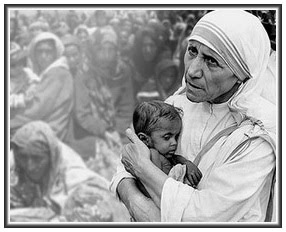
Mother_Teresa_compassion_2bIt is our emptiness that God promises to fill with Jesus. Mother Theresa has said we have nothing to give God that he needs but we can give him our emptiness, our spiritual hunger and thirst; not even God can fill something that is already full. As Christ poured out his life completely to do the will of his Father, we can empty ourselves completely to be filled with the Bread and Wine of Righteousness. Our emptiness is best filled when we follow the example of Christ. Think of a bottle of wine or a glass of water of a quart of milk. When you pour it out, the vessel is empty; there is nothing left to pour. Jesus not only poured out everything in his life but also allowed the vessel of his life to be destroyed so that we can be filled – our hunger and thirst are more than satisfied. We understand God’s compassion when we stir up our own compassion.

If we, then, can imitate Christ by emptying ourselves, can we feed others with what he feeds us? Of course we can! That is our privilege as Christians. We can offer whatever fills us to others who hunger and thirst. But what if we are not filled with Christ but with a mixture of Christ and the World? Wouldn’t that be like bread made with grain and sawdust? Recall that when the loaves and fish were multiplied, Jesus blessed them, broke them and passed them to the disciples, who then passed them to the people who in turn shared the food with each other. Jesus provided the food by multiplying what he was given by the lad with a lunch box, and the food was further multiplied by being shared by the people who received it. Had you and I been there that day, what you gave to me would have come from Jesus through you. Had you not passed it on, I would not have been fed, nor could I have been fed unless I received – accepted – what you passed on. The bread shared in that way satisfied the hunger and filled the emptiness of the body. The bread and wine Wisdom encourages us to consume is not only Everlasting, but also nourishes growth and is life-sustaining (Lay aside immaturity, and live). Our hunger for bread is like our hunger for understanding and compassion. We long to taste the goodness of the Lord – his Mercy.

We are called to feed the hungry as part of the Seven Corporal Works of Mercy. “To feed the hungry” is usually listed as first among the seven. In the Seven Spiritual Works of Mercy, the one listed first is usually “To instruct the ignorant.” The corporal mercy is to feed the body. The spiritual mercy is to feed the soul. If you count Matthew 5:11 as one of The Beatitudes, then the count is nine, and the fifth one, the one in the middle, is Blessed are the merciful, for they will receive mercy. (Check out the link and scroll to the bottom of the page to see The Beatitudes.) God is merciful. We are created in the image and likeness of God. We are to be merciful, too; we must feed ourselves and others – body and soul. We share bread for the table and Bread for the spirit. We are called upon to receive both and multiply both by sharing both with others. The amount we can share depends on the capacity of our emptiness as a measure of how much God can fill us with the gift of Bread he provides.

We can be bread to one another. Some cannot put bread on the table and so are not fed. We can put bread on their table, especially when we have more than we need. If the bread we have is thrown away, it feeds no one. If the bread we have is hoarded, it feeds only us and we are either gluttons or spendthrifts. Either way, the bread is not used as intended and loses its meaning of “bread to be fed to us and others.” When we give of our material wealth, the “bread” of money, we can help feed his sheep physically and spiritually. We must follow his example – The Way – to have concern, compassion, and generosity for others so that they can be fed. This helps us to walk in the way of insight [understanding]. In this way we come to know the goodness and meaning of Jesus’ assertion that he is the Bread of Life come down from Heaven. When we apply that understanding, we come to the point where whatever we do in and of itself praises God by feeding souls as well as bodies. When we understand that hunger can be both spiritual and corporal, then we lay aside our immaturity and walk in the fullness of faith, the fullness of The Beatitudes. Beatitude is a statement or condition of “utmost bliss, exalted happiness, great joyfulness.” When we are filled with such bliss, happiness, or joy and then share that with others physically and spiritually, we are filled beyond measure such that our cup overflows.

Have you been an offering of bread for another? To that one, you have been a life-sustaining gift. You have given bread for the life of the world because you have within you the Bread of Life. Think of your friends, your family, your fellow parishioners, members of your community, or citizens of the world: How to you fill the emptiness in them? How have they filled the emptiness in you? One of the best ways is to just be present for them – to put bread on the table, or to be bread of the soul. The Eucharist is the Thanksgiving for the Charity of the Table. It is so Christ-like to be the living bread that fills the emptiness of others. In the Epistle for this Sunday, the Apostle says, “Be careful then how you live, not as unwise people but as wise, making the most of the time, because the days are evil.” We are to be filled with the Spirit, to rejoice in the Lord together with songs and Psalms, and to give thanks to God for all of his blessings of Mercy and Grace. You have been fed. Pass it on and feed another. You have been saved. Pass it on and lead another to Christ. Jesus loves you. Pass it on.

Whatever, whenever, wherever, whoever, however, if ever, forever — at your service, Beloved!

Creative Commons License
Aloha Friday Messages by Charles O. Todd, III is licensed under a Creative Commons Attribution-ShareAlike 3.0 Unported License

Unless otherwise indicated, all scripture passages are from the New Revised Standard Version Catholic Edition (NRSVCE) New Revised Standard Version Bible: Catholic Edition, copyright © 1989, 1993 the Division of Christian Education of the National Council of the Churches of Christ in the United States of America. Used by permission. All rights reserved.


Thanks and a tip of the hat to Fr. Danilo Fuentes for some really good ideas!


Aloha Friday Message – August 7, 2015 – Seeking for God

1532AFC080915 – Seeking for God

Read it online here, please.

Isaiah 55:6Seek the Lord while he may be found,     call upon him while he is near;

Deuteronomy 4:29Yet there too you shall seek the LORD, your God; and you shall indeed find him when you search after him with your whole heart and your whole soul.

Ephesians 4:32 32 and be kind to one another, tenderhearted, forgiving one another, as God in Christ has forgiven you.

Aloha nui loa, ʻŌmea. Maluhia ana ke huakaʻi. Much love to you, Belovéd. Peace be with you. Have you been looking for God? Do you know someone who is trying to find God? Is there anyone we know who is trying to search for God’s presence? Where ya gonna go and who ya gonna call? What is the GOAL, the TARGET, the DESTINATION you want if you are seeking out, searching for, God? More importantly what are you going to do if you find God? If you can’t answer that last question, then I have to ask you, why are you searching for God? Why are you aiming to score some time with him? Here’s a little story about making something or someone a target.

Dart Test…

A young lady named Sally relates an experience she had in a seminary class, given by her teacher, Dr. Smith, a man who was known for his elaborate object lessons.

One particular day, Sally walked into the seminary and knew they were in for a fun day.

PaperDartTargetOn the wall was a big target, and on a nearby table were many darts. Dr. Smith told the students to draw a picture of someone that they disliked or someone who had made them angry, and he would allow them to throw darts at the person’s picture.

Sally’s friend drew a picture of a girl who had stolen her boyfriend. Another friend drew a picture of his little brother. Sally drew a picture of a former friend, putting a great deal of detail into her drawing, even drawing pimples on the face. Sally was pleased with the overall effect she had achieved. Dr. Smith put up the first drawing over the bull’s-eye target hanging on the wall

The class lined up and began throwing darts. With each new drawing, Dr. Smith left the bull’s-eye in place, gave the student his or her drawing, and then the mounted the next drawing. Some of the students threw their darts with such force that their target-drawings were ripping apart. Sally looked forward to her turn, and was filled with disappointment when Dr. Smith, because of time limits, asked the students to return to their seats. As Sally sat thinking about how angry she was because she didn’t have a chance to throw any darts at her target, Dr. Smith began removing the bull’s-eye target from the wall.

Underneath the target was a picture of Jesus. A hush fell over the room as each student viewed the mangled picture of Jesus; holes and jagged marks covered His face, and even His eyes were pierced. Despite all the damage, his serene face was still recognizable. Sally thought it even seemed to have an expression of sadness. Dr. Smith said only these words: “Truly, I say to you, as you did it to one of the least of these my brothers, you did it to me.” Matthew 25:40.

No other words were necessary; tears filled eyes of the students who were focused only on the picture of Christ. They understood. Jesus is the hidden face of everyone you see. That is where God can be found.

JesusSomber

Look beyond the face you see.

Look into the heart of me.

Look for Jesus everywhere

And you can find Him anywhere.

The invitation to seek the Lord in this passage from Isaiah is drawn from the references to the mercy of a God whose “ways” are completely mysterious. Just a few hundred words before this in 53:1 Isaiah said, Who has believed what he has heard from us? And to whom has the arm of the LORD been revealed?” Isaiah is telling us that what he has already said seems incredible, but what he is about to divulge is even more so.

The word used for seek in this passage means to seek a deity carefully in prayer and worship. It is to pay diligent, persistent attention to being in the presence of God. The word used for while (ἡνίκα) translates as “at which time,” as in “whenever it happens.” The implication is “when or where are you not in the presence of God?”

This Bible verse comes up during the Parable (or Discourse) of the Sheep and the Goats (Matthew 25:31-46) also called “The Judgment of the Nations.” It is a hard passage for many people because it quite clearly illustrates the value of meritorious action. Obey God’s command to love God and Neighbor, and eternal reward awaits you. The same passage illustrates the value of despicable action. Disobey God’s command to love God and Neighbor, and eternal punishment awaits you. At the very least, the division between blessing and curse might be based on one’s response to the people and message of the Gospel as presented by The Church. While it is true that Salvation comes only through Grace, it also appears that conduct has an influence on the outcome of Salvation, and for some folks this sets them up for a condition called scrupulosity.

Scrupulosity is an exaggeration of normal, healthy guilt. It is a pathological condition in which one obsesses over unworthiness about religious or moral actions and decisions. If you are mortally afraid that you might end up heading off with the Goats to eternal punishment because you didn’t give that inebriated panhandler a dollar, you are probably taking yourself too seriously. It’s really not all that complicated.

Be where God is and you will be near him. God is in your heart and in the heart of your neighbors. Acknowledge his presence by serving him and serving your neighbor. In this you will be honoring him by honoring his commands. Matthew 22:37-40Jesus replied: “‘Love the Lord your God with all your heart and with all your soul and with all your mind.’ This is the first and greatest commandment. And the second is like it: ‘Love your neighbor as yourself.’ All the Law and the Prophets hang on these two commandments.”

When we understand that Jesus becomes the target of our anger, our snappish comebacks, our selfish and prideful arguments, then we understand that – although we think we are seeking God where he may be found – we are actually ignoring and sometimes even insulting him. It would be a wise choice to reject throwing darts in favor of catching hearts.

In the passage from Ephesians, Paul is telling those Christians Brothers and sisters: Do not grieve the Holy Spirit of God, with which you were sealed for the day of redemption. All bitterness, fury, anger, shouting, and reviling must be removed from you, along with all malice. Otherwise, you are making Jesus the target of your imperfections. Is that how you want to connect with God? No, I didn’t think it was. But how do we know we’re making that connection?

Have you ever been just sitting there and suddenly you feel like doing something nice for someone you care about a little? …THAT’S GOD…He talks to you through the Holy Spirit and says “Care more!”

Have you ever been down and out and nobody seems to be around for you to talk to? …THAT’S GOD …He wants you to talk to Him and tell him you’re willing to place your life in his hands.

Have you ever been thinking about somebody that you haven’t seen in a long time and then next thing you know you see them or receive a phone call from them? …THAT’S GOD…there is no such thing as “coincidence” when you’re open to God’s call.

Have you ever received something wonderful that you didn’t even ask for, like money in the mail, a debt that had mysteriously been cleared, or a beautiful hand-made gift from a dear friend? …THAT’S GOD…He places in you the desires of your heart…

Have you ever been in a situation and you had no clue how it is going to get better, but now you look back on it and realize the fear and danger is gone? …THAT’S GOD…He passes with us through tribulation to see a brighter day.

When can the Lord be found? Better to ask, “When is he ever not to be found?”

Where can the Lord be found? Better to ask, “Where is there any place you can be that God is not there with you?”

How can the Lord be found? Try Matthew 7:7 Ask, and it will be given you; search, and you will find; knock, and the door will be opened for you.

God is in your heart, in your neighbor, in your church, in your school (no matter how hard they try to keep him out!), God is anywhere and everywhere you look for him, as well as all the places you think he can’t see you. You just have to chase after him until he catches you.

Whatever, whenever, wherever, whoever, however, if ever, forever — at your service, Beloved!

Share-a-Prayer

Many thanks and blessings for my good buddy M. Bee whose unstinting generosity points right back to God every day. Now she’s got a couple of grandchildren in their teens (and she’s a tad bit older than me), and your prayerful support will help her keep up that positive energy they need.

Pray also for people being ground down by economic and health problems. Ask God to tap them on the shoulder and show them he’s right there for them to find him.

Always and all ways loving you!


Creative Commons License
Aloha Friday Messages by Charles O. Todd, III is licensed under a Creative Commons Attribution-ShareAlike 3.0 Unported License

Unless otherwise indicated, all scripture passages are from the New Revised Standard Version Catholic Edition (NRSVCE) New Revised Standard Version Bible: Catholic Edition, copyright © 1989, 1993 the Division of Christian Education of the National Council of the Churches of Christ in the United States of America. Used by permission. All rights reserved.


Biblical languages inserts from Bible Hub (Bible Hub: Search, Read, Study the Bible in Many Languages) Visit at http://biblehub.com


Pages Email Newsletter Categories Archives Connect
  • Connct to us here