Aloha Friday Message – May 22, 2015 – Fire in the Whole!

1521AFC052215 – Fire in the Whole!

Read it online here, please.

Matthew 3:11 11 “I baptize you with water for repentance, but one who is more powerful than I is coming after me; I am not worthy to carry his sandals. He will baptize you with the Holy Spirit and fire.

Acts 2:1-4 When the day of Pentecost had come, they were all together in one place. And suddenly from heaven there came a sound like the rush of a violent wind, and it filled the entire house where they were sitting. Divided tongues, as of fire, appeared among them, and a tongue rested on each of them. All of them were filled with the Holy Spirit and began to speak in other languages, as the Spirit gave them ability.

This coming Sunday will be an exciting day for the Church, and especially exciting for Crucita and me as we wrap up the Mystagogy studies with our RCIA for Children. It is one of the few Sundays for which the liturgical vestments and decorations are red. It is Pentecost Sunday, and it is the day the Church began its mission. The Holy Spirit came to the Disciples of Jesus. We, too, are Disciples “if only the Spirit of God” dwells in us. (See Romans 8:9 by following that link.) Everyone chosen in the Spirit is the dwelling place of God. We should remember what Paul said in 1 Corinthians 3:16 – 16 Do you not know that you are God’s temple and that God’s Spirit dwells in you?

What does this phrase mean? “When the day of Pentecost had come?” Let’s look a little into what Pentecost is all about.

We begin by turning to Leviticus 23 where God is telling Moses about the feast days he wants celebrated. Leviticus is the third book of the Bible after Genesis and Exodus and the middle book of the Pentateuch, the first five books of the Hebrew Bible. The name Leviticus refers to the fact that most of the content of this book is the Policy and Procedure Manual for the Tribe of Levi, the Priestly Tribe. There are 27 chapters of rules, advice, and information on topics like sacrificial offerings, purity, holiness, the prescribed conduct and values for priesthood, rules for the sanctuary, and definitions and procedures for all of the feast days. In chapter 23, there are several feasts listed. They are given in the order in which they are to be observed and there is information on preparations for each and in some cases the reasons for the feasts and the rules that go with them.

Here are the feasts described in chapter 23, the section of Leviticus devoted to “Holiness Laws.” The Sabbath is described and then come other annual memorials. First comes Passover. Next is the Feast of Unleavened Bread which begins the day after Passover and lasts one week. During that time, Israelites ate unleavened bread. Then comes the Feast of Firstfruits, the day after Passover’s Sabbath, a Festival of Harvest and thanksgiving to God for the blessings of food. This was an offering made in hopes of further blessings from God. Usually this would be barley as it is one of the first grains to ripen.

Then there is the Festival of Trumpets, Rosh Hashanah which commemorates the creation of the world. No work was to be done on that day and all of Israel was to bring offerings to the temple when they heard the blast from the trumpets. This is the fifth of the Seven Feasts. The Feast of Trumpets begins on the first day of the seventh month. It is the opening Festival of the “High Holy Days.” These three feasts, Feast of the Trumpets, the Feast of Atonement – Yom Kippur, and the Feast of Tabernacles – Succoth) bring to a close the Liturgical Year of Israel and foreshadow the Plan of Redemption made manifest in Jesus. So, the seven feast are:

  1. Passover (Pesach)
    2. Unleavened Bread (Chag Hamotzi)
    3. Firstfruits (Yom Habikkurim)
    4. Pentecost (Shavu’ot) The Feast of Weeks or Festival of Harvest
    5. Trumpets (Yom Teru’ah)
    6. Atonement (Yom Kippur)
    7. Tabernacles (Succoth)

Pentecost is literally the centerpiece of the Feasts. It is described in Leviticus 23:15-22. There was a period of seven weeks – a week of Sabbaths – that were measured off. On the day after the end of the seven weeks – the fiftieth day, a celebration was prescribed by God. The name “Pentecost” comes from the Greek term for the celebration, Πεντηκοστή ἡμέρα (pentekoste hemera) which means fiftieth day. The offering for that day consisted of two loaves of finest yeast bread made from the finest flour, seven one-year-old lambs, one bull, and two rams offered as burnt offerings. Verse 19 says, “Then you must offer one male goat as a sin offering and two one-year-old male lambs as a peace offering.” It is also in this passage that the directive to allow for gleaning. It was the law of gleaning that brought Ruth and Boaz together. That’s for another lesson, though.

Jesus was crucified during the Feast of the Lord’s Passover, and he ascended 40 days after his resurrection. The Holy Spirit came 50 days after the Resurrection, which was of course, 10 days after the Ascension. Because of the importance of this feast, which God said, “This is a permanent law for you, and it must be observed wherever you live,” Jews of many nations would be gathered in Jerusalem in pilgrimage for this festival. When Peter, therefore, with the Holy Spirit rushing upon him and the other apostles stood up and addressed the crowd that had gathered around the place where the disciples were staying, persons of many languages and cultures were attracted to these curious events. The “tongues as of fire” are a fulfillment of John the Baptist’s prophecy of Jesus: “He will baptize you with Fire.” The parallel here is that God validated the Law given on Mount Sinai to Moses with fire (Exodus 19:16-18), and in the New Covenant, validated the arrival of the Paraclete with fire as well. Whereas in the First Covenant the fire was only in one place, in the New Covenant it was in many people.

The Feast of Firstfruits stands as a foreshadowing of the Resurrection of Christ as the “first fruits of them that sleep” (1 Cor. 15:20) in the expectation of further blessings from God – an even greater harvest. Pentecost foreshadows the coming of the Spirit, and the resultant harvest as the beginning of the “High Holy Days” of the Church.

Rosh Hashanah – which literally means “head of the year” in Hebrew – prefigures the Resurrection, the sounding of the trumpets and the dead being raised as Paul described in 1 Corinthians 15:51-58. This is one of my favorite Bible passages because it is one of my favorite solos in Handel’s Messiah. I’m getting the shivers just thinking about it right now!

Yom Kippur was the singularly unique event of the year in which the Most Sacred space in the Temple, the Holy of Holies (or “the Most Holy Place”), was entered. In a previous Aloha Friday Message I stated that it was where the Ark of the Covenant was the location for the Sh’khinah Glory of God to reside. God’s presence literally inhabited the area above the Ark, and no one was permitted into the Most Holy Place except on Yom Kippur and in the precise manner which God had established. It was on this day that the sins of the whole nation were considered atoned – expiated, wiped out, redressed – for the preceding year. With Jesus’ Atonement, the sins of all time are wiped out forever.

So, now we know a bit more about why Pentecost is called Pentecost, why everyone was in Jerusalem at the time, why it is 50 days after Easter and 10 days after Ascension. And we know why and how it relates to the Seven Great Feasts God told Moses and the Levites to establish forever for the people of Israel. As we are the adopted children of Moses, Abraham, Isaac, and Jacob through the Life, Passion, and Resurrection of Jesus the Christ, we really should know how these feasts came about and why they are important to us. But there is one more reason this is such an exciting Sunday.

Pentecost is the Birthday of The Church!

It was the arrival of the Advocate, the Paraclete – παράκλητον parakletos {par-ak’-lay-tos} the Comforter, and Intercessor who could speak the language of God in prayer: The Holy Spirit, the Bond of Love between God the Father and God the Son. The Holy Spirit is one who is summoned, called to our side to help us. He is the One who pleads our cause before a judge, a counsel for the defense against The Accuser. He is our legal representative at the Time of Judgment, an advocate whose Wisdom, Power, and Glory are from everlasting to everlasting.
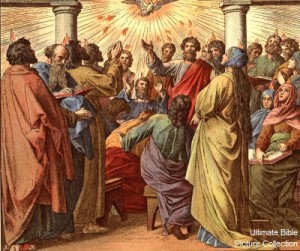
Day_of_Pentecost_1351-43Beloved, there is a New Pentecost blazing through the Church today. How does one become part of that rebirth? The same way it happened in The Way: Repent, be baptized, and receive the Spirit. You may say, “I try to be good and seek forgiveness when I’m not. I was Baptized as a child, and I know I belong to God because Original Sin was removed. And the Holy Spirit is always with me – as Jesus said – until the end of the age. I’m not missing anything by not feeling religious ecstasy.” Perhaps not, but perhaps you might. Repentance is always a tough one because it seems so repetitious; we’re never done with it because we’re never really done with sin. Baptism is something we could think a little differently about, though. There is the liturgical, sacramental Baptism we take as the entry into the Body of Christ; but there is another, deeper sense of it as well. It means – literally – to be immersed. Jesus said. “Can you drink the cup I drink or be baptized with the baptism I am baptized with?” (Mark 10:38b) Jesus was immersed in the baptism of his Passion. We are also to be immersed in the living of our faith, and in the Baptism of the Holy Spirit as a continuous state. It is not just a fixed moment in time, a single event in our lifetime; it is an ongoing process of renewal, submission, exultation, and action happening as we are fully aware of its source, its purpose, and its effects – the Gifts and Fruit of the Holy Spirit. Let us see the Whole Church ablaze with Holy Fire! Stand up for God and shout “FIRE IN THE WHOLE!” He is for you and with you always and all ways for all time.

Whatever, whenever, wherever, whoever, however, if ever, forever — at your service, Beloved!

Romans 15:13 – 13 May the God of hope fill you with all joy and peace in believing, so that you may abound in hope by the power of the Holy Spirit.

Unless otherwise indicated, all scripture passages are from the New Revised Standard Version Catholic Edition (NRSVCE) New Revised Standard Version Bible: Catholic Edition, copyright © 1989, 1993 the Division of Christian Education of the National Council of the Churches of Christ in the United States of America. Used by permission. All rights reserved.

Biblical languages inserts from Bible Hub (Bible Hub: Search, Read, Study the Bible in Many Languages) http://biblehub.com
Creative Commons License
Aloha Friday Messages by Charles O. Todd, III is licensed under a Creative Commons Attribution-ShareAlike 3.0 Unported License




Aloha Friday Message – May 15, 2015 – Look Him Up!

1512AFC051515 – Look him up

Read it online here, please.

Today I want to return to something from 2009. It begins right after the rainbow graphics. I feel strongly about sharing it with you again, so strongly that I have been thinking about how, exactly, I should present the topic that has dominated my thinking all through the Lenten and Easter Season. Every devotional, every Mass, every Bible study has been circling around this one passage from The Acts of the Apostles:

Acts 1:1-11In the first book, Theophilus, I wrote about all that Jesus did and taught from the beginning until the day when he was taken up to heaven, after giving instructions through the Holy Spirit to the apostles whom he had chosen. After his suffering he presented himself alive to them by many convincing proofs, appearing to them during forty days and speaking about the kingdom of God. While staying[a] with them, he ordered them not to leave Jerusalem, but to wait there for the promise of the Father. “This,” he said, “is what you have heard from me; for John baptized with water, but you will be baptized with[b] the Holy Spirit not many days from now.”

The Ascension of Jesus

So when they had come together, they asked him, “Lord, is this the time when you will restore the kingdom to Israel?” He replied, “It is not for you to know the times or periods that the Father has set by his own authority. But you will receive power when the Holy Spirit has come upon you; and you will be my witnesses in Jerusalem, in all Judea and Samaria, and to the ends of the earth.” When he had said this, as they were watching, he was lifted up, and a cloud took him out of their sight. 10 While he was going and they were gazing up toward heaven, suddenly two men in white robes stood by them. 11 They said, “Men of Galilee, why do you stand looking up toward heaven? This Jesus, who has been taken up from you into heaven, will come in the same way as you saw him go into heaven.”

This is a chance to review my #1 favorite passage of Scripture. It is also an opportunity to publicly say HAPPY BIRTHDAY (5/18) to my One True Love ~ Crucita. Make it a wonderful day, Crucita. I love you!!

AnimatedRainbowBar

Happy Aloha Friday, everyone.~!  Is everything looking up in your life despite so many people, places, things, and ideas being so down? I hope so. Looking up is a handy thing sometimes. After all, “What goes up must come down.”

F&W_DICTIONARYI look up a lot. Well, I mean, I look up a lot of things. I’ve always been kind of a research freak. I had the Richard’s Topical Encyclopedia when I was a kid – still have it in fact in my home library. It was one of those things my parents bought for me before I could even read. It also came with ten year’s worth of In Our times, an annual publication that summarized the year’s events. As I recall there was also a set of books called Lands and Peoples and a collection of popular books like Black Beauty, Heidi, Treasure Island, and even Tales from Shakespeare. One of my favorite places to look up things was the Funk & Wagnall’s Standard Dictionary of the English Language. It was two big, blue, thick, heavy volumes of thousands of words all defined to the nth degree. I loved using all those books and read for hours and hours just looking up one thing after another.

Of course, another mode of “looking up” is like, “Things are looking up!” I can remember joking (badly as is often the case in my life), “Well what are those ‘things’ looking up at?!” Of course that expression, things are looking up, means that life is getting better. I keep hearing that the things that are happening in the economy mean that “things are looking up,” but I am not convinced yet that they really are. I mean, we’re being told that what’s going on will make things better and that there would be consequences even more dire if we didn’t do them. Another “reflex” quip – something that pops out as a punch line whenever I hear the set-up – is “What’s up?” The reply is “Armstrong.” That is often missed by people born after 1975. Armstrong manufactures ceiling tiles. They’re over your head in many places. (And often so also is my “joke!”) There’s nothing humorous about the economy – it is getting better thanks to consumers looking for MADE IN AMERICA – but there is still a lot of homelessness, extreme poverty, hunger, and marginalization everywhere.

I just wonder if the duplicity and amorality that got us into this mess is the best approach to getting out of it. Can we really solve our economic crises by just printing more money and using it to pay for more stuff? I’m not very good at understanding that kind of thing, and the more I look up about it the more confused I get. I find that looking down on it doesn’t do me much good either. Looking past it or overlooking it doesn’t seem to be very helpful as well. My thinking is moving more and more toward “stop looking” and “get involved.”

We look up to people we respect – our elders, our heroes, our loved ones. That’s a good thing in some ways as long as we don’t put them up so high that all we can do is look up but never reach up high enough to connect up. We do that with God sometimes – put him up so high and far away that we forget He’s walking along with us every inch and every moment of the way, and even lives in our hearts! We look up to all these persons as persons of quality, persons who will accept the gifts of respect and love we exchange between them and us.

All of us have done the kind of looking-up at clouds and stars, and the moon (hooray for the MBN!!), and airplanes, and sky-scrapers, and birds (another hooray for the iwi and albatrosses here on Kaua‘i!!), and all manner of things above our heads. Of course, we still have to pay attention to what’s around our feet, and whatever is within our sphere of experience and responsibility. Looking up in awe is great exercise, too!

This week, yesterday in fact, there was another kind of looking up that we commemorated: The Ascension. To me, that event is so reassuring. It is a very strong central tenet of my faith. And in a way, it’s one of my favorites because the angels in that account have a little bit of attitude about them.

The Ascencion - by Copley

The Ascension – by Copley

Here’s what I mean. Jesus has just been talking with the disciples, and suddenly WHOOSH! He’s on the Cloud Elevator going back to spend eternity with His Dad – Abba. Very, very cool. And if we could be there watching (and we are – I’ll tell you about contemporaneous concomitance sometime), we would see the disciples standing there literally dumbfounded. Then two angels show up and say, “Men of Galilee, why-y-y-y are you standing there looking into the sky!? This same Jesus, who has been taken up from you into Heaven will return to you in the same way you saw him going up into Heaven.” Man! How great is that?!?! I think that passage is just amazing. I guess some scholars can debate about “in the same way” or “in like manner” but for me the word that jumps off the page and makes my ears ring is SAME as in THIS SAME Jesus. Now for those of you who are true Biblicists, really-real Bible scholars, I may be stepping out on a limb here. In the Greek used in Acts, the word for same is houtos I can put the Greek letters here, but they might not display correctly on your screen: οὗτος (oútos) {hoo-tohs or oo-tohs} So it turns out that this word, which is used in a bunch of places in the Bible, means this one, the one visibly present here, the one just named and none other than this one. There’s not another one, there’s no way it could be someone else. It will be precisely, exactly, permanently that same guy you just saw take off into the clouds. It is HE who will return to you.

Pre-millennial, post-millennial, silently or with a mighty trumpet blast, in fire or in thunder – I don’t really care about any of that. I only care that it will be Him. I don’t care if He comes with The Church Triumphant or The Bride of Christ or with Many Crowns or on a white horse with a mighty army of Angels, or whatever. It will be HIM, and that is all I need to know. It is also the best reason I have for always looking up in every sense of the phrase. He won’t be coming to us from inside us – where He lives now for all who accept Him. He will be coming back from somewhere UP THERE. Look up, Beloved. What went up will be what comes down: Christ, The Lord.

Whatever, whenever, wherever, whoever, however, if ever, forever— at your service.

Make it a great day, Beloved! Pray as you look up. Look up as you pray. Pray for healing, health, and hope for our loved-ones who are ill – yours and mine. Pray for justice, mercy, and peace – yours and mine, theirs and ours. Pray for enemies who seek to destroy life, faith, meaning, and freedom – yours and mine and even their own. Pray for those who pray. They are ours, together. Pray with, for, and about each other, Beloved. Be diligent in your love. When he returns, I want, you want, we want, to be found joyfully working in and for the Kingdom of God.
Creative Commons License
Aloha Friday Messages by Charles O. Todd, III is licensed under a Creative Commons Attribution-ShareAlike 3.0 Unported License

Unless otherwise indicated, all scripture passages are from the New Revised Standard Version Catholic Edition (NRSVCE) New Revised Standard Version Bible: Catholic Edition, copyright © 1989, 1993 the Division of Christian Education of the National Council of the Churches of Christ in the United States of America. Used by permission. All rights reserved.

Biblical languages inserts from Bible Hub (Bible Hub: Search, Read, Study the Bible in Many Languages) http://biblehub.com

It’s still Easter! Alleluia! Christ is Risen, Alleluia! Pass it on!! ALLELUIA!


Aloha Friday Message – May 8, 2015 – Do you love me?

1519AFC050815 – Do you love me?

Read it online here, please.

John 15:17 17 This is my command: Love each other. [1]

Aloha nui loa, ʻŌmea! Much love to you, Beloved! Yes, I do love you. How? Hmmm. That’s tough to answer in English. I took a look back at other times when we have asked about love and Love. Love is a four-letter word we use very often these days – so often that I think we have become a little confused about what it really means.

forever loveI love you. I love peanut butter. I love Mozart. I love the mountains, I love the rolling hills, I love the flowers, I love the daffodils, I love the fireside when all the lights are low, Boom-dee-adada! Boom-dee-adada! Boom-dee-adada! I love camping, I love violin music. I love jazz. I love the Beatles. I love Django Reinhardt. I love Stephane Grapelli. I love my kids. I love Crucita – a lot!! I love cream filberts. I love mango salsa. I love Hawaii. I love Chimayo chili. I love the Bible. I love Jesus. I love Yahweh. I love The Spirit. I love loving things, and persons, and just about any noun or verb you can think of. I love you more than I did when I started writing this message.

Anything wrong with that paragraph?

Ahhhhh, what is love?

We often turn to Biblical Greek here to help us understand what we find in Scripture. There are several words which are translated “love” in our Bibles. There is XENIA ξενία, (xenía) {zeh-NEE-ah} , which is hospitality “Guest-friendship.” It is hospitality that is not ostentatious but rather gracious and heartfelt, humble and unassuming, characterized by mutual courtesy and respect. This is usually on a one-to-one basis so that two people are involved, but it can also be for two or more persons.

Another Greek word for LOVE is STORGE στοργή (storgē) {store-gee}. This is the kind of natural, deep, instinctive love between parents and children. Again, it is usually on a one-to-one basis, but can also be for two or more persons. Those of us with large families know STORGE can be challenging at time, but also very powerful; in fact, it is powerful even if only two persons are involved.

A third word in Greek for LOVE is PHILIA φιλία (philia) {fil-i-ah}. This is a pretty familiar root-word and we see it in other words like “audiophile”, Philadelphia, and Theophilus. It is “brotherly/sisterly love,” and is usually associated with dignity and respect of and for others. In this also, the minimum number of persons involved is two.

There is also EROS ἔρως (érōs) {eh-rohs}. This is the LOVE that seems to capture most of the attention these days. It is the erotic [sic], passionate love, with sensual desire and longing. Physical and intimate, this LOVE is rooted in the deepest and most basic part of humanity. It is the form of LOVE that works best, in fact exclusively best, with only two persons.

Finally there is AGAPE ἀγάπη, (agápē) {ah-gah-ee}. Agape is the LOVE that transcends all other forms. In the New Testament, this is the verb used to characterize the LOVE that God has. We’ve all heard of AGAPE love, in fact I’ve mentioned it several times in these Aloha Friday Messages. Here, however, is something new and different I learned from Father Al Rubadello many years ago:

Agape LOVE is a love that can only exist for three or more persons. It is a love that grows out of community, not self. God is LOVE and God is Three Persons. When a couple shares agape LOVE, it usually includes him, her, and God; that’s five persons. Agape love with a child is Mom, Dad, and Baby. Or Mom, Baby, and God. Agape love is not self-based and as so is not self-serving. In modern Greek, this is the verb used for romantic love, the kind of love that is blind. Agape love carries with it no preconceptions, no prejudices; it is that kind of love that is usually called “unconditional.” Some folks think that only God can love unconditionally. I do not. My wife and kids prove it. They still love me despite the times I have not have always loved them as well as I could.

You know people like that, don’t you? People who love you no matter how much they know about you? How about people that YOU love regardless of how many time they have hurt, disappointed, or ignored you? See? You know about agape love, too. Keep God in the equation, and no matter what, you’ll always have enough love to actualize that agape reality. All the other forms of LOVE are real, but only agape love is really, really real. It is not a subordinate kind of love like all the previous words we’ve looked at here. It is superordinate LOVE, a LOVE that is superior in all ways to any and all other kinds of love. It is the way the Holy Trinity loves us.

You may remember this exchange between Jesus and Peter after Jesus’ Resurrection. Jesus has sent the Disciples up to Galilee promising to meet them there. While they are waiting, they decide to go fishing. The fish all night, catch nothing, and are about to give up and go ashore when a stranger on the beach asks if they’ve caught anything. Their answer shows their frustration at having caught nothing. Jesus tells them to try again. They do, and the net is filled to the point of nearly bursting. They realize the stranger on the shore is Jesus. Peter jumps in and swims ashore. The others come with the boat. Jesus helps them prepare a breakfast, then he turns to Peter and this happens:

doyoulovemeJohn 21:15-1715 When they had finished breakfast, Jesus said to Simon Peter, “Simon son of John, do you love me more than these?” He said to him, “Yes, Lord; you know that I love you.” Jesus said to him, “Feed my lambs.” 16 A second time he said to him, “Simon son of John, do you love me?” He said to him, “Yes, Lord; you know that I love you.” Jesus said to him, “Tend my sheep.” 17 He said to him the third time, “Simon son of John, do you love me?” Peter felt hurt because he said to him the third time, “Do you love me?” And he said to him, “Lord, you know everything; you know that I love you.” Jesus said to him, “Feed my sheep.”

In this exchange uses two “love words,” ἀγάπη and φιλία – agape and philia. It looks like this:

Jesus →   Peter Jesus Peter Jesus Peter
ἀγαπᾷς → φιλῶ Do you agapao me? I phileo   you. Do you truly love me? I am fond of you.
φιλεῖς → φιλῶ Do you phileis me? I phileo   you. Do you have affection for me? You know I am fond of you.

Scholars agree that in this exchange, Peter was reinstated after his denial during Jesus’ trial. How many times would Jesus have to ask me before I could be reinstated? Three? Once? A hundred? Too many to count? Yeah, that’s more like it; but, he’s always there, always coming back to me and asking, “Do you Love me now?” The follow-up question is always the one that trips me up: “How do show that you love me?” That command at the top of this message is how it is to be done. The Apostle Paul made it simple – as did Jesus: 1 Corinthians 16:14 14 Let all that you do be done in love. Πάντα ὑμῶν ἐν ἀγάπῃ γινέσθω. Another way to say that is “Make every thought, word, and deed begin and end in love.”

Beloved, if he comes to us and says, “Do you love me?” we can show him our agape love for God and neighbor. And should it seem to be a little insubstantial in the light of his Glory and Grace, then we can follow Peter’s example and feed Jesus’ flock with more of his Love. He told us that if we loved him we would keep his commandment. All we need is love, and for that you don’t even have to know how to dance. You may recall this song from “back in the day” by the Contours 1962 Do you love me?


Whatever, whenever, wherever, whoever, however, if ever, forever — at your service, Beloved!


Unless otherwise indicated, all scripture passages are from the New Revised Standard Version Catholic Edition (NRSVCE) New Revised Standard Version Bible: Catholic Edition, copyright © 1989, 1993 the Division of Christian Education of the National Council of the Churches of Christ in the United States of America. Used by permission. All rights reserved.

Creative Commons License
Aloha Friday Messages by Charles O. Todd, III is licensed under a Creative Commons Attribution-ShareAlike 3.0 Unported License

Biblical languages inserts from Bible Hub (Bible Hub: Search, Read, Study the Bible in Many Languages)
http://biblehub.com


[1] New International Version (NIV)

Holy Bible, New International Version®, NIV® Copyright ©1973, 1978, 1984, 2011 by Biblica, Inc.® Used by permission. All rights reserved worldwide.


Aloha Friday Message – May 1, 2015 – Fruit to Root

1518AFC050115 – Fruit to Root

Read it online here, please.

John 15:1-5 1 “I am the true vine, and my Father is the vinegrower. He removes every branch in me that bears no fruit. Every branch that bears fruit he prunesto make it bear more fruit. You have already been cleansedby the word that I have spoken to you. Abide in me as I abide in you. Just as the branch cannot bear fruit by itself unless it abides in the vine, neither can you unless you abide in me. I am the vine, you are the branches. Those who abide in me and I in them bear much fruit, because apart from me you can do nothing.”

1 John 3:23-2423 And this is his commandment, that we should believe in the name of his Son Jesus Christ and love one another, just as he has commanded us. 24 All who obey his commandments abide in him, and he abides in them. And by this we know that he abides in us, by the Spirit that he has given us.

These passages are excerpts from two of this coming Sunday’s readings, the Fifth Sunday of Easter. As we move toward Pentecost, our stops along the way take us through the Acts of the Apostles and the Gospel of John. Today’s theme comes from this passage from Matthew:

Matthew 7:15-20 15 “Beware of false prophets, who come to you in sheep’s clothing but inwardly are ravenous wolves. 16 You will know them by their fruits. Are grapes gathered from thorns, or figs from thistles? 17 In the same way, every good tree bears good fruit, but the bad tree bears bad fruit. 18 A good tree cannot bear bad fruit, nor can a bad tree bear good fruit. 19 Every tree that does not bear good fruit is cut down and thrown into the fire. 20 Thus you will know them by their fruits.

Jesus is teaching about false prophets. There were plenty of those throughout the whole history of Israel. A false prophet is one who gives the appearance of speaking the will of God to others. A true prophet is one who cannot help but glorify God in the message delivered, and whose prophecy is consistently reliable – what s/he says will happen does happen – and in agreement with Scripture. The false prophet speaks from his/her ego and seeks personal gain – money and prestige usually – in place of the honoring of God. We know them by their fruits. If they are prophesying in the name and will of God, then their fruit will be the fruit of the Holy Spirit. If they are prophesying from their sense of self, their fruit will be abominations that are the antithesis of the fruit of the Spirit:

Galatians 5:19-23  19 Now  the works of the flesh are obvious: fornication, impurity, licentiousness, 20 idolatry, sorcery, enmities, strife, jealousy, anger, quarrels, dissensions, factions, 21 envy,[a] drunkenness, carousing, and things like these. I am warning you, as I warned you before: those who do such things will not inherit the kingdom of God. 22 By contrast, the fruit of the Spirit is love, joy, peace, patience, kindness, generosity, faithfulness, 23 gentleness, and self-control. There is no law against such things.

Sound, true prophecy comes only to those who are in and of Christ. Even before his incarnation, the Old Testament spoke of God’s Messiah as the fulfillment of all of God’s promises from Adam and Eve and all through the history of Israel. Although some have tried to find inconsistencies between what the prophets conveyed, in the end, they are moot arguments because the “preponderance of evidence” is that God has spoken to us through scripture in ways that lead us to understand – as well as humans can understand – God’s intentions for his creation. There is enough evidence in the behaviors of those who claim to be prophets that one can see whether or not the fruit they produce has its roots in Holy Scripture and the traditions of teaching from Genesis to Revelation. We are most likely to be caught up by the misdirection of false prophesy if we have little or no idea what connects the root to the fruit. If we don’t know even that much, how can we know for sure if we are still ripening on the vine?

WhiteClimbingRoseSuppose I learned that you love white roses? And what if I know of a place where there is a beautiful climbing white rose draped across a stone wall round a big house? If I want to give you a gift of that white rose, I could snip off a few trailers and give them to you. You’d be able to keep them for a while, but eventually they would end up in the trash because they would die. You could keep them in water for a few days and they would stay fresh, but a day or two more and they would just dry up. They have no roots to bring nourishment. Where do your roots draw nourishment? Are you in the Word every day? We all should be there every day, and not just in passing – you can walk past a rosebush and stop to smell the roses, but that doesn’t become your rose bush – but deeply and richly living in the word of God so that we bear the roses of Grace and fruit of the Spirit. Who will tend to that rosebush to make it flower?

Well, the rosebush – or the grape vine, or the fig tree, or the shaft of wheat, or even the thistle – cannot prune itself. The gardener, the farmer, the husbandman takes care of the crop. The straggling, unproductive branches are removed (and it is rare that they are sent to someone else as a gift). That makes the bush or the vine healthier. We have things in our lives that are unproductive. We know they can be pruned out of us. We are in this way unlike the plants used in these metaphors. We can cut out some of that bad stuff that weakens us, strains our root system, and diminishes the quality and quantity of fruits (or flowers) we bear. A good husbandman, however, does more. Even that which is left after the no-good stuff is taken away is pruned to promote growth.

PruningVines_sPruning the vine helps to remove the deadwood, to promote growth, to shape a plant, to increase the fruitfulness. Taking out the deadwood is not enough. Pruning back increases the quality and quantity of good fruit. But you only prune the branches. You don’t start pruning at the roots because that is the origin of the fruits. In like manner, we must stay connected to the vine if we, the branches, are to bear much good fruit. How do we stay connected? What can we do that helps produce more and better fruit? We can follow Jesus’ commandments to love. All who obey his commandments abide in him, and he abides in them.

You can make a climbing rose look like a grape vine by tying clusters of grapes to it. You can make a cactus look like it is bearing figs by sticking them to the thorns. Would that really fool anyone? Yet sometimes we try to do that with our lives; we try to make them appear as though we are yielding those spiritual fruits by showing the outward signs of them. Do those signs last? If they don’t start at the root, then of course they don’t last! The same is true of false prophets. They drape themselves with the supposed fruits of their prophecy, but everything they produce smells of decay and ruin. They reek of the fruits of the flesh: fornication, impurity, licentiousness, 20 idolatry, sorcery, enmities, strife, jealousy, anger, quarrels, dissensions, factions, 21 envy, drunkenness, carousing, and things like these. In this time of upheaval we could also add terror, murder, blasphemy, deceit, persecutions, violence, evil appetites, and may things like these. When people produce this kind of fruit, it is because of where the root is growing. It grows from a bad tree and produces only bad fruit. When that fruit is fed to others, it takes root in them as well – we are what we eat. If, then, Christ is in us, then the fruit we bear will be good fruit if we remain in HIM. Will parts of our lives be like a slightly-fruitful vine that is pruned away to make better growth? Will we remain true to our roots? Will we produce the fruits to feed others? “Dear God, I hope so” is the prayer that helps us defeat the famine that is crushing the world. The prophet Amos described that famine:

Amos 8:11 11 The time is surely coming, says the Lord God,
when I will send a famine on the land;
not a famine of bread, or a thirst for water,
but of hearing the words of the Lord.

Beloved, remain in him as he remains in you. Do not uproot yourself by trying to be a hater, or any of the other “things like these” listed above. Pray – with intense faith – believing that Peace is possible. If you pray the Rosary, pray every day that God will deliver us from this present Evil. Pray for a victory like the one at the Battle of Lepanto. Be the fruit that is true. Go, and bear much fruit. And by this we know that he abides in us, by the Spirit that he has given us. For the fruit of the Spirit is love, joy, peace, patience, kindness, generosity, faithfulness, gentleness, and self-control. Thrive in the True Vine.

Whatever, whenever, wherever, whoever, however, if ever, forever — at your service, Beloved!

Creative Commons License
Aloha Friday Messages by Charles O. Todd, III is licensed under a Creative Commons Attribution-ShareAlike 3.0 Unported License
Unless otherwise indicated, all scripture passages are from the New Revised Standard Version Catholic Edition (NRSVCE) New Revised Standard Version Bible: Catholic Edition, copyright © 1989, 1993 the Division of Christian Education of the National Council of the Churches of Christ in the United States of America. Used by permission. All rights reserved.


Aloha Friday Message – April 24, 2015 – Where now?

1517AFC042415 – Where Now?

Read it online here, please.

2 Timothy 1:7 for God did not give us a spirit of cowardice, but rather a spirit of power and of love and of self-discipline.

Romans 8:15 15 For you did not receive a spirit of slavery to fall back into fear, but you have received a spirit of adoption. When we cry, “Abba!Father!”

Proverbs 16:25 25 Sometimes there is a way that seems to be right,
but in the end it is the way to death.

Peace be with you, Beloved. How our hearts long for that “Peace that surpasses all understanding!” Daily we hear of the great violence done against many people – notably against Christian – by the group which identifies itself as ISIS. This horrific and egregious violence prompts much anger and hateful speech around the world. There are vituperative arguments from Christians, Muslims, and many other parties trying to lay blame against ISIS, Christian, Jews, the British Empire, and Satan himself. There is blame enough to go around, but focusing on that makes us part of the problem and not part of the solution.

I plead with you to stop here, and to read 2 Timothy 3:1-13! This cross-references to Matthew 10:2222 You will be hated by everyone because of me, but the one who stands firm to the end will be saved. In 2 Timothy, Paul describes a world that sounds a lot like what we see happening today. It is a world so given over to evil and to self-gratification that the entire concept of Truth has been belittled to being nearly meaningless. One thinks of Pilate’s question to Jesus: “What is Truth?”

I’m going to do some non-PC things here and comment about Truth. First I want to quote again Frank E. Peretti’s statement about The Truth: “There’s no way for you to know whether what I’m telling you is true unless you know what the truth is. And there’s no way for you to know what the truth is unless there is a truth that you can know. (If you’re searching for the truth, and there is none, then what are you searching for?) You’ve got to have a truth that true whether you believe it or not. A truth that is true whether you like it or not. It’s true whether you even know about it or not. It’s just TRUE: OBJECTIVE EXTERNAL ETERNAL TRUTH THAT STANDS IN AND OF ITSELF.”

When I think about it that way, The Truth has to be objective, not subjective. I can’t just say, “I know the truth unless The Truth exists and I have encountered it is ways to understand it without external arguments. Most of us reading this today will realize that this is a working definition of Faith. We know The Truth experientially because we see it at work in our lives. The Truth that we know upholds the dignity of all life – everything that God created from quarks to narwhals. Faith knows that desecration of any part of life is “anti-Faith.”  Faith knows that Truth does not seek to verify itself, or to vilify others. Faith knows that Peace is the end-goal of the universe (notice I didn’t capitalize that!). When everything comes to an end, the result is Peace because Truth is seed that blossoms and bears the fruit of Peace. Those who deliberately pervert The Truth, no matter how sincere they are about defending their position – will not know Peace in the end, but only Death. Perversion of Truth and Faith are known by another name: Sin. Those who attribute their sin to God’s will pervert The Truth. Their way ends in death; but often not before there errors cause a great deal of damage.

Jesus made the point several times that his followers would be persecuted, and today we see it’s by an ever-growing cadre of persecutors. Recall he said in Matthew 5:10-12 10 “Blessed are those who are persecuted for righteousness’ sake, for theirs is the kingdom of heaven. 11 “Blessed are you when people revile you and persecute you and utter all kinds of evil against you falselyon my account. 12 Rejoice and be glad, for your reward is great in heaven, for in the same way they persecuted the prophets who were before you. Today the persecution of Christians is very widespread – and you need to realize it’s not just so-called jihadists who are committing this persecution. Take a look at this map which you can find here: https://www.opendoorsusa.org/christian-persecution/world-watch-list/

PERSECUTION2015s


Here you see listed the top 50 countries where Christians are persecuted in 2015. Wherever you see the red areas, those are where the persecutions are most severe. In large portions of those red areas, the persecutions are in the name of Allah.

Allah is not Jehovah. Jesus – Isi in Arabic – is not the son of Allah. Allah is a word reserved exclusively for God in Islam and cannot be made plural. The origins of Islam reputedly go back to Ishmael a son of Abraham, and several Old Testament personages appear in the scriptures of Islam. Noah, Abraham, Moses, and David are part of the Islamic heritage, and while Allah is the word for God, and Islam purports there is only one God, it is not Allah that is the Judeo-Christian God of Mercy, Grace, and Peace. The three “Abrahamic faiths,” – Judaism, Christianity, and Islam – are monotheistic religions (all believe in only one God). Judaism rejects the idea of Jesus being the Messiah, and similarly so does Islam. Christianity and Judaism reject the idea that the Quran is a more accurate accounting of the ultimate truth of God’s relationship with humanity. The argument is that in every language there is a unique word for God – Dios, Dieu, Gott, Maykapal, Ke Akua, Mungu, Deus, but all are the same entity – God. Further it is argued that in the Hindu religion all of the “gods” are manifestations of the same one and only Supreme Being. Who is right? Who indeed has The Truth? Which of these three great religions has “He whose hands are sinless, let him throw the first stone.”?

Those who remain slaves to violence against their neighbor are those who fail to love God and neighbor, and in any of the three Abrahamic religions, that is a sin. When that sin is promulgated against other humans in the name of their God, that is a heinous sin. Who committed that sin first? Does it matter? It could go all the way back to Moses – or even earlier – but my question here today is, “Who is committing that sin now?” Who is it that is trying to use fear and terror or promote the idea that other religions have twisted and attempted to invalidate the purity of God’s revelations of his Glory and Love to mankind? Is it the Jews? Is it the Christians? Is it the Muslims? Is it you or me? In my heart it does not matter who started it. It does not matter who continues it. It matters only who stops it by everyone, from everyone, to everyone, for everyone. I call upon all of us – Muslim, Christian, Jew; atheist, pagan, agnostic; any and all humans – to end it in prayer. Let’s look back in history at one such event – the Battle of Lepanto.

October 7, 1571, a great naval battle took place. Pope Pius V – who convened the Council of Trent, published the works of Thomas Aquinas, instituted a new catechism, excommunicated Queen Elizabeth I, and instituted a great many reforms of the clergy – called for 40 hours of prayer from all of Europe, forty hours of ceaseless and fervent Rosaries in support of the Holy League that opposed the Ottoman Turks. The victory ended the threat of Islam against Western Europe.

We need a similar surge of prayer around the world – not just in Europe, but everywhere that Peace is threatened by terror and violence. As you look at the map again, you can see that many millions of people are suffering due to the mendacious campaign of violence, abuse, and tyranny imposed by men who claim that their religion is one of peace. Therefore, let us hope – and urge – leaders in all three of these “Abrahamic Faiths” to call their believers together in prayer for deliverance from these monstrous assassins of Peace. It is insufficient to rail against them with angry words. It is even insufficient to war against them with destruction. The best weapons we have are the Two Great Commandments and fervent, consistent, truthful, and hope-filled prayers for wisdom and mercy to sweep over and through ISIS.

Don’t think that will work? Then you’d best pray that many others will believe it will work. Evil is not overcome by evil but by good. Look at what St. Peter told us in 1 Peter 3:13-17 13 Now who will harm you if you are eager to do what is good? 14 But even if you do suffer for doing what is right, you are blessed. Do not fear what they fear, and do not be intimidated, 15 but in your hearts sanctify Christ as Lord. Always be ready to make your defense to anyone who demands from you an accounting for the hope that is in you; 16 yet do it with gentleness and reverence. Keep your conscience clear, so that, when you are maligned, those who abuse you for your good conduct in Christ may be put to shame. 17 For it is better to suffer for doing good, if suffering should be God’s will, than to suffer for doing evil. Our Christian brothers and sisters who have been martyred by ISIS testify against those who murdered them. The jihadists claim their Islamist martyrdom is what ensures their reign in Allah’s paradise. Our prayer should be that Truth will prevail, the violence will cease in light of Truth, and God will soon remove the evil that disrupts his Peace.

If you don’t want to pray the Rosary once a day every day (or all together for 40 hours), pray at the very least for Peace to reign where violence now holds sway, and pray that the highest levels of leadership in Judaism, Christianity, and Islam – in full agreement – will pray and ask God to command to put an end to this aberration of religion that is so decidedly wicked. This is not the first time in history that a thoroughly evil force has devoured the peace of its neighbors, but we can certainly pray that it will be defeated soon and thereby become the last thoroughly evil force to threaten the planet. Defeating this evil requires an act of Grace. I ask you to take 2 minutes and listen to this short Lesson on Grace by Frederick Buechner. It may open you to the Grace to pray for enough Faith to believe in Peace. That kind of Faith is Courageous Faith, the kind of faith martyrs show, a spirit of power and of love and of self-discipline. It is true: For you did not receive a spirit of slavery to fall back into fear, but you have received a spirit of adoption. When any earthling claims that murder, torture, terror, and evil are gifts from his god, there is a way that seems to be right, but in the end it is the way to death.

Where now? To our knees in prayer.


Whatever, whenever, wherever, whoever, however, if ever, forever — at your service, Beloved!


Unless otherwise indicated, all scripture passages are from the New Revised Standard Version Catholic Edition (NRSVCE) New Revised Standard Version Bible: Catholic Edition, copyright © 1989, 1993 the Division of Christian Education of  the National Council of the Churches of Christ in the United States of America.  Used by permission. All rights reserved.


Creative Commons License
Aloha Friday Messages by Charles O. Todd, III is licensed under a Creative Commons Attribution-ShareAlike 3.0 Unported License

Aloha Friday Message – April 17, 2015 – Power Switch

1516AFC041715 – Power Switch

Read in online here, please.

Proverbs 18:21Death and life are in the power of the tongue,
and those who love it will eat its fruits.

James 1:26 26 If any think they are religious, and do not bridle their tongues but deceive their hearts, their religion is worthless. (See also James 3:1-12 and Hold Your Tongue!)

Reverend Father Michael White: “Words have power and God’s word has God’s power. And when we speak God’s word we unleash God’s power. Proclaiming God’s word and being faithful to what it says unleashes God’s power in our congregation.” You can find that statement by following this link. Fr. Michael White coauthored REBUILT – Awakening the Faithful, Reaching the Lost, Making Church Matter with Tom Corcoran. This quote appears on page 138 of that book. When I first read it, I marked my page-margin

!WOW!


I had a cascade of Bible verses run through my mind!

Psalm 39:1 I said, “I will guard my ways
that I may not sin with my tongue;
I will keep a muzzle on my mouth
as long as the wicked are in my presence.”

1 Corinthians 4:18-20 18 Some of you have become arrogant, thinking I will not visit you again. 19 But I will come—and soon—if the Lord lets me, and then I’ll find out whether these arrogant people just give pretentious speeches or whether they really have God’s power. 20 For the Kingdom of God is not just a lot of talk; it is living by God’s power. [New Living Translation (NLT)]

Isaiah 55:9-11 For as the heavens are higher than the earth,
so are my ways higher than your ways
and my thoughts than your thoughts.

10 For as the rain and the snow come down from heaven,
and do not return there until they have watered the earth,
making it bring forth and sprout,
giving seed to the sower and bread to the eater,
11 so shall my word be that goes out from my mouth;
it shall not return to me empty,
but it shall accomplish that which I purpose,
and succeed in the thing for which I sent it.

James talks about the power of speech, the power of the tongue. The power of speech is one of the most amazing gifts God has given us. In any language a human can praise God, bless God, worship God, adore God, glorify God, teach fellow souls about the power of God’s Word, and assist the Holy Spirit to lead lost sinners to Christ. But with that same tongue we can blaspheme God, insult God, sin against God and our brothers and sisters, and – like the Adversary – we can tell lies that can ruin a life, destroy a relationship, or break someone’s heart. We have the ability to speak truth; it is certainly the best way to influence others; and yet so often we take this ability for granted or – worse – abuse it and invent our own “truth.” When that invented truth is conceived in anger, it definitely causes problems.

Proverbs 13:3 Those who control their tongue will have a long life;
opening your mouth can ruin everything.

Been there, done that, got the T-shirt, don’t wanna go back – ever! But I do go back, and it’s awful!  That is why Fr. Michael’s words really clobbered my mind – and my heart. God’s Word ≡ God’s Power. My word ≡ my power. My power makes trouble. God’s Power spoke the universe into being. God’s Word came to us so that whoever believed in him would not perish, but have everlasting life; would not be condemned by God but be given – g-i-v-e-n – salvation by and through God. The Word became flesh. The Word had a tongue, and that tongue spoke God’s Power. Here’s what the Word said at the end of Luke’s Gospel:

Luke 24:44-49  44 Then he said to them, “These are my words that I spoke to you while I was still with you—that everything written about me in the law of Moses, the prophets, and the psalms must be fulfilled.” 45 Then he opened their minds to understand the scriptures, 46 and he said to them, “Thus it is written, that the Messiah is to suffer and to rise from the dead on the third day, 47 and that repentance and forgiveness of sins is to be proclaimed in his name to all nations, beginning from Jerusalem. 48 You are witnesses of these things. 49 And see, I am sending upon you what my Father promised; so stay here in the city until you have been clothed with power from on high.”

Notice, please that I emphasized the word upon. (Here we go with that Greek thing again.) That word Upon you is ἐφ’ (eph’) {eph}  and is a preposition. It is a form of the preposition ἐπί (epi) {ep-eé}.  ἐφ’ means upon, unto, against, over, covering (like a cloak) as in until you have been clothed with power from on high. And once clothed in that power, the Apostles spoke. They spoke in diverse languages, they spoke with power, they spoke miracles, they spoke boldly, they spoke prophetically, and they spoke The Word of God. The first seven chapters of The Acts of the Apostles are filled with scripture quotes about the prophesies Jesus fulfilled. There were so many convincing things spoken during the early days of The Church that it was like a perfect storm of Perfect Words. It was a constant barrage of The Good News. It reminded me of this picture of God’s Power – his Blessing through his Word:

Psalm 147:16-18 16 He gives snow like wool;
he scatters frost like ashes.
17 He hurls down hail like crumbs—
who can stand before his cold?
18 He sends out his word, and melts them;
he makes his wind blow, and the waters flow.

OK, so we get the idea: The tongue can be a tiny little monster at times, yet it is essential to life, but can also be a source of death. We need to be careful how we control it and how we deal with the consequences. Another passage in Proverbs speaks of the person who doesn’t care about the destructive power of his carelessly spoken words. “Like a madman who throws firebrands, arrows, and death, is the man who deceives his neighbor, and says, ‘I was only joking!'” (Proverbs 26:18-19). It’s easy to let our ego move us away from “love thy neighbor as thyself” and smack-dab into “Umm-m-m-m-m! You stu-ped! I’m going to tell.” It’s easy because that’s what The World expects under the domination of The Prince of The Air – Satan, The Accuser whose whole existence is controlled by his own lying tongue. Because of that he was cast away from God, and when I follow his advice, I am also moving away from my Creator. That’s what happens when I’m talking to hear myself talk. Look again at the second half of that quote from Proverbs at the top of the page.

It says “ and those who love it will eat its fruits.” What that means is that those whose words bring happiness and learning to themselves and others have consequences that are richly productive. Those whose words bring corruption, calamity, and coarseness have consequences that are absolutely destructive.  The power of the words is that the words are generated by the power of the speaker. If the words are Words God has spoken, the power is God’s. If the words are lies the Accuser has spoken, the power is Death’s.

Do we want to see our nation grow? Do we want to see our churches grow? Do we want to see our families grow? Then what we speak decides which way that power-switch is thrown. Just as actions speak louder than words, words speak from the power behind them.  For the Kingdom of God is not just a lot of talk; it is living by God’s power. Look around. Where you are right now, is the power-switch open or closed to the Power of God? Are we switched on to the power of Life or the power of Death? What power will we unleash in our community? Let’s commit to proclaiming God’s Word of Life and being faithful to it. Wow!

PowerSwitch

Whatever, whenever, wherever, whoever, however, if ever, forever — at your service, Beloved


Aloha Friday Messages by
Charles O. Todd, III is licensed under a Creative Commons Attribution-ShareAlike 3.0 Unported License


Unless otherwise indicated, all scripture passages are from the New Revised Standard Version Catholic Edition (NRSVCE) New Revised Standard Version Bible: Catholic Edition, copyright © 1989, 1993 the Division of Christian Education of the National Council of the Churches of Christ in the United States of America. Used by permission. All rights reserved.


Aloha Friday Message – April 10, 2015 – Lord have mercy!

1515AFC041015 – Mercy Me!

Read it online here, please.

Psalm 103:8 The Lord is merciful and gracious,
    slow to anger and abounding in steadfast love.

Aloha nui loa, ʻŌmea! Much love to you , Beloved! Lent is behind us. Resurrection Sunday dawned bright and fair here in Kapaʽa. Our Rite of Christian Initiation class of five children received the Sacraments of Baptism, Confirmation, and First Communion. They did a GREAT JOB!

Our entire Triduum was just so wonderful! We were blessed to be lectors for Palm Sunday’s Gospel of The Passion as it appears in Mark, then Thursday evening at the Maundy Thursday Mass we were also lectors. Crucita read the Proclamation for the Presentation of the Sacramental Oils which are used in anointing the sick, in Baptism, and in Confirmation. I did the reading from 1 Corinthians 11:23-26 (Paul describing the institution of Holy Communion). There was Adoration of the Blessed Sacrament all Thursday night through Friday Afternoon; I went from 2-3 AM, the hour I usually take because no one else usually does.

Then there was the Good Friday Service in the evening, and Crucita and I read the Passion from the Gospel of John. Saturday we were back at 9:00 in the morning to rehearse with our kids who have been studying with us for their Baptism, Confirmation, and First Communion. We went through all the parts of the Vigil Mass with everyone who had some role in it. We finished rehearsal at about 11:15.

The Vigil started right on time at 7:00 PM. The kids did GREAT! We are so proud of them, and the kids, their parents and godparents (and lots of family members too) were so excited and happy. (Which reminds me, I need to post some photos to Facebook). I was the cantor for the Litany of the Saints. This year we did it in F# minor instead of D minor, so it was a little high for me, but we still got through it.

Vigil ended just before 10:30, so it was home to bed for us because it was already way past our bedtime. Then Easter Sunday rolled around. We always volunteer to do the Old Testament and Epistle readings for the 9:30 Mass on Easter Sunday because most of the other readers go to either the Sunrise Service or the 7 AM service, or they are visiting somewhere with family, so usually there aren’t many other lectors – or people – at that Mass. This year, though, we were astonished to see that all the Masses and services throughout the Triduum were packed!

So, yes it was an exciting and very blesséd Easter. Being part of a three-day-long church service was quite a boost for us. Living here in Kapaʽa is an even greater blessing because of our association with the people of St. Catherine of Alexandria Parish. I mean, Kauaʽi is pretty darn cool, but our Parish Life makes it super-nifty!

We are enabled and blessed to do these things because of God’s Mercy and Grace. April 12th – the first Sunday after Resurrection Sunday – is Divine Mercy Sunday. Our opening scripture passage today states that God is merciful and gracious. Those words are closely related, but they are different, and that’s what I’d like to explore today. I hope you don’t mind that I take you back to the Hebrew words for this passage. For me, it helps me to understand what  the Spirit is showing us when we look at the words HE uses to tell us what’s on God’s mind. Merciful (is merciful actually) looks like this רַח֣וּם rachuwm {rakh-oom’}. The best sense of it is compassionate. In many places it is translated as kind, kindness, kindhearted, benevolent, or steadfast love. When used to describe God’s disposition toward Israel, the compassion is overwhelming and super-abundant, far above anything that is deserved or could even be desired. It is exceedingly generous.

God’s Mercy is “from everlasting to everlasting.” (Psalm 103:17-18). Although it is passed down from generation to generation, it does have a limit. God is merciful “to those who keep his covenant and remember to is commandments.”  Mercy is the kindness God shows when we deserve to be punished for our sins, but he shows leniency because of his great love for each and every soul. God’s Mercy is one of his core characteristics. That means, of course, that it should be in our core values, too; we are created in the image and likeness of God. We are required to be merciful as he is merciful.

In the Beatitudes (and I love it when someone pronounces that as the “Be Attitudes!”), Jesus says in Matthew 5:7 Blessed are the merciful, for they will receive mercy. We see the same thing in Luke 6:3636 Be merciful, just as your Father is merciful. How do we do that? How do we show mercy? You may remember we talked about the Spiritual and Corporal Works of Mercy back in 2010. So, Beloved, I have been looking into what mercy is and how it has a role in our lives. The first thing I learned is that works of mercy – being merciful – affects us body and soul. There are corporal works of mercy, traditionally seven.

1. Feed the hungry,
2. Give drink to the thirsty,
3. Welcome the stranger,
4. Clothe the naked,
5. Care for the ill,
6. Visit the imprisoned,
7. Bury the dead

There are also seven spiritual works of mercy, six taught to us by Jesus, and the seventh added to affirm respect for human life.

1. Admonish sinners,
2. Instruct the uninformed,
3. Counsel the doubtful,
4. Comfort the sorrowful,
5. Be patient with those in error,
6. Forgive offenses,
7. Pray for the living and the dead.

As you can see, being merciful, or as Micah 6:8 puts it “to love mercy,” presents to us with a formidable list of requirements. It seems to me that we would surely need to be both just and humble to tackle this list successfully. How in the world can we acquire and use those virtues? Through Grace; it is by Grace that we have access to all of God’s gifts.

Where does Grace originate? With God, of course! 2 John 1:3 Grace, mercy, and peace will be with us from God the Father and from Jesus Christ, the Father’s Son, in truth and love. God even said that about himself  when Moses went up on the mountains the second time to receive God’s Law.

Exodus 34:6 The Lord passed before him, and proclaimed,

“The Lord, the Lord,
a God merciful and gracious,
slow to anger,
and abounding in steadfast love and faithfulness,

What is grace and what does it cost us? Grace is “God’s unmerited favor.” It is undeserved, unearned, a totally FREE gift that is given to us in unlimited abundance. On of the characteristics of Grace is Mercy, but there is so, so much more!! The root word for Grace is the Greek word χάρις, (charis) {khar’-ece). It is an expression of God freely and abundantly extending himself to us because he wants to be near us, to bless us, to love us, and to share his holiness with us. It gives him joy, delight, and pleasure – it blesses him – to bless us with his favor. He grants it in such excess that it can never, ever be depleted; it will never be used up. It is his way of ensuring that we can recognize and emulate his own goodness, steadfast love, mercy, kindness, holiness, and charity. Grace is what makes us eligible for Eternal Life, and eternal life is in Christ Jesus. And, Beloved, Grace comes only from God. You and I cannot dispense Grace. We can share the benefits of Grace with others, but we cannot give them Grace. When we love one another as he has loved us we prepare hearts for Grace. It is Jesus Christ who testifies to the gift of Grace and pours it into the hearts and live that are prepared for it.

1 John 5:6-10 This is the one who came by water and blood, Jesus Christ, not with the water only but with the water and the blood. And the Spirit is the one that testifies, for the Spirit is the truth. There are three that testify: the Spirit and the water and the blood, and these three agree. If we receive human testimony, the testimony of God is greater; for this is the testimony of God that he has testified to his Son. 10 Those who believe in the Son of God have the testimony in their hearts. Those who do not believe in God have made him a liar by not believing in the testimony that God has given concerning his Son.

Where can we get it? HOW can we get it? It’s a simple prayer away; it’s just that close. The Spirit of Truth testifies for our benefit. We just have to accept it as God’s gift:

Hebrews 4:16 16 Let us therefore approach the throne of grace with boldness, so that we may receive mercy and find grace to help in time of need.

And so, Beloved, I want you to know both the Grace and the Mercy of God. We remember. We celebrate. We believe. Our God is an awesome God who came to us to show he is meek and humble of heart. Go to him. Learn from him. The Grace is free, and the Mercy is overly-abundant. They are ours for the taking. And through that perfect gift of Mercy and Grace we can know God’s unending favor and keep his commandment to love one another as he has loved us.

Whatever, whenever, wherever, whoever, however, if ever, forever — at your service, Beloved!

Creative Commons License
Aloha Friday Messages by Charles O. Todd, III is licensed under a Creative Commons Attribution-ShareAlike 3.0 Unported License

Unless otherwise indicated, all scripture passages are from the New Revised Standard Version Catholic Edition (NRSVCE) New Revised Standard Version Bible: Catholic Edition, copyright © 1989, 1993 the Division of Christian Education of the National Council of the Churches of Christ in the United States of America. Used by permission. All rights reserved.

Special prayers are requested for a young man who was badly injured in an ATV crash in New Mexico. Also, we are asked to remember an aging mother whose son is in hospice care.


Aloha Friday Message – April 4, 2015 – Good Friday

1513AFC040315 – Into Your Hands

Read it online here, please.

Aloha kakahiaka, ʻŌmea! Good morning, Beloved! Today is Good Friday. I hope you will make time to go to church today. If not, I hope you will reflect on the events of this day nearly 2000 years ago. Here are a few insights to help you with that reflection. First, here are the scripture passages we will be using:

Psalm 31:5 Into your hand I commit my spirit;
you have redeemed me, O Lord, faithful God.

Matthew 27:50-5150 Then Jesus cried again with a loud voice and breathed his last. 51 At that moment the curtain of the temple was torn in two, from top to bottom. The earth shook, and the rocks were split.

Mark 15:37-3837 Then Jesus gave a loud cry and breathed his last. 38 And the curtain of the temple was torn in two, from top to bottom.

Luke 23:44-46 44 It was now about noon, and darkness came over the whole land until three in the afternoon, 45 while the sun’s light failed, and the curtain of the temple was torn in two. 46 Then Jesus, crying with a loud voice, said, “Father, into your hands I commend my spirit.” Having said this, he breathed his last.

We are finishing up a series on The Seven Last Words of Christ. Let’s start with the passage from Psalm 31. In this Psalm, David shows he is in fear for his life. His enemies are plotting ways to kill him. All the people he thought he could rely on have abandoned him at best, and joined his enemies at worst. He turns to the Lord for protection, and expresses unwavering confidence in God’s loving kindness and powerful protection. Then he restates his confidence in God and, in heartfelt praise, recounts blessings he has received and expects still to receive. At verse 5, he places his very life – the spiritual mark of God in his soul – in God’s protecting hand to receive or restore as God wills.

In the March 13 post, 1511AFC031315 – Recitation, we looked at the way Jesus quoted from Psalm 22. Here again he quotes a Psalm, knowing that whoever hears him – or hears about what he said – will know the reference and context of the crucifixion. Jesus, who is also surrounded by enemies and deserted by friends, echoes David’s declaration of confidence in God’s authority and unconditional Love to receive or restore Jesus’ spirit – his human life –  as God wills. In this final word, Jesus marks the completion of his role in Salvation by returning his human life to God. Jesus’ human life is over. But that, of course, is not the end of the story! We know that Resurrection Sunday is just hours away, but the disciples did not understand that was the emerging reality. Surely the members of the Sanhedrin that had condemned him did not know, nor did anyone in the Roman Occupation Government know. God knew, and Jesus knew, and for that day – which we call Good Friday – that was enough.

And yet, there was another clue about what had just happened as Jesus turned his life over to his Father: That thing with the Temple Veil that all three writers mention. Let’s look back a few years to 1202AFC011312 – Sh’khinah Glory for you. Here is a short quote from that post:

The Temple architecture was based on the Tent of Meeting originally established during Moses’ leadership of Israel. We learned that there is inside of us a Holy of Holies, a tabernacle, a place for God to dwell within us, to rest with us on a throne which we provide. We also learned that access to that resting place is no longer barricaded to keep us out. In Solomon’s Temple there were three curtains or “”veils.” The first was the entrance to the Outer Court. That veil was called The Way. The second veil led to The Holy Place where the objects used in the sacred worship of God were stored. The veil to that area was called The Truth. The final veil was the heaviest and most sacred because it led to the Holy of Holies, the place where God was present among His people enthroned on the Cherubim of the Ark of the Covenant. That veil was called The Life. The next logical step is to understand that is the source of Jesus’ reference to Himself as The Way, the Truth, and The Life. And we also recall that at the moment of His death, “the curtain of the temple was torn in two from top to bottom.”

Jesus, Emanuel – God With Us – took down the barriers so that God can dwell in every heart through every time and place. If we think about the historical facts we know about that veil called, The Life, we can get some insights into Paul’s understanding of the significance of this event as he explained it in the Epistle to the Hebrews, chapter 9. Herod Antipas, the Roman-backed “ruler” of Israel, had done some remodeling for the temple and had increased the height of the temple to about 60 cubits high (around 90 feet) 16 cubits wide (about 24 feet) and about 4 inches thick – the width of a man’s palm. It was made of dyed linen cords of purple, blue, and red, and embroidered with Cherubim.

As you can see, that was a very formidable piece of cloth! Seeing it torn in two from top to bottom must have been mind-blowing. Here are some other thoughts about this that I came across recently.

First, I hope you will take some time to look at Paul’s explanation of Jesus’ Priesthood in Hebrews 6:17-10:39. There are a lot of details there you should explore, study, and understand. In particular, I want to look at something St. Paul said about the tearing of the veil (curtain) in Hebrews 10:20 20 by the new and living way that he opened for us through the curtain (that is, through his flesh), where the tearing of the veil which opens up the Holy of Holies to that God is exposed to us is likened to the tearing of Jesus’ flesh by which we have access to his Spirit – a new and living way. Jesus’ sacrifice – once for all – opened the entrance to the Truest of the Holy of Holies, the Presence of God. Here is something I learned from Michelle Arnold. Michelle Arnold is a staff apologist at Catholic Answers. You can visit her personal blog or contact her online through Facebook.  In a post on April 1, 2015 called The Ripping of the Veil, Michelle pointed out that the tearing of clothing was and is part of a Jewish ritual for expressing grief by tearing one’s clothes, preferably whatever is covering the upper body covering the heart. She continues her comments by pointing out that “small details matter.” Indeed, it is important to understand why all three Gospel writers made a point of mentioning the tearing of the veil in the temple. If we further understand that something twenty-four feet tall and four inches thick was torn “from top to bottom,” then we can begin to grasp what an impact this would have had on the Jewish communities to which Matthew and Mark were writing. Luke, most likely not Jewish, only mentions that it was torn, but still includes it as part of the history of that moment when Jesus turned his human life over to God.

This last statement by Jesus on the Cross at the moment of his death is recorded only in the Synoptic Gospel of Luke. In Matthew and Mark, there is a description of the temple veil being “torn in two, from top to bottom.” Luke only mentions that it was torn in two. For me, the significant small detail that I most identify with is the prayer David originated – Into your hand I commit my spirit. It forms the basis of my “going to sleep prayer.” As I prepare to take my nightly rest, I pray, “Father, I put my life in your hands. Abba, into your hands I commend my spirit.” There are other prayers that follow – an evening offering of my day’s activities – like maybe an Act of Contrition, intercessory prayers for or from the Moon Beam Network – but pretty much every night, it’s this prayer of surrender to my Father that gets things going. It sort of “harks back” to the Children’s prayer many of us learned.

Now I lay me down to sleep,
I pray the Lord my soul to keep.
If I should die before I wake
I ask the Lord my soul to take

But if by Grace I pass the night
I pray tomorrow that I might
Walk beside you all the day
And show your Love in every way

I want to close with thanking you for praying with us as intercessors. Here are just a few of the things your praying affected (and effected!)

  • Rapidly advancing recovery for NJ after this very bright young lady had a stroke.
  • Continued remission of cancer for CW and FO.
  • A return to the Lord for TO and MC.
  • Addiction recoveries for at least half-a-dozen persons. (Praise GOD!!)
  • Healing for MANY others.
  • Successful missions for BC and the safe and healthy birth of another daughter.
  • The receiving of the Sacraments for five really great kids this coming Easter Vigil.
  • A remarkable conversion of a remarkable man, SW, and his astonishing growth in Faith.
  • Sufficient financial security that Crucita and I can stay here where God needs us.
  • The Moon Beam Network.

Go to church. Praise God from Whom All Blessings Flow! Be joyful! The Lord is coming to you this Sunday. Honor him with your presence. Give him your spirit. Open the veil around your heat and let him in. The Lord is with you!

Quotes and links from Michelle Arnold used by permission from the author.

Creative Commons License
Aloha Friday Messages by Charles O. Todd, III is licensed under a Creative Commons Attribution-ShareAlike 3.0 Unported License

Unless otherwise indicated, all scripture passages are from the New Revised Standard Version Catholic Edition (NRSVCE) New Revised Standard Version Bible: Catholic Edition, copyright © 1989, 1993 the Division of Christian Education of the National Council of the Churches of Christ in the United States of America. Used by permission. All rights reserved.

Aloha Friday Message – March 27, 2015 – Sixth Friday of Lent

1513AFC032715 – Consummation!

Read it online here, please.

Genesis 2:1Thus the heavens and the earth were finished, and all their multitude.

In Hebrew, that word looks like this: וַיְכֻלּ֛וּ

The Hebrew word for finished is וַיְכֻלּ֛וּ way-ḵul-lū which comes from the root word כָּלָה (kalah) { kaw-law’}. The expression finished here means “consummated” or ” to perform the last act which completes a process, to accomplish, fulfill.” Everything that needs to be done has been done. It is a fully-completed, made-to-order, exactly-right process concluded properly and correctly in every possible way. Whatever can or needs to come next can succeed because the perfect preparation for it has been completed. Remember? The verse immediately before this one says 31 God saw everything that he had made, and indeed, it was very good. And there was evening and there was morning, the sixth day. (Genesis 1:31) All the other days of creation ended with “And God saw that it was good.” At the end of the sixth day, indeed it was very good, so good in fact, that God could rest for a day after all the work he had cone creating the Heavens and the Earth and all that is in them. It was the perfect ending of all he had done. Now, with that in mind, let us look at today’s word from the Cross:

John 19:30 30 When Jesus had received the wine, he said, “It is finished.” Then he bowed his head and gave up his spirit.

“It is finished.In Greek, this is Τετέλεσται, (Tetélestai) {teh-TEH-les-tie}. Some translations read, “It is consummated,” which is another appropriate translation of the word Τετέλεσται. This expression comes from a Greek word τελέω teléō  {tel-eh’-o}, which also means consummation, or to complete a process all the way through the final step which means everything that needed to be done has been done. It is a fully-completed, made-to-order, exactly-right process concluded properly and correctly in every possible way. Whatever can or needs to come next can succeed because the perfect preparation for it has been completed. Wait. That sounds familiar! So, could it be that way-ḵul-lū in Hebrew and teh-TEH-les-tie in Greek have the same denotative and connotative meanings? Certainly! Jesus was there when the words of Genesis 2:1 were spoken (think of John 1:3aAll things came into being through him, and without him not one thing came into being.)

Jesus had not gone to his death completely unaware of what was happening, what would happen, or what the results would be. He fully understood what was in that cup he asked his Father about in Gethsemane. He completely emptied that cup so that it was fully-completed, made-to-order, exactly-right process concluded properly and correctly in every possible way. He completed that process in the same way that Adam had undone the perfection of creation. Adam’s fall and death came through the use of his free will to disobey. Jesus’ death and resurrection came through the use of his free will to obey. You might think of these two events as mirror opposites. Adam fell and died through disobedience. Christ died and rose through obedience. Eve, mother of all the living, received life through the flesh of the sleeping Adam. Mary, Mother of the Living God gave flesh to Jesus through her conscious decision to be the handmaid of the Lord. The sin which brings death through Adam becomes the death of sin through Christ. Sin is finished, forgiven, and forgotten – conquered by the Lamb of God that was slain for our salvation. But it is not unmade yet. There is still much to wait upon in God’s plan.

There is to be a New Heavens and a New Earth, all arising from a New Covenant arising from the Last Cup taken up by Christ on the Cross. There are some that say that on the night he was betrayed, he and his disciples did not take the Fourth Cup of the Seder – the Passover Meal. It is called “The Cup of Completion.” Jesus’ tasting of the wine moments before his death – in the teachings of those who hold this view – was The Fourth Cup. (Please see this resource for more information.) Rather than the ceremonial Kittel often worn by one presiding at a Seder Meal, Jesus was stripped of his clothing and exposed in ways that were atrociously demeaning to Jews. Yet, he endured all of this willingly. Abraham accepted God’s request to sacrifice his son on the mountaintop because Abraham reasoned that God’s promise was trustworthy and somehow – no matter what Abraham did to Isaac, God’s promise that a host of nations would come from Abraham would be a fully-completed, made-to-order, exactly-right process concluded properly and correctly in every possible way. Whatever can or needs to come next could succeed because the perfect preparation for it had been completed.

Wait! That sounds familiar! Many generations later, Moses and Aaron would lead the children of Isaac out of Egypt – another fulfillment of God’s promise of salvation. Salvation came to the world through the Only Begotten Son of God who is “a Priest forever.” And who was the Priest to whom Abram (before he was renamed Abraham) give a tenth of all his possessions in thanksgiving to God for a victory over his enemies? Check this passage from Genesis:

Genesis 14:18-20 – 18 And King Melchizedek of Salem brought out bread and wine; he was priest of God Most High. 19 He blessed him and said,

“Blessed be Abram by God Most High,
maker of heaven and earth;
20 and blessed be God Most High
who has delivered your enemies into your hand!”

And Abram gave him one-tenth of everything.

That crosses back to Psalm 110:4 – The Lord has sworn and will not change his mind,
“You are a priest forever according to the order of Melchizedek.”
 The Apostle Paul writes of this encounter in Hebrews. Hebrews 5:5-10 Christ did not glorify himself in becoming a high priest, but was appointed by the one who said to him,

“You are my Son,
today I have begotten you”;
as he says also in another place,
“You are a priest forever,
according to the order of Melchizedek.”
In the days of his flesh, Jesus offered up prayers and supplications, with loud cries and tears, to the one who was able to save him from death, and he was heard because of his reverent submission. Although he was a Son, he learned obedience through what he suffered; and having been made perfect, he became the source of eternal salvation for all who obey him, 10 having been designated by God a high priest according to the order of Melchizedek.

Paul finishes up in the seventh chapter of Hebrews with an astute analysis of God’s fulfillment of his plan of salvation tying it all to Abram’s encounter with Melchizedek. Truly, that plan was consummated when Jesus pronounced, “It is finished.” But, for us Beloved, it all began there!

Jesus’ willing sacrifice made in obedience was the one and only fully-completed, made-to-order, exactly-right process concluded properly and correctly in every possible way that was. Whatever can or needs to come next can succeed because the perfect preparation for it has been completed. Next week we will examine the one remaining statement made by Jesus on the Cross. Until then, I pray you will have a wonderfully transforming Holy Week beginning with Palm Sunday and ending with Easter Vigil.

Whatever, whenever, wherever, whoever, however, if ever, forever — at your service, Beloved


Aloha Friday Message – March 20, 2015 – Fifth Friday in Lent

1512AFC032015 – A Thirsting

Read it online here, please.

Exodus 17:3 But the people thirsted there for water; and the people complained against Moses and said, “Why did you bring us out of Egypt, to kill us and our children and livestock with thirst?”

E pili mau na pomaika‘i ia ‘oe a me ke akua ho’omaika’i ‘oe, ʻŌmea! (May blessing always be with you and may God bless you, Beloved!)  This Bible verse is the first use of the word thirst in the Bible. This was the confrontation between Moses and The People at Massah in the Desert called Meribah. Moses was at wits end with the Israelites, but God was there to show his power to Moses and The People. God told Moses to strike the rock with the staff he held to divide the waters. When Moses obeyed, the rock broke open and the water flowed.

Revelation 22:17 The Spirit and the bride say, “Come.”
And let everyone who hears say, “Come.”
And let everyone who is thirsty come.
Let anyone who wishes take the water of life as a gift.

This Bible verse from Revelation (please note there is no s at the end of Revelation) is the last use of the word thirst in the Bible. It is part of the Epilogue and Benediction in John’s prophecy in the last chapter of Revelation – the last page of the Bible as it were. On the first page of the Bible, we also find water: Genesis 1:1-2 1 In the beginning when God created the heavens and the earth, the earth was a formless void and darkness covered the face of the deep, while a wind from God swept over the face of the waters.

Throughout all of our Scripture, water is a very important tool in the work of God. Water cleanses the Earth of all but a handful of living creatures – eight earthlings and a giant menagerie of animals as Noah obeys the command of God to be righteous. It is especially used as a marker of suffering – being thirsty is one of the most terrible experiences in our lives, especially if it is a chronic problem with little hope of relief as at Massah in the desert. Thirst is also a simile for the spiritual longing we feel for the presence of God; we thirst for the righteousness of God.

The Prophet Isaiah used the idea of slaking our thirst to demonstrate God’s magnificent generosity and compared it to a marvelous feast to which all are invited and for which none have to pay:

Isaiah 55:1 Ho, everyone who thirsts,
    come to the waters;
and you that have no money,
come, buy and eat!
Come, buy wine and milk
    without money and without price.

Often water is the symbol of relief and satisfaction as well as cleansing and restoration. Things are made new when they are cleaned and restored. Distress is nullified when water is sufficiently present. Think of the greatest migrations across the deserts and savannahs of Africa – they are quests for water. Thirst is a very powerful motivator that can keep a person crawling through tortuous heat in the hope of quenching that thirst with water, co-o-o-o-l, cle-e-e-e-ear water.

In this series on the Seven Last Words of Christ, we are at the point in his passion where he is nearing the end of his earthly life. He has been beaten nearly to death, tortured by being forced to carry a 200 pound cross uphill to the crest of Golgotha, willingly submitted to being stretched out on the cross so forcefully that his shoulder was dislocated, nailed to a rough wooden upright and crossbeam, and left for six hours to slowly suffocate in agony. He knows the end is near, but he has not yet finished his task. He knows he must continue to fulfill scripture. He’s been living out the prophecy in Psalm 22, and now he continues that commitment by saying “I thirst.” John tells us about this moment because, from his position at the foot of the cross, he heard and saw this happen to Jesus: John 19:28-30 28 After this, when Jesus knew that all was now finished, he said (in order to fulfill the scripture), “I am thirsty.” 29 A jar full of sour wine was standing there. So they put a sponge full of the wine on a branch of hyssop and held it to his mouth. 30 When Jesus had received the wine, he said, “It is finished.” Then he bowed his head and gave up his spirit.

Which scripture is being fulfilled? There are two places in the Psalms where we can look for the prophecy about this moment. The first is Psalm 22:15 my mouth is dried up like a potsherd,
    and my tongue sticks to my jaws;
    you lay me in the dust of death.

That is certainly an accurate description of thirst! There is another passage which relates to this moment of his Passion and death: Psalm 69:21 They gave me poison for food,
    and for my thirst they gave me vinegar to drink.

You may remember that right after he was crucified, he was offered gall – myrrh – which would have helped deaden the pain. He refused it. It is described in the Gospels of Matthew and Mark:

Matthew 27:33-34 33 And when they came to a place called Golgotha (which means Place of a Skull), 34 they offered him wine to drink, mixed with gall; but when he tasted it, he would not drink it.

Then later we read in Matthew 27:45-50 45 From noon on, darkness came over the whole land until three in the afternoon. 46 And about three o’clock Jesus cried with a loud voice, “Eli, Eli, lema sabachthani?” that is, “My God, my God, why have you forsaken me?” 47 When some of the bystanders heard it, they said, “This man is calling for Elijah.” 48 At once one of them ran and got a sponge, filled it with sour wine, put it on a stick, and gave it to him to drink. 49 But the others said, “Wait, let us see whether Elijah will come to save him.” 50 Then Jesus cried again with a loud voice and breathed his last.

Mark 15:22-23 22 Then they brought Jesus to the place called Golgotha (which means the place of a skull). 23 And they offered him wine mixed with myrrh; but he did not take it.

This was customary in Roman crucifixions. The wine was “sour wine,” vin egar – vinegar – which was the common drink for Roman soldiers. The myrrh – gall – was a type of pain killer. It dulled the senses a little. Jesus refused the wine – which could have relieved his thirst at the beginning of his suffering – and he refused the gall or myrrh which would have lessened his suffering a little. Now, just as his life-light is flickering out, he speaks of his thirst, but only to fulfill the Scriptures. Remember when Jesus was talking to the Samaritan woman at the well of Jacob and he told her that he could give her Living Water? He denied himself even that there on the cross!

Truly we long for water as an essential sustenance in our lives, but we also need to long for the Living Water that comes from God. Here are some passages to think about:

Psalm 42:1-2 As a deer longs for flowing streams,
so my soul longs for you, O God.
My soul thirsts for God,
for the living God.
When shall I come and behold
the face of God?

John 7:37-39 37 On the last day of the festival [of Booths], the great day, while Jesus was standing there, he cried out, “Let anyone who is thirsty come to me, 38 and let the one who believes in me drink. As the scripture has said, ‘Out of the believer’s heart shall flow rivers of living water.'” 39 Now he said this about the Spirit, which believers in him were to receive; for as yet there was no Spirit [or was not yet given], because Jesus was not yet glorified.

Amos 8:11 The time is surely coming, says the Lord God,
when I will send a famine on the land;
not a famine of bread, or a thirst for water,
but of hearing the words of the
Lord.

Revelation 22:1-2 Then the angel showed me the river of the water of life, bright as crystal, flowing from the throne of God and of the Lamb through the middle of the street of the city. On either side of the river is the tree of life with its twelve kinds of fruit, producing its fruit each month; and the leaves of the tree are for the healing of the nations.

As Jesus hung on the cross, dying for every living soul ever created, he fulfilled scripture. Let us pray that we will fulfill the prophecy of Amos and have A Thirsting for hearing the words of the Lord. Let our hearts break forth like the waters at Massah in the desert with rivers of Living Water so that we will be among those who take the water of life as a gift. Honor the Giver by accepting the Gift. Turn to the Lord, the Giver of Life, who alone has told us he is True Food and True Drink. John 6:53-55 53 So Jesus said to them, “Very truly, I tell you, unless you eat the flesh of the Son of Man and drink his blood, you have no life in you. 54 Those who eat my flesh and drink my blood have eternal life, and I will raise them up on the last day; 55 for my flesh is true food and my blood is true drink.

Only that Communion will satisfy “those who hunger and thirst for righteousness, for they shall be filled.” O, Lamb of God, I thirst!


Whatever, whenever, wherever, whoever, however, if ever, forever — at your service, Beloved

Creative Commons License
Aloha Friday Messages by Charles O. Todd, III is licensed under a Creative Commons Attribution-ShareAlike 3.0 Unported License

Unless otherwise indicated, all scripture passages are from the New Revised Standard Version Catholic Edition (NRSVCE) New Revised Standard Version Bible: Catholic Edition, copyright © 1989, 1993 the Division of Christian Education of the National Council of the Churches of Christ in the United States of America. Used by permission. All rights reserved.


Pages Email Newsletter Categories Archives Connect
  • Connct to us here