Aloha Friday Message – March 13, 2015 – Fourth Friday of Lent

1511AFC031315 – Recitation

Read it online here, please.

Mark 15:34 At three o’clock Jesus cried out with a loud voice, “Eloi, Eloi, lema sabachthani?” which means, “My God, my God, why have you forsaken me?”

Greek Text:

᾿Ελωΐ, ᾿Ελωΐ               λαμὰ                σαβαχθανι
Eloi,     Eloi                  lema                sabachthani
(elói,    elói)                 (lema)              (sabachthani)
{el-o-ee’, el-o-ee’}        {lem-ah’}          {sab-akh-than-ee’ or sab-akh-than’-ee}

Matthew 27:46 And about three o’clock Jesus cried with a loud voice, “Eli, Eli, lema sabachthani?” that is, “My God, my God, why have you forsaken me?”

Greek text:

Ἠλὶ*,    Ἠλὶ*                 λεμὰ                σαβαχθάνι*
Eli,       Eli,                   lema                sabachthani
(éli)      (éli)                  (lama)              (sabachthani)
{ay-lee’, ay-lee’}          {lam-ah’}          {sab-akh-than-ee’ or sab-akh-than’-ee}

Psalm 22:1 My God, my God, why have you forsaken me?
Why are you so far from helping me, from the words of my groaning?

Hebrew Text (from right to left):
אֵלִ֣י                     אֵ֭לִי                 לָמָ֣ה                             עֲזַבְתָּ֑נִי
‘ă·zaḇ·tā·nî                  lama                ’ê·lî                   ’ê·lî
a zahb thāh nee          lā māh             ale-ee              ale-ee

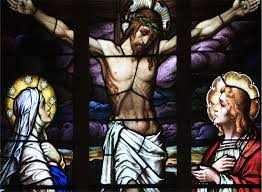
Good morning, Beloved. Today we are looking at the fourth time Jesus spoke from the cross. Now that we’ve gotten the transliteration – the representation of letters or words written in one alphabet using the corresponding letters of another – and pronunciation down, we can look at what this means. Since we got off to such a “technical” start, I’ll get right to the point so that you don’t have to spend a lot of time deciphering the Greek and Hebrew above.

When we hear either of these readings during the Passion narrative, there are usually questions that arise:

  1. Why did Jesus say that?
  2. Did God really abandon him?
  3. Is that Hebrew or Aramaic?
  4. Does Psalm 22 predict the crucifixion?
  5. Why did David write this Psalm?

I’m going to go in reverse order because the first question is the most important of these five questions.

Why did David write this Psalm? We don’t know the exact circumstances, but it is believed that he was in pain. This is a form of poetry called a lament. More specifically this is a personal or individual lament. David is lamenting the constant persecution by his enemies who are gentiles (hence the reverence to dogs in verse 16). He is wearied with dealing with them. David’s own agony over his relentless enemies is also applied to others who are suffering. This may also have been a cry for deliverance from a mortal illness; we don’t know exactly what David had on his mind. But it is vital to remember that this is only one verse out of 31.

In the first part, verses 3-13, David recalls God’s merciful intervention in the past. In verses 14-21, he is surrounded by terrible enemies such as wild dogs that bite at him and “Bulls of Bashan.” This idiom is a figure of speech had depicts powerful enemies who, like a gathering of many powerful bulls, surrounded him. Bashan is an area where the largest and strongest cattle were raised, so the Bulls of
Bashan represented the rich and powerful oppressors of the people. In verses 22-27, there is a description of universal praise for God. The last four verses, 28-31, are a declaration that those who rely on the Lord will know the glory of his victory over their enemies. What begins in agony ends in victory.

Does Psalm 22 predict the crucifixion? It is certainly easily supported that this is also a prophetic look into the persecution and death of “his holy one.” (See Psalm 16) There are many correlations between the hours during which Jesus hung in agony on the cross and the events described in Psalm 22. The piercing of the hands and feet, the dehydration, the rapid heartbeat from shock and blood loss, that extreme agony of being stretched out so that it is nearly impossible to breathe, and isolation of dying alone and helpless while being constantly mocked. The parallels are easily found. Some persons read into the words in the Psalm more than some others might; nonetheless, it is chilling to note the similarities between David’s lament and the Passion of Our Lord.

Is that Hebrew or Aramaic? This is, perhaps, one of the most difficult questions about this passage because the answer is “Yes,” and “No,” and “perhaps.” As you can see by the Hebrew and Greek texts at the top, there are some similarities and differences between the accounts of this quote in Matthew and Mark. Rather than spend several pages comparing and contrasting the two, I will just briefly say that the one in Matthew is closer to Aramaic in the first part – My God, my God – but closer to Hebrew in the second part – Why have you forsaken me? In Mark’s version, what we see is closer to the Greek words: ᾿Ελωΐ, ᾿Ελωΐ which means My God My God and the transliteration is Eloi, Eloi. In both passages there is a difference between the ending word in the New Testament and the ending work in Psalm 22. Since the writers of these Gospels were kind enough to provide translations for the phrases they wrote down, it is sufficient to say that – by comparrison – all three say the same thing in only slightly contrasting ways. The language in which it is expressed is not as important as the content which the Apostles Mark and Matthew provided for us as translations.

Did God really abandon him? Again, the answer appears to be both “Yes,” and “No.” The humanity of Jesus certainly felt the abandonment of being alone in his death throes. God did not abandon Jesus’ to suffering, but Jesus perhaps felt the same sense of hopelessness that all humans feel in times of great duress: “Where is God in all this suffering? Surely a good God would not allow this?” Still, we know that when we are deep in the grips of sin, we feel distanced from God and that is a terrible form of suffering alleviated only by our decision to return to him “with a heart humbled and contrite.” We are reminded of the remarkable prophecies in Isaiah 53, especially verse 10: Yet it was the will of the Lord to crush him with pain. When you make his life an offering for sin, he shall see his offspring, and shall prolong his days; through him the will of the Lord shall prosper. God knew what was happening to his Son, and he rewarded the obedience of the Son with the forgiveness of all who believe in Jesus, and in his death and resurrection. Jesus completed his mission there on the cross. As we have said before, it was not the nails that held Jesus to the cross. It was his obedient Love of God the Father that held him there for our sake.

Why did Jesus say that? This is perhaps the simplest question to answer because we now know so much about the Jews of that time and place. Jesus fully understood what was needed; he informed his disciples several times that he was going to be turned over to his enemies, suffer greatly, die, and be raised again. They simply could not understand what all that meant. He also had supreme confidence in God’s purpose, power, and providence – his divine intervention in the fate of all earthlings. Consider that Jews in Jesus time were, for the most part, well-trained in the Law and the Prophets. The Psalms were something like the Hymnal of the Hebrews. People, especially men, were expected to know them and to be able to recite them “on demand.” Thus, a teacher of Hebrew Scripture would expect his students to be able to take a cue from the beginning of a Psalm and then recite the entire thing, all the while rehearsing in their mind what they had been taught about its meaning. For example, today if someone were to say or sing “Oh say can you see …” most of us would be able to go on with that famous lyric. If someone said “In the land where I was born / Lived a man who sailed the sea …” we might not be able to recall the entire text, but we would at least know what it was about and generally what happened. “If I were to say, “For God so loved the world that …” probably most of the world could finish that sentence. In Jerusalem at that time if someone spoke the words “Eli, Eli, lema sabachthani?” the Jewish listeners would know the next 29 verses. They would know the various parts of that Psalm, and that it contained confident praise of God and an assurance of victory by God’s strong hand. Jesus knew this also, and from the cross led many minds to that Psalm which had been memorized by pious students of the scriptures and was always readily available for recitation. It was often used by Jews to remind them that, even in the face of death, God was with them and would provide the victory for them.

Let us therefore raise our minds from the isolation and forsakenness of the crucifixion and, like Jesus, know that however real the pain and suffering, the Salvation and Glory of God is incomparably greater. Let’s not get hung up on just the beginning, but let us instead see the whole context of this Psalm. Even beyond that, we need to be aware that taking bits and pieces of scripture to ponder, quarrel over, and use for personal aggrandizement is truly foolish. The Word is best understood in the context of the Whole Word, and the Whole Word is the voice, the heart, and the very mind of God.

Whatever, whenever, wherever, whoever, however, if ever, forever — at your service, Beloved

Unless otherwise indicated, all scripture passages are from the New Revised Standard Version Catholic Edition (NRSVCE) New Revised Standard Version Bible: Catholic Edition, copyright © 1989, 1993 the Division of Christian Education of the National Council of the Churches of Christ in the United States of America. Used by permission. All rights reserved.

Creative Commons License
Aloha Friday Messages by Charles O. Todd, III is licensed under a Creative Commons Attribution-ShareAlike 3.0 Unported License
Aloha Friday Message – March 6, 2015 – Third Friday of Lent

1510AFC030615 – By Love Adopted

Read it online here, please

John 19:26-27 – 26 When Jesus saw his mother and the disciple whom he loved standing beside her, he said to his mother, “Woman, here is your son.” 27 Then he said to the disciple, “Here is your mother.” And from that hour the disciple took her into his own home. New Revised Standard Version Catholic Edition (NRSVCE)

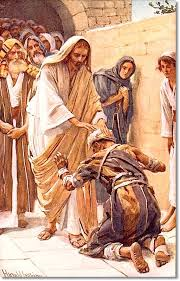
WomanBeholdToday is the third Friday of Lent, and we continue with the Seven Words of Christ. In this scene at the foot of the Cross, Mary the Mother of Jesus, the Apostle John, and other women who were friends and supporters of Jesus and the Disciples are near enough to the Cross that they can see and hear Jesus and he can see them. Although none of the Gospel accounts record that this group followed Jesus as he carried his Cross to Golgotha, we do know that after he had been crucified and had endured the agony of that cruel torture for some time, he spoke first to his Father begging forgiveness for his executioners. A little later on, as the crowd and the soldiers mocked and jeered beneath him, he spoke words of forgiveness and hope to the repentant thief crucified along with him. At this point in his Passion, he turns to his Mother and to John and with kindness so characteristic of the Son of God, he commends his mother to the care of The Beloved Disciple, John; and Jesus also commends John to Mary’s care. John has already left his family behind to follow Jesus. (See Mark 1:20) Now Jesus gives John and Mary an adoptive family.

It is quite probable that John’s parents, Zebedee and Salome, were still alive; but, they are not mentioned as bystanders by the Cross. As we look through the Gospels, this is the list of women there during that terrible day: Mary Magdalene, Mary the mother of James and John, and the mother of the sons of Zebedee (Matthew 25:55-56), and Jesus’ mother’s sister Mary the wife of Cl(e)opas (either Clopas or Cleopas, probably the same person). John was the only man who had traveled with Jesus during his ministry who had the love and courage to stand by him during his Passion and death; but, several of the women who were among his most active disciples were there, including his Mother, his first true disciple. She and John went on to spread the Gospel after Jesus’ ascension. I can only imagine how wondrous it must have been to hear Mary say, “Let me tell you about my Son,” all the while depending on her “adopted” son, John.

When I think of adoption, I often remember the story of Mephibosheth { mef-ee-bo’-sheth} (or Merib-baal), the crippled son of King David’s friend Jonathan. After David had defeated all his enemies, he searched for any relatives of Jonathan who might have survived the wars. He was told about Mephibosheth and had him brought to his court. David restored all of Saul’s lands to him, and “Mephiboshethate at David’stable, like one of the king’s sons.” (See 2 Samuel 9). Although the concept of adoption was not expressed in the Old Testament and was not practiced by the Israelites per se, they understood this kind of relationship as one of the ways God cared for their nation. For example, through Moses he says to Pharaoh, “Thus says the Lord: Israel is my firstborn son.” (See Exodus 4:22) Through the prophets Isaiah and Hosea God states he is a Father to Israel, and has loved them as his own children. In Psalm 2:7, David writes, I will tell of the decree of the Lord: He said to me, “You are my son; today I have begotten you.”  And Paul cites 2 Samuel 7:14 in Hebrews 1:5 – For to which of the angels did God ever say, “You are my Son; today I have begotten you”? Or again, “I will be his Father, and he will be my Son”? Paul understood our kinship with Christ as an adoption – we are sisters and brothers of the Lord through adoption by the Father, and – I think – by the Son as well.

And of course, the most famous Old Testament story of adoption is the story of Moses. In Exodus 1:15-22, we learn that Pharaoh had decreed that the midwives who attended to the Hebrew women were to dispose of the males but keep the females. Later, in Exodus 2:1-10, we read that a Levite woman named Jochebed gave birth to a male child and, putting him in a waterproof basket, set him adrift in the Nile where he was discovered and subsequently adopted by Pharaoh’s daughter. It was God’s will that the child would become Moses, and to lead the Hebrews out of Egypt.

In the Gospels of Matthew, Mark, and Luke Jesus clearly states that whoever does God’s will is his brother and sister and mother. See Matthew 12:46-50, Mark 3:31-35, and Luke 8:19-21. The Apostle Paul refers to our relationship with God the Father and God the Son as an adoption in these passages:

Galatians 3:29 29 And if you belong to Christ, then you are Abraham’s offspring, heirs according to the promise.

John 1:12-13 12 But to all who received him, who believed in his name, he gave power to become children of God, 13 who were born, not of blood or of the will of the flesh or of the will of man, but of God.

Romans 8:14-18 14 For all who are led by the Spirit of God are children of God. 15 For you did not receive a spirit of slavery to fall back into fear, but you have received a spirit of adoption. When we cry, “Abba!Father!” 16 it is that very Spirit bearing witness with our spirit that we are children of God, 17 and if children, then heirs, heirs of God and joint heirs with Christ—if, in fact, we suffer with him so that we may also be glorified with him.

Understanding adoption may be difficult for some of us who have not experienced adoption. Here in Hawaiʽi there is an old tradition of Hānai which is an informal adoption and promise of caregiving between two persons. Here it is often one family “grafting” their child or other relative into another family. Other Polynesian cultures have similar traditions. The long, complicated, and often frustrating process of legal adoption is another relationship many of us do not understand well unless we have been through it. Crucita and I have done that twice, and it is so very true that we love our children deeply and uniquely, and I believe in some ways with intensity equal to or greater than parents who are able to bear children. We also have a practice called Spiritual Adoption. It’s a little different from the Spiritual Adoption of Unborn Human Life in that it is a consensual agreement between us and another (or others) to pray for and care about someone we love. Here’s how it goes:

SPIRITUAL ADOPTION

_____________, I claim your life in the name of Jesus. From this day forward may no person, place, thing, idea, or spirit ever hinder or harm the bond in His love that exists between us now; and so may Almighty God bless you, and I bless you [S.O.T.C. (+) traced on the forehead] in the name of the Father, and of the Son, and of the Holy Spirit. _________________, from now on, you are a [brother/sister // son/daughter // etc.) to me as we are children of the Father, and heirs with the Son through the Unity of the Holy Spirit. Peace be with you.

When these words are spoken, “I claim your life in the name of Jesus,” It means the adoptive parent/sibling is taking on the responsibility of caring for the spiritual welfare of the adopted child/sibling. It is a pledge to lovingly pray for each other with the closeness of a sacred and consecrated familial bond. In some cases, Spiritually Adopted persons achieve a relationship that is even closer that biological relationships.

It would be negligent of me not to mention that sometimes being adopted is difficult. We’ve all seen movies, news reports, and documentaries about children who  were “given up for adoption” finding their birth parent(s), or birth parents praying for and about the children the released into the love of an adoptive family. Usually adoption works out well, and these children – born of two hearts from two mothers – grow up knowing who they are as individuals. Some never look for their birth parents, content to know that they had the unconditional love of their adoptive parents. Some always long for that connection to the “other family,” the brothers and sisters, cousins, grandparents, aunts and uncles that are somewhere out there. I think that is like the ache we feel for the Family of God – we want to be with them and for them to be with us. Even in death, we long to be reunited, and often reach out – or feel connected still – to loved-ones who have passed. I believe that is because we all recognize that there is something Eternal within us; it is that Love about which Paul wrote, the love that makes us cry out to God “Daddy! Father! I love you!” We know that love because our God gave us his only begotten Son, and on the Cross the Son gave us his Mother and His brother as examples of the true kindred of Christ: Those who do the will of his Father.

And yes, I do know I am the Brother of Jesus, a son of the Father, and am so very grateful that I can choose and have chosen Mary to be my Mother just as John chose her there at the foot of the Cross.

Whatever, whenever, wherever, whoever, however, if ever, forever — at your service, Beloved

Unless otherwise indicated, all scripture passages are from the New Revised Standard Version Catholic Edition (NRSVCE) New Revised Standard Version Bible: Catholic Edition, copyright © 1989, 1993 the Division of Christian Education of the National Council of the Churches of Christ in the United States of America. Used by permission. All rights reserved.

Creative Commons License
Aloha Friday Messages by Charles O. Todd, III is licensed under a Creative Commons Attribution-ShareAlike 3.0 Unported License

Aloha Friday Message – February 27, 2015 – Second Friday of Lent

1509AFC022715 – Next Stop Paradise

Read it online here, please.

Luke 23:43 He replied, “Truly I tell you, today you will be with me in Paradise.”

May blessings always be with you and may God bless you, Beloved!

“Where is the world is Paradise?” Well Beloved, you know the answer. Paradise is not in this world, it is the Next World. It is The Next World.

“So, why is the Garden of Eden called Paradise?” Because Paradise means “garden.” Let’s take a closer look at that before going farther with our study of this, the Second Word of Christ. The Greek word for Paradise is παράδεισος (paradeisōs) {par-ad’-i-sos}. In turn, that Greek word comes from an ancient Persian word transliterated as pairidaēza. That denoted a special place of leisure, pleasure, and calm such as a walled-in garden or park. It was planted with trees and flowers, and a place of peaceful bliss and harmony. It was a place specifically designed to make the best use of light, vegetation (trees, shrubs, and flowers), irrigation (as in flowing streams), and traditionally stresses artistic and sensorial features over functionality. It is a beautiful place to pass the time beautifully.

Eden was Paradise for Adam and Eve, and apparently a place of visitation for God who walked there with them (See Genesis 3:8). The link in the previous sentence identifies the location of the Garden God created “east of Eden.” (You should investigate information about John Steinbeck’s novel by that title as well as the movie directed by Ilia Kazan and starring James Dean, Julie Harrison and Raymond Massey). The word Paradise is not used per se in the Old Testament. In the Greek translation of the OT, it is used sparingly and generally used when referring to a resplendent garden or other magnificent views; however, by Jesus’ time it was a well-known and much-used connotative word for Heaven. Another tem was “The Garden of God.” It occurs only three times in the New Testament – in Luke 43:23 (above), 2 Corinthians 12:4 (Paul is describing “someone” caught up in spirit to Paradise), and Revelation 2:7.

Today we use the word Paradise to describe a place of exquisite beauty. Crucita and I have lived in Colorado, New Mexico, Texas, Arizona, Alabama, and Diné Tah (Navajo Country), and we found all of those places to have the characteristics of Paradise. Now, of course, we live in Hawaiʽi which just about everyone calls paradise! Still, all these places (and all the places where you have found Paradise) are barely shadows or amorphic images of the True Paradise.

So we began with a Persian word which roughly translates as an incredibly beautiful enclosed garden like the famous Hanging Gardens of Babylon. That morphs into the Greek word παράδεισος. In the Greek translation of the Old Testament (The Septuagint), the Hebrew word for garden – גָּן (gan) {gahn} was translated as paradeisōs – paradise. The end-times theology (eschatology) of Jewish, and later, Christian messianic thinking was that heaven would be a splendiferous garden of eternal bliss, light, joy, and freedom from any form of misery. There are abundant non-canonical  references to Paradise, its nature, and its location, but there is no such detail in the accepted canon of Jewish or Christian scripture. The New Testament occurrences of the word are written in the spirit of Jewish apocalyptic literature – a genre of literature in the Bible that focuses on the end time. In our opening scripture, Paradise is the place where Jesus and the repentant thief are going. Again, looking at the Greek for  the last phrase in this verse (today you will be with me in Paradise.) – which says σήμερον μετ’ ἐμοῦ ἔσῃ ἐν τῷ Παραδείσῳ – the word σήμερον semeron {say’-mer-on} means this very day. Another word of interest here is ἔσῃ comes from the Greek word εἰμί (eimi) {i-mee’} for to be or to exist. All of the words in the phrase are crystal clear about what they denote so that we could read it as “this very day exactly you will actually be with exactly me in exactly Paradise.” Pretty clear what he meant, yes? Considering the pain he and his two compatriots were in, it was not a time for dithering about word choices. So, is Paradise Heaven, then?

Yes; well, probably yes. So what is Paradise? Honestly, we don’t really know, but there are lots of good guesses out there based on similar concepts used in the Bible – like Sheol.

Sheol is Hebrew for hell, which is also translated as Hades in Greek. In scripture, this is the “abode of the dead” (see CCC  §633). This is also translated in the Old Testament as death, the pit, or the grave. It is void of activity, and awaiting place for the resurrection. There is no pomp, no power, no privilege. Travelers, particularly sinners (like us) going to Sheol are like sheep shepherded by Death. In Psalm 49:14-15 we read

14 Like sheep they are appointed for Sheol;
Death shall be their shepherd;
straight to the grave they descend,
and their form shall waste away;
Sheol shall be their home.
15 But God will ransom my soul from the power of Sheol,
for he will receive me. Selah

Sheol is not a physical place on Earth. It is a place which only God can see, and only he can deliver a soul from their abode there (I Samuel 2:6). It is from Sheol – Death –  that God will call us. Christ was given the keys to Sheol and Hades (Revelation 1:17-18) when the time comes for the Final Judgment. In Revelation 2:7, Paradise is the ultimate location of the Tree of Life – Heaven.

None of can avoid death, of course. Whenever I think of that, I remember a lyric by Hank Williams:

“No matter how you struggle or strive,
You’ll never get out of this world alive.”

There are lots and lots of brilliant dissertations and theological loop-de-loops about all this. It’s not my place to take you there, though. I just want you to know that God always means what he says (even if we don’t fully understand it all yet), so when Jesus said, “Truly I tell you, today you will be with me in Paradise.”, that is exactly what happened. “Why do I need to know that?” you might ask. You should know this Truth that God says what he means and means what he says because if you don’t know that truth you don’t know God. Even Jesus’ enemies acknowledged his truthfulness. Matthew 22:16 16 So they {the Pharisees} sent their disciples to him, along with the Herodians, saying, “Teacher, we know that you are sincere, and teach the way of God in accordance with truth, and show deference to no one; for you do not regard people with partiality. The Apostle John tells us that Jesus is the essential element in knowing Truth in 1 John 5:20 20 And we know that the Son of God has come and has given us understanding so that we may know him who is true; and we are in him who is true, in his Son Jesus Christ. He is the true God and eternal life.

Jesus’ word to the repentant thief was a word of forgiveness, as was the First Word, “Father forgive them …” He first forgave his executioners. Next he forgave one who acknowledged the justice of his own punishment, repented of his sins, and asked to be remembered in Jesus’ Kingdom. Today we still read about this man who, at Death’s door, appealed to the Creator of Heaven and Earth for Mercy. Shall we not do likewise, and appeal The One who overcame Death?

Whatever, whenever, wherever, whoever, however, if ever, forever — at your service, Beloved

Unless otherwise indicated, all scripture passages are from the New Revised Standard Version Catholic Edition (NRSVCE) New Revised Standard Version Bible: Catholic Edition, copyright © 1989, 1993 the Division of Christian Education of the National Council of the Churches of Christ in the United States of America. Used by permission. All rights reserved.

 
Creative Commons License
Aloha Friday Messages by Charles O. Todd, III is licensed under a Creative Commons Attribution-ShareAlike 3.0 Unported License
 

Aloha Friday Message – February 20, 2015 – First Friday of Lent

1508AFC022015 – Father Forgive Them

Read it online here, please. (Lots of good links here. Please use them.)

Genesis 50:16-1716 So they approached Joseph, saying, “Your father gave this instruction before he died, 17 ‘Say to Joseph: I beg you, forgive the crime of your brothers and the wrong they did in harming you.’ Now therefore please forgive the crime of the servants of the God of your father.” Joseph wept when they spoke to him.

This is the first occurrence in the Bible of using the word forgive when asking for forgiveness. The verb in Hebrew is נָשָׂא nasa’ {naw-saw’}. This verb carries with it the idea of carrying away, carrying off, lifting, taking away, to lift up, exalt, support, aid, assist, forgive. Looking at all of that together, the word that comes to my mind is “unburden.” Take away the burden of our guilt. Take away the weight of my sin. Lift away the condemnation for what I – we – you – s/he – they have done. Reuben and Judah somewhat lessened the cruelty of the crime against their brother Joseph. Reuben counseled against killing him, but left the area planning to come back and “rescue him.” But Judah suggested that instead of leaving him in the dry cistern to die that they sell him to the caravan of Ishmaelites passing by. When Reuben got back, the deed was done, and the rest is His-Story. Out of that horrible scenario, God provided for the salvation of Joseph’s family during a great famine, and eventually, our salvation from our burden of sin, too.

All of us at some time feel burdened by our sins. We know our sins can be forgiven, but we also know that there are consequences for sin that sometimes cannot be avoided. How often have you seen a convicted murderer forgiven by a victim’s family, but still go to jail for 25 to life? Forgiveness removes the debt, but does not always eliminate the consequences; not always. Sometimes even the temporal consequences are diminished or eliminated, and that comes usually out of love, compassion, or pity. It’s one of those WWJD things. He didn’t want us to be overwhelmed with sin. That’s a common theme in the Psalms. Here are a few examples:

Psalm 38:4 For my iniquities have gone over my head; they weigh like a burden too heavy for me.

Psalm 130:3 If you, O Lord, should mark iniquities, Lord, who could stand?

Psalm 51:3-53 For I know my transgressions, and my sin is ever before me. Against you, you alone, have I sinned, and done what is evil in your sight, so that you are justified in your sentence and blameless when you pass judgment. Indeed, I was born guilty, a sinner when my mother conceived me.

There’s no getting around it; we are sinners, and we need God’s forgiveness without which eternal life is impossible. How do we get forgiveness? When Jesus taught his disciples to pray, he included the idea of forgiveness. “Forgive us our debts as we forgive our debtors” or “Forgive us our trespasses as we forgive those who trespass against us.” There are two ways to say that prayer, and they are different. The Lord’s Prayer is found in the Gospels of Matthew and Luke. Matthew’s in is Matthew 6:9-15. Luke’s is in Luke 11:1-4. (Notice that the Doxology – the short hymn of praise at the end of the prayer – appears in the King James Version, and several others, but not all versions. Take a look at the link for Doxology to see what I mean.) Back to the Lord’s Prayer: In Matthew 6:12 we read either debts or sins. In Luke 11:4 we read, “forgive us our sins as we forgive everyone indebted to us.” In both versions, the idea of trespasses comes after the completion of the prayer. Jesus says that we cannot be forgiven if we do not forgive. It’s that pesky little word “as.” Forgive us as we forgive others. Love one another as I have loved you. Be perfect as your Heavenly Father is perfect. Be merciful as your Father is merciful. That as has been identified here previously as being like an identity sign ≡. That “as” means “in precisely this same way.” Bottom line: Forgiveness isn’t complete unless we are forgiving.

The Greek word for forgive is ἄφες aph’-es {af’-ace}, to disregard, to let go, give up a debt, forgive, to remit.

Debts = ὀφειλήματα opheilēmata {of-i’-lay-mah-tah} something which is justly or legally due, a debt, and in a religious sense, sin.

Debtors = ὀφειλέταις opheiletes {of-i-let’-ace}, one held by some obligation, bound by some duty, one who has not yet made amends to whom he has injured; one who owes God penalty or whom God can demand punishment as something due, i.e. a sinner.

Trespasses = παραπτώματα (paraptōmata) {par-ap’-to-mah-tah} = transgressions, offenses, misdemeanors, wrongdoings, indiscretions, “guilty-pleasures.”

For Catholics the idea of sins, debts, or transgressions is summed up in the word trespasses, which word we find in Matthew 6:14-15 14 For if you forgive others their trespasses, your heavenly Father will also forgive you; 15 but if you do not forgive others, neither will your Father forgive your trespasses. (Also see Matthew 18:32-35 and Mark 11:26) Christ’s Passion, Death, Resurrection, and Ascension cinched the deal for every living soul who believes that Jesus is the only begotten Son of Almighty Everliving God. Jesus came to preach the Gospel and to deliver us from the wages of sin which is death. He did that through his intercessions for forgiveness of our sins by becoming sin itself. Everything he did – every single thing – was geared toward one thing: Reconciliation with God through the forgiveness of sins. When we look at the seven statements Jesus made during his crucifixion, it is little wonder, then, that the first statement he made was to ask God the Father to forgive the murders of God the Son.

That word – FORGIVE – may mean a little more to us if we understand how God intended to use it. It started with the abuse of Joseph who began his service to God as a slave in Egypt and rose to be a Vizier and Chief Steward in the House of Pharaoh. It was Joseph who forgave his brothers of their duplicity. Throughout the history of Israel thereafter, forgiveness was a gift from God, a gift of love – love for God and love for neighbor. Jesus loved each of us enough to take the punishment for our sin, to pay our debt, to wipe out our transgressions great and small. That was the first thing on his mind while he was fixed to the cross in horrible agony. Forgiveness has a price, and he paid it in full. Thank God for that. So how did Jesus use that word “forgive?”

Luke 23:34Then said Jesus, Father, forgive them; for they know not what they do. And they parted his raiment, and cast lots. Authorized (King James) Version (AKJV)

Can we say, though, that we don’t know what we’re doing when we sin? I don’t think so, do you? He forgives us anyway whenever we humble our hearts and seek that forgiveness. Psalm 51:7New Living TranslationThe sacrifice you desire is a broken spirit. You will not reject a broken and repentant heart, O God. Jesus forgave his executioners and thereby began the forgiveness of the whole world.

That is just SO AWESOME!

Whatever, whenever, wherever, whoever, however, if ever, forever — at your service, Beloved

Unless otherwise indicated, all scripture passages are from the New Revised Standard Version Catholic Edition (NRSVCE) New Revised Standard Version Bible: Catholic Edition, copyright © 1989, 1993 the Division of Christian Education of the National Council of the Churches of Christ in the United States of America. Used by permission. All rights reserved.

Creative Commons License
Aloha Friday Messages by Charles O. Todd, III is licensed under a Creative Commons Attribution-ShareAlike 3.0 Unported License

Aloha Friday Message – February 13, 2015 – The Hand of the Prophet

1507AFC021315 – The Hand of the Prophet

Read it online here, please.

Mark 1:40 40 A leper came to him begging him, and kneeling he said to him, “If you choose, you can make me clean.”

Happy Aloha Friday, Beloved. We are creeping up on the season of Lent, so this will be the last of the messages on the readings from Ordinary Time. Next week we may continue with comments about the readings for Lent – or, we may start a series. Any suggestions? I have one recommendation already to focus on the Last Words of Christ during Lent. We’ll see what the Lord provides. Meanwhile, we have this story today of a leper who asks Jesus for healing. Jesus fills the request very simply. He reaches out, touches the man and says, “I do will it. Be made clean.”

I think sometimes when I read that first sentence, it is easy to misread it and say, “I will do it.” That’s not what he said; he said, “I do will it.” That makes a difference doesn’t it? Once again we see that Jesus has authority over illness. The first miracle in the Gospel of Mark is the casting out of an unclean spirit – a demon (Mark 1:23-26), the second is the healing of Peter’s mother-in-law (Mark 1:30-31), and this healing of a leper is the third. In the incident with the demon, it was the demon that called out to Jesus. With Peter’s mother-in-law, Jesus learned she was ill and went to her on his own. In this healing of a leper, the man humbles himself before Jesus and states – he does not ask – “If you choose, you can make me clean.” Other translations might read that as If you are willing, or If you want to. The Greek word for choose or willing or want to is θέλῃς thelo {thel’-o}. This word also includes the concept that one would take delight in, or have pleasure in doing so. If we stretch it a bit we could read this sentence as “If it would please you, you can make me clean.” However we look at what the man said, Jesus response was and emphatic I WILL (θέλῃς or ἐθέλω ethelo {e-thel’-o}.).

In these three miracles we see something of the way Jesus responds to instances where his power to heal is exercised. He heals when confronted with evil. There are many passages where Jesus is described as “healing their illnesses and casting out demons.” He heals of his own volition as in this example in Mark or in the instance of the raising of the son of the widow of Nain in Luke 7:11-16. He heals when someone humble presents Jesus with an opportunity to heal, and these are usually accomplished through expressions of the petitioner’s faith. In this story of the leper, we again see Jesus strictly telling the man not to tell anyone about what has happened. Of course, the guy immediately takes off and tells everyone he sees! Jesus knew his mission, and he knew he didn’t have a lot of time to complete it, so he didn’t want to kick the hornets’ nest too hard and give his enemies a quicker and clearer reason for going after him. He was doing mighty deeds – which marks him as a Prophet – and the powers-that-be had been pretty rough on Prophets for the previous 1300 years! The result of this publicity was that Jesus had to stay out of town and inhabit “desolate places.” Still, people from all the surrounding region came to find him (see Mark 1:45). He created quite a buzz.

One reason people wanted to see him, of course, was because of his growing reputation as being a miracle worker. In the last verse of the story in Nain, (Luke 7:16), we read, 16 Fear seized all of them; and they glorified God, saying, “A great prophet has risen among us!” and “God has looked favorably on his people!” This frame of mind is an echo of the effect Elisha’s healing of Naaman had on the people of Israel. Naaman had gotten permission from the king of Aram to go to Israel and find Elisha in the hope of being cured of his leprosy. He sent Naaman to the king of Israel asking for safe passage for his soldier. Here’s what happened in 2 Kings 5:7-8 When the king of Israel* read the letter, he tore his clothes and said, “Am I God, to give death or life, that this man sends word to me to cure a man of his leprosy? Just look and see how he is trying to pick a quarrel with me.” But when Elisha the man of God heard that the king of Israel had torn his clothes, he sent a message to the king, “Why have you torn your clothes? Let him come to me, that he may learn that there is a prophet in Israel.” * Possibly Jehoram.

Naaman’s request for healing was granted when he did as Elisha told him – dunk himself in the Jordan seven times. Sometimes God heals by stretching out his hand and touching  the supplicant, sometimes it is through a command as with the ten lepers in Luke 17:11-19, and – as with the widow of Nain – with both a touch and a command. The phrase “stretched out his hand” (or sometimes “stretch out your hand”) is a depiction of God in command-mode. He is the wonder-working God, and that is what the people saw. After Pentecost, Peter and John were preaching in Jerusalem, and the authorities told them they had to stop. Instead they prayed that they might preach with greater boldness in Acts4:23-31 and part of that prayer is 29 “And now, Lord, look at their threats, and grant to your servants to speak your word with all boldness, 30 while you stretch out your hand to heal, and signs and wonders are performed through the name of your holy servant Jesus.” As soon as they finished, the place in which they were gathered together was shaken; and they were all filled with the Holy Spirit and spoke the word of God with boldness. Take a look at Exodus 14 for more about God’s mighty deeds. Remember, though, that often Jesus not only healed but also forgave. There, indeed, is God’s mightiest feat! When he speaks, things happen; what he touches, he changes – unless we turn a deaf ear and run from his outstretched hand!

Isaiah prophesied that what God spoke as The Word would accomplish what God intended in Isaiah 55:10-1110 For as the rain and the snow come down from heaven, and do not return there until they have watered the earth, making it bring forth and sprout, giving seed to the sower and bread to the eater, 11 so shall my word be that goes out from my mouth; it shall not return to me empty, but it shall accomplish that which I purpose, and succeed in the thing for which I sent it. That purpose is for us to be reconciled with God, a healing certainly of our souls, but sometimes even our minds and bodies, too. As we approach the Season of Lent, let us follow the example of this leper in Mark and kneel humble at the feet of the Lord with the expectation of healing. Then, as David said, let us acknowledge our sin: Psalm 32:5 Then I acknowledged my sin to you, and I did not hide my iniquity; I said, “I will confess my transgressions to the Lord,” and you forgave the guilt of my sin. Selah

“If you choose, you can make me clean.”

Open your ears, your heart, and your mind and listen for his reply: ἐθέλω. The hand of the Prophet is stretching out toward you. Kneel and be healed.

Mark1-40


Whatever, whenever, wherever, whoever, however, if ever, forever — at your service, Beloved

Scripture passages from –

New Revised Standard Version Catholic Edition (NRSVCE)

New Revised Standard Version Bible: Catholic Edition, copyright © 1989, 1993 the Division of Christian Education of the National Council of the Churches of Christ in the United States of America. Used by permission. All rights reserved.


Creative Commons License
Aloha Friday Messages by Charles O. Todd, III is licensed under a Creative Commons Attribution-ShareAlike 3.0 Unported License

Aloha Friday Message – February 6, 2015 – What’s your Gripe?

1506AFC020615 – What’s Your Gripe?

Read it online here, please.

Job 7:6-7, 16-19“My days are swifter than a weaver’s shuttle, and come to their end without hope. Remember that my life is a breath; my eye will never again see good. I loathe my life; I would not live forever. Let me alone, for my days are a breath. What are human beings, that you make so mruch of them, that you set your mind on them, visit them every morning, test them every moment? Will you not look away from me for a while, let me alone until I swallow my spittle?”

E pili mau na pomaika‘i ia ‘oe a me ke akua ho’omaika’i ‘oe, ʻōmea! (May blessing always be with you and may God bless you, Beloved!) This weekend we will be hearing a passage from the Book of Job. This is a very ancient piece of literature, probably composed around 2500 B.C. – and may believe it came into being even earlier than that in the 7th, 6th, or 4th centuries B.C. The passage above is from the Judeo-Christian Tradition, but there is also a so-called “Babylonian Job” called The Ludlul-Bel-Nimeqi. There are a few similarities, but generally the two are quite different. The one thing they both have in common is the apparently unjust and horrific suffering of a genuinely religious person. Both stories take up an old, old question: “Why must there be suffering?” Rabbi Harold Kushner took up the question again in 1978 with his book When Bad Things Happen to Good People. He concluded that basically God was not powerful enough to eliminate evil. We saw recently in Isaiah 59:1 See, the Lord’s hand is not too short to save, or his ear too dull to hear. He does have the power, and chooses not to use it. Still, suffering and evil are mysteries we deal with in our daily lives – daily lives. We can’t help but ask, “WHY?” this is an especially important question if it is we who are suffering.

Many times this question takes the form of “Why is God doing this to me?” Another form is “How can a supposedly loving God allow this to happen?” I want to focus on those two questions first. “Why me” is rooted in the idea that God uses suffering as a punishment for evil. The Old Testament is often cited as a proof for this supposition. Perhaps the most elaborate construct of this idea is the conquering of Canaan by the Israelites. Think back to our lesson on Jonah. The Ninevites were a thoroughly evil people. God had it in mind to destroy them. Nonetheless he sent Jonah to warn them. The Ninevites repented and were spared – for a while. When they reverted to their evil ways, they were destroyed. Yet it took centuries of opportunities to change before their demise was accomplished. The same was true for the inhabitants of Canaan. They too were thoroughly evil and had many opportunities to change. They did not. In fact, in the case of the Amorites God gave them roughly 450 years to get it together. My point is that you are not being punished. God is getting your attention by correcting you, by showing you the consequences of your choices to be stubborn and selfish. In the book of Proverbs we read at Proverbs 3:12 For the LORD corrects those he loves, just as a father corrects a child in whom he delights. (New Living Translation). Paul cites this passage in Hebrews 12:6-7“… for the Lord disciplines those whom he loves, and chastises every child whom he accepts.” Endure trials for the sake of discipline. God is treating you as children; for what child is there whom a parent does not discipline?  You are given an opportunity to change. You can choose to do so because you have free will.

Sometimes, though, it is true. The things that happen to us are not our fault. They are not God’s fault either. Sometimes something painful happens so that something better replaces it. Have you ever been to a dentist? Have you ever had a broken bone?  Have you ever seen a marble sculpture? Sometimes painful things result in better things. Sometimes the things that hurt make us better in the long run. We have to look beyond the hurt and accept that good comes from it. Here are some additional insights from the Apostle Paul:

Romans 8:18 I consider that the sufferings of this present time are not worth comparing with the glory about to be revealed to us.

2 Corinthians 4:16-18 So we do not lose heart. Even though our outer nature is wasting away, our inner nature is being renewed day by day. For this slight momentary affliction is preparing us for an eternal weight of glory beyond all measure, because we look not at what can be seen but at what cannot be seen; for what can be seen is temporary, but what cannot be seen is eternal.

Romans 8:28 We know that all things work together for good for those who love God, who are called according to his purpose. Another way to say that is in all things God works for good.

“Eat your spinach. It’s good for you!” may seem like suffering at the time, but it’s nothing compared to having a healthy body which comes from healthy eating.

Sometimes the suffering we have to endure comes from the way others have treated us. There’s no denying that there have been gaggles of parents who abused their children but claimed “it was only discipline.” The same goes for other interpersonal relationships – siblings, spouses, children, other relatives, coworkers, supervisors, authority figures, or neighbors. We would be disingenuous to say that such abuse does not exist and does not seriously impact many lives. This reality is often the root of that second question, “How can a supposedly loving God allow this to happen?” That question is especially relevant when innocents suffer at the hands of great evil as when parents murder their own children (especially when they are unborn children), or when sociopathic killers torture and murder people. One I see quite often these days relates to ISIS and the horrific and egregious acts of terror they commit. How can people, in the name of God (whom they call Allah), do those things? As I have said here before, these acts are committed by heretics, and Allah is not Jehovah. At some points in history just about every major religious – and even antireligious – group has committed atrocities. Whoever the perpetrators are, it is still atrocious, still evil, and still a choice. We are not commanded to annihilate the earthlings that are different from us. We are commanded to love and forgive them.

Hebrews 12:15See to it that no one fails to obtain the grace of God; that no root of bitterness springs up and causes trouble, and through it many become defiled.

Ephesians 4:32 and be kind to one another, tenderhearted, forgiving one another, as God in Christ has forgiven you.

1 John 1:8-10 says, If we say that we have no sin, we deceive ourselves, and the truth is not in us. If we confess our sins, he who is faithful and just will forgive us our sins and cleanse us from all unrighteousness. If we say that we have not sinned, we make him a liar, and his word is not in us.

Matthew 6:14-15 For if you forgive others their trespasses, your heavenly Father will also forgive you; but if you do not forgive others, neither will your Father forgive your trespasses.                                                                  

Matthew 22:37-40 He said to him, “‘You shall love the Lord your God with all your heart, and with all your soul, and with all your mind.’ This is the greatest and first commandment.  And a second is like it: ‘You shall love your neighbor as yourself.’ On these two commandments hang all the law and the prophets.”

In 1 Thessalonians 5:12-22, Paul tell us to be at peace with all men, return good for evil (not evil for evil), to take care of the weak and be patient with everyone (not only others, but ourselves as well), to pray without ceasing and “in everything give thanks,” so as not to quench the Spirit, and to abstain from all appearance (and practice) of evil. That’s a pretty tall order! Yet throughout the entirety of our Bible,  God tells us to love him and each other.

So, does “love your neighbor” mean we complacently allow these evil persons to perpetrate crimes against us? Of course not! We have a moral responsibility to combat evil. The Two Greatest Laws do not say “Do No Harm.” God’s Law says to put God and neighbor first and we are to follow the whole Law. One commandment (5th or 6th depending on how you number them) forbids intentionally destroying human life. Some argue that this forbids war. Yet there are times when the so-called “just-war doctrine” compels us to take a stand. In this question, too, the key consideration is that we have a choice, and our choice should be guided by Christ’s Law of Love. Still, enduring evil and suffering – even if we do so within the guidelines of Scripture – is not easy, and we still want answers. Let’s return to Job and see how he was answered.

In the book of Job, God never tells Job why he was suffering. When you read the first part of the story of Job – Job 1:6-12 – we see that Satan – the Accuser הַשָּׂטָ֖ן ha-satan {haś·śā·ṭān} – obtains permission to demonstrate his belief that Job is a good and upright man because God has surrounded Job with divine protection. Equally important in the story, Job consistently denies that the reason for his suffering is his sin. In answer God comes down in a whirlwind and asks Job dozens of questions, and all of them are unanswerable! See Job 38:1-42:6. God never tells Job to stop complaining, either; even though the griping we looked at in the beginning of this essay is pretty harsh, God never said Job should stop. Job listens in silence and his response is also silence. He is humbled before God, and that is the posture we need to take when our lives seem to be only suffering, evil, and pain. We always have that choice to defer to him, to reverence him, to kneel in awe before him, and to surrender everything to him. What do I mean by everything?

By “everything” I mean whatever you have in your life that is contrary to the life God created in you. Can you and do you say “I hate!”? Then you have not surrendered that act of unlove to God. Do you and can you claim that God has given you more than your share of suffering and that none of it is the consequence of your own choices? God does not give you suffering. God does permit you to feel the consequences of separating yourself from him in the hope that you will choose not to make that separation the choice you select for eternity after your resurrection. “Why is God doing this to me?” “How can a supposedly loving God allow this to happen?” “Why doesn’t God fix this/me/them?” We have seen that some of the heinous evil that brings great suffering is the consequence of free will which makes Love possible. We know that the end of our life on this earth is not the end of everything because we are created in the image of God and are therefore eternal beings. We know that God can (and will always) bring great good out of great evil – think of the stories of Joseph in the Old Testament and Jesus in the New Testament. The bottom line is that suffering and evil – like salvation, creation, the trinity, and other Divine Mysteries – are things we just cannot understand. Whatever your gripe is, this one thing is clear about evil and suffering: It does not come from God. It comes from our fallen nature and is part of our journey back to the life God intends for us – eternal, sinless, and glorious just like him. We know this because we know God truly does understand our suffering. Look to the life, passion, death, and resurrection of his only begotten Son.

Whatever, whenever, wherever, whoever, however, if ever, forever — at your service, Beloved

 
Creative Commons License
Aloha Friday Messages by Charles O. Todd, III is licensed under a Creative Commons Attribution-ShareAlike 3.0 Unported License

Unless otherwise indicated, all scripture passages are from the New Revised Standard Version Catholic Edition (NRSVCE) New Revised Standard Version Bible: Catholic Edition, copyright © 1989, 1993 the Division of Christian Education of the National Council of the Churches of Christ in the United States of America. Used by permission. All rights reserved.


Aloha Friday Message – January 30, 2015 – Hesitation Nation

1505AFC013015 – Hesitation Nation

Read it online here, please.

Hebrews 3:7-8 Therefore, as the Holy Spirit says, “Today, if you hear his voice, do not harden your hearts as in the rebellion, as on the day of testing in the wilderness …”

“I wish I could lose some weight.”

“I need to start saving some money for retirement!”

“I have got to stop saying ‘yes’ to everything.”

“I should call my mom; she’s probably lonely after Dad died.”

“Tax time again. This year I’m not going to wait until the last minute.”

“You know, I ought to get back to going to church.”

OK, beloved, maybe you’ve got another “one of these days” theme in your life. I’ve got three words for you: WHAT’S STOPPING YOU? “I don’t know. I just can’t seem to get motivated to, you know, do it.” I’ve got three words for you: GET ON WITH IT. “I’m not sure where to start. It just seems so overwhelming!” I’ve got three words for you: GET OVER IT! You know that old saying, “He who hesitates is lost.” Perhaps you know this one: “Postponement is the father of failure.” For many of us who say “one of these days” it turns out to be “none of these days.” Hesitation can be fatal; no, really, especially if it is hesitation that interferes with staying or becoming healthy. That little voice we hear reminding us that we need to do something is able soothe our worrying by saying, “There’s still time.” Think back to a couple of weeks ago when I said, “Now would be a good time.” (1/11/15) In that post there was this from St. Paul – 2 Corinthians 6:2 For he says, “At an acceptable time I have listened to you, and on a day of salvation I have helped you.” See, now is the acceptable time; see, now is the day of salvation! (See Isaiah 49:8) When is that “day of salvation?” Check out Hebrews 4:7 again he sets a certain day—”today”—saying through David much later, in the words already quoted, “Today, if you hear his voice, do not harden your hearts.”

Sometimes when we hesitate, we just want someone to take us by the hand and lead us forward. Remember when Lot was visited by the Angels just before the destruction of Sodom? Genesis 19:16 When Lot hesitated, the men [angels] grabbed his hand and the hands of his wife and two daughters because the LORD had compassion on them. They led them away and placed them outside the city. (NET Bible) Sometimes we get help like that from the “angels” in our lives – a friend, a family member, a pastor – but often we are the ones who have to make the effort to get up and go. Perhaps Lot hesitated to give up what he had because he did not know what he was about to receive – safety. We often dilly-dally about making changes. First, we are programmed to dislike change; it makes us uncomfortable. And second, we often fear that what’s coming is not as good as what’s here. For Lot, as it turned out, he kept his life but he ended up losing his wife anyway, and he and his daughters escaped to a safe haven – sort of. He was taken to a little place which came to be named Zoar which means “Little Place.” Sometimes we are just too stubborn to make the change that is best for us, so we satisfice – we settle for the minimally-acceptable alternative.

Beloved, that is not God’s way. God always wants to give us his best blessings, his best protection, and his best help. When we settle for less than the best, we go against what God wants for us. The prophet Jeremiah assured us that God is prepared to give us hope regardless of our fears. In Jeremiah 29:11 God says, 11 For surely I know the plans I have for you, says the Lord, plans for your welfare and not for harm, to give you a future with hope. We should not choose things which tarnish that hope. The Israelites had heard God speaking and were reluctant to hear him again because they found it frightening even if it meant hope. Moses told the Israelites about that hope in Deuteronomy 18:17-20 – [Moses told the people:] 17 Then the Lord replied to me: “They are right in what they have said. 18 I will raise up for them a prophet like you from among their own people; I will put my words in the mouth of the prophet, who shall speak to them everything that I command. 19 Anyone who does not heed the words that the prophet shall speak in my name, I myself will hold accountable. 20 But any prophet who speaks in the name of other gods, or who presumes to speak in my name a word that I have not commanded the prophet to speak – that prophet shall die.”  God’s way is to have us rest in the safety of his Love, and that rest is surely a divine rest because it is based on God’s resting on the seventh day – it is a Sabbath rest.

In the Old Covenant, “Remember the Sabbath Day to keep it Holy” was the third commandment. In the New Covenant, we still need to take time to be with the Lord, to rest in him, to honor him, to experience his Peace. Paul says in Hebrews 4:9 So then, a Sabbath rest still remains for the people of God; it is another of God’s blessings for those who are faithfully obedient. It is also a day set aside for learning from and about God. Many of the teaching moments in the Gospels are on the Sabbath, for example in Mark 1:21 we read –  21 They went to Capernaum; and when the Sabbath came, he entered the synagogue and taught. In the passage in Hebrews the word used for “Sabbath rest” is σαββατισμὸς sabbatismos {sab-bat-is-mos’}. It is a rare word and specifically refers to “Sabbath rest.” In other passages, the word translated as “rest” is κατάπαυσις katapausis {kat-ap’-ow-sis}. In the Old Covenant, this was the rest of refuge gained by settling in Canaan. In the New Covenant, σαββατισμὸς sabbatismos {sab-bat-is-mos’} is a rest that is greatly blessed by the cessation of toils and troubles in the Kingdom by those who worship God “in Spirit and in Truth.” (See John 4:24 God is spirit, and those who worship him must worship in spirit and truth.) Jesus is the Prophet God promised in Deuteronomy. He was sent to speak to us everything that God commands.

Hardened heartIn the Gospel of John we read in John 7:16 16 Then Jesus answered them, “My teaching is not mine but his who sent me. 17 Anyone who resolves to do the will of God will know whether the teaching is from God or whether I am speaking on my own. He speaks the Truth because he IS the Truth! He says only what his Father says, does only what his Father does. (See John 12:49 and John 5:19). He is the personification of the Sabbath Rest – in the Old Covenant it was a reminder of God’s providence for his creation and for the rescue of Israel from slavery. In the New Covenant, it is the testimony of Jesus as the Lord of the New Heavens and New Earth yet to come and the rescue of every living soul who believes in him from the death of sin. God has provided everything we need to restore us to him. It is all perfectly worked out. There is no reason to hem-and-haw about what to do next. There is no reason for hesitation; however, if you are still hesitant, then keep your eyes open for the Angels who will lead you away from death to New Life. Sometimes they try to get through to you even in an email. Harden not your heart.

Whatever, whenever, wherever, whoever, however, if ever, forever — at your service, Beloved

chick

Creative Commons License
Aloha Friday Messages by Charles O. Todd, III is licensed under a Creative Commons Attribution-ShareAlike 3.0 Unported License


Except where stated otherwise, all scripture from New Revised Standard Version Catholic Edition (NRSVCE) New Revised Standard Version Bible: Catholic Edition, copyright © 1989, 1993 the Division of Christian Education of the National Council of the Churches of Christ in the United States of America. Used by permission. All rights reserved.


Aloha Friday Message – January 23, 2015 – Repenting of Repentance

1503AFC012315 – Repenting of Repentance

Read it online here, please.

1 Corinthians 7:29a, 31bI tell you, brothers and sisters, the time is running out. For the world in its present form is passing away.

Jonah 3:3-5, 10 So Jonah set out and went to Nineveh, according to the word of the Lord. Now Nineveh was an exceedingly large city, a three days’ walk across. Jonah began to go into the city, going a day’s walk. And he cried out, “Forty days more, and Nineveh shall be overthrown!” And the people of Nineveh believed God; they proclaimed a fast, and everyone, great and small, put on sackcloth. 10 When God saw what they did, how they turned from their evil ways, God changed his mind about the calamity that he had said he would bring upon them; and he did not do it.

Aloha nui loa, ʻŌmea! Repent! The world is coming to and end!

We’ve seen that cartoon dozens of times. Some frazzled bearded guy in long robes and sandals is carrying a sign announcing the end of everything. We’ve seen it in the news – predictions that on such-and-such a date at some particular time – ZAP!! Everything and everyone will burst into flame and Jesus will come in the clouds. And we grin, because first of all it’s a bit comical, and secondly because we know that “concerning that day and hour no one knows, not even the angels of heaven, nor the Son, but the Father only.” (Matthew 24:26) We may not view that threat of imminent destruction with contempt (“familiarity breeds contempt”), but maybe we don’t take it seriously enough. Any of us could see our world end any minute now – you know, when your number is up? Even knowing that, we don’t take the idea of repentance very seriously. There’s always time for that, right? Yeah, well maybe.

Paul gave sort of the same message to the Corinthians, and everyone else he spoke to or taught: YOU need to get your act together and start following Jesus’ commands to love God and each other. Paul knew that if we just stuck with those two rules it would lead us to believe in our hearts and confess with our mouths that Jesus Christ is Lord, we would be saved. (see Romans 10:9-10) Everything about that begins with the word REPENT. We’ve defined and analyzed that word enough by now to know that it means to pull a 180 in your lifestyle and then keep going in that direction. It’s the second part of that which gives us the most trouble – keep going in that direction, the direction of good behavior. God makes it absolutely clear how he wants us to behave. For starters, we’ve got the Ten Commandments, and they don’t mince any words. Then we’ve got Scripture – lots of it! There are pages and pages of laws and regulations for better living. Histories and stories and records of judgments by Judges who weigh the Truth, prophecies by prophets who prophesy on God’s behalf, Apostles who give us the Gospels, and of course Jesus himself who wraps up all of that together when he says,  “The time is fulfilled, and the kingdom of God is at hand; repent and believe in the gospel.” (Mark 1:15) We also have Peter telling us how Jesus wants this to work in Acts 2:38Repent, and be baptized every one of you in the name of Jesus Christ so that your sins may be forgiven; and you will receive the gift of the Holy Spirit.” We know what to do. We even know how to do it. We seem to be lacking, though, is how to do it longer.

That’s what we see with the Ninevites. They caught Jonah’s message, and from the King right down to the lowliest donkey, everyone repented in sackcloth and ashes. When I think of sackcloth, I think of burlap – itchy scratchy stuff made of jute and sisal. In the passage in Jonah, the saq (שַׂק saq {sak}) was probably made of some sort of animal hair – often goat hair – so I can only imagine how scratchy and smelly that would be! The Hebrews, and other ancient peoples, wore it as a sign of mourning, repentance, and/or humiliation. Sometimes the prophets wore it – sort of a “uniform.” Then there’s sitting in ashes – as did the king of Nineveh – or even as some believe, on a heap of dung as Job did (see Job 20:7 comments). I seriously doubt that many (if any) of us would go that far to demonstrate repentance! It worked for the Ninevites, though, because God decided they had done their 180 and he held off on overthrowing them. But they repented of their repentance. That led me to wonder what the Ninevites did that was so egregious, so awful that God wanted to wipe them off the face of the Earth.

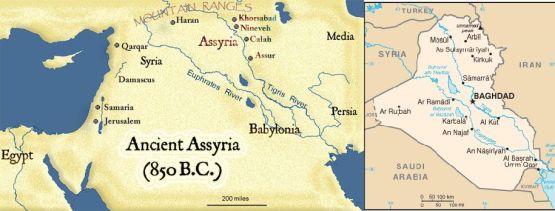
Nineveh was the capital city of the Assyrian empire. I’m going to put in a little map of Ancient Assyria, and there will also be a more modern map of the same area today.

AssyriaAreaM


The Assyrians were the ancient ancestors of the people who now live in Syria and Iraq. Nineveh’s ruins were discovered in the vicinity of a city we’re familiar with – Mosul. There was absolutely not a scarp or a scintilla of niceness in the Assyrians. They were ruthless, cruel, and thoroughly evil. They persecuted Israel for centuries, but not just Israel. They were constantly causing mayhem and monstrous suffering through their incessant hegemony over their neighbors. If fact, they considered their cruelty a virtue to be pursued and boasted about! They committed unspeakable crimes of violence against everyone – even their own neighbors. They cut off the heads of hundreds of people and bound them onto poles around the city or stacked them up in pillars. They peeled the skin of living people and then spread the skins out on the walls of the city. The amputated hands, feet, noses and ears, then blinded their victims and left them to die. One bragged he had murdered 3,000 people by burning them alive. They also highly valued prostitution, sorcery, divination, and immorality of every kind. That was the kind of town Jonah headed into. Knowing that, I’m a little more sympathetic about his being unwilling to go, and all the more impressed because he finally did go. What’s even more amazing in Jonah’s story is that they did repent – for a while anyway. Fast forward around 200 years and the prophet Nahum shows us that they hadn’t been able to maintain their spirit of repentance.

Nahum lived in the waning years of the 600’s BC. He is listed as one of the “minor prophets,” and wrote his prophecies (or historical account) somewhere around 615-612 BC, the time of the fall of the Assyrians and the destruction of Nineveh. His writing is in poetry, and even though it condemns the crimes of Nineveh and the Assyrians, it does so with rollicking poetry. Chapter 3 of Nahum describes God’s judgments against them. It’s every bit as harsh as what they deserved. (That’s really worth reading if you can spare a few minutes.) God had judged and destroyed other cities in the neighborhood, and had run out of patience with Nineveh. He humiliated them in grand ways, turning their boastings into accusations against them and depriving them of everything they valued, even to the point of seeking safety with their enemies. Once that nation was destroyed, it took centuries and intensive searches to find anything that remained of it. They were paid out the full wages of their sin: Death by annihilation.

There are others in our day and age who boast of their cruelty, who go to great lengths to terrorize, torture, and traumatize the world. They have turned from their opportunity to repent, and they will meet the same end as the Ninevites. They have gone “home” to their ancient territories to rebuild what they believe is the will of their gods. They will prevail for a time, but their end is ominously similar to the Assyrians’.

We have these lessons in our scriptures to teach us the difference between true repentance and false pretensions. Next time you decide to repent, God requires that you stick with it instead of saying, “Oh. It’s OK. I can always do it over again.” It is true, and I have said it many times, that there are no limits to how many times we can experience repentance. Well, it seems there is one, and the Assyrians learned about it firsthand. When we have reached the fullness of our wickedness (see Genesis 15:16), God will show us the door, and it just may be that he’s there to shut the door (see Genesis 7:16).

Repent, and be baptized every one of you in the name of Jesus Christ. The “baptism of repentance” is way better than any other alternative. The world is coming to an end for someone today. Best to be sure you’re properly prepared for that!

Whatever, whenever, wherever, whoever, however, if ever, forever — at your service, Beloved

Scripture passages from

New Revised Standard Version Catholic Edition (NRSVCE)

New Revised Standard Version Bible: Catholic Edition, copyright © 1989, 1993 the Division of Christian Education of the National Council of the Churches of Christ in the United States of America. Used by permission. All rights reserved.
Creative Commons License
Aloha Friday Messages by Charles O. Todd, III is licensed under a Creative Commons Attribution-ShareAlike 3.0 Unported License


Aloha Friday Message – January 16, 2015 – Hard-hearted Doorkeeper

1503AFC011615 – Hard-hearted Doorkeeper

Read it online here, please.

Psalm 95:7b-9O that today you would listen to his voice! Do not harden your hearts, as at Meribah, as on the day at Massah in the wilderness, when your ancestors tested me, and put me to the proof, though they had seen my work.

1 Samuel 3:9-10Therefore Eli said to Samuel, “Go, lie down; and if he calls you, you shall say, ‘Speak, Lord, for your servant is listening.'” So Samuel went and lay down in his place.

10 Now the Lord came and stood there, calling as before, “Samuel! Samuel!” And Samuel said, “Speak, for your servant is listening.”

E pili mau na pomaika‘i ia ‘oe a me ke akua ho’omaika’i ‘oe, ʻōmea! (May blessing always be with you and may God bless you, Beloved!) Last week we looked into hearing God calling us by name, picking us to be on his team, as it were. If we listen for his call and answer, if we chase him until he catches us, then we have an eternity to be with him. We also saw that, either way, our lives are going to be eternal; there will be a resurrection and some earthlings will be resurrected to Eternal Joy, but other will be resurrected to Eternal Sorrow. In today’s opening Bible verse from Psalm 95, the Psalmist recalls the provocation of God in the desert by the Israelites. This happened twice, and is recounted once in Exodus 17 and another time in Numbers 20. It was this second occasion when Moses and Aaron were as impatient and impertinent as the People and for that were banned from entering the Promised Land. This wandering in the desert came about because, as they neared Canaan and sent scouts to survey it on their Journey, Jehovah was greatly provoked with the men who returned and discouraged the hearts of the Israelites. He made them wander for forty years so that the generation that had disobeyed him would perish in the journey. (See Numbers 32, especially verse 13). They were stubborn. They chose to cling to their fear of the inhabitants of Canaan rather than the fear (absolute reverence for) of the Lord. This is characterized by the idiom of a hardened heart. But to understand that, we need to better understand what that meant in their time and culture.

When we see this phrase, we usually think about “heart” in modern terms. It is the place of love and hate, of desire and courage, of dreams and defeats. In the language of the Bible, “heart” is the place where our humanness is found. Understanding, kindness, thoughts, sympathy, reasoning and judgment, blessings and curses, and even joy – all of these things – which we think of as intellectual properties – are things of the “heart.” In other words, in today’s language, being hard-hearted is what we would call hard-headed. To be hard-headed is to be pragmatic, businesslike, not sentimental, stubborn – someone who can’t or won’t change their mind. They won’t listen to reason because they have their own reasons, and their reasons are definitely better than yours! From their point of view, they are “realistic and down-to-earth.” In the view of those trying to convince them to change their minds, they are unrealistic, and opinionated. They will stick to their ideas even to the detriment of their future just so that they can say they got their way. As I have commented before, there are some people who are not always right, but they are certainly never wrong.

When we are hard-hearted – or hard-headed – it can be really difficult for us to hear, see, or feel God’s call. We want what we want when we want it, and we shan’t be denied just because what we want is not good for us! That attitude seemed to reign supreme back in the 60’s when the motto was “If it feels good, do it.” There were a lot of devout hedonists in those days, and they – unfortunately – heavily influenced the generations to come. (Remember that hedonism is the belief that personal pleasure or gratification is the ultimate pursuit of humanity.) It is it that hedonism that is at the root of the absurdities we find in “Being PC.” Political Correctness aims at accomplishing faceless mediocrity in place of strong convictions. What happened at Meribah, as on the day at Massah in the wilderness was a precursor of the repeated sins of Israel: “We’ll go where you lead us as long as it’s where we want to go.” That sounds silly, doesn’t it? Why ever would anyone allow their own decisions to contradict God’s leadership? After all, God “only” controls the land, the sea, the stars, and the universe. How is that we suppose we can obstinately defy him? He has shown us what to do, but we do not do it because we are blinded by our sin. He tells us what to do, but we do not do it because we cover our ears and shout LA-LA-LA-LA-LA-LA-LA!

Now, compare this to what happened to Samuel. His parents, Elkanah and Hannah, gave him back to God; his mother took him to the Priest, Eli, and left him there to serve the Lord. Samuel knew he belonged to God, but did not understand it until God called him into service. Eli taught him to respond by saying, “Speak, for your servant is listening.” He chose to listen to God. The hard-hearted choose to listen to their own counsel. No one, not even God, has the right to deny them the things that they want. They will argue that there is nothing that is illegal if it makes them feel good (I know! Sounds crazy, right?) The Apostle Paul recognized this attitude in the Church at Corinth, and spent a considerable portion of his first letter to them reminding them of the many mistakes the Hebrews made when deciding for themselves what God really wanted. 1 Corinthians 10:23 23 “All things are lawful,” but not all things are beneficial. “All things are lawful,” but not all things build up. Another way to express that is in the New Living Translation – NLT 1 Corinthians 10:23You say, “I am allowed to do anything”– but not everything is helpful. You say, “I am allowed to do anything”– but not everything is beneficial. Who decides what is helpful, beneficial, constructive, or edifying? Is it me? Apparently not because I’m pretty good at choosing things that are not good for me! Is it you? Well, I’d venture to say you’ve made your fair share of mistakes, too. Is it anyone you know? Yes, of course it is, and you know exactly who decides what is Good: The Author of All Goodness from Whom all Good Gifts come, from Whom all Blessings Flow.

So what were the Corinthians so hung up about that Paul had to take them to task? Well, they had fallen into a trap that we know all too well in our times: Immorality. Paul sometimes calls it fornication. That would be sexual intercourse between a man and woman who are not married, or any form of sexual behavior considered to be immoral. He also uses the word debauchery. Here’s a series of synonyms for that word: excessive indulgence in sensual pleasures; corruption of fidelity; seduction from virtue, duty, or allegiance; excessive indulgence of the appetites; especially, excessive indulgence of lust; intemperance; sensuality; habitual lewdness; in other words that devout hedonism I mentioned earlier. Paul further says this is a type of idolatry. Idolatry?! How can that be? Beloved, anything that gets more honor and attention in our lives than God does is an idol. I’m reminded of something we often hear on that crazy “reality TV show,” American Idol Judge: “What does this mean to you to win this competition.” Contestant; “It means the world to me. It means everything. There’s nothing I want more than to win this thing. And I’m just the one to do it!” What hubris! What excessive pride and arrogance! And yet, not to say that is considered being a natural-born looser!  Another “reality show” that just blows my mind is the one where some man or woman publically embarrasses themselves and twenty or so others of the opposite sex looking for “the one.” Is that really reality?

Jesus stands knocking at the door of your heart. Who would be so hard-hearted a doorkeeper as to shout out, “Go away! No solicitation allowed!”? Beloved, sin corrupts our hearts and minds. It makes us blind and deaf to God’s voice. It negates our prayer life when we refuse to repent and stick to our own hedonism and “guilty pleasures.”  Our conscience becomes dulled so that we not only cannot distinguish right from wrong, but also we begin to think there is no right or wrong! God created that body that has been carrying you around all these years. Do you think he wants it desecrated with lust, drunkenness, addiction, hatred, idolatry, and slavery to materialism? God’s Breath is in us! It is his Spirit that makes us Living Beings. Look at these other verses and think about God’s life being inside you every moment of every day.

Hebrews 3:7-8Therefore, as the Holy Spirit says, “Today, if you hear his voice, do not harden your hearts as in the rebellion, as on the day of testing in the wilderness …”

Colossians 3:5Put to death, therefore, whatever belongs to your earthly nature: sexual immorality, impurity, lust, evil desires and greed, which is idolatry.

1 Corinthians 3:16-1716 Do you not know that you are God’s temple and that God’s Spirit dwells in you? 17 If anyone destroys God’s temple, God will destroy that person. For God’s temple is holy, and you are that temple.

1 Corinthians 6:19-20 Or do you not know that your body is a templeof the Holy Spirit within you, which you have from God, and that you are not your own? 20 For you were bought with a price; therefore glorify God in your body.

Choices         

Your heart and your mind are what guide your body. Give them to God, and you will glorify and honor him in Heaven for all Eternity. Give them to your lusts, and you will not. The difference between immorality and immortality is the Cross. Look for yourself.

IMMORALITY

IMMORALITY

Whatever, whenever, wherever, whoever, however, if ever, forever — at your service, Beloved!

Creative Commons License
Aloha Friday Messages by Charles O. Todd, III is licensed under a Creative Commons Attribution-ShareAlike 3.0 Unported License

Aloha Friday Message – January 9, 2015 – Now would be a good time

1502AFC011114 – Now would be a good time

Read it online here, please

Isaiah 55:6-9Seek the Lord while he may be found, call upon him while he is near; let the wicked forsake their way, and the unrighteous their thoughts; let them return to the Lord, that he may have mercy on them, and to our God, for he will abundantly pardon. For my thoughts are not your thoughts, nor are your ways my ways, says the Lord. For as the heavens are higher than the earth, so are my ways higher than your ways and my thoughts than your thoughts.

Aloha nui loa, ʻŌmea! Last week we read about living on the borders of temptation, daring God to slap us a good one up the side of the head and put us back on the Straight and Narrow. We saw that God allows us to play in the dangerous neighborhood because we have the Gift of Free Will. God wants us to choose him, not the Devil’s wily tricks. We saw that Samson believed he was strong enough to escape the Tempter’s snare, so he crossed over the border at Timnath, hooked up with Delilah, and lost everything including his life. Only in that moment when he brought down the temple of Dagon did he truly turn back to God and give his life to him. Why only then? Why wait so long? In fact, why wait at all?

God is always ready to welcome us into his embrace, and he is always happy when we go there. He calls us constantly, even when we’re dallying on the borders, sitting on the fence, or diving into the depths of degradation he waits for us with open arms. See what Isaiah says about God’s readiness for our response. Isaiah 65:1 I was ready to be sought out by those who did not ask, to be found by those who did not seek me. I said, “Here I am, here I am,” to a nation that did not call on my name. He has made ample time for us to hear that call. Can you imagine how great it would be if he heard us also saying, “Here I am! Here I am!!”? Just imagine the joy when he notices us jumping up and down saying “Oo! Oo! Pick me! Pick me!” and then he does! He’s listening for that from us. He’s been listening for that for a long, long, long time! It may seem like he’s never going to stop listening for that, right? But it’s a limited-time offer and the limit is literally the length of your life. If you don’t know when you’re going to go, then now would be a good time to answer back to God, “Here I am! Pick me!” Paul expanded on that idea when writing to the Church at Corinth:

2 Corinthians 6:2 For he says, “At an acceptable time I have listened to you, and on a day of salvation I have helped you.” See, now is the acceptable time; see, now is the day of salvation! (See Isaiah 49:8)

“There’s no time like the present.” Why is that? Because the present is really all we have. The past is gone and cannot be undone, the future is not inevitable and cannot be fabricated, but the present is something that can change both. “How can that be?” you say. It is true that what is done is done and nothing will change it; but our actions in the past can be forgiven. It is true that what is future is unknown and unknowable, but it can be extended eternally and that eternity can be either unimaginably good or unimaginably bad. What we do in the present determines the effects on our past and future. As long as we live, we can make the choice that leads to forgiveness, remission of sins, and eternal life. Why not make that choice now? And then make it again when your recent past is clouded by recent sin and your near future is threatened by negative consequences? How often can you do that, anyway? The answer is simple: Often enough to make a difference. There’s no time like the present because the Present – the Gift from God – is the time you need to chase him until he catches you.

How do we learn to know and love him? Who will testify on his behalf? The Holy Trinity testifies. It is God the Father who calls us and offers us his only begotten Son. It is the Son whose blood was shed for the  complete expiation of our sins. “Expiation” the reparation, the recompense, the payment, the penitence, the penance, the punishment, and the pain of our sin is totally wiped out. The past is still there, but it is forgiven. The future is still there, but it is blessed. Here’s what the Apostle John has to say about that:

1 John 5:6-12This is the one who came by water and blood, Jesus Christ, not with the water only but with the water and the blood. And the Spirit is the one that testifies, for the Spirit is the truth. There are three that testify: the Spirit and the water and the blood, and these three agree. If we receive human testimony, the testimony of God is greater; for this is the testimony of God that he has testified to his Son. 10 Those who believe in the Son of God have the testimony in their hearts. Those who do not believe in God have made him a liar by not believing in the testimony that God has given concerning his Son. 11 And this is the testimony: God gave us eternal life, and this life is in his Son. 12 Whoever has the Son has life; whoever does not have the Son of God does not have life.

Even if you do not have life, you still have a future because – like it or not – your life is eternal. You will be resurrected to Everlasting Life. I do not lie. It’s coming to a future near you – Eternity. It’s your choice where you spend that Eternity. You can do it with God and his friends or with Satan and his friends. Choose life! Unless of course you think God is no longer interested in you. Really? After eons of calling every living soul, he could decide to leave you out, stop calling you? I think not! Let’s us suppose that at one point you decided to claim that promise of Eternal Life, but at the last second you changed your mind and decided God wouldn’t reach out for you, or that he couldn’t hear you yelling (or mumbling) “Pick me! Pick me!” Isaiah again has words of reassurance for you, reassurances directly from God: Isaiah 59:1-2See, the Lord’s hand is not too short to save, or his ear too dull to hear. Rather, your iniquities have been barriers between you and your God, and your sins have hidden his face from you so that he does not hear.

You and I should be “somewhere listening” as recounted on July 25, 2014, where we also learned about HEARING THE VOICE OF GOD. And what will we do if he does hear? We will give our present to him so he can forgive our past and bless our future. Oh, you say you’ve already done that? You have already accepted Jesus Christ as your personal Savior? Want to do it again? (Couldn’t hurt!) Ah! You haven’t done that yet! Would you like to do it now? (No time like the present.) Not sure you know what to do or say either way – renewing or beginning a life of faith. NO PROBLEM! Take a breath, fold your hands, bow your head now and pray –

Lord Jesus Christ, I have come to believe that you are truly the only Eternal Son of the only Almighty and Everliving God. I know in my heart, in my mind, and in my spirit that you can forgive me of my sins, and I ask you now for forgiveness of all my sins. I accept that you died on the cross for me to make full payment for my sins. I trust in your unconditional Love for me and place my life in your hands knowing that through faith in you I will attain eternal life. I firmly believe in my heart and I confess with my mouth that you will always be my Lord and Savior, my Master and God, my Brother and King. Send me your Holy Spirit to be my Comforter, Companion, and Advocate to help me to obey Our Father in Heaven. In the name of Jesus I pray. Amen

Sit quietly for a moment and you will hear, “OK, my Beloved Child, I pick you!


All scripture passages from New Revised Standard Version Catholic Edition (NRSVCE) New Revised Standard Version Bible: Catholic Edition, copyright © 1989, 1993 the Division of Christian Education of the National Council of the Churches of Christ in the United States of America. Used by permission. All rights reserved.


Please remember RH in your prayers this week. In addition to several chronic illnesses, recent diagnostic procedures indicate the possibility of liver cancer. Let’s pray for successful diagnosis and treatment.


I_chose_you_med

Creative Commons License
Aloha Friday Messages by Charles O. Todd, III is licensed under a Creative Commons Attribution-ShareAlike 3.0 Unported License


Pages Email Newsletter Categories Archives Connect
  • Connct to us here