Aloha Friday Message – August 15, 2014 – Wisdom’s Well

1433AFC081514 – Wisdom’s Well

Read it online here, please.

ROMANS 11:33-36 O the depth of the riches and wisdom and knowledge of God! How unsearchable are his judgments and how inscrutable his ways! “For who has known the mind of the Lord? Or who has been his counselor?” “Or who has given a gift to him, to receive a gift in return?” For from him and through him and to him are all things. To him be the glory forever. Amen.

Today’s text is just down the page a bit from the end of next Sunday’s reading from Romans 11. There is a statement there as profound as it is short:

Romans 11:29 For the gifts and the call of God are irrevocable.(Use the link at the end of that so see a previous message based on that verse.)

KnowFearFish-L_Rev.300X100Today I want to write about Wisdom, especially as it applies to our most trying experiences in life. Let’s begin with Proverbs 9:10The fear of the Lord is the beginning of wisdom, and the knowledge of the Holy One is insight. We know that the phrase “fear of the Lord” means to revere and reverence God with attitudes of wonder, amazement, respect, astonishment, gratitude, veneration, admiration, mystery, profound unconditional love, and even worship. The phrase “Fear of the LORD” in Hebrew is yirat YHYH or יְהֹוָה יִרְאָה That word yirat can also mean fear in the sense of frightened, but in these passages today, it means to stand in awe of the depth of the riches and wisdom and knowledge of God.

What do we think of when we hear that word – wisdom? It brings to mind ideas like good judgment, insight, perceptiveness, understanding, insight, judiciousness, depth of knowledge, intelligence, prudence, and the ability to discern between good and bad or just and unjust. Wisdom is knowing what path to take, when to hold’em and when to fold’em (etc.), and wisdom is the ability to give advice that is not only common sense, but also advice that seems startlingly obvious when we finally comprehend it. Wisdom is something that is earned by living through lots of mistakes and learning to profit from them. We all know what wisdom is when we see it or hear it, but we are often baffled as to why others have it and we do not. “How did they get wisdom, and I missed out?”

Let’s go to the Apostle James to find out. James 1:5 If any of you is lacking in wisdom, ask God, who gives to all generously and ungrudgingly, and it will be given you. The source of wisdom is God. Sounds pretty simple, doesn’t it? Wisdom was there throughout all creation, throughout all human history (although we seemed to have missed detecting the presence of wisdom with remarkable consistency). If we need wisdom, why not go to the source, the purest, widest, deepest, most profound Wisdom anywhere (and everywhere). And how do we prepare our hearts and minds to accept God’s Wisdom? We are so imperfect; how can we possibly access God’s Perfect Wisdom? For a tip on that let’s turn to Job 28:28And he said to humankind, “Truly, the fear of the Lord, that is wisdom; and to depart from evil is understanding.” (Please see more at Job 28:20-28) So there it is again, “fear of the Lord.” What do we know about God’s idea of “fear?” Well, we don’t have to look any farther than the First Commandment in Deuteronomy 6:4-5 – “Hear, O Israel: The Lord our God is one Lord; and you shall love the Lord your God with all your heart, and with all your soul, and with all your might.” What is the best way to honor God, to “fear” God? It is to LOVE him. An honestly, that’s pretty easy to do, right? “What’s not to love?” In Matthew 22:37, we read, Jesus said unto him, Thou shalt love the Lord thy God with all thy heart, and with all thy soul, and with all thy mind. There’s a subtle difference between those passages. In Deuteronomy, the word for might is מְאֹדֶֽךָ׃  – meodeka (me-OD-de-KA), and it refers to using every ounce of strength and force to hold onto something. In Matthew, the work for mind διανοίᾳ dianoia (dee-an’-oy-ah) and it means “movement from one side (of an issue) to the other to reach balanced-conclusions; full-orbed reasoning (= critical thinking), i.e. dialectical thinking that literally reaches “across to the other side” (of a matter).” (Please see this source.)

Either way, we are to give our most complete effort to loving God because in doing so we reverence him; we are doing his will – and surely that is Wisdom, to do the will of God. It should be the all-in-all of our purpose in life. You’ve heard of people who eat, sleep, and drink [whatever]? Doing the will of God is what feeds our souls. Check this out: John 4:34 Jesus said to them, “My food is to do the will of him who sent me, and to accomplish his work.” And later on he says in John 6:38 For I have come down from heaven, not to do my own will, but the will of him who sent me That was Jesus’ plan, Jesus’ mission, Jesus’ goal, to do his Father’s will. We know we are to love God, but he also says we must be obedient to him. Even Jesus said keeping the word of God is a blessing in Luke 11:27-28 … a woman in the crowd raised her voice and said to him, “Blessed is the womb that bore you, and the breasts that you sucked!” But (Jesus) said, “Blessed rather are those who hear the word of God and keep it!”

We are blessed with Wisdom when we [1] Love and obey God and [2] love our neighbors as we love ourselves. I am sure there is no one among us who can honestly say, God has never blessed me!” You’re still breathing, right?

Breath=GiftWhen our lives are in disarray, we sometimes throw a little pity party and try to claim God has left us – even when we know full well, HE has not moved away since forever began. I’m going to give you a little link to a song I heard about 15 years ago. I only heard it once, but I never forgot the message. It’s about a guy named Ike. The Devil decides to play a trick on him and fill up the wells on his property with dirt. When Ike goes out in the morning to get a drink of that fresh cool water, he finds quite a surprise. Even more surprising is his response. With a big smile he picks up his shovel and … well you really should listen. (↔ Music Link) Ike understood something about the fear of the Lord. He knew that “if God blessed me once, he can bless me again.” All I have to do is just love, honor, and obey him. Does that sound a little bit like marriage vows to you? Hmmm. Maybe that’s why the Church is called The Bride of Christ.

So, beloved, if you’re feeling down and think God’s on vacation, send him a little love note, then pick up your shovel and get busy because someone else just might need another well. And you know that you can just lower that bucket made of Love down into the well of God’s Wisdom and draw up the Living Water using the Fear of the Lord as the rope at Wisdom’s Well.

Whatever, whenever, wherever, whoever, however, if ever, forever — at your service, Beloved.

Shovel_Dig


Creative Commons License
Aloha Friday Messages by Charles O. Todd, III is licensed under a Creative Commons Attribution-ShareAlike 3.0 Unported License

Aloha Friday Message – August 8, 2014 – Topics from the Tropics

1432ACF080814 – Topics from the Tropics

Read it online here, please. (And also, please share this with others – forward, post, or copy and send the link.)

As most of you are aware, our beautiful state of Hawaiʽi is in for an unusual weekend starting today. We have Iselle smacking into the Big Island – Hawaiʽi Island – as of Thursday morning, and today or tomorrow – perhaps even momentarily – we’ll be hosting Isellle’s twin brother Julio. Both of them have strengthened on their way to our neighborhood; original forecasts said they would weaken, so we’re sort of in hyper-drive here. Many folks on Kauaʽi have strong memories of hurricane Iniki which hit September 11, 1992 – the last major hurricane to hit the islands, so it’s been 22 years. Still, it literally reduced Kauaʽi to rubble, but the strong-hearted citizens of Kauaʽi worked long and hard – for around 10 years – to rebuild. It’s no wonder some folks are mindful that “hurricanes that begin with ‘I’ are real trouble.” Crucita and I – and everyone we know – have made good preparations (we even have our P dried Palm Sunday palm leaves ready just in case), so we’re thinking it’s going to be messy, but not massive; lots and lots of rain, several hours for winds in the 40-60 mile range, and certainly heavy local flooding. The floods disrupt our homes and lives, but they are seriously damaging to our reef (already in serious trouble!) by piling even more silt and trash on them. All in all, though, we plan on coming out of the other side of this double-whammy with thanks and praise to God for his protection, and appreciation for our communities’ leaders who have helped us be well-prepared. We’re listening to what they – God and our officials – say about this danger. We thank you all in advance for your prayerful concerns.

With The Voice of God in mind, today’s message comes from the story of Elijah’s fearful flight from Ahab and Jezebel. In this passage – part of Sunday’s readings – Elijah has put to death all of the prophets of Baal after God sent down fire on Elijah’s sacrifice. Now Ahab and Jezebel are out to kill him. Elijah tells God he’d rather be dead than wait for them to find him, so God tells him to go to Mount Horeb and to find a certain cave and wait for Him there. Elijah obeys. This is the scene at the cave:

1 KINGS 19:11-13He [the LORD] said, “Go out and stand on the mountain before the Lord, for the Lord is about to pass by.” Now there was a great wind, so strong that it was splitting mountains and breaking rocks in pieces before the Lord, but the Lord was not in the wind; and after the wind an earthquake, but the Lord was not in the earthquake; and after the earthquake a fire, but the Lord was not in the fire; and after the fire a sound of sheer silence. When Elijah heard it, he wrapped his face in his mantle and went out and stood at the entrance of the cave. Then there came a voice to him that said, “What are you doing here, Elijah?”

Now, there are many things here from which we can learn about God’s communications with us. The first is that Elijah was always in communication with God. As a prophet, he could not help but hear God speak, nor could he help but obey God’s command to convey His words; it’s what prophets do. We may not think of ourselves as prophets, but we are called upon to witness to others about what God has said and done, and in that way we fulfill one component of our threefold-purpose in life to be Priest, Prophet, and King. God has made his way known to us. He has written His Word into our hearts (see Jeremiah 31:33), and – like a prophet – we feel it bubble up in us at times and we have to share it. That’s a good habit to have, and not that difficult to develop. You just have to say with Isaiah, “Here I am. Send me.” When we dialog with God, great things happen!

Another lesson drawn from Elijah is that we need to do what God tells us. Recently I reread the story about Jonah. You’ll remember he bristled at the idea of God expecting him to do something, and it ended up in some troubled days for him. When he finally did as God asked, the results were spectacular. We often complain that it’s hard for us to know what God wants us to do. Really? I mean we’ve got the best Instruction Manual in the world – the Bible. Probably one of the easiest passages to remember is Micah 6:8 (you probably have this memorized by now because I cite it all the time). Another is the passage in Matthew where the lawyer asked Jesus, “Teacher, what is the greatest commandment in the law?” Jesus’ reply was that we must love God completely and love our neighbors as ourselves. So, you see, it’s not so hard to know what God wants us to do because he’s constantly telling us! Even our conscience, our internal moral compass, tells us that we can’t live life only for our own pleasure; others have to be part of our life. Even the people who trouble us can be part of God’s plan for Salvation for all.

Elijah was certainly troubled by Ahab and Jezebel! Remember he thought he’d be better off dead – but was not in a rush to have Jezebel do that. God spoke to him with very specific instructions about where to go, and even provided him with provisions to make the journey (read all of 1 Kings 19 for that story; it will take about 8 minutes.) God gave Elijah the strength to carry on, not only to survive, but to also to prevail against his enemies. We are all familiar with what the Apostle Paul said about getting strength from God: Philippians 4:13I can do all things through him who strengthens me. Many of us are nodding in agreement while recalling that memory verse.

Paul had that certainty of strength because he, too, listened to what God said. He knew what he did was risky, but for him the risk was nothing compared to the reward! He knew full well that being a “testimony for Jesus Christ” was the job of a martyr – one who testifies. Perhaps he had heard accounts of Jesus telling the Twelve before sending them out to preach the Good news, Matthew 10:32[Jesus said] Whosoever therefore shall confess me before men, him will I confess also before my Father which is in heaven. But whosoever shall deny me before men, him will I also deny before my Father which is in heaven. I can’t think of anyone I’d rather have speaking up for me other than Jesus! Elijah knew that God spoke up for him by speaking through him; he will do the same for us.

“But it’s so hard! I’m no good at that; it’s too much to ask, too big of a job.” OK, then just do the little things – those are the ones that really count. Remember this passage: Luke 16:10 – Whoever is faithful in a very little is faithful also in much; and whoever is dishonest in a very little is dishonest also in much. Just do a good job with the little stuff. Preach the Gospel every day, and if absolutely necessary, use words (tip of the hat to St. Francis there!) There is an interesting example of that second method in a recent movie called God is not Dead – the moviethat did well in theaters and is now out on DVD. Crucita and I watched that recently, and one of the topics touched on was “Why is there evil?” Of course the answer was that ultimately God’s gift to us was Free Will. The dialog in the movie supported the conclusion that evil is temporary because it comes from the Devil, but free will is permanent because it is a gift from God. Right after watching the movie, I saw a C. S. Lewis quote that really grabbed my attention. Try this out. C. S. Lewis – “The safest road to Hell is the gradual one — the gentle slope, soft underfoot, without sudden turnings, without milestones, without signposts.” That reminded me of something one of the characters in the movie said: From “God is not Dead – the movie” – Sometimes the devil allows people to live a life free of trouble because he doesn’t want people turning to God. Their sin is like a jail cell, except it is all nice and comfy and there doesn’t seem to be any reason to leave. The door’s wide open. Till one day time runs out and the door slams shut and suddenly it’s too late to get out.

However, we have the key to the jail cell! The parts of that key – the shank, the setting or bitting (teeth), all “little things” that turn the tumblers in that lock are … the Bible verses in this message! And that’s only one possible key out of gazillions! We have the Key, we have the Life, and we have the Basic Instructions Before Leaving Earth (B.I.B.L.E.). What is stopping us from using them? Think about last week’s message (Romans 8:35-39). What’s the answer? NOTHING! God is the God of the living, we are alive, and we can do all the little stuff in Christ who strengthens us, and we know all this because – even at this very moment – we hear God’s tiny whisper saying, “What are you doing here?”

What are you doing here? I dearly hope you are listening to God asking you in your heart, “Who shall we send,” and you are ready to say, “Here I am LORD, Send ME!” Back to the movie for just a second. God is not dead, but I am – dead in sin or dead to sin. If only the Spirit of God lives in me, in you, in us, we are ALIVE in God! And living in Christ Jesus I am alive because, like him, I have a resurrection to a new-and-eternal life. He told us so in the Voice of the Holy Spirit. Were you listening?

How then shall we hear THE VOICE OF GOD? Once again I refer you to this link: HEARING THE VOICE OF GOD by Brendan Case. In addition, here is another invitation from The Companions of the Holy Spirit for you to consider this weekend:

We want to see God move, but even more, God longs for us to see Him move with His presence and power. Wouldn’t you agree that we need to do all we can to help others to stand in awe of the person and work of the Holy Spirit? With this in mind, I want to encourage you to watch the movie available at the link below. It will be online for 24 hours this Saturday, August 9th.  The cost is $5.00 (such a deal!) The film will be available for 24 short hours starting August 9th at Noon Central Time, after which you won’t be able to see it until September 6th! Check out the trailer here, and purchase it to stream for only five bucks.

http://holyghost.vhx.tv

Please get this out to others.

Whatever, whenever, wherever, whoever, however, if ever, forever — at your service, Beloved!


Aloha Friday Message – Steadfast in All – August 1, 2014

1431AFC080114 – Steadfast in All

 Read it online here, please.

 Romans 8:35-39 (NRSVCE) – Who will separate us from the love of Christ? Will hardship, or distress, or persecution, or famine, or nakedness, or peril, or sword? As it is written, “For your sake we are being killed all day long; we are accounted as sheep to be slaughtered.” No, in all these things we are more than conquerors through him who loved us. For I am convinced that neither death, nor life, nor angels, nor rulers, nor things present, nor things to come, nor powers, nor height, nor depth, nor anything else in all creation, will be able to separate us from the love of God in Christ Jesus our Lord.

 E pili mau na pomaika‘i ia ‘oe a me ke akua ho’omaika’i ‘oe, ʻōmea! (May blessing always be with you and may God bless you, Beloved!)  Last week our message was based on Isaiah 55:3 – Incline your ear and come to me heedfully, listen, that you may have life. I will renew with you the everlasting covenant, the benefits assured to David. That is the last verse of the first reading (the Old Testament Reading) for August 3, 2014. Today’s message is based on the second reading for August 3, the Epistle of Paul to the Romans. Let’s begin with a little background.

 Based on the chronologies in the Acts of the Apostles, it appears Paul wrote this letter to the Romans from Corinth, most likely around the end of 56 AD through the early part of 57 AD. By this time, there was already serious persecution by the Romans perhaps as early as the reign of Claudius, and through the time of Caligula and later Nero. The persecutions became increasingly severe over the next 300 or so years. It is that escalating persecution about which Paul is writing, assuring the Romans that no matter what happens, the love of God for them will always be greater than the evils the World of Rome can inflict on them. In this passage from Romans, Paul quotes from Psalm 44 (around vv. 22-23) Yet for your sake we face death all day long; we are considered as sheep to be slaughtered. Understanding this quote helps us to understand better what Paul is talking about, so let’s look at it in context.

 This Psalm has three parts. The first part, vv. 1-8, describes how God won the victories for them when they entered Canaan and despoiled the nations living there. They acknowledge it was God’s hand that sustained them, fought for them, and made their nation great. In vv. 9-22, the account changes; something is terribly wrong, because others are persecuting them – not because they are evil or in the wrong, but because they are loyal to their God and have discredited the false and useless “no-gods” of their enemies. The surrounding pagan nations are persecuting Israel for their faith, not for their lack of faith (or lack of loyalty to God). That is a bit different from what we usually hear when Israel is being persecuted.

 Throughout Old Testament history, when the Hebrews – Israel, the Jews – failed to honor and serve God, there were subjected to conquest, humiliation, and defeat by other nations. This happened over and over, and Israel repeatedly repented, was restored, and relapsed into sin again. In this instance, though, the claim is that “we didn’t do anything wrong.” In fact, the Psalmist here points out that the People have been loyal to the covenant, have not stretched out their hands in supplication to false gods; indeed, it is their loyalty and faithfulness that is the cause of their persecution. Thus they claim they are under constant threat of death at the hands of their enemies because they have chosen to honor God. This is the image Paul is passing on to the Jewish believers in Rome. A Jewish community of Christians in Rome was a doubly-dangerous place to be. In 49 AD it is believed the Emperor Claudius Caesar expelled all the Jews from Rome, so those who were still around – even as part of a nascent Christian community – were risking their lives to stay there. Paul is assuring them that no persecutor can separate us from the love of God in Christ Jesus our Lord. This is because of their faithfulness. God had certainly punished Israel in the past for their infidelity. I invite you to read a fascinating passage of scripture in Deuteronomy chapter 32. Pay particular attention to verse 21 in which God says, They provoked me with “no-gods,” aggravated me with their pieces of junk. So I am going to provoke them with “No-People,” aggravate them with a nation of fools. (Deuteronomy 32:21) God always calls sinners to repentance so that he can show them the power of his mercy. Some he calls to faith so that others can see his mercy and power. The persecutions they were enduring were a living example of the steadfastness of God’s love as shown to us in Christ Jesus. What is repentance and from what or of what must we repent?

 In Ezekiel 33:11 God says, Say to them, ‘As surely as I live, declares the sovereign LORD, I take no pleasure in the death of the wicked, but prefer that the wicked change his behavior and live. Turn back, turn back from your evil deeds! Why should you die, O house of Israel?'” There is the key: that the wicked change his behavior and live. Turn back, turn back from your evil deeds! Repentance is to turn around and go away from evil. ) Jesus and John the Baptist used the word μετάνοια, – metanoia. It is a change of heart, a change of mind, or a change of direction as in a one-eighty turn. A closely-related word is μετανοέω – metanoéō. Both come from the same root meanings meta – above, beyond, higher; and noein to think from nuos – mind. So, metanoia is to move beyond where our hearts and minds are to a new paradigm, a new way of thinking and feeling and seeing everything in life. When we repent, we have a change of mind – not a renewing of mind (See Romans 1:12). Another way to think of it is we quash, break, nullify, defeat, or conquer a temptation that is repeatedly before us; we break a bad habit; we realign our values-system so that it aligns more closely with God’s values. WE make an effort to sin less even though we know we can never be sinless. Not even sin can separate us from the love of God in Christ Jesus our Lord.

 “Now, wait a minute!” you say. “That’s not the way I learned it.” Let me show you what I mean. Sin certainly separates us from God. We refuse to accept the grace and love of God when we sin. And as soon as we do that, God says what? “For that you go directly to Hell.” NO! God says, “Turn to me and be saved, all you ends of the earth; for I am God, and there is no other.” (Isaiah 45:22) And he also says, “Even now,” declares the Lord, “return to me with all your heart, with fasting and weeping and mourning.” Rend your heart and not your garments. Return to the Lord your God, for he is gracious and compassionate, slow to anger and abounding in love, and he relents from sending calamity. Who knows? He may turn and relent and leave behind a blessing – grain offerings and drink offerings for the Lord your God. (Joel 2:12-14)

 Beloved, there is nothing that will be able to separate us from the love of God in Christ Jesus our Lord. NOTHING! Especially nothing of flesh – humankind, governments, wicked rulers, terrorists, haters, deeply evil people, nor anything else in all creation; they cannot keep us from the Love of God in Christ Jesus. When we are in Christ, we are in God and the Holy Spirit is in us. Just a few verses before today’s selected text we read, But you are not in the flesh; on the contrary, you are in the spirit, if only the Spirit of God dwells in you. Whoever does not have the Spirit of Christ does not belong to him. (NAB – Romans 8:9)

 Now, knowing that, I want to ask you for a very special Share-a-Prayer WEEK. I want you to pray for the Christians being persecuted in Somalia, Nigeria, Rhodesia, Sudan – especially Darfur – and in Ethiopia, Zambia, Zaire, Libya, Mali, Democratic Republic of Congo, Central African Republic, Iran, Iraq, and Afghanistan. Just pray for the Christians in those countries in that list at least once a day every day. They are suffering severe persecutions. Pray that they will be immersed in the Faith that comes to us from the love of God in Christ Jesus our Lord. Not only can nothing separate us from his love, but also nothing can separate us from our love of HIM!


Romans_8_38-39

Whatever, whenever, wherever, whoever, however, if ever, forever — at your service, Beloved

chick


Creative Commons License
Aloha Friday Messages by Charles O. Todd, III is licensed under a Creative Commons Attribution-ShareAlike 3.0 Unported License


1431AFC080114 – Steadfast in All

Read it online here, please.

Romans 8:35-39 (NRSVCE) – Who will separate us from the love of Christ? Will hardship, or distress, or persecution, or famine, or nakedness, or peril, or sword? As it is written, “For your sake we are being killed all day long; we are accounted as sheep to be slaughtered.” No, in all these things we are more than conquerors through him who loved us. For I am convinced that neither death, nor life, nor angels, nor rulers, nor things present, nor things to come, nor powers, nor height, nor depth, nor anything else in all creation, will be able to separate us from the love of God in Christ Jesus our Lord.

E pili mau na pomaika‘i ia ‘oe a me ke akua ho’omaika’i ‘oe, ʻōmea! (May blessing always be with you and may God bless you, Beloved!)  Last week our message was based on Isaiah 55:3 – Incline your ear and come to me heedfully, listen, that you may have life. I will renew with you the everlasting covenant, the benefits assured to David. That is the last verse of the first reading (the Old Testament Reading) for August 3, 2014. Today’s message is based on the second reading for August 3, the Epistle of Paul to the Romans. Let’s begin with a little background.

Based on the chronologies in the Acts of the Apostles, it appears Paul wrote this letter to the Romans from Corinth, most likely around the end of 56 AD through the early part of 57 AD. By this time, there was already serious persecution by the Romans perhaps as early as the reign of Claudius, and through the time of Caligula and later Nero. The persecutions became increasingly severe over the next 300 or so years. It is that escalating persecution about which Paul is writing, assuring the Romans that no matter what happens, the love of God for them will always be greater than the evils the World of Rome can inflict on them. In this passage from Romans, Paul quotes from Psalm 44 (around vv. 22-23) Yet for your sake we face death all day long; we are considered as sheep to be slaughtered. Understanding this quote helps us to understand better what Paul is talking about, so let’s look at it in context.

This Psalm has three parts. The first part, vv. 1-8, describes how God won the victories for them when they entered Canaan and despoiled the nations living there. They acknowledge it was God’s hand that sustained them, fought for them, and made their nation great. In vv. 9-22, the account changes; something is terribly wrong, because others are persecuting them – not because they are evil or in the wrong, but because they are loyal to their God and have discredited the false and useless “no-gods” of their enemies. The surrounding pagan nations are persecuting Israel for their faith, not for their lack of faith (or lack of loyalty to God). That is a bit different from what we usually hear when Israel is being persecuted.

Throughout Old Testament history, when the Hebrews – Israel, the Jews – failed to honor and serve God, there were subjected to conquest, humiliation, and defeat by other nations. This happened over and over, and Israel repeatedly repented, was restored, and relapsed into sin again. In this instance, though, the claim is that “we didn’t do anything wrong.” In fact, the Psalmist here points out that the People have been loyal to the covenant, have not stretched out their hands in supplication to false gods; indeed, it is their loyalty and faithfulness that is the cause of their persecution. Thus they claim they are under constant threat of death at the hands of their enemies because they have chosen to honor God. This is the image Paul is passing on to the Jewish believers in Rome. A Jewish community of Christians in Rome was a doubly-dangerous place to be. In 49 AD it is believed the Emperor Claudius Caesar expelled all the Jews from Rome, so those who were still around – even as part of a nascent Christian community – were risking their lives to stay there. Paul is assuring them that no persecutor can separate us from the love of God in Christ Jesus our Lord. This is because of their faithfulness. God had certainly punished Israel in the past for their infidelity. I invite you to read a fascinating passage of scripture in Deuteronomy chapter 32. Pay particular attention to verse 21 in which God says, They provoked me with “no-gods,” aggravated me with their pieces of junk. So I am going to provoke them with “No-People,” aggravate them with a nation of fools. (Deuteronomy 32:21) God always calls sinners to repentance so that he can show them the power of his mercy. Some he calls to faith so that others can see his mercy and power. The persecutions they were enduring were a living example of the steadfastness of God’s love as shown to us in Christ Jesus. What is repentance and from what or of what must we repent?

In Ezekiel 33:11 God says, Say to them, ‘As surely as I live, declares the sovereign LORD, I take no pleasure in the death of the wicked, but prefer that the wicked change his behavior and live. Turn back, turn back from your evil deeds! Why should you die, O house of Israel?'” There is the key: that the wicked change his behavior and live. Turn back, turn back from your evil deeds! Repentance is to turn around and go away from evil. ) Jesus and John the Baptist used the word μετάνοια, – metanoia. It is a change of heart, a change of mind, or a change of direction as in a one-eighty turn. A closely-related word is μετανοέω – metanoéō. Both come from the same root meanings meta – above, beyond, higher; and noein to think from nuos – mind. So, metanoia is to move beyond where our hearts and minds are to a new paradigm, a new way of thinking and feeling and seeing everything in life. When we repent, we have a change of mind – not a renewing of mind (See Romans 1:12). Another way to think of it is we quash, break, nullify, defeat, or conquer a temptation that is repeatedly before us; we break a bad habit; we realign our values-system so that it aligns more closely with God’s values. WE make an effort to sin less even though we know we can never be sinless. Not even sin can separate us from the love of God in Christ Jesus our Lord.


“Now, wait a minute!” you say. “That’s not the way I learned it.” Let me show you what I mean. Sin certainly separates us from God. We refuse to accept the grace and love of God when we sin. And as soon as we do that, God says what? “For that you go directly to Hell.” NO! God says, “Turn to me and be saved, all you ends of the earth; for I am God, and there is no other.” (Isaiah 45:22) And he also says, “Even now,” declares the Lord, “return to me with all your heart, with fasting and weeping and mourning.” Rend your heart and not your garments. Return to the Lord your God, for he is gracious and compassionate, slow to anger and abounding in love, and he relents from sending calamity. Who knows? He may turn and relent and leave behind a blessing – grain offerings and drink offerings for the Lord your God. (Joel 2:12-14)


Beloved, there is nothing that will be able to separate us from the love of God in Christ Jesus our Lord. NOTHING! Especially nothing of flesh – humankind, governments, wicked rulers, terrorists, haters, deeply evil people, nor anything else in all creation; they cannot keep us from the Love of God in Christ Jesus. When we are in Christ, we are in God and the Holy Spirit is in us. Just a few verses before today’s selected text we read, But you are not in the flesh; on the contrary, you are in the spirit, if only the Spirit of God dwells in you. Whoever does not have the Spirit of Christ does not belong to him. (NAB – Romans 8:9)

Now, knowing that, I want to ask you for a very special Share-a-Prayer WEEK. I want you to pray for the Christians being persecuted in Somalia, Nigeria, Rhodesia, Sudan – especially Darfur – and in Ethiopia, Zambia, Zaire, Libya, Mali, Democratic Republic of Congo, Central African Republic, Iran, Iraq, and Afghanistan. Just pray for the Christians in those countries in that list at least once a day every day. They are suffering severe persecutions. Pray that they will be immersed in the Faith that comes to us from the love of God in Christ Jesus our Lord. Not only can nothing separate us from his love, but also nothing can separate us from our love of HIM!

Aloha Friday Message – July 25, 2014 – Somewhere Listening

1430AFC072514 – Somewhere Listening

Read it online here, please.

Isaiah 55:3 – Incline your ear and come to me heedfully, listen, that you may have life. I will renew with you the everlasting covenant, the benefits assured to David.

Aloha nui loa, Belovéd. Last week I wrote about making a concerted effort to develop a personal relationship with the Holy Spirit. It is so fulfilling to experience that kind of exceptional closeness with the entire Trinity!  Listening to the voice of God is somehow easier, or so it seems to me, when we are fully attentive to the fullness of God. I came across a quote recently that speaks to this issue: “Even in the midst of the world, it is possible to listen to God in the silence of a heart that wants to be God’s alone.” (Élisabeth Catez) How do you listen to God? Where do you listen to God? Is he in your head or in your heart? Is he outside of you somewhere walking ahead of you, or behind you, or beside you? When he speaks, what does he say? What does he sound like? A big booming voice like in the movies, or a still small whisper like Elijah heard in Horeb? Do you hear God speaking in church?

As the Church works its way through the Gospel of Matthew, we have heard passages that contain a series of parables used by Jesus to teach the crowds about the coming of The Kingdom of God and its Righteousness (See Matthew 6:33). In Matthew 13, Jesus has just finished with the story of the sower, and the disciples ask him why he talks to the crowds in parables. Jesus quotes Isaiah 6:9-10 – “Yes, go, and say to this people, ‘Listen carefully, but do not understand. Watch closely, but learn nothing.’ Harden the hearts of these people. Plug their ears and shut their eyes. That way, they will not see with their eyes, nor hear with their ears, nor understand with their hearts and turn to me for healing.”  Jesus said he was speaking to them in parables because the crowds were looking but not seeing, hearing but not listening. The parables were simple stories that made people think; those reflections on the meaning of the story became the vehicle for their faith. The parables helped them to listen, to “incline” their ears.

InclineEarLet’s go back to Isaiah 55:3 and work through that verse as an approach to listening to God. We start with “Incline your ear and come to me heedfully.” Recall that sometimes when we want to listen most closely to someone, there is a tilt of the head, maybe one ear is turned toward the speaker; sometimes a hand is cupped around the ear to pick up more sound. We’re not just hearing – we are concentrating, listening, engaging more than just one sense in the process of gathering information.  What is heedfully? It is to be alert, cautious, careful, watchful, attentive, thoughtful, and fully conscious of what is happening and might happen. Here God is saying that when we come to him we must be prepared to see, hear, and obey. “This isn’t a company picnic. This is a life and death matter. Listen up!”

Next he says, “listen, that you might have life.” The word used here for listen is also used in the Old Testament for the verb hear, but it is a command to hear, not always the act of hearing. The most recognizable instance is in the Shema: Sh’ma Yis’ra’eil Adonai Eloheinu Adonai echad. Hear, Israel, the Lord is our God, the Lord is One. This declaration by Moses is so powerful! The connotation is “hear, listen to this, and obey.” In this “hearing” one achieves consent, agreement, understanding because what is heard is so undeniably clear it goes straight to our hearts. We know we have heard Truth speak. And when Truth speaks, there is life. Do you remember what Jesus said about truth? John 8:32 And ye shall know the truth, and the truth shall make you free. And Truth? John 14:6b – “I am the way, and the truth, and the life. No one comes to the Father except through me.” That is the Life that comes from the listening. It is life that renews us.

That renewal is what God promises as the compensation for coming to him with our eyes and ears wide open, eagerly waiting for something that is exciting and life-changing – the blessing of God! He says, “I will renew with you the everlasting covenant, the benefits assured to David.” What are those benefits? Take a look at this list of translations of this verse and see how that last phrase is presented:

… my faithful love promised to David … my steadfast, sure love for David … the promises assured to David … the blessings I promised to David … And what are those promises? The Messiah would be his descendant, sit on his throne as King of Israel which will be established as a new and everlasting Kingdom. David’s descendant, the Messiah, would conquer sin and death, bringing peace and joy to the New Israel – the Church – to grow out of the lives of the Apostles. The promises to David are the vital promises and foundation of Christian life. That LIFE is our inheritance – when we listen carefully. But where? How? When? What do we hear?

The “where” is everywhere. God has given us so much positive evidence of his presence, his creative power, his love, his might, his compassion, and his absolutely amazing mercy. It’s everywhere! How do we listen? Carefully, paying attention, as if our very lives depended on it (think about that for a second longer). When do we listen? Well, if God is speaking to us everywhere all the time, that’s be best time and place to listen: Everywhere all the time. We earthlings find it difficult to do that for some reason – lots of reasons, actually. The World and the Prince of the Air don’t want us to listen and there are plenty of distractions to make us stop our ears and cover our eyes. And that brings us back to the Parables.

Jesus’ quote from Isaiah is a good example of God’s indignation when we ignore him. He does indeed give us so many opportunities to see, to hear, to learn, to know, and to obey. Here he is, telling Isaiah, “Make sure they don’t listen. Don’t let them see what I’m doing. If they recognized what’s been right under their noses since forever, they might wake up and realize that I AM is here to heal and save them if only they will listen and obey.” Jesus is in the middle of Israel, performing miracles, fulfilling prophesies, teaching about and bringing about the Kingdom of God, and the leaders – and some of the crowd too – can’t get past the fact that he’s just a country boy whose dad was in the construction business – in Nazareth, of all places! Who does he think he is, carrying on like he had a direct line to God?! Ah, beloved, who do we think we are if we think we can listen to God?

I’ll tell you who we are. We are The Kingdom. We are The Church. We are the Body of Christ. We are the Bride of the Lamb. We are the Temple of the Spirit. We are the Joy in God’s smile. We are the Children of the Promises. We are the Adopted Siblings of Jesus. We are the sinners who become the Saints of God. We are the People Set Apart because when God spoke, we shut up, tilted our ears and eyes toward him, and we watched and listened as he proved to us through his life, death, and resurrection that God is Love, and those who abide in Love abide in God.

Are you interested in learning more about Hearing the Voice of God? I’m going to invite you to visit Brendan Case’s dynamic course on just that topic – HEARING THE VOICE OF GOD. It is there for you, thanks to God’s generosity and Brendan’s cooperation, FREE. In Matthew 10:8b, Jesus says, “Freely you have received; freely give.” God wants to make it that easy for you; take a free course and learn how to discern God’s voice out of the thousands of voices contrary to his Word. In 1 Corinthians 2:12, Paul says, “Now we have received, not the spirit of the world, but the Spirit who is of God; that we might know the things that are freely given to us of God.” Belovéd, all the benefits assured to David are YOURS, freely given to us by God. The price?

Pay attention. Be Somewhere Listening!

Whatever, whenever, wherever, whoever, however, if ever, forever — at your service, Beloved

Thank you for your prayers for EN, RN, MB, and MC! ALL have been blessed because of your faithfulness!!!


Aloha Friday Messages by
Charles O. Todd, III is licensed under a Creative Commons Attribution-ShareAlike 3.0 Unported License


Aloha Friday Message – July 18, 2014 – A Spirited Friendship

1429AFC071814 – A Spirited Friendship

Read it online here, please.

Today I want to introduce you to a friend of mine, a very dear and special friend with whom I share my thoughts, my hopes, my fears, my aspirations, and even my soul. My friend’s advice is always spot-on. Whenever I follow that advice, everything – every single thing – turns out better than I expected. When I don’t follow that excellent advice, my friend is patient and understanding and floods me with gentle reminders about “doing the right thing.” I love this friend so much because we are talking back and forth all day long – even sometimes through the night. No matter where I go, no matter what I am doing, whatever is in my heart is known by my friend. He is especially comforting when I am praying because he knows just exactly what to say. When I am in trouble, my friend is always there to speak on my behalf, to defend me, and to comfort me when I am afraid. I guess you could say we’ve been friends since the moment I was born, but actually our real friendship solidified somewhere during the early- to mid-nineties. Many of you have also met my friend, talked with him, walked with him, called out his name. Take a look at what our mutual friend, Saint Paul said about him in his letter to the Romans.

Romans 8:26-27The Spirit comes to the aid of our weakness; for we do not know how to pray as we ought, but the Spirit himself intercedes with inexpressible groanings. And the one who searches hearts knows what is the intention of the Spirit, because he intercedes for the holy ones according to God’s will.

You had probably already guessed that my friend is the Holy Spirit, or perhaps Jesus, or more generally God. But I am seriously asking you now to get to know the Holy Spirit with the same kind of personal relationship you have with Jesus and God the Father. Yes, a personal, living, loving, day-to-day relationship wherein you can talk to each other like two friends sitting on a park bench on a sunny day.

These days we understand that the Holy Spirit is the third Person of the Trinity, the bond between the Father and the Son, the Comforter, the Advocate, the Paraclete given to us by the Son after his ascension into Heaven. We also know that the Trinity was and is always Father, Son, and Spirit. In the very beginning of the scripture we read about the Ruach Elohim, the Spirit of God, hovering over the surface of the waters in the Creation (See Genesis 1:1-2 ). Elohim: God the Creator, Mighty and Strong. Ruach: Breath, Spirit, Wind, Mind. The idea of the Spirit of God is found hundreds of times throughout the Bible. The terms used vary. When God is speaking, he says my Spirit,  as in Joel 2:28 – And it shall come to pass afterward, that I will pour out my spirit upon all flesh; and your sons and your daughters shall prophesy, your old men shall dream dreams, your young men shall see visions: There are prophesies of the outpouring of the Holy Spirit in Joel, Isaiah, Ezekiel, and Zechariah. In David’s great penitential Psalm, Psalm 51, David says – Cast me not away from thy presence; and take not thy holy spirit from me. Psalm 51:11

The Spirit of the Living God has always been part of the equation of creation. God started with nothing and made everything. The Spirit of God is the creative power of God, “The LORD, the Giver of Life.” When we speak to and with the Spirit, we are speaking to and with the One who is sent to comfort, defend, and counsel us. When we speak in and through the Spirit, we are speaking in and through the One who knows and understands all our needs, all our wants, all our thoughts, anticipates all our deeds, and – when we’re stuck for a way to express all that, he himself makes his prayers with, for, and about us. Take ten seconds right now and read that last phrase in that sentence two more times. When we’re stuck for a way to express all that, he himself makes his prayers with, for, and about us. When we’re stuck for a way to express all that, he himself makes his prayers with, for, and about us. Who could ask for a better friend than that?!?

WalkingInTheSpiritKnowing that, we can better understand what Paul was telling us in Philippians 4:6Do not be anxious about anything, but in every situation, by prayer and petition, with thanksgiving, present your requests to God. And the peace of God, which transcends all understanding, will guard your hearts and your minds in Christ Jesus. The Peace of God is what surrounds and saturates us when we are in the Spirit of God. Do you remember what happened when David was anointed by Samuel? And the Spirit of the LORD rushed upon David from that day forward. (1 Samuel 16:13b). God’s Holy Spirit comes to comfort and bless everyone open to his presence. In the prophesies of Isaiah, the Spirit of the LORD is grieved by Israel’s disobedience, and we read, Isaiah 63:8-10For he said, “Surely they are my people, children who will not deal falsely”; and he became their savior 9 in all their distress. It was no messenger or angel but his presence that saved them; in his love and in his pity he redeemed them; he lifted them up and carried them all the days of old. 10 But they rebelled and grieved his holy spirit; therefore he became their enemy; he himself fought against them. They failed to trust in the LORD and his salvation, relying instead on their own “wisdom.” That is not the way of God.

Proverbs 3:5-6Trust in the Lord with all your heart, and do not rely on your own insight. In all your ways acknowledge him, and he will make straight your paths.  God takes care of the just, the poor, the lowly, the humble; widows and orphans are dear to his heart and he charges us to be instruments of his Peace for all of these people. When we trust the LORD, when we are immersed in the power of his friendship, when we honor and reverence him – then we are ready to be friends with the Holy Spirit. We can make him part of our prayer life.

Can we pray to the Holy Spirit? Absolutely! How? Just like we pray to God the Father or to Jesus. They’re all God, right? That old question, “Do you have a personal relationship with Jesus?”  is just as applicable to the Holy Spirit. In my life, I decided one day that I wanted that – a closer relationship with the Holy Spirit. I prayed about it, talked with him, asked for his presence, even asked him to come and sit on the edge of my bed and hold my hand. I asked him to talk to me, to answer my questions, to be my friend. And he is my friend!  I speak to him many times a day, just as often as I speak to God the Father or to Jesus or even my guardian angel. And you know what? If I can do that, ANYBODY can do that. Does it make me saintly? Most people who know me at all will say, “Not that I can see.” Do I have an air of piety and the ineffable scent of roses surrounding me? Goodness, NO! However, I do know my friend is always just a thought or a whisper away. Jesus walks beside us and carries us when life is rough. God the Father walk before us and creates the world for our sojourn. The Holy Spirit walks within us and is the dearest and finest traveling companion possible. Therefore, Paul writes Ephesians 3:16 I pray that, according to the riches of his glory, he may grant that you may be strengthened in your inner being with power through his Spirit, and that Christ may dwell in your hearts through faith, as you are being rooted and grounded in love.

We can be strengthened with the Power of the Spirit internally as Christ dwells in the tabernacle of our hearts. Please consider the invitation to get to know the Holy Spirit as intimately as you know your Creator and your Savior. Again, are they not all GOD? Speak to him, invite him in, take comfort in his presence, share his joy, follow his counsel, let him pray your prayers. Become his ally as he has already become your ally. He is given to us for all of that and more. Ask him yourself. He’ll tell you it is true.

Whatever, whenever, wherever, whoever, however, if ever, forever — at your service, Beloved

Share-a-Prayer:

For EN, recently and unexpectedly hospitalized in ICU. Pray for the family and for her healing.
For RN, recuperating from unexpected heart problems, but raring to go back to work.
For MB, waiting for a clear diagnosis regarding cancer before taking the next step.
For MC and all the other persons looking for gainful employment. Pray that they will interview well and work hard.
For everyone in the MBN, everyone we have ever loved, everyone who has ever loved us, and anyone who has ever loved them: Pray that we all will soon name among our best of friends The Spirit of The Living God.

chick

Creative Commons License
Aloha Friday Messages by Charles O. Todd, III is licensed under a Creative Commons Attribution-ShareAlike 3.0 Unported License

Aloha Friday Message – July 11, 2014 – Tilling the Soil

1428AFC071114 – Tilling the Soil

Read it online here, please.

Isaiah 55:10-11As the rain and the snow come down from heaven, and do not return to it without watering the earth and making it bud and flourish, so that it yields seed for the sower and bread for the eater, so is my word that goes out from my mouth: It will not return to me empty, but will accomplish what I desire and achieve the purpose for which I sent it.

Good morning, Beloved. Isn’t it strange that it’s nearly the middle of July? Maybe it is true that as we get older, time seems to rush by so fast – remember the joke about the roll of bathroom tissue? Anyway, these days it seems that I really can see the grass growing. Years ago, we used to say, “That’s as fascinating as watching the grass grow (or the paint dry),” implying it was slow and boring. Now, I swear, the grass does grow much faster than we can keep up with, and when we paint, it dries so fast that our brushes stick to the wall! Of course, in the back of my mind I hear that Little Guy in the Back of My Head saying, “Is the world speeding up, or are you just getting slower!?” Hmmm. I think we all know the right answer to that. But what got me thinking about that?

This weekend we’re coming up on a really fascinating parable – the parable of the sower (also called the parable of the four soils). It’s coupled with this passage from Isaiah at the top of the page. I want to show you one idea from this parable – which is found in all three Synoptic Gospels. It’s about the seed that fell on good ground.


Matthew 13:23 Mark 4:25 Luke 8:15
 But he that received seed into the good ground is he that heareth the word, and understandeth it; which also beareth fruit, and bringeth forth, some an hundredfold, some sixty, some thirty. And these are they which are sown on good ground; such as hear the word, and receive it, and bring forth fruit, some thirtyfold, some sixty, and some an hundred. But that on the good ground are they, which in an honest and good heart, having heard the word, keep it, and bring forth fruit with patience.


All from the Authorized King James Version.

parble_soils

When we read this, often times we identify with the sower, the farmer who is scattering the seed. He wants the seed to grow, but doesn’t seem to have 100% control over where the seed falls. Some lands in the rocks, some on the path, some in the weeds, and some – hopefully most of it – falls where it grows with great fecundity producing 30 or 60 or even 100 times more seeds in the crop that is harvested. Other times, we might identify with the soil. We are quick to hear the word but slow to take it in and it is whisked away before it can germinate. If it sticks with us for a while, we are shallow and resistive to the rooting of the word, so it sprouts up, but dies quickly. We are so distracted by the temporal and material wants in our lives that when the Word does take root in our hearts, it can’t compete with all the other trash planted there. And once in a while we are so open to the Word, so committed to nurturing its effects in us that we receive the seeds of the Word and its lush harvest is shared.

Most of us reading this, I believe, are part of the field of grain that is sown in the good soil. The Word has taken root in our hearts and we produce a good return on the seeds sown in us. Have you ever wondered though about how the good soil got to be good – or even better? It’s that thought that came to me earlier this week as I thought about that passage in Isaiah. What can we do that might make the yield larger? Let’s look at another parable for a clue.

In Mathew 25:31-46, Jesus is describing the scene at the Day of Judgment. We often think of Judgment Day as a day when punishment is meted out to sinners; but, it is also the day when reward is conferred on the righteous. In this passage, Jesus is telling his disciples – and us – that the Corporal works of Mercy (such as feeding the hungry, giving drink to the thirsty, welcoming strangers, clothing the naked, visiting the sick or those imprisoned) are the criteria on which we are to be judged. The passage ends with And the King will tell them, ‘I assure you, when you did it to one of the least of these my brothers and sisters, you were doing it to me!'” Loving our neighbor as ourselves enriches our lives.

We find another clue in the parable of the fig tree in Luke 13:6-8“A man had a fig tree planted in his vineyard; and he came looking for fruit on it and found none. So he said to the gardener, ‘See here! For three years I have come looking for fruit on this fig tree, and still I find none. Cut it down! Why should it be wasting the soil?’ He replied, ‘Sir, let it alone for one more year, until I dig around it and put manure on it.'” The parable isn’t difficult to understand. The tree is Israel – and ultimately us as well. God is the owner of the vineyard, and the gardener is Jesus. The gardener gives attention to the soil to make the tree more fruitful. Ah. The soil is what nourishes the tree – and the grain – so it produces fruit, as is God’s will in creation, its God-given mission.

Jesus’ only mission was to do the will of God. We might ask if that is also our only mission. Jesus said he did nothing on his own but only what his Father told him. Sounds like a pretty good plan to me! We are to go out into all the world and spread the Gospel. We are to be merciful – physically and spiritually – to our neighbors even unto the least among us. We are to bear fruit that will last. John 15:16 You didn’t choose me. I chose you. I appointed you to go and produce fruit that will last, so that the Father will give you whatever you ask for, using my name. It was God’s will that Jesus should do as God required – see John 4:34and that is what we are to do. If we want to produce fruit that will last, what can we do to ensure a bumper crop? We return to Matthew chapter 6 for three more clues.

Giving: Matthew 6:1 Be careful that you don’t do your charitable giving before men, to be seen by them, or else you have no reward from your Father who is in heaven.

Praying: Matthew 6:5-6 And whenever you pray, do not be like the hypocrites; for they love to stand and pray in the synagogues and at the street corners, so that they may be seen by others. Truly I tell you, they have received their reward. But whenever you pray, go into your room and shut the door and pray to your Father who is in secret; and your Father who sees in secret will reward you.

Fasting: MATTHEW 6:16When you fast, do not look somber as the hypocrites do, for they disfigure their faces to show others they are fasting. Truly I tell you, they have received their reward in full.

These acts also enrich our lives. In fact, Jesus’ will is that we be filled-to-overflowing with life. John 10:10b I am come that they might have life, and that they might have it more abundantly. As with the gardener in the parable of the fig tree, we must make a little effort to make the soil better. Would the wheat grow for the farmer if he didn’t plow, weed, and irrigate the fields? Can we expect a yield of good proportions if we do not work at giving the Word a better place to take root in us? The life Jesus talks about is life here before the harvest, and life with him after the harvest. That is abundant life! Its abundance comes from living the Gospel as Jesus showed us. He was able to do that because he trusted that God’s will was better than his own.

The Psalmist contemplated that kind of trust in Psalm 70 (71):5 For thou art my hope, O Lord GOD: thou art my trust from my youth. The sower, the gardener, the man who built his house on the rock, the faithful servant – all these parables tell us that trusting in God and doing the right thing by caring for and sharing with others – these are the things that make rich lives in the Kingdom of God. Remember in the parable of the four soils that a noticeable part of the seed sown turned out to be food for the birds. So it was with Jesus’ Word. But that didn’t stop him; it shouldn’t stop us.

We’ve looked at preparing the soil, but just for a moment let’s look at the sower. Did he give up because some of the seed was lost? Did he give up because the sun was scorching hot? Did he give up because there were rocks, or weeds, or birds? Did he scatter only ONE handful of seed to see how it would do? Or did he sow great quantities of seed tirelessly and then care for it until the time of harvest? What will we do, Beloved, when it’s time to account for the fields and orchards we have been given to tend?

Whatever, whenever, wherever, whoever, however, if ever, forever — at your service, Beloved

Share-a-Prayer

Please take a moment to pray for our friends and family dealing with cancer, this week especially women with breast or ovarian cancer newly diagnosed, in treatment, or in remission. Ask Jesus to touch and heal their ailment and to increase the abundance of their lives.
Creative Commons License
Aloha Friday Messages by Charles O. Todd, III is licensed under a Creative Commons Attribution-ShareAlike 3.0 Unported License

Aloha Friday Message – July 4, 2014 – The Yoke’s on You

1427AFC070414 – The Yoke’s on You

Read it online here, please.

Matthew 11:28-30 “Come to me, all you who labor and are burdened and I will give you rest. Take my yoke upon you and learn from me, for I am meek and humble of heart; and you will find rest for your selves; for my yoke is easy, and my burden light.”

Have you ever had a day when it just seems there is too much work left at the end of the day? I’d like there to see much more day at the end of the work! Jesus says if I take up his yoke, I’ll feel better about the end of today and the beginning of tomorrow.

What is a yoke, anyway? Here’s what the Greek word ζυγός (zugos) {dzoo-gos’} means: “a wooden bar placed over the neck of a pair of animals so they can pull together; (figuratively) what unites (joins) two people to move (work) together as one,” like this:

        So the idea is that two work together as one. Another image is like a balance that has two pans balanced on either side of a fulcrum . Whatever you do to change one side affects the other.

A yoke can also be worn by one person to do the work of two more easily. One example is carrying a heavy load balanced on a yoke across the shoulders, like this.

A yoke, then, is something that keeps us joined so that we can work together with more control. It is a tool that allows us to share a burden and lighten it. A yoke allows a wider span of control – I can carry two heavy buckets instead of one, control a team of oxen, or even a prisoner. A yoke can be used to force an animal or a person to carry a heavy burden. It can be used as a device of punishment or even torture. We even talk about being “under the yoke of oppression.”

When Jesus says, “My yoke is easy and by burden is light” what is he telling us? This passage only exists in the Gospel of Matthew. Matthew’s community of predominantly Jewish converts to Christianity believes it is only possible to be a true disciple of Jesus if one keeps The Law (See Matthew 5:1 7-20). Jesus was critical of the heavy burden the Pharisees laid on people of Israel. Matthew presents him as a second law-giver, a new Moses – just as Paul saw Jesus as a new Adam – Jesus saw hypocrisy in the actions and attitudes of the Pharisees and that hypocrisy imprisoned and oppressed the people who were the nation of Israel. Here’s what he said: Matthew 23:4 – They tie up heavy burdens [hard to carry] and lay them on people’s shoulders, but they will not lift a finger to move them.

Jesus is saying that, compared to what the Pharisees taught with their hundreds of nit-picky little rules about every little detail of life, Jesus’ “rule” – his yoke – was easy. Here is another word that has a rich depth of meaning. The word is χρηστός chréstos (khrase-tos’) – and it carries the meaning of fitting well, of being useful, pleasant to use, and even kind/gentle. Jesus commands his disciples to love one another. The Pharisees demand the people to obey the law. By comparison, Jesus yoke – his rule for togetherness – is a better fit, kinder, gentler, more useful that the Pharisees’ harsh, judgmental stance.

But Jesus does ask a lot of us in his Law of Love. How much is “a lot?” We start out with “love God and love your neighbor with equal intensity.” Then, as we saw just over a year ago, it became “Love one another in the same way as I have loved you.” That is still a lighter yoke than the heavy demands of THE LAW. Keeping THE LAW is tiring. Sharing THE LOVE is not.

But don’t you get tired of all those “Goody-Two-Shoes?” I’d answer that, “Not really.” Here’s why: “… learn from me, for I am meek and humble of heart.” Instead of the prideful one-upmanship of the Pharisees used to control  people, Jesus asks for the humble docility of the disciples be used to serve people. Paul touched on this in his letter to the Galatians. Galatians 6:9-10 Let us not grow tired of doing good, for in due time we shall reap our harvest, if we do not give up. So then, while we have the opportunity, let us do good to all, but especially to those who belong to the family of the faithful which is the Christian household or church. Doing good has a universal object (to all), but the local community makes specific the reality of those to be served.

OK, but does it really make any difference? I mean, nobody¸ is going to notice. Haven’t you ever heard “no good deed goes unpunished?” Sometimes when we go out of our way to be kind or generous or thoughtful, it doesn’t work out well. It’s true; people often “bite the hand that feeds them.” We also say, “Virtue is its own reward.” Well, sometimes it seems life doesn’t always work out that way. What Paul is saying is that when we live our lives consistently for the purpose of “doing the right thing,” it may not always pay off in immediate rewards, but in the long run it will always bring a great harvest. It is not tiring to be nice, to be as loving as Christ’s Law of Love commands. And believe me, God notices.

Take a look at what Paul wrote in his letter to the Hebrews. Hebrews 6:10 For God is not unjust so as to overlook your work and the love you have demonstrated for his name by having served and continuing to serve the holy ones. Paul knows what he’s talking about because he understood what Jesus was saying. Instead of being subject to THE LAW, Jesus life, death, and resurrection freed us from THE LAW and all the “silly little things” the Scribes added on to make it even more complicated and convoluted. Jesus call his disciples to find rest and peace in the simplicity of obedience to his Law of Love.” John 15:10“If you keep my commandments, you will abide in my love, just as I have kept my Father’s commandments and abide in his love.”

So, if we take on Jesus’ yoke, it’s more than “Love God and love neighbor.” It is how we can love God and neighbor the way God loves God and neighbor? Yes. Exactly! And when we learn from Jesus, that is an easy yoke which brings peace and rest. My mind and body may grow weary, but my soul is refreshed by him.

“Take my yoke upon you.” How, exactly, does that work? Remember that a yoke is a way to unite two individuals so they can pull together; what unites two people to move together as one. Work beside Jesus as his disciple and “The Yoke’s on You.” (Sorry, that’s too hard to resist.) When you are working with him, side-by-side, you are “yoked together.” And when you share Jesus’ yoke with others, you are also yoked with them.

OK, I get it; but what’s that think about being “unequally yoked?” That’s in Paul’s second letter to the Corinthians. It says we should Stop forming inappropriate relationships with unbelievers. Can right and wrong be partners? Can light have anything in common with darkness?  Can Christ agree with the devil? Can a believer share life with an unbeliever?” But we also need to remember that we can experience what some have called “sanctification by association.” Paul taught that if a Christian marries a non-Christian, the home and its children are sanctified (blessed, consecrated, purified, approved) by the presence of the believing spouse. Here again, the yoke of loving service brings rest and peace to all who are joined together by it. Rather than a yoke of oppressive control it is a union of inspirational freedom, freedom to love and to be loved as God has loved us – perfectly.

How can I “get into” this yoke Jesus is talking about? Start by getting rid of what you don’t


need, the needless burdens that wear you down. Throw away the burdens of anxiety and fear –

1 Peter 5:7 Cast all your anxiety on him because he cares for you.

Next, move forward in the shelter of his protection 1 Corinthians 15:58Therefore, my dear brothers, stand firm. Let nothing move you. Always give yourselves fully to the work of the Lord, because you know that your labor in the Lord is not in vain.

It seems to me that, quite simply, I just have to trust Jesus to take care of the stuff I have to deal with, but I can’t expect him to take care of the stuff I don’t hand over – that stuff I need to dump off – it’s all my fault, that’s for sure. It doesn’t seem fair that anyone else should have to deal with it, but Jesus says he’ll be able to handle whatever I throw His way. Sometimes I think we act as if we believe we cannot or should not be forgiven. We think perhaps God is going to say …

Now, that’s crazy, I know, but sinners do crazy things. We’ll hold onto the very worst about our lives as if God didn’t know they were there. And eve if we ask God to help us with laying that burden down, when we ask for the graces we need to be righteous, we sometimes don’t trust the answer he give us. Jesus’ Love makes it possible for you and Jesus to work together on your sojourn to Heaven. Beloved, that is so much easier than trying to do it on your own!

Are we weak and heavy-laden,
‘Cumbered with a load of care?
Precious Savior, still our refuge—
Take it to the Lord in prayer!

Source: http://www.hymnal.net/en/hymn/h/789#ixzz36GlGw3ea

Whatever, whenever, wherever, whoever, however, if ever, forever — at your service, Beloved.

Aloha Friday Message – June 27, 2014 – A Friday Flock of Doves

1426AFC062714 – A Friday Flock of Doves

Read it online here, please.

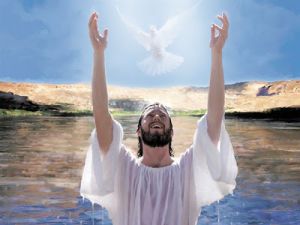
In our Parish this summer there are around 16 people working on a 10-week study of the Gospel of Matthew. As part of that study, we looked at the passage in Matthew 3 that describes Jesus’ baptism by John the Baptist. The incident is recorded in all 4 Gospels. It is a significant event for several reasons, but for today I want to focus on that moment when the Holy Spirit goes to Jesus just as he comes up from the water. Here is a Gospel-parallel presentation of that moment:

Matthew   3:16-17

Mark   1:10

Luke   3:22

John   1:32-34

16 And when Jesus had been baptized, just as   he came up from the water, suddenly the heavens were opened to him and he saw   the Spirit of God descending like a dove   and alighting on him. 17 And   a voice from heaven said, “This is my Son, the Beloved, with whom I am   well pleased.” 10 And just as he was coming up out of the water,   he saw the heavens torn apart and the Spirit descending like a dove on him. 21 Now when all the people were baptized, and   when Jesus also had been baptized and was praying, the heaven was opened, 22 and the Holy Spirit descended upon him in   bodily form like a dove. And a   voice came from heaven, “You are my Son, the Beloved;   with you I am well pleased.” 32 And John testified, “I saw the Spirit   descending from heaven like a dove,   and it remained on him. 33 I   myself did not know him, but the one who sent me to baptize with water said   to me, ‘He on whom you see the Spirit descend and remain is the one who   baptizes with the Holy Spirit.’ 34 And   I myself have seen and have testified that this is the Son of God.”

All citations from New Revised Standard Version Catholic Edition (NRSVCE). Links above also display public domain King James Version (KJV).

dove jesusholyspirtdoveThere is a dove described in all four Gospels. If you look at each of them separately, it is a little difficult to sort out just who saw the dove. It seems perhaps only Jesus saw it in Mark’s account. In Luke’s account it could have been Jesus only, or Jesus and John, or Jesus and everyone. It’s something to think about. John’s Gospel quotes John the Baptist’s testimony. He had been promised a sign – ‘He on whom you see the Spirit descend and remain is the one who baptizes with the Holy Spirit.’ John states flatly, “I saw the Spirit descending from heaven like a dove, and it remained on him. I myself did not know him …” If we make a construct of the content of all four Gospels, it seems clear that at least John and Jesus saw the Spirit descending like a dove. Now, is it as a dove or like a dove? Honestly, I don’t think we know, because the Greek word used in all four Gospels is ὡσεί hosei {ho-si’}. This word might make a difference if we understand the differences between as and like. I could say, “As your friend, I am sharing my thoughts with you.” (I am your friend.) Or, I could say, “Like your friend, I am sharing my thoughts with you.” (I may or may not be your friend, but your friend and I have something in common). If the Spirit descended like a dove, there was a similarity between the movement of the Spirit and the movement of a Dove. If the Spirit descended as a dove, it was a dove – as Luke testifies. Does that mean then that the Holy Spirit was momentarily incarnate? One could hardly accept that but, again, it is something to think about. In my heart and mind, a dove landed on Jesus and those who witnessed it (John and Jesus at the very least) understood it to be the Spirit of God which echoed the image of the dove released by Noah in Genesis 8:8-12. Whether we say “as” or “like,” the event itself represents God’s announcement of an imminent change.

NoahDove7In the Flood story, the return of the dove with an olive leaf in its beak is a sign that the Earth has passed its crisis and is being restored. It is the promise of the start of a new world. In Jesus’ Baptism, it is the start of his ministry which is also the start of The Kingdom of Heaven. The dove of the Ark is a messenger of sorts because it shows Noah there is hope that his ordeal is coming to an end. At Jesus’ baptism, the dove is also a messenger of hope for us but for Jesus it is a message that his ordeal is starting. With the start of his ministry came also the start of his persecutions, the accusations against him, the misunderstandings of his mission, and ultimately his passion, death, and resurrection. Immediately after his baptism in water by John, Jesus – in the Power of the Spirit – goes into the desert for an extended trial of fasting, discernment, and ultimately complete-submission to the entirety of God’s plan for Salvation – a plan that includes a very violent death for the man called Jesus of Nazareth. That whole series of events began with a dove.

As I reflected on the role of that dove, I wondered where else in Scripture a dove was part of the story. We’ve already recalled the story of Noah and the dove (although we left out the work of the raven Noah sent out). I looked for other places where a dove is mentioned. Here’s a list of those places (not including the quotes from Genesis and the Gospels already presented):

Psalm 55:6
Psalm 68:13
Song of Solomon 2:12-14
Song of Solomon 5:2-3, 12
Song of Solomon 6:9
Isaiah 38:14
Jeremiah 48:28
Hosea 7:11

The word dove is a term of endearment in the Song of Solomon (also called Canticles). Doves are thought of as clean and delicate birds that will not nest in damp or dirty places. They often nest in the rock crevices around the mouth of a cave or under the overhang of a cliff. Thus, they rest in safety because where they live it is hard for pursuers to capture them. (See Psalm 55:6) In Psalm 68, the dove is described as having wings of silver and gold. This song, a romanticized description of God’s protections of Israel against her enemies, was meant to be sung as a sort of positive encouragement for Israel. Even before the army forms up and attacks, as they hunker down in their camps and lay low, God foresees their victories and the richness of the plunder which they will take. In Isaiah, three birds are mentioned – a crane, a swallow, and a dove (or a swallow, a thrush, and a dove). The dove’s cry is always taken to be plaintive and mournful whereas the cries of the other two are chattering and noisy. Isaiah’s imagery conveys that he was so demoralized by the circumstances of Israel’s condition that – instead of being vigorously able to defend
himself– he can only moan and sigh, groaning with sorrowful mourning like a dove. In Hosea, Israel is again represented as a dove – Hosea uses the name of the largest Tribe in Israel, Ephraim to represent the whole nation – but in this prophecy, the dove flits from one place of danger to another, first to Egypt, then to Assyria, like a dove it has been easily deceived and lacks discernment. He is telling Israel they just don’t make sense. They commit the sin of idolatry knowing full well that it deprives them of God’s protection, but still they brag about being idolaters! Israel was like a dove trying to escape being caught by a hawk and instead flying right into the nets of the bird-catcher, or which goes to the fields to eat the corn spilled there without noticing the net set to capture it.

Of all these images of doves in scripture, I certainly enjoy and appreciate the presence of the dove at Jesus’ baptism. It isn’t the symbol of the Holy Spirit there; it is the Holy Spirit. There are valuable lessons to be learned through understanding the other places where doves are mentioned, especially as representing peace, love, and quiet confidence. For me, though, the image I most relate to is the one in Hosea. Beloved, how often do we go out to gobble up what we perceive to be a bounty of pleasure and wealth only to be caught up in the nets of sin? It is true that, as the song says, “On the wings of a snow white dove he sends his pure, sweet love,” it is also true that it is easy to fall prey to evil because we are not as watchful as we should be. Think now of Matthew 10:16“I am sending you out like sheep among wolves. Therefore be as shrewd as snakes and as innocent as doves.” Also remember Isaiah 59:11. We all growl like bears, like doves we moan without ceasing. We look for right, but it is not there; for salvation, and it is far from us. Let us pray, therefore, that the Holy Spirit will descend on each and every one of us while he seeks a gentle landing place that is welcoming and safe so that he will remain on us, in us, and with us.

Whatever, whenever, wherever, whoever, however, if ever, forever — at your service, Beloved

Thank you for all the prayers you have offered for those who asked for your help! You really do make a difference!

Luke 3, 21-22

Creative Commons License
Aloha Friday Messages by Charles O. Todd, III is licensed under a Creative Commons Attribution-ShareAlike 3.0 Unported License

Aloha Friday Message – June 20, 2014 – Faith and Mystery

1425AFC062014 – Faith and Mystery

Read it online here, please

Deuteronomy 8:3He humbled you by letting you hunger, then by feeding you with manna, with which neither you nor your ancestors were acquainted, in order to make you understand that one does not live by bread alone, but by anything that the Lord decrees.

John 15:10If you keep my commandments, you will abide in my love, just as I have kept my Father’s commandments and abide in his love.

1 Corinthians 10:16The cup of blessing that we bless, is it not a sharing in the blood of Christ? The bread that we break, is it not a sharing in the body of Christ?

1 Corinthians 13:12 – For now we see through a glass, darkly, but then face to face. Now I know in part; but then shall I know, even as also I am known.


Institution of the Eucharist

Matthew 26:26-28 While they were eating, Jesus took bread, and after giving thanks he broke it, gave it to his disciples, and said, “Take, eat, this is my body.” And after taking the cup and giving thanks, he gave it to them, saying, “Drink from it, all of you, for this is my blood, the blood of the covenant, that is poured out for many for the forgiveness of sins.” Mark 14:22-24 And as they did eat, Jesus took bread, and blessed, and brake it, and gave to them, and said, Take, eat: this is my body. And he took the cup, and when he had given thanks, he gave it to them: and they all drank of it. And he said unto them, This is my blood of the new testament, which is shed for many. Luke 22:19-20And He took bread, and gave thanks and broke it and gave it unto them, saying, “This is My body which is given for you. This do in remembrance of Me.” Likewise also He took the cup after supper, saying, “This cup is the new testament in My blood, which is shed for you.”


Happy Aloha Friday everyone, and Happy Summer, too! The 2014 Solar Solstice is tomorrow, June 21. Today’s message started off with John 15:10. The “assignment” was to connect that to the institution of what Christians commonly call Communion. Our Lord has commanded us, in the form of an imperative declaration (explanation coming), to become one with the sacrifice he was making on our behalf. He said, “Truly, I say to you, unless you eat the flesh of the Son of man and drink his blood, you have no life in you.” John 6:53 So, if we do want to have life within us, we must eat his flesh and drink his blood. This is difficult for some among us today even as it was difficult for some who heard Jesus make this statement. I don’t think that today I will be able to present every viewpoint – there are many more than one can imagine – but I would like to talk a bit about why we have Communion and not so much about what it is. So, with that in mind let’s begin in Deuteronomy.

Moses is reminding Israel that God provided for them in the desert as they wandered and were preparing to cross over the Jordan River to enter the Land of Milk and Honey promised to Abraham. God provided bread (manna), meat (quail), water, shelter, rest, and protection. Every word God spoke helped sustain them. God spoke, and sustenance was given. The sustenance they received nourished their bodies and allowed them to carry on in their quest for the Promised Land. Everything God said or did was invigorating – giving them strength, energy, and refreshment thus revitalizing their unity. What God gave became part of them, part of their flesh and bone and blood. Even his words – the Law – and his promises (some claim there are 30,000 promises in the Bible!) were sustenance for the heart and mind of the Nation. Hence, everything that God spoke into being was life-giving. Think about that for a few seconds <<PAUSE>> Everything God says is life-sustaining. It’s not just the bread he gives; it is the bread and everything it takes to make the bread part of us.

At this point, I’m going to insert a long and very familiar passage from the Gospel of John. Please patiently read it.

John 6:47-60 “Very truly, I tell you, whoever believes has eternal life. I am the bread of life. Your ancestors ate the manna in the wilderness, and they died. This is the bread that comes down from heaven, so that one may eat of it and not die. I am the living bread that came down from heaven. Whoever eats of this bread will live forever; and the bread that I will give for the life of the world is my flesh.” The Jews then disputed among themselves, saying, “How can this man give us his flesh to eat?” So Jesus said to them, “Very truly, I tell you, unless you eat the flesh of the Son of Man and drink his blood, you have no life in you. Those who eat my flesh and drink my blood have eternal life, and I will raise them up on the last day; for my flesh is true food and my blood is true drink. Those who eat my flesh and drink my blood abide in me, and I in them. Just as the living Father sent me, and I live because of the Father, so whoever eats me will live because of me. This is the bread that came down from heaven, not like that which your ancestors ate, and they died. But the one who eats this bread will live forever.” He said these things while he was teaching in the synagogue at Capernaum.  When many of his disciples heard it, they said, “This teaching is difficult; who can accept it?” As the body must assimilate food to live, so the soul must assimilate who lives because the Father lives.

Well, there are certainly several promises there, and also several very clear declarations that belief in and sharing in the Body and Blood of Christ is imperative if one seeks the eternal and everlasting life promised. In my heart and mind the conditions imposed in these promises are commandments, imperatives, and the eternal life promised is contingent on compliance with those commands for, if you keep my commandments, you will abide in my love, just as I have kept my Father’s commandments and abide in his love.” That is what I meant by “an imperative declaration.” What Christ has declared is an imperative and therefore contained in “… anything that the Lord decrees.” We are “ordered” to participate in the sharing of the Body and Blood of Christ; we ought to do so consciously and fully-engaged in the majesty and mystery of this sacrament. But it must be more than just consuming some bread and fruit of the vine. Here is the reason for that:

Day after day we eat and drink to nourish our bodies. What we eat becomes part of us. The food each individual eats is united with that person’s body. With the Eucharist it is the other way around. We become what we eat. Now, I know someone out there just had that old saying “You are what you eat” pop into your head; junk in – junk out, good in – good out. In Communion, we consume the Body and Blood of Christ and we are united to Body and Blood as we become – truly indeed – The Body of Christ, his Church. Everything that is less-than-divine is joined with Every Thing that is Divine: John 14:19-21Before long, the world will not see me anymore, but you will see me. Because I live, you also will live. On that day you will realize that I am in my Father, and you are in me, and I am in you. Whoever has my commands and keeps them is the one who loves me. The one who loves me will be loved by my Father, and I too will love them and show myself to them.

That is communion. We do not become God, or part of God; we live in Jesus and Jesus lives in us and in our Father. We share this with, in, and for The Body of Christ. We share it with, in, and for the Love of God in Christ Jesus by the ministry of the Holy Spirit because “The cup of blessing that we bless, is it not a sharing in the blood of Christ? The bread that we break, is it not a sharing in the body of Christ?

As it was surely difficult for the first disciples to grasp this mystery, it is certainly equally difficult today. Difficult, that is, if you choose to believe it. Sadly many, many people – non-Christians and even many Christians – do not believe it. There is every possible proof that it is true – God sent Salvation into the world as his only begotten Son and our mandate is to share that assurance with each other in Communion; but, when we cannot, or do not, obey that imperative, we make God out to be a liar. We have Jesus’ testimony about us being in him, and he being in God. What other Witness do we need?

1 John 5:7-12 So we have these three witnesses– the Spirit, the water, and the blood – and all three agree. Since we believe human testimony, surely we can believe the greater testimony that comes from God. And God has testified about his Son.  All who believe in the Son of God know in their hearts that this testimony is true. Those who don’t believe this are actually calling God a liar because they don’t believe what God has testified about his Son. And this is what God has testified: He has given us eternal life, and this life is in his Son. Whoever has the Son has life; whoever does not have God’s Son does not have life.

Please, please, please: Remember why Jesus’ commands at The Last Supper are important. Remember that – every time you receive it – as he told you to do. Be engaged, not blasé. Be aware, not oblivious. Become the Body of Christ through faith in this Mystery. Beloved, love one another, but love God most. Pray for everyone always in, as, and for The Body of Christ.


Whatever, whenever, wherever, whoever, however, if ever, forever — at your service, Beloved.

body-and-blood-of-christ-2

Creative Commons License
Aloha Friday Messages by Charles O. Todd, III is licensed under a Creative Commons Attribution-ShareAlike 3.0 Unported License

Aloha Friday Message – June 13, 2014 – Blessed Trinity (longer version)

1424AFC061314 – Blessed Trinity

 Read it online here, please.

John 3:16-18 For God so loved the world that he gave his only Son, so that everyone who believes in him may not perish but may have eternal life. Indeed, God did not send the Son into the world to condemn the world, but in order that the world might be saved through him. Those who believe in him are not condemned; but those who do not believe are condemned already, because they have not believed in the name of the only Son of God. (2014)

John 16:12-14“I still have many things to say to you, but you cannot bear them now. When the Spirit of truth comes, he will guide you into all the truth, for he will not speak on his own authority, but whatever he hears he will speak, and he will declare to you the things that are to come. He will glorify me, for he will take what is mine and declare it to you.” (2013)

Matthew 28:18-20 Then Jesus approached and said to them, “All power in heaven and on earth has been given to me. Go, therefore, and make disciples of all nations, baptizing them in the name of the Father, and of the Son, and of the Holy Spirit, teaching them to observe all that I have commanded you. And behold, I am with you always, until the end of the age.” (2012)

2012: Matthew 28:18-20 This is The Great Commission. It is the command given to all Christians to evangelize the entire world.

2013: John 16:12-14 This is from the discourse at the Last Supper. Jesus is telling the Disciples that he will be leaving them soon; they, of course, do not understand, but he assures them that the Holy Spirit will come to them and help them to remember and understand everything he has taught them.

2014: John 3:16-18 One of the best-know, most-quoted passages in the Bible, this passage describes in just a few words the amazing plan God has implemented by sending his Son for the Salvation of the World.

Tom and Margaret went to the same high school from their freshman to senior years. They always “sort of” got along, but both of them were fiercely independent and a bit feisty. Still, they did make a good couple. They were often seen cruising in Tom’s clunky old ’58 Chevy pickup. He’d be driving with one hand, and Margaret would be snuggled up right next to him. Toward the end of their Senior year, they were practically inseparable, and by the week after graduation, each was feeling a yearning emptiness for the other. They were headed for different colleges in the Fall, and it seemed they’d never really get back together. In less than a year, they lost touch with each other. Neither made the effort to reach out, although Margaret still thought about Tom now and then.

At their Five-Year Class reunion they seemed to pick up right where they left off. Within just months they were married. Twenty-two years and four kids later, they were taking a Sunday drive in their 1958 Chevy Apache pickup they’d restored together just as Tommy was graduating from high school. Margaret looked over at Tom and said, “You know, twenty years ago when we were younger, we never sat this far apart.” Tom’s response was quicker than it should have been and he knew it was too late to snatch it back when he said, “Well, I haven’t moved.”

Beloved, how close to your Heavenly Father do you sit as the two of you travel through your life? Have you ever experienced the comfort of snuggling up with Jesus as you travel down the Road of Life? Does the Holy Spirit brighten your way even in the worst of traffic? If you don’t feel as close to God as you used to – or want to – think about the reason for it. Why does God seem so far away?

The three readings at the top are reading from the Solemnity of the Holy Spirit for each of the three cycles of readings – A, B, and C. The numbers in parentheses are the years these excerpts from those passages were part of the Gospel. I want to focus on the 2014 reading for this message.

John 3:16 is probably the most-cited and most-quoted verse in the Bible. Upwards of 80% of the world has seen JOHN 3:16 on television, in print, on the Internet, on billboards, in pamphlets, and heard it on every kind of broadcast media. It is a favorite memory-verse, quoted by millions of Christians worldwide. You might say it’s the basic tune of Christians everywhere. That phrase, “whosever believeth in Him” is brandished with unrelenting fervor as believers confront unbelievers to ask them, “Do you have a personal relationship with Jesus Christ?” If you say no, they may try to move you in that direction – push, pull, or carry you to the foot of the Cross. If you say yes, then perhaps the next question will be, “Do you have a church home?” That’s often followed by an invitation to make their church your church, their Jesus your Jesus, their religion – the only right and true faith – your religion because anything else falls woefully short of God’s plan for your salvation. It’s like, “Join us or go to Hell.” Maybe you feel that is a mischaracterization, a caricature if you will, but when I am confronted by that style of evangelization, I will often ask, “What about John 3:17?”

Most people don’t memorize that one. Some people slide right past it, so sure of being redeemed eternally because they are confident they are in the group called Whosever Believeth in Him that they have no qualm whatsoever in roping off their part of the world with the Personal Relationship Clause of their religion. So, what about John 3:17? “For God sent not his Son into the world to condemn the world; but that the world through him might be saved.” It seems to me that if God sent Jesus for Salvation and not condemnation, I shouldn’t be condemning either. It seems too impersonal to write someone off because they disagree with me about how my relationship with Jesus works. “Of course I have a personal relationship with Jesus,” I tell them. “In fact, I have a close, personal, and deeply satisfying relationship with the whole family – Father, Son, Holy Spirit, our Blessed Mother, and all the Angels and Saints.”

Perhaps it is unkind to respond that way, and I confess I have taken the wind from the sails of an occasional evangelizer by saying, “Yes I’ve accepted Jesus as my personal Savior. Have you accepted Mary as your personal Mother?”  I believe a personal relationship with Jesus is a very good idea, and I do continuously reassess the relative distance between us.  It is the Trinity, however, to whom I gravitate. When I say, “God,” I mean “Father, Son, and Holy Spirit.” When I say, “God bless you,” I am asking the Trinity to bless you. They are, after all, three distinct Persons all in one Being. Because I am created “in the image and likeness of God,” I can see the same patterns in me. (See Genesis 1:26-27) Image and likeness are two different things. In Hebrew, image is from צֶ֫לֶם – tselem {tseh’-lem}, and likeness is from דְּמוּת demuth {dem-ooth’}. Beloved, I looked at all kinds of explanations about that difference and it got pretty complicated, so maybe I can state it this way:

“You know, Tommy’s just a chip off the old block. He’s got his dad’s good looks and also his stubborn streak and great compassion.” Tommy looks like and acts like his dad. We were created in such a way that we look like and act like our Heavenly Father – we should be like him. God is Spirit; we are spirit. God creates everything from nothing; we make many things from what God created. God chooses to do his will; we can choose to do his will or choose not to. God is community; we are born into community and are stronger as community. God is infinitely intelligent and wise; we use our God-given gifts of intellect and wisdom to shape our lives and the world around us. God communicates to us through creation, through scripture, and through our gifts; we communicate with God and each other in the same ways.

God gave us himself as a Father and Creator. God gave us himself as a Brother and Savior. God gave himself to us as an Advocate and Companion. God is always and everywhere present in our lives as Trinity, the Almighty and Ever-living God, Father, Son, and Spirit. If we move away from his Fatherly care, Jesus’ brotherly love moves closer to us. If we turn away from Jesus, the Holy Spirit speaks the words of our hearts into the heart of God. If we mistrust the Gifts and fruit of the Holy Spirit, God the Father and God the Son inundate us with even more gifts – so much of a deluge of gifts that the flow of that generosity, like a River of Life, carries us to the Presence of God in and through our ways of looking like and acting like we belong to God.

I once heard something on The West Wing that never left my mind. It went something like, “If you are not sure you are a righteous man, act as though you were, and you will be.” If you are saved by believing in Jesus rather than condemned by sin, act accordingly. BE a son or daughter of God, BE a sister or brother of Jesus, BE a vessel or conduit of the Holy Spirit. You are body, mind, and spirit. So is God. If you want to be nearer to him, be nearer to all of him, our Almighty, Ever-Living, Triune God.

And so, Beloved, now you may better understand what Saint Paul said in 2 Corinthians 13:14 – which I repeat to you here:

TrinityVerse


Whatever, whenever, wherever, whoever, however, if ever, forever — at your service, Beloved


Creative Commons License
Aloha Friday Messages by Charles O. Todd, III is licensed under a Creative Commons Attribution-ShareAlike 3.0 Unported License

Pages Email Newsletter Categories Archives Connect
  • Connct to us here