Aloha Friday Message – June 6, 2014 – 7 Short Weeks

1423AFC060614 – 7 Short Weeks

Read it online here, please.

Exodus 34:22Celebrate the Festival of Weeks with the firstfruits of the wheat harvest, and the Festival of Ingathering at the turn of the year.

Leviticus 23:15-16You must count for yourselves seven weeks from the day after the Sabbath, from the day you bring the Wave Offering sheaf; they must be complete weeks. You must count fifty days—until the day after the seventh Sabbath—and then you must present a new grain offering to the Lord.New English Translation

Deuteronomy 16:9-11Count off seven weeks from when you first begin to cut the grain at the time of harvest.Then celebrate the Festival of Harvest to honor the Lord your God. Bring him a voluntary offering in proportion to the blessings you have received from him.This is a time to celebrate before the Lord your God at the designated place of worship he will choose for his name to be honored. Celebrate with your sons and daughters, your male and female servants, the Levites from your towns, and the foreigners, orphans, and widows who live among you.New Living Translation (NLT)

Aloha nui loa, ʻŌmea! Have you ever heard of the Festival of Weeks? How about Shavuot? Have you got a good grasp of the meaning of a Wave Offering? Do you understand the connection between this festival, the life of the Church, and the terms Holy Roller, Quaker, Shaker, and Jesus Freak?

The three quotes are from three books of the Pentateuch, the first five books of the Bible and are also called the Torah, the Books of Moses. (That link is a great article to spend some time with, Beloved.) They are the core of Jewish Scripture and therefore also the foundation of scripture for the Abrahamic religions. This Feast of Weeks is a Harvest Feast, and this one occurs fifty days after Passover. Those fifty days are referred to as the Counting of the Omer. The Feast of Weeks was a celebration commanded by God. It is one of three celebrations which require all the men of Israel to make a pilgrimage to Jerusalem – the Festivals of Passover, Weeks, and Tabernacles (Tents). At these three feasts, Jerusalem would be packed with visitors from all over Israel as well as Jews from all around the Mediterranean and Asia.
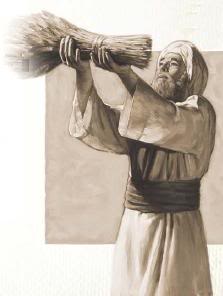
 waveofferingIn the passages which describe God’s commands for celebration of this feast, we read that the very first day of the harvest, the nation counted fifty days. This was called the Counting of the Omer. The omer was a dry measure of volume; today we’d say is was just under 3.5 quarts. The grain, or bread made from the grain, was held up before the Altar – waved – thereby offering God the firstfruits of the harvest (think of Cain’s and Able’s offerings). The Wave Offering took place on the fiftieth day.

This Feast is also called Shavuot (shah-voo-ōt) celebrating the giving of the Torah to the entire nation of Israel at the foot of Mount Sinai – although that is not explicitly described in Scripture. There are scholarly discussions of the background of this Feast in the Talmud – the “oral Torah.”

In Jesus time, the Feast of Weeks – especially the conclusion – was referred to by its Greek name, πεντηκοστή (pentékosté) {pen-tay-kos-tay’} – Pentecost meaning “fiftieth day.”

Ah. And there we are, ready to understand The Second Chapter of Acts a little deeper and wider than before. We will hear the beginning of that passage in Church this Sunday:

Acts 2:1-4Seven weeks had gone by since Jesus’ death and resurrection, and the Day of Pentecost had now arrived. As the believers met together that day, suddenly there was a sound like the roaring of a mighty windstorm in the skies above them and it filled the house where they were meeting. Then, what looked like flames or tongues of fire appeared and settled on their heads. And everyone present was filled with the Holy Spirit and began speaking in languages they didn’t know, for the Holy Spirit gave them this ability.

This is the Birthday of The Church!
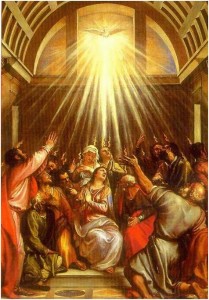
PENTECOSTIt was the arrival of the Advocate, the Paraclete – παράκλητον parakletos {par-ak’-lay-tos}the Comforter, and Intercessor who could speak the language of God in prayer: The Holy Spirit, the Bond of Love between God the Father and God the Son. The Holy Spirit is one who is summoned, called to our side to help us. He is the One who pleads our cause before a judge, a counsel for the defense against The Accuser. He is our legal representative at the Time of Judgment, an advocate whose Wisdom, Power, and Glory are from everlasting to everlasting.

Now we connect this to the swollen population in Jerusalem. There were thousands upon thousands of visitors because it was The Feast of Weeks. There is a list representing “the whole known world” in Acts 2:9-11. They had been attracted to the place where the Disciples were meeting by the sound of a “mighty, rushing  wind.” Hmmm. That sounds familiar. Genesis 1:2 we read “… the earth was a formless wasteland, and darkness covered the abyss, while a mighty wind swept over the waters.” The Hebrew text says “ruach Elohim,” The wind/breath of God – the Spirit of the Living God. So the same Spirit of Creation that formed the Universe was also present for the birth – the creation – of the Universal Church.

The witnesses to this event were divided in their response. Many were astonished, awestruck, flabbergasted. But there were a few who jeered. Even though they heard the wind, even though they saw the Disciples standing, exulting, praising God and declaring the mightiness of his powers, these watchers said, “Ah, these folks are just drunk on new wine. They don’t know what they’re doing! Look at them. They’re acting like fools, all that jumping and shouting, and babbling in ‘different languages.’ Give me a break! These people are in some kind of mass hysteria or delirious with ‘religious fervor.'” OK, so not all of that made it into Luke’s Book Two: The Life of Jesus and the Church. But, you get the idea. Some people just thought the whole thing was comical, and certainly not “proper” for True Sons of Abraham.

This kind of radically zealous worship and testimony was consistently characteristic of the people united in the New Covenant – they called it The Way for a long time after that first Pentecost. St. Paul wrote about it in 1 Corinthians 14:23So if the whole church comes together and everyone speaks in tongues, and inquirers or unbelievers come in, will they not say that you are out of your mind? Yep. Out of my mind and into the Spirit!

That’s what a lot of people think, alright! That’s the kind of reaction behind those names like Holy Roller, Quaker, Shaker, and Jesus Freak? All of these were intended as derogatory names, but those who “earned” those monikers came to embrace and accept them as positive identifiers. Quakers were admonished to “tremble before the Lord.” The Shakers are a subgroup of the Quakers known for their ecstatic behavior during worship services. The term “Holy Roller” is related to these ideas – the vigorous physical movement, shouting, and enthusiasm of worshipers “caught up in the Holy Spirit.” It can include dropping to the floor and rolling, or being “slain in the Spirit,” a form of prostration in which an individual falls to the floor while experiencing religious ecstasy. Prostration is a gesture of placing the body in a reverent or submissive prone position as a gesture of worship. I have also seen it as a person “falling out” to a kneeling or even supine position.

Not all encounters with the Holy Spirit are like that. Often, when I am writing for you, there is a certain feeling. The feeling … the feeling is like a hand grabbing my spine between my shoulder blades and lifting me up. It is always like that when The Spirit takes me. Next comes the word-processor, then the Internet, then the email you receive, and by the time all of that is over I’m out looking for the next clue. Sometimes it is a shaking or trembling, sometimes chicken-skin (goose-bumps) all over, sometimes just profound quiet and Peace. When it happens, there’s no mistaking it for anything else – even too much new wine.

Beloved, there is a New Pentecost blazing through the church today. How does one become part of that rebirth? The same way it happened in The Way: Repent, be baptized, and receive the Spirit. You may say, “I try to be good and seek forgiveness when I’m not. I was Baptized as a child, and I know I belong to God because Original Sin was removed. And the Holy Spirit is always with me – as Jesus said – until the end of the age. I’m not missing anything by not feeling religious ecstasy.” Perhaps not, but perhaps you might. Repentance is always a tough one because it seems so repetitious; we’re never done with it because we’re never really done with sin. Baptism is something we could think a little differently about, though. There is the liturgical, sacramental Baptism we take as the entry into the Body of Christ; but there is another, deeper sense of it as well. It means – literally – to be immersed. Jesus said. “Can you drink the cup I drink or be baptized with the baptism I am baptized with?” (Mark 10:38b) Jesus was immersed in the baptism of his Passion. We are also to be immersed in the living of our faith, and in the Baptism of the Holy Spirit. It is not just a fixed moment in time, a single event in our lifetime; it is an ongoing process of renewal, submission, exultation, and action happening as we are fully aware of its source, its purpose, and its effects – the Gifts and Fruit of the Holy Spirit.

Whatever, whenever, wherever, whoever, however, if ever, forever — at your service, Beloved


Aloha Friday Message – May 30, 2014 – Give Thanks to the LORD

1422AFC063014 – Give thanks to the LORD

Read it online here, please.

Psalm 107:1 Give thanks to the LORD for he is good; his lovingkindness is everlasting.

Psalm 103:17 But the steadfast love of the Lord is from everlasting to everlasting on those who fear him, and his righteousness to children’s children …

(NLT) 1 Thessalonians 5:18 No matter what happens, always be thankful, for this is God’s will for you who belong to Christ Jesus.

Aloha pumehana, Beloved. This message today is a departure from what I had planned. Normally I would point out that yesterday, Thursday, May 29, 2014, was Ascension Day. In my “calendar of significant events,” this usually holds top place. I can think of nothing in Scripture that means more to me than Luke’s description of the Ascension in Acts 1:6-11 especially the last verse 11, which says: “Men of Galilee,” they said, “why do you stand here looking into the sky? This same Jesus, who has been taken from you into heaven, will come back in the same way you have seen him go into heaven.” I’ve addressed this before. The very idea that this SAME Jesus is coming back “in clouds of glory” is often more than I can get my head around. And yet, Jesus himself had told the disciples that “There is more than enough room in my Father’s home. If this were not so, would I have told you that I am going to prepare a place for you? When everything is ready, I will come and get you, so that you will always be with me where I am.” (John 14:2-3) I find I am in full agreement with the Psalmist when he said, “Such knowledge is beyond me, far too lofty for me to reach.” (Psalm 139:6) And so, this week, rather than go into all the reasons why “this same Jesus” blows me away, I want to tell you how it makes me feel (other than stupefied by its implications). I feel grateful.

All this week, the refrain from a common responsorial Psalm has played over and over, hundreds – perhaps thousands of times. It is in my head as “background music” even as I type. It is one of the most repeated phrases in the Bible appearing dozens of times in the Old Testament and often quoted or referred to in the New Testament. The refrain goes, “Give thanks to the LORD for he is good; His love is everlasting.” I want to take that apart starting with “give thanks.

In some translations, this combination of words is preceded by the interjection O! which intensifies the verb used for give thanks. The Psalmist emphasizes that to give thanks to God is that which flows naturally out of our understanding of his great mercy – love, lovingkindness, goodness, gracious love – which is given to us in such abundance that we cannot comprehend the magnitude of the gift. There is more love, mercy, and grace than could ever be exhausted by every soul who ever has lived, is living, or will yet live. Our paltry ability to thank God for this gift is the best we can do in our human condition; and, God knows this as well, it is also the least gift we can give because of our humanness. Still, the priests and prophets God sent to make us aware of this remind us again and again that we should always thank God for everything – literally everything.

The word used for thanks is הֹד֣וּ (yadah) {yaw-daw’}, and it’s a bit more than just “thanks.” It is to confess the name of God, to give praise, to revere or worship with extended hands. It is a joyous exclamation which rises up from our deepest soul where our identity with the Spirit of God is strongest. I have often said, “If I didn’t believe it, it would be incredible.” The power and magnitude of God’s mercy is so majestic it is … hard to believe; yet, there it is in front of us, around us, and inside us. We know it is there because of the exultation we feel when we confess it. God is GOOD! All the time! (All the time, God is GOOD!) We know it. We believe it. We confess it. We proclaim it. We shout with joy because it is true. He is Good.

This good is also something so superlative that we scarce can comprehend it. God has shown us, over and over, that he is fair, beautiful, pleasant, beneficent (even Omnibenevolent), giving as his bounty all that brings us happiness, peace, joy, and love. Because it is God’s goodness, it is perfect goodness, and there is more of that than we can ever use up as well.

Lovingkindness is something we examined in the Mercy Series this past Advent. It is mercy, compassion, kindness, consideration, care, fairness, goodness, mercy, pity, loyalty, covenant-love, and Godly tenderness. All of these words evoke the idea of unconditional love, love without equivocation, love that is true whether you know it or not, whether you believe it or not, whether you feel it or not. THAT is the Love of God! And, thinking back to stating that previously stated as an identity expression …

GOD ≡ LIGHT ≡ LOVE ≡ TRUTH ≡ WAY ≡ LIFE ≡ ETERNAL ≡ MERCY ≡ GOD

And all of that “endureth forever.” This word forever is one we’ve seen before, too. It is עוֹלָם (‘olam) as in El Shaddai Olam – The Almighty Everliving God. This part is the easiest to understand. It is God’s Mercy, so of course it “endureth forever.” It is from antiquity to futurity, from forever before to forever after: Eternal. It has always been there as God has always been there. It is there now as God is there now. It will always be there as God will always be there. It is I AM THAT I AM.

I thank God for that. He is Good, all the time, everywhere, in every circumstance, in all things, no matter what happens, he is there, and he is GOOD. That kind of GOOD is most definitely GOOD enough for me! and I am grateful for that. Always.


Whatever, whenever, wherever, whoever, however, if ever, forever — at your service, Beloved!


chick 🙂

Creative Commons License
Aloha Friday Messages by Charles O. Todd, III is licensed under a Creative Commons Attribution-ShareAlike 3.0 Unported License

Aloha Friday Message – May 23, 2014 – Big Changes Ahead

1421AF052314 – Big Changes Ahead

Read it online here, please.

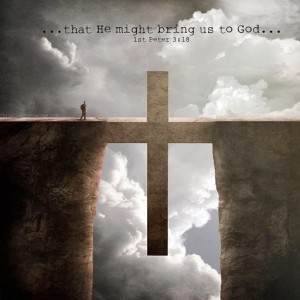
1 Peter 3:18For Christ also suffered for sins once, the righteous for the sake of the unrighteous, that he might lead you to God. Put to death in the flesh, he was brought to life in the spirit … New International Version (NIV)Holy Bible, New International Version®, NIV® Copyright © 1973, 1978, 1984, 2011 by Biblica, Inc. ® Used by permission. All rights reserved worldwide.

E pili mau na pomaika‘i ia ‘oe a me ke akua ho’omaika’i ‘oe, ?omea! (May blessing always be with you and may God bless you, Beloved!)

About two weeks ago a friend from church passed away after a long bout with pulmonary fibrosis – basically scarred lung tissue that got progressively worse, is untreatable, irreversible, and uniformly fatal. He and his wife were older than we are; she was a Eucharistic Minister for a while, but Parkinson-like tremors made that ministry difficult for her. Both were from Berlin; we enjoyed greeting one another bilingually – although my German never got beyond a few touristy phrases over the years. A couple of years ago, I started wearing a dress-shirt and tie to church. Throughout my professional career I usually dressed as “The Business.” It was not so much dress for success as it was wearing a business uniform. Sometimes I wore wingtips, power ties, and Arrow shirts. Other times I wore Acme boots, bolo ties, and “cowboy” shirts. Here in Kapa?a, whenever I went to say good morning before church got started, he’d always say, “Now I know it’s Sunday.” He thought people should dress up a little better than they did when going to the beach, or to work. You might surmise that not many men wear a dress-shirt and tie here; you’d be right. So why do it?

I chose that uniform, that costume, to emphasize that being where we were – at Mass – was different from being at work, or going out to eat. Here, there is a “usual” uniform and that was always Aloha Wear. Some folks come in shorts and T-shirts – a bit too casual for this conservative old man. Most members dressed nicely as befitting the dignity of the house of God. Our Pastors’ “uniforms” include layers of vestments that make their appearance very different from the rest of us. It’s not just Catholics that have clergy wearing vestments, of course, but ours are very distinctive and in tropical weather, pretty uncomfortable. They still do it though – no shortcuts either. I wanted to be in solidarity with them, so I chose a uniform that was decidedly different from what I usually wear around town. My friend appreciated that idea of solidarity; he had a couple of reasons. The first was that he had been brought up with the idea that it was sort of a Rule that you had to dress up for church. Me, too. The second was that we had another reason for solidarity: I, too, have lungs full of scar tissue from years of asthma, pneumonia, bronchitis, and even a bout with histoplasmosis. My internal medicine doc and my pulmonologist have not formally labeled me with pulmonary fibrosis; I get the COPD label for now.

Another recent passing also got my attention – the wife of a colleague in Indian Health Service who suffered – really suffered – with cancer. He’s also been hit with The Big C and they were in and out of remission several times over the years. We’ve had them in the Share-a-Prayer lists often. Then – as all this was going on – there was also Crucita’s stretch with shingles. She’s 90% better now, but still, it was hard to see her suffering that pain! Taking all of this together, you might also guess that the whole idea of mortality has gotten increased attention in my musings. When I read this short passage from this coming Sunday’s readings, it just popped out like a neon sign. What happens in the flesh is one thing; what happens in the spirit is quite another, and that is by design – not “Intelligent Design” – but by Divine Design. And it’s hard to imagine what happens when death in the flesh becomes life in the spirit.

The Bridge to HeavenWe do try to imagine it though. Angels wearing long white robes play harps while riding clouds. St. Peter at the Gate. Streets of gold, meeting our friends and relatives and all the holy men and women who preceded us. We imagine these loved ones as they appeared in the flesh. We think of them walking around in beautiful gardens conversing amiably about anything and everything. They greet and embrace one another even though they have no bodies.

That’s right. They are spirits. They do not have a resurrection body yet. So what do spirits look like and can they really distinguish the differences between this man and that woman? No matter what you think, the answer is: We can only guess until we see it ourselves. Contemplating the gaining of that knowledge is wonderful! Actually gaining it seems to terrify most of us because it is something you learn only after your body dies. The price of admission to the afterlife is quite simply everything you’ve got because you can’t take it with you. We all know that. We all know life in Heaven is … well, heavenly. But we don’t want to get there (most of us anyway) any sooner than we have to … until our number is up. But what will that be like?

As I prepared for this post over the past week, I was led to a passage about the resurrection body. It’s clear that until that Day of Resurrection, God has us scheduled for Life in The Spirit. I can’t tell you what that’s like; I haven’t been there yet, although I’ve been to the edge of the Light at the end of the tunnel a few times. I’m going to close with that passage. I’m pasting it here from Bible Gateway. Before I go, though, I want to ask you to pray with me for the dying friends we know, that God will give them Peace as they move resolutely toward death. Pray also for families shattered by poverty, or drugs, or war, or even something as simple as bad judgment. And pray for your clergy! Thank God for them and ask God to strengthen them. The Ruler of This World is making hell on earth for billions of people. Be part of the shield that deflects his fiery arrows!

The Resurrection Body – 1 Corinthians 15:35-56

35 But someone will ask, “How are the dead raised? With what kind of body do they come?” 36 Fool! What you sow does not come to life unless it dies. 37 And as for what you sow, you do not sow the body that is to be, but a bare seed, perhaps of wheat or of some other grain. 38 But God gives it a body as he has chosen, and to each kind of seed its own body. 39 Not all flesh is alike, but there is one flesh for human beings, another for animals, another for birds, and another for fish. 40 There are both heavenly bodies and earthly bodies, but the glory of the heavenly is one thing, and that of the earthly is another. 41 There is one glory of the sun, and another glory of the moon, and another glory of the stars; indeed, star differs from star in glory.

42 So it is with the resurrection of the dead. What is sown is perishable, what is raised is imperishable. 43 It is sown in dishonor, it is raised in glory. It is sown in weakness, it is raised in power. 44 It is sown a physical body, it is raised a spiritual body. If there is a physical body, there is also a spiritual body. 45 Thus it is written, “The first man, Adam, became a living being”; the last Adam became a life-giving spirit. 46 But it is not the spiritual that is first, but the physical, and then the spiritual. 47 The first man was from the earth, a man of dust; the second man is[a] from heaven. 48 As was the man of dust, so are those who are of the dust; and as is the man of heaven, so are those who are of heaven. 49 Just as we have borne the image of the man of dust, we will[b] also bear the image of the man of heaven.

50 What I am saying, brothers and sisters,[c] is this: flesh and blood cannot inherit the kingdom of God, nor does the perishable inherit the imperishable. 51 Listen, I will tell you a mystery! We will not all die,[d] but we will all be changed, 52 in a moment, in the twinkling of an eye, at the last trumpet. For the trumpet will sound, and the dead will be raised imperishable, and we will be changed. 53 For this perishable body must put on imperishability, and this mortal body must put on immortality. 54 When this perishable body puts on imperishability, and this mortal body puts on immortality, then the saying that is written will be fulfilled:

“Death has been swallowed up in victory.” 55 “Where, O death, is your victory?     Where, O death, is your sting?”

56 The sting of death is sin, and the power of sin is the law.

New International Version (NIV)Holy Bible, New International Version®, NIV® Copyright © 1973, 1978, 1984, 2011 by Biblica, Inc.® Used by permission. All rights reserved worldwide.

1-Peter-3_18


 Creative Commons License
Aloha Friday Messages by Charles O. Todd, III is licensed under a Creative Commons Attribution-ShareAlike 3.0 Unported License

Aloha Friday Message – May 16, 2014 – Special People

1420ACF051514 – Special People

Read it online here, please.

1 Peter 2:9But you are “a chosen race, a royal priesthood, a holy nation, a people of his own, so that you may announce the praises” of him who called you out of darkness into his wonderful light.

Aloha nui loa, Beloved. Today I want to give you some cross references to this passage so that all of us can see how thoroughly the Apostle Paul knew scripture, and how true he was to the meaning of that scripture. I’ll show you a phrase, then give you the scripture reference.

A chosen race: Isaiah 43:20-21The wild animals honor me, the jackals and the owls, because I provide water in the wilderness and streams in the wasteland, to give drink to my people, my chosen, the people I formed for myself that they may proclaim my praise.

As such, a people chosen by God by Divine election, Ephesians 1:4-6 For he chose us in him before the creation of the world to be holy and blameless in his sight. In love he predestined us for adoption to sonship through Jesus Christ, in accordance with his pleasure and will – to the praise of his glorious grace, which he has freely given us in the One he loves.

By making Israel of and for himself, he created a royal priesthood (one is reminded of the King and Priest of Salem, Melchizedek, the priest to El Elyon – God on High). Exodus 19:5-6 “Now therefore, if you obey my voice and keep my covenant, you shall be my treasured possession out of all the peoples. Indeed, the whole earth is mine, but you shall be for me a priestly kingdom and a holy nation. These are the words that you shall speak to the Israelites”

In that passage we also see God chose Israel to be a holy nation. Israel was unique among all nations because she was consecrated to God. As a consecrated nation, they were given the priests of God to facilitate their purpose – to praise and glorify God – and the circumcision prescribed by God through Abraham. The consecration included a call to holiness and inward purity inspired by devotion to God, and as shown physically, by a “cutting off” from the World.

In this way, God claims them as his own possession: Malachi 3:17 They shall be mine, says the Lord of hosts, my special possession on the day when I act, and I will spare them as parents spare their children who serve them.

Even after they were repeatedly unfaithful, God remained faithful to his side of the Covenant. Even though Israel repeatedly defied the terms of the Covenant, God repaired the damage they had done. At one point, they had transgressed so badly that they became “no people.” Hosea 1:9 Then the Lord said, “Call him (i.e., Israel) Lo-Ammi {עַמִּ֑י} (which means “not my people”), for you are not my people, and I am not your God.

But, God, because of his infinite Mercy and untiring faithfulness continued to provide his chosen people with the very things they refused him. He restored them to his expectations in the Covenant. When they were “no people,” he did what it took to restore them to “chosen people.” He is once again their God because they are once again his people because of his Divine Mercy. Hosea 2:23“At that time I will plant a crop of Israelites and raise them for myself! I will show love to those I called ‘Not loved.’ And to those I called ‘Not my people,’ I will say, ‘Now you are my people.’ Then they will reply, ‘You are our God!'”

God keeps creating “a chosen race, a royal priesthood, a holy nation, a people of his own, so that you may announce the praises” by taking what we have not defiled with our sinfulness and re-creating it – and us – into the people he intends us to be. Just as Christ is the cornerstone rejected by the builders but chosen before all time to be the foundation on which the Eternal Nation of God – the resurrected People of God – will be built. God alone has done this, for it was by God through Christ Jesus that he has made it possible in us to fulfill the purpose for which we have been created. We Come to him, a living stone, rejected by human beings but chosen and precious in the sight of God, and, like living stones, let yourselves be built into a spiritual house to be a holy priesthood to offer spiritual sacrifices acceptable to God through Jesus Christ. Remember what Jesus said in his triumphal entry to Jerusalem? “I tell you,” he replied, “if they keep quiet, the stones will cry out.” (Luke 19:40)

It is a beautiful thought to contemplate being built into the Everlasting City the Spiritual edifice of the Christian community, as Living Stones. Just for fun, Google “Living Stones” and read some of the insights. Here is a story which expresses another beautiful thought.

I want to leave you with a story from a few years ago.

What a beautiful thought!

On November 18, 1995, Itzhak Perlman, the violinist, came on stage to give a concert at Avery Fisher Hall at Lincoln Center in New York City. If you have ever been to a Perlman concert, you know that getting on stage is no small achievement for him. He was stricken with polio as a child, and so he has braces on both legs and walks with the aid of two crutches. To see him walk across the stage one step at a time, painfully and slowly, is an awesome sight. He walks painfully, yet majestically, until he reaches his chair. Then he sits down, slowly, puts his crutches on the floor, undoes the clasps on his legs, tucks one foot back and extends the other foot forward. Then he bends down and picks up the violin, puts it under his chin, nods to the conductor and proceeds to play.

By now, the audience is used to this ritual. They sit quietly while he makes his way across the stage to his chair. They remain reverently silent while he undoes the clasps on his legs. They wait until he is ready to play.

But this time, something went wrong. Just as he finished the first few bars, one of the strings on his violin broke. You could hear it snap – it went off like gunfire across the room. There was no mistaking what that sound meant. There was no mistaking what he had to do. We figured that he would have to get up, put on the clasps again, pick up the crutches, and limp his way off stage – to either find another violin or else find another string for this one. But he didn’t. Instead, he waited a moment, closed his eyes, and then signaled the conductor to begin again.

The orchestra began, and he played from where he had left off. And he played with such passion and such power and such purity as they had never heard before. Of course, anyone knows that it is impossible to play a symphonic work with just three strings. I know that, and you know that, but that night Itzhak Perlman refused to know that. You could see him modulating, changing, and re-composing the piece in his head. At one point, it sounded like he was de-tuning the strings to get new sounds from them that they had never made before.

When he finished, there was an awesome silence in the room. And then people rose and cheered. There was an extraordinary outburst of applause from every corner of the auditorium. We were all on our feet, screaming and cheering, doing everything we could to show how much we appreciated what he had done.

He smiled, wiped the sweat from this brow, raised his bow to quiet us, and then he said – not boastfully, but in a quiet, pensive, reverent tone – “You know – sometimes it is the artist’s task to find out how much music you can still make with what you have left.”

What a powerful line that is. It has stayed in my mind ever since I heard it. And who knows – perhaps that is the definition of life – not just for artists but also, for all of us. Here is a man who has prepared all his life to make music on a violin of four strings, who – suddenly – in the middle of a concert, finds himself with only three strings; so he makes music with three strings, and the music he made that night with just three strings was more beautiful, more sacred, more memorable, than any that he had ever made before, when he had four strings. So, perhaps our task in this shaky, fast-changing, bewildering world in which we live is to make music, at first with all that we have, and then, when that is no longer possible, to make music with what we have left.

~~The World-Famous Author, Anonymous

It is not what you are or what you have been that God sees with all-merciful eyes, but what you desire to be when you are freed from what you do not need. Please visit Genesis 9:1-13 (God’s covenant with Noah), Psalm 102 (the afflicted man sees impermanence and ruin, but God is eternal and merciful), and Mark 8:27-33 (Peter rebukes Jesus for saying He is going to die, and Jesus rebukes Peter for doubting what He had said). In every case, God supplies what we are lacking so that we can be his people created to give him the sacrifices of adoration, thanksgiving, and praise. Here are some other passages to make this clearer.

James 4:8-10Draw near to God, and he will draw near to you. Cleanse your hands, you sinners, and purify your hearts, you double-minded. Lament and mourn and weep. Let your laughter be turned into mourning and your joy into dejection. 10 Humble yourselves before the Lord, and he will exalt you.

If you do that, you will be amazed at how much music comes from what you have left after you have emptied out your pride, your sin, and your duplicity.

If you think that doesn’t work, try it again. Get closer still. Please. He will come near to you through the power of His Grace.

“Before you can clean the fish, you first have to catch it.”

and

He will make you Fishers of Men. You Catch’em and He’ll Clean’em!

Continue reading

Aloha Friday Message – May 9, 2014 – The Good Shepherd

1419AFC050914 – Good Shepherd Sunday

Read it online here, please.

John 10:7 So Jesus said again, “Amen, amen, I say to you, I am the gate for the sheep.”

Psalm 23:5 You prepare a table before me in the presence of my enemies; you anoint my head with oil; my cup overflows.

John 10:11 I am the good shepherd: the good shepherd lays down his life for his sheep.

John 10:14 I am the good shepherd, and know my sheep, and am known of mine.

THE LORD IS MY SHEPHERD
A Sunday School teacher decided to have her young class memorize one of the most quoted passages in the Bible; Psalm 23. She gave the youngsters a month to learn the passage. Little James was excited about the task but, he just couldn’t remember the Psalm. After much practice, he could barely get past the first line.

On the day that the kids were scheduled to recite Psalm 23 in front of the congregation, Rickey was really nervous! When it was his turn, he stepped up to the microphone and said proudly, “The Lord is my Shepherd, and that’s all I need to know.”

This Sunday is the fourth Sunday after Easter and in churches of many denominations it is called Good Shepherd Sunday. The readings for that Sunday include Psalm 23 and John 10:1-16. I’ve provided those links so you can have them open as you read this. Better still, though, dust off your Bible and set it beside you as you go through this. Let’s begin with Jesus being the gate or door to the sheepfold (another word for it is sheepcote).

SheepDoor01In this drawing you can get an idea of how a shepherd might protect his sheep by being the door or gate to the sheepfold. Most sheep folds were constructed of low stone walls, unroofed (although sheepcotes were sometimes sheds with roofs), and quite often circular. The shepherd could lay across the threshold or entrance of the holding pen and that way anything (or anyone) coming or going would literally have to pass by him. It was quite a security system. The shepherd was that gate and, one might also say, the gatekeeper (see verse 3).

The gatekeeper opens the sheepfold for the shepherd. In much the same way, the Holy Spirit opens the Church (the sheep and sheepfold) for the shepherd (The Word) to lead and protect. The sheep obey the shepherd who has conditioned them to know his voice. They know when that voice speaks there is safety for it is the shepherd’s leading that takes them to graze on verdant slopes and rest by running waters which are always fresh and clean rather than stagnant puddles and ponds. The shepherd values his sheep, so much in fact that he names them and calls them by their names much like we name our pets. But for shepherds in Biblical times – and most likely even today in herds not run by agribusiness – sheep are not just pets, and yet are more than just livestock. The sheep provided wool, leather, meat, and a sacrificial victim for important feasts and rites. Shepherds invested time and effort in caring for the sheep because they were a major component of their lives. They took care of the sheep because they needed the sheep; to fail to take care of them would be to abandon them. Scripture uses the imagery of sheep and shepherd to describe the relationship between Israel and Jehovah. Sheep are the most-mentioned animals in the Bible – at least 200 times – and the shepherds are often mentioned with them.

Do you remember who the first shepherd was in the Bible? Turn to Genesis 4:1-2Now Adam slept with his wife, Eve, and she became pregnant. When the time came, she gave birth to Cain, and she said, “With the Lord’s help, I have brought forth a man!” Later she gave birth to a second son and named him Abel. When they grew up, Abel became a shepherd, while Cain was a farmer. Able was also the first victim of murder in the Bible. “Tending flocks” was usually a lonely job. One solitary shepherd might tend to a dozen sheep or several hundred sheep. Sheep are fairly obedient – although we tend to think of them as dim-witted and unwise – but they are easily spooked, too. When they are frightened their tendency to bolt makes it difficult to keep them under control. That is why the familiarity between the shepherd and the flock was so important. The shepherd definitely needed the sheep, but most certainly the sheep needed the shepherd even more. They depended on each other.

MyShepherdWe also tend to think of sheep being driven, like other domesticated herd animals. But sheep are better led than driven. The shepherd is at the head of his flock. He knows what they need, goes where they are going and gets there before them. If they are going to the sheepfold, he enters first. If they are leaving, he exits first. If they are going to pastures for grazing, he finds those pastures. The sheep follow only the shepherd; they run from strangers; they panic when attacked by carnivores like wolves or lions. They form a sort of attachment to the shepherd – something like we do with our pets – and they are contented to remain in that relationship.

When the Psalmist says, “The Lord is my Shepherd, I lack for nothing” he is saying that he is in a one-to-one relationship with God. God needs him and he depends on God. God loves and cares for him, and he in turn loves and serves God. God gives him peaceful contented rest and renews his strength through healing. As a shepherd, God led David (and leads us, too) in the ways of righteousness; his own righteousness and goodness keep us nurtured and safe and shows us the goodness of a holy life. Even in the worst of times, David knew (and so should we) that God would protect him from his enemies and strengthen him and his allies. His protection will be effective and generous.

In fact, God’s generosity affects everything about David’s life (and ours). In the temporal things, God grants David such wealth and prestige that his enemies can only stand afar off and wish they could have it a tenth as good; David has the assurance of hope and protection. God has anointed him (and us) with a kingly consecration. At banquets the heads of guests were anointed with fragrant oil – sometimes  the feet were also anointed – and that served as a sign of the wealth of the host and of the richness of his welcome to his table. In David’s song, he says his cup runs over; there is such an abundance of blessing that he cannot contain it all and so the blessings run from his life to the lives of others. God’s generosity is so superabundant that David’s generosity becomes more abundant (as should ours). David also understands that the abundance of those blessings of grace and faith and salvation is not just a one-time occurrence; it is continuous – so continuous that it is eternal.

When we see the term “The House of the Lord,” or “of the House and lineage of David,” we know that the word house means family. David states “I will dwell in the House of the Lord.” David is part of God’s family; so are we – by adoption in Christ Jesus. Because of our Good Shepherd, we are called by name to follow his Word and to dwell with him forever in the last and highest sheepfold – Heaven. Many are called; few are chosen. Only those who answer that call know the voice of the Good Shepherd. Our Good shepherd leads us out of the sheepfold of evil in this world and calls us to follow him to verdant pastures and running waters – a life of blessed peace and joy without fear, without suffering, without death. He has lain down his life for us and – even better – he has taken it up again. So also shall he take up our lives. Psalm 95:7-8For he is our God, and we are the people of his pasture, and the sheep of his hand. O that today you would listen to his voice! Do not harden your hearts, as at Meribah, as on the day at Massah in the wilderness!

We belong to the Good Shepherd, the Great Shepherd, but we also depend on other shepherds in our day-to-day lives. Our Pastors, Priests, and Rabbis are also part of God’s abundant generosity, part of the richness of his Table. The foretaste of that Banquet we receive at the hands of these consecrated and ordained ministers is what nourishes our spirits and makes our joy overflow while the enemies of God can only watch from afar. On this Good Shepherd Sunday, take a minute to [1] thank God for the Shepherd who laid down his life for his sheep, and [2] thank the shepherd of the flock where you worship for the generous gift of their lives for your benefit.

Whatever, whenever, wherever, whoever, however, if ever, forever — at your service, Beloved.

Please remember in your prayers all of those called by the Shepherd who have refused to follow the Word spoke by the Holy Spirit – particularly TO, MC, SM, and all those whose lives are filled with the enemy’s poisons, deceits, and empty promises.

chick

Aloha Friday Message – May 2, 2014 – Close Encounter of the 6th Kind

1418AFC050214 – A Close Encounter of the Sixth Kind

Read it online here, please.

Luke 24:32They said to each other, “Were not our hearts burning within us while he was talking to us on the road, while he was opening the scriptures to us?”

Matthew 3:11“I baptize you with water for repentance. But after me will come one who is more powerful than I, whose sandals I am not fit to carry. He will baptize you with the Holy Spirit and with fire.”

Jeremiah 20:9If I say, ‘I will not make mention of him, nor speak any more in his name,’ then there is in my heart as it were a burning fire shut up in my bones, and I am weary with forbearing, and I can’t.”

C. S. Lewis: “I pray because I can’t help myself. I pray because I’m helpless. I pray because the need flows out of me all the time – waking and sleeping. It doesn’t change God – it changes me.

Do you remember the 1977 movie “Close Encounters of the Third Kind” directed by Stephen Spielberg? Do you know that there are five kinds of “Close Encounters?

Encounter of the first kind: See a UFO within 500 feet
Encounter of the second kind: Physical evidence left at the site of a UFO encounter
Encounter of the third kind: Occupants of the UFO are visible
Encounter of the fourth kind: “Alien abduction”
Encounter of the fifth kind: Direct communication between human and alien

So what could be a Close Encounter of the Sixth Kind? I’ll explain shortly.

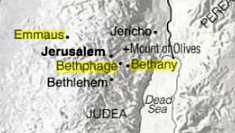
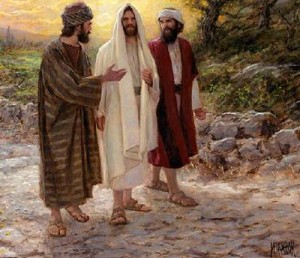
Today we will be looking at what happens when we have a close encounter with God. There are many such encounters described in the Bible. Abram hearing from God an invitation to travel hundreds of miles to a new land. Abraham and Sarah entertaining Messengers of God and being told Sarah would bear a child. Moses confronting the burning bush, and years later encountering God on a mountaintop. Mary Magdalene seeing Jesus outside the tomb. The two travelers on their way to Emmaus who meet Jesus on the day of his resurrection. That is setting for the passage at the top of the page. Cleopas and his unnamed companion are walking sort of northwest away from Jerusalem toward the small town of Emmaus. Emmaus (ee-MAY-us) was about seven miles from Jerusalem in the hill country of Judah. You might think of it as sort of a resort town; Emmaus means “Warm Spring.” It sounds like the two disciples were on their way home when Jesus overtook them on the road. He asked them what they were discussing. The two men were struggling with the news that “certain women” of the group which followed Jesus had visited the tomb and scared off the Romans. Instead, they had seen Jesus murdered by the Romans who had been influenced by Jewish leaders to put their Master to death.

HolyLand01They told Jesus how this had astonished them and they were talking about what it could all mean. They were upset enough that they did not recognize Jesus. He said to them, “Foolish men, and slow of heart to believe in all that the prophets have spoken! Didn’t the Christ have to suffer these things and to enter into his glory?” (Luke 24:25-26)Then he explained everything that had happened by referencing the scriptures fulfilled. The three travelers got to the outskirts of Emmaus and Jesus indicated he was going farther. The disciples asked him to stay with them as it was getting close to sunset. He went in with them and as they sat to share a meal together, he broke bread and gave it to them. Instantly they recognized him, and the moment that happened, he disappeared.

EmmausSmThey had a close encounter of the Sixth kind. They met God live and in person. Just as it was with Abram, and Moses, their close encounter with God changed them. They were instantly convinced that what they had heard about Jesus was true. They realized that as they were speaking with Jesus, as he was unveiling the Scriptures to their minds and hearts, they knew something extraordinary was happening. Their hearts were “burning within them.” No, that doesn’t mean they got heart burn. It means that they intuitively opened their hearts to Hope and Faith because of Love.

As C. S. Lewis said, meeting God changes us, not the other way around. We can meet him day or night, here or there, now or then. Sometimes we even meet him on the road, or at work, or in the grocery store. He can be hitch-hiking, asking for spare change, speaking wisdom in the guise of a child, or delivering a sermon at church. We meet him in Scripture, and we meet him in Prayer. That’s pretty much the whole idea behind these Aloha Friday Messages; you have links to the Scriptures so you can encounter him there. You have whatever it is the Holy Spirit has stirred up in me and then – added to that – you have whatever the Holy Spirit stirs up in you when you read this message.

Sometimes we meet God when he is working in and through us, and that is so startling! As in the quote from Jeremiah, sometimes we just can’t shut up about what God is doing or saying! We can clamp our teeth together and close our eyes and ears, but God just presses us to declare his Word. We give in, and it’s like a bubbling fountain – it just comes out and there nothing we can do to stop it. Sometimes, like C. S. Lewis, we can’t help but pray because we cannot help ourselves the way God can help us. It is only Jesus who can baptize us with the Holy Spirit and with Fire, the Fire that burns in our hearts to warm and brighten our souls. Sometimes we cannot stop a prayer or a prophetic word. Sometimes, God acts in us or through us because it is his will to do so, and we have yielded to his will. We experience a Close Encounter with God, and it indeed changes not just us, but everything about us. That encounter – more often than not – is unexpected; but should that be the case?

Cleopas and his friend were immersed in their emotions over what had happened and curious about the amazing news Mary Magdalene and Mary the wife of Cleopas (see John 19:25) had given them – that Jesus was alive and wanted the disciples to go meet him in Galilee. (See Matthew 28:1-10) The two men could barely believe what they had heard. The certainly did not expect that they would meet Jesus. Once they realized all that had happened, they hightailed it back to Jerusalem where the other disciples were hiding out and shared the amazing news which was confirmed when the other disciples said, “The Lord is risen indeed and has appeared to Simon.” (Luke 24:34) Remember our four “omni” words from the Advent Series on Mercy? God is Omnipotent, Omniscient, Omnibenevolent, and Omnipresent. He is all-powerful, all-knowing, all-goodness, and present everywhere all the time. You probably encounter him thousands of times per day (There are 84,600 seconds in one day.) Literally “any second now” you might be suddenly aware he is with you. He’s there all the time anyway. We just don’t pay attention. Maybe we should follow the advice of Mr. Ralph R. Upton, a high school teacher in Seattle who coined the phrase Stop – Look – Listen. That warning was posted at thousands of dangerous railroad crossings. What if we were to Stop – Look – Listen at the crossroads in our lives? Would we notice Jesus is there trying to get our attention, trying to engage us in a Close Encounter of the Sixth Kind? You know that happens sometimes! You have those moments when you just suddenly feel a very certain and special sensation that says to you, “Jesus is here!” You know that there are times when the Holy Spirit rushes upon you and your heart just blazes with the Light of his Glory and Grace. What prompts us to Stop – Look – Listen?

TelephonePoleWhat do you see here? Is this just a telephone pole? Or does it remind you of something else? You’ve just had a close encounter! Look around the place where you are reading this. How many things do you see that remind you of The Cross? Think about looking into the sky and spotting the moon – day or night. For me (and hopefully for most of you) I am reminded of the Moon Beam Network and I take 15-20 seconds to pray the MBN Prayer. Hear a siren? See an ambulance or fire truck or police cruiser? Another close encounter! Pray for the operators of that emergency vehicle and for the people they are going to help. Hear a hungry child crying? Remember the Corporal Works of Mercy, and then do something merciful. Did a friend pass away recently? Comfort the family with true kindness. Know someone who is pilfering office supplies at work? Admonish that sinner! Something catch your ear at church? Meditate on what it means to you; then find out what God wants you to do with that new knowledge. Stop – Look – Listen. Not so much because you are in a dangerous place, but because you are in danger of missing another awesome opportunity to encounter GOD. All of these are Encounters with God. How many of them do we miss in one hour, one day, one year, one lifetime?

We are human after all. We are sinners. We are not tuned-in 100% of the time. But, pay attention to your heart. When it is burning within you and you know it’s not from lunch, Stop – Look – Listen – then Rejoice! He is risen indeed and with you even now.

Whatever, whenever, wherever, whoever, however, if ever, forever — at your service, Beloved
chick 


Creative Commons License
Aloha Friday Messages by Charles O. Todd, III is licensed under a Creative Commons Attribution-ShareAlike 3.0 Unported License

Aloha Friday Message – April 25, 2014 – Mercy Me!

1417AFC042514 – Mercy me!

Read it online here, please.

Micah 6:8He has shown you, O mortal, what is good. And what does the LORD require of you? To act justly and to love mercy and to walk humbly with your God.

Hosea 6:6For I desire mercy, and not sacrifice; and the knowledge of God more than burnt offerings.

Romans 11:30-32Just as you were once disobedient to God but have now received mercy because of their disobedience, so they have now been disobedient in order that, by the mercy shown to you, they too may nowreceive mercy. For God has imprisoned all in disobedience so that he may be merciful to all.

Joel 2:12-13 – “Yet even now,” declares the Lord, “return to me with all your heart, with fasting, with weeping, and with mourning; and rend your hearts and not your garments.” Return to the Lord your God, for he is gracious and merciful, slow to anger, and abounding in steadfast love; and he relents over disaster.

This coming Sunday is called Divine Mercy Sunday – for Catholics around the world. For Christians of other denominations, it is the first Sunday after Easter. I want to touch again on the topic of Mercy. There was a short series on Mercy back in November-December of 2013. Today I’ll start with some thoughts recently gathered, and occasionally touch on older material from that series.

In addition to the celebration of Divine Mercy Sunday, there are some current events that have tugged at my heart which affect the way I want to approach the subject. Let me begin with another item occasionally mentioned previously; it’s from a conversation between Abram and God found in Genesis 15:16 – But in the fourth generation they shall come here again: for the iniquity of the Amorites is not yet complete. To me, this is significant because it speaks to the patience of God – itself a Mercy. This statement occurs on the day God and Abram entered into the Covenant Promise that Abram would become Abraham, the Father of Many Nations. He would be the progenitor of the people who eventually took over the Promised Land, the Land of Canaan. But that would not happen until the fourth generation – about 400 years from that day in Abram’s history. God knows the life-course of every living soul. He patiently waits for each soul and each nation of souls to acknowledge his Sovereignty and to return to him. The Amorites were very powerful as a nation – and also very wicked. Nonetheless there were some good persons among them as well, and some of them became allies of Abraham, and later even of the nation Israel.

The point here is that eventually, despite God’s good patience, they reached a point of no return, where they would never repent; and when that point is reached and God’s patience is exhausted, God allows that the “wages of sin” overtake the sinners, and thereby they are removed from life. There are other instances where this kind of thing happened. One of them, perhaps the most notable, has recently been in the news and in the public eye: Noah. God had reached the limit of his patience with the evil that was perpetrated on the earth and reluctantly decided to start over; but, he kept a remnant of Creation – one family, and at least one pair of all living creatures. I have always felt strongly warned when, in the account of the Deluge and the Ark, we read in Genesis 7:16 – A male and female of each kind entered, just as God had commanded Noah. Then the LORD closed the door behind them. God shut Noah, his family, and all the creatures in; and on the flip side of that, he shut everyone and everything else out. Is there a point in a sinner’s life where God can act like that; shut the sinner out of his presence?

Yes.

If you believe there is a Heaven, there is also a Hell. To put it in the simplest terms, Heaven is Eternity in the Presence of God and Hell is Eternity in the Absence of God. But, God is patient, and because of his mercy we have access to forgiveness, salvation, and Eternal Everlasting Life. That phrase in not a redundancy. Eternal means life without end. Everlasting means Life which is constantly renewed and revivified. If you don’t believe in Heaven or Hell, or God for that matter, then God will patiently wait for you to figure out that you’re missing something until such time as you are out of time and stand before Jesus on The Day of Reward (usually called Judgment Day). On that day, you will received the Reward for the conduct of your life, and that reward will be possible on the basis of Christ opening the doors to Heaven and Hell and dividing the souls before him between those locations. It is going to happen. But there is still God’s Mercy.

What are we to do? How will we know this Mercy? You’ve seen Micah 6:8 here many times. It is the clearest statement I know of declaring God’s expectations of us. We must do the right thing, be merciful to others, and walk humbly before God. It seems very simple in concept, yet surprisingly elusive in practice. God wants us to be loving and merciful because HE is loving and merciful. The whole point of creation, salvation, revelation, and life itself is that we are created in his image and all he wants from us is to live with that in mind. What could be simpler? Ah, but the way he placed that before us, and what seems to cause us to botch that up is that we have to choose to be loving and merciful. Instead, we usually choose the opposite – indifferent and cruel. Think about it. All of us have multiple opportunities to be compassionate and generous every day. Most of those opportunities go unanswered; yet God is still patient and supplies us with thousands more opportunities in our lives to be like him – a chip off the old block so to speak.

Everyone is “imprisoned in disobedience” for “all have sinned and come short of the Glory of God.” We all live in sin. We can be – and are – all forgiven when we do as God intends: “Return to me with all your heart.” What is so hard about that? Surely we can see that being with and in God is far better than being with and in Satan – yet we make that latter choice so often one begins to wonder if humankind has any sense at all. There is so much evil that we wonder where there can be found any good. Just this past week I read an article stating that Canadian aborted fetuses were being shipped to a power plant in Oregon and used as fuel to provide electricity. Such depravity should not – indeed could not – occur in a culture that knows it must act justly and to love mercy and to walk humbly with your God. God wants US to be with him, here in this life and eternally thereafter. He GAVE us Salvation through his Only Begotten Son. It is a Gift beyond value in this life on Earth. Jesus told the crowds, in Luke 12:32-24 “Do not be afraid, little flock, for it is your Father’s good pleasure to give you the kingdom. Sell your possessions, and give alms. Make purses for yourselves that do not wear out, an unfailing treasure in heaven, where no thief comes near and no moth destroys.  For where your treasure is, there your heart will be also.” That is what justice, love, mercy, and humility look like when put into practice in our lives. We choose to sin. We can also choose not to.

You may remember this from December 6, 2013

Proverbs 10:16The wages of the righteous is life, but the earnings of the wicked are sin and death.

God’s patience with our sin is the hallmark of his Mercy. Whether we remember his Mercy as part of a religious celebration or as a moment of clarity in our lives (hopefully both!), God is Kind and Merciful, his mercy endures forever. He wants us to have The Kingdom, but how do we get it? Like all of God’s gifts, we receive it by accepting it in Love. Love him as much as you can. That will always be enough, and you will be AMAZED at what he does with it! That is how Mercy is made manifest in your life. God’s Mercy is an additive gift; it’s part of the Kingdom.

How long will it be before God says of us, “Their iniquity is filled up; they shall be no more.”? Perhaps – maybe even probably – it will be beyond our lifetimes as a nation. But what about today in my life, in your life, in our lives in or outside of the Kingdom of Heaven, a gift from our El Shaddai Olam – Almighty and Everliving God? When the Day of Reward comes, could it be that God will pull shut the doors of Heaven? If so will we be closed in or closed out? If we choose to accept his Mercy and all that comes with it, we will be closed in – with him and all the saints who have gone before us. Refuse that Mercy, and be locked out at the Day of Resurrection.

What will you choose today?

John5v28-9

Creative Commons License
Aloha Friday Messages by Charles O. Todd, III is licensed under a Creative Commons Attribution-ShareAlike 3.0 Unported License

Aloha Friday Message – April 18, 2014 – Nailed it!

1416AFC041814 – Nailed it!

Read it online here, please.

Isaiah 53:1-12 (NIV) – 1 Who has believed our message and to whom has the arm of the LORD been revealed? 2 He grew up before him like a tender shoot, and like a root out of dry ground. He had no beauty or majesty to attract us to him, nothing in his appearance that we should desire him. 3 He was despised and rejected by others, a man of suffering, and familiar with pain. Like one from whom people hide their faces he was despised, and we held him in low esteem. 4 Surely he took up our pain and bore our suffering, yet we considered him punished by God, stricken by him, and afflicted. 5 But he was pierced for our transgressions, he was crushed for our iniquities; the punishment that brought us peace was on him, and by his wounds we are healed. 6 We all, like sheep, have gone astray, each of us has turned to our own way; and the LORD has laid on him the iniquity of us all. 7 He was oppressed and afflicted, yet he did not open his mouth; he was led like a lamb to the slaughter, and as a sheep before its shearers is silent, so he did not open his mouth. 8 By oppression and judgment he was taken away. Yet who of his generation protested? For he was cut off from the land of the living; for the transgression of my people he was punished. 9 He was assigned a grave with the wicked and with the rich in his death, though he had done no violence, nor was any deceit in his mouth. 10 Yet it was the LORD’s will to crush him and cause him to suffer, and though the LORD makes his life an offering for sin, he will see his offspring and prolong his days, and the will of the LORD will prosper in his hand. 11 After he has suffered, he will see the light of life and be satisfied; by his knowledge my righteous servant will justify many, and he will bear their iniquities. 12 Therefore I will give him a portion among the great, and he will divide the spoils with the strong, because he poured out his life unto death, and was numbered with the transgressors. For he bore the sin of many, and made intercession for the transgressors.

First a little story I got in an e-mail a few years back. A Big Mahalo to CeW for sending this fine little lesson:

Amen and Amen.

A man dies and goes to heaven. St. Peter meets him at the Pearly Gates and says, “Here’s how it works. You need 100 points to make it into heaven. You tell me all the good things you’ve done, and I give you a certain number of points for each item, depending on how good it was. When you reach 100 points, you get in.”

“Okay,” the man says, “I was married to the same woman for 56 years and never cheated on her, not even in my heart.”

“That’s wonderful,” says St. Peter, “that’s worth two points!”

“Only two points?” he asks? “Well, I attended church all my life and supported its ministry with my tithe and service.”

“Terrific!” says St. Peter… “That’s certainly worth a point, and that makes three.”

“One point!?!!” He continued, “I started a soup kitchen in my city and worked in a shelter for homeless veterans.”

“Fantastic, that’s good for two more points! You’ve got five all together,” he says.

“Five total points!?!!” Exasperated, the man cries. “At this rate the only way I’ll get into heaven is by the Grace of God.”

“Bingo! 100 points and that makes a total of one-hundred-and-five! Come on in!”

We often try to fix many of our problems with things like WD-40 and duct tape, bailing wire, chewing-gum, string,  “reasoned arguments,” angry accusations, whining, and even some fast talking. The good things that we do sometimes live after us, but to live after them we need something other than what’s done in this world. We need a permanent solution that fixes it all.

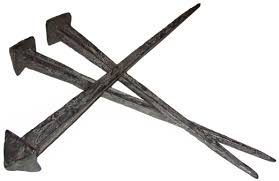
God did it with just 3 nails.

Matthew 27:33-36 – When they had reached a place called Golgotha, that is, the place of the skull, they gave him wine to drink mixed with gall, which he tasted but refused to drink. When they had finished crucifying him they shared out his clothing by casting lots, and then sat down and stayed there keeping guard over him.

Just 3 Nails

Just 3 Nails

Matthew’s account of the crucifixion of Jesus leaves out the gruesome details of that awful moment when he was nailed to the wood of the cross. Even the accounts of the scourging, the plaiting of a crown of thorns, the mocking by the cohort of soldiers, and the cowardice of Pilate against the malice of the crowd are not described in the kind of detail we have grown accustomed to in the cinematic portrayal of Jesus’ life, Passion, and death. For Matthew, these things are not important. The important part of the story is what’s happening in and through others.

Everything Jesus preached, everything he represented, every moment of his ministry was being repudiated through the actions and attitudes of the people around him. The soldiers saw him as just another rebel, maybe a nut-case who got carried away with his own story. The crowd for the most part rejected his message, his miracles, his ministry, and his menshkeite – his noble character and dignity – the fact that he always did what was right, responsible, and righteous. The agony of that rejection was made all the more exquisitely painful when he sensed that even God his Father had abandoned him. He was deserted by most of his closest friends, betrayed by one of his own, murdered by an occupying power that cared nothing about his ideology, and offered up by his own nation’s leaders.

He did all of that willingly. He accepted the suffering – and it was immense beyond measure – because it pleased God his Father who allowed his Son, his only begotten son, to make a pure, final, and perfectly complete sacrifice of himself for the sake of every living soul, any time, everywhere. The Passion of the Christ was, and is, the one and only key to the door of Grace. Once that door was unlocked, Heaven and Earth were no longer separated by the Veil of Death. Jesus knew that would happen, knew it was the will of his Father, knew it would mean eternal life for you, for me, for us, for all who are his disciples and even those who are not. He knew he could complete that sacrifice for his Father and for us.

He was right you know. When they came to arrest him, someone (Peter we assume) struck the servant of the high priest, and Jesus said, “Do you think that I cannot appeal to my Father, and he will at once send me more than twelve legions of angels? But how then would the scriptures be fulfilled, which say it must happen in this way?” (Matthew 26:53-54) Instead, he allowed the arrest, the mock trial, the abuse and stayed there on that ghastly instrument of torture because he was the only one who could do it. The crowd jeering below yelled, “Look at you now!” they yelled at him. “You said you were going to destroy the Temple and rebuild it in three days. Well then, if you are the Son of God, save yourself and come down from the cross!”

(Matthew 27:40) You know what? He had the power to do that. Perhaps Judas figured that in the end Jesus would use some miracle to save himself. It didn’t matter to Judas that such a thing might not happen because Judas was still not convinced Jesus was the Messiah. He ended up dying for that mistake.

Judas never got past his own self-importance. He was a thief, a scoundrel, a traitor, and … a friend of Jesus. The betrayal of a friend is incredibly painful to endure; but Jesus knew it was going to happen – along with everything else in his Passion, Death, and Resurrection (!) – and still pleased he his Father by willingly accepting it all. When Judas saw how mistaken he was, he regretted his decision. The KJV says “when he saw that he was condemned, repented himself, and brought again the thirty pieces of silver to the chief priests and elders” in Matthew 27:3, but his repentance went only as far as remorse; he was upset because his plan didn’t work out. He did not repent; he did not turn back from evil and seek forgiveness; he went farther into evil and killed himself.

There is a difference between repentance and remorse. In this passage, the word used is μεταμεληθεὶς – metamelētheis – felt remorse. Repentance, on the other hand is μετάνοια (metanoia) – “to think differently after.” Judas still thought he was right, and it was his undoing. Paul summed it up best in 2 Corinthians 7:10 For the kind of sorrow God wants us to experience leads us away from sin and results in salvation. There’s no regret for that kind of sorrow. But worldly sorrow, which lacks repentance, results in spiritual death. Judas did not have the opportunity to see Christ beaten, mocked, and crucified. He hanged himself before all of that. And of course he never met the Risen Christ. Unlike Peter, who went out and wept bitterly, Judas was embarrassed by his mistake, and did not repent. He never got a chance to learn that it was not those 3 nails that held Jesus to the Cross.

Those 3 nails could not keep him there.

So what held Jesus to the Cross?

Love.

Love for his Father. Love for obedience. Love for Eternity. Love for us. Crucifixus etiam pro nobis – Crucified even for us. It was the New Beginning in the New Covenant at the threshold of the door of Grace unlocked for all of us by and through that one Perfect Sacrifice of Love. We, the True Believers, are the offspring of that Covenant. We enter Heaven by the Grace of God.

Have a blessed Holy Friday, Beloved. And Happy Easter to us, every one.

Whatever, whenever, wherever, whoever, however, if ever, forever — at your service, Beloved.

chick
Creative Commons License
Aloha Friday Messages by Charles O. Todd, III is licensed under a Creative Commons Attribution-ShareAlike 3.0 Unported License

Aloha Friday Message – April 11, 2014 – Hosanna!

1415AFC041114 – Friday Before Palm Sunday

Read it online here, please.

Zechariah 9:9Rejoice greatly, O daughter of Zion! Shout aloud, O daughter of Jerusalem! Behold, your king is coming to you; righteous and having salvation is he, humble and mounted on a donkey, on a colt, the foal of a donkey.

Isaiah 53:10Yet it was the will of the LORD to crush him; he has put him to grief; when his soul makes an offering for guilt, he shall see his offspring; he shall prolong his days; the will of the LORD shall prosper in his hand.

Zechariah 13:7 – “Awake, O sword, against my shepherd, against the man who stands next to me,” declares the LORD of hosts. “Strike the shepherd, and the sheep will be scattered; I will turn my hand against the little ones.”

John 16:32“Behold, the hour is coming, indeed it has come, when you will be scattered, each to his own home, and will leave me alone. Yet I am not alone, for the Father is with me.”

This is Friday before Palm Sunday, the Sunday that begins Holy Week and the Sunday before Easter. Jesus has become well known by thousands because of his marvelous deeds – feeding people, speaking with authority, raising the dead. Now he enters the city of Jerusalem, riding on a baby donkey. The fact that Jesus rode into Jerusalem on a donkey was, in part, a fulfillment of scripture. But there’s more. A king who rides in on a donkey is coming peacefully. A king who rides in on a horse is coming in war. It is also significant that the colt Jesus’ disciples borrow is one that has never been ridden. Here the King of Peace is so gentle and so humble that even a young colt never before ridden submits to Jesus’ presence. Instead of bucking him off, the colt meekly carries a full-grown man. It is interesting to me that the disciples who went to fetch it did so without question, and then they put their own cloaks on the back of the colt to make a more comfortable seat. I think it might have also been more comfortable for the colt! And you know, I think that colt’s mama walked next to him on that journey. Read it again and see if you think so, too.

As he rode through Jerusalem, the crowds who recognized him paid him homage: Mark 11:9 – And those who went before and those who followed were shouting, “Hosanna! Blessed is he who comes in the name of the Lord! Blessed is the coming kingdom of our father David! Hosanna in the highest!” That word, Hosanna, is found only in the New Testament, but there are echoes of it in other places in the Old Testament, too. It means to help or to save (See Psalm 118:25, for example). It comes from a Hebrew phrase hoshiya na. in Psalm 118:26, it is followed by Blessed is he who comes in the name of the Lord! Over the centuries between David and Jesus, the expression hoshiya na had come to mean Salvation is now! When Jesus got on that baby donkey, he started toward Jerusalem to fulfill what had been prophesied about the Messiah.

Jesus was in Bethany, close to Bethpage (“Place of new – or unripe – figs”) somewhere perhaps around the Mount of Olives. He gets on the colt in Bethany – about 2 miles from Jerusalem, and heads into town. On the way people who have seen him, who know him – some intimately, some only be reputation – get excited about seeing him, and they begin to remember Zechariah 9:9. They start pulling down palm fronds and laying them on the path in front of him or waving them in the air. The palm was a symbol of victory – even Holy Victory. In addition people were laying their cloaks down in the road and letting the little donkey pass over them. A similar event is reported in 2 Kings 9. [They hurried and took their cloaks and spread them under him on the bare steps. Then they blew the trumpet and shouted, “Jehu is king!”] Elisha had just anointed Jehu (“Yahweh is He”) as King of Israel, and had ordered him to go avenge the murders committed by Jezebel’s forces when she had the prophets slaughtered. The king, Ahab, had permitted this, and Jehu was told to destroy Ahab as well.

Spreading cloaks or other objects to “pave the way” was a common demonstration of respect for the dignity and power of a person – a King, a general, even a prophet. So now we have Jesus on a baby donkey and everyone is shouting and happy and cheering and dancing and running ahead and coming back and just going nuts over what Jesus is doing. He was finally defining himself as the Messiah, the Ruler of Israel, The Son of David! And, they surely thought he was about to kick the Romans out of town as the Rightful Ruler.

But, he was on a donkey, not a horse. And the people understood. They identified with him.

What is it that you might learn about Jesus that would help you identify more with him, feel closer with him? I remember a story I read when I was maybe a fifth-grader. It was about a little girl of about three years who had a wooden doll named Ruth. The Roman soldiers came galloping through her village scattering the villagers. As she ran to get out of the way she fell. Her mom snatched her out of the way just as the cohort reached the place where she fell. The doll slipped out of her arms. An iron-shod hoof stepped squarely on Ruth’s face. Moments later, when the dust had settled, the little girl went back and found the ruined doll. She began to cry.

Then a man’s hand rested on her shoulder and the man’s voice said, “Here, let me have a look at that.” The little girl looked up and saw a young man in his late-twenties. He had long, dark, curly hair and gentle eyes. He was smiling. The girl handed Ruth to the man. He sat down and said, “Hmmm, I think I might be able to fix her up a little. Would you like that?” Through dirty tears the girl nodded. The man borrowed a knife from his father who was walking with him. His mother went to sit with the little girl to comfort her. He started whittling around the hoof mark. Within a few minutes, the evidence of the damage was gone and Ruth had a new face with a beautiful little smile – a smile just like the little girl’s. He handed the little girl the doll, gave her a hug, and returned to the road to continue his journey to Jerusalem with his parents. About 5 years later the little girl saw him again. He was riding into the city on a baby donkey, and people were shouting “Hosanna!” When he passed by her, she held up Ruth for him to see. He winked at her and wiggled his fingers to say hello to Ruth.

Where is YOUR Bible?

Where is YOUR Bible?

Have you met Jesus in a way that made him really accessible to you? Have you heard his quiet whisper on the mountaintop? Did you see him playing with his dog in the park? Have you given him a plate of food at the shelter? Did you hear his prophecy in a song on the radio? Did he offer you loving correction and guidance in the heart of your friend? Did he bake you a batch of your favorite cookies? Did he show up at your door with a casserole when your dad died? Did he ride with you through the storm or away from the forest fire? Could you hear the nails piercing his wrists? Did someone see Jesus in you when you did these things for them? Then Jesus was present. And you were present with him.

But, as we know, the disciples who were present with him for about three years abandoned him at the worst possible time. He had been telling them for months that he must go to Jerusalem and suffer many things from the elders and chief priests and scribes, and be killed, and on the third day be raised. (Matthew 16:21) In the few days that followed his entry into Jerusalem as the King of Peace, he was betrayed by a trusted friend, arrested by people who were afraid of the Romans because of the possibility that Jesus might provoke them into becoming crueler in their governance of the nation, and then he was tortured to death.

Now you know a little about the story. When you are holding your palm branches Sunday, think about that little donkey and what a privilege it was to carry Jesus. Beloved, you can carry him too; in your heart, not on your back. Spread out your best things for him and invite him to have a seat. Carry him wherever you go and once in a while, just for the sheer JOY of it, shout, I said SHOUT, “HOSANNA!!”

And, with a humble and contrite heart, let us all remember the times we also not only stopped carrying Jesus, but actually ran away from him. It was for us, for you, and even for me that he was crushed with infirmities, bruised for our iniquity, killed as a perfect sacrifice for our sins. He did indeed suffer greatly. (See Matthew 16:21From that time Jesus began to show his disciples that he must go to Jerusalem and suffer many things from the elders and chief priests and scribes, and be killed, and on the third day be raised. The manner of his death was so horrible that even today it astonishes us and anyone would endure that willingly. And yet, he gave himself – body, mind, and spirit – over to Death so that we might live.

Jesus had all the body parts any man has, plus all the feelings, all the susceptibilities, and all the good things in every human life. He just didn’t have sin. But: For you, for me, for us he became sin and died to take all our sins away. And that, perhaps, is what is the most important and most striking about the ways we can identify with him. I did the sin. He did the reparation. Do you remember the song “When He was On the Cross, I Was On His Mind” which was popular around 2007 and earlier? That is another thing we have in common with Jesus. He knows our sins because he paid for every single one of them. Once for all because he loved us that well, well enough for him to lose everything so we could gain everything through his loss. Knowing that, we no longer have any reason to run from his presence.

Whatever, whenever, wherever, whoever, however, if ever, forever — at your service, Beloved
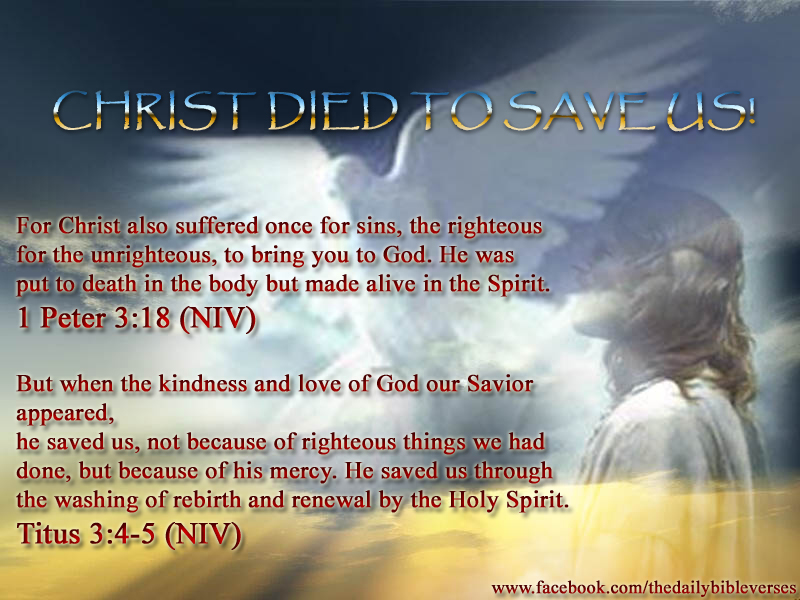
 

Creative Commons License
Aloha Friday Messages by Charles O. Todd, III is licensed under a Creative Commons Attribution-ShareAlike 3.0 Unported License

Aloha Friday Message – April 4, 2014 – Believer, Come Forth!

1414AFC040414 – Believer! Come Forth!

Read it online here, please.

Isaiah 25:7-8 – And he will destroy in this mountain the face of the covering cast over all people, and the veil that is spread over all nations. He will swallow up death in victory; and the Lord GOD will wipe away tears from off all faces; and the rebuke of his people shall he take away from off all the earth: for the LORD hath spoken it.

Happy Aloha Friday, Beloved. We are already at the fifth Friday of Lent, and this coming Sunday the Gospel is about Lazarus, the brother of Mary and Martha. The account of Lazarus’ death and resurrection is powerfully emotionally and spiritually. This family was one of Jesus’ favorites. You can tell by the intimacy he enjoyed there that Jesus loved this trio of believers. It was Mary who anointed Jesus feet with fragrant spikenard ointment and dried his feet with her hair just six days before his Passion and Crucifixion, and this act prefigured his donning a towel and washing the feet of the apostles on that holy night. Jesus was at their house often, and perhaps they had known each other since before he began his ministry. We can imagine how these three people lived in their home in Bethany. There is no mention of other family or parents. Bethany was close to the Mount of Olives. Jesus passed through there on his way to Jerusalem more than once. It was near Bethany that the Disciples witnessed his Ascension. These three, then, were people Jesus really, really cared about. He loved them in a very special way.

Around the time of this event in Jesus’ life, there was a strong movement among some of the people to capture him and kill him. His Apostles, Disciples, and other friends were very concerned about these constant threats on his life. Jesus knew about the threats, and he also knew how it would all turn out, he knew what would ultimately happen to him near Bethany, in the Garden of Olives. He knew what had happened to Lazarus, too; despite knowing all the pain associated with that knowledge – Lazarus was dead and Jesus would soon be crucified – Jesus stayed with his mission of teaching and healing. When someone tracked him down to tell him about Lazarus, Jesus told them, “He is only sleeping.” They took that to mean Lazarus was resting and getting better. He told them point-blank that Lazarus had died, but his death would not be the end of the story or his life. Finally he says he will go to his friends’ house so that he can demonstrate God’s power and will. That’s when one of my favorite Bible characters pops into view again. Here’s the passage.

John 11:1-45 16 Then Thomas (also known as Didymus) said to the rest of the disciples, “Let us also go, that we may die with him.” Thomas fascinates me! He always seems to be a beat behind, or maybe he was just a strong pessimist, “Oh, well, if we’re going to Bethany, we’re all gonna die!” Then again, he might have been the bravest one in the bunch, ready to die with his Master and friend. Later on (John 14:5), Jesus is telling them – in the Last Discourse, “Don’t worry. Everything will be alright. You know where I’m going. I’ll come back and get you.” Thomas pops up again and says, “How can we know where you are going? We don’t know where you are going so how can we know the way?” And of course Thomas is most famous for saying, “I won’t believe he’s back until I see him for myself.” Thomas wasn’t in the Cenacle – the Upper Room – when Jesus first appeared to the 11 after his resurrection, and so he got stuck with the moniker “Doubting Thomas.” Odd that he should doubt Jesus was resurrected because he had been a witness to the resurrection of Lazarus. He stood there with Jesus, Mary and Martha, and all the other mourners as Jesus, his heart stirred emotion and tears in his eyes, and he shocked them all with what he said.

38 Jesus, once more deeply moved, came to the tomb. It was a cave with a stone laid across the entrance. 39 “Take away the stone,” he said.

Everybody there went, “What?!?! It is not a good idea to move that stone. It’s going to smell really bad, and … you don’t really want to do that now. You should have come a week ago when he got sick and you could have healed him, but now, it’s too late. He’s rotting away in his grave.” Jesus must have given them quite a look before he turned toward the tomb where Lazarus had been placed. He told Martha straight out, “Did I not tell you that if you believe, you will see the glory of God?” Somebody, maybe several people, maybe even Thomas (although there’s no way to know for sure who moved the stone) had the courage to lift that stone out of the way. Then The Moment:

43 When he had said this, Jesus called in a loud voice, “Lazarus, come out!” 44 The dead man came out, his hands and feet wrapped with strips of linen, and a cloth around his face.

Lazarus, come forth!

Lazarus, come forth!

Lazarus came out of the tomb all wrapped up in the trappings of death. He came out to new life. He came out to fresh air, sunshine, solid ground, and within a short time – a few weeks, perhaps more – he and Jesus were reclining at the table enjoying a feast prepared by Martha and enjoying the fragrance of the ointment Mary was lovingly massaging into his feet. Jesus’ tender sympathy for these friends shows us the very human side of his person. His heart is deeply moved, and he groans inwardly because of their pain. He joins them in shedding tears, but he is also hearing the cries of the mourners and sees the impact the loss of Lazarus has on this tiny community of Bethany. Together they had shared in the joys of life, in the happiness of Jesus’ visits, and now they shared in the mourning, weeping, and immense sorrow of these two sisters who had lost their beloved brother, a brother who had entertained Jesus in his home. In fact, these sisters hoped and prayed that they would be reunited with their brother. They just did not expect it to happen that day!

Some of the bystanders had insinuated that if Jesus could make the blind see, he could sure have gotten here in time to save Lazarus’ life. Jesus actions deliberately counter that idea. He gave them something much more powerful than a healing to talk about. He gave them a resurrection in broad daylight in front of many witnesses.

So let’s get to the point. For whatever reason we doubt God’s love or Jesus saving power, he is always ready and able to exceed all our expectations. Whether we go to our death with him from bravery or loyalty or from a sincere fatalism that recognizes our frailty, if we die with him we shall rise with him. And when we rise with him he will take us where has prepared a place for us. But we need to respond when he calls.

Take away the stone. The stone in front of your tomb. Move it! Yes. Take away whatever it is you are hiding behind, whatever it is that keeps you in your tomb of death, and step out to meet your Lord in the Light of his Word. He calls you to come away from the death of flesh to be alive in Spirit, alive in your Creator, your King, your Saviour, or as Thomas put it so well, “My Lord and my God!” Come away from the death of sin and come alive, renewed, revived, and resurrected from your former self. Shed the wrappings of death, and the stench of decay. Listen with your ears and hear with your heart. Strip away the things that bind you to your death. Loose the things that stop you from walking into his Light, his Everlasting Life. Be freed of the trappings of death. Take away the stone! He is calling you.

And here is something to think about: Jesus did not move the stone. Lazarus did not move the stone. Neither Martha nor Mary moved the stone. The friends of Lazarus moved the stone. Sometimes we are liberated from those things which have us paralyzed as if we were dead by the love of others around us. They take away the stone, they open the way to new life. WE have to get up and go out of the tomb and back into life! We have to respond with every fiber of our being when the people who love us call, as Jesus did,

“Beloved, come forth!”

Rise up. Go to him. Live. He has already swallowed up death in victory!

Whatever, whenever, wherever, whoever, however, if ever, forever — at your service, Beloved!

chick

Creative Commons License
Aloha Friday Messages by Charles O. Todd, III is licensed under a Creative Commons Attribution-ShareAlike 3.0 Unported License

Pages Email Newsletter Categories Archives Connect
  • Connct to us here