Aloha Friday Message #365! – April 26, 2013 – A Friend for the Ages

1316AFC042613 – A Friend for the Ages

Read it online here, please

Proverbs 16:18, Proverbs 27:6, Proverbs 27:17, Galatians 6:3, Matthew 26:50

What a Friend we have in Jesus, all our sins and griefs to bear!

What a privilege to carry everything to God in prayer!

O what peace we often forfeit, O what needless pain we bear,

All because we do not carry everything to God in prayer.

Help me, O God, to be a good and a true friend; to be loyal and never to let my friends down: Never to talk about them behind their backs in a way that I would not do before their faces; never to betray a confidence or talk about the things I should be silent about; always to be ready to share everything I have; to be as true to my friends as I would wish them to be to me. This I ask for the sake of him who is the greatest and truest of all friends, for Jesus’ sake. Amen.

– by William Barclay

I have said “I love having friends and I have loving friends.” This has been true for me for many years. Sometimes, though, I am not as good at being a friend as I should be. I mess up, or I forget something important, or maybe precipitate a quarrel. That is one of the inherent qualities of friendships; sometimes there is hurt. Do you remember this lyric?

You always hurt the one you love,
The one you shouldn’t hurt at all.
You always take the sweetest rose
And crush it till the petals fall.

How does that happen anyway? Often it happens when our pride gets in the way of our friendship. Proverbs 16:18 says, Pride goes before destruction, a haughty spirit before a fall.” In any close relationship, we are able to get close because we build our relationship on trust in each other. When that trust is interrupted, the interruption often traces back to pride. There is offense taken at some real or perceived slight or oversight and we feel offended by that because it is inconsistent with our self-perception. We deserve to be treated better than that! After all, aren’t we friends? (“How could you say/do that? I thought you were my friend!”)

When we raise a comment like that, then we end up with two wounded persons. I am wounded by your words or actions and you are wounded by my egoistic accusation. You may say, “I’m only looking out for your best interests.” That sometimes gets interpreted as “I’m smarter and better than you are, so pay attention and get your act together!” Now you’re offended because I’ve apparently made a judgment against you, and I’m offended because I now believe you’re suffering from a superiority complex. In Proverbs 27:6 we read, Wounds from a friend can be trusted, but an enemy multiplies kisses.” This is similar to the old adage attributed to General Sun-Tzu, “Keep your friends close and your enemies closer.” When a friend flies off the handle and says something so outrageous that we are totally caught off guard, more likely than not it’s because we haven’t been paying attention to the loving guidance our friend has been offering. This is one of the most frequent sources of arguments between friends. We want our friend to heed our counsel, but instead they keep right on doing what we are advising against. Tension builds until POW! Our friend gets a rude awakening through our anger.

Now, of course, that’s not always the way it goes; in fact, if it always went like that it would be pretty difficult to establish and maintain friendships. Probably more often than hurting one another, our friends are a great help to us. They share in our lives; they are the “family we choose.” Proverbs 27:17 says, As iron sharpens iron, so one person sharpens another.” There is something about friendship – especially a good, deep, and lasting friendship – that “wears at” us a little. We get sharpened by our interaction with a friend. We learn things, we teach things, we share things. Sometimes when there is a lot of “sharpening” going on, things get heated because of the friction. Sometimes the sparks really fly! But as time goes by, things cool down and we are not only sharper, but we are closer because there are fewer rough edges between us.

One of the greatest things friends help each other do is to face the truth. It’s also one of those things that can strengthen a friendship into a mighty alliance or strain a friendship to a miserable antagonism. “I’m just trying to make/help you see the truth” is sometimes followed by, “You made a mistake,” or “Your attitude about this is really only hurting you and no one else.” Friends can hold up a mirror for us to look at ourselves. They can help us arrive at a new perspective that can be a life-changing experience. Sometimes they can read our pain better than we can. Facing the truth placed before you by a friend can itself be painful, and yet often our friends are willing to bring that pain because they know that the pain will liberate us from the bondage of untruths. In Galatians 6:1-6, Paul is instructing the Galatians to be truthful with each other about shortcoming, but without playing “one-up-by-one-down.” He warns us not to correct people by saying, “Why can’t you be more like me?” He urges them to share each other’s burdens, not judge each other’s faults.

Even in the presence of horrendous faults or shortcomings, it is still possible to take a deep breath and to bless rather than to curse, to respect rather than to reproach, and to love rather than to lose a friend. In Matthew 26:50, Judas comes to Gethsemane to betray Jesus with a kiss. Jesus says to him, Do what you came for, friend.” This is an interesting statement from Jesus when taken in context. The word used in this passage to express the word “friend” is the Greek word ἑταῖρος – hetairos (het-AH-ee-ros). In its normal usage it means someone who is a comrade, a partner, a “cousin.” But, in this context the meaning is ironical. It is similar to what we express when we say, “Do what you’re gonna do ‘my friend.'” It is exposing the supposed friend as an imposter seeking his own gain. Indeed, Judas did have a share in Jesus’ ministry. He went out with the other disciples to the towns to spread the Gospel, to heal, to witness to the Power of God in Jesus the Christ of God. Did he actually accomplish that? We have no way of knowing, but we do know why Judas used this signal.

Judas had told the crowd, really a mob, he would give them a positive ID on Jesus but greeting him and kissing him. This crowd was not just a cohort of Roman soldiers under Roman law but an arrest by the religious leaders according to Matthew, Mark, and Luke. In John we read it was a “cohort of Roman soldiers and some officials.” Judas ensures the identification of Jesus because Judas had agreed to be the court-recognized plaintiff in the event a trial was called. Judas led the mob to one of Jesus’ favorite places of prayer, where only his enemies would see what was going on. Even in this context, Jesus response to Judas was gracious and kind. He did not say, “What do you want you snake-in-the-grass!”

Betrayal like this is demoralizing and destructive. It is heart-breaking. It causes us to question our own judgment. We might even wonder if there is even more damaging information coming out soon. We have the urge to strike back – usually in blazing anger – and fix the sorry soul that did this to us. And the hurt goes deep, deep, deep into our hearts – “the first cut is the deepest.” Yet, all of us have witnessed extraordinary acts of forgiveness, too. People openly forgive, sometime, the person who murdered their child or spouse, or people who stole every last penny, or even a bosom friend who totally destroyed one’s faith in humanity; often these are people who were strangers. It is easier to forgive a stranger than a friend? I think sometimes that is the case. Why? Because we love our friends. When they betray us, they betray our love and trust. They betray the core of our being. And they betray themselves. That mutual betrayal is difficult to forgive.

Recently I watched a Hallmark Movie on TV about a guy who’d totally lost his short-trem memory to an aneurysm that destroyed the part of his brain where short-term memory resides. If he went to sleep, today was gone – totally erased. Every morning he had to start off relearning who and where he was, what had happened, and what to do with the people, places, and things in his life after that medical disaster. I thought to myself, “God sees me get up every morning, and everyday it’s like starting all over with Him. He doesn’t remember the sinner. He remembers his child.” That may not be theologically accurate, but you can see what I mean. God, our Triune Creator, forgives us. In scripture, the word and idea for forgive is ἀφίημι aphiémi  (af-EE-ay-mee), as in “Father forgive [ἄφες] them…” This word signifies the idea of letting go, disregarding, not remembering, releasing, remitting, or to keep no longer.

Jesus-helping-kidsJesus is that kind of friend for us. He takes everything we’ve got – the good the bad, and the ugly – grasps it to himself, and when God looks at us he sees His Child who has released our sins through forgiveness. We are called upon to strive to be like that. We should try to be the friend who does not betray another; when we are the friend betrayed, we should try to let it go. Here’s an important aspect of that last statement. The betrayer must also try to let it go, and of course apologize and make an effort to restore the friendship and salve the hurt. Sometimes things go a little crazy and we make a mess of our friendships. Sometimes things go horribly wrong and we betray a friend in anger or in spite. In those times we have a perfect Friend who will bear all our sins and grief because not only is he a Friend, he is our Brother. We can take it all to him in prayer.

Whatever, whenever, wherever, whoever, however, if ever, forever — at your service, Beloved.

chick

This is the 365th post to this site! As you look at it, remember that Jesus is not only our friend for all Eternity, but also our Shepherd, our Rescuer Down Under, and Meadiator between God and all of us earthlings.


Aloha Friday Message – April 19, 2013 – Aloha Friday Times 44!

History0003

1316AFC041913 – Happy 44th!

Read it online here, please.

Genesis 2:24 – For his reason a man shall leave his father and his mother, and be joined to his wife; and they shall become one flesh.

Matthew 19:4-6 – “Haven’t you read,” Jesus replied, “that at the beginning the Creator ‘made them male and female,’ and said, ‘For this reason a man will leave his father and mother and be united to his wife, and the two will become one flesh’? So they are no longer two, but one flesh. Therefore what God has joined together, let no one separate.”

Look at the stars in those beautiful eyes! This was us forty-four years ago today. Over all those years we have always lived out the vow to make our home a Christ-centered home. We knew it was essential to be committed to something larger than the two of us, to Someone greater than the two of us, and that the Sacred Vows we took that day must last a lifetime. You remember how it goes:

“I, Charles, take you, Crucita, for my lawful wife, to have and to hold, from this day forward, for better, for worse, for richer, for poorer, in sickness and in health, until death do us part.”

“I, Crucita, take you, Charles, for my lawful husband, to have and to hold, from this day forward, for better, for worse, for richer, for poorer, in sickness and in health, until death do us part.”

The sacredness of Marriage is deeply and permanently rooted in the sacredness of creation, for God created Adam from the clay of the earth, but God created Eve from the bone and flesh of Adam thereby making her the ideal and only helpmate in all of creation – in all of creation! What a joy and privilege it is therefore to take up the vow, and the honor and responsibility that go with it, to be one flesh. God has given us this sacred vocation – to love and serve each other as one flesh – and sealed it with the blessing of his Love.

One need only look in one’s immediate family, or neighborhood, or even church to see that somehow this vow, this sacred vocation, has become disposable like so many things in our culture. It got caught up in what has been called “The Culture of Death.” For many, it is a convenience, not a sacrament. It is an option, not a vocation. It has become malleable and ephemeral rather that rock-solid and perpetual. It is a convenient, optional, and flexible choice for many who choose it for those reasons, but there are great numbers – perhaps even greater than those who choose marriage – who elect to “skip the formalities because it’s just a piece of paper,” or to redefine and reconstruct the whole concept of marriage so that all vestiges of its sacramental nature are obliterated. There will be judgment for that, and the judgment will fall on the World – even those who have preserved the sanctity of marriage – because the World has embraced sin and death and all humanity will be deluged with the chastisements that will come to help cleanse and purify the polluted rivers and streams of commerce, greed, and pride that are an affront to God’s Oceans of Grace.

Many people avoid marriage because they are lazy. Being married is hard work, and there is no denying that. There’s an old joke Crucita and I tell sometimes that goes like this: He says, “We’ve been happily married for 35 years!” She says, “Thirty-one dear. Thirty-one.” He says, “No, Sweetie, it’s 35, see? We were married in 1978 and this is 2013, so that’s thirty-five.” She says, “Well, Honey, not all those thirty-five years were happy.” Yes, we do have hard times even when we are committed spouses, and some people just can’t handle the truth: You have to work at being married or being married will work at you. We have our days – everyone does – but we also have 44 years behind us and God only knows how many more until “death do us part.” I have the privilege and honor of serving one of the most amazing persons God ever thought up. She has the blessings of having sufficient grace, wisdom, and strength to put up with that. It is indeed a marriage made in Heaven! And one we will never toss aside.

Just as we know our marriage is not disposable, we also know that life is not disposable. We believe in and support the sanctity of life from conception to natural death. Sometimes we might not see eye-to-eye about how that applies in every situation or on what to say when someone tries to challenge that belief, but we do respect and honor Life. We keep our vows to God to be in communion with Him and with his People here on earth and in Heaven and expect to be resurrected there with him at the day of His choosing. Sometimes we could not agree about how to finish the chores, or discipline the kids, or get from A to B without a map or a stop at the gas station; but, we have always agreed, and always will agree, that God and only God is God. We believe in and support the teachings and sacraments of our faith. We love the Word of God as much as we love each other, too, so that’s a lot of Love goin’ on.

We’ve lived in a lot of wonderful places – all of them Paradise – and in every place we lived we have found other people to love and have been loved by others – and that can be a difficult task for folks because we’re both pretty headstrong. But, we are heart-strong, too. And our hearts belong first to Jesus. Whatever we do, wherever we go, in all things we are his first. We have left behind our former lives to cleave to one another and not leave one another. It’s wonderful of course to have connections to friends and family from far-away and long-ago; all of us need that connectedness to our past because it is the topsoil of our future. But for us, the bedrock of our future is Christ the Lord.

So today for our forty-fourth anniversary, I repeat,  “I, Charles, take you, Crucita, for my lawful wife, to have and to hold, from this day forward, for better, for worse, for richer, for poorer, in sickness and in health, until death do us part.” (And whatever else our God throws in to make it even more amazing!)

I would be remiss to focus only on this joyful celebration when there is so much tragedy in our nation and in our world. The shocking events with the bombing and the poisons in the mail, the grievous wars and persecutions all across the globe, and the corruption we see in all manner of institutions of government – all these are signifiers of the evil that underlies that culture of death. For those who commit such heinous and dehumanizing acts of terror, murder, and indifference to the sacredness of life, let us all the more reaffirm our resolve to make faith, hope, and love prevail and above all to love one another as He has loved us. Beloved, the whole purpose of the Moon Beam Network is to pray for one another and to feast on the Word. St. Ambrose of Milan said, “He who reads much and understands much receives his fill. He who is full refreshes others. So Scripture says: “If the clouds are full, they will pour rain upon the earth.” And if hearts are full of Love, the rain they make is refreshing indeed!

Whatever, whenever, wherever, whoever, however, if ever, forever — at your service, Beloved.

Mom'n'Pop

Aloha Friday Message – April 12, 2013 – Trust and Obey

1315AFC041213 – Trust and Obey

Read it online here, please.

KJV Psalm 56:10 In God, whose word I praise, in the Lord, whose word I praise, 11 In God have I put my trust: I will not be afraid what man can do unto me. 12 Thy vows are upon me, O God: I will render praises unto thee.

NIV Psalm 56:10 In God, whose word I praise, in the LORD, whose word I praise—11 in God I trust; I will not be afraid. What can man do to me? 12 I am under vows to you, O God; I will present my thank offerings to you.

NRS Psalm 56:10 In God, whose word I praise, in the LORD, whose word I praise, 11 in God I trust; I am not afraid. What can a mere mortal do to me? 12 My vows to you I must perform, O God; I will render thank offerings to you.

NKJ Psalm 56:10 In God (I will praise His word), In the LORD (I will praise His word),11 In God I have put my trust; I will not be afraid. What can man do to me? 12 Vows made to You are binding upon me, O God; I will render praises to You,

YLT Psalm 56:10 In God I praise the word, In Jehovah I praise the word. 11 In God I trusted, I fear not what man doth to me, 12 On me, O God, {are} Thy vows, I repay thank-offerings to Thee.

NLT Psalm 56:10 O God, I praise your word. Yes, LORD, I praise your word. 11 I trust in God, so why should I be afraid? What can mere mortals do to me? 12 I will fulfill my vows to you, O God, and offer a sacrifice of thanks for your help.

NJB Psalm 56:10 In God whose word I praise, in Yahweh whose word I praise, 11 in God I put my trust and have no fear; what can mortal man do to me? 12 I am bound by the vows I have made, God; I will pay you the debt of thanks,

Our theme today: The only thing permanent in our lives is God’s Love. Everything else – including life itself – is only temporary.

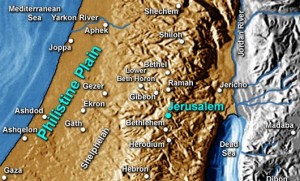
Gath+PhilistiaAloha nui loa, Beloved! Last week I came across this Psalm in my Read-The-Bible schedule. I was just reading along and suddenly these two verses just caught my attention – jumped out at me as they say. The theme of the Psalm is “Trust in God under Persecution.” David had escaped King Saul’s reach and fled to the city-state of Gath and its king, Achish, as well as the home of Goliath and his brothers. You can see it there just WSW of Jerusalem in the area we still call Gaza today. David stays there about 16 months despite the fact that he and the Philistines were – literally – mortal enemies. When the courtiers of Achish saw David, they went and told their king, “Look, this is David, our enemy. His King Saul is trying to kill him. Let’s take care of that for Saul.” David gets wind of this and decides he’s going to act like he’s lost his mind because of all his running away from Saul; he fakes being crazy. King Achish asks his servants, “Are there so few crazy people in Gath that we need this one to come into our city?” They decide to leave him alone and David skedaddles up into the hills to hide in a cave where he is soon joined by allies.

This is another Psalm related to this episode in David’s life – Psalm 34. There are a lot of familiar phrases in this Psalm:

  • “The angel of the Lord stands guard around those who have respect for him. And he saves them.”
  • Godly people cry out, and the Lord hears them. He saves them from all of their troubles. The Lord is close to those whose hearts have been broken. He saves those whose spirits have been crushed.
  • Many are the afflictions of the righteous, but the Lord rescues them from them all.

As I studied these Psalms, I was struck by how they are prayers where the psalmist says things like Deliver me Lord, punish my enemies, you are strong and mighty, save me from death, I will praise you and bless your name, I will rejoice in your law, I will keep your commandments, I will proclaim your justice in the vast assembly.

David’s life was filled with many amazing episodes. It would have made a best-selling dramatic series if TV had been available in his day. Heroics, wars, lust and passion, hatred, jealousy, intrigue, betrayal, sex, … I guess all that was missing was drugs! Even as a man after God’s own heart, as God’s anointed, as the heroic King of Israel and founder of the House in which the Messiah would arise, this man went thorugh a LOT of changes! Talk about drama!! If today we talk about Drama Queens, we might look on David as the Drama King. But, with David we always have something that occurs between the dramatic moments. David always repents and returns. Sometimes it takes him a while, and often he suffers greatly, but when the accounts come in, it is David who has the humility to open himself to the Holy Spirit again and again. Saul had once prophesied in the Spirit, but he would not repent and so evil took over his heart. When I think about Saul’s prayers in his later years, they were prayers telling god, “This is how it’s going to go.” David’s prayers in his later life were more like, “I made the wrong choice and I am sorry.”

Sometimes when you are not sure what or how to pray, try turning to the Psalms. Many of the are prayers – lamenting, repenting, rejoicing, praising, lots of different types of prayers, but prayers nonetheless. Want to praise God? Try Psalm 8. What about an apology to God? Try Psalm 51. Need reassurance under attack? Try Psalm 3. Need to feel closer to God? Try Psalm 63. Want to just cuddle up with God and let him surround you with his Love? Try Psalm 139. Feeling a little insecure? Try Psalm 91. Not sure about any of this? Open your Bible with your eyes closed and ask God to speak to you in the first words you see; then you will begin to speak to God about what he wants you to know.

In our prayers we can seek to make our hearts trust and obey the Lord, or we can seek to weeblesmake the Lord’s heart our tool. However often or quickly our life changes from this to that to something else, we can always keep our proper orientation by keeping our face toward the Son. Sometimes we get knocked down, even knocked out, but we have Eternal Life living in us, and it is that life which lifts our hearts and minds to prayer. It seems a little silly when I see it on the page, but having the Light of Life in us makes us like the Weebles. We wobble but we don’t fall down. Paul says it much better though in 2 Corinthians 4:8-12: We always carry around in our body the death of Jesus, so that the life of Jesus may also be revealed in our body.

This Light of Life is the Word, and the Word is Love. It is God’s Love given to us as a Gift that keeps us from perishing. It is prayer that opens our lives to the Light of the Word – Jesus. And why and how does that happen? You can find the answer in one of the best-known scripture passages in the world: John 3:16-17 – For God so loved the world that he gave his one and only Son, that whoever believes in him shall not perish but have eternal life. For God did not send his Son into the world to condemn the world, but to save the world through him. Beloved that is an eternal promise based on Love, God’s perfect Love. No matter what happens to you, when you Turn Your Eyes Upon Jesus, your life is set aright. If you’re like me and things get “a little crazy” sometimes, take a minute to put your hand in the hand of the Man who stilled the waters.

Beloved, when you pray with and in the Psalms this week, pray for all the troubled places in the world – especially Syria, Russia, and North Korea. BE the light that drives away the darkness by putting your trust in God and letting your little light shine, shine, shine.

Whatever, whenever, wherever, whoever, however, if ever, forever — at your service, Beloved.


Aloha Friday Message – April 5, 2013 – Collect your Bonus

1314AFC040513 – Collect your Bonus

Read it online here, please.

Philippians 4:6Do not worry about anything, but in everything by prayer and supplication with thanksgiving let your requests be made known to God.

James 5:13-15  Is any among you afflicted? Let him pray. Is any merry? Let him sing psalms.  Is any sick among you? Let him call for the elders of the church; and let them pray over him, anointing him with oil in the name of the Lord: And the prayer of faith shall save the sick, and the Lord shall raise him up; and if he have committed sins, they shall be forgiven him.

Why doesn’t God answer my prayer? Why does God allow evil to exist? I cannot believe in a God who would let my loved-one die. What’s wrong with GOD!? Doesn’t he know I need this!? I’ve done everything I can to make my prayers right; so why don’t I have an answer yet?

Aloha nui loa. E pili mau na pomaika‘i ia ‘oe a me ke akua ho’omaika’i ‘oe! (Much Love. May blessing always be with you and may God bless you!) Rabbi Harold Kushner published a book in 1978 called When Bad Things Happen to Good People. In that book I found the encouraging words: “The conventional explanation, that God sends us the burden because He knows that we are strong enough to handle it, has it all wrong. Fate, not God, sends us the problem. When we try to deal with it, we find out that we are not strong. We are weak; we get tired, we get angry, overwhelmed. We begin to wonder how we will ever make it through all the years. But when we reach the limits of our own strength and courage, something unexpected happens. We find reinforcement coming from a source outside ourselves. And in the knowledge that we are not alone, that God is on our side, we manage to go on.” [Rabbi Harold Kushner, When Bad Things Happen to Good People, New York: Schocken Books, 1981; page 129]

I think many of us have felt at times that God isn’t listening, or doesn’t want to give us what we are praying for so earnestly. Sometimes we even think that there’s no point in praying because nothing happens. We quote Bible verses like James 4:3 – When you ask, you do not receive, because you ask with wrong motives, that you may spend what you get on your pleasures, and then say that God isn’t fair because that’s not what we were going to do anyhow. Well, let’s look at the context of that quote – an important thing to do when looking and any Bible quotes someone is throwing around. Did you follow that link? If you did, you have a better understanding of what James was saying. Even if you didn’t follow the link, you can probably see that there is some wisdom in warning against giving God a “gimme” list or a To-Do list hoping he will comply and maybe toss in a bonus.

This is a tough topic, and I can only encourage you to explore it more – there are dozens of books on this subject – and also share with you my own experiences. There are things I have prayed for years on end, and still pray about because the end result I desire has not come about. I want a certain person to come back to Christ, embrace the Church, and confess their faith; it hasn’t happened, and it’s been over 20 years of praying for that. I lost my engagement ring on the River Walk in San Antonio only weeks after we had it specially hand-crafted – a matching set – and never got it back (although I thought I saw it being worn by a department store clerk many years later). I have prayed for families to heal and reconcile only to see them crash and burn in bitter conflict. I have prayed for deeper, stronger, clearer faith and slammed face-first into the reality of my own sinfulness and weaknesses.

A couple of weeks ago I asked, “Why should I pray?” The answer of course is that I pray because I believe I am heard. So, if God doesn’t answer my prayers, it is not because he isn’t listening. God is Love and God is Kindness (omnibenevolent), so he’s not holding off on “my answer” just to be mean. God is all-powerful (omnipotent) so it’s not that he can’t answer my prayer. God is all-knowing (omniscient) so it can’t be because he doesn’t understand what I want or why I want it. God is Perfectly Just, so he isn’t denying my requests because he doesn’t like me. Why then do I not see the result I want? Why doesn’t God make that person repent and return to the Faith? Why did I never get that ring back? Why do my friends continue their hostility and fail to reconcile?

I might as well ask “Why does God expect us to pray?” I can see only one reason: He wants to hang out with us. God created us in his image. He created us to share in his Life. He walked with Adam and Eve in the Garden and shared in fellowship with them. What is fellowship? Here are some words that come to mind when we see the word “fellowship” in Scripture: Communion, companionship, friendship, community, sharing, κοινωνία (koinonia) – in short, spiritual union by intimate participation. That was “in the beginning.” Before long, though, came sin, and that intimacy was severely interrupted. Nonetheless, in that very moment in which God marked the first sin, redemption, reconciliation, and reunion were already set to be part of our reality. God wants to reclaim that intimacy with us. He wants us to regain that same righteousness we had before sin. He gave us the gift of prayer so that we could experience something of that closeness, that impeccable intimacy, that Divine Mercy of Love which unites us to him eternally.

He wants us to pray so that we will choose to be with him instead of with the world. When even our prayers – our precious opportunities to spend time with him – are so saturated (James would say adulterated) with worldly cravings, it is so difficult for him to be intimately with us; God is always with us, even when we ignore him, but when we remember who we are long enough to identify with our Creator, he has that moment of intimacy with us. And as Rabbi Kushner said, “And in the knowledge that we are not alone, that God is on our side, we manage to go on.”

Beloved, do not make God wait any longer to spend those loving, intimate, powerful moments with you. Do not make him stand there holding an armload of gifts for you, waiting for you to open your arms and your heart to receive them! He already gives you everything you need to live – water, air, your body, food, light, energy, faith – but he has so much more for you!! It’s all yours if you’ll just sit with him for a while and talk. Once you get the hang of that, you realize that getting what you want is way less important than wanting what you’ve got. And what have you got? You have intimacy with God. You are in the constant companionship of the Trinity, and all of that with just a simple acquiescence to pray and let God be intimately, personally, totally, eternally yours.

Here’s the kicker: That part is the Bonus – and you get it even if you don’t get what you’re praying for! God give you the best part, the bonus part, the greatest possible outcome the moment you raise your heart and mind to heaven and say, “God?” That one little thing thrills him so much that he gifts you with the Joy of his presence before he gifts you with your answer.

Would you like to give him a Bonus? I ask you to consider adding this short prayer to your daily communications with him:

Almighty God: My gift to you today is the love you gave me which I then multiplied in the love I give to others, the lovely and lovable people you gave to me to love. My love for them and my love for you is my gift to you today. Grant that my gift may increase so that it will be more fitting tomorrow.

Whatever, whenever, wherever, whoever, however, if ever, forever — at your service, Beloved.


Aloha Friday Message – Good Friday, March 29, 2013 – Easter Prayers

1313AFC032913 Easter Prayer

Read it online here, please.

Luke 22:15And he said to them, “I have eagerly desired to eat this Passover with you before I suffer.

Today is Good Friday. Why and how did we get that name? There are no clear explanations for it, and it seems that is only the name in English-speaking countries. In the Eastern Rite churches it is called Great and Holy Friday. In German it is called Karfreitag, Suffering Friday or Sorrowful Friday. In some places it is called Black Friday, and in others Easter Friday. In French it is Le Vendredi Saint – Holy Friday. In Spanish is Viernes Santo – also Holy Friday. According to some catechisms, the term Good Friday is a reflection of Christ’s victory over death through his Passion, Death, and Resurrection. Christ, by His Death, “showed His great love for man, and purchased for him every blessing.” Good, in this sense, means “holy.”

Good Friday is the middle of the Triduum, the ending of Lent (also a word used only in Western Christianity). The Triduum is a single, albeit long, celebration which starts with the evening service commemorating the Last Supper of Holy Thursday and continues to the evening of Easter Sunday. Though chronologically three days, they are liturgically one day unfolding for us the unity of Christ’s Paschal Mystery.

The single celebration of the Triduum marks the end of the Lenten season, and leads to the Mass of the Resurrection of the Lord at the Easter Vigil.

The liturgical services that take place during the Triduum are:

  • Mass of the Lord’s Supper
  • Good Friday of the Lord’s Passion
  • Mass of the Resurrection of the Lord

Today I will share with you several Easter Prayers for a variety of sources. I hope you will find one or more of them will resonate with your heart and soul. Have a joyous and Holy Easter. And go easy on the candy this year. It’s not that good for you, you know?

Easter Prayer

God our Father,
by raising Christ your Son
you conquered the power of death
and opened for us the way to eternal life.
Let our celebration today raise us up
and renew our lives by the Spirit that is within us.
Grant this through our Lord Jesus Christ, your Son,
who lives and reigns with you and the Holy Spirit,
one God, for ever and ever. Amen.

Traditional Easter Day Prayer

Christ is Risen: The world below lies desolate
Christ is Risen: The spirits of evil are fallen
Christ is Risen: The angels of God are rejoicing
Christ is Risen: The tombs of the dead are empty
Christ is Risen indeed from the dead,
the first of the sleepers,
Glory and power are his forever and ever
St. Hippolytus (AD 190-236)

An Easter prayer for teenagers

Jesus, you have overcome death
And conquered every fear I could imagine
Help me to live each day remembering that You are alive
That You are bigger than anything or any situation
And that Your power is real
Jesus, you’re my hero and I’m walking with you.
Amen.

Anglican Prayer for Easter Sunday

Almighty God, who through your only‑begotten Son Jesus Christ overcame death and opened to us the gate of everlasting life: Grant that we, who celebrate with joy the day of the Lord’s resurrection, may be raised from the death of sin by your life‑giving Spirit; through Jesus Christ our Lord, who lives and reigns with you and the Holy Spirit, one God, now and forever. Amen.

Source: Book of Common Prayer, 1979 version, Protestant Episcopal Church in the USA.

 A Prayer for Easter Morning

0 Lord Jesus Christ, who upon this day did conquer death and rise from the dead,
and who are alive for ever more, help us never to forget your Risen Presence forever with us.

Help us to remember,

That you are with us in every time of perplexity to guide and to direct;
That you are with us in every time of sorrow to comfort and console;
That you are with us in every time of temptation to strengthen and to inspire;
That you are with us in every time of loneliness to cheer and befriend;
That you are with us even in death to bring us to the glory of your side.

Make us to be certain that there is nothing in time or in eternity which can separate us from you, so that in your presence we may meet life with gallantry and death without fear.

You turn our darkness into light, in your light we shall see light.

Lord in your mercy, hear our prayer.
Christ the Lord is risen today!
ALLELUIA!!

by St. Francis of Assisi

— Adapted from ThisIsChurch.com

Most High, glorious God, enlighten the shadows of my heart, and grant unto me a right faith, a certain hope and perfect charity, sense and understanding, Lord, so that I may accomplish Thy holy and true command. Easter reminds us that each time we deny you, Lord, another nail is sharpened; and each time we defy you, Lord, into your hand it’s hammered. When faith is weak,
temptation strong and courage fails, forgive us, Lord and once again become that risen presence within our hearts. Amen
Read more at: http://www.faithandworship.com/prayers_Easter.htm#ixzz2OsW39Mkb
Under Creative Commons License: Attribution

Easter Thanks

We give thanks to you, Lord, for you have done marvelous things! When we were walking in darkness you were there, you were there, when we were kneeling in weakness you were there, you were there, when we drew near feeling worthless you were there, you were there, when we were needing forgiveness you were there, you were there, when we were searching for your grace you were there, you were there. We give thanks to you, Lord, for you have done marvelous things!
Read more at: http://www.faithandworship.com/prayers_Easter.htm#ixzz2OsW73Ya6
Under Creative Commons License: Attribution

Easter People Prayer

We are often not the Easter People that we should be, living in the certain knowledge of your great mercy and love. Distracted by the world around us we fail to hear your voice, or hide when faith is challenged as we wander off the path. Forgive us, we pray; restore the love that we first had, a faith that can endure. We will keep our eyes fixed on you, Lord, and with you at our right hand we shall not be shaken.
Read more at: http://www.faithandworship.com/prayers_Easter.htm#ixzz2OsWBKRIH
Under Creative Commons License: Attribution

Beloved, I pray the Lord will greatly bless you in all you think or do or say throughout this Holy Triduum so that the Holy Trinity might be glorified in you. Let us think of the Resurrection of Christ as the Eighth Day of Creation wherein the Old World passed away and the advent of the New heavens and New Earth dawns upon us with the Easter Sunrise.

349. The eighth day. But for us a new day has dawned: the day of Christ’s Resurrection. The seventh day completes the first creation. The eighth day begins the new creation. Thus, the work of creation culminates in the greater work of redemption. The first creation finds its meaning and its summit in the new creation in Christ, the splendor of which surpasses that of the first creation.

2174 Jesus rose from the dead “on the first day of the week.” Because it is the “first day,” the day of Christ’s Resurrection recalls the first creation. Because it is the “eighth day” following the Sabbath, it symbolizes the new creation ushered in by Christ’s Resurrection. For Christians it has become the first of all days, the first of all feasts, the Lord’s Day (he kuriake hemera, dies dominica) Sunday: We all gather on the day of the sun, for it is the first day [after the Jewish Sabbath, but also the first day] when God, separating matter from darkness, made the world; and on this same day Jesus Christ our Savior rose from the dead.

Whatever, whenever, wherever, whoever, however, if ever, forever — at your service, Beloved.

chick

Aloha Friday Message – March 22, 2013 – Why should I pray?

1312AFC032213 – Why should I pray?

Read it online here, please

1 Timothy 2: 8 – It is my wish, then, that in every place the men should pray, lifting up holy hands, without anger or interior dissention.

The prayer of the community should not be spoiled by internal dissension between persons. If we look at Matthew 5:21-26, Matthew 6:14, and Mark 11:25, we can see that one way of looking at this is that we must be at peace with one another. I want to expand that a little by again going back to the Greek word for the “interior dissention.” If you look at several translations, you see that there are a variety of terms to express Paul’s charge against internal strife: disputing, controversy, doubting, quarreling, argument, argumentative, or disputing. The word at the end of that verse is διαλογισμός dialogismos {dee-al-og-is-mos’}. This comes from the Greek word for debate, or consider, more at vacillate between ideas; “to go back-and-forth when evaluating, in a way that typically leads to a confused conclusion. The term implies one confused mind interacting with other confused minds, each further reinforcing the original confusion.”

As I reflected on this, I could see, hear, and feel times in my own past when those kinds of vacillating arguments went on inside my mind and heart. I thought about the kinds of dissentions we have among Christians, as well as between Christians and others of different faiths, or for that matter persons of no faith. It is wearying to think of it, and wearying to experience. Endless debates based on endless “new perspectives” and all of that “justified by Scripture” in one way or another. It makes me dizzy to think about it. If I go back to that list of words used as translations for dialogismos, I think maybe all of them go on in our heads when we try to think up and answer for the question “Why do you pray?”

If you are praying, it only makes sense for you to be praying to someone or something. Polytheists prayed to darn near everything – the sky, the sun, the trees, the dirt, the wine, the wind, and all the little invisible creatures that were the spirits of every particle of creation. It is important to be aware that polytheists were not irreligious; in fact, they were very religious. They have gazillions of rights and rituals, and to them it all made perfect sense. In the Abrahamic tradition, we have a position that is against the use of idols and multiple deities. God is One, Spiritual, and does not arise from the work of one’s hands or mind. He simple IS. So, for most of us, when we pray, we are praying to God – Jehovah, El Shaddai, Adonai, El Elyon, Jesus, Yeshua, YHWH. We shy away from the idea that our prayer is merely us speaking to No One, ουδείς (oudeis) pronounced as oo-dEEs. In fact, if you’re just talking to yourself, or talking to empty air, folks generally think of you as crazy. We pray to God because we believe, we have faith that, he hears us.

An even more basic question is, “Why do you have faith that he hears you?” “Because he answers my prayers.” We pray because we believe our prayers are heard. If we didn’t believe that, we would think we are crazy. And this is where a little of the confusing confusion begins to set in. We debate with our “other self” about what we are doing. We have doubt, confusion, and internal quarreling; we become skeptical of our motivation for praying. We have dissention in the ranks as it were, and when we pray, we fail to remember that surprising promise Jesus gave us (see last month’s message) in Mark 11:24.

What do you think about when you reflect on your own prayer life? Do you really expect God to hear you? Suppose you are in church, praying the Lord’s Prayer, for example. Do you pray it or do you recite it? If your congregation proclaims a Creed during your worship service, do you, there in the pew, proclaim it is your profession of faith, or recite it as your duty in the assembly. In either of those portions of the service, do you just stand there silently and wait for everyone to finish? If that is the case, then perhaps your god is ουδείς.

What about your private prayer life? Do you pray for 5, 10, 30, 60, 90 minutes using written or memorized prayers which you read or recite? You can see the point I’m trying to make here. Praying has to be “more than skin deep.” When we pray like the Pharisee who “prayed to himself,” there is really not much value or point for us praying. Nonetheless God hears those prayers. He even hears those unintended prayers we often send up. I think I may have written about this before but I haven’t been able to find it; so here’s what I mean by unintended prayers:

O, my God, really?
Oh God! Now what!
Jesus Christ, that was close!
God ____ it, I already said no.
God, did you see that idiot? (Trust me, God saw the idiot, and heard your contempt.)
Oh. My. God! s/he is so cute!
Gesundheit! God bless you!

You see that most of these fit into the grammatical category of exclamatory remarks. This list also fits into the category of prayers that use God’s name in vain. There are other exclamatory prayers that are – or at least can be – less profane:

LORD God, you are awesome!
Jesus Christ, I love you!
O God, come to my aid for I am in trouble.
Oh, My God, how astounding is your love for us!
Bless the LORD O my soul, and all that is within me bless his holy name.
Gesundheit! God bless you! (If prayed with the intent of blessing, yah?)

God hears all of these prayers because when we say or think his name, he’s paying attention. In fact, the Psalmist tells us: Before a word is on my tongue you, LORD, know it completely. So even when we’re not talking to him, which is exactly what praying is, he is listening, watching, caring, helping, and most of all LOVING us!! How’s that for an exclamatory phrase?

Beloved, I want you to pray, to talk to God, and to fully intend to speak your heart and mind to him. You may ask, “If God knows everything, including what we are going to think or say or do, why do we need to pray?” It’s simple, really. God wants to talk to us. He wants us to hear his voice. He wants to love us and to know that he loves us. God is community, and he wants us to be part of his community. We talk to our friends and v\family. God is both of those and so much more. We are invited to pray, commanded to pray, taught to pray, encouraged to pray, and expected to pray because God wants us to know him. Praying helps us align our lives with his precepts and laws – like Christ’s Law of Love.

And you know, he never gets tired of our asking. It’s OK, in fact encouraged, to be persistent in prayer. Where we humans sometimes run into problems is when we get offended when God does not do as we tell him to. As if God should be at our command! Beloved, if you already pray often then pray deeper. If you pray infrequently, learn to pray often. If some of your prayers are unintended, remember God is listening; do you really want to have those prayers be included in your list of petitions? Wouldn’t you rather be offering him sacrifices of thanks and praise?

Cancer Prayer Candle

Cancer Prayer Candle

This past week I received many requests for prayer for persons who are ill – many with cancer, some of whom are terminal, some in treatment, and some (like EL, thanks be to God!) in remission. So, if you know someone who has or has had cancer, please take 30 seconds right now and pray for them and for all the others who have written in to ask for prayers. I’m going to give you this little prayer candle as a reminder. Maybe you could pass it on to them.


 Whatever, whenever, wherever, whoever, however, if ever, forever — at your service, Beloved.


Aloha Friday Message – March 15, 2013 – A Mountain-Top Reality

1311AFC031513 – Mountain-Top Reality

Read it online here, please.

mountain top seek and ye shall findJesus often went up into the mountains to pray. Sometimes when we feel really connected to God in prayer we call it a Mountain-Top Experience. It is an epiphany. It is a joyous moment when we are overcome and overwhelmed with the grace and love of God. We do not have to be standing on a mountain, though, to have a Mount-Top Experience. We can have one in our car, or in church, or at the lake or beach, or even in the hospital. These moments are brilliant and real in our memories. But, we could also be standing on a beautiful mountain with a stupendous view and be utterly lacking in closeness to God. Recall this instance of prayer in the Temple.


Luke 18:11The Pharisee stood and prayed to himself like this: ‘God, I thank you, that I am not like the rest of men, extortioners, unrighteous, adulterers, or even like this tax collector.

Last week I included a contemporary prayer that I’ve received several times as one of the endlessly recycling Internet offerings. Here are some of the opening words to a couple of the paragraphs: ” Heavenly Father, Help us remember that the jerk who cut us off in traffic tonight …” “Help us to remember that the old couple walking annoyingly slow …” And here is something from a Bible study I recently read: “James the Apostle understood that the poor, needy, and under-resourced are fertile ground for the good news we call the gospel message. They are often broken people who are keenly aware of their need.” As the days went by in this past week, I realized my prayers were at times more like invectives than intercessions. I put a link there because I want you to understand how revulsed I felt about those statements. Revulsion is a: a sudden or strong reaction or change b: a sense of utter distaste or repugnance. I found them embarrassing. I found them Pharisaical like the prayer in the Bible verse I quoted.

If you read that Bible study about offending the homeless, you will perhaps understand that sometimes when we are trying hard to say something right, we fail so miserably that we completely undo the good we intend. Politicians suffer from this foot-in-mouth disease constantly. Of course, one usually ends up saying, “That was taken completely out of context,” but really, how can the context help clarify something arrogant we have tried to disguise as something compassionate? Say what? Here, please take a look at this picture. I understand that it may hurt your eyes to do so, but give it a try anyway.

Does this image make your eyes go crazy?

Does this image make your eyes go crazy? Does it look like it is moving?


This image – part of a Mandelbrot set – appears in a discussion of how to camouflage vehicles in the war in Afghanistan with “Dazzle Camouflage.” This technique was used to some degree in WWI and to a lesser degree in WWII, but its effects in our current wartime strategies would be hardly worth the effort. I mention this because I think sometimes we do this in our Spiritual Warfare. We cover our prayer with nearly infinite self-justifications that are, in fact, judgments of ourselves and others.

Remember the tax collector’s prayer? Luke 18:13But the tax collector stood at a distance and dared not even lift his eyes to heaven as he prayed. Instead, he beat his chest in sorrow, saying, “O God, be merciful to me, for I am a sinner.” He prays to God, but to whom does the Pharisee pray? Look at that verse again. Yes, Beloved, he prayed to himself, and all of us have heard prayers like that. Sometimes we hear them in our own voice because they are in our own prayers. Other times we hear them in the voices of others. Sometimes we hear “extension prayers” that are a summary of a sermon, homily, or Bible study: “O God we know that you have told us that we are to pray like this tax collector who humbled himself before you and confessed to you that he was a sinful man. We thank you that when we feel like praying in the same fashion as the Pharisee, you are there to remind us that his prayer went nowhere. We thank you, Lord, for giving us these parables to teach us ….” Where is the Love in that? Where is the humility? “The important thing is not to think much but to love much; and so do that which best stirs you to love.”

Some of us are used to praying in litanies, others are not, but I ask you to consider this Litany of Humility. Try it more than once. See if you can pray it at least once a day for the next seven days. It is an edifying experience to pray – rather than simply read – this prayer. And please, do not overly concern yourself with the authorship of this Litany. Instead look at the content, intent, and extent of the words here. I have never been able to memorize this whole Litany, but I always feel better when I pray my way through it. It is a difficult and dangerous prayer because if you pray it fervently and in Spirit and Truth, your life will be irrevocably changed. Remember the words we find in Proverbs 3:36 and James 4:6 – “Toward the scorners he is scornful, but to the humble he gives favor;” and “But he gives more grace. Therefore it says, “God opposes the proud, but gives grace to the humble.” Jesus asks us to learn from Him for He is “meek and humble of heart.” Therefore let us humbly pray …

O Jesus, meek and humble of heart, Hear me.

From the desire of being esteemed, Deliver me, Jesus.

From the desire of being loved, Deliver me, Jesus.

From the desire of being extolled, Deliver me, Jesus.

From the desire of being honored, Deliver me, Jesus.

From the desire of being praised, Deliver me, Jesus.

From the desire of being preferred to others, Deliver me, Jesus.

From the desire of being consulted, Deliver me, Jesus.

From the desire of being approved, Deliver me, Jesus.

From the fear of being humiliated, Deliver me, Jesus.

From the fear of being despised, Deliver me, Jesus.

From the fear of suffering rebukes, Deliver me, Jesus.

From the fear of being calumniated, Deliver me, Jesus.

From the fear of being forgotten, Deliver me, Jesus.

From the fear of being ridiculed, Deliver me, Jesus.

From the fear of being wronged, Deliver me, Jesus.

From the fear of being suspected, Deliver me, Jesus.

That others may be loved more than I, Jesus, grant me the grace to desire it.

That others may be esteemed more than I, Jesus, grant me the grace to desire it.

That, in the opinion of the world, others may increase and I may decrease, Jesus, grant me the grace to desire it.

That others may be chosen and I set aside, Jesus, grant me the grace to desire it.

That others may be praised and I unnoticed, Jesus, grant me the grace to desire it.

That others may be preferred to me in everything, Jesus, grant me the grace to desire it.

That others may become holier than I, provided that I may become as holy as I should, Jesus, grant me the grace to desire it.

God, grant that all our small prayers be offered up in much love.

Of all the things we can do for Jesus’ honor and glory, surely among the best available is to love all persons – you, me, and everyone else – as he has Loved us. He told his contemporaries many times that he did and said only what saw and heard his Father doing and saying. How closely do we resemble our Father, and his Son who is for us the face of God? Let us then ask the Spirit for greater humility that we will be conformed to his image. Then, whatever ground we stand upon will be a Holy mountain-top and we will pray to God and not to our self.

Whatever, whenever, wherever, whoever, however, if ever, forever — at your service, Beloved.


To God be the Glory!!

Aloha Friday Message – March 8, 2013 – Modeling prayer

1310AFC030813 Modeling Prayer

Read it online here, please.

Hebrews 4:16Let us therefore approach the throne of grace with fullest confidence, that we may receive mercy for our failures and grace to help in the hour of need.

Today we are called upon to collect ideas from a variety of sources and share some insights into building a confident and effective prayer life. I got a little kick-start from a man we heard about in a recent MBN message, Dr. Peter Marshall. Here is a short passage from the same book, “Mr. Jones, Meet the Master.

I read the story of a woman who was trying to find God. She had a certain dream, which she dreamed more than once, namely, that she was standing in front of a thick, plate glass window.

As she looked at it, she seemed to see God on the other side.

She hammered on the window, trying to attract His attention, but without success.

She grew more and more desperate, and began to call him, and found herself shrieking at the top of her voice.

Then a quiet, calm voice at her side said, “Why are you making so much noise? There is nothing between us.” (Mr. Jones, Meet the Master, pp 143-44)

Elliot'sPrayerYes, it is true. Nothing can separate us from the Love of God, and that means – since God is Love, He places no obstacle between us and Him. And yet, we stumble through prayer sometimes as if it were a terrible ordeal, or breeze through prayer as if it were a recitation of some sort with no depth of meaning. Sometimes we feel that we need to learn how to pray so that when we pray we don’t just babble and we don’t recite platitudes and we don’t go away thinking, “Well, if that didn’t work, I don’t know what else will!” Really? Let’s take a look at the anatomy of a prayer. For instance, how do you start?

  • Dear God … Um, Hi God, it’s me. You know, “The Sinner in Apartment D-316?”
  • Jesus, I come to you today to ask for your help with my nut-case neighbor.
  • Almighty God, we come to you today to thank you for sparing us during this latest winter storm.”

So what kinds of “things” go into a prayer, and how can we learn to build a prayer that flows, that is both Biblical and relevant, and one which isn’t so convoluted we don’t even remember what we said? I’m going to suggest a simple outline and give some examples. Here’s the outline:

  1. Greeting
  2. Praise
  3. Thanks
  4. Petition
  5. Confession/Profession
  6. Closing

#1 – Greeting: Name the person to whom you address your prayer: God, Father, Jesus, Holy Spirit, Blessed Trinity, Lord, Master, Gracious and Loving or Almighty or Holy (plus any of the preceding), any opening like that is fine. I have said before my favorites are My El Shaddai and Abba.

#2 – Praise: Hallowed be thy name, you alone are Holy; you are our awesome God, Omnipotent and Omniscient Creator, Lover of my soul, source of all that is Good, Great, and Just Judge of all mankind, and so on. What is there in my heart and mind that just totally wows me when I think of Him? How can you combine that with the Greeting? They can work together. Here is one that was inspired by a popular contemporary Christian music group – the Hemphills – in the 80’s:

Father, we worship you as One in the Love of the Spirit and the Son.
Jesus, we honor you as Lord by all of Heaven and Earth adored.
Spirit, we love you as our Friend and giver of Love and Gifts without end.

#3 – Thanks: We thank you for all your gifts, thank you for hearing my prayer, thank you for all your blessings, thank you for subduing my enemies, thank you for this day / this life / this world / this family / this spouse / this (everything). To borrow a line from a Gospel chorus … “Thank you, Lord, for saving my soul / Thank you Lord for making me whole. / Thank you Lord for giving to me / Thy great Salvation so rich and free.” Yes. You can quote another’s prayer as part of your prayer especially if it’s a song!

#4 – Petition: This is the part we’re pretty good at. In fact, truth be told, this is almost always where most of us start. Even if we don’t usually pray the “gimme” prayer, we pretty much expect God to pop up like the genie in the bottle and grant our wishes. A care, a house, a victory over an enemy, something to suit our passions, You know what to ask, and the Bible tells you how to ask – with faith, believing that you will receive it, and in Jesus’ name. But we’re not quite to that closing part yet. Sometimes the best petition is to ask God for guidance, for the grace to see and do his will, or for direction about what he would have us do next. Another is to prepare your heart for his Presence.

#5 – Confession/Profession: “What? I’m not Catholic.” “What is there to confess?” “What do you mean, ‘confess’? And what could I profess that God doesn’t already know?” You know that part in the Lord’s Prayer “Forgive us our debts (trespasses) as we forgive our debtors (those who trespass against us)? That is a confession of our sinfulness. “Lead us not into temptation (Do not put us to the final test): That is a confession of our weaknesses. But deliver us from evil (from the evil one): That is a confession of our awareness that we are sinners redeemed by Grace through the loving protection of God. What does that sound like outside of the Lord’s Prayer? When you pray the Apostles or Nicene Creed, your profession of faith, you declare publicly what you believe. You can declare that privately in your personal prayer as well.

Master, I do not know how to pray so that my prayers are pleasing to you, but send me your Spirit to pray with me. I know my sinfulness. Grant me faith to overcome sin and to live in your presence at all times. Look into my heart, Holy Spirit, and remove all that is offensive to you. Cast me not out from your presence O God, but in your mercy save me from my sins. I confess my love for you, my Lord and my God. I place my trust in you. You are my hope and my Joy. In you alone do I find comfort and peace. In you, O LORD, I am made whole. Jesus, I trust in you. Jesus, I love you above all things and persons, and I desire to receive you into my heart and soul. Sprit of the Living God, I surrender my entire life to the Holy Trinity without reserve. O God, you are my God and I will always praise you.

#6 – Closing: Jesus told us to pray in His name, and that’s pretty easy: In Jesus name. Amen. In your most precious name, we pray. As the Lord taught us, we pray in His name, Amen. In faith believing, we place our trust in you, Jesus. As you have commanded through your Son, Jesus Christ, we pray in His name, AMEN. In the Power of the Blood of Jesus we humbly pray. Amen.

We don’t always have to be so formal, though. Here’s one that circulates around the Internet every so often:

=*+*=*+*=*+*=*+*=*+*=

Heavenly Father, Help us remember that the jerk who cut us off in traffic tonight is a single parent who worked nine hours that day and is rushing home to cook dinner, help with homework, do the laundry. And spend a few precious moments with her children.

Help us to remember that the pierced, tattooed, disinterested young man who can’t make change correctly is a worried 19-year-old college student, balancing his apprehension over final exams with his fear of not getting his student loans for next semester.

Remind us, Lord, that the scary looking bum, begging for money in the same spot every day (who really ought to get a job!) is a slave to addictions that we can only imagine in our worst nightmares.

Help us to remember that the old couple walking annoyingly slow through the store aisles and blocking  our shopping progress are savoring this moment, knowing that, based on the biopsy report she got back last week, this will be the last year that they go shopping together.

Heavenly Father, remind us each day that, of all the gifts you give us, the greatest gift is love. It is not enough to share that love with those we hold dear. Open our hearts not to just those who are close to us, but to all humanity. Let us be slow to judge and quick to forgive, show patience, empathy and love.

=*+*=*+*=*+*=*+*=*+*=

And once we learn to converse with God instead of simply giving him a To-Do list, then our prayer life becomes a source of constant joy. Therefore, Beloved, pray for one another that God will give all of us “the will to do small things with great love.” Remember, God – all three Persons – knows everything, is everywhere, and is all-powerful. Knowing these things, we also know God is always with us, around us, and in us, and we have no need to shout or doubt. We can be confident that He reads and hears our heart’s longings.

Whatever, whenever, wherever, whoever, however, if ever, forever — at your service, Beloved.

Aloha Friday Message – March 1, 2013 – A Perfect Fit

1309AFC030413 – A perfect fit

Read it online here, please.

Colossians 4:12 Epaphras*, who is one of you and a servant of Christ Jesus, sends greetings. He is always wrestling [ἀγωνιζόμενος] in prayer for you, that you may stand firm in all the will of God, mature and fully assured.

* Epaphras [Ἐπαφρᾶς] = “lovely” 1) a Christian man mentioned in Paul’s epistles (Colossians 1:7, 4:12, Philemon 1:23); Epaphras {ep-af-ras’} contracted from Ἐπαφρόδιτος = Epaphroditos {ep-af-rod’-ee-tos or e-pä-fro’-dē-tos} = “Devoted to Aphrodite” or “Lovely/Handsome”

ἀγωνιζόμενος = agōnizomenos to endeavor with strenuous zeal, strive mightily, vigorously oppose any adversary

bible-bite  Jeremiah 15:15-21   15 O Lord, you know; remember me and visit me, and take vengeance for me on my persecutors. In your forbearance take me not away; know that for your sake I bear reproach. 16 Your words were found, and I ate them, and your words became to me a joy and the delight of my heart, for I am called by your name, O Lord, God of Hosts.** 17 I did not sit in the company of revelers, nor did I rejoice; I sat alone, because your hand was upon me, for you had filled me with indignation. 18 Why is my pain unceasing, my wound incurable, refusing to be healed? Will you be to me like a deceitful brook, like waters that fail?

19 Therefore thus says the Lord: “If you return, I will restore you, and you shall stand before me. If you utter what is precious, and not what is worthless, you shall be as my mouth. They shall turn to you, but you shall not turn to them. 20 And I will make you to this people a fortified wall of bronze; they will fight against you, but they shall not prevail over you, for I am with you to save you and deliver you, declares the Lord. 21 I will deliver you out of the hand of the wicked, and redeem you from the grasp of the ruthless.”


**Jehovah, Elohim Sabaot

 צְבָאֽוֹת׃ אֱלֹהֵ֥י יְהוָ֖ה

ṣə·ḇā·’ō·wṯ  ’ĕ·lō·hê YHWH

Epaphras: He most likely is not the man named Epaphroditus, the “brother and fellow worker” Paul mentions in Philippians 2:25; because Epaphroditus was a messenger from Philippi in Macedonia, and Colossae was in Asia, that seems unlikely. He was obviously a close associate of Paul. We can learn a few things from his prayer-life because he was a vigorous intercessor – a Prayer Warrior!

First, it was persistent. He was always praying. The second thing to notice about his prayers is that they were intense. They were explicit; they were “for you.” Sounds like a job description of a Prayer Warrior, someone who commits to continuous ardent prayers for others. These are Servant Prayers – prayers made by one who lays aside all of his or her life to bless the life of others. He was the perfect fit as a coworker with Paul and the citizens of Colossae, Laodicea, and Hierapolis. He had a reputation of being the go-to guy for prayer, support, and evangelization. It seems he may have eventually stayed for a prolonged time with Paul as a “fellow prisoner” in Rome.

Epaphras was one of those church members who was right in the middle of the main effort, part of the core group that got things moving and kept them going. It seems that has always been a fairly small group – Twelve Apostles (13 with Paul) generated thousands of converts to The Way. From that core group, others were commissioned – volunteers in the Holy Spirit – to work diligently to spread the Gospel. Is that something you might be called to do?

intercessionseries-02  Do the people around you think of you as someone who is so dedicated to Christ that your day-to-day activities are all about the Gospel? Is your speech characterized by endless prayer or praise and intercession? Are your actions those of a servant of God? Are you an instrument of his peace? Is that your reputation? If you know someone like that, do you think they are “a little strange,” maybe “too Baptist,” or “too evangelical,” or “too Catholic?” Who do you know that is known to be a student and proclaimer of the Word, someone who studies, understands, and teaches every chance s/he gets? Do you know someone who is a person of prayer like Epaphras, diligently striving to present others’ needs to Jesus and to share the joy of discipleship by setting an example? Is there someone you know whose unrelenting service to others ends up changing lives and thereby changes the community around them? Is there someone whose compassion is so deep that many people – even complete strangers – confide in them and draw comfort from their caring and gentle wisdom? If you know these people, you know they are a perfect fit for the lives of others.

Sometimes you can be injured emotionally, and even physically or spiritually, if you devote your entire life to serving others. “How so?” you might ask. Hard-working, well-intentioned Christians can acquire a sense of self-importance if they are not careful. That can lead to emotion pain for them and their loved ones; if your god is church, you may need to reassess your priorities. Sometimes the people we minister to are so resistive to what we say and do that they can lash out against us even physically. We certainly have plenty of examples of that in scripture and even in the history of the Church; these are people whose Christian witness is a martyrdom – suffering and sometimes even death – for the sake of the Gospel. What about spiritual injury? Can you remember times when it seemed you were cut off from God, as if he wasn’t listening, or times when you were so discouraged that the Light seems to flicker out and die in you? Many a “power-house” Christian has experienced these “Dark Nights of the Soul.” That brings us to Jeremiah’s situation.

Jeremiah was facing a tough audience. They wanted to trick him, denounce him, embarrass and discredit him, and even to kill him. Despite all that, he kept relying on God and kept putting the Word of God right out front where anyone could see it. They hated him for that. But throughout the prophesy he delivered, Jeremiah consistently showed that he work was not his mission – it was God’s mission. God reassured him: You don’t have to do everything yourself. I am here to help you. When Jeremiah said he wasn’t up to the task, God not only reassured him, but also touched him with the Word so that he would. Jeremiah was as fervent about his vocation as a prophet and leader as Epaphras was about his vocation as an intercessor and evangelist. God told him he would meet vigorous, painful, persistent opposition, but that he would prevail over all his attackers. Nonetheless, there were some pretty tough days for Jeremiah as we can derive from the quote at the opening of this study.

Jeremiah accused God of not helping him when he really needed it. Jeremiah had taken his eyes off God’s purposes and was feeling sorry for himself. He was angry, hurt, and afraid. In response, God didn’t get angry at Jeremiah; he answered by rearranging Jeremiah’s priorities. As God’s mouthpiece, he was to influence the people, not let them influence him. There are three important lessons in this passage: (1) In prayer we can reveal our deepest thoughts to God; (2) God expects us to trust him, no matter what; (3) we are here to influence others for God. And God’s response to Jeremiah’s complaint was the same as his response to Israel – and to us when we feel neglected and oppressed. “Trust me. I am taking care of it. You’re going to be OK. I’ve got your back. Just trust me!”

So, from these two men we can see some things that make our mission – our vocation – here both worthwhile and doable.  First, use your gifts. Epaphras had gifts of preaching, instruction, and administration and he used these to found churches in the Lychus valley and to serve Paul in his mission. Jeremiah had the gifts of God’s words, and he used that gift to help Israel understand why they country was subjugated to Babylon, and to inspire the hope that God would rescue them.

Second, these men saw the problem and made their lives available to God to help ease the problem. Epaphras prayed aggressively on behalf of the people in the church at Colossae, and worked day and night to ease their burden and to help Paul build the church among the gentiles. Jeremiah came back again and again – denounced by his relatives, beaten and imprisoned, opposed by a false prophet with a false message that made everyone’s life worse, held prisoner by the king, defamed and threatened with death, and lowered into a cistern to die. And still, despite all this, he was a perfect fit for the job. Why were Epaphras and Jeremiah so well-suited to these missions?

The missions they took up were not their mission; they were God’s missions. The two men were open to the word of God, trusted that God had called them, and obeyed that call. The soon found out that the work they took up was never really “finished.” There was always more to do, and they found others who would help them. The stuck to the fundamental purpose of the work God gave them: Remind the people that they are God’s and God wants them to acknowledge that by serving him through serving each other. They were given all the skills, gifts, and power to do what God required. In fact, all they had to supply was their devotion and service. It was not they who would change the world. It was God, and each of them was the perfect tool, the ideal instrument, for God’s work.

How about you? What is your call? Have you answered? Or do you mock and insult God by saying, “Far be it from me to presume that I can be your servant?” Beloved, he wants you,  yes YOU. You cannot begin to imagine what wonderful things await you if you can simply say, “Speak, LORD, for your servant is listening.” Remember, he is there to keep you safe and prosper the work of your hands.

Whatever, whenever, wherever, whoever, however, if ever, forever — at your service, Beloved.

Please remember CML this week. She took a nasty face-first fall and fractured two cervical vertebrae (1 and 7). She is uncomfortable – to say the least – and dealing with progressive paralysis. Well-advanced it age, she is also a perfect fit in her community and family. Ask God to grant her and her family relief and hope.

Aloha Friday Message – February 22, 2013 –

1308AFC022213 Persistent prayer

Read it online here, please.

John 15:7 If you abide in me, and my words abide in you, ask for whatever you wish, and it will be done for you

Luke 18:1-8And will not God grant justice to his chosen ones who cry to him day and night? Will he delay long in helping them?

Ecclesiastes 5:2 – Do not be quick with your mouth, do not be hasty in your heart to utter anything before God. God is in heaven and you are on earth, so let your words be few. (NIV)

Mark 11:24  – I tell you, you can pray for anything, and if you believe that you’ve received it, it will be yours.

Romans 8:26In the same way, the Spirit helps us in our weakness. We do not know what we ought to pray for, but the Spirit himself intercedes for us with groans that words cannot express.

James 4:3You ask and do not receive, because you ask with wrong motives, so that you may spend it on your pleasures.

Psalm 51:17The sacrifice you desire is a broken spirit. You will not reject a broken and repentant heart, O God.

holy_spirit_intercedes_medBeloved, where is “The Presence of God?” In what way, in what place, or in what manner is God present in you, in your life, and in your prayers? What is “God’s Presence” anyway? Do you believe God has the omnipotence to be present in and around you at every moment in every place? Or do you believe God is “up there somewhere,” and not really involved much in day-to-day life?

Prayer is an act of faith and an act of hope. It is acknowledging an awareness of God (faith) and a trust that he hears our prayers (hope). If we believe he’s not listening, or perhaps not even there, what is the point of praying? When you pray, do you feel you are having a conversation with an imaginary friend? Have you felt awkward about starting or ending a prayer, or do you sometimes wonder if you’re praying wrongly because nothing happens?

You might say to me, “Jesus says ‘ask for whatever you wish, and it will be done for you,’ and then James comes along and says, ‘You ask and do not receive, because you ask with wrong motives.’” In both of these verses, the missing part on that question is the disposition for prayer. What is the temperament we need to bring with us to prayer? Do we stand, sit, hold our hands up, close our eyes, get on our knees, shout, pray silently, or sing? There is a simple answer: YES!

Prayer is a conversation with God. That means he is part of the conversation. When we speak, he listens; when he speaks … do we listen? If not, then it’s a “one-sided conversation.” And you are right, that’s no conversation at all. We cannot just pray based on an assumption that we know the will of God and we want to make a to-do list for him so he knows we are “in sync.” That just isn’t appropriate, and frankly it is still a one-sided prayer. We need to live our lives as being accountable for our actions, and pray as being dependent on God for his action.

The references today focus on persistence, propriety, and posture. Jesus tells us to be persistent but persistent in the context of his teaching. We are to abide in him and his teaching is to abide in us; otherwise persistence is moot. Jesus also says we have to pray “in faith, believing.” Paul says when we’re “stuck” while praying, the Holy Spirit can and will pray on our behalf in the very language of God so that our prayer is pure. James says we must pray for what God wants in our lives, not for our own passions. The writer of Ecclesiastes tells us our conversations with God ought to be thoughtful and reverent.

If you have the opportunity to sit down for a discussion with a famous person – philosopher, movie star, politician, or anyone outside your immediate circle of friends and family – you make an effort to be polite, even-tempered, and attentive. With family and friends, you might act like that as well, but you would also be more likely to be freer in your language, posture, and tone. We want to speak to God with reverence and yet also we desire that closeness, that familiarity, which allows us to be comfortable in his presence. Have you ever wondered if he is comfortable in your presence? I have. When I know I am rife with sin, or praying while angry, when I let my mind wander as I recite familiar prayers rather than pray them, I wonder if I’m kind of like that noisy gong or clanging cymbal Paul spoke about.

Here’s what I want to leave with you today. You have the references (top of the page) about being persistent (Luke 18:1-8), honest (James 4:3), reverent (Ecclesiastes 5:2), and humble (Psalm 51:17). The following list – all with links to scripture – describes postures of prayer. There really is no single posture that is “best” or “prescribed” or “required for success.” Whatever posture helps you to be persistent, honest, reverent, and humble is the appropriate posture. When I pray the Lord’s Prayer for example, I pray standing with head bowed, eyes closed, hands raised in surrender. When I pray for my family, it is often sitting, or on my knees. When I pray in adoration, it is on my knees. When I pray in JOY, it is whatever the Spirit moves in me which can include shouting, clapping, dancing, singing, standing, and waiving my arms over my head. Here’s what the Bible says about posture during prayer (and it’s only a smidgeon of what’s there about it!):

Aaron and the people of Israel bowed down (Exodus 4:29-31)
Abraham prostrated himself while praying (Genesis 17:3).
David sat and prayed (2 Samuel 7:18)
Ezekiel prayed in a loud voice (Ezekiel 11:13)
Hannah prayed silently to the Lord (I Samuel 1:13)
Jeremiah stood before God to pray for his people (Jeremiah 18:20).
Jesus said we can pray privately and quietly (Matthew 6:6)
Jesus, during his agony in the garden, lay prostrate with his face on the ground (Matthew 26:39)
King Jehoshaphat placed his face on the ground (2 Chronicles 20:18)
Nehemiah sat down when he prayed (Nehemiah 1:4).
Paul prayed and sang in the spirit (I Corinthians. 14:15)
Peter went to his knees to pray (Acts 9:40).
Psalm 28:2 describes lifting up of hands (Psalm 28:2) as does Psalm 63:4, Psalm 134:2, and 1 Timothy 2:8
Queen Esther mortified herself before God (Septuagint * Esther 4:16 Chapter C:12-15)
Solomon prayed on his knees with raised hands (1 Kings 8:54)
Solomon prayed Standing with his hands raised (1 Kings 8:22)

* The Septuagint (LXX) is an ancient Greek translation of the Bible. This passage is from an expanded section of Esther which is not included in many Bible translations. It reads as follows:

Esther C:12 Queen Esther, in deep agony, turned to the Lord. Esther C:13 She took off her splendid robes and put on garments of mourning and grief. Instead of her rich perfumes, she put ashes and dung on her head. She did all she could to destroy any dignity in her appearance. She let her tangled and uncombed hair hang down over her body that she had always taken such care to beautify. Esther C:14 She prayed to the Lord God of Israel, “My Lord and King, only you are God. I am alone, and I have no one to turn to but you. Help me!  Esther C:15 I am about to risk my life.

Whatever, whenever, wherever, whoever, however, if ever you decide to pray, take just a moment at the beginning to acknowledge the One who will be listening.


Pray often, and you will pray well for the Holy Spirit will form in you a habit of prayer that brings you closer to union with the Trinity. And now, I ask you to pray a prayer of faith, believing that God knows the names and needs of everyone who prays for us and everyone who asks for our prayers, especially that ever-lengthening list of prayer requests sent to the MBN. There’s a page on the MBN site you might like. It’s a short collection of prayers by Augustine of Hippo. (354-430 AD), whose works formed the basis of the development of Western Christianity, philosophy, and most importantly, theology.

Whatever, whenever, wherever, whoever, however, if ever, forever — at your service, Beloved.


AGE QUOD AGIS

chick

Pages Email Newsletter Categories Archives Connect
  • Connct to us here