Aloha Friday Message – December 14, 2012 – O Sing of the LORD!

1250AFC121412 The O Antiphons

Read it online here, please.

You may have heard of something called “The O Antiphons.” If not, you’ve probably sung a hymn called “O come, O come Emanuel.” They are related in subject and content, and are sung during this time of year – Advent – during the period called “the Octave of Christmas” which is December 17 through 24 – a period of 8 days, hence octave. The first 7 days of the Octave of Christmas correspond to the 7 O Antiphons; the eighth day of the Octave, December 24, is the Christmas Vigil. The words in these Antiphons are familiar because of the hymn O Come, O Come Emanuel, but the meanings behind them may not be, so we’re going to take a look into the history and meaning of these Antiphons. Each of the antiphons presents insight into the Divinity of the Messiah by recalling descriptive passages of Scripture. There is evidence that they have been in use in the Church since the Fifth Century. By the Eighth Century, they were in common use in most Rites of Liturgy. They describe for us seven ways by which the Lord “comes to us” in Advent by telling us how he will be revealed to humanity. The Antiphons are in Latin, so that will be presented first, then the English translation, then the date in December when the Antiphon is sung.

Normally they are recited or sung in the evenings as part of an evening prayer service. When I listen to them, I am reminded of Christmas 1968. A friend at Metropolitan State College, Mary Jane McBride as I recall, invited me to go to Vespers at a nearby Seminary. I was already contemplating conversion from Baptiterian to Catholic, and that experience moved me miles and mile farther down that road. It was a true Mountain-Top Experience – exhilaration, a feeling of deep spiritual connection, and the glowing-shivers (ya know wuddamean?) … I can still feel that today as I remember it. So this one’s for Mary Jane and everyone who’s taken a friend to the Mountaintop because now, when we say the word GOD, we understand we are naming The Holy Trinity – Father, Son, and Spirit – who have existed together eternally. And it is God who is praised in the O Antiphons:

O SAPIENTIA – O Wisdom December 17: Wisdom was with God at Creation (Proverbs 13:19) and God’s Wisdom cannot be surpassed (Isaiah 40:13-14). God have created all things and all times with only the Wisdom of his Word. O Wisdom, who came from the mouth of the Most High, reaching from end to end and ordering all things mightily and sweetly: come, and teach us the way of prudence.

O ADONAI – O SUPREME LORD December 18:  The root ADON means steward-administrator, Master, Lord as a respectful title indicating authority and power. Adding –ai elevated the meaning to a superlative as “Lord of All,” “Supreme Authority,” or “Ultimate Power.” The common expression “Supreme Being,” falls far short of the meaning of Adonai, a name commonly used in Hebrew Scripture to represent the name YHWH. See Exodus 3:1-6.


O RADIX JESSE – O ROOT OF JESSE December 19: A shoot shall grow out from the stump of Jesse and a branch shall grow out of his roots.” I love this verse. The image is of an ancient olive tree cut down after many years because it is no longer bearing fruit as it should. The stump is left and irrigated, cared for, and watched over. Then a shoot, a new olive tree, sprouts from the stump and has the support of the ancient roots beneath it. Read Isaiah 11 with this in mind. It’s another Mountaintop Experience.

O CLAVIS DAVID – O KEY OF DAVID December 20: This is the Key that liberates prisoners, unfetters the chains that bind into death all who walk the Earth. This is the Scepter of Israel. Only this key opens what no human can open, and only this key closes what no human can close. See Isaiah 61:1, Isaiah 42:7, and Luke 4:16-20. This is The Christ of God.


O ORIENS – O RISING DAWN December 21: O Radiant Dawn of the east, brightness of light eternal, and sun of justice: come, and enlighten those who sit in darkness and in the shadow of death. See Isaiah 9:2 and Matthew 4:13-17. God, who are Light, as dawned upon the Earth and dispelled the darkness of death as Light is victorious over the shadows of night. Just as the celestial sun gives warmth, energy, light, and life to the earth, so the Sun of Justice spreads the Light of God over all creatures. And so our eyes and hearts and minds look to the east for the Light of the Nations.

O REX GENTIUM – O KING OF THE NATIONS December 22: O King of the Gentiles and their Desired One you are the Desired of all nations (Haggai 2:7), you are the cornerstone (Isaiah 28:16) that binds the two into one (Ephesians 2:14). Come, and bring wholeness to man whom you fashioned out of clay (Genesis 2:7). In the King of Glory disciple is united to Christ (John 17:01-22), every living soul will acknowledge God’s reign (Isaiah 45:23, Romans 14:9-12 Philippians 2:9-11)

O EMANUEL ­– O EMANUEL, GOD WITH US December 23: O Emmanuel (Isaiah 7:14), God with us, our King and lawgiver (Isaiah 33:22), the expected of the nations and their Savior: come to save us, O Lord our God. The hymn, already mentioned – O come, O Come Emanuel – is a reworking of the O Antiphons: O Come, Emanuel, Rod of Jesse, Day-Spring, Key of David, and Lord of Might for example. The hymn itself appears to have been written in the twelfth century in Latin (Veni, Veni Emanuel) and was based on eighth-century arrangements of the 7 O Antiphons. As you can see, this has been around a long time, and – taken together – these antiphons give us a Biblical encapsulation of the Advent season. In several sites I explored for this post, researchers also mentioned that there is a specific order for these seven antiphons. If start at the seventh and go backwards to the first, and you take the first letter of each title of Christ you get E (Emanuel), R (Rex Gentium), O (Oriens), C (Clavis David), R (Radix Jesse), and S (Sapientia). Looking at the letters you get E R O C R A S. This forms two Latin words: Ero cras. That phrase somewhat freely translated means “Tomorrow, I will be there,” or “I will come tomorrow.” That pretty well matches the whole theme of advent!

And so, Beloved, there we have it, the Seven O Antiphons. I have many personal reason for loving the hymn, and I have enjoyed listening to the Benedictine chant version of the Antiphons. You can listen to them too, if you like, and get a deeper sense of the power of the scriptural insights the Antiphons carry.

This coming Sunday, December 16 is the day before the Octave of Christmas. It is often called “Gaudete Sunday (gow-DEH-teh). The Introit for Gaudete Sunday is taken from Philippians 4:4,5: “Gaudete in Domino semper” (“Rejoice in the Lord always”). On this Sunday, the Vestments can be rose-colored rather than purple as is usual during a penitential season (Lent and Advent). The rose color reminds us we have passed the midpoint of the season and things are brightening up  as is indicated by the entrance (Introit) verse which says, “REJOICE!”

Rejoice with one another, Beloved. Pray for, with, and about one another. Be kind to one another, and be especially kind to strangers. Remember what He said: “Whatever you do to the least of these…” and “I AM coming tomorrow.

Whatever, whenever, wherever, whoever, however, if ever, forever — at your service, Beloved!

chick

 

Aloha Friday Message – December 7, 2012 – Second Friday of Advent

1249AFC120712 – Messianic Psalms Friday before the Second Week of Advent

Read it online here, please

This message could end up being the shortest in a long time or the longest ever. I’m going to give you a list of Messianic Psalms, Psalms that speak prophetically about Jesus’ birth or about his passion, death, and resurrection. With each Psalm, I will give you a link to a verse the shows how that prophecy was fulfilled “in accordance with the Scriptures.” There are several dozen more places in the Old Testament that contain prophecy about Jesus, but I will present only texts from Psalms.

The reason I say this will be short is that I am not going to comment on the texts. The reason I say this will be the longest ever is that I am asking you to go through the table below each day of the coming week and look up the Psalm with the prophesy and the verse describing the fulfillment of the prophecy. The conclusion I hope you will reach by the end of the week is that Jesus has been the Christ since before the Earth began, and will be the Christ forever after the Earth is dissolved. As we did last week, we will be focusing on and confirming the Divinity of Jesus.


Date

Psalms about his coming

Friday, 12/7

Psalm 2:6 – He will be a King Matthew 21:5; John 18:36, 37
Psalm 2:7 – you are my Son, today I have begotten you Matthew 3:17; Acts 13:33
Psalm 69:9 – zeal for thy house has consumed me John 2:16-17

Saturday, 12/8

Psalm 78:2 – He will speak in parables Matthew 13:34, 35
Psalm 110:1 – He will be called Lord Matthew 22:43–45; Luke 2:11; Hebrews 1:10
Psalm 118:22 – He will be the stone rejected by the builders. Acts 4:10-11; Romans 9:32-33; 1 Peter 2:7-8

Sunday 12/9

Psalm 118:26 – He will come to the Temple Matthew 21:12; John 2:13-17
Psalm 132:11; Jeremiah 23:5 – He will come from the House of David Matthew 1:1; Luke 3:23, 31
Psalms about his Passion, Death, and Resurrection
Psalm 16:10; Psalm 30:3 – He will die but not decay Acts 2:31; Acts 13:33-35
Psalm 22:1 – He is abandoned Matthew 27:46; Mark 15:34

Monday, 12/10

Psalm 22:7 – People wag their heads and mock him Matthew 27:39; Mark 15:29
Psalm 22:16 – He will be counted among sinners Matthew 27:38; Mark 15:27; Luke 23:32; John 19:18
Psalm 22:16 – Hands and feet pierced John 19:22-37

Tuesday, 12/11

Psalm 22:17 – They will stare and mock Matthew 27:36; Luke 23:35
Psalm 22:18 –Garments are divided and lots are cast Matthew 27:35; Mark 15:24; Luke 23:34; John 19:23
Psalm 30:3; Psalm 41:10, Psalm 118:17 – He will be raised to life on the third day Acts 13:33, Matthew 28:6; Mark 16:6; Luke 24:34-46

Wednesday, 12/12

Psalm 41:9; Psalm 55:12-14 – Betrayed by a friend Matthew 10:4; Matthew 26:20-25; Mark 14:18-21; John 13:18
Psalm 68:18-20 – He ascend to Heaven and defeat death Mark 16:19; Luke 24:51; John 20:17; Acts 1:9
Psalm 69:21 – Given vinegar to drink Matthew 27:34, 48; Mark 15:23, 36; Luke 23:36; John 19:29
Psalm 110:1 – Sits at the right hand of God Hebrews 1:3; Acts 2:34-35


Share-A-Prayer

  • “Shannon” – Peace, Baptism in the Holy Spirit, victory over drug use.
  • Missionaries who go out into the world to carry the Good News and the Sacraments to every land and nation, including missionaries, itinerant preachers, and lay people carrying God’s word and God’s gifts to our communities.
  • The Peoples in Egypt, Syria, Iran, Israel, Afghanistan, and North Korea who are suffering persecutions, terror, imprisonment, torture, and other inhumane injustices: Pray that God will empower leaders who will govern with morality, compassion, integrity, wisdom, and justice so that peace can grow and flourish.
  • Citizens along the United States’ East Coast who continue to suffer because of hurricane Sandy, and for other states and areas experiencing disruptive and unusual weather: Pray that many more people will pitch in to help those to recover their losses who have lost so much.
  • For families enduring illness, rebellion, addiction, failing marriages, or other grievous trials, we ask God to brighten and lighten their days by planting hope wherever despair sprouts up.
  • Pray for love. Love of family, love of friends, love of life, love of scripture, love of mercy, and love of God in all things and through all things for the endless Glory of God.

Whatever, whenever, wherever, whoever, however, if ever, forever — at your service, Beloved.

Jesus is Lord!

MARAN ATHA! MARANA THA!


Whatever, whenever, wherever, whoever, however, if ever, forever — at your service, Beloved.

Beloved, I really want you to use the links to access, read, and meditate on the scriptures this week. To help you with that, I’ve given you a PDF copy of this message. You can save it and open it later rather than look for this email for the links.

🙂 chick

Aloha Friday Message – November 30, 2012 – First Week of Advent

1248AFC113012 First week of Advent

Read it online here, please.

The First Sunday of Advent this year is December 2, 2012. I want to do another series this year, and for the series I’d like to take a look at four things we hear often, but may sometimes say to ourselves, “I wonder what that’s all about?” Here is what I have in mind:

2012 advent series:


So, let us begin. In the Gospel of John, there are 7 distinct statements Jesus makes which all begin with “I AM.” These statements are significant for thousands of reasons (at least thousands of sermons and homilies, articles, essays, and tracts have been written about them). One of the most significant reasons is that the structure – in Greek – of the statements is a bit unusual. It is a little like the intensive form we sometimes see in a statement that combines two pronouns for emphasis such as I myself. What we see – in Greek and in Latin translations – is Ἐγώ εἰμι ≡ I am me …. Ego sum (I am) ≡ Me, I am … This intensive/emphatic form carries a very clear message; it leaves no doubt about excluding everyone but Jesus from the claim about to be made. Combining that intensive pronoun with a definitive article “the” makes a very strong statement: “I myself am specifically and only this.” I AM WHO AM or I AM THAT I AM. YHWH.

So, here is a list of the statements:

Seven I AM Statements

            I AM …

  1. The Bread of Life (John 6:35, 48-51)
  2. The Light of the World (John 8:12)
  3. The Gate (John 10:9)
  4. The Good Shepherd (John 10:11)
  5. The Resurrection and the Life (John 11:25)
  6. The Way, The Truth, and The Life (John 14:6)
  7. The True Vine (John 15:1 & 5)

I AM THE BREAD OF LIFE – Jesus begins his sustaining relationship with the citizens of the Kingdom of God the same way his Father did: With Bread. God revealed the power of his love by providing bread – Manna – in the desert. Manna sustained life, but only in a temporal, ephemeral way. People still got hungry the next day and needed more manna. And even after eating manna for many, many days, people also eventually died. Jesus says that he is the Living Bread come down from Heaven (John 6:51). And this Living Bread sustains eternal life. While Israel had manna in the desert to sustain their corporeal lives, Jesus alone (I AM) can sustain Spiritual Life, Life as known only in God and by God, but now made available to us through Jesus. Through Jesus we are transformed so that we will also know Life in God as God knows Life. Only Jesus can do this because he is the only truly begotten son of I AM. Remember? That was the NAME YHWH, and the use of that style of speaking – this intensive/emphatic form – was (and is) the way God speaks. So not only do we have Jesus demonstrating that he and he alone can rightfully claim to be the Bread of Life, but his statement also asserts his Deity by identifying with YHWH – I AM. The Apostle John is stating something that would have been very clear to Jesus’ listeners, but it would also be very extraordinary. They even say, “How can he say he came down from heaven?” This was a mind-blowing statement, and the ones that followed were even more remarkable.

I AM THE LIGHT OF THE WORLD. LIGHT is a strong recurring theme in the Gospel of John. Take a look:

  • John 1:4 – In him was life, and that life was the light of men.
  • John 3:19 – This is the verdict: Light has come into the world, but men loved darkness instead of light because their deeds were evil.
  • John 9:5 – “While I am in the world, I am the light of the world.”
  • John 12:35 – Then Jesus told them, “You are going to have the light just a little while longer. Walk while you have the light, before darkness overtakes you. The man who walks in the dark does not know where he is going.
  • John 12:36 – Put your trust in the light while you have it, so that you may become sons of light.” When he had finished speaking, Jesus left and hid himself from them.
  • John 12:46 – I have come into the world as a light, so that no one who believes in me should stay in darkness.

Jesus was speaking in the part of the Temple where the offerings were put (8:20), where candles burned to symbolize the pillar of fire that led the people of Israel through the wilderness (Exodus 13:21-22). In this context, Jesus called himself the light of the world. The pillar of fire represented God’s presence, protection, and guidance. Jesus brings God’s presence, protection, and guidance. Is he the light of your world?

This statement is addressed to the Pharisees while Jesus is in the part of the Temple where the offerings were put (see John 8:20). In that area there were large candles burning which represented the Pillar of Fire which led and protected Israel in the desert. Surrounded by the supposed best of Israel in from of him and the candles glowing behind him, the symbolism is powerful. God has returned as Living Light to lead Israel out of the desert of darkness. The leadership and protection Israel knew as God’s Presence was the Pillar of Fire. Now it is Jesus the Son of Light who is present among us to guide and protect us.

I AM THE GATE. In Jesus’ time and place sheep were the source for precious staples such as wool, milk, and meat. They were not raised for slaughter only, but were counted as a resource, as wealth. They were certainly worth protecting, so they were usually penned in. On the pen, there was only one doorway in the wall. Since the sheep were valuable, often the shepherd slept in the doorway – he was, in fact, THE door! Once again, Jesus is confronting the Pharisees. In the previous chapter (9) Jesus had healed a blind man using clay made from dirt and his own spit. They are questioning the blind man and claiming he is a liar and even accuse Jesus of being a sinner. Jesus testifies that the blind man has seen “the Son of Man.” Jesus uses this metaphor of the sheepfold to illustrate that the safety, security, protection, and care given to sheep by a lowly shepherd is possible because the shepherd becomes the barrier between the sheep and the dangers outside the sheepfold.

I AM THE GOOD SHEPHERD. Jesus intensifies his metaphor by showing that the Gate (or Door) is the Shepherd, and a Good Shepherd at that. He, literally, lays down his life to protect the sheep. In this we see another sharp contrast between Jesus and the Pharisees. They were supposed to be the “Shepherds of Israel” – spiritually that is – and they were anything but good. They are acting like the hired-hand who doesn’t really have anything of himself invested in the sheep or the sheepfold. To him they are just dumb animals, and in a similar way, Jesus accuses the Pharisees of not caring for the people of Israel. The Pharisees would sacrifice nothing of themselves for the people, yet Jesus is preparing to “lay down his life for the sheep.” Not just for the sheep in the sheepfold of Israel does he do this, but he says it is also done for “sheep of another pen” (the gentiles, see 10:16)

I AM THE RESURRECTION AND THE LIFE. Here, Jesus is talking to Martha, the sister of Lazarus. She believes he is talking about the end-of-the-world resurrection. In a matter of minutes Jesus fully validates his statement by calling Lazarus out of the tomb. Jesus gives a very powerful object lesson: I AM The Resurrection. Death is no longer a final obstruction. I AM the Life. The Life in Jesus is not constrained by any temporal bounds; it is eternal. Jesus shows all present that he has a supernatural and divine authority that reigns with unquestionable supremacy over even death. As we later learned, that supremacy covered even his own death.

I AM THE WAY, THE TRUTH, AND THE LIFE. About a year ago, we touched on the meaning of this statement while discussing the floor plan of the Temple, particularly the Sanctuary and Holy of Holies. Pop back there for a look if you don’t recall it. In this statement, the heaviest emphasis in on the first part, The Way. He is talking about the path to Salvation, for he says, “No man comes to the Father except through me.” Each of these elements is distinctly separate and unique, but all three share this in common: All three refer exclusively to Jesus, and work together to disclose his divinity. Jesus says he is The Truth, not just someone who knows, or teaches, or exemplifies truth. He is The Truth; that is Jesus and Truth are identical. Therefore what he says and does is True because it is what God has ordained for Jesus’ purpose. Then he says he is The Life, and here again we see that it identifies his divinity, his oneness with God the Father who created us and everything around us out to the edges of creation (if such a thing exists and an edge of creation). As The Way and the Truth, he is the point of mediation and expiation the point at which the loops of the infinity symbol cross and these – the Way and The Truth – tie humanity together as recipients of God’s Gracious Mercy. As The Life, Jesus connects us – through and in him – to and for God the Father thus making it possible for God to “be all in all” (1 Corinthians 15:28), because “He is before all things, and in him all things hold together.” (Colossians 1:17)

I AM THE TRUE VINE. In Psalm 80:8 we read, “You brought a vine out of Egypt; you drove out the nations and planted it.” The vine, of course, was Israel and it was transplanted into a better soil – a land of milk and honey – from which Israel with God’s help and direction had cleared the land of it former noxious inhabitants. Once transplanted, a vine draws moisture and nutrients from the earth and the sky, in a way uniting them. The stalk of the vine divides in smaller and smaller portions out to all the tips of the tendrils, leaves, and finally the fruit. It gives this nourishment to all without interruption. Any leaf, any tendril, any branch, or twig that is connected to the vine is connected to the roots. Jesus is the Divine vine that unites heaven and earth, and his father is the vinedresser. Jesus is the source of all Life in his disciples (including us), and through him we receive the grace and energy to become fruitful in holiness. And it is God the Father who prunes – cleans and cares for the vine. There’s something important about this I want you to know, and it has to do with pruning grape vines:

If a grape vine is not properly pruned, it will “overproduce.” It will make a huge number of buds and leaves, so many in fact that it cannot support the fruit that comes from this explosion of fruition. When purging, the master of the vineyard cuts away all but 2-8% of the remaining growth from the previous year! Only 2-8% is left. Think about that. If the vine is left without pruning a second year, the fruit it produces will be of poor quality, the grape clusters will be sprawling and disheveled, and not much of the fruit will actually ripen. Even if some of the fruit ripens, the vine pours so much energy into producing the fruit that the production of leaves and woody-stalk is diminished.

If you’re going to stay connected to The True Vine, you are going to be expected to “bear fruit that will last,” and for that 90-98% must be pruned away. 90-98%, Beloved. Wouldn’t you love to get rid of 90-98% of the things that keep you from being fruitful?

So we have covered these statements. All of them affirm the identity of Jesus as the Christ of God. They confirm his divinity, his mission, and his eternal role in creation, salvation, and reconciliation. Jesus is Truly the I AM because he is Truly YHWH. In the Aramaic Bible in Plain English this last passage reads “I AM THE LIVING GOD, The True Vine, and my Father is the vine dresser.” Amen, to that.

Share-A-Prayer

I’m trying something new. There is an edited version of the Morning Intercessory Prayer List at the website. Look over to the right-hand column where it says Pages. Here’s what you’ll see:

Pages

About
BLOG
Guest Book
Moon Shots
SHARE A PRAYER

Click on that link and you can see the list. Spend a few minutes there. Pray for the needs the Spirit inspires you to notice. Thank you.

Whatever, whenever, wherever, whoever, however, if ever, forever — at your service, Beloved.


Aloha Friday Message – November 23, 2012 – Duty and Discernment

1247AFC112312

Read it online here, please.

Beloved, before we start I want you to know this was a tough one for me to write. It challenged a lot of my own thinking. The outcome is that I know I need to reevaluate how I respond to Christ’s Law of Love. As I edited this, I came across this passage in 1 Corinthians 1:10 – Brothers, I urge you, in the name of our Lord Jesus Christ, not to have factions among yourselves but all to be in agreement in what you profess; so that you are perfectly united in your beliefs and judgments. As you read through this, the example used is the topic I am called upon to write about. I hope you will follow me patiently to the end of it.


 MICAH 3:8-18 8 “Will a man rob God? Yet you rob me. “But you ask, ‘How do we rob you?’ “In tithes and offerings. 9 You are under a curse– the whole nation of you– because you are robbing me. 10 Bring the whole tithe into the storehouse, that there may be food in my house. Test me in this,” says the LORD Almighty, “and see if I will not throw open the floodgates of heaven and pour out so much blessing that you will not have room enough for it. 11 I will prevent pests from devouring your crops, and the vines in your fields will not cast their fruit,” says the LORD Almighty. 12 “Then all the nations will call you blessed, for yours will be a delightful land,” says the LORD Almighty. 13 “You have said harsh things against me,” says the LORD. “Yet you ask, ‘What have we said against you?’ 14 “You have said, ‘It is futile to serve God. What did we gain by carrying out his requirements and going about like mourners before the LORD Almighty? 15 But now we call the arrogant blessed. Certainly the evildoers prosper, and even those who challenge God escape.'” 16 Then those who feared the LORD talked with each other, and the LORD listened and heard. A scroll of remembrance was written in his presence concerning those who feared the LORD and honored his name. 17 “They will be mine,” says the LORD Almighty, “in the day when I make up my treasured possession. I will spare them, just as in compassion a man spares his son who serves him. 18 And you will again see the distinction between the righteous and the wicked, between those who serve God and those who do not.


There is a reason for this scripture being given to us this week. There is a need to make a connection between the message on October 14th and the message from last week. The message in October, “How To Measure UP,” looked at the benefits and consequences of taking care of the “Third T” in Time, Talent, and Treasure. The message last week looked at 3-D Discernment – Direct, Deliberative, Descriptive. What is the connection between these two messages?

The connection is Duty and Discernment. Throughout scripture, and therefore throughout history, God is abundantly clear about our duty. Several times in the past few months we have looked at Matthew 22:24-24. Hearing that Jesus had silenced the Sadducees, the Pharisees got together. One of them, an expert in the Law, tested him with this question: “Teacher, which is the greatest commandment in the Law?” Jesus replied: “‘Love the Lord your God with all your heart and with all your soul and with all your mind.’ This is the first and greatest commandment.  And the second is like it: ‘Love your neighbor as yourself.’ All the Law and the Prophets hang on these two commandments.” For the first part of that we have the Ten Commandments, all the liturgical, ceremonial, and social Laws in the Old Testament, and Tradition such as the Torah and the Mishnah, Talmud, and Gemara. For the second part, we have Scripture, Tradition, and the teaching of the Church for centuries. There are ways things are to be done, obligations that have to be met, rules and Laws which must be obeyed. We can decide to not obey them, for that is what Free Will is all about, but when we make that decision, when we accept a compromise of Divine Law, there are natural consequences – things that happen when we manipulate the Law for our own purposes.

Compromise is not a biblical word, it is not a Biblical concept, and it is not an acceptable approach to living with God in his universe. The word compromise is pretty difficult to find in the Bible. In all the versions I have, I could only find it in one – the New Jerusalem Bible, and then in only 1 verse: 2 Corinthians 6:16(-18): The temple of God cannot compromise with false gods, and that is what we are — the temple of the living God. We have God’s word for it: I shall fix my home among them and live among them; I will be their God and they will be my people.  17 Get away from them, purify yourselves, says the Lord. Do not touch anything unclean, and then I shall welcome you. 18 I shall be father to you, and you will be sons and daughters to me, says the almighty Lord. Other translations read like this example from the King James: 16 And what agreement hath the temple of God with idols? for ye are the temple of the living God; as God hath said, I will dwell in them, and walk in them; and I will be their God, and they shall be my people.  17 Wherefore come out from among them, and be ye separate, saith the Lord, and touch not the unclean thing; and I will receive you,  18 And will be a Father unto you, and ye shall be my sons and daughters, saith the Lord Almighty.

So one way of approaching it is to say, “We cannot compromise with false gods” and the restatement is “Where is there agreement (sameness) with idols.” Either way, the point is “We are the temple of God and in that temple there can be no idols.” Right at the head of the Ten Commandments, correct? One God, only God, no other god is the way we are to understand it. From those rules and commands we have in both the Old and New Testaments, in Scriptural Tradition, and in apostolic teaching and congruency for centuries. So how can we actually believe it’s OK to compromise God’s Laws by diluting them with human precepts? Well, Jesus had a few things to say about that, and he usually addressed his remarks to a group he called, “You Pharisees, hypocrites!” He consistently pointed out that compromising about the Law was not the same as keeping the Law.

No one can “keep the whole Law” for the Law brings condemnation, and Salvation is only from God. Nonetheless, even through Salvation, we are not excused from the Law. The Law is fulfilled in Christ, by Christ, and through Christ. But in Matthew 5:17-18, Jesus says, Do not think that I have come to abolish the Law or the Prophets; I have not come to abolish them but to fulfill them. I tell you the truth, until heaven and earth disappear, not the smallest letter, not the least stroke of a pen, will by any means disappear from the Law until everything is accomplished.” To be quite direct about it, the passage says that Jesus alone fulfills The Whole Law – all the moral obligations and all the ritualistic obligations – and that none of the Law would be abolished until it – God’s plan of redemption and salvation – was fulfilled. I restate that as all of the Law is still there. And it is not difficult to infer that the consequences of compromising the Law are still there as well.

Go back to the top. You can see where I’m headed. Is my “Fair Share” to God 2% of my income? Are my sacrificial offerings limited to buying Girl Scout cookies, and dropping two bucks in the offering plate for the Building and Maintenance fund at my church? Many church leaders have told us over the course of many years – many decades even – that “The Lord loves a cheerful giver, so give whatever makes you cheerful.” “Well, I’m happy with two percent.” And that is OK because that is my decision to make. Here’s the deal, though. I am opting out on the fullest blessing by fulfilling only 20% of the Law. I don’t think I will go to Hell for that – and least there doesn’t seem to be any Biblical support for it – but I also am shortchanging God and therefore shortchanging myself.

“Love your neighbor as yourself.” There are hundreds of thousands on our own East Coast who are suffering greatly weeks after hurricane Sandy. There are multiple appeals daily. If I made a sacrificial offering by sending ten bucks to a relief agency like maybe the Red Cross, I have helped take care of your neighbor. But, if I say, “I’m not going to send them any money. It never gets to the people who really need it, and once those agencies get your name, they never stop bugging you for more money.” And that is OK because that is my decision to make. Here’s the deal, though. I am opting out on the fullest blessing I could receive by taking every opportunity to be generous provided to me by God. He is the one asking me to be generous, not the Red Cross. Oh, that’s what their commercials say, alright, but actually it’s God saying, “Love your neighbor as yourself.”

Beloved, I told you – as have many others – there is a whopping BIG Chastisement coming. Your neighbors – the ones across the street as well as the ones “halfway around the world” are going to be suffering. I, you, we will be suffering too. We can do something about it. We can begin by putting an end to cheating God because when we cheat God we not only cheat ourselves, but you also cheat our neighbor.

So, to wrap it up: We can choose not to keep the letter of the Law, but we are not encouraged to compromise the spirit of the Law. Keep the Law. “Keep his decrees and commands, which I am giving you today, so that it may go well with you and your children after you and that you may live long in the land the LORD your God gives you for all time. (Deuteronomy 4:40, Ephesians 6:1) Do not cheat God. Do not cheat our neighbors. Do not cheat ourselves. Discern the most direct path to fulfilling the commands to Love God and Love Neighbor. That is not accomplished through compromise. It is accomplished only through consistent, conscious, conscientious attention to the letter and the spirit of the Law.

Going back to 1 Corinthians 1:10, there is no room for compromise when it comes to fully serving God and neighbor. God alone made the Law, God alone created the universe. God alone inhabits all of his creation, God alone binds us to the Natural and Supernatural laws that govern our existence. We do have a right to choose, and God directs us to choose to perform our duty with discernment. What God has decreed binds us on Earth as well as in Heaven when we pray, Thy will be done on Earth as it is in Heaven. Whenever I choose to compromise the commandments in Matthew 22:24-24, I am robbing God not only of what is rightfully his because he expects it of me but also because I resist accepting all of the blessings in the promises he attaches to those two magnificent commands. In doing so, I become part of the events that precipitate the loving correction God sends to us now. As I persist in those choices that do not meet those commands, those portions of The Law, I am convicted by my actions, not by my words. I pray that I will learn to fully access both duty and promise with the same single-minded completeness Paul spoke of and Jesus demonstrated. I see and understand that I need to test God’s goodness through obedience, not his judgment through disobedience.

Whatever, whenever, wherever, whoever, however, if ever, forever — at your service, Beloved.

Share-A-Prayer

Our list of daily intercessions continues to grow. I ask you to take part in it three ways. First, make time in your life to intercede for others. Secondly, join me in reciting the Moon Beam Network Prayer daily. Third, take stock of your compromises, the things you love more than God, the things that replace his primacy in your thoughts, words, and deeds. Use that 3-D Discernment to discover more and more ways you can love God and neighbor with increasing single-mindedness. As Paul said in Romans 12:1-2 – Romans 12:1-2 I urge you, then, brothers [ and sisters], remembering the mercies of God, to offer your bodies as a living sacrifice, dedicated and acceptable to God; that is the kind of worship for you, as sensible people. 2 Do not model your behavior on the contemporary world, but let the renewing of your minds transform you, so that you may discern for yourselves what is the will of God — what is good and acceptable and mature.

Thank you for your patience. May God continue to richly bless you with hope, grace, and peace that you may abound in Love.

Aloha Friday Message – November 16, 2012 – 3-D Discernment

1246AFC111512

Read it online here, please.

Philippians 1:9-11 (ESV) And it is my prayer that your love may abound more and more, with knowledge and all discernment, so that you may approve what is excellent, and so be pure and blameless for the day of Christ, filled with the fruit of righteousness that comes through Jesus Christ, to the glory and praise of God.

Today I am thinking about discernment. Recently I received a Word from the Lord about discernment, and I want to share with you what I found. The Word came as “3-D Discernment.” 3-D Discernment is a Discernment that is Direct, Deliberative, and Descriptive. Direct in the sense that it is confrontational as when Jesus spoke directly to the demon that was oppressing someone. Deliberative because it weighs the evidence of Good Fruits versus Corrupt Fruits. Descriptive in that it lays out in no uncertain terms where the errors are and defines them so that only a demon or a fool would be unable to see the differences between Truth and error.

Discernment is a process described many times in the Bible. In some places it is translated as understand or understanding. The first time we see that word in scripture is when God is telling Moses about the craftsmen he has chosen to build the tabernacle of the congregation and everything that is in it: KJV Exodus 31:1-11And the LORD spake unto Moses, saying,  2 See, I have called by name Bezaleel the son of Uri, the son of Hur, of the tribe of Judah:  3 And I have filled him with the spirit of God, in wisdom, and in understanding, and in knowledge, and in all manner of workmanship, … In this first example in the Bible, we see clearly that the skills, knowledge, understanding, and abilities to perform the work all come from God. In this instance, the understanding is to be able to know, to recognize, which tools, what medium, and which techniques will produce the work God has ordained.

We can see another aspect of understanding later in 1 Samuel 25 in the description of Abigail, the wife of Nabal. Nabal was a wealthy, arrogant, abrasive bully. David was not yet king, and he sent word to Nabal asking for provisions for his troop of about 400 men. Nabal insulted David and his troops by mocking David’s family heritage, and this greatly offended David. He decided to go teach Nabal a lesson and forcibly collect the provisions. Nabal’s wife, Abigail, learned that David was headed toward Nabal with vengeance in mind. She gathered up a load of provisions and gifts – without telling Nabal – and met David before he got to Nabal. David accepted her gifts and called off the attack. The next day, Abigail told Nabal about what had happened. He keeled over with a heart attack and died 10 days later. Abigail’s actions we based on understanding in the form of prudence, insight, and discretion – also gifts of God.

The main word in the Old Testament used for “discern” is בִּין [bin]. We see this in Proverbs 23:1 as consider: When you sit down to dine with a ruler, consider carefully what is before you,”  and in Job 23:8 we read, “Behold, I go forward, but he is not there; and backward, but I cannot perceive him.” In the New Testament, the word used for discern is διακρίνω [diakrino]. This word gives us a clue about the true nature of discernment. The roots are “dia” – through or across – and “krino” – to distinguish between, to separate. The Hebrew root “bin” carries the same connotation, to make separate, to make clear distinction between this and that.

Having looked at what discernment is and how it is used in Scripture, we can now look into the first of the three D’s, Direct. Here we are using the word as in the sense of uncompromising, immediate, and candid. This kind of approach can have its dangers; we can easily slip into the role of the Pharisee and sound harsh, arrogant, and self-righteous. Therefore, we must remember that discernment is an act of humility, not an act of power. We discern between good and evil because we seek to do God’s will, not our own. This, above all, requires humility. In order to be direct but humble, we must be open to the Spirit’s guidance for it is only in the Spirit that we have right judgment. It is only in the Spirit that, as Jesus did, we confront evil and name it. We are “direct and to the point.” We do not equivocate. We speak directly to the issue, to the perceived wrong, and to the effects of that wrong.

The second D is Deliberative. This is a process of decision making that is characterized by careful thought. Deliberation is also a quality wherein we move without haste; we proceed with alert caution taking one step at a time, testing the process and progress of decision-making. We weigh options, and we give careful consideration to options and variances. In short, we avoid making a snap judgment by relying on the inspiration of the Spirit to shed light on the issue, to dispel the shadows that hide the distinctions between two things, and to help us more clearly perceive and comprehend the origins of those differences. In practice, this may seem to take little or no time at all because we speak in and with the confidence we have through the Holy Spirit. Actually, this gift of deliberation is something we acquire by repeatedly submitting to the guidance of the Spirit until our gift matures to the point where our deliberation is based on sound Biblical teaching and Scriptural tradition.

The third D is Descriptive. As I said in the opening, this is where you lay out the truth, to lay your cards on the table so to speak. Think of it as Applied Apologetics. Now, “Apologetics” sounds a bit like “apologize,” but actually it’s quite different. It comes from the Greek ἀπολογία [apologia] which is a speech in strong defense of something. It is intelligent reasoning, a clear legal defense. We see this word in 1 Corinthians 9:3 where Paul says, “This is my defense for those who sit in judgment on me.” It is also in 2 Timothy 4:16 “At my first defense, no one came to my support, but everyone deserted me. May it not be held against them.” Realize, though, that this is not defensive in the sense of being protective; it is defensive in the sense of preventing harm, of debunking lies, and of calling the Devil’s bluff by calling attention to the errors in his attack.

When evil, Satan, attacks us, he gives away his intent. If we could think of him playing poker, for instance, he has “a tell.” He will always attack us at our weakest point, “us” being the Church – the living Body of Christ on Earth. He tries to cast shadows, blur lines, and employ the old “smoke and mirrors” deception. He tries to lie well enough to get us to listen to him, to go along with him, to even serve him in his fight against God. “It’s OK. You can do whatever you want. Don’t let them tell you what to do! Be yourself. Look inside of you, that is where the real truth is! Here. Let me show you.” Then he holds up to us an idol, an image of himself fashioned to look like an image of us. “See now? Doesn’t that look better?” And we doubt. Doubt is an insult to God. We doubt because we fail to discern. We fail to discern because we convince ourselves it doesn’t matter. Beloved, you can bet your soul it does matter! It is the difference between Life and Death.

I’m going to close this now, but I think there may be more to come. Thank you for being patient thus far. God go with you as you consider 3-D Discernment. Hey, you don’t need 3-D glasses to use it any more than you need 3-D glasses to see the Real World. 3-D movies and comics are based on optical deceit. 3-D Discernment is based on Spiritual Truth. Word. Right you are, Beloved: Word of GOD. Word of Knowledge.

Whatever, whenever, wherever, whoever, however, if ever, forever — at your service, Beloved.

Aloha Fridan Message – November 9, 2012 – Scars and Prayers

1245AFC110912

Read it online here, please

Today I want to send you something about one of the after-effects of healing. This little tale talks about healing in our bodies, but it can be extended to minds, hearts, relationships, and souls as well.

Scars

Some years ago, on a hot summer day in south Florida, a little boy decided to go for a swim in the old swimming hole behind his house. In a hurry to dive into the cool water he ran out the back door leaving behind shoes, socks and shirt as he went. He flew into the water not realizing that, as he swam toward the middle of the lake, an alligator was swimming toward the shore.

His mother, in the house and looking out the window, saw the two as they got closer and closer together. In utter fear she ran toward the water, yelling to her son as loudly as she could. Hearing her voice the little boy became alarmed and made a U-turn to swim to his mother. It was too late!

Just as he reached her, the alligator reached him. From the dock the mother grabbed her little boy by the arms just as the alligator snatched his legs.  That began an incredible tug-of-war between the two. The alligator was much stronger than the mother, but the mother was much too passionate to let go.

A farmer happened to drive by, heard her screams, raced from his truck, took aim and shot the alligator. Remarkably, after weeks and weeks in the hospital, the little boy survived. His legs were extremely scarred by the vicious attack of the animal. And, on his arms, were deep scratches where his mother’s fingernails dug into his flesh in her effort to hang on to the son she loved.

The newspaper reporter who interviewed the boy after the trauma asked if he would show him his scars. The boy lifted his pant legs. And then, with obvious pride, he said to the reporter, “But look at my arms. I have great scars on my arms, too. I have them because my Mom wouldn’t let go.”

You and I can identify with that little boy. We have scars, too. No, they are not from an alligator, but the scars of a painful past. Some of those scars are unsightly and have caused us deep regret. But some wounds, my friend, are because God has refused to let go. In the midst of your struggle He’s been there holding onto you. The Scripture teaches that God loves you.

You are a child of God. He wants to protect you and provide for you in every way.  But sometimes we foolishly wade into dangerous situations not knowing what lies ahead. The swimming hole of life is filled with peril, and we forget that the enemy is waiting to attack. That’s when the tug-of-war begins, and if you have the scars of His love on your arms be very, very grateful. He did not, and will not, ever let you go.

Please pass this on to those you love. God has blessed you so that you can be a blessing to others. You just never know where a person is in his/her life and what they are going through. Never judge another person’s scars because you don’t know how they got them.

Also it is so important that we are not selfish to receive the blessings of these messages without forwarding them to someone else. Right now, someone needs to know that God loves them and that you love them too; enough to not let them go.

I never want to let YOU go either!!


Whatever, whenever, wherever, whoever, however, if ever, forever — at your service, Beloved.


Share-A-Prayer

  • CW and GW both learned that their cancers are growing. This means more difficult days ahead for this loving couple. Pray for them and for everyone you know who is battling any kind of cancer, even for those you know who have precancerous conditions.
  • Remember also please those with chronic disease like JE, FR, DL, and others. Take a moment to especially pray for peace in mind and spirit. For those who have been recently diagnosed with serious illness that has the potential of being long-term, pray for a spirit of acceptance bolstered by a spirit of strength.
  • Pray for our Pastors, Priests, Rabbis, Ministers, Imams, and all who lead others to seek God with a sincere and peaceful heart.
  • Many friends, family members, and acquaintances know to us are still unemployed or under employed. Pray for them to find financially stable, suitable work as quickly as possible.
  • Pray for our political leaders at all levels of government around the world. Satan is just itching for a chance to find a way to have authority over them. Don’t give him an excuse by denigrating these men and women who strive to lead our communities and nations. For those who do so out of a genuine commitment to serve others, pray that their work will be doubly blessed. For those who lead through violence, oppression, and self-interest – pray that they will be enlightened by the Light of Christ.
  • Pray for, with, and about one another. Read your Bible, review your Catechism, learn to practice, defend, and live out your faith. Be the person God created you to be.


In Luke 8:50, Jesus is talking to Jairus and says, “Don’t be afraid; just believe, and she will be healed.” Folks that works for people, for families, and even for nations.


In Psalm 20:7 we read “Some trust in chariots and some in horses, but we trust in the name of the LORD our God.”

Check out Colossians 2:15, 1 Peter 5:8, and 1 Corinthians 15:20-28; we still need to be wary of the Devil. And also Matthew 24:21-25. Go on! Get your Bible! It’ll do ya good!

Love in Him who is LOVE

Chick

Aloha Friday Message – November 2, 2012 – The Seeds of Truth

1244AFC110212

Read it online here, please. Today we have something a little different, a short lesson called The Seed. Māhalo nui loa, thank you very much, to long-time friend and member of the MBN, TT, for sending us The Seed. The scripture references are at the end this time.

The Seed

Don’t be afraid of failure…it may be your lifetime’s most shining moment.

With God’s hands beneath us, we need not fear what lies before us.

1 Peter 5:6Humble yourselves, therefore, under God’s mighty hand, that he may lift you up in due time.

Always remember to play nice in the sandbox. You never know when one of those people may become your best friend for life.

This is an interesting and very thoughtful message for all to read. This is special!

A successful business man was growing old and knew it was time to choose a successor to take over the business.

Instead of choosing one of his Directors or his children, he decided to do something different. He called all the young executives in his company together.

He said, “It is time for me to step down and choose the next CEO. I have decided to choose one of you. “The young executives were Shocked, but the boss continued. “I am going to give each one of you a SEED today – one very special SEED. I want you to plant the seed, water it, and come back here one year from today with what you have grown from the seed I have given you. I will then judge the plants that you bring, and the one I choose will be the next CEO.”

One man, named Jim, was there that day and he, like the others, received a seed. He went home and excitedly, told his wife the story. She helped him get a pot, soil and compost and he planted the seed. Everyday, he would water it and watch to see if it had grown. After about three weeks, some of the other executives began to talk about their seeds and the plants that were beginning to grow.

Jim kept checking his seed, but nothing ever grew

Three weeks, four weeks, five weeks went by, still – there was nothing.

By now, others were talking about their plants, but Jim didn’t have a plant and he felt like a failure.

Six months went by — still nothing in Jim’s pot. He just knew he had killed his seed. Everyone else had trees and tall plants, but he had nothing

Jim didn’t say anything to his colleagues, however, he just kept watering and fertilizing the soil – He so wanted the seed to grow.

A year finally went by and all the young executives of the company brought their plants to the CEO for inspection.

Jim told his wife that he wasn’t going to take an empty pot. But she asked him to be honest about what happened. Jim felt sick to his stomach, it was going to be the most embarrassing moment of his life, but he knew his wife was right. He took his empty pot to the board room.

When Jim arrived, he was amazed at the variety of plants grown by the other executives. They were beautiful – in all shapes and sizes. Jim put his empty pot on the floor and many of his colleagues laughed, a few felt sorry for him!

When the CEO arrived, he surveyed the room and greeted his young executives. Jim just tried to hide in the back. “My, what great plants, trees and flowers you have grown,” said the CEO. “Today one of you will be appointed the next CEO!”

All of a sudden, the CEO spotted Jim at the back of the room with his empty pot. He ordered the Financial Director to bring him to the front. Jim was terrified. He thought, “The CEO knows I’m a failure! Maybe he will have me fired!”

When Jim got to the front, the CEO asked him what had happened to his seed. Jim told him the story.

The CEO asked everyone to sit down except Jim. He looked at Jim, and then announced to the young executives, “Behold your next Chief Executive Officer! His name is “Jim!” Jim couldn’t believe it. Jim couldn’t even grow his seed.

“How could he be the new CEO?” the others said.

Then the CEO said, “One year ago today, I gave everyone in this room a seed. I told you to take the seed, plant it, water it, and bring it back to me today. But I gave you all boiled seeds; they were dead – and it was not possible for them to grow.

All of you, except Jim, have brought me trees and plants and flowers. When you found that the seed would not grow, you substituted another seed for the one I gave you. Jim was the only one with the courage and honesty to bring me a pot with my seed in it. Therefore, he is the one who will be the new Chief Executive Officer!”

So, Beloved, think about this:

If you plant honesty, you will reap trust

♥   If you plant goodness, you will reap friends

♥   If you plant humility, you will reap greatness

♥   If you plant perseverance, you will reap contentment

♥   If you plant consideration, you will reap perspective

♥   If you plant hard work, you will reap success

So, be careful what you plant now; it will determine what you will reap later.

Do you want to change the world? Change the parts of it you can touch.

Do you want to change the Universe? Change yourself.

Think about this for a minute:

Do you know about the relationship between your two eyes?

They blink together;

they move together;

they cry together;

they see things together;

they react to light and delight with each other;

but they never see each other;

and yet together they give us a clearer perception of everything in life.

Consider this as well:

ó    Your aspiration is your motivation,

ó    Your motivation is your belief ,

ó    Your belief is your peace,

ó    Your peace is your target.

STAY ON TARGET!

Proverbs 19:1Better to be poor and honest than to be dishonest and a fool.

Philippians 4:8Finally, brothers, whatever is true, whatever is noble, whatever is right, whatever is pure, whatever is lovely, whatever is admirable—if anything is excellent or praiseworthy—think about such things.

Proverbs 11:3Honesty guides good people; dishonesty destroys treacherous people.

Romans 12:1-8 Therefore, I urge you, brothers, in view of God’s mercy, to offer your bodies as living sacrifices, holy and pleasing to God—this is your spiritual act of worship. Do not conform any longer to the pattern of this world, but be transformed by the renewing of your mind. Then you will be able to test and approve what God’s will is—his good, pleasing and perfect will.

For by the grace given me I say to every one of you: Do not think of yourself more highly than you ought, but rather think of yourself with sober judgment, in accordance with the measure of faith God has given you. Just as each of us has one body with many members, and these members do not all have the same function, so in Christ we who are many form one body, and each member belongs to all the others. We have different gifts, according to the grace given us. If a man’s gift is prophesying, let him use it in proportion to his faith. If it is serving, let him serve; if it is teaching, let him teach; if it is encouraging, let him encourage; if it is contributing to the needs of others, let him give generously; if it is leadership, let him govern diligently; if it is showing mercy, let him do it cheerfully.

And lastly Beloved …

Galatians 6:7-9 – Do not be deceived: God cannot be mocked. A man reaps what he sows. Whoever sows to please their flesh, from the flesh will reap destruction; whoever sows to please the Spirit, from the Spirit will reap eternal life. Let us not become weary in doing good, for at the proper time we will reap a harvest if we do not give up.


 Whatever, whenever, wherever, whoever, however, if ever, forever — at your service, Beloved.  🙂

Please remember to pray for all the millions of people suffering in the wake of Hurricane Sandy and the ensuing Super Storm. If there’s something you can do to help out physically or financially, please jump on it right away. But absolutely ask for Mercy and Aid for everyone who has been through this epic event which will continue to have ripples for weeks and weeks to come.

Aloha Friday Message – October 26, 2012 – Jericho Road

1243AFC102612 – Jericho Road

Read it online here, please.

NJB Mark 10:46-52 They reached Jericho; and as he left Jericho with his disciples and a great crowd, Bartimæus — that is, the son of Timæus — a blind beggar, was sitting at the side of the road. 47 When he heard that it was Jesus of Nazareth, he began to shout and cry out, “Son of David, Jesus, have pity on me.” 48 And many of them scolded him and told him to keep quiet, but he only shouted all the louder, “Son of David, have pity on me.” 49 Jesus stopped and said, “Call him here.” So they called the blind man over. “Courage,” they said, “get up; he is calling you.”

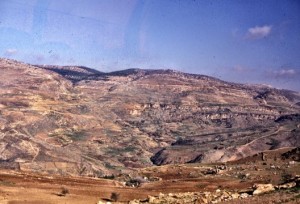
Along the road between Jericho and Jerusalem in the Qelt Wadi.

50 So throwing off his cloak, he jumped up and went to Jesus. 51 Then Jesus spoke, “What do you want me to do for you?” The blind man said to him, “Rabbouni, let me see again.” 52 Jesus said to him, “Go; your faith has saved you.” And at once his sight returned and he followed him along the road. (The New Jerusalem Bible. General editor, Henry Wansbrough, Doubleday, 1985.)

This Sunday’s Gospel takes place during Jesus’ last trip to Jerusalem before his Passion, death, and resurrection. It is about the healing of Bartimæus, the man who wanted to see. His name, “Son of Timæus” can be taken two ways. In Aramaic, it is Son of Timæus but what is the meaning of the word Timæus? It comes from the Greek τιμή (timē) meaning Honor. We’ll look at another possible meaning shortly. Bartimæus wants to see. He had a great job as a beggar, but that also was a great problem. His location was “on the road to Jericho,” a very busy place, and he probably did well financially. But the Jewish culture at that time thought of blindness as a punishment. They were even prohibited from full participation in the Temple because blindness was considered one of the “blemishes,” and even an outcome of sin – either personal or familial.

There is a story nearly identical to this one in the Gospel of Luke, but in that story the event happens as Jesus and his followers were approaching Jericho, and the blind man is not named. In Matthew’s Gospel, there are two blind men, both are unnamed, and in all of these stories sight is restored because of the faith expressed in asking for healing. The fact that it occurs in some form in all three of the synoptic Gospels is a good indication that it is an important message that should be studied because it was obviously studied much in the early church.

So, along with the story of “The Son of Honor,” we also have superimposed on it the story of a man who is condemned to a life of begging because he is obviously unclean – he has the blemish of blindness. Because of this there is a less-well-known – and probably lease feasible – history of the derivation of Bartimæus from bar-tim’ai = “son of the unclean,” and this derivation carries the allegorical meaning of “the Gentiles” or those who are spiritually blind. Although a little improbable, it does give the story an interesting, albeit subtle, double lesson. Let’s take a closer look at this passage and study the characters and the actions.

As a matter of custom, blind men who were beggars wore certain coats to identify them, so that people could recognize their needs. Now we have Bartimæus seated by the road to Jericho, a very lucrative location, wearing a uniform that identifies him as qualified to be a beggar. He is “trustworthy” because he is following the rules. He hears a crowd approaching and learns that “Jesus of Nazareth” (or Jesus the Nazorean in some translations) was the source of the commotion. Bartimæus has apparently heard of Jesus and also apparently knew of certain prophesies which applied to Jesus. He calls out to him, not as Jesus the Nazorean, but as “Jesus, Son of David.” At this point in the narrative, the sizable crowd is still passing. It seems Jesus is a little farther back in the pack because it is the leaders of the crowd, the folks who have worked their way up to the front, who first interact with Bartimæus. Now, Bartimæus is making quite a racket with his shouting, and he keeps it up despite the fact that he is told to be quiet, and scolded for “speaking out of place.” After all, he is obviously a sinful man who is punished by God with blindness, and he has no right calling out to the Master, the Teacher, Jesus. He is shushed and scolded.

That makes him cry out all the louder, “Son of David, Jesus, have pity on me.” In this, we see the value of persistence in prayer despite the times when other persons, other things, or other events and priorities make it hard to persist. Even if people rudely told him to mind his place and shut his mouth, he knew what he wanted because he had already accepted the fact that Jesus, and only Jesus, could help him. He didn’t ask for money, or respect, or forgiveness from whatever sins brought on his condition. He didn’t send someone else to get Jesus to come over to where he was. He did not ask to be carried or led to Jesus. He just prayed with simplicity and conviction, “Jesus, Son of David, have pity on me” over and over and over. Between the ruckus he’s making and the people telling him to be quiet, the group of travelers slows, quiets, and turns their attention toward the disruption.

Jesus stops and says, “Call him here.” He did not say, “Bring him here.” He did not go to the man who called him. He did not tell Bartimæus, “Come over here.” He told others around him to call Bartimæus. We are also called to approach Jesus. Sometimes, for example when we were children, others carried us to Jesus. As we grow older and mature, there are times when we know Jesus comes to us even though we don’t know he’s on his way. The sweetest times, though, are those when someone calls us and notifies us Jesus is asking us to pay attention, to interact with him. It seems to evoke that “where two or more” dynamic. We are changed by the hope it gives us. That is what happened to Bartimæus.

Others called him and told him, “Cheer up. Take courage, be happy. He is calling you.” At this point Bartimæus does something very significant, something that teaches us several lessons in a single action: He throws off his cloak. Now, recall that his cloak was his uniform. It was what allowed him to take up a lucrative spot along the highway and legitimately gain an income. Begging is not usually thought of as work – until you’ve tried it. It’s a bit like hunting for your survival. Some days are better than others. Some days you do well, and other days you don’t. Bartimæus had not asked to be healed. He asked only for Jesus’ mercy. In anticipation of that he was willing to give up four things: His career and the income that went along with it; his uniform, the cloak; the shelter and protection the cloak provided; and the place by the road where he worked and was well-known. He tossed all of that aside and jumped up to go to Jesus.

Sometimes when Jesus calls, we can be a little sluggish in our response, but not Bartimæus! He went directly to Jesus. And the next thing, the next lesson, is that Jesus says to him, “What do you want me to do for you?” Jesus listens to our prayers, our needs, our hope, dreams, anxieties, and fears, too. Think of a time when he asked you, “What do you want me to do for you?” If you can remember a time like that, chances are it is because he granted what you requested in faith. If you can’t remember a time like that, think about what you can do that would be similar to what Bartimæus did. Would you toss aside your security, jump up, and go directly to Jesus?

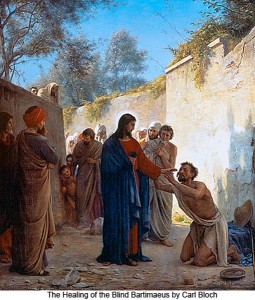
Bartimæus told Jesus exactly what he wanted – to see. Now, instead of “son of David,” he calls him “Rabuoni.” He addresses him as Teacher, Master, one who is respected much. As in the photo above, we can see him kneeling before Jesus during this exchange, imploring him to answer his prayer for healing. He tells Jesus, “I want to see.” The verb used here is ἀναβλέπω (an-ab-lep’-o) which means “I look up, recover my sight.” Bartimæus knew what he was missing. He was missing the ability to see life. In the parallel meaning of his name and the implications that go along with this, we realize we know what we are missing, the ability to see Life, to know the Truth. And Bartimæus receives both of these when he lays aside all worldly things, humbles himself before Jesus, and says, “Lord, let me see.”

Bartimæus had so much faith that he would be healed by Jesus that he threw off his cloak, jumped up, and went to Jesus knowing that he no longer would need the uniform that identified him as a blind beggar, even before he was healed. Then we see what happens after Jesus answers his prayer. Jesus said to him, “Go; your faith has saved you.” And at once his sight returned and he followed him along the road. He followed along the Road to Jerusalem, to the Passion, to the Resurrection, and to Eternity. I want to walk with Bartimæus along that road; how about you?

Share-A-Prayer

Cancer WHETHER ACTIVE OR IN REMISSION, and other serious, chronic illnesses: DL (and also eye and back trouble); CF, FO, DO, SC, GW, SP, EL, SR, JM, MJ, JE, JC, JL, MG, KW, TW, NA, CC, LM, CR, CW, KV, and others. We ask God for hope, healing, and health.

Addiction whether active or recovering: PB, TO, JL, CN, BL, DN, FJ, CO, JG, KD, RL, and others.

Personal intentions and prayer requests: All others in the MBN, all our family, friends, loved-ones, benefactors, and associates.

Whatever, whenever, wherever, whoever, however, if ever, forever —

at your service, Beloved.

Please carefully evaluate all available candidates in local, state, and federal elections, and act on those choices by VOTING. YOUR VISION, YOUR VOICE, YOUR VOTE.

PRAY FOR MORE VOCATIONS IN THE CHURCH – PRIESTS, RELIGIOUS ORDERS, LAY MISSIONERS, AND ALL WHO SERVE GOD BY SERVING OTHERS.

Creative Commons License
Aloha Friday Messages by Charles O. Todd, III is licensed under a Creative Commons Attribution-ShareAlike 3.0 Unported License

Unless otherwise indicated, all scripture passages are from the New Revised Standard Version Catholic Edition (NRSVCE) New Revised Standard Version Bible: Catholic Edition, copyright © 1989, 1993 the Division of Christian Education of the National Council of the Churches of Christ in the United States of America. Used by permission. All rights reserved.
Biblical languages inserts from Bible Hub (Bible Hub: Search, Read, Study the Bible in Many Languages) Visit at http://biblehub.com

Aloha Friday Message – October 19, 2012 – A Different Fear

Someday I’d like to see this as a window decal – white against dark-tinted glass.

1242AFC101912 – A different fear

Read it online here, please.

Not long ago I wrote about The Fear of the Lord and foolishness. Here are a couple of references from that topic.

Psalm 111:10The fear of the LORD is the beginning of wisdom; all who follow his precepts have good understanding. To him belongs eternal praise.

Proverbs 9:10 – The fear of the LORD is the beginning of wisdom, and knowledge of the Holy One is understanding.

In this context, “fear” is equivalent to reverence. We’ve touched on the ideas of reverence, gratitude, and service as components of stewardship. Today, I am thinking of a different kind of fear. It is unpleasant – or it should be – and sometimes it saves our lives, while other times it fills us with dread or even heart-stopping physiological changes. It takes hold of us when we see danger or are otherwise alarmed. We are taught in the Bible to fear – that is, reverence – our God, but we are also taught in the Bible not to fear anyone or anything else. There are over 200 places in the Bible where God says, “fear not” or “be not afraid.” Take a look at just a few of those.

NIV Psalm 56:11 – in God I trust; I will not be afraid. What can man do to me?

NIV Psalm 91:5 – You will not fear the terror of night, nor the arrow that flies by day,

KJV Proverbs 3: 25-26 – Be not afraid of sudden fear, neither of the desolation of the wicked, when it cometh. 26 For the LORD shall be thy confidence, and shall keep thy foot from being taken.

NIV Matthew 10:28 – Do not be afraid of those who kill the body but cannot kill the soul. Rather, be afraid of the One who can destroy both soul and body in hell.

KJV Luke 12: 31 – But rather seek ye the kingdom of God; and all these things shall be added unto you. 32 Fear not, little flock; for it is your Father’s good pleasure to give you the kingdom.

NIV John 14:27 – Peace I leave with you; my peace I give you. I do not give to you as the world gives. Do not let your hearts be troubled and do not be afraid.

NIV 2 Corinthians 13:11 – Finally, brothers, good-bye. Aim for perfection, listen to my appeal, be of one mind, live in peace. And the God of love and peace will be with you.

NIV Hebrews 13: 6 – So that we may boldly say, The Lord is my helper, and I will not fear what man shall do unto me.

Just up the page I said that fear is unpleasant – or it should be. I am thinking about the forms of so-called entertainment where we are exposed to things meant to frighten us either physical or psychologically. Physical frights are usually some mechanical monstrosity that hurtles us through space in ways that make our bodies pump adrenaline – rollercoasters, sky-diving, and other physically challenging diversions. There are also the psychological fear-inducers, most notably movies, which we love to watch because they are so suspenseful and gory. Personally, I find these films offensive; I don’t see any entertainment value in watching suffering. It does nothing for me except make me ill and sleepless. I used to enjoy some “amusement park rides,” but I think I outgrew them when the discomfort I experienced riding them lasted for weeks instead of minutes.

For some strange reason, we earthlings like to give ourselves “a good scare” once in a while. We like that feeling of danger, risk, excitement – as long as it can be resolved neatly and end in laughter. Well, if there’s a “good” scare, then there’s also a “bad” scare, and that kind we don’t like as much because it is not induced, it is not pretended, it is, rather, a genuine threat to our life. This kind of fear is mostly based on the possibility or probability of actual physical pain, damage, or even loss of life. It is the fear of war, torture, vulnerability to someone or something far more powerful than we are. It is what we feel when we see a flood approaching, hear or see an explosion, recognize the rapid advance of an enemy, or realize that our own bodies have turned against us and marched us straight off to death. It can even be those terrifying moments when we are asleep and our subconscious mind unleashes incidents and threats that paralyze us until at last we awake gasping and grasping for reality.

Lately I’ve heard a lot of fear expressed about, of all things, politics. Is that a good scare or a bad scare? That’s a hard one to call. I think it depends on why it scares you. If you feel the changes coming, regardless of how the political landscape changes, pose an actual physical threat like imminent death, (which I find hard to imagine). It’s more likely you fear some loss of status which might end “life as you know it,” but will not in fact make you dead. You most likely will suffer, if that is your disposition, and you might even suffer long and hard. Well, that is the thorny part of the covenant we have with God; we get all of his blessings along with some persecutions. See Mark 10:29-30.

Our world is a word of exaggerations, overstatement, hyperbole, embellishment, and all of those are synonyms for lies. And based on what we see in the World around us, you’d think we really enjoy lies! Look at all the exaggerated and deceptive things you can find on the Internet – from pornography to snake-oil medicine – and the same goes for new, entertainment, literature, art, dietary choices, in fact every aspect of life as an earthling has been distorted so badly that we seem to have lost our grip on the truth. Somehow we know this, but are still surprised that is it so pervasive and we’re part of it! How can this happen?

We are simply following our leader, the Prince of the Air. Remember him? He’s also called The Father of Lies, and the Ancient Dragon. Throughout all of human history, there have always been a few who openly, willingly, and zestfully follow his lead. His downfall was to try to ascend to Power in opposition to the will of God. Through all the millennia of history, he found many willing to repeat his error. From the sickening worshipers of Moloch to the atrocities of Stalin and Hitler, there have been people of consummate evil in this world who have flourished for a while and then exited leaving a nasty and bloody smudge in the line of history. But Beloved, we are surely not evil like that, are we? No, of course not! We modern-day earthlings don’t sacrifice the lives of infants for our own personal gain as worshipers of Moloch did. We 21st century humans do not allow our enemies to be tortured so we can exterminate their supporters. Humanity in this day and age no longer raises up pogroms of ethnic cleansing. Surely we do not pollute the earth, the sea, and the sky only for our personal comfort.

Beloved, we ought to be less afraid of politics and more afraid of judgment by and because of politics. Throughout history, there have been wars, crimes, persecutions, terror, and all brought to bear on fellow humans by the hands of a few evil men. Although the evil is perpetrated by a few, the effect falls on many. In this well-shrunken world, it is more likely than ever that the consequence will fall upon everyone and everything. We forget too easily that we did not create the universe, or even this world, or anything in it. We build things, invent things, craft things, but we do not create things. We do not even create evil; we merely cooperate with it from time to time. Hopefully these times are few and far between and we are, instead, cooperating with good. It is not the times we should fear, however. Whatever is constrained by time is to be neither a source nor outcome of fear. The worst that can happen is we die a horrible, painful, and gruesome death – like Jesus did. Instead it is better for us to die to fear and to live in Christ.

Be not afraid, I go before you always. Come. Follow me, and I will give you rest.” Please go back to the top of the page and reread those eight passages about not being afraid. I am not saying we should expectantly wait in peaceful hope for martyrdom. I am saying, however, that if that time ever comes when that is our future, we will be able to accept it with the same equanimity as the Apostles and Saints who endured all not because they lost hope, but because in hope they found their endurance. Don’t be afraid of politics. Don’t be afraid of anything worldly. God will allow the World to experience the consequences of its apostasies and atrocities, and some of that will fall on us. Those who are only Worldly will suffer more than any and then will go on to suffer longer than any. Those who are other than Worldly will suffer – some greatly – but then will go on to a complete lack of suffering as they live in eternal bliss.

Blessed be God forever in his Angels and in his Saints. A special shout-out to all the Pilgrims on the road this week to the Holy Land, or Rome, or Spain, or Africa – wherever God leads them. Our prayers go with you!

Pray for our leaders, Beloved. If our future must be in their hands, pray that they are in God’s hands.

Whatever, whenever, wherever, whoever, however, if ever, forever — at your service, Beloved.


Aloha Friday Message – October 12, 2012 – Ubi Caritas

1041AFC101212 Ubi Caritas

Read it online here, please.

KJV

1 Corinthians 13:1 – Though I speak with the tongues of men and of angels, and have not charity, I am become as sounding brass, or a tinkling cymbal.

KJV 1 Corinthians 16:14 – Let all your things be done with charity.

NIV 1 Corinthians 16:14 – Do everything in love.

NAB 1 Corinthians 16:14 – Your every act should be done with love.

In the King James Authorized Version (KJV) of the Bible, the word charity appears nine times in the first letter of the Apostle Paul to the Corinthians. Altogether in the Pauline Epistles – in the KJV – the word charity appears 18 times, so half of them are in 1 Corinthians. It occurs another seven times in other Epistles. It does not occur in the Old Testament, and it does not occur in the Gospels. In all the occurrences of charity in the New Testament are translated from a word very familiar to us by now – ἀγάπη – agape [ah-GAH-pay] – LOVE.

St Augustine had a pretty high opinion of Love. He reportedly wrote, “Love. Then do as you will.” Ah, easy enough if you’re a Saint among Saints, but for a puny little sinner like me, that Love Augustine is thinking about is the AGAPE of Christ. It is the real, heavy-duty, super-turbocharged diesel version of LOVE. Mine is more like a two-cycle weed-whacker motor kind of love. It takes everything I have to keep that going, too. I sputter to a jolting stop quite often when “Love your neighbor” turns into, “What is that idiot up to now?!?”

St. Augustine and St. Paul were pretty much on the same page when they talked about love – I don’t know why it got translated to charity in the KJV, but I’m sure there’s a good reason. They get the ideal of Love from Jesus, of course, who willing endured a nearly incomprehensible transition from Divine to human to Resurrected. That transition is one of the main reasons we can sing “Our God is an Awesome God.” Such LOVE is literally beyond our ability to understand. It is so huge. If you could understand God’s LOVE, you could probably also explain quantum mechanics, if and how the universe is expanding, and why kids love stomping in puddles. But we don’t understand LOVE, not even human love even though we know it’s more glorious than the whole universe because Love is God; God is LOVE.

We have lots of ways to express love, and lots of words for love. Here is a link to a couple of posts in the past that went into more detail. I’ll leave it to you to decide whether or not to satisfy your curiosity about what love is (Now I have that song stuck in my head “I wanna know what love i-i-i-i-i-s!“) Bottom line is that God expects us to try to love one another selflessly and without hostility – at the very least do not seek to cause harm to our neighbor. Even if that neighbor drives us absolutely crazy, out of love we treat them with kindness, even esteem. We are to bless them, not curse them. We are to forgive them as we are forgiven. Our goal is LOVE, – ἀγάπη. What does that mean to us? Can we really love everyone when it is sometimes so difficult to love anyone?

What about criminals and terrorists and bad people who do really bad things? Is there any possibility, any possibility at all, that God could love them? If so, then we should, too. It means that even if the people we love are pagans, we love them. It means even if we don’t understand why we suffer or even why the people we love suffer, we love God. It means that no matter how much we love or how many people or places or things we love, love is the quintessential element or our persona individually and collectively!!

Why?

Ahhh, beloved. It is so simple. We are created in the image of God.

Almighty
God
Is
Love
Eternal

Be agile in your love: Be A.G.I.L.E.

The words at the top of the page – UBI CARITAS – come from an ancient Latin chant. Here are a few verses with their translation:

So in this Latin hymn, charity and love are two different things. Charity is usually thought of as acts of kindness to supply something someone else needs – often money. Charity is humanitarian kindness, and it often arises out of humanitarian love. AGAPE is divine, PERFECT, kindness, and it always arises out of PERFECT Divine Love. Charity is one of the works of faith we call the Corporal Works of Mercy. You may recall we studied those during Lent in 2010. Charity is the pragmatic expression of the commandment to “Love thy neighbor as thineself.” It’s worth listing them once more as a reminder:

1. Feed the hungry,
2. Give drink to the thirsty,
3. Welcome the stranger,
4. Clothe the naked,
5. Care for the ill,
6. Visit the imprisoned,
7. Bury the dead.

Now we see a pattern emerge in these lyrics. We have LOVE and we have Charity. When we build our lives around these two things, we work on those two Greatest Commandments:

Matthew 22: 36-40 – “Teacher, which is the greatest commandment in the Law?” Jesus replied: “‘Love the Lord your God with all your heart and with all your soul and with all your mind.’ This is the first and greatest commandment. And the second is like it: ‘Love your neighbor as yourself.’ All the Law and the Prophets hang on these two commandments.”

So, “Where charity and Love are, God is there.” There is another hymn you might be thinking of as you read this: “Where Charity and Love Prevail.” Here are the first and last verses of that version.

Where charity and love prevail,
there God is ever found;
Brought here together by Christ’s love,
by love are we thus bound.

No race or creed can love exclude,
if honored be God’s name;
Our family embraces all
whose Father is the same.

And so, Beloved, we can know with certainty that we do His will when Charity and LOVE work together to the glory of God.

Share-A-Prayer

We pray for all whose vocation it is to serve God by serving others in his name. Ask God to strengthen and guide them in serving him through the work that they do. With God, we bless them for the sacrifices they make to bring souls into the Kingdom. We especially pray for his servants who go out into the world as missionaries to carry the Good News and the Sacraments to every land and nation.

Please, Lord, touch also the hearts and minds of our laity to come forward to serve in the ministries of our churches and encourage many of our laity to volunteer time, talent, and treasure to help our churches be a blessing to our communities through their compassionate service to others. We ask this through Christ our Lord. Amen.

Pray for the prisoners, especially those like JR, who are unjustly accused.

Pray for all who are deaf to the Gospel because they oppose “organized religion.” Help them to see and understand that FAITH is a community-based human experience, not a solo-flight with our own background music.

Pray for our leaders – past, present, and future – and for our electorate so that we will once again as a nation focus on truth that is true and lasting, justice that is righteous and merciful, and leadership that is moral, just, compassionate, wise, and governs with integrity.

Pray for one another, Beloved, that all of us will have the will to do small things with great love, that love which we share among all of the members of the Moon Beam Network. Let everything we do be done in LOVE.

I love you. Whatever, whenever, wherever, whoever, however, if ever, forever — at your service, Beloved.

chick

Pages Email Newsletter Categories Archives Connect
  • Connct to us here