Aloha Friday Message – March 23, 2012 – Fifth Friday in Lent

1212AFC032312 – Catholic Letter Series

Read it online here.

KJV 1 Peter 2:4 To whom coming, as unto a living stone, disallowed indeed of men, but chosen of God, and precious, 5 Ye also, as lively stones, are built up a spiritual house, an holy priesthood, to offer up spiritual sacrifices, acceptable to God by Jesus Christ.

NIV 1 Peter 2:4 As you come to him, the living Stone– rejected by men but chosen by God and precious to him– 5 you also, like living stones, are being built into a spiritual house to be a holy priesthood, offering spiritual sacrifices acceptable to God through Jesus Christ.

NAB 1 Peter 2:4 Come to him, a living stone, rejected by human beings but chosen and precious in the sight of God, 5 and, like living stones, let yourselves be built into a spiritual house to be a holy priesthood to offer spiritual sacrifices acceptable to God through Jesus Christ.

Aloha nui loa, Beloved. Today we are going to look at a beautiful letter attributed to Peter, also called Cephas (KAY-phus) which means Rock in Aramaic and is also a Greek word for rock Κηφᾶς.

In this letter, Peter gives us many beautiful images, draws many examples from Old Testament writers, and presents a wide array of topics that address many aspect of life in the early Church. The one I chose for the open in this message is one of my very favorites. In this he makes a connection between Christ, “the stone which the builders rejected,” and believers who have become “living stones,” that is to say like Christ in that they are to be Holy, submissive to God, and to build a holy dwelling which will be a Holy Nation serving God. The word for “living” used here is ζῶντα zaonta {dzah’-on-tah} from za,w zao {dzah’-o}. za,w is the verb “to live,” and ζῶντα is “living.” But it carries a much deeper connotation that being “merely alive.” One example is in the term “living water.” This is water that has “vital power in itself and exerting the same upon the soul.” It is living that is fresh, strong, efficient, active, powerful, and efficacious. We come to Christ as living stones animated with the same capacity for holiness found in the Apostles because that holiness comes from and through Christ. What a mighty image that brings to mind!

Peter tells us Christ was “chosen by God and precious to him.” Christ, the Messiah is “called ‘elect,’ as appointed by God to the most exalted office conceivable.” And we are called to that same life as his servants. We are called the elect, the chosen because “Even before he made the world, God loved us and chose us in Christ to be holy and without fault in his eyes” (Ephesians 1:4) This word is ἐκλεκτός eklektos {ek-lek-tos’} and it denotes the best of its kind or class.

As living stones, we are to be built into a “spiritual house,” a family for generations, offering up ” spiritual sacrifices acceptable to God through Jesus Christ.” WOW! That is such a powerful statement, because it describes not only our calling, but also the fulfillment of that calling.

In 1 Peter 1:8-9 Peter tells us, “Though you have not seen him, you love him; and even though you do not see him now, you believe in him and are filled with an inexpressible and glorious joy, for you are receiving the goal of your faith, the salvation of your souls.” What is that inexpressible joy and how do we feel it? How do we recognize it? It is the power of his love as delivered to us in and through the Holy Spirit that makes our hearts and minds leap for joy as we raise hearts and hands and voices to praise god for his generous love, unfailing promise, and awesome presence in our lives.

In 1 Peter 2:9 Peter tells us the reason God has fashioned us a living stone. “But you are a chosen people, a royal priesthood, a holy nation, a people belonging to God, that you may declare the praises of him who called you out of darkness into his wonderful light.” God is Light. We are called to live in the Light, to let our Light shine, to be the Light shining in the darkness. In John 8:12, Jesus says, “I am the light of the world. Whoever follows me will never walk in darkness, but will have the light of life.”

There are dozens of power-packed images like that in this single short letter. Scholars generally agree that it was written by Peter, with help from Silas (who may have been a “professional writer,” helping Peter achieve a very polished Greek text which might have been a bit out of Peter’s reach normally). The letter is addressed to churches planted by Paul and his fellow sojourners in Asia Minor: Pontus, Galatia, Cappadocia, Asia, and Bithynia. That may have been the order in which a courier might have delivered the letter to those churches.

The letter mentions persecutions, suffering with Christ as we daily take up our cross, even dying under persecutions for the Gospel and for the joy we have of being so close to our Savior and God. I looked at several analyses of how this letter is put together, and here is a listing based on those reviews:


  1. 1 Peter 1:112: The JOY we have in knowing God loves us so much he provided a Perfect Sacrifice for our salvation – his only begotten son.
  2. 1 Peter 1:132:3: God’s love should inspire us to v-be some much like him that we strive mightily to be holy as he is holy.
  3. 1 Peter 2:412: Israel, the children of Abraham, Isaac, and Jacob, was the People God chose to be distinctly his own, the People of the First Covenant. Despite the many times they ignored that, God honored his promises, and not only made Abraham the father of many nations, he also us part of Abraham’s descendants through Jesus sacrificial suffering.
  4. 1 Peter 2:13-23: We can share in, identify with, and submit to persecution and suffering with Jesus and for the Gospel. Whenever we do so, we die a bit to ourselves and to the world, but we also glorify God.
  5. 1 Peter 2:2425: Jesus’ expiation (The complete reconciliation of God and humans brought about by the redemptive life and death of Jesus) of our sins is a powerful, awesome, incomprehensibly valuable gift – it is a gift given through the Grace of God, and that brings us back to the “Shepherd and Overseer” of our souls – our Creator, God. How can we begin to measure how grateful that can make us feel?!?
  6. 1 Peter 3:17: God is community as the Trinity. He established family as a community through the sacrament of marriage. Husbands and wives can honor this sacred vocation by honoring one another, loving one another as God has loved them. Dishonoring one’s spouse is point-blank dishonoring God.
  7. 1 Peter 3:822: This passage begins, ” Finally, all of you, have unity of mind, sympathy, brotherly love, a tender heart, and a humble mind. Do not repay evil for evil or reviling for reviling, but on the contrary, bless, for to this you were called, that you may obtain a blessing.” Peter goes on to say that under no circumstance or persecution and suffering should we seek to harm those who bring about that persecution and suffering. If we suffer for doing what is good, that is so much better than suffering for doing evil!
  8. 1 Peter 4:111: The World wants us to be like them, and constantly entices us to live “in sensuality, passions, drunkenness, orgies, drinking parties, and lawless idolatry.” They make fun of us for being “religious nuts,” but when Judgment comes, they will have one hell of a time coming to them. As for us, we are to ” keep loving one another earnestly, since love covers a multitude of sins (theirs and ours). Show hospitality to one another without grumbling. As each has received a gift, use it to serve one another. Jesus blood cleansed you of your sins – the ways you have hurt yourself, your community, and your God; is blood also cleansed the sins of those who hurt you, hurt your community, and offend our God. His sacrifice covers all completely, permanently, eternally.
  9. 1 Peter 4:1219: “No matter how you struggle or strive, you’ll never get out of this world alive.” And struggle and strive as we might, we will always be facing situations where our suffering persists. Rather than wail and gnash or teeth, we can rejoice because are blessed, in that suffering when “the Spirit of glory and of God rests” upon us. ” Therefore let those who suffer according to God’s will entrust their souls to a faithful Creator while doing good.”
  10. 1 Peter 5:16: When the World sees us acting this way – joyous in serving, joyous in suffering – they will want to know more about our joy and more about our shepherd. Those who are chosen for servant- leadership through the gifts of God will serve gladly, equitably, humbly – as did Christ. I probably will never be easy, but Peter tells us ” after you have suffered a little while, the God of all grace, who has called you to his eternal glory in Christ, will himself restore, confirm, strengthen, and establish you.”
  11. 1 Peter 5:714: God will do all these powerful and wonderful things to and for us because of his intense, eternal, infallible LOVE. No matter what Satan tries to do to us to destroy our relationship with God, that relationship is always restored when we reconfirm our alliance with God and rejoice in the wonder of his uncompromising love and care.

Share-A-Prayer

M&PC wrote to tell us, “We are praying for whole world for peace, safety, and wellbeing everywhere.” What an excellent prayer intention. Maybe you can add it to your list of intentions. So many places around the world are experiencing terrible weather, terrible acts of evil, terrible acts of violence. Pray that Peace will rule the planet, and let it begin with you.

Please continue to pray for the family of Baby Cheyanne. She lost her battle with multiple health problems. It has been so difficult for Mom and Dad, and for the whole family. They know Cheyanne has found 100% healing in the Light of His Glory and Love. The loss of that sweet child, however, was a hard blow. Pray for them to return to the joy they anticipated the moment she was born.

Pray for those who suffer for their faith. You would think that “in this day and age” religious persecution – even to the point of martyrdom – would be nonexistent. But it is not.

Pray for everyone who suffers poverty, injustice, hunger, loss of work or loss of income; for those who suffer through illnesses like cancer, mental illness, chronic disease, acute or chronic pain; pray for those whose family are falling apart and for those whose families are just beginning or just beginning to heal.

Finally beloved, pray for one another. You know there is a Daily Intercessory Prayer List. Whenever you pray the MBN prayer, that short prayer includes all of the intentions in the Intercessory prayer list – over 100 now.

Whatever, whenever, wherever, whoever, however, if ever, forever — at your service, Beloved.

chick
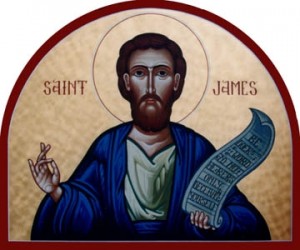
Aloha Friday Message – March 16, 2012 – 4th Friday of Lent – James

1211AFC031612 – Catholic Letter Series

Read it online here. Use the links to get additional information.

From the ESV

James 1:5 If any of you lacks wisdom, let him ask God, who gives generously to all without reproach, and it will be given him.

James 3:17 But the wisdom from above is first pure, then peaceable, gentle, open to reason, full of mercy and good fruits, impartial and sincere.

E pili mau na pomaika‘i ia ‘oe a me ke akua ho’omaika’i ‘oe! (May blessing always be with you and may God bless you!)

Today we take a peek into a truly remarkable epistle, the Epistle of James. First, a little background. The Epistle of James begins, “James, a servant of God and of the Lord Jesus Christ, to the twelve tribes in the Dispersion: Greetings.” In this opening greeting, James refers himself as a servant (viz. “slave”) of God and of the Lord Jesus Christ. This points us away from the assumption that the epistle was written by the same James that was an Apostle, the brother of John, and a possible relative of Jesus who is usually referred to by the word ἀδελφὸν [{a•DEL•phon}: a brother, member of the same religious community, especially a fellow-Christian] (See Galatians 1:19)

Secondly, this document  is not really in the form of an epistle – a letter – like those which were written by Paul. There’s no general blessing at the beginning, and the document ends abruptly by stating that whoever converts a sinner “will save his soul and will cover a multitude of sins.” No one who is a contemporary of James is mentioned by name. Only the Great Heroes of the Jews are mentioned. It has no distinct divisions other than segues from one topic to another. It is a very pleasant, well-composed essay about the ethical boundaries the Christian Community should respect and teach. It is a collection of the respected teaching of someone who had a strong commitment to Christ as Lord and Savior, James the Just. The “letter” was distributed and studied widely throughout the diaspora. For the next 300 years or so there was ongoing debate as to whether or not this document was something that should be included in the uncontested (canonical) literature but it was finally ratified by the third council of Carthage in 397 AD. It always traveled with the name JAMES attached to it.

This particular JAMES seems to have been recognized as a representative of the early Christian community in Jerusalem who is often referred to as James the Just. He was stoned to death under the authority of the High Priest at that time, one Ananus II, who was the son of the High Priest Ananias who completed a famous role in the Passion of Christ. It may be no coincidence that this epistle seems to have appeared within a year or so of that incident, around 62 A.D. James was clearly a man who was well respected in the early church, not just in Jerusalem, but throughout the diaspora, the dispersion of the Jews and of the Church. I accept the assertion of many scholars who have identified him as “James the brother of the Lord” – a cousin of Jesus – who at first did not believe, but then came to know a profound faith when Jesus appeared to him individually after the resurrection (See Corinthians 15:3-11 especially v. 7)

So, all in all, this epistle was a collection of information sent out by James the Just and/or his disciples. It  was sent to encourage the early Christians (first called Christians in the Church of Antioch in about 31 AD) to endure everything brought against them by

  • relying on God’s generous wisdom, James 1:5
  • recognizing Christ as the Living Word of God (LOGOS), James 1:19-2:13 16
  • understanding the true work of faith by putting true faith to work James 2:14-26
  • speaking always in, through, and with LOVE James 3:1-12 33
  • tuning to the wisdom of God to inform the wisdom of man James 3:13-18
  • submitting fully to God’s authority and teaching in Jesus James 4:1-17
  • resisting the enticements of materialism James 5:1-6
  • waiting patiently for the imminent return of the Lord, James 5:7-11 and
  • using the power of faith rather than the power of persuasion James 5:12-20

For the next 300 years or so there was ongoing debate as to whether or not this document was something that should be included in the uncontested (canonical) literature but it was finally ratified by the third council of Carthage in 397 AD.

The two verses I chose capture something about the book of James that has always brought me back to reading it when I have questions about how certain things should get done – day-to-day living things. I have a knack for finding ways to do foolish things, to “lack wisdom.” At times it seems it is the only aspect of my life in which I truly excel. 😉 James 1:5 was one verse that was quoted frequently to me when I was growing up. The idea is to ask God for HIS wisdom, because it’s way better than mine, and to ask with confidence because of God’s generosity.

From there, James goes on to say. “But when you ask him, be sure that your faith is in God alone. Do not waver, for a person with divided loyalty is as unsettled as a wave of the sea that is blown and tossed by the wind.” There is just so much good, practical, easy-to-understand advice in this treatise on good Christian conduct. If you have teens in your family, try reading it with them – half a chapter a day at least –so they can hear the content. It will serve them well both soon and later.

It is in James that we have the idea of the tongue being a terribly powerful weapon worse than fire, stronger that a ship’s rudder, and able to bring calamity on others and especially one’s self. (James 3:1-12) In the very next section of James, he writes about the importance of wisdom from above and how those who teach about God must rely on that more than anything else. Only the Wisdom of God is so pure that it can put our hearts and minds at rest. Our own wisdom leaves much that can undo itself, whereas God’s wisdom is so complete that there is nothing in it which can be undone. It is not through religiosity that wisdom comes, but the The Spirit of God which is the Spirit of Wisdom that accompanied God at the Creation and is with God always. Immersing our intent in God’s wisdom makes that intent pure and peaceable and the person with that intention become purified, humbled, and holy. It purifies the heart above all else, making the intention and the one who holds that intention righteous, harmless, and just.

When our inward lives – our hearts and minds – are transformed like this, made pure and just in the Wisdom of God, our outward lives – our works, prayers,  joys, sorrow, sufferings, victories, defeats, distress, desires, and dreams – all of these in turn become pure, then peaceable, gentle, open to reason,  full of mercy and good fruits, impartial, and sincere.

So we know we should seek God’s own Wisdom, and sometimes even God’s own energy so we can grasp that wisdom, and when He bestows that wisdom on us, we must accept it with humility and openness so that we will willingly allow our life in him to conform to that Wisdom which is also His will and His Gift to us through Jesus.

It would probably take you about 20 minutes to read straight through this remarkable document (which truly is one of my favorite things to do), so I urge you sometime this week either to read it through, or just read 1 chapter a day until all five chapters have been read. I am certain you will benefit from that exercise.

And here is Wisdom, Beloved:

“‘Love the Lord your God with all your heart and with all your soul and with all your mind.’ This is the first and greatest commandment. And the second is like it: ‘Love your neighbor as yourself.’ All the Law and the Prophets hang on these two commandments.”

When your enemies treat you with kindness and are conciliatory, are you more inclined to spring to a renewed attack, or return the kindness with the goal of reconciliation?

W-W-J-D? Easy answer: Die for you to reconcile you to God.

Whatever, whenever, wherever, whoever, however, if ever, forever — at your service, Beloved.


Aloha Friday Message – March 9, 2012 – Paul and Philemon

1210AFC030912  – Philemon and Paul

Catholic Letter Series

Read it online here.


KJV Philemon 1:18 If he hath wronged thee, or oweth thee ought, put that on mine account;

NAB Philemon 1:18 And if he has done you any injustice or owes you anything, charge it to me.

NLT Philemon 1:18 If he has harmed you in any way or stolen anything from you, charge me for it.

Today I want to look into the very short epistle to Philemon. It is a very special epistle, first because it is so short, and secondly because it says so much about Paul’s relationship with the church at Colossae. Paul had never visited the church at Colossae before he wrote 1 Colossians, his first epistle to the church there. It seems it was established by Epaphras along with help from the churches Laodicea and Hierapolis (Col 1:7-8; 4:12-13). Philemon was a leader in that church. He apparently enjoyed a close friendship with Paul who refers to him as a dear friend and fellow worker.

The letter to Philemon is unusual also because it is a letter that is personal and to a friend, a private letter sent along with other public letters. It is unique among the epistles because it was not intended to reach a wide audience; it’s just a short note asking a friend to do him a personal favor – to forgive and accept Onesimus, Philemon’s thieving, runaway slave. Paul might have even known Onesimus because Paul was a mentor to Philemon and knew him and his family well. Onesimus was a fugitive in Rome, where Paul was imprisoned and under constant guard, and somehow he and Paul got connected. Perhaps Onesimus sought out Paul, or perhaps he was captured and imprisoned with him; we do not know the circumstances. But one thing was clear: If he was caught and prosecuted, he would have been put to death, most likely in a very shameful and painful way.

Paul is taking on the role of an arbiter, a peacemaker who is asking both men to concede that their relationship has changed and they need to accept that as the basis for a new relationship and then move forward in the will of God. His appeal is very polite as he makes it clear he does not want to impose his will on Philemon on behalf of Onesimus. He makes the argument in the form of a chiasm. In verse 5 he says, ” because I hear about your faith in the Lord Jesus and your love for all the saints.” If you were to map it out it would look like this:

The interaction between the components takes on the shape of the Greek letter, Chi which looks like an X.

There is also an interesting historical value to this letter. It gives us insight in to the man Paul and the events in his life as a man of tenderness, a side we don’t expect when we consider the content of other epistles. Here is he breaking “social mores” of the time by advocating for a slave. Onesimus’ status was one who was possibly under penalty of death for his escape and perhaps even for theft (v 18) The name, Onesimus, means useful and all through this epistle, Paul makes little wordplay remarks based on that meaning of the name Onesimus. In verse 11 he says, “Formerly he was useless to you, but now he has become useful both to you and to me.” In the light of today’s humor that isn’t really so funny or clever, but in Paul’s day, that was a masterful play on words that discloses to us Paul’s ability to quip and show a sense of humor.

Another characteristic of this short little note is the theological power in Paul’s request. He is teaching Philemon, and thereby showing us as well, that God is asking for something Philemon can do in his life that will make a difference in Paul’s life as well as in the life of his [spiritual] son, Onesimus. He is asking Philemon to forgive Onesimus and to allow him to return to Colossae, perhaps to be not only reinstated in his former position, but also to be received as a new brother in Christ. Paul wants to see Onesimus restored to the good graces of his master, Philemon, and to hold nothing against him for having run off with his master’s property.

The evangelist, Paul, delivers a message to Philemon that is hard to miss – whatever is gone wrong in life, God has a plan to fix it. The loss of a slave, and apparently some property as well, was a financial and personal loss, even an embarrassment. Paul is urging Philemon to live out the Gospel, to imitate Christ (and Paul) through his acceptance of Onesimus’ return.

Paul also plays a little “church politics” when he says, “I know you will do more than what I ask you.” Paul urges Philemon to welcome Onesimus back as a penitent, but to install is slave in his household as a brother whose God-given gifts include being a valuable helper not only in Philemon’s household, but in the church that meets there, and moreover in the Kingdom of God He is in effect saying, although he is still your servant, he is also your colleague, your coworker, your brother in Christ, and he has earned that recognition through the help and love he has given to Paul.

You can imagine that Onesimus might not have been too keen on going back to Colossae. Despite the probable reluctance to return to Philemon, Paul helps him understand that one has to pay one’s debt – Onesimus had to go back and make amends with Philemon, and submit to his authority even at the risk of death. And then Paul throws in the clincher: ” If he has harmed you in any way or stolen anything from you, charge me for it.” Put it on my account. Don’t charge him with anything. Whatever he owes you, I’ll cover it. And then he says, ” I will pay it back– not to mention that you owe me your very self.” Whoa! Way to lock in a favor!

The conclusion Paul wants Philemon to reach is that Jesus paid for Onesimus’ crime – as well as the crimes (sins) of Philemon, Paul, and all the saints – so “receive him as you would receive me,” for we are all the same in Christ. Paul says, “If this man has wronged you, I will take the blame and pay the price,” just as Christ has said repeatedly to us. “You have sinned against God and against man, but I have paid the price because God – your Heavenly Father and mine – sent me to tell you he loves you, just like I love you.” And therein is the heart of this message. Just as Christ paid for all the crimes of all the persons involved, Paul is willing to pay for the very crimes against Philemon; the hope is that Philemon will see that Onesimus is indeed a fellow believer and forgive him his trespasses as God, in Christ, has forgiven Philemon’s.

Can others’ failures make you angry or cause you to demean them, “I love them exactly as much as I love you. How much do you love me? As much as I love you and them?” That is the question Paul wanted to run through Philemon’s mind,  and now I hope it is running through your mind.

Reconciliation with God always comes as a result of a blood sacrifice. From the days of Abraham through Easter Morning some 2000 years ago, that blood sacrifice was nonhuman. Jesus willingly allowed himself to be the sacrificial lamb and that ended blood sacrifice once and for all. “Once” because it was the first, last, and only perfect sacrifice. “For all” because God’s plan is to redeem all mankind. In the Old way, for reconciliation to take place, death as a payment for sin came by bloodshed. “The wages of sin is death.” In the New way, the price for sin has been paid with Christ’s blood. That allows us to participate in the benefits of that sacrifice if I am also willing to “die” to sin. If I surrender my dreams, desires, wishes, hopes, and do it in and for Christ then I have died in and for another. I will die to my bad habits, my addictions, my selfishness, so that our relationship with God and each other might live, freed from all encumbrances that are not love. Like Onesimus, our debt had to be repaid, but it has already been paid in full.

“But the gift of God is eternal life through Jesus Christ, our Lord.” That is Good News. That is the Gospel. God loved us so much that he gave us the blood and spiritual sacrifice of his only begotten son. He accepted us back into and unto him. He asks us to do the same. We are to love one another as Christ loves us. We are to forgive one another and God forgives us. We are to serve one another rather than only ourselves. Paul gives us a very clear reason for doing all of this by setting an example any of us can understand – not to mention you owe me your very self.

That is the message Paul gives to Philemon, and to you and me. No matter how badly you’ve messed up, God always has a solution, but you are not that solution; Jesus is. Thank God for that.

Whatever, whenever, wherever, whoever, however, if ever, forever — at your service, Beloved.

chick  😀

Aloha Friday Message – March 2, 2012 – Titus, The Evangelist – Second Friday of Lent

1209AFC030212 – Titus The Evangelist – Catholic Letter Series

Read it online here.

Aloha nui loa, Beloved. Today I am thinking about the letter to Titus. It’s really short, and if you wanted to read it, I think it would take less than 10 minutes. Here’s a highlight from the second chapter.

KJV Titus 2:7 In all things shewing thyself a pattern of good works: in doctrine shewing uncorruptness, gravity, sincerity, 8 Sound speech, that cannot be condemned; that he that is of the contrary part may be ashamed, having no evil thing to say of you.

NAB Titus 2:7 showing yourself as a model of good deeds in every respect, with integrity in your teaching, dignity, 8 and sound speech that cannot be criticized, so that the opponent will be put to shame without anything bad to say about us.

NJB Titus 2:7 and you yourself set an example of good works, by sincerity and earnestness, when you are teaching, and by a message sound and irreproachable 8 so that any opponent will be at a loss, with no accusation to make against us.

Titus accompanied Paul to the Council in Jerusalem, to Troas (about 30 miles from the Dardanelles (Hellespont), the treacherous entry to the Sea of Marmara and the Black Sea beyond, was actually named Alexandria and often referred to as Alexandria Troas to distinguish it from the many other cities named Alexandria), Dalmatia, Crete (where he later returned to continue establishing the church there, and eventually wintered with Paul in the Nicopolis the “city of victory” – which was the capital of Epirus in northwestern Greece. It commemorated Julius Caesar’s victory over Mark Antony at the battle of Actium on September 2, 31 BC). According to the second letter to the Corinthians, Titus accompanied Paul on his Second Missionary Journey.

This letter is one of the “pastoral letters” which contain advice from Paul to his protégés about how to carry out their ministries and accomplish the tasks assigned to them. This letter describes to Titus how he is to choose his assistants from among the Minoans (the correct name for the inhabitants of Crete at that time rather than “Cretians”). Paul knew this would be a very difficult task. The inhabitants of Crete had a “world-wide” reputation for their rough-and-tumble morality, their obstinacy, and appetite for too many things that were not good for them. Paul even stated flatly that “One of them, a prophet of their own, once said, “Cretans have always been liars, vicious beasts, and lazy gluttons.” That testimony is true.” Titus had a tough row to hoe! Paul’s advice to him concerned the characteristics of persons Titus would need to locate and cultivate to get the church going on Crete. Minoans were always tough customers. There’s some good evidence to show there were the ancestors of the Philistines, the age-old arch-nemesis of the Israelites. In short, establishing a church on the Island of Crete with sound Christian doctrine and persons capable of holy living would be a formidable challenge – sort of on the order of converting the foxes to live peaceably in the chicken coop.

As you read though this short Epistle, you begin to notice that some of the things Paul recommends for characteristics of church leaders are in fact good guidelines for any leaders – in our families, in our communities, in our governments, or anywhere in the world. Let’s list a few of those.

Paul tells Titus that the motivation for becoming the kind of person that can legitimately be a believer and a member of the church leadership is the redemptive power of Christ’s passion, death, and resurrection coupled with the promise of his imminent return. Most of the early Fathers of the Church – the Apostles and their immediate converts – believed Christ would return in Glory in their lifetime. And ever since those days, great leaders in the church have professed the same belief: Christ’s return is just a short time from now. These two central beliefs shaped much of the Christology in the Early Church. The persons who come to these beliefs through baptism and the justification (forgiveness of sins) in Christ Jesus will have the strength to overcome the social pressures to be like the Minoans historic characteristics.

The believers Titus was told to cultivate would be people who had absolute confidence in the HOPE of everlasting life in Christ. Their incomparable joy would come through the hearing of the Word – evangelism – and for some to hear, others must preach. Those who were to preach in Crete had to be blameless. Now, “blameless” is not “perfect.” It means, innocent, virtuous, righteous, beyond doubt or accusation of wickedness. These would be people married only once, with children who were also believers and obedient to their parents (not trouble-makers like other youth). The men appointed to positions as Titus’s helpers had to be sober, but not somber, assertive but not aggressive, and fiscally responsible but not greedy. They were to be hospitable and lovers of hospitality, men of restraint, with well-known self-control. Most of all they were to be men of strong faith and well educated in their faith so they could debate and defeat those who came against the Church and win without being contemptuous. There were a lot of contemptuous, contentious, and contradictory ruffians who wouldn’t be easily silenced, much less easily converted.

The reason for choosing persons with these qualities was easily seen. Paul says (See Titus 1:15-16), “To the clean all things are clean, but to those who are defiled and unbelieving nothing is clean; in fact, both their minds and their consciences are tainted. They claim to know God, but by their deeds they deny him. They are vile and disobedient and unqualified for any good deed.”

Paul tells Titus that he must not be like those men; he must be consistent, reverent, knowledgeable, and must show that enduring love that characterizes Christ and his followers. Paul tells Titus that older men and women should show the wisdom of their years and avoid slander, gossip, and drunkenness. In these things they will set the example for the younger parents – men and women – who must bring up their children in this very adverse and abrasive environment. Workers – Paul uses the term slaves – should strive to be obedient and loyal as Christ commands.

These characteristics lead one to the Transformed Life, a life that aims to be freed from the contemptuous behaviors that are historically attributed to the Minoans. The people “await the blessed hope, the appearance of the glory of the great God and of our savior, Jesus Christ” (See Titus 2:13) Titus is to take a stand on these central principles and not feel put down or looked down upon by any in the community.

Paul reminds Titus that all persons should submit to proper authority because that authority comes from God. Even if the authority is used to demean others or to promote injustice, still the authority comes from God and God has a way and a plan for the exercise of that authority.  Paul points out that in the past he and Titus – and all believers who have been evangelized and converted – were once sinners who “were once foolish, disobedient, deluded, slaves to various desires and pleasures, living in malice and envy, hateful ourselves and hating one another.” (See Titus 3:3)

Paul begins the closing of the letter by telling Titus to ensure that the Church in Crete is dedicated to good works which benefit the Church and those for whom the good works are done. These works should be performed without regard to reward or recompense; they are good things done for the sake of being good; doing this right because they are right. For those who continue to practice heresy, sacrilege, and blasphemy, they are to get two warnings, and then to be excluded from the circle of believers. Paul declares that such people perverted, sinful, and have condemned themselves by their actions and words. (See Titus 3:10-11)

Paul adds some closing remarks, and that is the end of the Epistle. We don’t often get to read this letter or to study it in depth. I have given a surface-peel of the content, but there is much to be learned, especially about leadership, in this important Epistle. If you are in a role of leadership, particularly if you are in a clerical-leadership role, a close study of this Epistle with cross-references to the book of Acts and to the Gospels would be instructive.

To me the key point in this letter is that we must evangelize in thought, word, and deed “a model of good deeds in every respect, with integrity in your teaching, dignity, and sound speech that cannot be criticized.” We must live in the JOY of the Word. Everyone must be able to see our willingness to belong totally to Jesus, to relinquish our pride and our prejudices – there is no room for them in the Spirit of Love, or as we say in Hawaii, in the spirit of Aloha. Sometimes it seems to me that the people going to receive communion are so sad or so angry or so absent from the sacrament that I wonder what happened to the JOY of being in the True Presence of Christ. Other times people are so loud and so irreverent in church that I wonder if they know the True Presence is just a few feet away, quietly waiting to be acknowledged and loved by them. Beloved, let us lay aside the traits of the Minoans and instead – from the depths of our souls to the ends of the Earth – praise God with Great JOY. Let us be hospitable and lovers of hospitality, but let us also purify that hospitality with JOY and with the “fear of the Lord,” the reverence due to so great a God and Savior.


Romans 15:13 May the God of hope fill you with all joy and peace in believing, so that by the power of the Holy Spirit you may abound in hope.


chick 😆

😀                         😉


Updated Sunday, June 10, 2018

with new Scripture links

Aloha Friday Message – February 24, 2012 – First Friday of Lent

1208AFC022412 – Catholic Letter Series

Read it online here.

In keeping with past years, I’ve decided on doing a series for the Lenten issues of the Aloha Friday Messages. They will be based on the “catholic letters” – catholic as in universal – from the New Testament. Altogether there will be ten messages beginning first Friday on Lent – February 24 – and going all the way through April 27, a month before Pentecost. This is the schedule:

# Date Epistle
1 February 24 Hebrews (10:24)
2 March 2 Titus
3 March 9 Philemon
4 March 16 James
5 March 23 1 Peter
6 March 30 2 Peter
7 April 6 (Good Friday) 1 John
8 April 13 2 John
9 April 20 3 John
10 April 27 Jude

The series may continue with a closer look other books of the Bible and/or important personages in Scripture. The last in the extended series will be on May 25th, the Friday before Pentecost.

The passage chosen from Hebrews today was chosen because it is the central theme of Pope Benedict XIV’s Message for Lent, 2012 also available here . In fact, his essay is so much better than mine that you might want to just follow one of those links right now and skip the rest of this.

KJV Hebrews 10:24 And let us consider one another to provoke unto love and to good works:

NAB Hebrews 10:24 We must consider how to rouse one another to love and good works.

NLT Hebrews 10:24 Think of ways to encourage one another to outbursts of love and good deeds.

NJB Hebrews 10:24 Let us be concerned for each other, to stir a response in love and good works.

This is a perfect corollary to the Golden Rule, “Do unto others as you would have them do unto you.” It reminds me of that expressions often attributed to Anne Herbert, “Practice random kindness and senseless acts of beauty.”

You might also remember the 2007 movie Evan Almighty in which the main character, Evan Baxter (Steve Carrell) is visited by God (Morgan Freeman) who tells him the world can be changed by doing one Act of Random Kindness (ARK) at a time. Taking all three notions in mind – The Bible verse, the bumper-sticker, and the movie plot – one can see that being kind arises from being loving, and that rather than be “merely random,” the objective is to be so consistently loving and kind that we are moved closer to the goal of The Gospel – that everyone should always love God and one another so intensely that love and good deeds are continuously spontaneous – being loving and kind to one another becomes habitual rather than calculated, premeditated, and potentially self-serving.  Aristotle is quoted as having said, “We are what we repeatedly do. Excellence, then, is not an act but a habit.

When God, speaking to Evan, describes performing Acts of Random Kindness, the action is qualified by the phrase “at a time.” There is an implication – and a very good one – that it will take more than one Act of Random Kindness to truly change the world. It will take many such acts, and even though the effect is cumulative, it is not necessarily lasting. Just as there are earthlings who consciously set out to follow Paul’s advice, there are also earthlings who consciously set out to perform Random Acts of Cruelty or Concerted Deeds of Evil, and the effect of these actions is to nullify the good others do with the objective of turning the tide toward the victory of evil and death. The battle lines in this war were once uncompromisingly delineated, but in our present era – which is characterized by pervasive compromises over any and all moral integrity and decency – it is difficult for many to see anything but a vast gray sea of endless storms and lost horizons.

Jesus’ message always comes back to the theme of Love. It is the kind of Love which is obedient to the Law and the Prophets because it fulfills the law and harkens to the prophets. It is the Love that adores God rather than self and serves God by serving others ahead of one’s self. It is such Love that God expected – but did not receive or observe – in his chosen people, Israel. Ultimately the promise of redemption made in Genesis 3:15 came into being through Christ. Paul’s lengthy letter to the Hebrews, Israel’s descendants, traces God’s constancy and love for his chosen people and helps us understand that what God expected from them – and duly expects from us – is love and respect for him and for each other. He wants us to act justly and to love mercy and to walk humbly with our God. Because a seemingly endless succession of earthlings could never get that quite right, God did it for us by taking on our form and living among us. He expected ancient Israel to be a light to guide the nations because his Law leads to righteousness through which all the world will witness the Salvation only he can give. That Law is Christ’s Law of Love – it is Jesus who fulfills for all of us the purpose for which we were created: To show all the Peoples that there is no god like our God.

Paul’s letter to the Hebrews looks into the lives and accomplishments of the Three Patriarchs we know as Abraham, Isaac, and Jacob. The letter also describes each of them as archetypes for Faith and Faithfulness flowering in Righteousness. They put their faith in God’s Faithfulness, and Paul wants his audience, including us, to understand that is precisely what God expects – our trust in his never-ending Faithfulness to his promises. Paul’s letter to the Hebrews also directs our attention to the incomparable status of Jesus, the Christ, the Living and Only-Begotten Son of God. In Christ and Christ alone are fulfilled all the purposes for which Israel was chosen, protected, blessed, and set forth as an example of God’s majesty and power. Although he had often revealed his will and demonstrated his purpose for designating Israel as his beloved, to love him, to serve him, and to be exemplars so as to lead others to also love and serve him, they often forgot his faithfulness and turned their backs on him. He sent priests like Melchizedek, Aaron, and Zadok, prophets like Samuel, Isaiah, and Elijah, Judges like Gideon, Samson, and Eli; though the Nation rallied under their influences from time to time, they soon forgot the Divine purpose for which they were created and fell back into the service of and devotion to false gods who could be fabricated from any material God had created. Paul uses the history of the Hebrews to demonstrate the sound wisdom of God’s plan for their salvation.


Paul follows along through the history of the Hebrews and at every place where they failed, in every instance where they were proven inadequate, Paul shows how great a triumph obliterates their failures and what elegant excellence easily exceeds all God’s earlier expectations. The result God originally purposed for his people becomes reality in and through the establishment of The Kingdom of God. Through Jesus’ life, passion, death, and resurrection all Peoples can be that Nation of Priests, Prophets, and Kings which God envisioned for his chosen ones from the very start. Because of this, we have all the benefits of the First Covenant and all the benefits of the Second Covenant as well.


Next week we will look at the pastoral letter to Titus and explore the fundamental processes of establishing a new community of believers in the Early Church.

Share-A-Prayer

As we prepare to celebrate the Easter Mysteries only a few short weeks away, let your prayers seek the guidance of the Holy Spirit to help you prepare a welcome for the Risen Lord. In the Upper Room of your prayer life, in the quiet recesses of your heart and mind, look for those things you cling to that stop you from depending entirely on God’s faithfulness to his promise.

Please pray also for all the intentions we have mentioned in the past month – persons with health issues, relationship problems, financial needs, loneliness, people who are experiencing big changes in their lives for any reason, and pray for anyone you know who needs to get closer to God (I think that covers all of us and everyone any of us knows!).

Especially pray for our leaders in government, faith communities, families, and at work. They are gifted by God with the authority to lead, so ask God to help them do that with morality, compassion, wisdom, and justice.

Whatever, whenever, wherever, whoever, however, if ever, forever — at your service, Beloved.

chick

Aloha Friday Message – February 17, 2012 – Looking over the obvious…

1207AFC021712 Looking over the obvious

Read it online here.

ESV James 2:18-20 – 18 But someone will say, “You have faith and I have works.” Show me your faith apart from your works, and I will show you my faith by my works. 19 You believe that God is one; you do well. Even the demons believe—and shudder! 20 Do you want to be shown, you foolish person, that faith apart from works is useless?

KJV James 2:20 But wilt thou know, O vain (κενέ – kene {ke-ne’}) man, that faith without works is dead?

NAB James 2:20 Do you want proof, you ignoramus (kενός – kenos {ken-os’}) that faith (πίστις – pistis {pis’-tis}) without works (ἔργων – ergon {er-gōn’}) is useless?

NLT James 2:20 Fool! When will you ever learn that faith that does not result in good deeds is useless?

Aloha nui loa, Beloved. Here we are just a few days after Valentine’s Day and just a few days before Ash Wednesday, the beginning of Lent. The Lenten Season is a time of preparation for the celebration of Easter. It is a time when the scripture passages we hear, read, and reflect on are reminders of our sure need for redemption which is supplied for us through the Passion, death, and resurrection of Christ Jesus. It is a time when we ponder our own weaknesses and strive to make some changes in our lives that will bring us closer to each other, and through that, closer to Christ. There is the lingering tradition associated with Lent of “giving something up for Lent.” In the past this meant that for the 7 weeks of Lent we consciously avoided some favorite food or activity – kids gave up candy, adults gave up smoking or drinking, many practice fasting and/or abstinence to varying degrees, all with the idea of denying oneself something that normally is pleasurable. It is still a good practice. I want to challenge you to do something more this Lent rather than something less.

This passage from James, which is part of a treatise on ethical conduct, is one of many exhortations and warnings in this document which is really more of an essay than a letter. It is addressed to the Jewish community that became the Early Church and was probably directed against the persons who claimed that their “immense knowledge” of the life and works of Christ gave them justification and salvation. James gently but firmly puts them down by pointing out the obvious fact that having the facts isn’t at all like having the faith. We see something of the same thing in our own day, often within our churches but more often outside of church communities – not just Christian communities, but all religious communities which advocate for ethical conduct and moral behavior. The group of “believers” in the Early Church were classified as the Gnostics, a pre-Christian and early Christian religious movement teaching that salvation comes by learning occult spiritual truths that free humanity from the material world, believed in this movement to be evil. Thus, in their point of view, knowledge was the antidote for evil. James contradicts this by reprimanding them for their empty-headed foolishness. Good works are insufficient unless they arise out of faith. Let’s take a look at the words used in the essay, and then focus on verse 20 to finish up.

“You have faith, I have works.” Our world has many, many people who do not believe in Christ but who can point to their good works as a demonstration of how it is possible to do good things without attributing them to Christ’s Law of Love – Love God and love your neighbor. “I don’t have to be [religion] to do good things. It is natural for people to do good things for others.” James replies that faith is not a “work.” Faith (pistis) is always a Gift from God; it cannot be manufactured or contrived up by human enterprise. We see this over and over in Scripture, particularly in Paul’s letters: (All of these will be from the ESV – English Standard Version.

Ephesians 2:8-9 – For by grace you have been saved through faith. And this is not your own doing; it is the gift of God, not a result of works, so that no one may boast.

Romans 4:16 – That is why it depends on faith, in order that the promise may rest on grace and be guaranteed to all his offspring—not only to the adherent of the law but also to the one who shares the faith of Abraham, who is the father of us all

1 John 5:4, 5 – 4 – For everyone who has been born of God overcomes the world. And this is the victory that has overcome the world—our faith. 5 Who is it that overcomes the world except the one who believes that Jesus is the Son of God?

2 Thessalonians 1:11-12 – 11 To this end we always pray for you, that our God may make you worthy of his calling and may fulfill every resolve for good and every work of faith by his power, 12 so that the name of our Lord Jesus may be glorified in you, and you in him, according to the grace of our God and the Lord Jesus Christ.

Faith is always a gift from God given exclusively to those who are redeemed in Christ. It is always the work of God and never the work of any earthling. It comes from hearing his voice (Romans 10:17 – So then faith comes by hearing, and hearing by the word of God) which persuades us to seek God’s salvation – the preferred state for all of God’s creation which is unity with him. Those who rely on some sort of contrived “belief system,” even if they don’t get hung up in esoteric rituals and secret knowledge, are like the Gnostics who are trying to use human effort to “produce” saving Grace. Ain’t gonna happen, folks!

Another term in this passage is “vain man.” The context here gives it the connotation of “air-head.” This is a person who argues eloquently about erroneously-conceived “truths.” The fallacy, or misconception, that faith is artificial and knowledge is the only reality fosters such arrogance as to claim to know exactly what must be done to win or earn God’s favor by understanding his thoughts. Sounds pretty dumb, right? But there were – and are – people who still operate from that faulty premise. These are people who are destitute of spiritual wealth; spiritually bankrupt; they claim to have transcendental awareness and boast of their ability to “pierce the veil” by intentionally and foolishly claiming to be able to exceed the indescribably colossal character and powers of God. They are overlooking the obvious: God is far too great to be pinned down with a handful of manufactured explanations. God is GOD. James tells them instead to observe the obvious presence and power of God, admit that God alone is God and God alone is best encountered through faith – a gift he provides – and not through theories, rites, rituals, or even theologies.

Lastly, for today anyway, we have works. Good deeds that, for some, arise out of the goodness of their hearts. This question of good works without faith in something is a dichotomy that often sends my brain running in circles. A dichotomy is the division into two mutually exclusive, opposed, or contradictory sets of information; for me the dichotomy is that many good things done by people who are irreligious or antireligious are significantly more generous and effective than those done by people who are religious. How can that be? James gives some insight into that. Doing a good deed is always a good thing whether you attribute that motivation to do-good to the Universe, the Force, the Intelligent Designer, or even random chance. It is noteworthy to realize that the motivation for this kind of charity always arises from within the self; it is self-centered and – even though it purports to be done in the service of social justice – it is always self-serving. It is at all times a better thing to serve social justice as an effect of love, and because all good things come from and through God (Every generous act of giving and every perfect gift is from above and comes down from the Father who made the heavenly lights, in whom there is no inconsistency or shifting shadow. ISV: James 1:17) it is just plain silly to take credit for something you didn’t – and couldn’t – do without Grace from God – even if you don’t acknowledge him in any way whatsoever!

Is there any goodness in the World? It comes to us in and through God by the love of Christ and the ministry of the Holy Spirit. Is there truth in any religion other than Christianity, or the Abrahamic Faiths? Whatever truth can be found in any religion or self-made “belief system” comes to us in and through God by the love of Christ and the ministry of the Holy Spirit. As we approach the Lenten Season, I want to continue this discussion about how and why we are stewards of God’s gifts, gifts that cannot be denied, cannot be manufactured by us earthlings, and – in the end – glorify God because they begin and end in him. In fact, everything – including you and me – begins and ends in God when we acknowledge HE is indeed GOD.

James’ point is this: You can have good works without faith – any fool can do that. BUT you cannot profess to have Faith and refuse or avoid doing good works. That’s not faith; it’s just an air-head’s blather. It’s like having an isolated cogwheel with nothing to engage it.

====================

Share-A-Prayer                ||

====================

† For baby Cheyanne, just a few weeks old, she had some serious difficulties with her heart, rallied for a while, and then experienced cascading organ failures. Pray for a miraculous recovery and for mom to be able to accept God’s leading whatever the outcome.

† GW, SC, MG, RM, MJ, MT, JC, CB, EL, FO, CW and many others dealing with cancer or other tumors we commit their lives to the care of the Lord first, to the care of their families second, and the care of their medical professionals and everyone else who can help bring them back to wholeness.

† Continued prayers for GW (a different one from that above) for a full recovery from infections and damage caused by a dog bite.

† Continued prayers for all religious leaders of all faiths to promote peace rather than violence, thanksgiving rather than terror, and generosity rather than oppression.

† Continued prayers for individuals and their loved-ones who are entering or continuing their recovery form substance abuse. Pray they will see that step 2 – a Power greater than oneself and outside of oneself – is a wiser choice than trying to find the strength within oneself.

Whatever, whenever, wherever, whoever, however, if ever, forever — at your service, Beloved.

Aloha Friday Message – February 10, 2012 – An Inconvenient Blessing (part 2 of 2)

1206AFC021012 – An inconvenient Blessing? (part 2 of 2)

Read it online here.

Last week we started with Paul’s blunt statement in 1 Corinthians 9:17 – If I did it on my own initiative I would deserve a reward; but if I do it under compulsion I am simply accepting a task entrusted to me.

Today we continue that message, and look at the Mercy available to, and through, us when we experience the ever-saving power of the Blood of Calvary – the epitome of God’s Mercy and Grace.

Part 2

When I think about the great gifts of prophesy and faith given to the prophets in the Old Testament, I almost always think of Jeremiah. Do you remember what he said (Jeremiah 20:7)?

You duped me, O LORD, and I let myself be duped; you were too strong for me, and you triumphed. All the day I am an object of laughter; everyone mocks me.

Preaching and living the Gospel was Paul’s gift and vocation, and he said he couldn’t stop sharing that gift even if he wanted to. Paul was driven by the necessity, arising from Love and Grace, to do what God wanted, to use God’s gifts to him for God’s glory. What special gifts has God given you? Are you motivated, like Paul, to honor God with your gifts? Are you ready to not only recite the Mystery of Faith, but to live it out in your heart, in your family, in your community and – best of all – in the Kingdom of God? How much Time do you have for God? What Talent did he give you to share with us? Do you have Treasures (other than your Time and Talent) that would glorify God when put to use unselfishly? Think about these people:

Ted is the go-to guy for people with problems. They know he will make the time to listen, that he will help breach the gap between enemies or facilitate a necessary change that will bring about justice. Both sides or parties in an issue often confide in Ted without the other knowing. Ted carries the message for justice or for managing change despite the inconvenience of frequently being the messenger who is repeatedly shot. As pastor of a small evangelical church, he has plenty of opportunities to give his time to others in need; the privilege of not having any time he can call his own is his vocation.

Marcie has a remarkable capacity of genuinely loving many different people. She has friends in all walks of life, in many locations, men and women, and all ages from toddlers to the very elderly. Her tenderness comforts people. Her nonjudgmental interactions with her friends encourage them to pass that love on to others. She had a talent for sensing exactly what each person needed to become what God created them to be. Despite all this “sweetness and light,” Marcie can erupt into fearsome anger and lash out. Marcie is frequently taken advantage of even by the people who admire her and enjoy the warmth of her love. Marcie has hundreds of contacts and honest caring for each and every one of them, but she often longs for the quietude and solitude that is the opposite of her busy, outgoing life.

Mark grew up in an inner-city neighborhood that was so dangerous that many kids did not grow up. They died in gang wars, from overdoses, or lost interest in life and drifted into the endless cycle of ignorance and poverty. Mark has a gift for turning a profit. He’s always on the lookout for opportunities to expand his line of businesses. He started out like a lot of kids delivering papers when he was in the fifth grade, and by the time he graduated from high school, he had his own courier service running in several neighborhoods in his home town. He got a degree in business at the State College and went on from there to investment-banking. Mark’s a multimillionaire now, and he lets people know with crystal clarity that his wealth is the outgrowth of seeds planted early in his business life – seeds of love for God and service to his community.

These days Mark spends less time inventing and running businesses. He uses his abilities to serve, to lead, to direct, and to inspire – all of the God-given talents that made him wealthy – by going to schools, colleges, churches and anywhere else that can accommodate him and his power wheelchair to speak to crowds of people eager to hear his story. Mark was beaten nearly to death by drug dealers in Ted’s neighborhood one evening when he went to speak at Marcie’s church. Marcie, who is an R.N., saw Mark lying wounded on the sidewalk next to his van which was also badly damaged. She immediately assessed his wounds, called 911, and started CPR. Mark and Marcie got married at Ted’s church eleven years ago this March. Ted, Marcie, and Mark count themselves blessed to have experienced the inconveniences of being called to serve God with the gifts he generously gave them. For each of them, those gifts are proof positive of God’s extravagant generosity and abundant mercy.

Think of this, Beloved. What do you have that was not given to you or has been allowed by God for your edification and joy? Do you count among your gifts illness, suffering, pain, doubt, fear, or distress? Can you love, write, speak, inspire, sing, play an instrument, play a sport, be a friend, solve a problem, be a peace-maker, be a change-agent, be a preacher, a teacher, a priest, a prophet, or a king? Do you have the gift of faith, the gift of skepticism, the gifts of knowledge, wisdom, understanding, faith, healing, prophecy, or tongues? Does your life produce, or help others produce, love, joy, peace, patience, kindness, generosity, faithfulness, gentleness, or self-control? Then you have Godly gifts, and your calling – your vocation – is to willingly and correctly use those gifts to the Gory of God. Any inconveniences you might experience in that vocation is, well, merely inconvenient. That’s good to know, isn’t it? That is the kind of knowledge that builds and nourishes faith. I direct you to this quote from St. Augustine:

Faith is to believe what we do not see, and the reward of this faith is to see what we believe.

~~ St. Augustine

The efficacy of Mercy is something we cannot assess. The capacity of God’s loving kindness and everlasting Grace for producing a desired result or effect that is both objectively and subjectively measurable is indeed The Mystery of Faith. Like a babushka doll, it is a gift in which many other gifts are nested one inside the other, and at the very core is Eternal Life – unity to God our Creator http://en.wikipedia.org/wiki/Matryoshka_doll. It is that Mystery which was entrusted to Paul who in turn entrusted to the gentiles in Syria, Asia, Macedonia, Achaia, and finally in Rome. Through his letters, it is also entrusted to us; in that way, his stewardship of the Gospel continues right up to this very moment in time as you read this.

When we hear “stewardship” in church, we hear a familiar phrase: Time, Talent, and Treasure. I think we all  suspect that “what they’re really after is ‘treasure.’ They want more money.” I’d like to ask you to reconsider that assumption. Look at the order in which they are presented: Time, Talent, and Treasure. As it turns out, that is also the order of importance. You may know the hymn, “Take Time to be Holy.” If not, check it out here. God wants us to spend time with him, to acknowledge him through our loving obedience – as did Jesus, Paul, and the Apostles – and to share his love with every earthling with whom we come into contact. We are to live the Gospel. Paul’s commission, his Gift, was to preach the Gospel, but he also lived it, making him an example, a pattern, for believers for centuries to come.

God in his Mercy gives us many gifts and blessings: All that is good, all that is perfect, is given us from above; it comes down from the Father of all light; with him there is no such thing as alteration, no shadow caused by change. (James 1:17) Like Paul, we are entrusted with these gifts so that we can use them to praise and glorify God by loving and serving each other following God’s example of Perfect Integrity. God himself declares that integrity with his name YHWH and therefore Moses teaches his chosen people

Shema Yisroel Adonoi Eloheinu Adonoi Echad.

Hear Israel: The LORD our God is one LORD.

If we willingly put our gifts to use according to the purpose for which God gave them to us, we will, like Paul, have a recompense called Eternal Life in Heaven with God. And if we use these gifts unwillingly, we have, as did Paul, a certain stewardship which we must carry out; we must apply those gifts judiciously if we cannot apply them generously. And what if we refuse to use God’s gifts? Then, Beloved, we will learn the true meaning of misery as well as the true meaning of Mercy. How can that be? God’s loving mercy blankets every living soul with good and perfect gifts, those who use them willingly and generously – following God’s example – bless those whose life is sheer misery out of the merciful loving-kindness of their hearts. This is your calling, my calling, our calling: Love one another as I have loved you. The only time love is ever inconvenient is when it is incomplete. Despite
the “inconveniences” of pain, suffering, mockery, and persecution, he
continued to preach and live the Gospel because that was the gift Christ had
given him. Nothing stopped him from living and giving until he lived away and
gave away everything he had.

Share-A-Prayer

GW: infected dog bite means staying at home for three weeks getting IV antibiotics. Pray for quick and complete healing including repair of any tissue damaged by the infection.

SER: Recovering from surgery. Every prayer helps.

TO, CN, PB, VC, CO, and others struggling with addictions (including the addicts’ families): We continue to anticipate and/or support their sobriety with our prayers and love.

RH: Prayers of thanksgiving for the many gifts given and shared through the creativity and kindness that characterizes all his work.

RM: Recently diagnosed with brain tumor, but afraid to find out more about the cause and the prognosis. Pray for courage, and healing.

For all of our friends, family, and acquaintances dealing with cancer: Thanks be to God for life and love, for hope, healing, and health. Where the outcome is longer life, we thank you for your mercy Lord. Wherever suffering is shortened we thank you for your mercy Lord.

Special request for ALL clergy everywhere: Strengthen and guide them in serving You through the work that they do. Bless them for the sacrifices they make to bring souls into the Kingdom. We especially pray for your servants who go out into the world as missionaries to carry the Good News and the Sacraments to every land and nation.

Bless and protect the lives and works of the gallant men and women who serve in our Armed Forces around the world. For those who are in the greatest danger in combat zones, send your mighty angels to stand with them against our foes.

Lord God, in your infinite mercy and love, grant us the faith to pray for Peace and the grace to make it happen in every life we touch.

We thank and praise you, God, for all of your blessings. We thank you for our lives, our work, our homes, and our families. These, and many more, are the Blessings we can see. Today, Lord, we are also deeply grateful for the thousands of blessings and gifts we never know about, but which sustain us in every endeavor. It is through this constant stream of Grace that we come to know you and to know the Joy of walking in the light of your Presence. Today we, your children, honor the Giver of all good Gifts. In our gratitude we in turn offer you the gift of our lives as well as the lives of those we love. Bless and approve this offering, make it holy and acceptable, and offering of adoration, thanksgiving, and praise.

Whatever, whenever, wherever, whoever, however, if ever, forever — at your service, Beloved!

Aloha Friday Message – February 3, 2012 – An Inconvenient Blessing?

1205AFC020512 – An Inconvenient Blessing? (Part 1 of 2)

Read it online here.

NAB 1 Corinthians 9:17 If I do so willingly, I have a recompense, but if unwillingly, then I have been entrusted with a stewardship.

NLT 1 Corinthians 9:17 If I were doing this of my own free will, then I would deserve payment. But God has chosen me and given me this sacred trust, and I have no choice.

NJB 1 Corinthians 9:17 If I did it on my own initiative I would deserve a reward; but if I do it under compulsion I am simply accepting a task entrusted to me.

Aloha nui loa, Beloved. Today I am thinking about the Apostle Paul and what an extraordinary life he lived. This verse from Sunday’s Epistle caught my attention because of the word STEWARDSHIP. As you can see from the three different translations I presented, Paul’s ministry was something he was compelled to do; but this was not a mission founded through coercive force. It was begun in the power of Love – the Love of God in Christ Jesus for everyone, all the time, everywhere, then, now, and forever. Paul’s life had an urgency to it that arose from his understanding that God was always ready to embrace and cherish every living soul in all of history – not just his chosen people, Israel, but rather everyone including Israel.

Paul took the Great Commission to heart in a remarkable way. We know that he started out persecuting those who followed “The Way.” After his conversion on the road to Damascus, his zeal, originally directed against believers in Jesus, was redirected in the exact opposite direction and furthermore it was intensified because he understood the Power of Grace which had converted him. It was not force that changed his heart and mind. It was not persuasive argument that convinced him. It was simply the power of Grace, the overwhelming, unmerited, saving power of God’s love.

Paul touched on this many times in his letters to the churches. For example there is this passage: Colossians 1:24-25 I am glad when I suffer for you in my body, for I am completing what remains of Christ’s sufferings for his body, the church. God has given me the responsibility of serving his church by proclaiming his message in all its fullness to you Gentiles. And again in Ephesians 3:2, Paul says, “As you already know, God has given me this special ministry of announcing his favor to you Gentiles.” He knew with every fiber and breath of his being that God had chosen him to receive the gift of the Holy Spirit for the express purpose of spreading the Gospel, the Good News of the Kingdom of God. God had appointed Paul to be the Steward of that Gospel.

Let me return then to the thing that attracted me to this passage – stewardship. The word is οἰκονομία oikonomi’a {oy-kon-om-ee’-ah} which means the management of a household or of household affairs – or specifically, the management, oversight, or administration of others’ property or activities. It is the same term used in Ephesians 1:10 for the plan that God directs and in which Paul has specific and essential responsibilities. Paul was taking care of Someone Else’s business and property. He did that because he understood the power of Grace. Grace truly is amazing. It is God’s Love that changed him and it was the Love of God he preached. He was given a gift, and he willingly shared it; willingly, he tells us over and over, but with a willingness that overpowered every moment of suffering in his life. We have studied previously,the integrity and power of that Love. Paul suffered, as he said in his letter to the Colossians, but suffered joyously in the sure knowledge that his gift would continue to be shared even after his suffering and his life ended. He was beaten with rods, nearly stoned to death, imprisoned, shipwrecked, bitten by a snake, endured hardship after hardship in his travels, worked diligently at his trade so he could carry out his mission without remuneration – so in short he lived through a lot of agonizing pain and suffering in his body and I would venture to say in his emotions as well; nonetheless, he told us, ” For this cause I also suffer these things. Yet I am not ashamed, for I know him whom I have believed, and I am persuaded that he is able to guard that which I have committed to him against that day. Always the steward, Paul knew God had entrusted to him to look after his household, and Paul fulfilled that trust to the end of his earthly life. He knew that his gifts – and ours – are given to us not as our own possessions but for use in God’s service.

Paul also recognized he had been given the gift of Apostleship even though he had not been among those who had been chosen to be among the original Twelve. Paul was singled out to be a leader, and this motivated him to profound humility and at the same time incredible passion. He realized the wealth inherent in God’s grace to him, and it spurred him to extravagant generosity in sharing that gift.

The profuse generosity and indomitable courage which characterized Paul was not something that arose out of vanity. It was the power of humility expressed in respectful obedience to his calling despite any opposition or trial. Had he used his charisms – his God-given gifts – for his own “stardom” he would be unknown to us today. He knew first-hand the intensity and power of Mercy and Grace. He gave over his life completely to the duty of Mercy to which he was called. That duty was to make known God’s integrity, justice, love, and mercy available only in and through Christ.

We turn to Paul’s letters daily for direction and inspiration. He demonstrated that the most effective instruments of evangelization are love and reverence for God as shown through love and reverence for the life of every person we meet and even for every person we can never meet. I believe all of us would agree that such love and reverence is very challenging in this sinful world. It is often inconvenient to be God’s delegate to humanity, and it is impossible if we boast about having been given that post in life. We have these gifts through God’s Boundless Mercy. It is that Mercy to which we will turn in next week’s Aloha Friday Message. Some of the responsibilities that come along with blessings require stewardship of those blessings and sometime some inconveniences; but the rewards for faithful stewards are Heavenly.

Share-A-Prayer

New request for BL: Ask God to help in beginning and then maintaining recovery from multiple chemical dependencies. For TO, please continue to help with your prayers so that an affordable and efficacious addiction recoveyr program can be found.

ECP: Thanksgiving for a good result on a recent diagnostic procedure. Continued prayers for relief from damaged toes, feet, and knees.

KB: Strength and courage for going ahead with potentially-life-saving surgery.

RH: Continued improvement through therapy.

TM: Successful treatment of disseminated cancer.

NR: Here’s a special little toddler who’s having a really rough time right now. He’s a
wonderful little boy sidelined with pneumonia and other challenges. Please
take a moment right now and ask for a quick recovery to full health so he can
continue to grow in the love showered on him by family and friends.

For families torn apart by sin, jealousy, anger, betrayal, drug abuse, child abuse, and all forms of misunderstandings: Pray for and work for peace and reconciliation. Pray against the tendency toward divorce, the acceptance of abortion, and all sins that betray and usurp the lives of the innocent.

Please pray for those whose loved-ones have left this world – for whatever reason – that each departed soul may know the Glory of Heaven and each surviving soul may know Peace regardless of situation of their loved-one’s death.

Whatever, whenever, wherever, whoever, however, if ever, forever — at your service, Beloved.

chick
☼ 🙂

Aloha Friday Message – January 27, 2012 – Seven Aspects of Faith

1204AFC012712

KJV Hebrews 11:1 Now faith is the substance of things hoped for, the evidence of things not seen.
NAB Hebrews 11:1 Faith is the realization of what is hoped for and evidence of things not seen.
NLT Hebrews 11:1 What is faith? It is the confident assurance that what we hope for is going to happen. It is the evidence of things we cannot yet see.
NJB Hebrews 11:1 Only faith can guarantee the blessings that we hope for, or prove the existence of realities that are unseen.

Faith is to believe what we do not see, and the reward of this faith is to see what we believe.
~ St. Augustine.
I have been challenged recently to think about what my faith is and how it shapes my life. That got me thinking about the shape of faith. Well, of course the first thing that came to mind was a triangle – well, actually a tetrahedron, but we already covered that some time ago.

Believing in the Trinity is a doctrine – a piece of what faith is all about – but it doesn’t’ quite express what I believe.

In his letter to the Romans, Paul said
“So then faith comes by hearing, and hearing by the word of God.” Paul’s discourse in this passage is about the Hebrews who were heirs to the Tradition in Moses of a promised redeemer, the Messiah. He’s answering the questions about why the gentiles had received faith and grace while many Israelites had not because the rejected Jesus testimony.

Paul cites the authority of the Law (Moses) and the strength of Tradition (Isaiah) to describe how it came about that the gentiles had become adopted heirs, with and through Jesus, as part of God’s plan for salvation for every earthling – ever! In this discourse, this exposition of God’s plan, Paul relies heavily on Scripture as well. All of the quotations he uses in this passage are from sacred Scripture. So these three things then shape his argument: Scripture, Authority, and Tradition.

Paul placed hearing the Word of God at the beginning of Faith. If you haven’t heard the message, how can you start building faith? God’s plan for salvation began before Jesus ministry on Earth began, but Jesus was part of the Trinity before Creation began. For me, that is also where my understating of faith begins – in scripture. As I feed on the Word, it transforms me and my spiritual life transcends my mortal life. I became aware of the salvation in Christ that Jesus’ life, death, and resurrection guaranteed every living soul when I was just a child. Many, many times since that first childhood understanding I have relearned what that salvation cost, and how I have added to that cost.

Each time that level of understanding changed, it was like a new conversion – a conversion where I let go of one more piece of my selfishness (even an infinitesimally small piece has a great effect) – and that conversion strengthened my understanding of scripture which strengthened my understanding of salvation, which then anchored my “latest conversion.”

I try to remember and celebrate the important spiritual events in my life –
– Infant Baptism 3/27/48,
– Initiation into the Catholic Church on 4/5/69,
– First Church Membership on 4/18/55,
– Marriage (my absolute favorite spiritual event to celebrate) on 4/19/69. and
– Confirmation on 3/25/77
And others.

As I go through this process, I see the truth in Jesus statement, “The measure with which you measure will be measured out to you….” In this passage Jesus is saying we should listen carefully because the more carefully we listen the better we will understand and the more our knowledge will be increased. (Mark 4:24) But again, if no one is sending the message, what is there to hear? We now recognize the importance of the fourth side of that square inside the triangle – Evangelization. That’s how the word gets out. Evangelization is The Great Commission as recorded in Mark 16:15-16: He said to them, “Go into all the world and preach the good news to all creation. Whoever believes and is baptized will be saved, but whoever does not believe will be condemned.” Even the Spirit testifies on behalf of Salvation when someone is listening really closely. The Spirit himself bears witness with our spirit that we are children of God, and if children, then heirs—heirs of God and fellow heirs with Christ, provided we suffer with him in order that we may also be glorified with him. Notice that Paul says WITH our spirits and not TO our spirits.

So, when we evangelize, the Spirit of God testifies with us because we are his children (always remember John 1:12 when you see that assertion). And that brings us right back to the base – Scripture. This process of thinking and living like an evangelist is the calling of every Christian in every time in every place. Paul sent out missionaries like Timothy, Titus, Silvanus, and others to establish the early churches. Remember the controversy in Jerusalem when the Hellenists complained that their widows were not being treated fairly? The Apostles (The 12) told the Hellenists to select 7 Deacons (The 7) from among their members. By this we know the first chosen deacons were not Jews, but Greeks, gentiles, – among them Stephen (the first martyr) and Philip (called “The Evangelist” a powerful preacher who converted Simon the Magician in Samaria). Those fledgling steps were the first in establishing the structure and teaching authority of the church at the very beginning when Christian it was still called The Way.

For me, especially since my conscious and joyous decision to embrace my catholic Catholic faith in 1969, my faith has grown and been shaped by these Seven Aspects of Faith: [1] Scripture – as proclaimed through the Church, and Scripture – as I feed on it, ponder it, apply, it, and – most importantly – share it so that it takes root and grows, [2] Authority – as defined by the Magisterium, [3] Tradition – as handed down to us from the days of Moses, the lives of the prophets, the writings of the Church Fathers, and the Councils that defined our Creed, [5] my sure knowledge of the absolute saving power of the life, death, and resurrection of Christ Jesus, [6] Conversion – not just once but renewed with every repentance and every new insight into the Mystery of Faith, and [7] Evangelization – the opportunity to share the Gospel. That sharing is done through proclamation, witness, and just plain daily living. A popular hymn written in 1966 called “They’ll know we are Christians by our Love” carries this set of lines in the third and final verse:

We will walk with each other, we will walk hand in hand
And together we’ll spread the news that God is in our land
And they’ll know we are Christians by our love, by our love
They will know we are Christians by our love
© 1966 by F.E.L. Publications, Ltd./ASCAP (1925 Pontius Avenue, Los Angeles, CA 90025)

THAT, to me, is faith – both active and contemplative. It is all that faith needs to be because it is all that faith is. My faith is kept alive and true by the Seven Aspects of Faith, but it is lived out in the times I can love God and others more than I love myself without being unloving to me (a/k/a sin).

Now, for those of you who read more carefully, why did I write “catholic Catholic” above? Big-C-Catholic is the Church. Little-C catholic is “universal, wide-reaching, all-embracing, and extensive.” So that sentence would begin, ” For me, especially since my conscious and joyous decision to embrace my universal, wide-reaching, all-embracing, and extensive Catholic faith in 1969, … ” What that means to me is that every single one of you is part of what that faith reaches, touches, embraces, and loves. But, you’re not alone! People who are not in the MBN are included in that. People who are not Christians are included in that. Only non-humans are excluded (and I’m not 100% sure about that because surely some dogs, cats, horses, and what-have-you might go to heaven), and that’s only because I don’t have any of the Seven Aspects of Faith that testify to them.

So, that’s what I believe and why. I am glad that from time to time FAITH is challenged. There’s a tendency to get flabby when you don’t work out, and flabby faith is just so … well, you know.

Whatever, whenever, wherever, whoever, however, if ever, forever — at your service, Beloved.

Share-A-Prayer

TM: Another diagnosis of unexpected but already advanced ovarian cancer with apparent metastases to other locations. Diagnosis is less than a week old, so pray for wisdom for the physicians and the patient as they plot a course of treatments.

RH: Another stroke and it’s back to Physical Therapy for a week. Fortunately damage was not as severe as it could have been and the OutLook for recovery is good.

FO: making real progress on the second round of treatment! Numbers are looking good, spirits are high, and the ability to tolerate all that toxic stuff used to kill the cancer is as strong as ever. BRAVO! Keep going! MBN – keep praying! IT’S WORKING!!

TH: Got a part-time job – now we’re shooting for full-time with decent benefits. TH credits your prayerful support for this breakthrough.

DT: Back from a brief hospitalization for renal failure. Thank God the family knows how to recognize and cope with problems like that!

Say, how about telling me about your faith?

Aloha Friday Message – January 20, 2012 – The End Is Nearer

1204AFC012012 The End Is Nearer

Read it online here.

Mark 1:14 – After John had been arrested, Jesus came to Galilee proclaiming the gospel of God: “This is the time of fulfillment. The kingdom of God is at hand. Repent, and believe in the gospel.”

1 Corinthians 7:31b – For the world in its present form is passing away.

The verse from the Gospel occurs at the beginning of Jesus’ ministry. There are four extraordinary statements – concepts – in these three sentences:

First, the time has come for God’s long-awaited and long-promised trouncing of evil. God is never late; he is always right on time, and always has everything in place when implementing a change. He, who alone is eternal, knows and touches all things in time as things that are timeless. That seems mysteriously contradictory, but that is only because we can only perceive and measure time in a linear and limited way. We are in “the stream of time.” God is completely outside of time. We can be out of time, just in time, behind the time, timely, or in time-out. God is beyond time. Ironically, it can be said for God, “There is no time like the present.” And in a way, that is what Jesus is telling the people in Galilee: “The present is the moment God has chosen to see the past as darkness and the future as brightness. Everything is ready. His promises are being fulfilled.”

The second astonishing statement is that the rule of “The Prince of the Air” – the kingdom of evil and the power of sin – are about to end. Not only that, but also evil and sin will be vanquished and replaced by the Kingdom of God, a Kingdom founded upon Grace, and called “The Kingdom of Heaven.” Lucifer – Satan – and his minions are going to be defeated, overcome, crushed, routed, destroyed, conquered, annihilated, and subjugated to God’s Justice. “No more let sin and error reign!” This was a radical idea! What? No more sin? Impossible! But as with Gabriel’s statement to Mary, “With God, all things are possible.” Jesus’ statement was surprisingly simple, but incredibly bold. It was not a “Believe-it-or-not” statement; it was a “Believe-it-or-else” statement!

Next came a word that people around Galilee and the region around the Jordan had heard often: “Repent.” This is a word that comes up often in these messages, so I know you will recall that repent means to make a 180, to turn and go in the opposite direction, to “go, and sin no more.” That is the genesis, the dawning Light of the Kingdom of Heaven. It becomes a reality through genuine repentance – sincere contrition through efficacious remorse for past thoughts, words, and deeds that are contrary to the Law as it was known to God’s People, the Jews. It is the Law that convicts us of our sins. Without knowledge of the Law, we could not as easily discern what sin is. And there is this understanding implicit in the idea of repentance: There is only one Law. There are not ten laws that make up The Law. There are Ten Commandments in the one Law. If you have stolen, you have broken The Law. If you have worshiped someone or something in place of God, you have broken The Law. Have you any infractions against the first, or fifth, or seventh, or any combination of Commandments one through ten? You have broken The Law. But Jesus is saying, “Repent. Things will change.”

And so we come to the reason for the fulfillment of time, for the victory over sin, and for the necessity to repent. The Reign of God’s Grace has begun, and to be part of it all one has to do is accept the fact that The End Has Come. This is Good News – Gospel. That word, Gospel, comes from an Old English phrase God spel, “good news.” The Greek word used in this passage reveals even more about Jesus’ intent it is εὐαγγέλιον – euaggelion – yoo-ang-ghel’-ee-on. A similar word is εὐαγγελίζω – euaggelizó – yoo-ang-ghel-id’-zo. The “eu” part of these words means “good.” In the second part – which means “message” or “messenger,” you might recognize two syllables – ang-ghel – angel! An angel is a messenger, and Gospel in Greek is “good message.” So, Jesus tells everyone who will listen, “This is good news. Believe it!” Now is the time to become part of the Kingdom of God. Only determined effort to remain in sin and to completely resist any form of repentance could prevent one from entering into the Light of Life in the Gospel.

The verse from the Epistle is from a long series of advisory statements in answer to some questions from the Church in Corinth and also based on Paul’s observations of that locale. Specifically in this passage, he is referring to immorality. He is telling the church in Corinth that immorality has no part in their lives as Christians. Pagan religions often featured wildly immoral components involving all sorts of sexually deviant behaviors. Pagans were very religious people. That much is clear from the multitudes of gods, goddesses, demiurges, and demigods all of whom were honored and served by countless rites, rituals, offerings, and acts of devotion. This is a recurrent theme in Pauline literature: Avoid immorality, idolatry, and selfish contentions.

The people of Corinth were still using some of their pagan practices in the Corinthian church. Some had gotten drunk “during church” – at the Lord’s Supper. At one point they had even bragged about an instance of incest in their church community. Paul was writing to correct this behavior and the kind of reasoning that supported it. He wanted them to relinquish the idea that everything that had to do with the human body – over-indulgence in food, drink, and immorality – was inconsequential. The body was going to be destroyed anyway, so what did it matter what they did with it? The body and every action associated with it was extraneous. All that was really important was thought and knowledge. If you knew about the life of Christ and thought it was the source of salvation, that was enough.

“The world in its present form is passing away.” Peter, Paul and their contemporaries believed for a time that Jesus’ return was imminent – probably within their lifetime. In 2 Peter 3:10-12, there is a description of the world – the universe – ending in fire, an utter destruction that comes suddenly without any immediate warning. But might Paul also be referring to the transformation of the world but the Reign of God. Might it also be that the pagan world of rampant immorality will be displaced by a world where Christ’s Law of Love is the dominant way of life? Rather than a warning of destruction, might Paul be giving us promise for renewal in the Parousia and the resurrection? Personally, I find that fits in with how I feel about Paul’s point of view. Paul seems to always speak out for faith, hope, and love.

So, The End is Near but Not Quite Here – even if it could happen in one flash-bang nanosecond from now, …. Or now…. Or now….You get the point. “No one knows about that day or hour, not even the angels in heaven, nor the Son, but only the Father.” So what is the world coming to but destruction? Well, hopefully to repentance and belief in the Gospel. Of what, then, should we repent? Well, there are those infractions of The Law, aren’t there? We could work on that as individuals. But as a community – a family, a neighborhood, a church, a nation, a couple, a group of any kind – we might think about Mahatma Gandhi’s Seven Dangers to Human Virtue:

1. Wealth without work
2. Pleasure without conscience.
3. Knowledge without character.
4. Business without ethics.
5. Science without humanity.
6. Religion without sacrifice.
7. Politics without principle.

Any community that could work on repentance of any of these Seven Dangers would be helping to make the world a better place by helping The World to pursue a renewal, to expand the borders of The Kingdom of God, and to live up to the commandments of Christ’s Law of Love. Did he not tell us that to love God and to love our neighbor is the best way to fulfill The Law?

Beloved, let us then pursue Virtue with the zealous faith of the Apostles, and work hard to eliminate these dangers that expose us every day to distressing loss of love and community. God calls us to regeneration, not degeneration. The important part of that sentence is “God calls us.” What is our answer?

Whatever, whenever, wherever, whoever, however, if ever, forever — at your service, Beloved.

Pages Email Newsletter Categories Archives Connect
  • Connct to us here