2134AFC082-21 – Love and Marriage
Read it online here, please. And please, when you visit there, use one of the social media links at the bottom of the page to share this post. Thank you! And remember, we now have a READER VIEW available, so share this link or this email often.
 Ephesians 5:28-32 – 28 In the same way, husbands should love their wives as they do their own bodies. He who loves his wife loves himself. 29 For no one ever hates his own body, but he nourishes and tenderly cares for it, just as Christ does for the church, 30 because we are members of his body. 31 “For this reason a man will leave his father and mother and be joined to his wife, and the two will become one flesh.” 32 This is a great mystery, and I am applying it to Christ and the church.
Revelation 21:2 – 2 And I saw the holy city, the new Jerusalem, coming down out of heaven from God, prepared as a bride adorned for her husband.
Aloha nui loa, ʻŌmea! Grace and Peace to each of you from God our Father and our Lord, Jesus the Christ, in the Power of the Holy Spirit. Some of us “of a certain age” will remember a 1955 song with lyrics by Sammy Cahn and music by Jimmy Van Heusen called “Love and Marriage.” We may also remember it was recorded by Frank Sinatra, Dinah Shore, and Peggy Lee. When I was in the fifth grade, I was “volunteered” to participate in a musical dance number with seven other students to that tune at the Denver Coliseum as part of the Denver Public Schools Folk Festival (I think that was the name) which featured groups from elementary schools in the Metro Denver Area. It was one of those childhood experiences that I dreaded because I was so clumsy and shy, and never could remember all the steps. I can still visualize the colored spotlights and hear the music echoing across the crowded floor. Even today when I hear that song on TV or the radio, I’m swept back to that moment when I finally got to escape from the lights and noise, find my parents, and get out of there. Still, the lyrics are fixed solid in my mind – especially the phrase “like a horse and carriage.” They do indeed go together.
We have quite a few phrases like that in our idioms – go together like bread and jam, bread and butter, cheese and crackers – and sometimes the phrase goes the opposite direction as in goes together like oil and water or like cats and dogs. Marriage has always been one of those states in life that attracted me. Although I was extraordinarily shy, I remember wanting to “get married.” Naturally I had no idea how complicated married life could be. I just thought it was always going to be wonderful. My parents seemed very happily married, and we spent lots of time with families from our church who seemed happily married. The moms and dads loved each other, they loved their kids, their kids loved them, and we all loved each other. It seemed like being married was the most natural goal for every boy and girl. As I grew older, the luster of that conclusion tarnished and faded. I remember the first time I heard about one of the couples we knew and visited often getting divorced. It was incomprehensible to me. Why would anyone want to do that? It saddened me that something I cherished so deeply could turn out to be so painful to my childhood friends and their parents. That sadness also strengthened my determination to get married and stay married.
Since marriage and family life was something like “The Prime Directive” for the Christian families we associated with, we heard about it often in Sunday School Lessons and sermons. Some of those messages connected marriage to the relationship between God and the Church – more specifically the Church as the Bride of Christ. Here are some examples of what came up:
 Revelation 19:7-8 – 7 Let us rejoice and exult and give him the glory, for the marriage of the Lamb has come, and his bride has made herself ready; 8 to her it has been granted to be clothed with fine linen, bright and pure” — for the fine linen is the righteous deeds of the saints.
Revelation 21:2 – 2 And I saw the holy city, the new Jerusalem, coming down out of heaven from God, prepared as a bride adorned for her husband.
Revelation 21:9 – 9 Then one of the seven angels who had the seven bowls full of the seven last plagues came and said to me, “Come, I will show you the bride, the wife of the Lamb.
Revelation 22:20 – 20 The one who testifies to these things says, “Surely I am coming soon.”
Amen. Come, Lord Jesus!
2 Corinthians 11:2 – 2 I feel a divine jealousy for you, for I promised you in marriage to one husband, to present you as a chaste virgin to Christ.
This takes us back, then, to our Key Verse today at Ephesians 5:32 – 32 This is a great mystery, and I am applying it to Christ and the church. Sometimes it is difficult to follow the Apostle Paul’s comparisons. Here he is saying the relationship between Christ and his church is like the relationship between a married couple; they go together like a horse and carriage, bread and wine. In fact a successfully married couple can and do live as one because they were made by God for each other. As the Apostle Paul says, it is a union prepared for us and preferred by God. He instituted marriage and approves it. The reunion of humanity with God is seen as the marriage of Christ as the Bridegroom and the Church as the Bride – another perfectly natural fit prepared for us and preferred by God. We continue the comparison with this:
29 For no one ever hates his own body, but he nourishes and tenderly cares for it, just as Christ does for the church, 30 because we are members of his body. Christ loves and nurtures his Bride the Church. And who, what, and where is The Church? That’s us, folks. We are the Church. We are the Bride. We love and serve the Bridegroom and look forward eagerly to eternity with our Spouse. We are, in this correlation, “one flesh,” one bread, one body, one cup of Blessing, one hope, one faith, one Spirit, one baptism, serving one Lord and Savior of us all just as a man will leave his father and mother and be joined to his wife, and the two will become one flesh. In this same chapter we find some words to which certain sectors of modernistic thinking have vociferously protested. As you read this, you will know what I mean. I will attempt to clarify the intent momentarily.
Ephesians 5:21-24 – 21 Be subject* to one another out of reverence for Christ. 22 Wives, be subject to your husbands as you are to the Lord. 23 For the husband is the head of the wife just as Christ is the head of the church, the body of which he is the Savior. 24 Just as the church is subject to Christ, so also wives ought to be, in everything, to their husbands.
* hypotassomenoi I submit, put myself into subjection e.g., properly, “under God’s arrangement,” i.e. submitting to the Lord (His plan). Note: It is a voluntary submission, not forced, because we can choose to rebel.
This passage, and others like it, are bandied about in today’s Cancel Culture with rancorous vigor – perhaps justly in some times and places, but nonetheless result in a fallacious argument because the rancor is derived outside of context. In the fifth chapter of Ephesians, the Apostle Paul is admonishing the membership of The Church in Ephesus as a model or image of the worldwide Church. There were some problems there, and he sought to correct them by emphasizing the principle of Unity in Service to Christ and to each other as the Church. His advice centers on mutuality. Read Ephesians 5:21 again carefully: Be subject to one another out of reverence for Christ. It does not say Be subject to one another out of gender dominance. The Apostle Paul says that wives defer to their husbands, but not – as any husband can tell you – without expressing her views, needs, wants, and expectations. In like fashion he adjures husbands to care tenderly for their wives even as Christ cares for his Church. A very similar passage is found in Colossians 3:18-21 – 18 Wives, be subject to your husbands, as is fitting in the Lord. 19 Husbands, love your wives and never treat them harshly. 20 Children, obey your parents in everything, for this is your acceptable duty in the Lord. 21 Fathers, do not provoke your children, or they may lose heart. The tone and purpose of mutuality is the goal. The intentions and actions of domineering subjugation are antithetical to the Apostle Paul’s “Rules for Christian Households.” Why is that important and what does it have to do with The New Jerusalem and the Bride of Christ?
Today’s dissident voices might say, “God would never make us live in a patriarchal society where males are considered intrinsically superior.” Perhaps in feminist theology that is true, but such theology is of Worldly origin, not Divine origin. In our Scriptures, God (here again I am citing “Trinity” as God) presents as male. Without that, pretty much none of the content of Scripture has any coherence or meaning. Perhaps some among us don’t like that outcome and want to rewrite that content to better suit our choices in life – and we are perfectly free to do so because we have been given the remarkable Gift of Free Will. That means we are also perfectly free to be completely wrong. If we were to go through the Bible cover-to-cover, we could find hundreds of incidents where that was the outcome – the participants defy God’s Absolutely Perfect Plan (the APP) because they believe they are right and God is wrong. Now, to me, that sounds ludicrous; but then I remember my own sinfulness and realize I, too, can be just that stubborn, just that stupid, just that forgetful that God made the rules that govern the universe and I had nothing to do with creating it. What a pretentious little doofus I would be if I thought I was God and could change the way Life works! Come to think of it, I might have tried that a few times with disastrous results. For me, Life works so much better if I just stick to the APP. Here’s an example.
My childhood dream of being married came true! I have had the same wonderful, beautiful, talented, supportive, and One True Love for 19,116 days as of today. Most of those days have been wonderful days, a few have been troubled by illness or other unexpected changes, but – whatever came to us – we always tackled it together. It is, was, and always will be just the three of us – Jesus, Crucita, and me. As I see it, that’s even better than a horse and carriage. It’s more like that surrey with the fringe on top. The reason is simple – PRIORITIES. We know in whom we believe,(↔ Music Link) and we know we are right because he is Right. Some of the folks that listened to Jesus chose not to  believe him and so they dismissed him as a mere novelty and walked away. That’s the content of Sunday’s Gospel in John 6:60-69(↔ Click Link). It is a continuation of the Bread of Life Discourse. I encourage you to go back and reread John 6:48-60, but this time with the “foresight” of what came afterwards – the meaning of The Bride of Christ, the powerful image of Divinely Instituted Marriage, and the importance of knowing and believing in The APP well enough to trust and obey our Creator who has given us who believe in his only begotten Son (↔ Music Link) the Gift of Eternal Life by the union of Christ and his Bride, the Church. It’s a marriage made in Heaven. We stay in that union because there is nowhere else to find Eternal Life. It’s a Love thing.
Whatever, whenever, wherever, whoever, however, if ever, forever —
at your service, Belovéd!
Please pray with us here at Share-a-Prayer.
Unless otherwise indicated, all scripture passages are from the New Revised Standard Version Catholic Edition (NRSVCE) New Revised Standard Version Bible: Catholic Edition, copyright © 1989, 1993 the Division of Christian Education of the National Council of the Churches of Christ in the United States of America. Used by permission. All rights reserved.
Biblical languages inserts from Bible Hub (Bible Hub: Search, Read, Study the Bible in Many Languages) Visit at http://biblehub.com

Aloha Friday Messages by Charles O. Todd, III is licensed under a Creative Commons Attribution-ShareAlike 3.0 Unported License

 cross. Everything that had been planned in the first loop came to fruition in the second loop and infinity never changed. It just kept going and everything that was there is still there. That’s the whole idea behind
  I have a small statue of
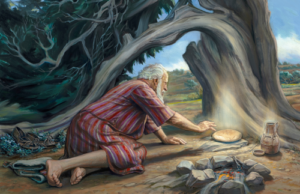 decision to focus on John Chapter 6 – the Bread of Life Discourse – we take a good look at Elijah (the name means “YHWH is my God”). In today’s Key Verse from 1 Kings 19, Elijah is running for his life from the evil queen Jezebel, the wife of the defiant King of Israel, Ahab. In the previous chapter we have the amazing story of Elijah taking on the 450 prophets of Ba’al and 400 prophets of Ashera and challenging them to a duel of fire. The idolatrous prophets would prepare an altar, stack it with wood, slaughter a bull, and lay the pieces of the bull on their altar. Elijah did the same. Then the false prophets for Ahab and Jezebel were to call upon their deity to set their offering ablaze with fire. They worked at that all day, even bloodying themselves with knives and swords to “appease” their deity, “but there was no voice, no answer, and no response.”
 That is something I really need to think about more often.
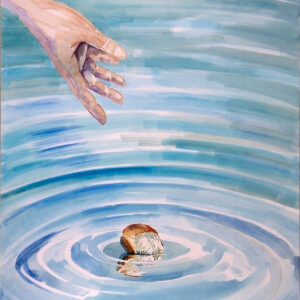 Some interpret that verse as an admonition to be practical in our business dealings. Taken in context, that make some sense – increase your profits by sending your material goods out for trade beyond your closest circle of customers – and if you do that in a responsible and timely manner, your profits will benefit from that risk. I believe there is more to it than that. God never stops inviting us to try to be like him. Think of that bread on the water as your material gifts given with his lavish generosity without any thought of being paid back. Remember the measure by which we give is the measure by which we receive? I see that verse in Ecclesiastes as telling us to be more generous than we believe possible and, when we do that, the return on that “investment” will supersede all our expectations.
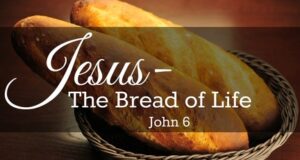 bread that I will give for the life of the world is my flesh. Compared to that 14,000-year-old bread, the Bread of Eternal Life sounds like something that we should much prefer – the bread and water of Righteousness. He became our righteousness so that through him we can become God’s righteousness. This entire immensely-long plan was set in place to do one simple thing: Reunite us with God and restore us to original innocence by removing original sin and all its consequences – including hungering and thirsting for righteousness. Whoever comes to me will never be hungry, and whoever believes in me will never be thirsty. Come on, Belovéd, let’s go to the Water and share the
 Do you remember this one? Part of our mission is to provide for others to be fed – spiritually, of course, but also mentally, physically, and emotionally. We feed not just ourselves, our family, or our “church family. We are to feed (and clothe and shelter and safeguard) GOD’S FAMILY. WHEN (if?) we do that, God blesses us with an increase 10-, 12-, 30- or even 100-fold. Now folks, that’s a bargain! But wait! There’s more!
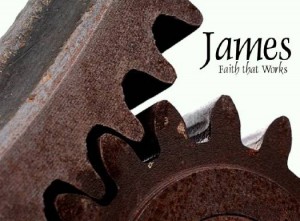 James’ point is this: You can have good works without faith – any fool can do that. BUT you cannot profess to have Faith and refuse or avoid doing good works. That’s not faith; it’s just an air-head’s blather. It’s like having an isolated cogwheel with nothing to engage it. It’s like having a

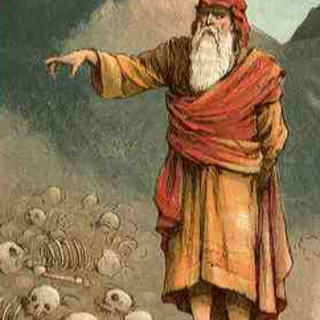 This image represents Ezekiel, the visionary Prophet of God. Our El Shaddai-Olam gave him many extraordinary visions, tasks, and prophetic messages. You can get an idea of the structure and content of this exceptional poetic message collection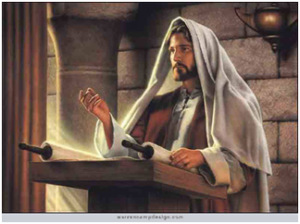
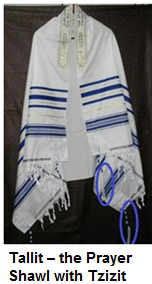 Although the New Testament is written in Greek – and Jesus had at least conversational expertise in it – he taught as a Rabbi in Aramaic and Hebrew when in Synagogue or Temple. While there he would wear a Tallit (tall-EET), a garment worn by men and women with very specific characteristics and purposes. It is primarily woven of fine white wool. The warp threads are tied off around the edges to make little fringe-like tufts. The blue-dyed wool is generally woven in horizontal stripes. The blue color represents royalty. Sometimes there is a prayer (in Hebrew) woven into the pattern. In this illustration, you’ll see that I added some ovals around the tassels hanging from the corners. Those are called Tzizit (sounds as it looks TZT-zit). One might think of it as a shawl – indeed it is; it is a prayer shawl that can be pulled up over the wearer’s head while praying. Jesus wore a Tallit like this because all Jewish men were required to wear one. It was positioned so that two corners were in front and two in back. For the Biblicist folks, Tallit and Tzizit won’t be in your KJV or NABRE per se. However, we have evidence of it in this passage:
  Here is an image of a set of Tzizit for a closer look. These devices were attached, as God had directed, to the four corners of the Tallit. Everyone had them, everyone knew what they were, everyone knew what they represented. When the woman with the twelve-year hemorrhage reached out to Jesus’ garment, she reached for his Tallit and held onto one of the Tzizit on the back. This is how the early Church would have understood this message. Sometimes we hear it was “the hem of his garment” and think of a long robe hemmed at the bottom. Sometimes we think it might have been the warp-tufts of his tunic (nope – woven in one piece from top to bottom). Her hope, her faith, her understanding of her role in life as a Jewish woman would have made the Tzizit the thing to touch. And what it touch it must have been! Here’s how it happened as reported by Luke in
  Twelve years of suffering ended instantly! And yet somehow Jesus knew what had happened. This in itself seemed incredible because Jesus was in the middle of a large and noisy crowd. Jesus had just crossed from Gennesaret to Capernaum. In Gennesaret he had cast out the demon horde called Legion. Now, as he moved along the shore and into the town, a Synagogue official named Ya’ir (God enlightens) come to Jesus to beg for his daughter’s life – he asks Jesus to come lay hands on her. The crowd jostles and jabbers all around him, and then POW! A woman in that mass of people gets complete healing after twelve years. Jesus tells her “Daughter, your trust has healed you. Go in peace, and be healed of your disease.” In Jewish tradition, twelve is the number indicating completion, perfection, control. There were twelve sons of Jacob and twelve sons of Ishmael and from those sons were formed twelve tribes of the two nations. There are twelve months, twelve hours of day, twelve major constellations. And at the end of twelve years of suffering there was complete and perfect healing because of her faith – her trust in Jesus was “paid in full.” Now Jesus follows Ya’ir, and as they start off, someone from Ya’ir’s household breaks the news to Jesus that the child is on his way to see has died. Now it is time to pay attention to the girl’s age.
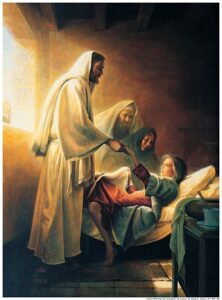 beginning of adult responsibilities – including the wearing of a Tallit, knowing the prayers, and going to Synagogue as an adult must. As they near the house, the professional mourners and some of Ya’ir’s family and friends are causing quite a commotion because of the child’s untimely death. Jesus tells Ya’ir, “Just trust and believe. She is not dead. She is only asleep.” They laughed at him, but he took the parents and Peter, James, and John (three witnesses for Truth, remember?) and went to her bedside. He took her hand and spoke in Aramaic saying “Talitha koum” – little girl, arise. She recovered immediately and completely, then got up and walked around. He cautioned the parents and witnesses to tell no one what he had done and told them to give her something to eat. What does this combination of episodes tell us?
 the beautiful sacrifices he most desires – adoration, thanksgiving, praise, justice, and kindness. Now we have one additional incident involving the number 12. It’s also a very familiar story. Can you guess what it is? Here’s a hint: It involved the Holy Family in Jerusalem. I think you got it! Yes, Jesus was twelve years old, the last year of preparation before his bar mitzvah. It was at that age when he realized and accepted that his mission in life was to do the works of his Father. He got his first Tallit after that. And on the corners of the Tallit were the Tzizit.

 Another lesson from my old friend, Abraham. What was his answer when God spoke? “Ready!” always obey immediately. “If you haven’t got time to do it right the first time, when will you have time to do it over?” Now substitute these words for “time”: inclination, will, Love, Faith, and discernment. See what I mean? WE choose God or WE choose N0-God and in NO-God there is NO Good. Better then to pray for wisdom (See
  “
“ Look, remember