Aloha Friday Message – July 5, 2013 – My Old Friend, Abraham.

1327AFC070513 – My Old Friend Abraham

Read it online here, please.

“Abraham lived to be 175 years old. Even at that ripe old age, he knew he would not see the promise of his descendants living in the lands promised to him at age 76. He was 99 when God told him Sarai would bear him a son to be named Isaac.” (From 11326AFC062813 – Righteousness for Real)

Genesis 17:1When Abram was ninety-nine years old, the LORD appeared to him and said, “I am El-Shaddai–‘God Almighty.’ Serve me faithfully and live a blameless life.”

Of all the Names of God in scripture, El Shaddai is my favorite. This passage in Genesis is the first time it is used in scripture. Remember, now, that Moses isn’t going to be on the scene for around 400 years, so Abraham, Isaac, Ishmael, Jacob, Esau, and all the sons of Jacob – heads of the twelve tribes – did not know the name of God as Jehovah (YHWH). They knew him as El Shaddai. The name EL signifies strength, power, and might in the ultimate degree, and it is the root of the name ELOHIM. In Genesis 1:1 we read, “In the beginning ELOHIM (אֱלֹהִ֑ים) created the heavens and the earth.” The name SHADDAI is most often translated as Almighty or All-Sufficient. It is related to a word that can mean “mountain” or “breast” and carries the connotation of supplying and satisfying every possible human need. Hence שַׁדַּ֔י אֵ֣ל is read as God All-Sufficient, God Almighty, and God Omnipotent. And, for Abram in this first revelation of God’s Name to him, Abram learns that God has the power to be merciful and forgiving.

You will remember that Abram had believed in the promise of God, and it was credited to him as righteousness. But Abram and Sarai decided perhaps God needed a little help getting started on that promise, so Sarai gave Abram her servant Hagar, and Hagar gave Abram a son name Ismael. In today’s passage, God is coming again to Abram and reminding him “I don’t need your help. I am God-Almighty. I can do anything and everything for it is within the power of my will. I am EL SHADDAI. Do what I tell you and stop trying to second-guess me. Let me be God and I will let you be Abraham.” Abraham needed some reminding later on in Genesis 35:11.

El Shaddai is a Sovereign God. “Sovereign” is a word we hear fairly often, especially when we are talking about governments of nations and states.  Some synonyms for sovereign are: Independent, autonomous, self-determining, supreme, predominant, matchless, self-sufficient, and peerless. A Sovereign God is, by definition, in a class by himself. There is none like him, none beside him, none before him, and none after him. In Isaiah 49:9-10, God states quite clearly, “Remember the things I have done in the past. For I alone am God! I am God, and there is none like me. Only I can tell you the future before it even happens. Everything I plan will come to pass, for I do whatever I wish.

In 1 Chronicles 29:11-12, King David is informing the public that Solomon will be the one to build the Temple of God. He praises God in the presence of the people gathered there, O Lord, you are great, mighty, majestic, magnificent, glorious, and sovereign over all the sky and earth! You have dominion and exalt yourself as the ruler of all. You are the source of wealth and honor; you rule over all. You possess strength and might to magnify and give strength to all.”

The Apostle Paul also testifies to the perfection of God’s plan of Salvation in Ephesians 1:11-14 when he says, “Furthermore, because we are united with Christ, we have received an inheritance from God,[a] for he chose us in advance, and he makes everything work out according to his plan.” Paul understood that God’s plans are ineffable, inexpressible, indescribable, and simply beyond words or understanding. While Paul acknowledged that God’s plan is so perfect that we will never fully understand it in this life, he was impatient with people who questioned not only God’s Divine Plan, but also God’s right and power to make such a plan. Look at Romans 9:19-20: “You will say to me then, ‘Why does he still find fault? For who has ever resisted his will?’ But who indeed are you—a mere human being—to talk back to God? Does what is molded say to the molder, ‘Why have you made me like this?’ Why indeed?

We are all familiar with the adage, “Let go and let God.” There is wisdom in that, a kind of wisdom we often allow to slip away because we forget to be wise. When we come to some petty adversity in our lives, we bristle, and pout, and shake a fist at God. We are like the man who traverses the living room in the dark while going to the kitchen. He bangs his shin on the coffee table, screams a curse using God’s name in vain, and kicks the table hard enough to overturn it and bruise his foot. The “LET GO” in this adage does not mean to let loose some invective blaming God. It was not God who hit the man in the shin; it was that coffee table the man had placed there of his own free will and then discovered in the darkness by banging his shin against it. In short, God doesn’t stop us from being stupid if that is our choice, so there’s no point in blaming him for the consequences of our stupidity. “Let go and let God” means we should stop holding onto our own “wisdom” and allow the Wisdom of God to guide us. We must submit to the Sovereignty of God.

To do just that, I would add a couple of words to this familiar adage: Let go and let God be God. Remember, “All things work together for good …” “All things” means all things. Nothing happens without his knowledge or permission. God alone knows what God knows, and whatever he wills to happen will happen and whatever her permits will become reality. In everything that he asks of us and everything that he allows to happen to us his plan includes the entirety of creation – the universe and all that is in it (including all earthlings). When we don’t get our way or when we don’t understand our suffering or the suffering of others, we become audacious, imprudent, and disrespectful. As we were recently reminded, “Don’t give God instructions — just report for duty!” And don’t complain about it either.

“How can a loving God allow this to happen? That’s not the kind of God I want!” Really? I do. I want a God who is always in control of all things always and all ways. If God is not always in control of all things always and all ways, then that is not “being God.” It is especially not being El Shaddai. Abraham eventually submitted to God’s sovereignty, after several reminders, and El Shaddai did with him as he promised; he was true to his Word. I know so many people whose lives are filled with pain and suffering and yet they can say “God is on his Throne and all is right with the world.” They know the sovereignty of God! In these past couple of weeks with fires, floods, loss of life, treason, persecution, war, martyrdom, and all kinds of mayhem around the world, we might ask, “Where is God in all this? How can you say ‘all is right with the world?’?” All is right because God is on his throne. I would much rather be on my knees before the Throne than standing in the dark kicking a wall. I just have to remember to “Let go and let God be God.” When I do that, I have a much better likelihood of doing what God asked of Abraham: Serve me faithfully and live a blameless life.

Whatever, whenever, wherever, whoever, however, if ever, forever — at your service, Beloved.

chick

Aloha Friday Message – June 28, 2013 – Righteous for Real

1326AFC062813 – Righteousness for Real

Read it online here, please.

Genesis 15:6Abram believed the LORD, and the LORD considered his response of faith as proof of genuine loyalty. (NET Bible)

Romans 4:9Is this blessedness only for the circumcised, or also for the uncircumcised? We have been saying that Abraham’s faith was credited to him as righteousness.

Romans 4:22 This is why “it was credited to him as righteousness.”

Galatians 3:6 So also Abraham “believed God, and it was credited to him as righteousness.”

James 2:23 And the scripture was fulfilled that says, “Abraham believed God, and it was credited to him as righteousness,” and he was called God’s friend.

Several times in the past, I have mentioned “my old friend, Abraham.” In this passage – which occurs before he was called Abraham – Abram is in the middle of a dialogue with God. God is blessing Abram with a promise to make him the progenitor of a people so numerous they cannot be counted. This people will dwell in a vast landscape that covers most of what we now call The Middle East.

Promised-Land1


Remember now that this Promised Land is not going to be called Israel for hundreds of years. The Land and the People were only part of the promise. God’s promise included Greatness, and God’s Protection for Abram and all his descendants, in fact ALL generations would eventually become heirs of this Covenant between God and Abram.

So how did this work? How did God choose this one man to bless so prolifically, so magnanimously? And we also have to wonder why God chose Abram from “Ur of the Chaldeans.” (Ur is over on the right-hand side of the map.) As you can see, Ur is located in what is now Southern Iraq. It was an important site of governance, trade, religion, and population and devoted to the moon god, Nanna. It is possible that Ur had been founded around 500 years before Abram’s time. There were libraries, schools. Their complex legal system was associated with the religion of Nanna’s followers who practiced astrology and witchcraft and worshiped idols dedicated to celestial objects (sun, moon, stars) and earthly objects (air, water, earth, even warfare). Abram’s father, Terah, worshipped these idols, and Jewish tradition points toward Terah as a maker of idols.

Terah was originally from Canaan and left Ur to go back there. He took part of his family with him including Abram and his wife Sarai, but they only went part way, settling in Haran for several years. God’s command to Abram was to go to Canaan, but the traveled considerably north and east of there on a trade route between the Mediterranean and the Tigris-Euphrates valley. After the death of his father and several false starts, Abram finally pointed his footsteps toward Canaan; during all the time he was delayed in Haran He did not hear the voice of God. With Genesis 12, we continue with the history of God’s plan of redemption, and it begins with God calling a man and the man obeying. From this point forward, Abram’s loyalty to God is continually strengthened and so also the blessing grew in pace with his obedience and faith.

Abram was called to leave his home, his life, the very wicked city of Ur, and much of his family to go “where he knew not.” He didn’t get to it right away, but let life sort of play out along the way. When he finally did make up his mind to do as God had commanded, he once again heard from God, and God rewarded his obedience with an unprecedented Covenant. We, too, are called to move away from the places and people of sin and death toward righteousness and life. We, too, allow many diversions to slow us down along the path leading to the Promise of the New Covenant which fulfills the Promise of the Old Covenant. We are blessed and become a blessing, we are in the enormous family of the Name above all names, we are moving toward a Promised Land called Heaven, and every step of the way our obedience and loyalty to God is guarded and protected by his Holy Spirit as a gift of God’s boundless and unmerited Grace.

Abram did not earn God’s blessing. It was an outright gift from God. Somehow Abram heard the voice of God amidst all the clamor and glamour of the evil around him. We do not know how he knew with certainty that it was God’s voice, but the narrative we have demonstrates that he heard God and believed what he heard to be from God himself. In this we see the substance of God’s Redemptive Mercy. We, too, receive unmerited Grace is extreme abundance. We have scripture that tells us the wonders of God’s love where Abram had only reasoning that God must be God and therefore capable of keeping his promises. We have the traditions of faith that are passed down to us literally from Abraham, Isaac, and Jacob all the way through to Christ and his Apostles where Abram had only God’s direct orders which he sometimes chose to ignore (as do we!). We have, more than any other generation in history, access to wider and deeper understanding of biblical history and scholarship where Abram had only an imagined future described in broad strokes by a God he did not choose but who instead chose him.

In this we see that, as always, God acts first. God is Creator. God is Love. God is Light. God is Promise. God is Salvation. God is preeminent in all actions, things, and places. God is directed only by his own Divine resolution. In choosing Abram, God continues the development of the plan of redemption given us in Genesis 3. In Abram, once he is given the name Abraham – Father of Multitudes – “all nations are blessed.” God promises that among Eve’s descendants there would be One who would crush the head of the serpent; Abram begins that long, long line of descendants leading to Mary and her child, the Son of God. It was Mary’s fiat, her unequivocal YES, which literally brought God’s salvific plan to fruition. It was Abram’s unwavering loyalty to God which literally opened the way to the Covenant Promises. Abram and Mary both submitted to God through a free choice, remained committed to that choice throughout all of their life on Earth, and it was “imputed to them as righteousness.” That is, God sees His righteousness in us because we place our faith, our trust, or loyalty, our decisions for obedience in HIM.

Beloved, that is one amazing Promise! It is our promise to claim, it is our purpose to pursue it, and it is our expectation to receive it. Just not all right now.

Say what?

Let’s go back to Genesis and fast-forward a few pages to Genesis 15:16 –  But in the fourth generation [about 400 years according to many scholars] they shall come hither again: for the iniquity of the Amorites is not yet full. Four-hundred years? 400! What kind of a promise is that? Abraham lived to be 175 years old. Even at that ripe old age, he knew he would not see the promise of his descendants living in the lands promised to him at age 76. He was 99 when God told him Sarai would bear him a son to be named Isaac. Although initially Abram was not what one would call an outstanding example of pure faith, he grew in wisdom and knowledge of God as God continued to reveal himself. The greatest spiritual value which Abraham’s later-life shows us is that whatever Good we have in life always comes first and only from God. And God is in no hurry. He let the Amorites sin their way into oblivion for 400+ years, the time between the birth of Abram and the birth of Moses. During much of that period, the people that would become the nation of Israel were enslaved in Egypt.  During that long journey from the Covenant meeting at Haran to the entry into Canaan by Joshua, Caleb, and the Israelites, the tradition of the Covenant with Abraham and his descendants was the guiding influence for the God’s Chosen People. During that long wait, God formed his People and prepared them for the fulfillment of all his promises.

We, too, have been on a long journey, a journey much longer than 400 years. We are already more than 2000 years past the birth of Christ and probably less than 50 years from the 2000th year since his death. Since God has already taken the initiative in our redemption, we have the opportunity to walk on this journey with Abraham and all his descendants from the Old and the New Covenants – a MULTITUDE INDEED! Along the way, then, let us remember to continue to move forward without being delayed by distractions put up by our enemy. Let us always choose to be loyal to God whenever our own wisdom argues against it. Beloved, shall we make this journey with Abraham, all of Israel, and all the saints of God who follow his Christ? I say we shall, and as we are engaged in our journey of obedience, I believe God will – as he has done before – look upon our faithful obedience with gracious kindness.

Whatever, whenever, wherever, whoever, however, if ever, forever — at your service, Beloved.

chick 💡 ➡

Pray for America, Beloved. We have continued to be distracted by our enemy’s plans.


Creative Commons License
This work is licensed under a Creative Commons Attribution-ShareAlike 3.0 Unportd License.

Aloha Friday Message – June 21, 2013 – Take Time to Be Holy

1325AFC062113 – Take Time to be Holy

Read it online here, please.

MATTHEW 5:48 – So be perfect, just as your heavenly Father is perfect.

LXE Leviticus 19:2 Speak to the congregation of the children of Israel, and thou shalt say to them, “Ye shall be holy; for I the Lord your God am holy.”

Leviticus 20:7 — So set yourselves apart to be holy, for I am the LORD your God.

JV Deuteronomy 18:13 Thou shalt be perfect with the LORD thy God.

NIV Luke 6:36 – Be merciful, just as your Father is merciful

NJB 1 Peter 1:16 since scripture says, ‘Be holy, for I am holy.’

This past Sunday afternoon this hymn popped into my mind, and it has stayed there all week. I call that a pretty strong hint! Then, much to my surprise, this passage was in the readings for Tuesday, June 18. As I reflected on that verse, and on how far I am from being anything that could be called holy, I realized there is something we need to understand about God’s expectation in this regard.

How can we be perfect? How do you feel about perfectionists? Have you ever been told, or have you ever told someone else, “Too bad we’re not all perfect like you are!” Let’s begin with saying that being a perfectionist is not the same as “being perfect” as God has commanded (see the other references, especially from the Old Testament.) Being a perfectionist often boils down to getting things the way you want them – having your way in everything. It’s true that there is some mighty fine – and often very generous – work done through the power of that attitude, but there is something more that would make it even better. In our thoughts, words, and deeds as we live our lives, whether for ourselves or others, our highest aspiration should be to emulate Christ in all things. (See Romans 8:29)

That’s a pretty big goal! Intellectually we all understand that this is how the Christian Life is to be lived. Spiritually, we cherish the hope that every day will hold moments when we mirror the life of Jesus in our interactions with others. But in the practical, Worldly sense of day-to-day life, we know we fall far short of that. (See Romans 3:23.) How can we live in this sinful world without being constantly drawn into the very things we are taught by Jesus to avoid? Jesus has chosen us to be with him, not with the world. If we spend our lives seeking to be close to him we are less likely to be close to the things of this world. It’s not that we ignore the world; we just are better able to do God’s will – live according to the beauty of his plan – when we are focused on his prerequisites rather than our petty desires.

That kind of focus takes a lot of practice. Remember “practice makes perfect?” The idea is that doing something over and over again is the only way to learn to do it well. When we practice, we repeat a specific and correct set of behaviors over and over, until we have mastered it. Performers call that rehearsal. It seems obvious that what we repeat must be repeated correctly; otherwise we are only perfecting a mistake. In addition, there is that adage attributed to Albert Einstein, “Insanity is doing the same thing over and over again but expecting different results.” If we continually practice sinning, we become better and better sinners. That’s not what God had in mind. Turning again to Romans, Paul tells us not go give in to sin, but to remember that we are baptized into the death of sin through the death of Christ. We are to use our bodies – our worldly lives – to do everything God approves of as given to us in scripture.

The scripture passages at the top of this message give us some insight into how this is done. Look again at that second passage from Leviticus – Leviticus 20:7 — So set yourselves apart to be holy, for I am the LORD your God. How do we set ourselves apart so that we love God more than we love the world? Aristotle said, “We are what we repeatedly do. Excellence, then, is not an act, but a habit.” Excellence, perfection, without flaw or blemish – none of these is a once-in-a-lifetime act. (Reread the passage from 1 Peter 1) We certainly know this never happens instantly; it is a process, a journey, and perhaps even involves a little wandering around until we find our way again. “Every day in every way I am getting better and better.” So says Albert Coué, “father of Applied Conditioning.” In living the Christ-like life, that is true if we are following Jesus command to love one another in the same way he (and therefore the Trinity) loves us: Perfectly.

So we begin to see that being holy – Holiness – requires total devotion to God. Whether in Greek, Hebrew, or Aramaic, the word used in Matthew 5:48 for “perfect” means to be whole, complete, as in fully developed. God created us for his purposes, not for our purposes. We differ from the world – set ourselves apart – not out of spite, but because we have been called by God to be in his Kingdom, and in his Kingdom we grow and grow until we become like him. God is there with us every step of the way to help us, to guide us, to sustain us, to help us repent, to help us become Holy. That is the life-transforming power of the Holy Spirit whom God the Father through Christ Jesus has given to us as our Companion.

Through an in the Holy Spirit we access the Grace of Salvation and not condemnation. I’ll offer one more Scripture here to help clarify that. It is John 3:17For God did not send his Son into the world that he would condemn the world, but that he would give life to the world by him. Remember Flip Wilson’s character, Geraldine, who always said, “The devil made me do it.”? We have the Power to resist that because we have the Power of the Holy Spirit, the Power to be Holy as God is Holy. Every time we make it our practice to rely on the Spirit, we are living out God’s beautiful plan for our lives. That plan might well look like this:

BeHoly


Whatever, whenever, wherever, whoever, however, if ever, forever — at your service, Beloved.

120

Normal
0

false
false
false

EN-US
X-NONE
X-NONE

/* Style Definitions */
table.MsoNormalTable
{mso-style-name:”Table Normal”;
mso-tstyle-rowband-size:0;
mso-tstyle-colband-size:0;
mso-style-noshow:yes;
mso-style-priority:99;
mso-style-parent:””;
mso-padding-alt:0in 5.4pt 0in 5.4pt;
mso-para-margin:0in;
mso-para-margin-bottom:.0001pt;
mso-pagination:widow-orphan;
font-size:11.0pt;
font-family:”Arial”,”sans-serif”;}

PS: a warm and loving welcome to Sarah Marie Case as of 6/18/13!


120

Normal
0

false
false
false

EN-US
X-NONE
X-NONE

/* Style Definitions */
table.MsoNormalTable
{mso-style-name:”Table Normal”;
mso-tstyle-rowband-size:0;
mso-tstyle-colband-size:0;
mso-style-noshow:yes;
mso-style-priority:99;
mso-style-parent:””;
mso-padding-alt:0in 5.4pt 0in 5.4pt;
mso-para-margin:0in;
mso-para-margin-bottom:.0001pt;
mso-pagination:widow-orphan;
font-size:11.0pt;
font-family:”Arial”,”sans-serif”;}

Aloha Friday Message – June 14, 2013 – Clay Pots

1324AFC061413 – Clay Pots

Read it online here, please.

2 Corinthians 4: 7-9But we have this treasure in jars of clay to show that this all-surpassing power is from God and not from us. We are hard pressed on every side, but not crushed; perplexed, but not in despair; persecuted, but not abandoned; struck down, but not destroyed.

I’ve been sidelined again by another upper respiratory infection and so – perhaps this may be a little shorter than what I usually send (around 1300 words). There is a hymn I love which is based on this passage. The refrain says …

We hold a treasure
Not made of gold
In earthen vessels, wealth untold
One treasure only, the Lord, the Christ
In earthen vessels.

Do you remember seeing a story about someone walking to the well with water pots and that one of the pots was cracked and leaked on the way back? The side of the path where the water leaked out of the cracked pot was vibrant with flowers – the benefit of hanging around with a crackpot – like me for example.

In this passage, Paul is describing putting something far more valuable than gold into fragile clay vessels. The inestimable value of the Gospel message has been entrusted to earthlings. Why do I keep referring to us as earthlings? Other choices are human, humanity, Homo sapiens, mankind, and so on. You see the common thread there. But earthling describes exactly where all of us originated – of the earth. We are the clay into which the Creator breathed the Breath of Life. We are made of earth. We go back to earth. But the message of salvation by God is entrusted to us, little lumps of clay – fragile, fallible, moldable, breakable clay. In fact, this salvation came through the destruction of one such clay vessel – Jesus, the man Christ Jesus who gave himself as a ransom for us all.

amphorae_terracotta1


Note, though, that Paul doesn’t focus on how crude or fragile these clay pots and jars are. He focuses on the treasure they contain. If you and I wanted to store something fabulously valuable, we would … what? Put it in a safe-deposit box at the bank? Build a vault for it underground and set armed guards around it? Put it in the center of a pyramid with all sorts of complex traps to annihilate anyone who would dare to steal our treasure (think Indiana Jones here)? An yet, we hold in these little amphoræ the greatest gift, the richest treasure, the most magnificent  mystery – the saving Grace of God in Christ Jesus … Emanuel. God-with-us came to us as clay but went beyond the clay to the glorified body of The Kingdom. God’s power dwelt among us in clay, and he entrusted to us, clay that we are, the Power of the Resurrection. We are used to pour out the gospel on the rest of the clay, and even more amazing, it is HE who fills us, and HE who causes the gospel to pour forth from us. We are empowered by him to do the same work as he and even greater things.

Paul also reminds us that, since we know that power is not ours but God’s, we should be able to keep the flow going in the right direction: From God’s heart to our hearts, to the hearts of others. We have nothing in which to boast; we’re just clay jugs after all. But other clay jugs need to be filled with that surpassing Joy, Peace, Hope, and Love that fills us. Our Joy is complete, our Peace is past understanding, our Hope is in the Lord who made Heaven and Earth and earthlings, our Love is the Love given to us by Jesus. We multiply that Love when we pour it out on others, and it doesn’t matter whom we pour it on, either.

SALT&LIGHTYou know, some of those little clay vessels were not for carrying liquids, or flour. They were also used for lamps. Little clay lamps with a wick laid off to one side in a little trough like this.

In this kind of vessel a piece of cloth or a bit of soft wood wicked-up the oil and provided light to the room. Other clay containers held spices, particularly salt.

And we are salt and light held in clay. Whatever the gospel needs to be in others it is as that in us. The Treasure is not withheld for only those who are worthy, only those who can be seen as righteous. It is held in us and poured out through us onto a world that is in agony because of sin.

We must not stopper up our clay vessels and seal them for some future use. When once we empty out the contents we find each vessel is refilled with startling quickness even to the point of overflowing.

I certainly know what it is like to be fragile. I also know what it’s like to be considered a crackpot. I will no doubt be an invalid some day, but I know that as a clay vessel I will never be empty of that Hope, Peace, Joy, and Love that fill me even in my time of weakness. No matter how much I pour out – whether I am stingy or magnanimous – I will always be refilled with that Treasure. How do I know this with such certainty? Because I know I am an earthling, and I am constantly being refilled with “wealth untold.”

Whatever, whenever, wherever, whoever, however, if ever, forever — at your service, Beloved.

chick

Aloha Friday Message – June 7, 2013 – The Other Side of the Mountain

1323AFC060713 – The Other Side of the Mountain

Read it online here, please. (Once again, special links are provided to broaden your experience.)

Exodus 24:15-18 Then Moses went up on the mountain, and the cloud covered the mountain. The glory of the Lord settled on Mount Sinai, and the cloud covered it for six days; on the seventh day he called to Moses out of the cloud. Now the appearance of the glory of the Lord was like a devouring fire on the top of the mountain in the sight of the people of Israel. Moses entered the cloud, and went up on the mountain. Moses was on the mountain for forty days and forty nights.

John 13:34-35  “I’m giving you a new commandment: Love each other in the same way that I have loved you. Everyone will know that you are my disciples because of your love for each other.”

This past Sunday our Pastor’s homily centered around a story about a hunting dog napping with the others of his pack when he spotted a rabbit a short distance away. Immediately he was off, baying out the call for his pack-buddies to follow in the chase. They too jumped up and ran to follow his lead, responding to his call with a chorus of howls and barks. The pack soon slowed, stopped, and quieted because they didn’t know what all the commotion was about now that they had been awakened. Only the first dog kept up the chase because only he had seen the rabbit. Only he knew the reason for the excitement, and only he pressed on in the hope of catching that “wascally wabbit.” I like that story, and it certainly helps me think about the excitement of seeing and understanding what the Lord is doing. I was reflecting on that when the time for “That Healing Word” came up. Once again I stood with my notebook in one hand, my red pen in the other, and waited for that word from the Word. It didn’t take long, and as soon as I saw it, my first comment was “Of course! That makes perfect sense!” What I had written was “The other side of the mountain.” The dog had seen the rabbit. The bear saw … The other side of the mountain.

Piece of pie! (I like pie better than cake.) I am going to be writing about The Other Side Of The Mountain. “Ah…,” said the tiny little pragmatist in the right-rear corner of my brain. “And what mountain would that be, Laddie?” I didn’t stay stumped for long – less than 24 hours I’d say – before I got my answer: The Mountain of God where Moses got the Ten Commandments. Now the question is, what is on the other side of that mountain? You already figured it out, didn’t you! It’s a new commandment that confirms and fulfills all the law and the prophets. My commission today is to look at what Jesus was saying there clearly enough that we all get the urge to get up and go after the rabbit. We’ll be dipping into the Greek lexicon three times, but I think you’ll find it rather more fun than intimidating. Ready? Here we go. I’m going to emphasize the English words we’ll be studying in Greek:

I give you a new [καινὴν] commandment [ἐντολὴν], that you love one another. Just as I have [καθὼς] loved you, you also should love one another.

First up – new. The Greek word here is καινὴν [kainós] (kahee-nos) – absolutely and uniquely new and without precedent. It is something that is completely different from anything anywhere anytime because this instant is the first time it ever existed and it is incomparably first-and-only.

Next – commandment. That Greek word is ἐντολὴν [entolé] (en-tol-ay) – a fixed rule which stipulates how something is to be done to achieve a specific outcome. The rule is axiomatic in the sense that the command is so clear that it sounds self-evident.

Finally, just as or in the same way as καθὼς [kathos] (kath-oce) – in exactly the same manner, to the same degree, to the complete extent, in a way that is identical to. We could go back to the identity expression we have used in the past to say

LIGHT ≡ GOD ≡ LOVE ≡ TRUTH ≡ WAY ≡ LIFE ≡ FOREVER

We can therefore say

YOUR LOVE FOR EACH OTHER ≡ MY LOVE FOR YOU

Now the question arises, “How is this new? Didn’t Jesus say that ‘Love the Lord your God with all your heart and with all your soul and with all your mind,’ and ‘Love your neighbor as yourself?’ are the greatest of the commandments?” Yes, he said that. In today’s passage he is saying something bigger, something intense, something mind-shattering. He is saying, “Love your neighbor as I do.” When we say, “Love your neighbor as yourself,” we assume that we love and care about our own well-being. It’s the basis for the Golden Rule “Do unto others as you would do unto yourself.” Treat others the way you want to be treated. Jesus isn’t saying that. He’s saying something new. He’s saying to love your neighbor in precisely the same way Jesus loves you and your neighbor – without selfishness, possessiveness, jealousy, pride, without holding anything back, completely abandoning any claim to be loved in return, sacrificing all for the good of another rather than your own good.

That is a lot to ask! It was, and is, Jesus who asks that of us now – right now.

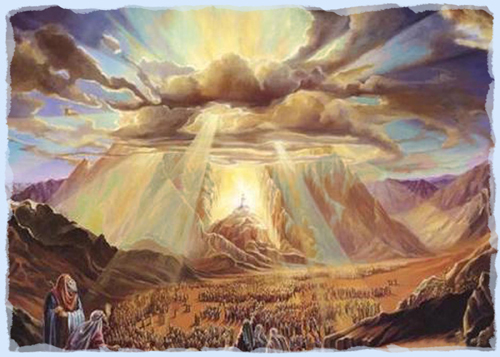
Perhaps across geography and time there are a handful of people who can do that. By all accounts, I am not one of them at this time and place. I know some people who are way closer to being able to love others like that than I am, but I bet if you ask them, they, too, would say they are nowhere near being close to that quality of love. For all of us it might as well be … on the other side of the mountain. That’s one long and arduous climb to get to the other side. Moses went up (עָלָה – alah = ascended) the side of the mountain and into the cloud which was the presence of God. For 40 days and nights the mountaintop radiated light as from an intense fire. Moses came down on that same side of the mountain with the Ten Commandments. Later, with the whole of Israel assembled, Moses read the words of the LORD. He set up an altar as the LORD has commanded and there offered up the Blood of the First Covenant, a covenant that would last thousands upon thousands of years but was nonetheless short-lived, transient, temporary. Jesus made that covenant complete by replacing it when he said, “This is my blood, which confirms the covenant between God and his people. It is poured out as a sacrifice for many.” Moses and the LORD established a covenant. Jesus confirms it with his Blood in a new and everlasting covenant by which we gained full access to the Trinity and to the capacity to love one another in ever-increasing selflessness – if only we will to do so.

Sinai

Look upward. Travel onward. Do not be afraid. The other side of the mountain is only steps away. It is the home of God’s Salvation. It is there all of us will be recognized as His disciples.

Whatever, whenever, wherever, whoever, however, if ever, forever — at your service, Beloved.


Aloha Friday Message – May 31, 2013 – Stay the Course

1322AFC053113 – Stay the Course

Read it online here, please.

Today’s scripture can be found here: Romans 12:11-12 especially verses 11 and 12.

Do not lag in zeal, be ardent in spirit, serve the Lord. Rejoice in hope, be patient in suffering, persevere in prayer.

Do you ever feel so tired that you just cannot imagine going one step farther? Have you ever felt so defeated that it just didn’t matter anymore whether you win or lose, stay or go on, perhaps even live or die? IF so, I urge you to read the entire twelfth chapter of Romans (and eventually read the whole book of Romans). This part of Paul’s letters sounds a little like the book of Proverbs or other Wisdom literature in the Bible. Verse 9 says, Let love be genuine; hate what is evil, hold fast to what is good. That sets the tone for the rest of the paragraph you read by using the link above. The three phrases in this verse – when taken as instructions – could look like this: Love sincerely and without deceit by rejecting the bad things that happen and hanging on to the things that are good.

That is good, sound advice about relationships. Turn loose of the bad stuff that is bound to happen, and hold on to the good stuff that will surely happen. Be honest. Keep the good. Forget the bad. The same sort of good advice appears in verse 11: Do not lag in zeal, be ardent in spirit, serve the Lord. If you are no longer enthusiastic about your faith, your marriage, your work, or your gifts – if you’ve lost your zeal – you can restore that enthusiasm by being ardent in spirit and serving the Lord. Most of the time when we burn out trying to be all that we can be, we forget to keep God in the equation. Paul is reminding us that we can be passionate and committed in our attitude toward life whenever we remember that we are best when we are serving God by serving others. We are worst when serving ourselves before others. Don’t hold back. Hold on. Or as in verse 10:Be devoted to one another in love. Honor one another above yourselves. And honor God above all.

In verse 12 above, Paul directs us to “Rejoice in hope, be patient in suffering, persevere in prayer.” When I look at that I think about all the ups and downs we have in life. If only it could be true that instead of peaks and valleys, toil and danger, trouble and care we marched along a straight, level, safe, and well-made road without struggles or doubts. But we know that’s just not going to be the case, not in this world. And yet, Paul gives us instructions on how to smooth that road a bit so that the changes are easier to handle. First, as expected, we should rejoice in hope. I see that two ways: “Rejoice because have hope” and “rejoice hopefully knowing things will be better still.” It is hard to rejoice without hope. Rejoicing is about hope, either hope fulfilled or hope in things to come. Rejoicing because of hope is pretty easy; in fact, we can sometimes overdo it because it’s so uplifting.

It’s not always so easy to be patient in suffering, though. When I suffer, I also whine, groan, squint, and frown. It’s pretty hard to miss the message: “I’m suffering here! Have a little respect for the sufferer!” I think it’s easier to be impatient with the suffering than it is to overdo the rejoicing. Rejoicing feels good, but suffering does not. Sometimes we enjoy the sympathy so much we begin to enjoy the suffering, too. We are way off course then, and it’s easy to get lost on the road to recovery. Some of us, though, must suffer – we may have cancer, or deep emotional scars, or live in oppression. When the likelihood of recovery is taken away, it is difficult to rejoice and more difficult to suffer patiently. Paul gives us the remedy to restore balance in that situation.

We are to “persevere in prayer.” We must stay the course in prayer, keep at it, stick to it, make it last. That word “persevere” comes from Latin perseverare “continue steadfastly, persist,” from persevereus “very strict, earnest,” from per- “very” (see per) + severus “strict.” In Greek it is proskarterountes προσκαρτερέω (proskarterountes) and it carries the meaning of ” triumphant strength” – properly, to consistently showing strength which prevails (despite all difficulties); to endure (remain firm), staying in a set course; to devotedly continue to do something with intense effort.

This all has a familiar ring to it. If you turn to 1 Thessalonians 5:15-19, you find the same sage advice. And at the very end of that passage it says, “Do not quench [stifle; extinguish] the Spirit.” It is in the Spirit that we find our strength for perseverance. We are reminded not to give in to things that counteract the influence of the Holy Spirit. Do not expect to be able to rejoice fully when encumbered by sin. Do not expect to suffer patiently when praying for an end to the suffering rather than praying for the strength to endure the suffering. Stay the course. Remember your Destination. Do not lag in zeal, be ardent in spirit, serve the Lord. Rejoice in hope, be patient in suffering, persevere in prayer.

How in the world can we do that? In the World, we cannot, but “with God all things are possible” if we will remember His command to “Love one another as I have loved you.”

Whatever, whenever, wherever, whoever, however, if ever, forever — at your service, Beloved.


Jesus_Savior_Pilot_Me

v\:* {behavior:url(#default#VML);}
o\:* {behavior:url(#default#VML);}
w\:* {behavior:url(#default#VML);}
.shape {behavior:url(#default#VML);}

Normal
0
false

false
false
false

EN-US
X-NONE
X-NONE

/* Style Definitions */
table.MsoNormalTable
{mso-style-name:”Table Normal”;
mso-tstyle-rowband-size:0;
mso-tstyle-colband-size:0;
mso-style-noshow:yes;
mso-style-priority:99;
mso-style-parent:””;
mso-padding-alt:0in 5.4pt 0in 5.4pt;
mso-para-margin:0in;
mso-para-margin-bottom:.0001pt;
mso-pagination:widow-orphan;
font-size:11.0pt;
font-family:”Arial”,”sans-serif”;
mso-bidi-font-weight:bold;}

Aloha Friday Message – May 24, 2013 – All in the Family

1321AFC052413 – It’s all in the Family

Psalm 86:16 – O turn unto me, and have mercy upon me; give your strength unto your servant, and save the son of your handmaid.

John 16:12-13 – I still have many things to say to you, but you cannot bear them now. When the Spirit of truth comes, he will guide you into all the truth; for he will not speak on his own, but will speak whatever he hears, and he will declare to you the things that are to come.

Aloha nui loa, Beloved. Before anything else, please just stop 30 seconds right now and offer another prayer for the good people in MOORE, OKLAHOMA, and please include all the other places where severe weather has caused extensive damage in the past 8 weeks – all up and down the central rivers of America for example. Then give thanks to God for protecting so many lives, and commend to him the lives that were lost. 30 seconds … GO!

Thank you.

Once again we have to seemingly dissimilar and unrelated passages to work with, but this is what was given, so this will be the foundation.

Beloved, when we witness such appalling events as we have seen in the past several weeks, we sometimes wonder if God isn’t watching any more. Has he turned away from us? Are we being punished for something, perhaps something we didn’t have anything to do with but are still being held accountable? Why are there so many disasters – fires, floods, earthquakes, wars and rumors of wars, climate changes, and so on – and why are there such horrible acts committed by humans against their neighbors – a man chopped to death in Britain, chemical weapons unleashed, vicious crimes that include mass-murders? Is this the world we have created by being uncharitable? Is this what happens when we ignore our mother’s constant admonitions as she said, “Behave yourself! You know better than that! Now straighten up and fly right!”

Thinking back to my school days – mainly in elementary school – I can see that most of the time I would have rather been ignored or been invisible than to be punished for disobeying. Eventually, though, I learned that life was better if I learned to behave no so much because my mom would wallop me a good one but because God expected me to behave, to know better, and to straighten up and fly right; which was of course exactly what my mom was trying to teach me. She had loads of help from my dad as well as from both of their mothers, but in the end the challenge was to be good because God is Good All The Time (“All The Time, God is Good.”) I cannot ever remember doubting that my parents were servants of the Lord; there were times when – in my judgment – their behavior was incongruent with what I thought a servant should do, but they came out on top as servants nonetheless. As such, I also know that they pleaded with God on my behalf that I would learn to “be a good boy.” I’m still working on that, you know?

And as it was in my childhood and youth, I am getting loads of help from family, friends, pastors, Moon Beamers, spiritual directors, and the Holy Spirit. He helps me see how many wonderful things God has given us even amidst all the gruesome horror that invades our lives every hour of every day. The foe is super-busy lately ratcheting up the distress and violence, and we must take a little extra time in our day to fight that for and in our own lives as well as for and in the lives of others, especially our family and friends.

Holy SpiritDo you have or have you had a BFF- a Best Friend Forever? You can share things there that you cannot imagine sharing with anyone else, and it is such a wonderful feeling to be accepted by another earthling that way! Being close to God is a lot like being close to your BFF, only a whole lot better. When God is your BFF, you get more than loads of help; you get every possible big hunk and little smidgeon of help possible because the Holy Spirit teaches you how to spot it in your life. He also teaches you how to use it, how to understand it, and how to share it. He will give to you the entire treasure map to your life and the life of the world around you just to ensure that you have access to as much Joy as you can possibly tolerate.

Note, though, what Jesus says about this BFF he sent us: “for he will not speak on his own, but will speak whatever he hears.” From whom does the Spirit hear what he speaks? Jesus tells us it is from God; God sends us the Word and enables us to behave, to know better, and to straighten up and fly right. And we know that when we depend on what we are told to do, we will be doing the right thing because “he will declare to you the things that are to come.” Not only do we receive the treasure map for all the gifts God has given but also the map for all those he will give. Now that really is a Best Friend Forever! Notice he also said, “I still have many things to say to you, but you cannot bear them now.” We know as much as we need to know to make our Joy complete. Whatever is not Joy makes us incomplete. I’ll say that again: Whatever is not Joy makes us incomplete. That completeness is a sign of God’s goodness – a sign so easily read that it gives the light of hope to the world despite all the foe’s attempts to plunge us into darkness.

The Holy Spirit leads us to the Truth through, for, with, and about Christ. He patiently teaches us the often subtle clues between right and wrong so we can learn (you guessed it) learn to behave, to know better, and to straighten up and fly right. That is what The Truth teaches us. That is what sets us free. We are free and capable to do the right thing at the right time. We are free to know and to live a better life that fills slowly but surely with endless joy. We are free to fly straight into the arms of God because Jesus sets us free. Do you believe that? Did you click on the link?

Our earthly parents are/were charged with the responsibility to mold us into “decent human beings.” As we have seen recently, despite that molding, some of us end up being vile and wretched earthlings whose behavior is far from the ideal God set before us when he established the sanctity of the family. Collectively we earth-bound souls have not done well in preserving that sanctity, and for those who are still hanging onto that notion, it is becoming more difficult to endure, much less prevail. But, we have a BFF standing by to help, to teach, to explain, to inspire, to guide, to lift us up in flight like the wind beneath the wings of the soaring eagle.

And that is but one Gift! All of us have so many gifts. Some of our gifts perhaps seem common when we look at people who speak in tongues, or have the gift of prophesy, or even those who have gifts like healing, or miracles – such a great variety of gifts! But the “common gifts” like being a good parent, being able to play an instrument, or writing a poem or a book or a letter or an essay or a play, being kind and understanding with difficult people, and so many of the other little acts of love and kindness we can perform – these are indeed great and wonderful gifts because they are the framework of our lives in Christ. You don’t have to tote the “Big Guns” of the Gifts of the Spirit; oh, it’s nice to have access to them, but actually, it’s so much sweeter to be simply part of the background music in the Opera of the Universe, simply to behave, to know better, and to straighten up and fly right. You know that good feeling you get inside when that happens? That’s the Holy Spirit telling you, “Way to go! Keep going! I’m right beside you all the way!” Ah, beloved! What a GOOD God we have!! Adoptive Father, Beloved Brother, Trusted BFF – What a family!!

Whatever, whenever, wherever, whoever, however, if ever, forever — at your service, Beloved.

🙂 chick

Aloha Friday Message – May 17, 2013 – Calling Every Living Soul

1320AFC051713 – Calling Every Living Soul

Read it online here, please.

Romans 8:29 – For those whom he foreknew, he also predestined to be conformed to the image of his Son, in order that he might be the firstborn among many brothers.

There are in this world maybe a couple dozen people I watch for some sign that they are hearing and responding to God’s call to faith. Maybe there are more than that; sometimes I pray an offering-prayer giving God the best of the day of “every living soul” so that God may be loved and honored in some way by all humanity.

Just over three years ago I wrote about those who were left behind when Jesus called – not like the series of book and movies, not that Left Behind. Mine was about the people who stayed where they were while the person Jesus called got up and followed him. Even in the Old Testament, there were people God spoke to and they just got up and did what he said. My favorite among those is Abraham. Abraham was always ready to obey. It was his nature. God spoke, Abraham acted. Unfortunately sometimes when God did not speak, Abraham acted on his own. When it really counted though, some seven times when God spoke directly to Abraham, he did as he was told, and “it was attributed to him as righteousness.” (Genesis 15:6) Abraham’s obedience, righteousness, faith – whatever you call it – was built-in.

There is no evidence in the accounts of Abraham’s journey of faith that he ever doubted that it was God speaking to him. He never said, “Wait. Who are you again?” or “You talkin’ to me?!” And you know, I think there’s something of that built-in faith for everyone. There is something inside us that knows God is there, that he calls us, and wants to delight in our company. Have you ever looked at an animal – a dog, a kitten, a deer, a meadow lark – across a distance and hoped it would turn and look back directly at you? It’s kind of a thrill to have something like that happen; we feel closer to nature, closer to creation, and closer to God. Now I know you have looked across a distance at another earthling – man, woman, child – and hoped your gaze would be met, eyes would lock, hearts and minds would open, and all of that without provocation arising. God is waiting for us to return his look.

He wants us to look back to him so much that he made us in his image so it would be easier for us to recognize him. It all works the same way. Just as you want the puppy across the street to look at you, you can also remember times when you whistled at a bird in a tree, meowed at a cat under the car, squawked like a peacock, quacked like a duck, or snorted like a pig just to see if they would respond, if they would “talk” to you. God calls us in many voices, including our own, and he wants to establish a dialog with us. Now, when we oink at a pig, the pig wonders why we are making those sounds and might even oink back. But when the pig oinks back, we don’t know what it is saying! It could be saying, “Speak up you dolt! Your accent is atrocious!” It might be oinking, “Yeah? In your ear, long-legs!” We didn’t create the pig, God did. God understands what the pig says, I don’t. The pig probably doesn’t understand what I said either, and yet, if I persist in making certain sounds and associating them with certain acts, the pig learns to come running why I shout “SOOOOOO-EEEEEEEE!

Our response to God is not a conditioned response like that pig’s. It is like an intuitive affinity for God’s voice. We are all built to hear him and so he calls everyone because everyone can hear. Not all respond, though. He shows us his power and good will toward us in every direction we can see, and is constantly beckoning for us to trust him enough to approach him. He surrounds us with endless proofs of his might, his love, his justice, his mercy, and sometimes even chastises or threatens us like a father scolding a child. He works on our inclination to know him and never stops beckoning. It is for us to realize that he draws us to him without compulsion, always allowing us to choose him when we realize there can be no better choice than his Perfection. What we might have perceived as obstacles become helps and pathways. We are as predisposed to go as he is predisposed to beckon us. As Augustine said, “a man is attracted by that in which he delights.” God delights in us, and we can choose to return that delight.

So why are there people who don’t, wont, or can’t? The first answer which comes to mind is a popular saying in our household: God knows, but he’s not telling. Well, that can’t be fully right, because God’s communiques are everywhere. A better answer is “God told me, but I wasn’t listening; then he showed me but I wasn’t watching. Then he drew me closer, but I fell down and refused to budge.” This puts us in mind of another passage perhaps nearly as perplexing as Paul’s letter to the Romans cited above. Let’s turn to John 6:44. No one can come to Me unless the Father who sent Me draws him; and I will raise him up on the last day.

So, Paul says God knew who could be conformed to the likeness of his Son and he called those “conformable” people. Jesus says no one will come to him unless God “draws him.” We need to look at that a moment and perhaps it will help us see more in the verse from Romans. This kind of “draw” is different from the kind of “draw” in most of the New Testament. The word in John 6:44 is the verb ἑλκύω [helkó] (hel-koo’-o) – to induce, draw in, attract, pull, persuade, lead, impel. The other word used for “draw” is σύρω [suró] (soo’-ro) as in dragged, like dragged to jail, or forced away, pushed away, pulled away. So, it’s pretty clear then that God does not cause us to be dragged, pushed, pulled, and prodded his direction. He calls us, and he also put a homing device – a spiritual GPS if you will – in our lives. That GPS is his Spirit. “He breathed in him the breath of life and man became a living soul.” He knows us because he is inside us. We know him because … he is inside us! And he wants us to be together! We are made for each other. Here’s another way to express that (and this was also the seed of this reflection) …


A Gaelic Prayer

A Gaelic Prayer

As the hand is meant for holding and the eye for seeing, you have created me for JOY, O God. Share with me in finding that joy everywhere: in the violet’s beauty, in the lark’s melody, in the child’s face, in a mother’s love, in the purity of Jesus. Amen.

– Traditional Gaelic Prayer

He is calling us, drawing us, waving to us, urging us, whistling to us, meowing, barking, and quacking to us – in other words he wants our attention because he wants us. And our neighbors are part of that “us.” Who are our neighbors? “EVERY LIVING SOUL.” God has done, is doing, and will complete his part in that. OUR part is to help. Pray, Beloved! Pray for the conversion of sinners, for the conversion of the WORLD, pray for the conversion of our neighbors (all 7.3 billion), pray for the conversion of our own hearts that we will all – you and me and our neighbors too – all will be drawn to him because the Father calls us.

Whatever, whenever, wherever, whoever, however, if ever, forever — at your service, Beloved.

Age Quod Agis
chick


PS: For more information,  read this.

PPS: HAPPY BIRTHDAY  SATURDAY TO MY BEAUTIFUL WIFE, CRUCITA!

Aloha Friday Message – May 19, 2013 – Bread and Sand

1319AFC051013 – Bread in the Wilderness

Read it online here, please.

Exodus 16:14-16 When the dew was gone, thin flakes like frost on the ground appeared on the desert floor. When the Israelites saw it, they said to each other, “What is it?” For they did not know what it was. Moses said to them, “It is the bread the Lord has given you to eat. This is what the Lord has commanded: ‘Everyone is to gather as much as they need. Take an omer for each person you have in your tent.’”

John 6:29-36Jesus answered them, ‘This is the work of God, that you believe in him whom he has sent.’ So they said to him, ‘What sign are you going to give us then, so that we may see it and believe you? What work are you performing? Our ancestors ate the manna in the wilderness; as it is written, “He gave them bread from heaven to eat.”’ Then Jesus said to them, ‘Very truly, I tell you, it was not Moses who gave you the bread from heaven, but it is my Father who gives you the true bread from heaven. For the bread of God is that which comes down from heaven and gives life to the world.’ They said to him, ‘Sir, give us this bread always.’ Jesus said to them, ‘I am the bread of life. Whoever comes to me will never be hungry, and whoever believes in me will never be thirsty. But I said to you that you have seen me and yet do not believe.’

iam

I am baffled and saddened when people turn down the Bread from Heaven so they can chew on the sand in the Wilderness. In the passage from Exodus, the Israelites had been on their trek for about six weeks. They were hungry, tired, and pretty cranky. The exultant nation – just starting to get itself together – was already out of patience, and also out of the corn they had brought with them. They were beginning to wonder if following this guy, Moses, was such a good idea after all. I can imagine some of the conversation:

“What do you think of this man Moses, Gershon?”
“Well, Mishael, I am wondering if we made a mistake following him.”
“So, do you think we should talk to him?”
“Couldn’t hurt.”
“Go ahead then and let me know what he says.”
“Me? What happened to ‘we’?”
“Well, one of us has to be left to tell the tale, yes?”

The sojourn of Israel in the wilderness is something that has fascinated me for decades – ever since I heard of it in Mrs. Wright’s class, I think, I have wondered where they got all the wood for all those fires they had to build. Think of what it takes to keep going a sacrificial altar like the one described in Exodus 27:1-8. It was 7-8 feet square and nearly 5 feet high. It was made of acacia wood which was overlaid in brass and had a brass grill inside to hold the burning wood and sacrifices. Where did they get all this wood, brass, gold, and thousands of animals?

Well, scholars estimate that Moses took with him 2.5 to 4.5 million people with all their livestock, plus the Egyptians gave them clothes, jewelry, additional livestock, actually just about anything to make them go away. Of course, Pharaoh regretted it later and tried to chase them down to bring them back – that didn’t work out so well for him – but think about it. That’s about half of the total population of Egypt at the time. A pretty significant event! So the Exodus from Egypt wasn’t something that lasted less than twenty minutes like in the movies. It must have taken days to get (taking an average) 3,500,000 men, women, and children and perhaps 10 times that number of animals (thirty-five million) outside the borders of Egypt.

As we read through the books of Exodus and Numbers, we see that the Israelites are constantly grumbling about lack of food, about being thirsty, about being tired and complained to Moses about everything happening to them. So how could they be starving with all that livestock around them? We don’t know. Scripture says nothing about it. Maybe – after living in Egypt for 400 years, they picked up some of the Egyptian lifestyle and thought of those animals as the Egyptians did – sacred. Maybe they realized that if they ate all of their animals along the way, they’d arrive in the Promised Land destitute – worse off than they had been in Egypt (or so they imagined). They distrusted Moses, and were perhaps suspicious of his claims that God had a place ready for them. But, they complained so much that God extended their journey to 40 years because of their disobedience (Numbers 14:26–35). Yet even in this, God dealt with them with tremendous mercy and grace. He fed them. He gave them manna, and they ate it for all 40 years! Please, read the passage in Numbers from the link above. There were also quail, but that’s for another time. Today we focus on manna – bread.


GatherMannaThere is evidence in traditional Midrashim (Jewish Rabbinical literature written to assist in the interpretation of complicated or unclear passages in the Scriptures) that the Messiah would confirm his authority by providing “Bread from Heaven” as the ultimate redeemer just as Moses had – through his intercessions – “brought” manna to Israel. There are phenomena similar the production and gathering of manna even today, but the manna, the miraculous food was beyond anything “natural.” It was a very long miracle! As such, it gives us a template for an even longer miracle – Eternal Life.

This chapter of John has a lot of potent stuff. Some of it is just as confusing to people today as it was when Jesus lived. How can we eat his flesh and drink his blood? We’re not cannibals! How can his flesh be true (perfect) food and his blood be true (perfect) drink? Perfect food and drink never “expire.” They don’t die. Jesus had just fed 5000 people. Now he was talking about food that never expires. The people wanted some of that thinking it was like the food they’d just eaten! He tells them not to work for, not to live for, food that perishes, but “food that endures for eternal life” which he alone can give them. They want to have this food now and ask how to receive it, how to do the works of God. He says, “The work of God is to believe.” In verse 35 he says, “I am the bread of life. Whoever comes [as a believer] to me will never be hungry, and whoever believes in me will never be thirsty.” How can the Eucharist be the Real Presence of Christ? It doesn’t look or taste like meat of blood.” The keyword then is BELIEVE. BUT IN WHAT, IN WHOM? The people to whom Jesus spoke had a hard time swallowing this message. They grumbled just as their ancestors had done because they failed to see that God’s plans are not based on human precepts. They did not understand why Jesus was in their midst.

Why did Jesus come here? What is the Passion, Death, and Resurrection of Jesus accomplishing in you and in me this very moment? What do we believe? We should believe that it was his Father’s will that everyone who looks upon Jesus and believes in him will have eternal life and will be raised up on the last day. (Verse 40) In verse 47 he says, “Very truly, I tell you, whoever believes has eternal life.” The food that does not perish is the eternal food, the Christ of God! That is why for thousands of years Christians have proclaimed:

I believe in one Lord Jesus Christ, the Only Begotten Son of God, born of the Father before all ages. God from God, Light from Light, true God from true God, begotten, not made, consubstantial with the Father; through him all things were made. For us men and for our salvation he came down from heaven, and by the Holy Spirit was incarnate of the Virgin Mary, and became man.

Believing is how we internalize the power of the Resurrection. Just as we internalize food and beverages by eating and drinking, we internalize the sacrifice of Jesus’ body broken for our sins and Jesus’ blood poured out for our salvation by eating his flesh and drinking his blood. Eating and drinking mean believing. How can we find the faith to truly believe?

Jesus himself tells us the answer and then provides the answer in verse 63: Life is spiritual. Your physical existence doesn’t contribute to that life. The words that I have spoken to you are spiritual. They are life. If you try to understand the power of Communion by using worldly parameters, it makes no sense. You walk away grumbling, as did Jesus’ contemporaries and just as the Israelites did in the desert. The Perfect Food that preserved their lives for a whole generation was right outside their door every morning. The perfect food that brings eternal life is right at the door of our hearts every moment. Even after forty years of manna, manna, manna, Israel lived on manna and the word of God through faith, trust, and obedience. Who among us would prefer to chew on sand and sticks and rocks and roots rather have the manna of the Body and Blood of Christ?

Do you have manna, manna, manna every day? Then you should be happy, happy, happy every day! Come on, sing along with me! Manna in the morning, noon, and night is a wonderful miracle! The joy of sharing in the Eucharist, Holy Communion, is an even greater joy!! Opening the Word and devouring it every day? Fantabulous!! What do you think? Manna, manna, manna? How about

MA-NA-MA-NAH! Doot-doo-di-doo-doot!!

➡ Now that’s happy!!

Whatever, whenever, wherever, whoever, however, if ever, forever — at your service, Beloved!

😉 chick

Aloha Friday Message – May 3, 2013 – Scissors and Stars

1318AFC050313

Read it online here, please.

You will not see anyone who is truly striving after his spiritual advancement who is not given to spiritual reading. ~ St. Athanasius of Alexandria


Luke 12:25-26 ~ Who of you by worrying can add a single hour to your life? Since you cannot do this very little thing, why do you worry about the rest? See also Matthew 6:25-27

Why worry when you can pray?
Trust Jesus, He’ll be your stay;
Don’t be a “doubting Thomas.”
Trust fully in His promise.
Why worry, worry, worry, worry,
When you can pray?

Alfred B. Smith, John W. Peterson

© 1949 Singspiration Music

“If you worry, don’t pray. If you pray, don’t worry.” Are you thinking “easier said than done?” In these passages – “the Sermon on the Plain” in Luke or the “Sermon on the Mount” in Matthew – Jesus lays out a long series of ways to get more enjoyment out of life. He urges all who are listening to turn to God first, give God primacy in all things, and then the rest of life just falls into place. First-things-first is a great way to live. But who or what is next? You and I plan things, work at or on things, we take responsibility for our actions, but sometimes stuff happens that messes up our plans. Think about this: Is it better to make our plans based on right priorities leading to right outcomes, or is it better to plan in the hold of anxieties about what can go wrong? Not hard to figure out if you put it that way, eh?

Really, what good is worry? It’s like empty calories. We love to eat cakes and cookies, drink soda or maybe even alcohol once in a while, we love that mighty-meaty pizza, or thick steak, and ice cream for dessert. But much of the caloric load in those foods is unusable for a healthy body; in fact, we Americans have an epidemic of obesity because we love those empty calories even if they don’t meet our real needs. It is the same with worry. It adds nothing of value to our lives, and in fact actually makes our lives less healthy. Would it make any sense to make a list of foods with empty calories and then eat only those foods?

Making the time to worry is so counterproductive. God created you, and he doesn’t create junk. From the tiniest subatomic particles in your funny-bone to the immense nebulae trillions of light-years away, God is in control. He placed every star right where it is supposed to be and knows the name of each of them. He knows you since before time began and he has loved you for that long, too. Why, then, do we cling so tightly to the futility of ignoring that immense power? We actually place our lives at risk and push away from God when we waste our energies on worry. Is it really so hard to trust him? I want you to think of the answer to that question for a few seconds, so I am going to put a picture* here for you to look at while you ask yourself, “Is it really so hard to trust God?”

M57-RingNebula

Do you remember earlier when I said that if we pray we have to believe we are heard? It takes faith to pray. It takes a lack of faith to worry. Faith is a combination of trust and knowledge. Worry abolishes both because it is based on fears and imagined failures.

When we pray, we act on faith through the devotion we give to God. In fact, worrying is pretty much the opposite of what God had in mind when he created us. Think about the Genesis account of the First Temptation. The Enemy used doubt, the antithesis of faith, to convince our first parents that they were not good enough for God because they were not like him and then he told them God made them different because he didn’t want them to be even a little bit like him. They worried that God was tricking them, that he did not love them, that he didn’t want them to be like him, and – most importantly – he didn’t want to be like them. We know better now, of course; he became one of us and died a horrible death to undo Satan’s nasty trick.

Nearly all of the 17 preceding messages in 2013 focused on prayer and were supported by scripture references, a sprinkling of Greek or Hebrew here and there, and a few photos. When I ask for the next topic, I just wait for something to show up that sort of lights up. I see or hear it and it comes with a very distinctive combination of sound and feeling. The sound is like spoken words – “There it is. Use it.” The feeling … the feeling is like a hand grabbing my spine between my shoulder blades and lifting me up. It is always like that when The Spirit takes me. Next comes the word-processor, then the Internet, then the email you receive, and by the time all of that is over I’m out looking for the next clue. I don’t worry about these posts. I know they will be there. Sometimes I worry about other things, though. Every time I do that, it turns out to be a bogus alarm, and I usually manage to make a fool of myself in the process of leaping before I look. You remember back in the day when we wore pagers? There was something we called “beep-ilepsy.” My pager would be clipped onto my belt, and when it started buzzing I frequently jumped as when startled. That’s what worrying is like. Jumping away from something that isn’t what you thought it was.

Let’s wrap this up (“finally” you say). Worrying is a waste of time and energy. We’re much better of praying about something. Praying comes with a built-in support group (Heaven), broadens our perspective (if God’s involved, the paradigm changes), and provides a virtually fool-proof (meaning I can’t mess it up too badly) strategy for dealing with any issue. Sure, when I do something really stupid or sinful (those two things are often one and the same), my gut churns, my heart burns, and my brain turns ’round and ’round trying to find a way to get out of trouble. I am always, always, always better off praying, “God, I really messed up – again – and I don’t know how to fix it – again. Could you please help – again?” You see, faith and prayer just belong together. I’m going to appropriate something from “my good friend” C. S. Lewis’ book, Mere Christianity and liken faith and prayer to a pair of scissors. Asking which one is most important is as silly as asking which scissor blade is the most necessary. They work together because that is what makes scissors be scissors!

Share-A-Prayer

Continue to pray for the people who suffered in the tragedies we’ve followed in the past few weeks – bombings, wars, earthquakes, building collapses, terrorism. These are indeed trying times.

I am moved to ask you to pray for Amanda Knox, for comfort for her and her family, friends, and supporters in her ongoing ordeal. Let God bring about true Justice according to HIS will. Whatever you think about what truly happened, pray for justice.

Pray for the servants of God – pastors, missionaries, itinerant preachers, and everyone whose vocation it is to serve God by serving others.

Pray for people who can’t or won’t pray. Ask God to help them trade their imagined self-sufficiency for the reality of God’s presence in every person, place, thing, or idea in their lives.

Pray for those whose parents, spouses, siblings, or offspring have given up on God and life and sobriety only to be lost in the lies and heartaches of addiction.

Pray for faith to pray for everything and everyone all the time without ever worrying about any of it.

Whatever, whenever, wherever, whoever, however, if ever, forever — at your service, Beloved.

* The photo is the Ring Nebula. It is about 2,300 light years away, so that should give you a hint about its size. God knows every single atom in that thing! He’s got you figured out, too. Ask him about it. He’ll tell you.


scissors

Pages Email Newsletter Categories Archives Connect
  • Connct to us here